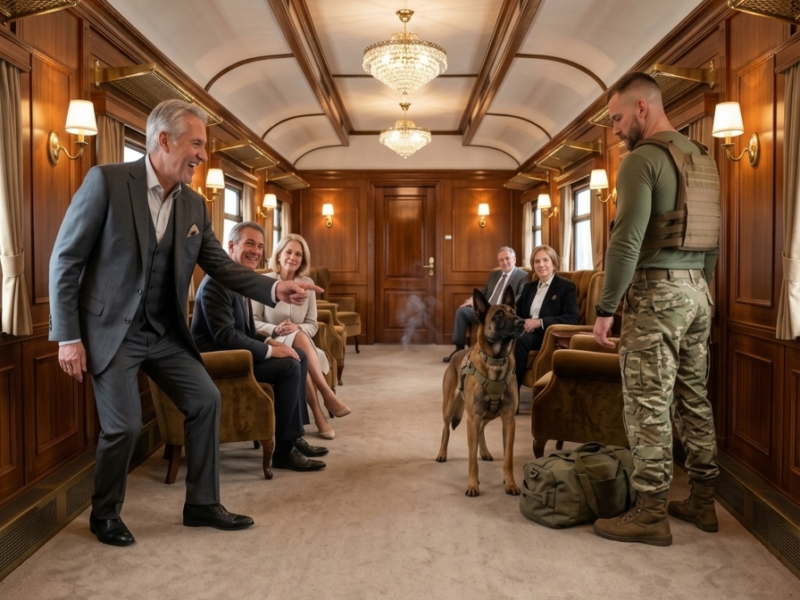
The wealthy tourists laughed at me and my scarred K9 on the luxury ferry, calling us “cheap security,” but when the deck suddenly tilted and hundreds of passengers screamed
The late-afternoon sun hung like a polished copper plate over the gray swells of Puget Sound. A brisk, salt-choked breeze whipped across the promenade deck of the Aegis Monarch, a state-of-the-art catamaran ferry boasting panoramic glass salons, teak decking, and VIP lounges that cost more for a single crossing than most deckhands made in a month.
I leaned against the brass rail near the stern, wearing a faded canvas field jacket that had seen better days in Helmand Province. Beside me, sitting squarely on his haunches, was Bear.
He was a Malinois-Dutch Shepherd cross, pushing ten years old, with coarse brindle fur shot through with iron-gray along his broad muzzle and around his heavy brow. His right hind leg was stiff from an old compound fracture sustained during a night raid near the Pakistani border—an injury patched with surgical steel pins that made cold mornings ache. Across his barrel chest ran a pale, hairless track of scar tissue where a jagged fragment of vehicle armor had torn through his tactical vest seven years ago.
He didn’t move like the nervous pet dogs that occasionally boarded the commuter shuttles. Bear sat like a piece of naval ordnance: anchored, unblinking, his amber eyes methodically quartering the deck in five-second sweeps.
A burst of shrill, champagne-fueled laughter drifted over from the heated outdoor salon beneath the VIP canopy. Three couples were clustered around a teak cocktail table, surrounded by designer luggage and heavy cashmere wraps.
One of the men—dressed in an immaculate camel-hair overcoat, his hair slicked back with expensive pomade—turned around with a flute of sparkling wine in hand. His gaze drifted down, catching sight of Bear’s scarred face and the utilitarian nylon harness I used instead of a standard civilian collar.
The man smirked, nudging the woman beside him, who was draped in an ivory fur stole.
“Look at that, darling,” the man said, raising his voice just enough to ensure the surrounding passengers could hear. “Looks like the ferry company hired extra muscle to keep the riffraff away from the first-class deck.”
The woman peered over her designer sunglasses, wrinkling her nose as if she had detected rotting fish. “That’s your idea of security? He looks more like he needs an orderly and a wheelchair. I hope that mangy thing doesn’t have fleas. It’s bad enough they let service animals up here, but that looks like a junkyard stray.”
The other passengers at their table chuckled, lifting their glasses in mild amusement.
I kept my hands buried in my jacket pockets, my posture loose, my expression flat. When you spend eight years running tactical counter-insurgency and another five living alone on a wooded peninsula fixing diesel engines, civilian arrogance doesn’t even register as an itch.
“Ignore them, buddy,” I murmured under my breath.
Bear didn’t growl. He didn’t even turn his head toward the laughter. He simply leaned two hundred pounds of lean, weathered muscle against my left knee, letting out a soft, dismissive snort through his nostrils. He had faced down Kalashnikov fire and buried antipersonnel mines; a spoiled hedge-fund manager holding a glass of Prosecco wasn’t worth the calories of an ear twitch.
Then, deep in the belly of the vessel, something missed a stroke.
To the wealthy tourists sipping their drinks, it was nothing—a microscopic shudder beneath the floorboards, no different from a hull meeting an incoming swell. But Bear’s ears instantly locked forward into rigid, triangular points. His spine stiffened. His nostrils flared, drawing in the humid, turbulent air rising from the ventilation shafts near the superstructure.
Ten feet away, a champagne flute rattled against a marble tabletop and tipped over, shattering on the teak planks.
A ripple of nervous, embarrassed laughter broke out among the tourists. The man in the camel-hair coat waved a careless hand at a passing steward. “Clumsy wake! Tell the wheelhouse to smooth out the throttle, will you? Some of us have dry-cleaning bills!”
Over the public address system, the chime sounded, followed by the calm, practiced voice of the first mate: “Good afternoon, passengers. Just a minor hydraulic fluctuation in the secondary trim tab. Nothing to worry about. We expect to arrive at Friday Harbor right on schedule. Enjoy the crossing.”
The passengers relaxed. Conversation resumed.
Bear stood up.
He didn’t rise with the sluggish stiffness of his age. He came up onto all four paws with sudden, electric tension, his claws clicking sharp and hard against the deck. His weight shifted forward. His nose pointed like an iron compass needle directly toward the steel companionway door that led down into the machinery spaces.
I put a hand on his harness. My heart rate kicked up a beat. In four combat deployments, Bear had never given a false alert. When that dog stood on his toes with his tail level and his ears pinned forward, it meant blood was already in the water.
“What is it, boy?” I asked softly.
Bear pulled against the leash, dragging me two steps toward the companionway.
The man in the camel-hair coat noticed the movement and rolled his eyes, taking a step toward us with an exaggerated grimace. “Hey, pal, keep that beast away from my wife’s coat. If you can’t control your mutt, put him in the car deck where he belongs. Relax, hero.”
Bear didn’t even look at the man. He opened his jaws and let out a single, thunderous bark.
BOOM.
It wasn’t a warning growl or a domestic yelp. It was the full-chested, percussive roar of an 80-pound patrol dog clearing a breach. The acoustic shockwave hit the glass partitions of the VIP lounge with the force of a gunshot.
The entire promenade deck went dead silent. The man in the coat froze mid-step, his smirk evaporating, his skin turning a chalky gray.
“Downstairs. Now,” I told Bear.
We moved. I pushed through the heavy steel door into the interior stairwell, leaving the stunned tourists behind. The moment the hatch swung shut, the sound of the wind was cut off, replaced by the deep, rhythmic grinding of the twin marine diesels below.
And then the smell hit me.
It wasn’t the clean, hot exhaust of properly burned marine diesel. It was raw, unburned, atomized fuel—thick, oily, and hanging heavy in the enclosed stairwell like a toxic fog. Mixed into that reek was something far worse: the acrid, metallic tang of an electrical arc, followed by the unmistakable scent of burning plastic casing.
“Stay back!” I roared, descending the metal stairs two at a time, my boots clattering on the steel diamond-plate treads.
Near the bottom of the second flight, just outside the watertight door to the auxiliary engine compartment, a young crewman in a blue grease-stained jumpsuit was frantically fumbling with a digital diagnostic tablet.
“Hey! You can’t be down here!” the crewman yelled, his voice cracking with panic. “Civilian access is prohibited! We have an auxiliary fuel pressure fault—”
“Shut the master fuel valves!” I shouted, grabbing the collar of his suit and hauling him backward away from the hatch. “You don’t have a fault, son! You’ve got an active aerosol leak over an open circuit breaker!”
The boy stared at me, his eyes wide with incomprehension. “What?”
Before he could pull away, a violent, deafening metallic crack ripped through the hull beneath our feet—the sound of high-tensile structural steel shearing under massive hydrostatic pressure.
The entire three-thousand-ton catamaran lurched violently to port.
The floor dropped out from beneath us. The crewman was thrown hard against the bulkhead, his tablet shattering on the deck. Overhead, the fluorescent lighting tubes popped in rapid succession, showering the companionway with sparks and glass, plunging the narrow passage into the bloody, flashing strobe of red emergency beacons.
From the decks above, the muffled sound of music and laughter was violently erased, replaced by the collective, terrified shriek of three hundred people realizing the floor was no longer level.
The ferry groaned—a terrible, resonant shriek of twisting aluminum that vibrated through the soles of my boots. The ship was listing ten degrees, twelve degrees, the angle steepening every second as water or fuel flooded an off-center compartment.
Bear didn’t slip. His claws found purchase on the diamond plating, his head turning back toward the stairs. Suddenly, with a low, desperate whine, he lunged forward, sinking his teeth into the tough canvas sleeve of my jacket and dragging me violently toward the rear alcove.
“Bear, what—”
CRASH.
A twelve-foot section of the heavy steel overhead cable tray, weighted down by hundreds of pounds of severed copper wiring and an industrial exhaust duct, tore free from its ceiling welds and smashed into the exact spot where the crewman and I had been standing half a second earlier. The impact punched a hole through the floor plating, throwing up a spray of boiling coolant and blinding white steam.
If Bear hadn’t dragged me back, our spines would have been snapped like dry kindling.
“Move! Up the stairs!” I screamed at the dazed crewman, hauling him up by his belt.
We scrambled up the listing stairwell, Bear surging ahead, clearing the steps with powerful, rhythmic lunges of his front legs, ignoring the limp in his hindquarters.
We burst through the mid-deck doors into the main passenger concourse.
The scene was pure, uncontrolled panic. The ship’s list had increased to nearly fifteen degrees. Heavy oak tables had slid across the polished floor, pinning terrified passengers against the outer glass walls. Suitcases, broken bottles, and serving trays littered the deck like debris in a storm drain. Emergency sirens were wailing a discordant two-tone blast, while automated pre-recorded evacuation announcements droned uselessly over the speakers in three languages.
Smoke—dense, chemical, yellow-gray smoke—was already pouring through the floor vents, stinging the eyes and choking the throat.
Through the haze, a figure came stumbling toward us on hands and knees, sliding down the canted floor.
It was the man in the camel-hair coat. The coat was torn at the shoulder, covered in gray soot and spilled wine. His expensive pomade was ruined, sweat and panic plastering his hair to his forehead. Behind him, his wife was screaming hysterically, clinging to a bolted bench.
He caught sight of my canvas jacket and reached up with trembling hands, grabbing my jeans like a drowning man clutching a piece of flotsam.
“Help me!” he sobbed, his voice stripped of every trace of arrogance. “Please! The main doors are jammed! We’re trapped! The ship is going down!”
I reached down, grabbed him by the scruff of his collar, and hoisted him to his feet against the canted wall. “Get your wife. Stay low, below the smoke line. Follow the dog.”
Bear was already five yards ahead, his nose skimming two inches above the floor where the thin layer of breathable air remained. He wasn’t heading for the main grand staircase—that was already a churning bottleneck of screaming passengers fighting over orange life vests. Bear was heading down a narrow service passage marked CREW ONLY: EMERGENCY EGRESS STERN.
We moved in a staggered line—the young crewman, the wealthy man dragging his sobbing wife, and three elderly passengers who had the sense to fall in behind us.
The smoke grew thicker, hotter. The air smelled of burning fiberglass and hydraulic oil.
Bear reached the heavy steel weather door at the end of the corridor that led out to the open lower stern deck. He hit the panic bar with his front paws.
The door didn’t budge.
I pushed past him, slamming my shoulder against the steel plate. It was solid. The latch mechanism clicked, but the door was held rigid at the top and bottom.
I wiped the stinging sweat from my eyes and peered through the small, reinforced wire-glass porthole in the center of the door.
Wrapped around the exterior dog-latches and looped through the heavy steel handrail outside was a thick, hardened-steel transport chain, secured with an industrial disc padlock.
The breath went cold in my lungs despite the sweltering heat of the smoke.
“That’s not an accident,” I muttered aloud.
This door hadn’t jammed because of the hull list. Someone had deliberately, methodically chained the primary lower escape route shut from the outside before the vessel ever left the terminal.
“We’re going to die here!” the woman in the fur stole shrieked, collapsing against the tilted bulkhead. “The door is locked! Break it down! Oh God, break it down!”
The wealthy man slammed his fists uselessly against the reinforced steel, sobbing in frustration as his knuckles split and bled against the rivets. “Open it! Somebody open it!”
“Shut up!” I barked, my voice cutting through the hysteria like a cold blade. “Panic burns oxygen. Keep your mouths shut and stay on your knees.”
I dropped down beside Bear, who had already backed away from the sealed door, his nose twitching toward the red emergency equipment cabinet recessed into the wall six feet back.
He planted his front paws on the glass face of the cabinet and let out a sharp, commanding whine.
“Good boy,” I said.
I swung my elbow into the glass. The thin pane shattered, scattering safety pebbles across the linoleum. Inside hung a standard twenty-four-inch, drop-forged high-leverage emergency bolt cutter and a long-handled fire ax.
I yanked the bolt cutters from their mounting brackets. The tool weighed nearly eight pounds, cold and heavy in my grip.
“Get back from the glass,” I ordered.
I used the hardened steel jaws of the cutter to smash out the wire-glass inspection port in the center of the door. The reinforced glass cracked in a spiderweb pattern, resisting at first, then gave way with a shower of sharp fragments that fell inward onto the deck.
Hot, fresh salt air rushed through the opening, cutting momentarily through the suffocating yellow smoke.
I shoved the long handles of the bolt cutters through the shattered porthole. It was an awkward, blind angle; the ship was listing nearly twenty degrees now, making it feel like standing on the roof of a steep barn. My boots slipped on the oily deck.
“Hold my belt!” I yelled to the young crewman.
The boy lunged forward, throwing his full weight backward to anchor me against the bulkhead.
I extended my arms through the jagged opening, feeling for the heavy transport chain with the hardened jaws of the tool. My fingertips brushed cold, grease-coated steel. The chain links were five-sixteenths case-hardened alloy—the kind used for heavy timber transport or securing cargo containers. You don’t find that in a ship’s locker. Someone had carried that aboard in a duffel bag.
I seated the cutting notch against a link, set the outer handle against the steel doorframe for leverage, and threw all my body weight into the inner handle.
My muscles burned. The scar tissue across my chest pulled tight, sending a sharp, familiar spike of pain down my left arm.
Snap.
The link sheared with a high-pitched metallic ping.
I worked the tool again, cutting the second loop that bound the handle to the rail.
With a hard, double-footed kick, I hit the panic bar. The heavy exterior door swung open into the howling evening wind, slamming against the outer bulkhead with a violent crash.
“Out! Everybody out!” I roared.
We tumbled out onto the open stern deck. The contrast was dizzying. After the suffocating, smoke-choked tomb of the corridor, the cold November wind off the Sound felt like an electric shock.
The Aegis Monarch was in a catastrophic state.
The entire port sponson was riding deep in the gray water, submerged past the rub-rail. White frothing foam was bubbling up through the stern scuppers as seawater rushed into the lower machinery compartments. Up on the main observation deck, hundreds of passengers were crowded along the starboard railing, screaming as crew members struggled to launch the inflatable life rafts against the severe list.
“Over here! Life jackets under the bench!” the young crewman yelled, finally finding his professional footing. He kicked open a fiberglass storage locker and began tossing orange vests to the passengers.
The man in the camel-hair coat grabbed a vest, clumsily shoving his arms through the loops, while I helped his wife fasten the heavy nylon straps around her chest.
Across the gray expanse of Puget Sound, the wail of maritime sirens began to pierce the dusk.
Two high-speed United States Coast Guard 45-foot response boats were already carving white wakes across the water, their blue emergency strobes flashing against the gathering gloom. Behind them, two commercial tugboats and a Washington State Ferry had altered course, converging on our position like a defensive flotilla.
The rescue was underway. The ship would not become a mass grave.
The evacuation of our small group moved with mechanical speed. Within eight minutes, the first Coast Guard cutter bumped against our low-riding starboard quarter, their deck crew securing heavy mooring lines and setting down a portable aluminum transfer ramp.
“Move, move, move! Women and children first, step down to the deck!” the Coast Guard petty officer shouted through a megaphone.
The wealthy man grabbed his wife’s hand, pushing her toward the ramp. But just before he stepped onto the aluminum plate, he stopped. He looked back across the canted, soot-covered deck.
Bear was sitting calmly near the open doorway, his flanks rising and falling in deep, rhythmic breaths, his eyes watching the burning interior of the ship with steady vigilance.
The man walked back across the listing deck, his expensive leather loafers ruined, his face streaked with grime and dried tears. He stopped three feet from the dog.
Slowly, carefully, he dropped down onto both knees in the wet sea spray.
He looked at Bear’s scarred muzzle, looked at the stiff back leg held at an awkward angle, and then looked up at me.
“I… I called him a junkyard stray,” the man whispered, his voice cracking with raw shame. “I laughed at you.”
I looked down at him. “He didn’t notice.”
The man extended a trembling, clean hand toward Bear’s nose. “I’m sorry. I am so damn sorry.”
Bear tilted his head slightly. He didn’t lick the hand. He didn’t nuzzle it. He leaned forward, sniffed the man’s knuckles once with cool, professional detachment, and then turned his head back toward the open sea, dismissing him entirely.
The man choked back a sob, nodded once in profound humility, and scrambled down the ramp onto the cutter.
“Sir! Handler! You need to clear the deck!” a firefighter from a Seattle municipal marine unit shouted, stepping off the ramp with a heavy Halligan bar in hand. “The port engine room is fully involved! We have to secure the fuel lines before the bulkheads breach!”
“We’re clear,” I said, clipping Bear’s lead back onto his harness. “Take the ship. Watch the service passages—someone chained the primary egress.”
The firefighter froze, his eyes narrowing beneath his soot-blackened helmet. “Chained? Are you sure?”
“I cut the links myself. Look at the door.”
The firefighter looked at the severed steel chain dangling from the railing, his jaw setting into a hard, grim line. Then he reached into his heavy bunker coat, pulling out a clear, zip-sealed waterproof evidence pouch.
“Then you need to see this,” the firefighter said, stepping closer to shield the pouch from the salt spray. “Our primary team just pulled this out of the auxiliary control locker next to the fuel manifold. It was wedged behind the override solenoid.”
He handed me the pouch.
Inside was a glossy, high-resolution 5×7 photograph.
My breath locked in my throat.
The photo showed the Aegis Monarch tied up at the commercial maintenance dock in Tacoma three days ago. But it wasn’t a tourist snapshot. It was a technical surveillance photograph taken through a high-powered telephoto lens.
Drawn in bright, permanent red grease pencil was a heavy circle around the lower hull plating of the port engine compartment—the exact space where the failure had originated twenty minutes ago.
I turned the pouch over in my trembling fingers.
On the back of the photograph, written in neat, military-style block printing, were two words:
NOT FINISHED.
A cold, electric shock ran down my spine, deadlier than the winter sea.
Beside me, Bear suddenly went rigid.
He didn’t whine. He didn’t look at the fire or the rescue boats. His head snapped toward the stern railing, peering far out across the choppy, darkening water.
A deep, vibrating growl rolled out of his chest—a sound so low and murderous that the firefighter instinctively took a step backward.
Three hundred yards behind the drifting rescue flotilla, bobbing casually in the churning wake of the dying ferry, was a small, commercial crabbing boat. It had no running lights. Its deck was dark, save for the faint, greenish glow of a marine radar unit in the enclosed wheelhouse.
The firefighter followed my gaze, shielding his eyes against the wind. “Do you know who’s on that boat?”
I shook my head. “No.”
Bear knew.
The dog lunged against the nylon leash, slamming his front paws against the brass rail, and began to bark with a frantic, savage fury that rose above the sound of the sirens, the burning engines, and the wind.
He wasn’t barking at the water.
He was barking at someone on that deck who was looking straight back at us through a pair of night-vision optics.
The green glow in the wheelhouse of that distant vessel flickered once, like a shutter closing, and then vanished into the black swells.
“Hey! Buddy, you can’t stay here! We’re cutting the lines!”
The firefighter’s hand closed around my upper arm, pulling me toward the transfer ramp. The Aegis Monarch gave another sickening groan, settling further by the stern. The water was already sloshing over the lower deck treads, swirling around my boots in cold, foamy eddies.
“Come on, Bear. Move!”
I hauled him down the ramp. We hit the metal deck of the municipal fireboat just as the crew cast off the heavy nylon hawsers. The fireboat’s twin water cannons roared to life, arching hundreds of gallons of foamy seawater onto the ferry’s burning port sponson.
The transit to the emergency staging area at the Anacortes ferry terminal was a blur of flashing emergency lights, thermal blankets, and the mechanical chatter of marine VHF radios.
While the other passengers were funneled into the heated passenger waiting terminal for medical triage and hot coffee, I stayed outside on the wet concrete dock, leaning against an iron bollard. Bear sat between my knees, his coat shivering with the residual cold, his gaze never once leaving the dark expanse of the channel.
Two local police cruisers and an unmarked dark sedan were parked with their engines idling near the security gate.
A man in a dark charcoal trench coat stepped out of the sedan, flashing a gold badge at the state troopers guarding the perimeter, and walked directly toward me. He was in his late forties, with cropped silver-gray hair, a crooked nose that had been broken more than once, and the tired, predatory eyes of a federal investigator.
“Special Agent Miller, Naval Criminal Investigative Service,” he said, holding up his credential folder for a fraction of a second before shoving it back into his coat. He looked down at Bear. “That’s a lot of dog for a civilian ferry ride, Mr. Hayes.”
“He’s a retired service asset,” I said, my voice rough from the smoke. “And you didn’t drive up from Bremerton in forty minutes because of a commercial boiler failure, Miller.”
Miller didn’t blink. He pulled a pack of cigarettes from his pocket, thought better of it, and tucked them away. “The firefighter handed over the pouch you were holding. The photograph.”
“Then you know this wasn’t a boiler failure. It was an extraction attempt or a hit.”
“What makes you say extraction?” Miller asked, his eyes narrowing.
“Because the fire was set at the auxiliary manifold, not the main fuel tanks,” I explained, gesturing toward the smoke plume still visible out on the dark water where the tugs were holding the ferry. “If whoever planted that charge wanted to sink the ship with all hands, they would have blown the main fuel line and the bottom hull plates simultaneously. The ferry would have rolled in ninety seconds. Instead, they cut the power, triggered a slow, controllable list to port, and chained the lower stern exit.”
Miller stared at me for three long seconds. The professional skepticism in his posture softened into something far more dangerous: acknowledgment.
“Who was on that ship, Hayes?”
“Three hundred tourists,” I said. “And one man in a camel-hair coat who had enough cash on his wrist to buy a house.”
Miller let out a dry, humorless snort. “Arthur Vance. Chief financial officer of Vanguard Maritime Logistics. He was scheduled to testify before a closed-door congressional subcommittee on naval procurement fraud in Seattle on Tuesday morning.”
The name hit my ears like a physical blow.
Vance.
Eight years ago, during my final deployment with the Navy’s special operations K9 unit, my platoon had been ambushed outside a classified weapons testing compound in Helmand. We were told an insurgent cell had hit our perimeter. But the weapons used against us weren’t rusted AK-47s; they were experimental, armor-piercing munitions that had vanished from naval supply depots in San Diego two months earlier.
The private contractor responsible for supply line security in that sector had been Vanguard Logistics.
And the man who had signed off on the missing inventory reports—declaring twenty crates of classified munitions ‘lost in transit due to hostile action’—was Arthur Vance.
“Vance was on that boat,” I whispered, the puzzle pieces slamming together in my mind with terrifying speed. “He wasn’t running away from Seattle. He was being moved.”
“He was supposed to be in federal protective custody,” Miller said, his jaw tightening. “He slipped his marshals in Vancouver yesterday afternoon. He thought he could blend in with the weekend tourists, take the ferry out to the islands, and disappear onto a private yacht heading for international waters.”
“And Vanguard found him,” I finished.
“They didn’t want him testifying,” Miller said grimly. “A dead witness can’t explain where two hundred million dollars in black-budget hardware went. But whoever was on that crabbing boat out there wasn’t just tracking Vance. They were tracking the dog.”
I looked down at Bear. The Malinois had his head cocked, listening to the hum of the sedan’s engine.
“Why Bear?” I asked.
Miller reached into his inner pocket and pulled out an old, faded personnel file bound in a red classified folder. He opened it, revealing an eight-year-old operational log stamped TASK FORCE IRON CLAW.
“Because Bear was the only working dog attached to your unit that survived the raid on the depot,” Miller said quietly. “His training records show he was imprinted on the specific chemical taggants Vanguard used to mark their experimental explosive compounds. If Vance had a sample of that compound in his luggage—proof to buy his immunity from the Justice Department—Bear would smell it from fifty yards away.”
I remembered the moment the ferry shuddered. Bear hadn’t just smelled fuel. He had caught a scent he hadn’t encountered since the blood and fire of that valley eight years ago.
“The photograph,” I said, my fingers clenching into fists. “The writing on the back. Not finished. That wasn’t about the ferry.”
“No,” Miller said, his voice dropping into a somber whisper. “Arthur Vance had a brother, Hayes. David Vance. The field operations director who commanded the private security contractors at that depot.”
My breath seized.
David Vance had vanished six years ago, officially declared dead when his private aircraft went down off the coast of Baja. No wreckage was ever recovered.
“David is alive?”
“We think he was the one steering that crabbing boat,” Miller said, looking out toward the dark channel. “And he didn’t come to Puget Sound to rescue his brother. He came to make sure Arthur didn’t talk. And now, he knows you and that dog are standing between him and the clean exit he’s been planning for eight years.”
Before I could reply, a sudden, piercing whine tore through the terminal’s public address system.
The overhead floodlights illuminating the concrete dock sputtered violently, then died.
The entire Anacortes terminal was plunged into absolute, pitch-black darkness.
Across the perimeter, the steady purr of the idling police cruisers was abruptly cut off as their electrical systems shorted out simultaneously, sparks showering from their dashboards.
“EMP device or localized grid sabotage,” Miller hissed, his hand instantly dropping to the service holster beneath his coat. “Hayes, stay down!”
In the darkness, Bear didn’t stay down.
He lunged forward to the end of his lead, his teeth bared in a silent, murderous snarl, his amber eyes locked onto the concrete slipway thirty yards to our right.
Out of the black water, three figures in dripping neoprene dive suits and night-vision goggles were silently hauling themselves over the wooden pilings of the pier, their suppressed weapons held at the low ready.
The silence was heavier than the dark.
The terminal had been transformed into an acoustic vacuum—no hum of transformers, no drone of engines, only the rhythmic slap of black seawater against the treated pilings and the heavy, measured breathing of three men who killed for a living.
They were moving in a tight diamond formation, their wet rubber suits squeaking faintly against the concrete as they cleared the edge of Slip Four. Through the gloom, I could see the pale green illumination from their helmet-mounted night-vision goggles. They weren’t local muscle. They moved with the deliberate, overlapping fields of fire of Tier-One maritime operators.
“Miller, two o’clock,” I whispered, barely moving my lips.
Miller had already dropped behind the heavy iron engine block of his sedan. The slide of his Glock 19 clicked back with a clean, oiled precision that told me he wasn’t just a desk investigator; he had carried iron in the field before he put on a suit.
“Federal agents! Drop your weapons!” Miller roared into the night.
The answer was immediate and lethal.
Pfft-pfft-pfft.
Three suppressed rounds snapped through the darkness, shattering the sedan’s windshield into a web of frosted safety glass and gouging deep chunks of lead out of the steel fender. Miller ducked, returning two quick shots that sparked off the concrete pier near the lead diver’s feet.
“Bear! Fass!” I commanded.
It was the command he hadn’t heard in eight years.
The dog didn’t bark. He didn’t hesitate. He became an eighty-pound shadow, launching off the concrete with explosive force. He stayed low, utilizing the cover of the parked luggage carts and steel bollards, moving at a dead sprint despite the stiff hitch in his hind leg.
The diver on the left flank swung his weapon toward the sound of the scrabbling claws, his infrared illuminator sweeping across the asphalt.
He was too late.
Bear hit him at the waist, driving all eighty pounds of bone, muscle, and momentum directly into the diver’s center of mass. The man let out a wet grunt as his spine slammed against the concrete.
Before the diver could bring his suppressed submachine gun to bear, Bear’s jaws locked onto the man’s right forearm, the heavy canine teeth punching clean through the heavy neoprene and crushing the radial bone beneath. Bear didn’t just bite; he violently thrashed his head, using the full torque of his neck to pin the man’s arm to the deck.
The diver screamed, dropping the weapon into the dark water of the slip.
“Covering fire!” the second diver shouted, pivoting his carbine toward Bear.
I broke cover. I didn’t have a rifle, but I had eighty pounds of momentum and the four-pound steel emergency bolt cutters I had never dropped from my belt.
I closed the distance in three strides, swinging the heavy drop-forged tool like a baseball bat.
The steel jaws struck the second diver squarely across the collarbone with a sickening, hollow crunch. The man spun sideways, his weapon discharging wildly into the salt air before clattering across the asphalt. He collapsed onto his side, clutching his shattered shoulder and gasping for air.
The third diver—the point man—backed away toward the edge of the pier, his weapon raised, his eyes locked onto me through the green lenses of his optics.
“Hayes,” a voice rasped from beneath the diver’s balaclava.
The voice was older, scarred, but it carried an unmistakable, mocking cadence I hadn’t heard since the briefings at Bagram.
“David Vance,” I breathed, freezing five paces away.
Beside me, Bear released the first diver, who was whimpering in the dark, and stepped up to my knee. His hackles were raised in a serrated line from his ears to the base of his tail. A continuous, subterranean growl rattled in his ribcage, vibrating through the cold air.
Vance reached up with his left hand, slowly pulling the night-vision goggles and the wet neoprene hood from his face.
The pale glow of the moon broke through the scudding clouds, illuminating a face mapped with jagged burn scars and cold, dead eyes. Half of his left ear was gone, torn away by the same shrapnel that had nearly killed Bear eight years ago.
“You should have stayed on your little farm, Cole,” Vance said, his voice flat, completely devoid of fear. “You should have let that old dog die in the woods. You always were too loyal for your own good.”
“You tried to drown three hundred people tonight, Vance,” I said, keeping my hands level, feeling Bear’s shoulder trembling with coiled fury against my leg. “Just to put your own brother in the ground.”
Vance let out a dry, rattling chuckle that sounded like stones grinding together. “Arthur was weak. He thought he could steal from the company, cut a deal with the feds, and spend the rest of his life drinking piña coladas in Costa Rica. He didn’t understand the work we did. The weapons we secured in that valley… they weren’t for sale to the highest bidder. They were leverage.”
“And what about my team?” I snarled, stepping half a pace forward. “What about the six men who died in that ditch while you were staging your own death?”
“Collateral damage,” Vance said simply. “A necessary line-item on an operational ledger.”
He shifted the weight of his weapon slightly, his finger tightening against the trigger.
“Now, step aside, Cole. I take the pouch, I take the evidence Arthur was carrying, and I walk back to my boat. You get to live out your quiet little retirement.”
“You’re not walking anywhere,” Miller’s voice called out from the darkness twenty feet behind Vance.
Miller was standing in the open, his service weapon held in a two-handed combat grip, the front night-sight aligned directly with the center of Vance’s skull. “Drop the weapon, Vance. The perimeter is sealed. Coast Guard tactical units have already interdicted your crabbing boat.”
Vance didn’t turn around. A slow, terrible smile stretched across his scarred face.
“Coast Guard?” Vance whispered. “You think I came here in a crabbing boat, Agent Miller? That was the decoy.”
From the dark waters of the channel, three hundred yards out, the low, percussive whump-whump-whump of an approaching helicopter tore through the night sky.
It was flying without navigation lights, hugging the surface of the water, a sleek, black-anodized civilian turbine ship fitted with auxiliary fuel pods.
“That’s my ride,” Vance said.
In a fraction of a second, Vance didn’t raise his rifle toward Miller. He reached down to his tactical vest, pulled a heavy, cylindrical smoke grenade from its loop, and slammed the spoon against his hip.
Hiss.
A blinding white phosphorus flash turned the pier into daytime, followed by a wall of choking, chemically dense white smoke that expanded forty feet in every direction.
Miller fired twice. The rounds pinged uselessly off the concrete seawall.
“He’s heading for the float plane dock!” Miller yelled, coughing violently as the chemical fog rolled over us.
Through the blinding whiteout of the smoke, my eyes were useless. The chemical agent burned my nostrils, blinding and disorienting.
I dropped to one knee, my hand finding the heavy nylon of Bear’s harness.
The dog’s eyes were tearing, but his nose—that incredible, ancient instrument of war—was already working the air currents. He ignored the burning phosphorus. He had the scent of the man who had ordered the ambush that broke his body eight years ago.
“Bear,” I choked out, wiping the tears from my cheeks. “Find him.”
Bear surged forward into the blinding white smoke, pulling me behind him at a dead sprint.
We tore through the blinding wall of white smoke like a living torpedo.
Bear didn’t hesitate. He didn’t search for visual landmarks. His nose was anchored to the sharp, unmistakable trail Vance had left behind: sea salt, neoprene, the sulfurous residue of the smoke grenade, and the bitter chemical taggants of the classified explosive Vance carried on his belt.
We cleared the cloud of phosphorus into the cold, clear air of the lower marina.
Fifty yards ahead, at the end of the wooden floating dock where the local float planes tied up, the black helicopter was hovering three feet above the wooden planks. Its massive rotor downwash was whipping the harbor water into a frothing, circular frenzy, sending sheets of freezing spray across the slip.
A crewman in a flight helmet was leaning out of the open side door, extending a gloved hand down toward the dock.
Vance was already there.
He had his boot on the metal pontoon strut of the helicopter, his left hand reaching up to grab the crewman’s harness. In his right hand, he held a heavy waterproof Pelican case—the ledger and the cryptographic drives his brother had hidden on the ferry.
“Bear! Fass!” I bellowed, throwing my entire soul into the command.
The dog didn’t just run; he flew.
Every ounce of age, every trace of pain in his pinned hip, every cold morning spent stiff and limping on my cabin floor vanished. He moved with the terrifying, beautiful ferocity of an apex predator closing the distance on the battlefield. His claws dug deep into the wet cedar planks of the floating dock, splintering the wood with every stride.
Vance heard the scrabble of claws over the roar of the turbine.
He turned his head, his scarred face twisting in shock as he saw the gray-muzzled Malinois bearing down on him across the thirty feet of open dock.
“Shoot it!” Vance screamed at the crewman, clawing wildly at the sidearm holstered on his chest.
The crewman reached for a short-barreled rifle mounted to the cabin bulkhead.
He never cleared the bracket.
Bear launched himself from the edge of the wooden dock.
It was an impossible leap—nearly ten feet across open, churning water through the hurricane-force downwash of the rotor blades. He cleared the gap like a guided missile, his eighty pounds of brindle muscle slamming directly into Vance’s back just as the man attempted to heave himself into the cabin.
The impact tore both men off the skid.
Vance shrieked as they plummeted into the black, icy waters of the harbor.
SPLASH.
The heavy Pelican case slipped from Vance’s grip, tumbling onto the wooden dock at my feet with a dull plastic thud.
The helicopter pilot, realizing the extraction had suffered a catastrophic failure and seeing Miller sprinting down the dock with his weapon raised, pulled violently on the collective. The turbine shrieked, the nose dipped, and the black aircraft banked hard across the bay, retreating into the coastal fog before federal air support could scramble.
I slid to a halt at the edge of the floating dock, my boots splashing through the foam, peering down into the dark water.
Five yards out, the surface broke.
Vance came up sputtering, coughing violently, thrashing his arms against the freezing current. He had ditched his heavy tactical vest, but the cold of the Puget Sound—barely forty-five degrees—was already shutting down his muscular control.
Beside him, Bear broke the surface.
The old dog’s head was held high, his ears pinned back, his powerful front legs churning the black water with steady, rhythmic strokes. He didn’t bite Vance. He didn’t tear his throat out.
Instead, Bear swam directly behind the drowning traitor, sank his teeth into the tough rubber collar of Vance’s wetsuit, and began to kick with all the strength left in his aging body, dragging the man toward the wooden pilings of the dock.
Even in the freezing dark, the dog was still executing the mission: Secure the asset. Bring him back across the wire.
“Bear! Here, boy!” I yelled, dropping flat onto my belly on the wet cedar planks, extending my arms down toward the water.
Miller arrived a second later, dropping beside me, his hands reaching for Vance’s wrists.
Together, we hauled Vance out of the icy brine. He flopped onto the wooden dock like a landed fish, shivering violently, his lips blue, his eyes rolling back in his head as hypothermia seized his limbs.
Miller immediately snapped heavy steel handcuffs around Vance’s wrists, pinning his arms behind his back. “David Vance, you are under arrest for treason, domestic terrorism, and attempted murder.”
I didn’t care about Vance.
I reached down into the dark water, my hands hooking beneath Bear’s heavy chest harness.
“Come on, buddy. Up. Up!”
I hauled him out of the harbor. Bear’s wet, heavy body landed on the dock with a wet thud. He shook himself once, sending a shower of freezing saltwater across the cedar planks, his teeth chattering uncontrollably from the shock of the cold water on his aged joints.
His stiff hind leg gave out. He collapsed onto his side, his ribs heaving in short, shallow gasps, a faint line of pink foam bubbling from his nostrils.
“Bear!”
I fell to my knees beside him, stripping off my canvas field jacket and wrapping it tightly around his shivering torso. I pressed my hands against his chest, feeling the frantic, fluttering rhythm of his heart beneath the scar tissue.
“Stay with me, boy. Don’t you quit on me. Don’t you dare quit on me.”
Miller looked up from Vance, his face tightening as he saw the dog’s condition. He grabbed his radio, shouting with an urgency I hadn’t heard from him all night: “Dispatch, this is Agent Miller! I need a priority veterinary trauma unit and an ambulance at Slip Four, Anacortes Marina! Code Red! We have a downed combat K9! Clear the roads!”
Bear’s amber eyes fluttered open.
They were cloudy, exhausted, but they found my face instantly.
He didn’t look afraid. He didn’t look like he was in pain.
Slowly, with an effort that seemed to consume every remaining ember of strength in his weathered frame, Bear lifted his head two inches from the cold cedar. He pressed his wet, graying muzzle against my jaw, letting out a soft, deep sigh that vibrated against my skin.
Then, his head fell back against my jacket. His breathing slowed, settling into a deep, ragged rhythm.
“You did it, buddy,” I whispered, tears blurring the cold harbor lights into streaks of gold and silver. “The debt is paid. Every single cent.”
Six weeks later.
The morning sun over the Olympic Peninsula was crisp and clear, burning away the thin layer of frost that coated the porch rails of my small cedar cabin.
The forest was dead quiet, save for the chatter of a stellar’s jay in the towering Douglas firs and the distant, rhythmic hum of the ferry crossing the strait miles to the east.
The front screen door opened with a soft creak.
Bear walked out onto the porch.
He was wearing a brand-new, thick sheepskin-lined orthopedic vest, paid for by a special commendation grant from the Department of the Navy. His limp was still there—it would always be there—but his coat had regained its rich, brindle luster, and the gray around his muzzle looked less like an old wound and more like an earned crown.
He walked to the edge of the cedar steps, circled his favorite heavy wool blanket three times, and lay down in the warm rectangle of morning sunlight.
I stepped out behind him, carrying a steaming mug of black coffee, and sat down on the top step beside him.
On the porch table lay that morning’s edition of the Seattle Times.
The front-page headline was printed in bold, uncompromising black ink:
VANGUARD CONSPIRACY EXPOSED: FORMER DEFENSE EXECUTIVES INDICTED IN MULTI-MILLION DOLLAR WEAPONS SMUGGLING RING. DAVID VANCE TRANSFERRED TO MAXIMUM SECURITY FEDERAL FACILITY.
Near the bottom of the article was a smaller photograph: Arthur Vance, dressed in a standard orange prison jumpsuit, being escorted into a federal courthouse. The article noted that Vance had entered a full guilty plea, turning over eleven years of encrypted financial records in exchange for protective confinement.
Beside the newspaper sat a polished wooden box.
Inside, resting on a bed of blue velvet, was the Navy’s Distinguished Civilian Service Medal, accompanied by an official letter signed by the Secretary of the Navy, formally recognizing retired K9 Asset Bear (M-891) for “extraordinary heroism and gallantry in the preservation of civilian life.”
I smiled, taking a sip of the hot coffee.
Bear didn’t care about the medal. He didn’t care about the newspaper, the congressional hearings, or the federal marshals who had spent the last month dismantling the corrupt empire that had hunted us.
He opened one amber eye, looked at the steaming coffee mug, and then rested his heavy, scarred chin squarely across my knee.
A soft, contented rumble started in his chest, vibrating through my leg like an engine finally idling in neutral.
I reached down, burying my fingers deep into the thick, warm fur behind his ears, scratching the exact spot where the old scars ended and the healing began.
“Good watch, Bear,” I whispered to the quiet woods. “Stand down, buddy. We’re home.”
Bear let out a long, deep breath, closed his eyes against the morning sun, and went to sleep.
The end









