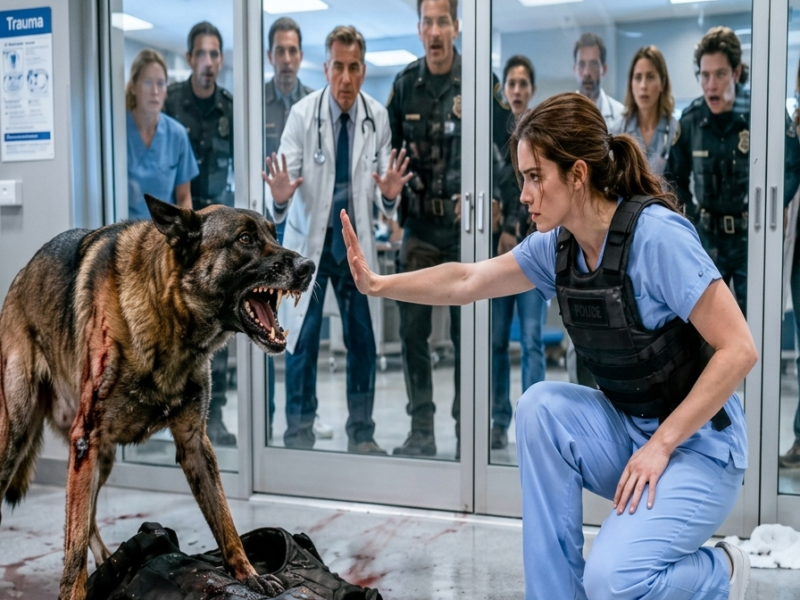
The veteran K9 nearly tore through his restraints in the middle of the VA hospital, forcing three combat medics to retreat while the attending physician ordered the rookie nurse to stay behind and clean up the mess
The first time I saw Ranger, he was standing beside an overturned medical cart in the main hallway of the Denver Veterans Medical Center, his dark, intelligent eyes locked on every person who moved, his muscle-bound body tense with violent, protective energy.
The German Shepherd had served three grueling tours overseas, and according to his military handler, he hadn’t allowed anyone except his former partner to touch him since returning to Colorado. He was hyper-vigilant, aggressive, and broken by the invisible wounds of a war that wouldn’t let him go.
That partner, Staff Sergeant Michael Bennett, had been declared dead eight months earlier.
“Keep your distance,” the handler warned, his knuckles white as he strained against the heavy tactical leash. “He nearly bit through a man’s thick leather glove this morning. He’s unpredictable.”
Dr. Collins, the attending physician, rolled his eyes and tossed a clip chart onto the nurse’s station with a sharp, dismissive thud. “We don’t have time for a dog with emotional problems. This is a medical facility, not a military kennel. Get him out of my hallway, or I’ll have security sedate him.”
I kept quiet, my hands resting in the deep pockets of my faded blue scrubs. I’d been working at the Denver Veterans Medical Center for nine days, and most of the senior staff treated me like a temporary, unskilled employee who had somehow wandered into the wrong profession. They saw a meek, quiet nurse who kept her head down, worked the double shifts nobody else wanted, and never argued when senior staff dumped their heaviest tasks on her desk.
They didn’t know I had once served as a decorated combat medic in the Arghandab Valley. They didn’t know why I had walked away from my military commission, my medals, and my career. And they certainly didn’t know that I had spent the final night of Michael Bennett’s recorded life in a blood-soaked field hospital, holding futile pressure against a wound that no amount of medical training could have saved.
At least, that’s what the official military casualty report had told me.
Ranger suddenly lunged with a terrifying roar. The handler stumbled backward on the slick floor, and a nearby nurse screamed as the dog snapped at the air inches from her face, his teeth clapping together like a steel trap.
“Get that animal out of here right now!” Dr. Collins shouted, backing away behind the security desk.
But Ranger wasn’t looking at the nurse anymore. He wasn’t looking at Dr. Collins, or the handler, or the gathering crowd of terrified onlookers.
He was staring directly at my left wrist. More specifically, at the old, scratched silver bracelet I wore every day.
My heart stopped in my chest.
Michael had given me that custom silver band the night before our final deployment, his rough thumb tracing the metal as he forced a smile. “Keep it safe for me, Em,” he had whispered into the cold desert wind. “Keep it until I come back to claim it.” I had worn it every single day since the military casualty officer knocked on my door to inform me he was gone.
Slowly, deliberately, I stepped forward and knelt on the cold linoleum floor.
“Don’t move, you idiot!” Collins barked from behind the desk. “Are you trying to get yourself killed? Back away from him!”
I ignored him entirely. The chaotic noise of the busy hospital faded into absolute silence. Ranger’s ears lifted sharp and high as I looked straight into his dark, storm-filled eyes. I saw the grief in them—the exact same grief that stared back at me in the mirror every morning.
I took a slow breath and gave the low, quiet command I hadn’t spoken aloud in eight agonizing months.
“Ranger, home position.”
The giant German Shepherd went completely still. The terrifying growl vibrating through his chest instantly died. A second later, he lowered his head, folded his powerful front legs beneath him, and slid across the floor until his heavy, warm body was pressed firmly against my knees. He buried his muzzle into my lap, letting out a long, shuddering sigh that sounded almost like a sob.
The entire hallway fell into an astonished, breathless silence. Dr. Collins stood frozen, his mouth slightly open. The handler stared at me as if he were looking at a ghost.
“Nobody outside Michael’s unit knows that command,” the handler whispered, his voice shaking. “That was a private tactical queue.”
I stroked the soft fur behind Ranger’s ears, my fingers trembling as I fought back the hot tears burning behind my eyes. “Michael taught it to me,” I whispered. “In another life.”
Before anyone could ask another question, Ranger’s ears twitched. He suddenly sprang up from the floor, his back fur standing on end, and charged toward the glass doors of the main entrance, barking furiously at the storm outside.
A heavily blacked-out SUV had pulled up to the curb. Two men in dark military uniforms stepped out into the rain. The older man, wearing a heavily decorated coat, walked straight up to the double glass doors, holding a thick, sealed Manila envelope against his chest.
When his eyes fell upon Ranger, the color completely drained from his face. Then his gaze shifted, locking directly onto me.
“Emily Carter?” he called through the narrow gap between the sliding doors.
I stood up slowly, stepping in front of Ranger to calm him. “Who are you?”
He pressed the envelope flat against the glass panel. “My name is Colonel Hayes. I was the commanding officer responsible for your partner’s final classified mission.”
Ranger began growling again—a deep, lethal vibration. But he wasn’t looking at the colonel’s uniform or his medals. He was staring directly at the envelope.
Colonel Hayes swallowed hard, glancing nervously over his shoulder at the dark street. “Your partner wasn’t killed by enemy fire, Emily,” he said, his voice dropping to a desperate whisper. “His death was officially recorded that way because someone high up needed that entire operation buried.”
My knees nearly gave out beneath me. The floor felt like it was tilting. “What mission? What are you talking about?”
The colonel checked the hospital security cameras mounted on the ceiling before leaning even closer to the glass. “Michael is alive, Emily. But he’s been missing for eight months. And yesterday, someone in intelligence discovered where he’s being held.”
He slid the envelope through the narrow gap between the automatic doors. I took it with numb, trembling fingers and tore it open.
Inside was a single, high-resolution photograph. It showed Michael—thinner, scarred, and visibly exhausted, but unmistakably, undeniably alive—standing behind the heavy iron bars of an underground concrete cell.
I turned the photograph over. On the back, six words were written in a sharp, slanted handwriting I would recognize anywhere in the world:
Don’t let them take Ranger tonight.
I looked up, my throat tight, my heart hammering against my ribs. “Colonel, where is he—”
The sidewalk was empty. The black SUV was already speeding away into the rain-soaked darkness, its taillights disappearing around the corner.
Before I could process what had just happened, a sharp, metallic screech echoed through the building. Behind me, every single light in the hospital flickered once, twice, and went completely dark. The backup generators sputtered, failing to turn on. Emergency red lights cast long, ominous shadows down the hallway.
Ranger pressed his heavy body against my leg, a fierce, lethal growl rising from his chest as he turned toward the pitch-black emergency stairwell.
Then, out of the shadows at the end of the corridor, a quiet, familiar voice emerged—whispering the one name I had spent eight agonizing months trying to forget.
“Emily.”
My breath hitched in my throat. The voice sounded so close, so intimately familiar, that every nerve ending in my body flared to life.
“Michael?” I whispered, taking a blind step into the dark corridor.
Ranger snapped at the air, placing himself firmly between me and the stairwell door. He wasn’t acting out of fear; he was in a tactical guard stance. His body was tense, his teeth bared toward the shadows.
“Emily, get back here!” Dr. Collins’ frantic voice called out from the darkness near the reception desk. “The main power grid just blew! Security is checking the basement! Don’t go wandering down those halls!”
I ignored Collins completely. I reached into my scrub pocket, pulled out my small medical penlight, and clicked it on. A narrow beam of white light cut through the gloom, illuminating swirling dust motes and long, eerie shadows stretched across the floorboards.
“Michael?” I called again, my voice stronger this time, carrying the authority of a combat medic who had faced darkness many times before.
A heavy footstep echoed from the stairwell. Then another.
A figure stepped into the narrow beam of my penlight. But it wasn’t the man from the photograph.
It was a tall, powerfully built man wearing a dark tactical jacket, combat boots, and a heavy ballistic vest with no insignia. His face was cold, sharp, and scarred across the left cheek. In his right hand, he held a suppressed military-grade pistol, lowered at his side.
Ranger let out a deafening, terrifying bark, springing forward until his leash snapped taut against my hand.
“Easy, dog,” the man said in a flat, raspy voice that lacked any emotion. “You’re a long way from the desert, Captain Carter.”
“I’m not a Captain anymore,” I said coldly, holding my penlight steady on his eyes, my hand never shaking. “And you aren’t hospital security. Who are you, and why are you using Michael’s voice?”
The man reached into his tactical pocket and pulled out a small electronic device—a voice-modulating speaker—and tossed it onto the floor between us. It bounced with a dull plastic click.
“An effective lure,” he said emotionlessly. “Colonel Hayes was a fool to come here. He thought he could hand you that photo and walk away. But Vanguard Security doesn’t leave loose ends.”
Vanguard Security.
The name hit me like an electric shock. They were a massive private military contracting firm that operated in gray-zone conflict areas across the globe. Eight months ago, during our final deployment, Vanguard contractors had been assigned to provide perimeter logistics for our special operations outpost in Afghanistan.
“Where is Michael?” I demanded, stepping forward despite the suppressed weapon pointed at my chest. “Is he alive?”
“He’s alive for now,” the mercenary replied, his finger tightening slightly on the trigger. “Because he possesses the encryption keys to an off-grid intelligence network that proves Vanguard was selling military hardware to hostile insurgents. But he refused to unlock the files without proof that you were still alive.”
He raised the pistol, aiming it directly at my forehead. “The Colonel brought you the picture. Now, I take you to him. Or I take your body as proof. It makes no difference to my employer.”
“You made a mistake coming into my hospital,” I said quietly.
“Did I?” the mercenary sneered. “You’re an unarmed nurse in a dark hallway.”
“I was a lead combat medic for the 75th Ranger Regiment,” I corrected him, my voice dropping to a icy whisper. “And you forgot about the dog.”
Before he could pull the trigger, I dropped my penlight, plunged the hallway back into total blackness, and gave a single, explosive command:
“Ranger! STRIKE!”
Ranger didn’t hesitate. He launched his entire hundred-pound frame through the darkness like an unguided missile.
A sharp, muffled gun blast illuminated the dark corridor for a split second, the bullet shattering a plastic wall clock behind me. But then came a sickening crunch of bone, followed by a grunt of pure agony as Ranger’s jaws clamped onto the mercenary’s arm, tearing him to the floor.
The gun clattered across the linoleum tiles.
I didn’t wait. I lunged forward into the dark, using the sound of the struggle to locate the mercenary. I drove my knee violently into his exposed ribs, heard a satisfying crack, and swept his second leg out from under him. As he groaned, I found the dropped pistol on the floor, picked it up, racked the slide with expert, practiced speed, and pressed the cold barrel directly against the base of his skull.
“Ranger, HOLD!” I barked.
The giant dog immediately stopped biting, but kept his massive paws planted on the man’s chest, his dripping jaws inches from the mercenary’s throat, growling a low, deadly promise.
The mercenary lay pinned to the floor, coughing blood, his eyes wide with absolute shock. He hadn’t expected a timid ER nurse to disarm and neutralize a trained operative in less than ten seconds.
“Who sent you?” I hissed, pressing the barrel harder against his head. “Give me a name!”
“It… it doesn’t matter…” the operative gasped, pain wracking his body. “A strike team… is already at the perimeter… they aren’t here for you… they’re here for the colonel’s files… in the basement archives!”
Suddenly, the heavy double doors at the end of the hall burst open. Dr. Collins and two hospital security guards rushed in, carrying bright emergency lanterns.
“Emily! We heard a gunshot!” Collins yelled, stopping dead in his tracks as the lantern light illuminated the scene.
They froze in complete terror.
There I was—the quiet, timid float nurse they had mocked all morning—kneeling over a wounded mercenary, a military sidearm held with lethal precision in my hands, and a battle-scarred war dog standing guard beside me.
“Dr. Collins,” I said without looking up, my voice cold and absolute. “Get these guards to tie this man up with restraint cuffs. Call the FBI field office, not the local police. Tell them Vanguard Security has breached a federal VA facility.”
“E-Emily…” Collins stammered, his face white as paper. “What… who are you?”
“I’m the person saving this hospital,” I said, standing up and checking the magazine of the captured pistol. Full load.
I looked down at Ranger, whose eyes were fixed on me, waiting for his next order.
“Come on, boy,” I whispered, sliding the weapon into my scrub belt. “We have a basement to clear.”
The basement of the Denver Veterans Medical Center was a labyrinth of dimly lit concrete corridors, steam pipes, and forgotten archive rooms dating back to the 1950s.
Emergency power hadn’t reached this level at all. Thick, heavy darkness swallowed everything beyond the four-foot beam of the tactical flashlight I had taken from the mercenary.
Ranger walked half a pace ahead of me, his nose low to the floor, his ears rotating toward every hiss of steam and drip of water. His tactical instincts were fully awake, his body moving with the silent, fluid grace of a hunter.
“Track, Ranger,” I whispered into the cold air. “Find Michael.”
He let out a soft, barely audible huff, catching a scent trail and accelerating down a narrow hallway lined with heavy steel fire doors.
We were looking for the facility’s legacy records room—the off-grid military archives where Colonel Hayes had hidden the original classified files regarding Michael’s unit. If Vanguard wanted those files buried, it meant the evidence inside was enough to dismantle their entire corporate empire and bring down every corrupted officer involved in the cover-up.
As we rounded a corner toward the vault doors, a sharp metallic click echoed through the corridor.
I flattened my back against the concrete wall instantly, pulling Ranger back by his harness.
Twenty feet ahead, two men in full tactical gear were using a thermal cutting torch to breach the heavy lock of the archive vault. Sparks showered into the dark hallway like blinding fireworks, casting wild, flickering shadows against the walls. A third man stood watch at the intersection, an assault rifle raised to his shoulder.
“How much longer?” the lookout grunted into his comms headset.
“Two minutes,” the man with the torch replied, his voice muffled by a respirator mask. “The steel door is six inches thick, but this thermite charge will melt the lock core.”
I calculated my odds in a split second. Three heavily armed contractors with automatic weapons, night-vision gear, and body armor. I had a single suppressed hand pistol, nine rounds of ammunition, and a military working dog.
Direct assault was suicide. I needed to use the terrain.
I reached up and pulled a heavy brass emergency valve on the overhead steam pipe directly above the lookout’s head. I jammed the nose of my pistol into the valve hinge and twisted with all my strength.
BANG!
The rusted valve snapped open. A roaring wall of superheated white steam erupted from the pipe, instantly flooding the narrow corridor with blinding, scalding fog.
“Thermal hazard! Fall back!” the lookout screamed, dropping his rifle to shield his face from the burning heat.
“Ranger! Go!” I barked.
Ranger moved like a shadow through the thick white fog. A second later, a horrific scream echoed through the corridor as Ranger hit the lookout at full speed, knocking him into the concrete wall and disarming him before he could fire a single round.
I sprinted through the blinding steam, keeping low beneath the rising heat. The second contractor turned, his assault rifle swinging toward my position. I slid across the wet floor, fired two precise shots into his unarmored thigh, and watched him collapse to his knees with a roar of pain.
The third operative—the man holding the cutting torch—dropped his equipment and reached for his sidearm.
I came out of the slide, rose to my feet, and slammed the heavy iron tactical flashlight straight into his jaw. He reeled backward, crashing violently into the glowing, half-melted vault door, and slid unconscious to the floor.
The corridor went silent again, save for the roaring hiss of the broken steam valve and the heavy breathing of my dog.
In less than forty seconds, the threat was neutralized.
“Good boy, Ranger,” I panted, patting his ribs as he returned to my side, his tail giving a single, subtle wag.
I turned my attention to the breached archive door. The thermite torch had done its job—the heavy lock core had been turned into a puddle of glowing, molten slag. I grabbed a heavy iron crowbar from the contractor’s gear bag, jammed it into the melted seam, and leaned back with my entire body weight.
With a loud, agonizing groan of protesting steel, the vault door swung open.
The room inside was pitch black, smelling of old paper, ozone, and copper. I raised my flashlight, sweeping the beam across rows of dusty metal filing cabinets.
And there, sitting on a wooden chair in the very back corner of the vault, illuminated by the beam of my light, was a man.
He was wearing a torn, blood-stained military undershirt. His wrists were bound to the chair with heavy zip-ties. His face was covered in bruises, his dark hair matted with dried blood.
He slowly lifted his head, squinting against the bright glare of my flashlight.
My breath caught in my chest. The flashlight trembled in my hand.
“Emily?” he rasped, his voice cracked and dry as dust.
It was Michael.
I dropped the crowbar. It clattered loudly against the floor, but I didn’t care.
“Michael!” I cried out, rushing across the room and throwing myself onto my knees in front of him.
Ranger let out a high-pitched, desperate whine, pressing his massive head against Michael’s lap, his tail thumping frantically against the concrete floor.
“Ranger… hey, buddy,” Michael breathed, a tear cutting a clean path through the dirt on his cheek as he leaned down to press his forehead against the dog’s nose. “You found me… you actually found me.”
I pulled a pair of tactical shears from my scrub belt and sliced through the heavy zip-ties binding his wrists. The moment his hands were free, Michael pulled me into a fierce, desperate embrace. His body was trembling, cold, and exhausted, but his grip was as strong and protective as it had ever been.
“I thought you were dead,” I sobbed into his shoulder, holding him as if he might disappear if I let go. “Eight months, Michael! I held your casualty report in my hands! I buried an empty casket!”
“I know, Em… I’m so sorry,” Michael whispered, his voice thick with emotion. “They staged the entire extraction. When our team was ambushed in the valley, Vanguard contractors didn’t come to rescue us. They were the ones who attacked us. They needed my biometric security clearance to access their hidden offshore weapons network. When I refused to give them the passcodes, they kept me in a black site in Eastern Europe.”
“How did you get here? To Denver?” I asked, pulling back to inspect his injuries with trained medical eyes. He had two fractured ribs, severe dehydration, and deep lacerations across his shoulders, but nothing immediately fatal.
“Colonel Hayes,” Michael explained, coughing weakly. “He was part of Vanguard’s board, but he had a stroke of conscience last week. He realized Vanguard was planning to execute every witness involved in the project. He smuggled me out of the European facility on a private transport two days ago. He hid me here, in the old archives, because nobody checks these decommissioned vaults.”
He reached out and touched the silver bracelet on my wrist, his eyes filled with profound tenderness. “You kept it.”
“I never took it off,” I said softly, covering his hand with mine.
“Where are the encryption files?” I asked, looking around the dark room. “Hayes said they were here.”
Michael reached beneath the wooden chair, pulled out a small, heavy steel data drive coated in reinforced rubber, and pressed it into my hand. “It’s all here. Corporate records, transaction logs, names of bought-off generals and politicians. Enough evidence to send the entire executive board of Vanguard to federal prison for the rest of their lives.”
Suddenly, a cold, heavy voice echoed from the open vault doorway behind us.
“And that is precisely why that drive can never leave this room.”
I stood up instantly, stepping in front of Michael, my gun raised and steady.
Standing in the doorway, framed by the steam floating down the corridor, was Colonel Hayes. But he wasn’t looking like the desperate, regretful officer I had met at the front doors an hour ago.
He was holding a high-caliber revolver, pointed straight at my chest. Beside him stood four more heavily armed Vanguard operatives, their assault rifles raised and locked onto us.
“Colonel,” Michael said quietly, stepping up beside me despite his broken ribs. “I thought you were trying to fix your mistakes.”
Colonel Hayes let out a bitter, exhausted laugh. “Fix my mistakes? Michael, I didn’t bring you here to save you. I brought you here to lure Captain Carter and Ranger out of hiding.”
My eyes narrowed into slits. “Why?”
“Because your little dog possessed the secondary biometric print required to open the master vault,” Hayes revealed, a cruel smile touching his lips. “Vanguard’s security protocol required a two-key authorization: Michael’s retinal scan, and the encoded microchip implanted in Ranger’s tactical collar during his service. Without the dog, the encryption drive in your hand is nothing more than a useless piece of plastic.”
He extended his left hand toward me. “Give me the drive, Captain Carter. Hand over the dog. And I might let you step out of this basement alive.”
The cold stillness in the vault was absolute.
The four Vanguard mercenaries shifted their weight, their boots crunching on the dusty floor. Four assault rifles and a high-caliber revolver were trained directly on us.
I looked at Michael. He gave me a barely perceptible nod—the same silent, unspoken communication we had shared across dozens of combat zones in Afghanistan. We didn’t need words. We were a team.
“You really don’t get it, do you, Colonel?” I said, my voice dangerously calm as I took a small step sideways, drawing Hayes’s attention away from Ranger.
“Get what, Captain?” Hayes demanded, his finger tightening on his trigger.
“You spent thirty years in comfortable offices pushing papers,” I said, cold disdain dripping from every word. “You think soldiering is about passcodes, microchips, and corporate balance sheets. You thought you could break Michael. You thought you could disarm me. And you thought Ranger was just a tool.”
“Enough speeches!” Hayes snapped, taking a step into the room. “Hand over the drive!”
“Ranger,” I said softly, my voice cutting through the dark like a blade.
The dog didn’t growl. He didn’t bark. He simply sank an inch lower to the floor, his muscles coiling like steel springs.
“Ranger,” I whispered, giving a command that wasn’t in any tactical manual, a command that Michael and I had created together on our very first mission: “PROTECT THE FAMILY.”
BANG!
I fired my hand pistol directly into the overhead fire-suppression sprinkler head mounted above Colonel Hayes.
The heavy iron brass head shattered. A violent, pressurized torrent of thousands of gallons of cold water roared down from the ceiling, instantly blinding the mercenaries, soaking their weapons, and creating absolute, chaotic bedlam in the enclosed vault.
“FIRE! KILL THEM!” Hayes screamed, spraying wildly into the dark as water poured into his eyes.
Ranger launched forward through the falling water like a demon, hitting Colonel Hayes squarely in the chest. The colonel went flying backward out of the vault doorway, his revolver spinning uselessly into the dark corridor.
Michael lunged at the nearest mercenary, grabbing the barrel of his assault rifle, twisting it upward as it discharged harmlessly into the ceiling, and driving a devastating elbow into the man’s throat.
I moved with lethal, fluid precision. I ducked beneath a stream of automatic fire, stepped inside the guard of the second operative, and slammed my tactical shears directly into the joint of his armor vest. He gasped, dropping his weapon. I grabbed his fallen rifle, spun around, and used the heavy buttstock to knock the third mercenary unconscious before he could acquire a target.
The fourth mercenary turned to flee back up the steam-filled corridor, but Ranger was already waiting for him. The dog took him down with a single, flawless tackle, pinning him to the wet concrete floor until he threw his hands up in total surrender.
In less than twenty seconds, the violent storm was over.
The heavy thrum of emergency floodlights suddenly flickered to life throughout the basement. The primary backup generators had finally kicked in, bathing the vault and corridor in bright white light.
Colonel Hayes lay on his back in the doorway, coughing water, his expensive uniform ruined, staring up at me in absolute terror as I stood over him with his own revolver in my hand.
“It’s over, Colonel,” I said, looking down at him with cold, unyielding judgment.
In the distance, the loud, wailing sirens of federal law enforcement vehicles echoed through the streets outside, rapidly approaching the hospital entrance.
Dr. Collins had actually listened to me. The FBI had arrived.
Ten minutes later, the main lobby of the Denver Veterans Medical Center was flooded with armed federal agents, state troopers, and emergency medical technicians.
Vanguard Security operatives were being led out in heavy hand irons. Colonel Hayes was pushed into the back of a federal vehicle, his head hanging low in absolute disgrace as news cameras flashed from behind the police barricades.
Dr. Collins stood near the entrance, holding a mug of warm coffee with two trembling hands. When he saw me walking out of the elevator beside Michael, supported by a pair of crutches, Collins walked over slowly, looking like a man whose entire world had been turned upside down.
“Emily…” Collins stammered, looking at my wet, torn scrubs, then at Michael, and finally at Ranger, who was walking proudly at my side. “I… I don’t know what to say. I had no idea who you were.”
I stopped and looked Dr. Collins straight in the eye.
“I’m an ER nurse, Dr. Collins,” I said clearly and calmly. “And starting tomorrow morning, you’re going to treat every single veteran who walks through these doors with the respect they earned. Do we have an understanding?”
Collins swallowed hard and gave a firm, humble nod. “Yes, Captain. Absolutely.”
I turned back to Michael. The morning sun was beginning to break through the dark rain clouds over the Denver mountains, casting a warm, golden light across the hospital plaza.
Michael reached out and took my hand, his rough fingers weaving through mine, his thumb resting gently against the silver bracelet.
“What do we do now, Em?” he asked softly, looking out at the rising sun.
I looked down at Ranger, who sat beside us, his dark eyes clear, calm, and peaceful for the first time in eight months. He leaned his head against my leg, letting out a soft, contented sigh.
“Now,” I said, a genuine smile finally breaking across my face for the first time in nearly a year, “we go home.”
The end,









