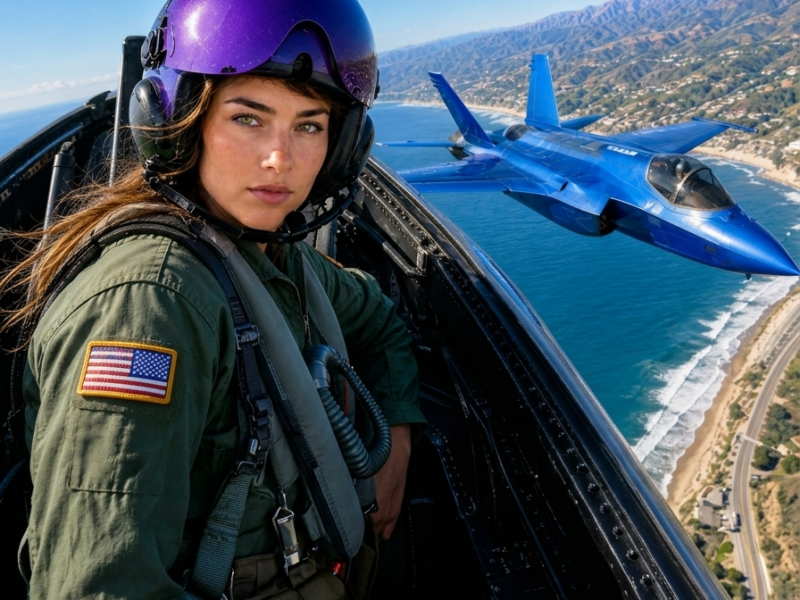
The Top Gun instructors laughed when I walked into the briefing room wearing scuffed boots and a faded jacket, but when the F-35 simulator locked onto six enemy fighters and every trained pilot in the room failed to survive
The silence in the briefing room was heavier than the atmospheric pressure at forty thousand feet.
Captain Reynolds, a seasoned Top Gun instructor whose flight suit was adorned with patches from every major combat deployment of the last decade, adjusted his posture. The smirk that had comfortably rested on his face for the last twenty minutes was gone, replaced by a tense, rigid line. Around him, five of the navy’s elite aviators—men who had clocked thousands of hours in supersonic jets—stared at the simulator display in utter disbelief.
“Is this a joke?” Reynolds had asked earlier, glancing at my name tag as the other pilots chuckled. “They’re sending a farm girl to teach us aerial combat?”
I had kept my eyes on the flight simulator waiting at the front of the room.
“My name is Claire Bennett,” I had said, my voice steady, carrying no warmth, no anger, just cold fact. “And I was told to report here.”
“Great,” Reynolds had replied with a smirk. “Maybe you can teach us how to herd cattle.”
Laughter had rolled across the room. I was wearing scuffed boots, faded denim, and a flight jacket that had seen better decades. I didn’t look like a navy ace. I looked like someone who had just stepped off a tractor in the middle of nowhere.
I had heard worse growing up in rural Montana, where people judged you by your truck, your boots, and whether your family owned enough land to matter. I had learned early that defending yourself with words rarely changed anyone’s mind.
So I said nothing.
The commander, Colonel Harris, had stepped forward and explained the exercise. Six simulated enemy fighters would engage a single F-35 in a mountainous combat zone, with limited visibility, restricted weapons, and no external support. The objective was simple: survive for ten minutes.
Reynolds had cracked his knuckles. “This should be entertaining.”
One by one, the instructors had entered the simulator, confident they could outmaneuver the virtual enemy. One lasted ninety seconds. Another lasted barely two minutes. The final instructor survived four minutes before a missile warning flashed across his screen, followed by the unmistakable message: AIRCRAFT DESTROYED.
The room fell silent. Colonel Harris rubbed his forehead. “All right. Who wants to try next?”
I raised my hand.
Reynolds laughed again. “You’re serious?”
“Completely.”
He leaned back in his chair. “Fine. Let’s see what the country girl can do.”
I climbed into the simulator and adjusted the seat, my fingers moving instinctively across the controls. For a moment, the room disappeared. I was seventeen again, sitting beside my father in an old crop-dusting plane, watching him guide the aircraft between the jagged mountain peaks behind our Montana ranch.
He had taught me to read wind patterns, recognize dangerous air currents, and trust the smallest changes in barometric pressure. “Machines tell you what they’re doing,” he used to say, his calloused hands resting lightly on the yoke. “The sky tells you what it’s about to do.”
I had never forgotten.
The countdown began. Three. Two. One.
The simulated fighters appeared on the high-definition display. Instead of climbing for altitude as every doctrine dictated, I dropped low and banked hard toward the canyon floor.
Reynolds scoffed. “She’s throwing away the high ground.”
Then the first enemy fighter overshot me, unable to match my radical deceleration against the canyon walls. I rolled beneath its simulated weapons envelope, used the shadow of the mountain ridge to break the second fighter’s radar lock, and forced two more aircraft into conflicting attack paths.
Within three minutes, three enemy fighters were out of the engagement. The laughter in the room had stopped completely.
At six minutes, I was still flying smoothly, weaving through virtual rock pillars. At eight, the remaining fighters began coordinating their attacks in a classic pincer movement. I waited until their formation tightened, then executed a violent, unconventional pitch maneuver—a high-alpha vector shift that no standard flight manual authorized. I used the local terrain density and a sudden change in simulated wind direction to separate them.
One disappeared from my display. Then another.
At nine minutes and forty seconds, the final fighter was locked in my sights and destroyed.
The simulator screen flashed brightly: MISSION SUCCESS.
Nobody spoke. The briefing room was as silent as a graveyard.
I climbed out of the cockpit, wiping a thin layer of sweat from my forehead, expecting questions about my technique or my flight line. Instead, Colonel Harris stared at me as if he had seen a ghost rising from the floorboards.
“Where did you learn that maneuver?” he asked, his voice barely above a whisper.
“From my father.”
His face drained of all color. “What was his name?”
“Daniel Bennett.”
Harris slowly closed the classified folder in his hands, his knuckles turning white. “That’s impossible,” he whispered.
I frowned, feeling an icy knot form in my stomach. “What is?”
He looked toward the sealed, reinforced steel door at the back of the room. “Your father was the chief civilian test pilot who designed that specific high-alpha vector maneuver,” Harris said. “He died in an F-35 prototype crash fifteen years ago in the Nevada desert.”
My throat tightened. “My father was a civilian crop-duster in Montana. He died in a tractor accident when I was nineteen. He never flew an F-35.”
Harris said nothing. He reached into his coat, pulled out a worn, black-and-white classified photograph, and slid it across the metal briefing table.
It showed a younger, sharply dressed version of my father standing beside a dark, matte-black experimental fighter aircraft with sweeping, radical wing geometry. His arm was wrapped around a little girl wearing oversized aviator sunglasses.
It was me. I was six years old in that picture.
On the back of the photograph, handwritten in faded black ink, was a single sentence:
IF CLAIRE EVER RETURNS, DO NOT LET HER FLY THE BLACK EAGLE.
Before I could breathe, before I could demand an explanation, the base air-raid sirens began to scream. A deep, pulsing siren echoed through the walls, shaking the glass panels.
A harsh, frantic voice thundered over the intercom loudspeakers: “WARNING. UNAUTHORIZED AIRCRAFT AIRBORNE. EXPERIMENTAL DESIGNATION BLACK EAGLE. ALL PERSONNEL EVACUATE THE FLIGHT LINE IMMEDIATELY. THIS IS NOT A DRILL.”
Colonel Harris lunged forward and grabbed my wrist, his grip like iron. “Claire, listen to me,” he whispered desperately. “If that aircraft is in the sky right now, then someone has just discovered your father’s final secret.”
I broke away from his grip and ran to the floor-to-ceiling reinforced window overseeing the main airfield. Rising through the thick gray fog above the desert runway was a pitch-black, angular fighter jet—the exact same silhouette from the photograph. It moved with unnatural speed, climbing vertically into the clouds without making a sound audible through the glass.
Suddenly, the phone in my pocket vibrated against my leg.
I pulled it out with trembling fingers. A text message from an untraceable, encrypted number glowed on the screen:
Your father is alive. And he knows you’re here.
The screen of my phone stayed lit for a few seconds before going completely black. I pressed the power button repeatedly, but the device was dead—wiped clean by a remote signal.
“Claire!” Colonel Harris shouted over the deafening blare of the base alarm. “We need to get to the underground command center now!”
Pilots and crew members were scrambling through the hallways in a state of controlled panic. Captain Reynolds, his arrogance completely shattered by the sight of the unauthorized jet, ran up to Harris.
“Sir, Radar lost tracking on the Black Eagle three seconds after takeoff!” Reynolds reported, his face pale. “It didn’t just jam our sensors—it completely erased itself from our network. Ground defense batteries can’t lock on!”
“Because it’s using Daniel’s dynamic frequency signature,” Harris muttered under his breath, turning his dark eyes back to me. “Follow me. Both of you.”
We sprinted down a long, concrete corridor leading deep beneath the Top Gun facility. We passed through two security checkpoints where armed guards were hastily reinforcing heavy steel doors. We finally entered a secure, windowless briefing room equipped with wall-to-wall tactical displays, satellite feeds, and intelligence terminals.
“Sir, what is going on?” I demanded, standing firmly across from Harris as he sat down at the main terminal. “My father raised me on a farm in Big Sky country. He fixed engines. He dusted wheat fields. You’re telling me he was a military test pilot who faked his death?”
Harris typed a complex security clearance code into the system. A classified file labeled PROJECT ARES: BLACK EAGLE opened on the main monitor.
“Daniel Bennett wasn’t just any test pilot, Claire,” Harris said quietly. “He was the chief flight dynamics architect for Skunk Works back in the late 2000s. He was a genius who saw aircraft control not as a matter of hydraulics and fly-by-wire computers, but as an extension of human intuition.”
He brought up a series of technical schematics showing a jet that looked decades ahead of anything currently in active service.
“Fifteen years ago, Daniel built the Black Eagle—a prototype fighter equipped with a revolutionary neural-kinetic interface,” Harris continued. “It didn’t use standard joysticks or fly-by-wire software. It synced directly with the pilot’s central nervous system through a bio-reactive flight suit. It responded to intent rather than physical input.”
Reynolds gasped. “A direct neural link? That’s sci-fi stuff. The latency alone would kill a pilot.”
“It nearly did,” Harris replied grimly. “During the initial test flights, the system exerted tremendous pressure on the pilot’s brain. Daniel was the only human being whose neural pathways were capable of surviving the link. But as the military pushed to weaponize it, Daniel realized the danger. He believed the technology was too dangerous to fall into the hands of military contractors or foreign powers. So, fifteen years ago, during a test over the Nevada desert, he faked a catastrophic crash.”
“And you knew?” I asked, my heart hammering against my ribs.
“I helped him,” Harris confessed, looking up at me with deep regret. “I was his wingman on that test flight. I confirmed the crash on radar. I watched him eject in secret over the mountains, step into the shadows, and vanish. He dropped off the grid, moved to Montana, changed his identity, and swore never to touch a control stick again. He wanted to give you a normal life.”
“Then who was I living with for nineteen years?” I whispered. “He died six years ago, Harris. I buried him!”
“Did you?” Harris asked softly. “Did you open the casket, Claire?”
I froze. The memory came rushing back. The closed mahogany casket. The local sheriff telling me that the tractor accident had been too gruesome for an open-casket service. The sudden, quiet burial on our property under the shade of the old oak tree. I had been nineteen, heartbroken, and completely alone. I had trusted the authorities.
“The accident was a second cover-up,” Harris said. “Six years ago, someone discovered his real identity. Someone came looking for the Black Eagle’s source code. Daniel had to vanish again—this time, even from you, to keep you safe.”
Before I could process the staggering revelation, the lights in the command center flickered violently. The screens lining the walls went dark, replaced by a single stream of scrolling green code.
“We’ve been breached!” a technician yelled from across the room. “Local network controls are failing! Someone is overriding our perimeter defense systems!”
The main monitor flickered back on. Instead of tactical maps, it displayed a live camera feed from a high-altitude drone tracking the desert airspace fifteen miles away.
The Black Eagle was hovering motionless in the air—an impossible aerodynamic feat for a jet of its size. It hung in the sky like a giant obsidian predator, defying the laws of physics.
Then, a voice crackled through the command center’s primary communications channel. The sound was distorted by static and an electronic synthesizer, but beneath the filter, there was an unmistakable cadence—a slow, deliberate drawl that sent a cold shiver down my spine.
“Colonel Harris,” the voice spoke. “You kept your promise for fifteen years. But you brought her back into the sky.”
“Daniel?” Harris leaned into the microphone, his hands shaking. “Is that you?”
“Tell Claire to step outside,” the voice replied calmly. “Or I will level this facility in sixty seconds.”
The air outside the underground bunker was hot, dry, and thick with the smell of aviation fuel and burnt rubber. The sun was dipping below the sharp edges of the Nevada mountain range, painting the sky in deep shades of crimson and violet.
I walked out onto the tarmac alone, exactly as the voice had demanded. Behind me, hidden in the shadows of the hangar doors, Reynolds and a squad of heavily armed base security personnel stood with their weapons drawn, waiting for Harris’s signal.
Above the airfield, the Black Eagle descended slowly, its engine producing a low, rhythmic hum rather than the roaring thunder of a traditional jet turbine. The aircraft settled onto the runway three hundred yards away from me, its dark, light-absorbing skin glistening under the dying sunlight.
The glass canopy hissed open, sliding back smoothly.
A figure stepped out of the cockpit and walked down the built-in ladder. He wore a matte-black flight suit fitted with glowing fiber-optic threads woven along the spine and arms. As he removed his helmet, the fading light illuminated his face.
The lines on his skin were deeper, his hair was entirely silver, and a jagged scar ran down his left cheek. But his eyes—piercing, icy blue—were identical to the ones I saw in the mirror every morning.
It was my father.
“Hello, Little Bird,” he said softly, using the nickname he hadn’t spoken since I was ten years old.
Tears sprang to my eyes, hot and furious, burning my skin. “You let me mourn you,” I choked out, taking a step forward, my hands clenched into fists. “You let me spend six years thinking I was completely alone in the world! I buried an empty box in Montana!”
“It was the only way you would survive, Claire,” he said, his voice carrying no weakness, only a heavy, crushing sorrow. “When Vanguard Defense Contractors found out I was still alive six years ago, they sent a recovery team to our ranch. If I had stayed, if I had fought them there, you would have been caught in the crossfire. I had to make them believe I was dead, and I had to leave you behind so they would never target you.”
“And now?” I asked, my voice trembling. “Why reveal yourself now?”
“Because they found the Black Eagle’s hidden hangar in the mountains three days ago,” Daniel explained, looking back at the dark jet. “Vanguard activated the secondary protocols. They were going to steal the prototype and upload its AI flight control network to an autonomous fleet of weaponized drones. I couldn’t let them have it. I stole it back two hours ago.”
“Then why bring it here?” Colonel Harris asked, stepping out from the shadows of the hangar with his hands raised, approaching us slowly. “Daniel, you’re putting the whole base in danger. The Pentagon will send every fighter wing in North America after you.”
“The Pentagon doesn’t control Vanguard,” Daniel replied darkly. “Vanguard controls the Pentagon’s defense network. And they are already on their way.”
Right on cue, the high-altitude warning systems across the base began to blare once again.
On the horizon, six black shapes broke through the cloud cover. They were not standard military aircraft. They were sleek, delta-wing autonomous drones, flying in a tight, hyper-efficient combat formation. They bore no national markings—only the stylized silver logo of Vanguard Defense.
“They tracked the Black Eagle’s signal,” Daniel said, his eyes narrowing as he looked up at the approaching strike force. “They aren’t here to negotiate, Harris. They’re here to erase the evidence and claim the prototype.”
“We need to get you into a shelter!” Harris yelled.
“There is no shelter that can survive what those drones are carrying,” Daniel said flatly. He turned to me, staring directly into my eyes. “The Black Eagle’s interface was mapped to my neural signature fifteen years ago. But human neural patterns degrade with age. My brain can no longer handle the G-forces and the data load required to engage six autonomous combat units at once.”
He took off his flight gloves and held out his hands. They were trembling violently—the unmistakable sign of neurological strain.
“The simulator test you took thirty minutes ago,” Daniel said, a proud smile breaking through his hardened features. “Harris thought you were just using my maneuvers. But I built that simulator scenario as an authentication test. The neural link doesn’t just recognize me, Claire. You share fifty percent of my genetic code and neural mapping. You are the only other person on Earth who can fly the Black Eagle.”
“No,” Harris interjected forcefully. “Daniel, she’s a civilian! She’s never flown a real fifth-generation fighter, let alone a bio-linked prototype!”
“She just defeated six Top Gun instructors on elite difficulty in less than ten minutes,” Daniel countered, his voice ringing with absolute confidence. “She didn’t fly with her eyes, Harris. She flew with her instincts. The same instincts I gave her.”
A explosion rocked the outer perimeter of the base as the incoming drones fired their first long-range missile salvo, obliterating an unmanned radar tower on the ridgeline.
Daniel grabbed my hand, pressing a small, metallic neural connector into my palm.
“They’re coming, Claire,” he whispered. “You can run into that bunker and hope the concrete holds… or you can take the sky.”
The cockpit of the Black Eagle smelled of ozone, leather, and fresh electronics.
As I strapped into the custom ejection seat, my father reached over and attached three lightweight, magnetic sensor pads to the back of my neck, right along the base of my skull.
“The moment the canopy seals, the bio-interface will initialize,” Daniel instructed, standing on the edge of the cockpit ladder. “It will feel cold at first, like ice water running down your spine. Don’t fight it. If you try to control the jet with your hands, you’ll be too slow. Let your mind drive the airframe.”
“What about you?” I asked, looking up at him as the sky turned dark around us.
“I’ll be in the base command center with Harris, managing your tactical data link,” he said, pressing his hand against my cheek. “You were born to fly, Little Bird. Show them who owns the sky.”
He stepped down and slammed the emergency closure hatch.
The canopy slid forward, sealing me into absolute silence.
INITIALIZING NEURAL LINK… a smooth, synthetic voice echoed directly inside my head—not through the helmet speakers, but through my acoustic nerve.
A sharp, electric coldness shot down my spine. For a terrifying second, my vision flashed bright white. The physical boundaries of my body seemed to dissolve. I could feel the jet’s flight control surfaces as if they were my own limbs. The wing flap actuators felt like the muscles in my forearms; the twin vectoring engines felt like the pulsing rhythm of my heart.
The tactical display wasn’t a screen anymore—it was an overlay projected directly onto my visual cortex. I could see three hundred and sixty degrees around the aircraft without turning my head.
NEURAL SYNCHRONIZATION: 98.4 PERCENT.
“Claire, do you read me?” my father’s voice rang in my mind via the encrypted data link.
“I read you, Dad,” I whispered, opening my eyes. “I can feel everything.”
“Vanguard drones closing in at Mach 2.2,” Harris’s voice cut in. “They’re entering weapon engagement range!”
“Engaging,” I said.
I didn’t push the throttle. I simply thought forward, and the Black Eagle exploded down the runway with terrifying acceleration. The g-force pressed me hard into the seat, but the bio-suit automatically inflated around my legs and torso, regulating my blood flow with incredible precision.
We cleared the runway in less than three hundred feet, shooting vertically into the dark clouds like a black spear.
Four incoming radar-guided missiles passed beneath us, missing by mere meters.
“Target lock acquired on Lead Drone,” the internal voice announced.
I didn’t press a red button on the joystick. I simply focused my eyes on the lead drone four miles away, visualized the target, and willed the short-range cannon to fire.
The Black Eagle pitched up at an impossible ninety-degree angle, vectoring its thrust through the jet nozzles. A burst of high-velocity tungsten rounds tore through the lead drone’s wing root, sending it spiraling into the mountain below in a brilliant orange fireball.
“One down!” Harris yelled over the radio. “Five remaining!”
The five surviving drones instantly broke formation, executing a complex swarm algorithm designed to flank me from all sides. They opened fire with high-rate kinetic cannons. Tracers lit up the night sky, crisscrossing around my canopy like lethal laser beams.
I dove into a deep canyon, flying less than fifty feet above the rocky riverbed. The terrain rushed past at eight hundred miles per hour. In a normal aircraft, a human pilot would have crashed into the canyon walls within seconds due to sensory overload. But the Black Eagle’s neural link processed the laser-radar terrain map instantly, guiding my flight path around every jutting cliff and boulder.
Two drones followed me into the canyon.
“Dad, they’re sticking to my tail,” I called out, my pulse racing. “They aren’t taking the bait!”
“They’re running automated predictive flight models, Claire!” Daniel replied. “They know every standard defensive maneuver in the military playbook! You have to do something unpredictable—something no computer can calculate!”
I smiled grimly through my oxygen mask.
“Unpredictable?” I muttered. “Let’s show them how we fly in Montana.”
I pulled the nose hard up toward the narrow canyon opening, cut the engine thrust to zero, and deployed the airbrakes while simultaneously reversing the vectoring nozzles.
The Black Eagle didn’t just slow down—it stood completely still in mid-air, floating upright like a hovering bird of prey for two full seconds while the two pursuing drones shot past directly underneath me, unable to react to the violation of aerodynamic physics.
Before they could adjust their flight paths, I re-engaged the twin engines, slammed the nose down, and locked onto both targets.
Two short-range air-to-air missiles erupted from the internal belly bays.
BOOM! BOOM!
A double detonation shattered the night, filling the canyon with burning debris.
“Three down,” I reported, pulling back up into the open sky above the clouds. “Three left.”
“Claire, watch out!” my father screamed over the link. “The remaining three drones aren’t attacking you! They’re altering their flight vector—they’re heading directly for the base command center!”
My heart stopped.
I flipped my visual view back toward the Top Gun base. The three remaining Vanguard drones were locked in a tight V-formation, diving straight toward the underground command facility. Their underbelly payload bays opened, revealing tactical bunker-buster munitions glowing red in the darkness.
They weren’t trying to dogfight me anymore. They were going to destroy the base, kill my father, erase Harris, and bury the secret forever.
“Dad! Get out of there!” I screamed, pushing the Black Eagle’s thrust into full emergency afterburner. “They’re targeting the bunker!”
“It’s too late to evacuate, Claire!” Harris’s voice cracked through the static. “The blast doors aren’t fully sealed!”
“I’m eighty miles away!” I shouted, watching the distance counter on my visual interface tick down agonizingly slowly. “I can’t reach them in time with standard weapons!”
“You can’t reach them with missiles,” Daniel’s voice came through, eerie and calm despite the looming destruction. “But the Black Eagle has one more system built into its core architecture. The Kinetic Override Pulse.”
“What is that?” I demanded, weaving through the turbulent clouds at Mach 3.
“It redirects the entire output of the aircraft’s experimental fusion battery into a localized directed-energy pulse,” Daniel explained rapidly. “It will burn out every microchip and guidance system within a two-mile radius. But it requires you to get within point-blank range of the targets, and it will completely discharge the Black Eagle’s flight computer. You’ll be flying blind on pure mechanical controls.”
“How do I activate it?”
“Reach the high-altitude ceiling directly above the base, drop straight down through their dive path, and initiate the dump,” Daniel said. “If you miss the timing by half a second, the energy feedback will fry your neural pathways, Claire. It could kill you.”
“I’m not losing you again, Dad,” I said, setting my jaw firmly.
I pulled back hard on the controls, forcing the Black Eagle to climb vertically, punching through fifty thousand, sixty thousand, seventy thousand feet. The sky around me turned pitch black, studded with cold, distant stars. The air was practically non-existent.
At eighty thousand feet, I inverted the jet.
Below me, three red target icons were descending rapidly toward the glowing lights of the military base.
“Initializing Kinetic Override Pulse,” the cockpit voice warned. WARNING: DANGER TO PILOT IS EXTREME.
“Override warning,” I commanded mentally. “Execute.”
I pulled the nose straight down and entered a terminal vertical dive. The speed indicator pegged past Mach 4. Friction heat washed over the dark canopy, turning the edges of my vision red. The g-forces felt like a mountain crushing down on my chest, threatening to force the air from my lungs and pass me out into blackness.
Fifty thousand feet.
Thirty thousand feet.
Ten thousand feet.
The three drones filled my front view. They were three seconds away from releasing their bombs onto the command facility.
“NOW!” Daniel shouted in my mind.
I willed the pulse to release.
A blinding, brilliant sphere of blue electromagnetic energy exploded outward from the nose of the Black Eagle. The shockwave expanded in a silent, dazzling wave through the night sky.
Instantly, the three Vanguard drones went dark. Their engines sputtered out, their control surfaces locked, and their guidance systems melted. They tumbled uselessly through the air, crashing harmlessly into an empty dry lake bed three miles away from the base, exploding in silent plumes of dirt and dust.
But the pulse didn’t stop there.
Inside my cockpit, every screen flashed red, then shut down completely. The high-pitched whine of the bio-interface faded away into deathly silence. The cold, electric connection at the base of my neck snapped violently, sending a wave of intense nausea through my head.
NEURAL LINK DISCONNECTED.
SYSTEM FAILURE. ENGINE SHUTDOWN.
The Black Eagle was dead. I was four thousand feet above the desert, falling like a lead brick in a dark, silent metal box.
“Claire! Do you copy? Claire!” my father’s voice was faint, coming through the backup emergency radio speaker in the cockpit.
“I’m alive!” I gasped, breathing heavily into my oxygen mask, fighting off the dizziness. “Primary power is dead! Controls are locked!”
“Use the mechanical manual override lever beneath your seat!” Daniel instructed frantically. “Pull it to release the physical hydraulic linkages! You have to fly it manually!”
I reached down between my knees, grabbed the red emergency handle, and pulled with all my strength.
CLANG!
A heavy mechanical clunk echoed through the airframe. The physical control stick in my hands suddenly became heavy, vibrating with the raw, brutal pressure of the rushing wind outside.
The desert floor was rushing up to meet me at blinding speed. Three thousand feet. Two thousand feet. One thousand feet.
I grabbed the mechanical stick with both hands, planted my scuffed boots firmly against the rudder pedals, and pulled back with every ounce of muscle in my body.
The heavy elevators on the tail bit into the thin air. The nose of the dark jet slowly, reluctantly began to rise.
The belly of the Black Eagle scraped across the desert floor, sending a massive shower of sparks into the dark night as it skidded along the dirt, tearing up rocks and brush for nearly a mile before finally grinding to a halt at the very edge of the runway.
Silence returned to the desert.
I sat in the dark cockpit, my lungs gasping for air, my hands trembling uncontrollably on the stick.
Outside, the searchlights of the military base swept across the terrain, illuminating the battered, dirt-streaked black jet. Sirens blared in the distance, and emergency vehicles sped down the tarmac toward me.
The manual canopy release hissed, and I pushed the heavy glass open.
Standing twenty yards away in the dust raised by the skidding aircraft were Colonel Harris and my father, running as fast as their legs could carry them.
My father reached the ladder first, climbing up and leaning over the cockpit. He reached in, unclipped my oxygen mask, and looked at me with tears streaming down his dust-covered face.
“You brought her down,” he whispered, his voice trembling with pride. “You actually brought her down.”
I wiped a streak of sweat and dirt from my forehead, a exhausted but triumphant smile spreading across my face.
“You taught me how to read the sky, Dad,” I said softly, looking up at the vast, clear night sky above Nevada. “The machine failed… but the sky never lies.”
Colonel Harris arrived at the side of the jet, panting, looking at the two of us—father and daughter, standing together in the light of the emergency vehicles.
“The Pentagon is already calling, Daniel,” Harris said, though there was a rare grin on his face. “What are we going to tell them?”
Daniel looked at me, then back at Harris, his expression turning cold and determined.
“Tell them the Black Eagle was destroyed in the crash,” Daniel said quietly. “And tell them the test pilot has officially retired.”
He reached out his hand, and I took it, climbing down from the cockpit of the world’s most dangerous aircraft, finally ready to step out of the shadows and go home.
The end.









