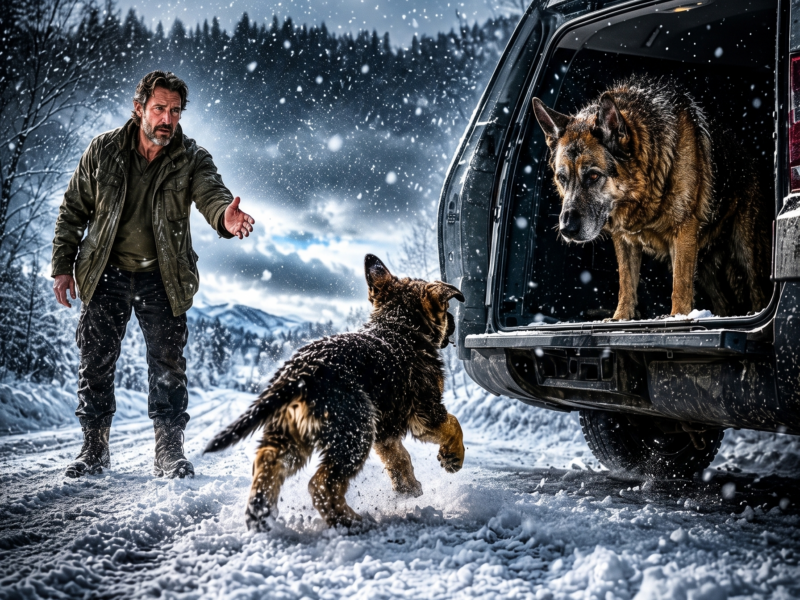
The tiny puppy kept chasing my Navy K9 through the freezing streets of Seattle, crying whenever she disappeared from sight, and when my dog finally stopped and began licking his face
The rainy wind howling off Elliott Bay blew sheets of ice-cold mist down 1st Avenue, soaking the neon signs of downtown Seattle until they bled into shimmering smears of red and blue against the slick pavement. I pulled my heavy leather collar up around my neck, adjusting my grip on the leash. Walking a three-year-old Belgian Malinois through a rainstorm isn’t a leisure activity; it’s an exercise in focused tactical discipline.
Luna walked at my left hip, her body moving with the effortless, low-slung grace of an animal forged in the furnace of high-stress operations. She was a former Navy K9—a specialist in explosive detection and high-risk tracking who had been retired early due to a shrapnel tear in her shoulder. I had spent two years working alongside her in the private security sector after leaving the military myself. We were two broken veterans who understood each other’s silence.
I had first noticed the little shape three blocks back near Pioneer Square.
At first, I thought it was a stray rat darting between the rain-slicked garbage cans. But as we crossed the intersection near the old pergola, a high-pitched, desperate cry pierced through the rumble of city traffic.
I turned around. A tiny, soaked puppy—barely eight weeks old, with matted golden fur, huge floppy ears, and a distinctive white blaze across his face—was scrambling across the freezing pavement. He was trembling violently, his tiny paws slipping on the wet asphalt as he pushed himself forward with heartbreaking determination. He wasn’t running toward me. He wasn’t looking for food. His pitch-black eyes were locked entirely on Luna.
“Come here, buddy,” I called out, dropping into a crouch and extending a gloved hand. “Easy, little guy.”
The puppy completely ignored me. He stumbled past my boots, his tiny chest heaving as he threw himself toward the massive Malinois.
Luna stopped dead in her tracks. Her ears flattened against her skull, her nostrils flaring as she drew in the cold, wet air. Normally, Luna maintained an absolute, icy indifference toward other dogs. She had been trained to view unknown animals as potential distractions or threats. But as the puppy crashed directly into her chest, her entire posture softened.
Slowly, carefully, Luna lowered her heavy, dark muzzle. She didn’t growl. She didn’t pull back. She began to lick the freezing rain off the puppy’s ears with long, gentle strokes of her tongue.
I froze, staring at them in the downpour. I had known Luna for three years. I had seen her scale six-foot walls, track scents through tear gas, and neutralize armed suspects without a moment’s hesitation. I had never seen her demonstrate a single instinct of maternal tenderness. Not with another dog. Not ever.
“Where on earth did you come from?” I muttered.
I reached down and scooped the little puppy up into my coat. He didn’t fight me, but his tiny head remained turned toward Luna, his paws reaching out toward her dark snout. Luna stepped closer, pressing her nose against my elbow, keeping her eyes fixed on the small golden bundle tucked inside my jacket.
When we reached my apartment above a converted warehouse in the Industrial District, I set up a heated bowl of goat’s milk and high-calorie puppy food near the radiator. The puppy refused to touch it. He stood on the hardwood floor, his legs shaking, letting out a sharp, ear-piercing cry every time Luna moved more than three feet away.
The moment Luna lay down on her thick orthopedic bed, the puppy scrambled across the room, tumbling over his own oversized paws, and wedged his entire body directly beneath Luna’s front legs. Luna curled her body around him, resting her heavy chin over his back like an iron shield. Within thirty seconds, the puppy’s frantic shivering stopped, and he fell into a deep, silent sleep.
The next morning, I began making calls. I checked with the Seattle Animal Shelter, local emergency vet clinics, and lost-and-found pet registries across King County. Nobody had reported a lost golden-mix puppy.
I brought him to a neighborhood vet to check for a microchip. The scan came back completely blank. No chip, no registration, no collar marks.
“He’s underweight and mildly dehydrated,” the vet told me as she examined his ears, “but otherwise surprisingly healthy. Though he does have a strange physical marker here.”
She turned the puppy gently on the examination table and parted the soft fur behind his left ear. A tiny, crescent-shaped white scar ran horizontally across his dark skin—a clean, surgical mark about half an inch long.
My heart gave a strange, uneven thump.
I reached down, my fingers trembling slightly as I turned Luna’s head toward the light. I parted the thick, dark fur behind her left ear. Right beneath the base of her skull lay an identical crescent-shaped white scar, exact in length, depth, and placement.
I stared at the two marks, my breath catching in my chest. “That’s impossible…”
Luna lifted her head, her dark eyes meeting mine with an unblinking, heavy intelligence. Beside her, the puppy crawled out from the blanket, sliding beneath her heavy paw as if fitting into a mold designed specifically for him.
Three days later, after I posted a vague description of a found puppy on a local community board, a knock rattled the heavy oak door of my apartment.
Standing in the hallway was a woman in her late twenties, wearing a faded rain poncho, her hands trembling as she clutched a worn leather folder against her chest. Her face was pale, her eyes rimmed with red.
“Are you Mark?” she asked, her voice barely audible over the hum of the building’s elevator. “I… I saw your post about the puppy with the white face.”
“I am,” I said, stepping back to let her enter. “My name’s Mark. And this is Luna.”
The woman stepped into the entryway. The moment her eyes landed on the puppy sleeping between Luna’s paws on the living room rug, she let out a choked gasp, bringing a trembling hand to her mouth.
“My name is Claire,” she whispered. “Claire Mercer. I think… I think I know where that puppy came from.”
She walked slowly into the living room, dropping her wet coat onto a chair. She sat on the edge of the sofa, her hands shaking uncontrollably as she opened the leather folder.
“My brother, David, was a Master K9 Trainer for the Navy,” Claire began, her voice cracking with suppressed emotion. “He worked at a private tactical breeding facility near Tacoma before he was deployed overseas two years ago. He was killed in a training helicopter crash in Okinawa last winter.”
She pulled a glossy, yellowed photograph from the folder and held it out to me.
“David raised service and tactical working litters,” Claire continued. “One of his senior brood females gave birth to a specialized working litter two years ago. But when David returned from his first rotation, his commanding officers told him the entire litter had died of a viral infection. They produced cremation records and medical logs.”
I took the photograph from her hand. The moment my eyes focused on the image, my stomach dropped like lead.
The photograph showed a younger Luna standing proudly in a concrete whelping pen. Curled against her front legs was a litter of seven tiny puppies. Six of them were dark-coated Malinois mixes, but tucked directly beneath her jaw was a single, tiny, golden-furred puppy with a distinct white blaze across his face and a small red surgical band behind his left ear.
I stared at the photograph, my mind spinning into a dark, confusing vortex.
“Where did you get this?” I asked, looking up at Claire, my voice dropping an octave. “Where did your brother take this picture?”
“David took that in secret,” Claire whispered, tears finally spilling over her cheeks. “Right before he was deployed. He didn’t believe the facility’s story about the puppies dying. He suspected that someone inside the regional military supply chain was falsifying medical records, stealing high-value, top-tier working dogs, and selling them on the black market to private security contractors and foreign buyers under forged identities.”
She pointed a shaking finger at the tiny golden puppy in the photograph.
“That puppy was the only one from the litter that completely disappeared from the facility’s master ledger before the reported infection,” Claire said. “David hid this photograph and an encrypted flash drive inside his personal belongings before he shipped out. He told me if anything ever happened to him… it meant he had asked the wrong questions.”
Before I could answer, a soft, heavy sound echoed from the rug.
Luna had stood up. She walked over to where I was holding the photograph, lowered her dark head, and began to nudge the edges of the worn picture with her nose, her tail giving a low, slow thump against the floor.
Claire covered her face with her hands, sobbing silently. “It’s her. She was the mother David lost.”
I shook my head, fighting the sickening realization creeping over me. “No… Luna was rescued from a regional shelter in Oregon by a civilian contractor three years ago. Her service record said she was retired after a shoulder injury.”
Claire looked up, her eyes wide with terror. “Her records were forged, Mark. They didn’t retire her. They stole her.”
That evening, the storm outside hit its peak. Thunder rolled across Elliott Bay, rattling the tall glass panes of my apartment windows.
At 2:00 AM, the glass shattered.
I awoke instantly to the sharp, terrifying sound of breaking glass from the lower living room, followed immediately by a guttural, blood-curdling growl from Luna.
I grabbed my sidearm from the nightstand, racked the slide, and sprinted down the hallway in my bare feet.
The living room was dark, cold wind and rain whipping through a shattered window leading to the fire escape. The coffee table had been knocked over. Claire’s leather folder lay open on the floor, its pages scattered across the wet hardwood.
The photograph was gone.
Standing in the center of the room, her body tense as iron, her teeth bared in a lethal display of rage, was Luna. She was standing directly over the tiny golden puppy, her body completely shielding him from the broken window, her dark eyes fixed on the fire escape outside where a dark, rain-slicked figure was vanishing into the night storm.
I stood in the cold wind, listening to the alarm echoing from the alley below, my gun raised, my heart hammering against my ribs.
For the first time, I understood.
The puppy hadn’t chased Luna through the freezing streets of Seattle because he was lost. He had followed her because somewhere deep within his instincts, he recognized the scent of the mother he had been torn from.
And whoever had stolen that litter two years ago had just realized that their most dangerous piece of evidence had walked right back into the hands of the mother who was ready to kill to protect him.
The rain showed no sign of stopping as dawn broke over the Port of Seattle. The gray light revealed a cityscape shrouded in heavy fog, the massive gantry cranes along the waterfront looming like mechanical ghosts against the tideflats.
I sat on my living room floor with a tactical flashlight, sweeping the hardwood around the shattered window. The intruder had been fast, professional, and precise. They hadn’t come for my electronics, my money, or my weapons. They had come for David Mercer’s photograph, sweeping it off the table before sliding back down the fire escape into the rain.
“They’re cleaning house,” I said softly to Claire, who sat huddled on the sofa wrapped in a wool blanket, clutching a warm mug of tea.
“They know I came here,” Claire said, her voice trembling. “Mark, if they traced David’s files to me, they’ve been watching my apartment for weeks. They knew the moment I walked through your door.”
Luna sat at my hip, her dark head turning instantly toward every small sound from the hallway. The puppy—whom we had started calling “Barnaby”—was curled tightly against Luna’s hind leg, his small nose tucked under her tail. The scar behind his left ear stood out clearly in the morning light.
“They didn’t just take the photograph to cover their tracks,” I said, standing up and pulling a heavy tactical duffel bag out of my closet. “They took it because it contained the registration code imprinted on the whelping pen’s corner post. I saw it right before the window broke: TAC-9-NW.”
Claire looked up, her brow furrowing. “TAC-9? What does that mean?”
“Tacoma Sector Nine,” I answered, pulling an M4 carbine from my gun safe, checking the action, and sliding it into a padded case. “It was an off-grid naval logistics depot near the Blair Waterway. It was officially decommissioned five years ago after a fuel spill, but private defense contractors still lease the cold-storage units down there.”
“You think that’s where they took the rest of the puppies?” Claire asked, her eyes widening.
“I think that’s where they forge the pedigree papers and health certificates before shipping high-value dogs out through the port,” I said, my voice dropping into a flat, icy register. “A fully trained Navy K9 with verified bloodlines sells for anywhere between fifty thousand to eighty thousand dollars on the international private security market. A litter of seven, bred from elite stock like Luna, is worth half a million dollars to the right buyer.”
I turned to look at Luna. She was watching me pack the bag, her ears pricked, her body already adjusting to the familiar rhythm of operational prep.
“We aren’t staying here,” I told Claire. “They know where we live. Pack your things. We’re going down to the tideflats before they burn that depot to the ground.”
Thirty minutes later, my black Ford F-150 was cutting through the heavy fog along Highway 99, heading south toward Tacoma. The industrial landscape of the tideflats unfolded in a maze of rusted shipping containers, chemical storage tanks, and gravel roads slick with black oil.
I parked the truck half a mile from the waterfront, tucked behind an abandoned railcar siding. The air smelled of salt water, diesel exhaust, and creosote.
“Stay in the truck with the doors locked,” I told Claire, handing her a spare 9mm pistol and showing her how to clear the safety. “If I’m not back in forty minutes, call the FBI Field Office in Seattle and give them David’s name.”
“Mark,” Claire said, grabbing my sleeve, her eyes wide with fear. “You’re just one man. If this is a military contractor network—”
“I’m not alone,” I interrupted, glancing into the back seat.
Luna was sitting bolt upright on the leather bench, her working harness strapped tight across her chest, her tactical leash snapped to my belt. Barnaby was tucked inside a cushioned pouch secured to Luna’s harness—a custom rig I had put together using an old chest rig. He was quiet, his white-blazed nose poking out over the edge of the ballistic cordura, his eyes wide and curious.
We stepped out of the truck into the biting wind.
The Tacoma depot was a sprawling, single-story corrugated steel building surrounded by a ten-foot chain-link fence topped with barbed wire. Heavy security cameras swept the gravel driveway, but the back perimeter—facing the murky water of the mudflats—was blind, shadowed by stacks of rusting iron cargo crates.
I used heavy wire cutters to snip a rectangular opening through the fence line. Luna slipped through the gap without a sound, her paws making no noise on the wet gravel. I followed close behind, holding my suppressed carbine at a low ready.
We moved along the shadow of a large red shipping container. Through the heavy rain, I heard the rhythmic thrum of an industrial diesel generator running near the back dock of the warehouse.
Luna suddenly stopped. Her head snapped toward a heavy steel side door marked SECTOR 9 – PRIVATE ACCESS.
A deep, low vibration started in her chest. Not a bark—a tactical growl that vibrated against my hip.
I dropped into a low crouch, pulling out an optical inspection camera—a flexible scope connected to a small handheld monitor. I slid the thin wire lens beneath the rubber weather stripping at the base of the door.
The monitor flickered to life, displaying a grainy, high-contrast image of the warehouse interior.
It wasn’t a storage unit for shipping crates. It was a state-of-the-art, covert veterinary facility.
Row upon row of heavy steel transport crates lined the concrete floor. Inside the crates were dozens of dogs—Belgian Malinois, German Shepherds, and Dutch Shepherds—all standing silently, their heads lowered, their bodies bearing the clean surgical marks of microchip implants behind their left ears.
Standing near a stainless-steel operating table in the center of the room were three men. Two wore dark tactical jackets with no insignia, holding submachine guns.
The third man was wearing a high-ranking naval officer’s service dress uniform beneath an open raincoat.
I zoomed the camera lens in on the officer’s face.
My blood ran cold.
The man holding a digital clipboard, checking off shipping manifests as workers loaded crates onto a hydraulic lift, was Commander Richard Vance—the former Director of Regional K9 Operations for Navy Special Warfare Command, and the officer who had signed David Mercer’s death notification letter.
“Twenty-four units ready for transport to the docks,” Commander Vance’s cold voice echoed through the small speaker of my inspection monitor. “The container ship leaves for Dubai at midnight. Make sure the international health certificates match the forged civil shelter papers.”
“What about the break-in at the apartment in Seattle?” one of the tactical guards asked, wiping grease from his hands with a rag. “The recovery team got the photograph, but the guy who has the dog is ex-military. Mark Miller. Former Navy SEAL, attached to 5th Special Forces Group.”
Vance didn’t even look up from his clipboard. “Miller is a ghost living in an old warehouse. Once the ship clears international waters tonight, send a team back to his apartment and clean it up. Make it look like a gas leak. I don’t want any loose threads connecting David Mercer’s old notes to this depot.”
“Understood, Commander.”
I pulled the camera wire back beneath the door, my heart hammering against my ribs like a trapped bird.
This wasn’t just a rogue theft ring. It was a massive, multi-million-dollar human trafficking pipeline for military working dogs—a shadow network that had been stealing top-tier genetic stock from federal breeding programs for over five years, faking animal deaths, and selling elite-trained K9s to private armies and foreign oligarchs.
And Luna had been their prize brood female.
I looked down at Luna. Her ears were pinned tight against her skull, her body coiled like a steel spring. She could hear Vance’s voice through the steel door. She remembered him.
Barnaby whimpered softly inside the chest pouch, his tiny paws scratching against the ballistic fabric. Luna immediately turned her head, placing her dark snout over the puppy’s face until he went completely silent.
“We have to cut the power first,” I whispered to Luna, leaning close to her ear. “If we hit the main door, they’ll flush the facility systems and lock down the crates.”
I looked down the dark exterior wall of the warehouse. Fifty yards to our left sat the main power junction box and the diesel generator supplying electricity to the building’s climate control and electronic locks.
Using the shadow of the cargo containers, we moved quietly along the perimeter toward the generator shack. The wind was blowing off the bay, carrying the sharp scent of ozone and hot engine oil.
I reached the junction box, opened my tactical kit, and pulled out a heavy pair of insulated cable cutters.
“Luna, hold the corner,” I ordered softly.
Luna took up a position at the edge of the generator shack, her dark eyes scanning the open gravel yard between us and the main docks.
I placed the heavy jaw of the cutters around the primary three-phase power line feeding the warehouse’s main breaker. I took a deep breath, braced my feet against the muddy ground, and clamped the handles together with all my strength.
A bright blue shower of sparks erupted from the box with a loud SNAP.
Instantly, every light inside and outside the warehouse went pitch black. The heavy thrum of the diesel generator sputtered and died, plunging the tideflats into eerie, silent darkness, broken only by the emergency red exit lights flickered to life along the roofline.
Inside the warehouse, shouting immediately broke out.
“Power’s down! Get the backup battery systems online!” a guard yelled.
“Main security doors are unlocked! Secure the perimeter!” Vance’s voice boomed through the steel walls.
Before the guards could recover their bearings, I stepped up to the heavy steel side door, placed a breaching charge across the lock mechanism, and pulled the mechanical igniter pin.
A sharp, deafening BANG blew the lock frame straight off its hinges.
“Go!” I roared.
Luna exploded through the smoke and shattered steel frame like a dark shadow launched from a cannon.
The room erupted into chaos. The red emergency lights cast a blood-colored glow over the concrete floor and row upon row of steel crates.
Luna didn’t bark. She didn’t hesitate. She targeted the nearest armed contractor standing near the central operating table, taking him down with a devastating strike to his arm before he could clear his holster. The man screamed as ninety pounds of muscle and rage slammed him onto the concrete floor, his submachine gun sliding away across the polished tile.
“Breach! We have a breach!” the second contractor yelled, raising his rifle toward Luna.
I stepped through the shattered doorway, raising my suppressed carbine, and fired a rapid two-round burst into the second contractor’s chest rig. He collapsed backward onto a stack of plastic supply bins with a heavy crash.
“Vance!” I shouted, my voice echoing off the corrugated metal ceiling like thunder. “Freeze!”
At the far end of the facility, near the hydraulic lift leading to the loading dock, Commander Vance turned slowly.
He was holding a heavy silver revolver, his face pale under the red emergency lights. Beside him, sitting on the edge of a raised steel platform, was a large, remote-controlled electronic control box wired directly to the lock mechanisms of every steel cage in the room.
“Miller,” Vance said, his voice cold, devoid of any panic. “I should have known you couldn’t leave well enough alone.”
“Drop the weapon, Vance!” I commanded, keeping my carbine sight locked directly onto his chest. “It’s over! Federal marshals are already moving on your perimeter!”
Vance offered a cold, mirthless smile. “Federal marshals don’t come into the tideflats without my authorization, Miller. You’re an old dog who doesn’t know when his war is finished.”
His thumb reached down toward the electronic control box beside him.
“You think you’re saving these animals?” Vance chuckled softly. “They belong to my clients. And if I can’t deliver them…”
His finger slammed down on a bright red emergency button on the console.
A high-pitched electronic siren shrieked through the facility as every steel crate door in the warehouse automatically clicked open at once.
Thirty elite, combat-trained military working dogs—confused, aggressive, and disoriented by the alarms and red lights—poured out of their cages onto the concrete floor.
The air inside the warehouse instantly shattered into a terrifying chorus of barks, growls, and clattering paws against concrete.
Dozens of high-drive working dogs—animals trained for war, stress, and attack—surged into the central aisle. Some were disoriented, running toward the open loading dock doors; others, driven by panic and territorial instinct, began circling each other in a chaotic, rising tide of aggression.
“Luna, heel!” I shouted over the deafening noise, dropping low to avoid being swarmed.
Luna didn’t panic. She stepped in front of me, her body low, her tail rigid. She let out a singular, deep, booming bark—a commanding sonic roar that cut straight through the chaos of the room.
It was the tone of a alpha female—the matriarch of the brood.
Instantly, three young Malinois mixes that were charging toward us stopped dead in their tracks. Their ears pricked up, their eyes fixing on Luna. They recognized her scent, her posture, her authority. They backed off, falling into a defensive perimeter around her.
“What are you doing?!” Vance screamed from the platform, his revolver shaking as he realized his engineered chaos hadn’t turned the pack against us.
He aimed his gun directly at Luna.
“Luna, down!” I screamed, lunging forward to throw my body over her.
A sharp, deafening gunshot echoed through the steel hall.
The bullet struck the concrete floor inches from my knee, spraying sharp rock splinters into the air.
Before Vance could squeeze the trigger a second time, a small, golden shape exploded out from the ballistic pouch on Luna’s chest.
Barnaby—the tiny eight-week-old puppy with the white-blazed face—leapt onto the stainless-steel work table beside the platform. He didn’t weigh more than six pounds, but he let out a sharp, high-pitched, furious puppy bark, diving straight at Vance’s leg, his tiny needle teeth locking firmly onto the cuff of Vance’s wool dress trousers.
The unexpected attack from a tiny golden fur ball caught the decorated commander completely off guard.
Vance stumbled backward, losing his balance on the slick steel platform. “Get off me, you little beast!” he yelled, kicking his leg violently.
That single second of distraction was all Luna needed.
She launched herself off the concrete floor like a dark missile. She cleared the five-foot height of the raised platform effortlessly, her jaws slamming shut around Vance’s gun arm before he could bring the revolver to bear.
Vance let out a horrific scream as ninety pounds of trained military muscle slammed him down onto the steel deck. The heavy silver revolver clattered out of his hand, tumbling off the edge of the platform and landing on the concrete floor below.
“Hold!” I commanded, scrambling up the metal steps of the platform.
Luna held him pinned against the deck, her front paws planted firmly on his chest, her teeth resting against his throat, her dark eyes glowing with a cold, terrifying intelligence. She didn’t bite down further; she simply waited for my command.
Beside her, Barnaby stood on Vance’s chest, his tiny tail wagging furiously, his white-blazed face covered in soot, letting out a series of proud, victorious yaps.
“Don’t shoot… please… don’t let her…” Vance gasped, his face completely drained of color, his hands raised in absolute surrender.
“Shut up,” I growled, pulling a pair of heavy steel handcuffs from my tactical belt and pulling his arms violently behind his back, snapping the cuffs shut until they clicked into place.
I stood up, panting heavily, my chest heaving as I looked out over the floor of the warehouse.
The remaining contractors were lying incapacitated near the side exits. The released dogs, sensing the fight was over, had settled into quiet, nervous clusters along the central aisle, watching Luna with broad, attentive eyes.
From outside the warehouse, the heavy, rhythmic thrum of rotor blades suddenly shook the steel building.
Bright white searchlights cut through the shattered side window, illuminating the rain and smoke inside the depot. Over a bullhorn, a booming voice echoed across the tideflats:
“ATTENTION SECTOR NINE DEPOT. THIS IS THE FEDERAL BUREAU OF INVESTIGATION SPECIAL OPERATIONS DIVISION. THE BUILDING IS SURROUNDED. DROP YOUR WEAPONS AND STEP OUT WITH YOUR HANDS RAISED.”
Claire had called them.
I let out a long, shuddering breath, lowering my carbine, and slumped down onto the edge of the steel platform.
Luna stepped over Vance’s groaning body, walked up to where I was sitting, and dropped her heavy dark head onto my lap.
Barnaby tumbled off Vance’s chest, scrambled over Luna’s paws, and squeezed his tiny golden body directly into the space beneath my knee, letting out a long, content sigh as he closed his eyes.
I reached down with my trembling, gloved hands, stroking Luna’s ears with my right hand and holding the tiny puppy with my left.
“It’s over, girl,” I whispered softly into the dark fur behind her left ear, right over the crescent-shaped scar. “You brought them all home.”
Three months later, the morning sun broke over the dark blue waters of Puget Sound, casting a warm, golden light across the grassy hills of Whidbey Island.
The air smelled of wild cedar, wet earth, and the crisp salt breeze blowing off the ocean.
I stood on the wide wooden porch of a restored historic farmhouse, holding a steaming mug of black coffee. Behind me, the new painted sign above the main barn entrance read:
MERCER & MILLER K9 RECOVERY & RETIREMENT SANCTUARY.
Following the raid on Sector Nine, federal authorities had dismantled Vance’s international trafficking ring, arresting fourteen high-ranking officers, private contractors, and corrupt defense brokers across three states. Every single dog recovered from the Tacoma depot had been evaluated, cleared of health issues, and placed into certified working programs or loving veteran homes across the country.
With the help of Claire Mercer, who had received her brother David’s full military pension and a substantial whistleblower settlement from the Department of Defense, we had purchased forty acres of coastal farmland on Whidbey Island to build a permanent sanctuary for retired and rescued military working dogs.
A soft footstep sounded on the porch behind me.
Claire walked out, wearing a thick wool sweater, holding her own mug of tea. She smiled as she looked out over the open, fenced pastures stretching down toward the water.
“The federal inspector just finished checking the new medical facilities in the east barn,” Claire said softly, leaning against the wooden porch railing. “We’re officially cleared to take in the next six retired K9s from Fort Lewis next Tuesday.”
“That’s great news, Claire,” I said, offering a genuine smile. “David would be proud of what you’ve built here.”
Claire looked down at the grass, her eyes shining with tears, but a quiet, peaceful smile rested on her lips. “He would be. He really would.”
A loud, joyful bark echoed from the lower meadow.
Down in the tall green grass, two shapes were running together through the morning sunlight.
Luna was moving with a light, effortless stride, her dark coat gleaming in the sun, her early shoulder injury completely healed under the quiet life of the island.
Running alongside her, trying his absolute best to match her long, powerful leaps, was Barnaby. He was nearly twice the size he had been three months ago, his golden fur thick and shiny, his white-blazed face held high as he proudly carried an oversized wooden stick in his mouth.
He stumbled over a small grassy knoll, tumbling head over heels into a patch of wild clover, dropping his stick.
Luna immediately stopped, turned back, and trotted over to him. She didn’t pick up the stick. She simply lowered her heavy, dark muzzle, gently licking the clover off Barnaby’s ears until he scrambled back to his feet, let out a happy yap, and thrust his nose right back against her chest.
I took a sip of my warm coffee, feeling the cool morning air against my face, watching the mother and her pup play in the open sun.
For years, I had walked through the world feeling like a ghost—a broken soldier holding onto memories of a war that had left me isolated from the rest of the world. But as I sat there on the porch on Whidbey Island, holding the hand of a friend and watching two rescued souls run free, I realized the truth.
The cold streets of Seattle were far behind us. The darkness was gone. And we had finally found our safe harbor.
The end.









