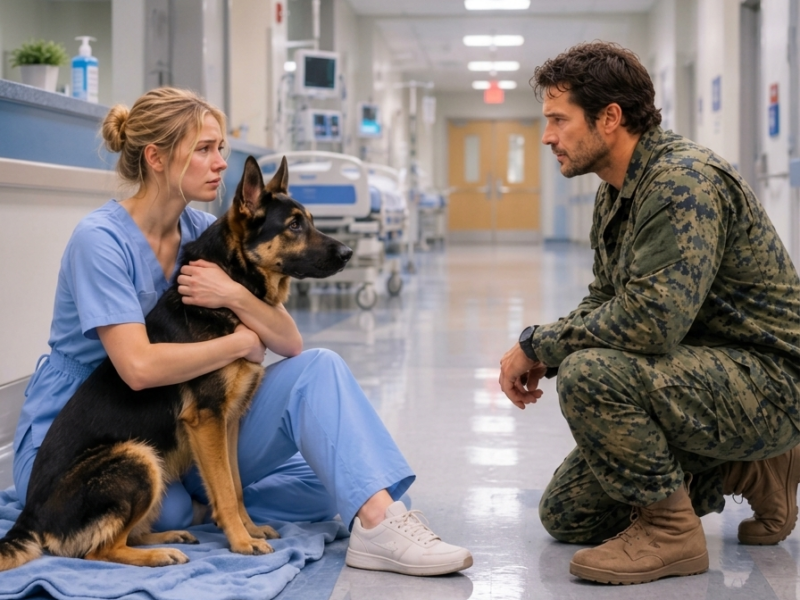
“The ten-dollar dog is useless,” the shelter manager laughed as everyone watched me struggle to carry the trembling animal outside, but when I whispered one forgotten military command
The fluorescent lights inside the Hanover County Animal Shelter flickered with an uneven, dying buzz that set my teeth on edge. The smell was the same as every underfunded municipal facility in central Virginia: wet concrete, cheap pine disinfectant, and the sharp, coppery tang of animal fear. Outside, a bleak November drizzle coated the asphalt, blurring the distant treeline into a smudge of gray.
“I wouldn’t waste your time, sweetheart,” Roy Finch said, leaning his heavy forearms against the laminate counter and wiping tobacco spit from his lower lip with the back of a calloused hand. He shook his ring of heavy brass keys, pointing toward the damp concrete corridor behind him. “If you’re looking for a companion to keep you company out on that old river road, go down to pen seven. Got a golden retriever mix. Two years old, housebroken, tail wags if you so much as sneeze near him. That thing in pen four? He’s garbage. Pure and simple.”
“I asked about pen four, Mr. Finch,” I said evenly. My voice had that flat, controlled cadence I had spent three years perfecting at St. Jude’s Memorial Hospital. When you work forty-eight hours a week on the graveyard shift in trauma triage, you learn how to speak without inflection. You learn how to sound like a machine so people don’t ask you what you did before you put on scrubs.
Finch snorted, shoving open the rusted swinging gate. “Suit yourself. Ten bucks takes him off county inventory today, or the state contractor puts him down on Thursday morning. The paperwork from animal control says he was found wandering near the rail depot off Route 1. Malnourished, infected ears, bad temperament. The boys couldn’t even get a canvas slip-lead over his ears without him bearing his fangs. You can’t train an animal that’s already cracked in the head.”
He led the way down the slick corridor, his rubber boots squeaking against the wet drain grates. In the neighboring chain-link runs, hounds barked and leaped, clawing at the galvanized wire, begging for sunlight or bread.
Pen four was silent.
The dog lay pressed against the back corner of the concrete slab, tucked tightly into the angle where the damp cinderblock met the floor. At first glance, he looked like a bundle of wet burlap. He was an aging Belgian Malinois, his coat a patchwork of dull charcoal and faded fawn, stripped of the sleek luster the breed was known for. His ribs showed through his skin like the slats of a broken fruit crate. A thick, white line of scar tissue cut horizontally across the bridge of his snout, terminating in a notched tear on his left ear. His left eye was clouded with an milky corneal haze, but the right eye—dark, amber, and unblinking—was fixed steadily on the puddle of water near the drain.
He didn’t growl. He didn’t rise. He simply stared, his breathing so shallow that his flanks barely moved.
Above the kennel hung a yellow index card clipped to the wire with a rusty binder clip. In smeared red grease pencil, someone had scrawled a single word: Untrainable.
“See?” Finch said, tapping the wire with his boot toe. “Dog’s checked out. Nerve dead. Probably took a header off a freight car or got kicked by a mule. Ten bucks gets you the rabies certificate and a cardboard carrier you’ll break trying to shove him into.”
I didn’t answer him. I stepped closer to the wire, lowering myself into a squat until my knees popped in the damp air.
Most people look at a stray dog and look for affection—a cock of the head, a tentative wag of the tail, an appeal for rescue. But I had spent four years in the Arghandab corridor and the rocky draws of eastern Paktika watching working animals move through dust and fire. I didn’t see an apathetic stray. I saw an animal holding a perimeter in his own mind. His weight was distributed evenly over his back haunches, even while lying down; his claws were dug into the concrete seam, ready to push off in a fraction of a second. His cloudy eye was turned toward the wall, but his good ear was canted at a forty-five-degree angle, tracking the footfalls of the kennel attendant three corridors away.
“Open the gate, please,” I said.
Finch frowned, his hand hesitating on the latch. “I’m not liable if he takes a chunk out of your forearm, nurse. You sign the waiver at the desk.”
“Open it.”
The latch lifted with a harsh metallic screech. Finch stepped back, keeping the galvanized door between his legs and the dog. I reached into my coat pocket, pulled out a ten-dollar bill, and laid it flat on the concrete curb by Finch’s boot. Then I stepped inside and pulled the gate closed behind me.
The dog did not flinch. He didn’t bare his teeth. But the muscles along his spine locked into stone.
I didn’t reach for him. In the mountains, if you reached for a working dog before he cleared your scent profile, you lost the meat of your palm. Instead, I sat cross-legged on the cold concrete floor, four feet away, resting my hands palm-up on my knees. I looked past him, staring at the green moss growing in the mortar joints behind his head.
“You’re tired,” I whispered, keeping my tone below the baseline of the ventilator hums I listened to every night. “I know how the cold gets into the bones when the rain starts.”
He didn’t move. But his black nostrils widened by a millimeter. He caught the scent of my skin: chlorhexidine scrub, surgical tape adhesive, stale hospital tea, and the faint, indelible trace of gun-cleaning solvent that never completely leaves the pores of someone who spent their youth cleaning an M4 in the dark.
Ten minutes passed in absolute silence. Finch grew bored and shuffled back toward the office, muttering about bleeding hearts and lost causes.
When Finch’s heavy footsteps faded into the front office, I shifted my weight forward. The dog’s dark amber eye tracked my movement with surgical precision.
“On your feet, soldier,” I said quietly in English.
Nothing. Not a tremor.
I took a slow breath, felt the familiar ache in my left collarbone where a piece of mortar casing had severed my trapezius six years ago, and switched to the dialect of low-country German commands used by the specialized tactical canine units attached to Joint Special Operations Command.
“Aufstellen,” I whispered. Rise.
The Malinois’s entire body shuddered. The change was so instantaneous it looked like an electric charge had run through the concrete floor. His front legs straightened, locking his chest off the ground. The cloudy eye widened. His ears snapped straight up into razor-sharp triangular points, pinning forward with an intensity that pulled the skin tight across his scarred skull.
He didn’t look like a dying stray anymore. He looked like an iron blade sliding out of a greasecloth.
He rose to all four paws, his hindquarters trembling from muscle atrophy, but his posture held the unmistakable, rigid dignity of a full-service tactical animal. He took three deliberate, silent steps forward until his black, leathered nose was resting against the collar of my flannel shirt. He inhaled once—deep, shuddering, and deliberate—pulling the history of my skin into his memory.
I lifted my hand slowly, showing him my open palm, and touched the thick scar across his muzzle.
“Let’s go home,” I said.
We walked out through the lobby without a leash. Finch sat behind his desk with his boots propped up on a metal trash can, holding a carbon receipt book. When the Malinois walked past his counter—stepping perfectly in time with my left knee, his head level with my hip, his eyes fixed dead ahead—Finch let his cigarette burn down to the filter without taking a drag.
“What did you do to him?” Finch breathed, his face slack.
“I gave you ten dollars,” I said, pushing the receipt into my pocket and pushing the glass door open into the rain.
My truck was a beat-up 2004 Ford Ranger with a rusted tailgate and two bald tires on the rear axle. I opened the passenger door, expecting to have to lift him over the rusted sill, but the moment the latch released, the dog gathered his withered hind legs beneath him and cleared the floorboard in a single, fluid bound. He settled himself into the torn passenger seat, staring straight through the windshield wiper sweep into the dark Virginia woods.
I climbed behind the wheel, turned the key until the starter groaned to life, and dropped the transmission into gear.
For five miles, neither of us moved. The rhythmic thump of the windshield wipers was the only sound against the drumming rain. We crossed the old Southern Railway tracks outside Ashland, where the overgrown industrial spurs turned toward the abandoned freight yards. A sudden crack of thunder rolled across the sky, shaking the truck cab and rattling the loose glass in the passenger window.
The dog didn’t flinch at the thunder. But when an oncoming commercial semi-truck blasted its air horn three hundred yards ahead, his front paws slipped on the vinyl seat, his claws scratching wildly for purchase as if bracing for incoming indirect fire.
I reached out with my right hand, catching him gently by the loose scruff of his neck, and spoke the second command of the old handler protocol.
“Bleib unten,” I whispered. Stay low.
The response was immediate and absolute. The dog dropped his belly flat against the bench seat, tucking his muzzle between his paws, his tail pressed against his flank, disappearing below the line of the dashboard so completely that an observer looking through the window would have sworn the cab was empty.
My hands tightened around the steering wheel until my knuckles turned white against the cracked vinyl.
That command hadn’t been taught at civilian obedience clubs. It wasn’t used by local police departments or security contractors. That specific syntax—the throat-click before the vowel, the low-frequency command to seek cover beneath ballistic vehicle armor—belonged to one unit. The 75th Ranger Regimental Reconnaissance Company’s Special Multi-Purpose Canine detachment.
A detachment that had ceased to exist seven years ago in the dry riverbeds outside Kandahar.
I pulled the truck onto the dirt driveway of my small rental cottage, tucked deep behind a screen of loblolly pines. The dog remained flat on the seat until I killed the ignition, pulled the handbrake, and spoke the release command: “Frei.”
He rose smoothly, hopped down to the gravel without a sound, and immediately swept the perimeter of the front porch, checking the treeline before looking back to ensure I had cleared the driver’s side.
Inside the cottage, he ignored the bowl of ground beef and rice I set near the hearth. He walked the circumference of the small living room, paused by the rear utility entrance, and finally sat on the bare pine floorboards by the front window, staring out into the pitch-black pines.
I sat on the edge of my bed, watching him in the dim light of the kitchen bulb.
“Who left you in that ditch?” I asked the room.
He didn’t turn his head. But three days later, at exactly 3:17 a.m., he rose from the floorboards, walked to the side of my mattress, and pressed his cold, scarred muzzle into my ear.
The clock on the bedside table read 3:17 a.m.
The Malinois stood rigid by the window, his head lowered, the hackles along his neck slightly lifted. He wasn’t growling. A dog trained for black operations never growls; noise gives away a hide site. Instead, his flank vibrated with that same silent, internal pressure I had seen in dogs working the perimeter wires at Forward Operating Base Chapman.
I sat up, sliding my feet onto the cold floor. “What do you hear, boy?”
Outside, the wind rustled through the wet pine needles, but beyond the wind, down at the end of the county access road half a mile away, the faint, low-frequency hum of an idling diesel engine thrummed through the damp earth. It sat there for two minutes, its exhaust vibrating against the silence, before turning around and grinding slowly back toward Route 1.
The dog did not relax until the engine noise was completely swallowed by the night.
“You don’t forget anything, do you?” I said, running my fingers through the coarse fur between his ears.
Underneath the thick ruff, my fingertips brushed against a small, hard nodule buried deep beneath the scar tissue at the base of his left ear. It wasn’t a tick or a cyst. It was the distinct, rectangular edge of a military subcutaneous microchip—an encrypted high-frequency RFID transponder used exclusively by the Department of Defense to track tactical assets worth more than an armored Humvee. Someone had tried to dig it out with a field scalpel, leaving a jagged trail of keloid scars, but they had missed the glass capsule by millimeters.
“I need to give you a name that doesn’t belong to a grave,” I murmured.
He leaned his heavy skull into my palm, his cloudy eye closing as if the weight of his own skull was too much to bear.
“Ranger,” I said.
His tail gave a single, solid thump against the floorboards.
By five in the morning, the rain had cleared into a cold, bone-aching Virginia ground fog. My shift at St. Jude’s Memorial began at six-thirty. The hospital sat on the northern fringe of Henrico County—a modern, four-story brick facility that served the surrounding rural counties and handled long-term rehabilitation contracts for the regional Veterans Affairs administration.
Because my cottage was isolated and I didn’t know what Ranger might do if left inside a strange house for twelve hours, I brought him with me, planning to leave him in the cab of the truck with the windows cracked in the shaded staff lot behind the boiler annex.
We arrived forty-five minutes early. The sky was still the color of wet slate, the sodium vapor lamps in the parking lot casting sickly orange pools across the damp pavement.
I parked in my usual spot near the cedar hedge bordering the delivery bay. When I shut off the engine, Ranger didn’t wait for my command to remain. His head whipped toward the hospital’s loading dock, seventy yards away. His nostrils flared, drawing in the humid morning air, his body locking into an aggressive point.
A low, pressurized whine slipped past his teeth.
“Ranger, heel,” I commanded, opening the driver’s door.
He obeyed, dropping to the gravel at my side, but his eyes never left the loading dock.
Parked against bay three was an unmarked white freightliner with tinted side windows and Virginia commercial plates. That bay was reserved for emergency medical supply drops—sterile surgical packs, blood products, and critical dialysis fluid delivered under tight county oversight. Normal logistics deliveries occurred at bay one between eight and ten in the morning. Deliveries at five-fifteen were unheard of.
Two men in dark gray canvas work coats were unloading pallets using a manual hydraulic jack. They weren’t using the motorized hospital lifts; they were moving with rapid, deliberate silence, stacking heavy wooden crates onto a flatbed hand-truck and wheeling them directly through the double rubber doors of the basement storage corridor.
Ranger took three steps forward, pulling the lead taut against my grip. He wasn’t acting like an aggressive dog; he was working an odor trail. He moved with his nose two inches off the wet asphalt, his movements rhythmic, methodical, and relentless.
“No, heel,” I hissed.
He ignored me—the first time he had broken a command since I brought him home from the shelter. He crossed the tarmac, moving in the shadow of the concrete retaining wall, and stopped behind the rear bumper of the white freightliner.
The back roll-up door of the truck was halfway open. Inside sat six wooden crates banded with heavy steel strapping. Stenciled across the rough pine faces in crisp military-grade black paint were federal procurement numbers: DOD-DLA-MED-2023-A774. Beneath that was the official insignia of the Department of Veterans Affairs: CRITICAL CARDIAC AND SURGICAL RESUSCITATION UNITS – FOR OFFICIAL USE ONLY.
Ranger placed both front paws on the steel bumper of the truck and pressed his nose against the seam of the nearest crate.
His lips pulled back. He didn’t bark. He emitted a sharp, vibrating hiss from the back of his throat, his ears flat against his skull, his tail rigid as an iron rod.
“Ranger, down!” I whispered, lunging forward to pull him away before the workers came back through the swinging doors.
As I grabbed his nylon harness, my eye caught the corner of the crate Ranger was pointing at. The heavy steel banding had already been clipped and re-fastened with thin silver wire. The green wax customs seal—the tamper-evident lock required on all federal medical shipments—had been sliced cleanly with a razor and resealed with clear industrial silicone.
I worked in trauma. I knew what those crates were supposed to contain. They were automated external defibrillators, portable mechanical ventilators, and advanced vascular tourniquet kits intended for the new spinal-cord injury wing the VA had funded on the hospital’s fourth floor.
I reached out and pulled back the loose pine lid of the top crate.
Inside, nestled in recycled gray packing foam, were cardboard boxes printed with cheap, offset lithography in broken English. I picked up one of the units. It was supposed to be a combat-grade intraosseous infusion drill—a life-saving device used to inject fluid directly into the bone marrow when a patient’s veins have collapsed from catastrophic blood loss.
The weight was entirely wrong. It was feather-light.
I popped the plastic casing with my thumb. The battery compartment was empty; the internal motor was a cheap, two-dollar electric toy actuator soldered to an ungrounded circuit board. The needle attachment was dull, stamped from brittle industrial aluminum that would splinter inside a human tibia.
It wasn’t medical equipment. It was salvage-grade scrap, manufactured in an unregulated overseas shop, dressed in forged packaging to look like nine-thousand-dollar tactical resuscitation hardware.
The entire crate was filled with them. Hundreds of them. Destined for the emergency wards of veterans who had given their limbs and lungs to this country.
“Find something interesting, Ross?”
The voice was cool, smooth, and dropped like ice water down my collar.
I slammed the wooden lid down and turned around, keeping my body between the open crate and the man standing six feet behind me.
Arthur Sterling stood on the wet concrete of the loading dock, wearing an immaculate charcoal cashmere overcoat over his tailored business suit. He was fifty-two years old, with silver hair cut close around his temples and the lean, athletic build of a man who spent his mornings on an elliptical before meeting with the regional healthcare board. As the chief administrative officer of St. Jude’s, Sterling was the man who had secured the multi-million-dollar federal renovation grant that had kept the rural hospital from going bankrupt two years ago.
He was holding a porcelain travel mug in his leather-gloved hand, his breath pluming white in the freezing morning air.
Beside me, Ranger didn’t move. Every muscle in the Malinois’s body went taut. He didn’t rise, but his amber eye locked onto Sterling’s face with a ferocious, unwavering hatred that made the fine hairs on my arms stand up.
“Mr. Sterling,” I said, keeping my hands steady against my scrub pants. “The delivery schedule seemed unusual. The seal on this federal crate was compromised. I was checking for damage.”
Sterling took a slow sip from his mug, his eyes drifting down from my face to the dog standing by my boots. He didn’t look at the crate. He didn’t look at the broken wax seal.
“Hospital logistics are managed by my procurement team, Nurse Ross,” Sterling said softly. His eyes narrowed slightly as he studied Ranger’s scarred muzzle and notched ear. “Clinical staff are expected to remain in clinical areas. That is hospital policy.”
“These devices are non-functional counterfeits, Mr. Sterling,” I said, my voice hardening. “If we deploy these in triage during an influx, patients will die.”
Sterling took one step down the concrete stairs, his expensive leather oxfords clicking against the damp riser.
“You’re a night nurse in a rural county, Ross,” he said, his voice dropping into a tone that was almost paternal in its quiet menace. “You have a clean employment file, you don’t talk to the day shift, and you don’t cause trouble. That’s why I hired you over three other candidates with actual local references. I value quiet people.”
He looked directly into my eyes, his face completely devoid of warmth.
“You didn’t see that crate. You didn’t inspect that shipment. You’re going to take your dog, walk through the south entrance, and report to the triage desk for shift handover. If you mention this to the county sheriff or the pharmacy inspector, your nursing license won’t just be suspended—it will cease to exist. Have I made myself sufficiently clear?”
I stared at him. “Who owns the shipment, Mr. Sterling?”
Sterling smiled—a thin, bloodless curve of his lips. He didn’t answer. He turned his back on me and walked toward the administrative entrance, waving his hand dismissively toward the two men in canvas coats who had just reappeared at the edge of the corridor.
Beside me, Ranger let out a single, deep, chest-rattling click of his jaws.
He didn’t need to look at the manifest. He knew who the shipment belonged to. And as I led the dog back to the truck with my heart hammering against my ribs, I knew with absolute, terrifying certainty that Arthur Sterling had not recognized the dog from a shelter ad.
He had recognized him from somewhere far worse.
The remainder of that twelve-hour shift was an exercise in walking through a minefield blindfolded. Every time the heavy double doors of the emergency bay swung open, my hand instinctively drifted toward the utility scissors in my pocket. I watched the security monitors above the triage desk; twice during the afternoon, I saw Arthur Sterling standing by the administrative glass partition on the second floor, looking down into the lobby with a cell phone pressed to his ear, his eyes fixed on my station.
When my replacement clocked in at seven that evening, she commented on how pale I looked.
“Flu bug going around, Elena,” she said, pulling on her latex gloves. “Go home. Get some sleep before the frost sets in.”
I didn’t answer. I clocked out, walked through the staff exit, and hurried toward the dark gravel lot.
The fog had rolled back in from the James River, thick as wet sheep’s wool, swallowing the tree line in front of the hospital. Ranger was waiting in the cab of the truck, his nose pressed against the glass. The moment I turned the key in the door, he tumbled into the footwell, pressing his head hard against my knee, trembling not from the cold, but from hours of pent-up tactical tension.
“We’re leaving,” I said, locking the doors and cranking the engine.
As I pulled out of the hospital gates onto State Route 156, a set of round halogen headlights flicked on fifty yards behind me. A dark, late-model Chevrolet Tahoe—heavy, window tints black as ink, no front license plate—pulled out from the shoulder and fell into position three car lengths back.
I didn’t panic. Panic gets you killed in the first sixty seconds of an ambush.
Instead, I watched the rearview mirror, tracking their distance. I didn’t take the highway; I took the back county cutoffs, turning through the narrow, unlit roads that wound through the abandoned dairy farms and loblolly timber tracks. The Tahoe matched every turn, maintaining the exact same sixty-yard gap, not rushing to overtake, simply tracking like a wolf running a wounded deer down a logging lane.
“They’re not trying to pass us, Ranger,” I murmured, my left hand resting on the dog’s scarred neck.
He was already down. The moment the high beams had hit the back glass of the cab, Ranger had dropped his chest flat against the passenger seat, his eyes fixed on the rear window, his ears rotating like directional radar antennae.
I pulled into my gravel driveway at twenty miles an hour, killed the headlights fifty feet before the porch, and let the truck coast to a stop behind the tangled screen of overgrown blackberry briars beside my woodpile.
The house was dark. The nearest neighbor was two miles down the ridge.
The Tahoe did not pull into the driveway. It stopped on the county road, its engine rumbling like a low drum, its headlights sweeping across the tops of the pine trees before cutting to parking lights.
Two car doors clicked open into the wet night air.
“Out,” I whispered in German. “Leise.” Silent.
Ranger slid out of the passenger side without his claws touching the metal sill. I slipped a heavy steel tire iron from behind the bench seat into my right hand, tucking it under the sleeve of my canvas jacket, and moved toward the cover of the porch steps.
The fog muffled their footsteps, but it couldn’t hide the heavy, rhythmic crunch of tactical boots on wet gravel.
Two men rounded the corner of the woodpile. They wore dark nylon windbreakers, tactical cargo pants, and baseball caps pulled low over their brows. They weren’t street criminals; their elbows were tucked tight to their ribs, their hands held at chest level, their eyes sweeping the darkness in forty-five-degree overlapping sectors. One of them carried a heavy, black canvas flex-cuff bundle in his left hand and a suppressed semi-automatic pistol held close to his hip.
“Vehicle’s still warm,” the first one said, his voice flat, professional, and chillingly devoid of emotion. “She didn’t run into the trees. She’s on the porch.”
The second man—taller, with a thick neck and a radio wire looped behind his ear—stepped forward. “Take the nurse clean. Sterling wants her phone and her computer before we stage the overdose. Make it look like clinical fentanyl theft. Quick and neat.”
He took two strides toward the porch steps.
From the black shadow beneath the crawlspace of the porch, eighty-five pounds of trained military muscle erupted like a mortar shell.
Ranger didn’t growl. He didn’t waste oxygen on a threat display. He hit the tall man at hip height, driving his entire mass into the man’s pelvis, slamming him violently onto his back in the gravel. Before the operative could draw breath to scream, Ranger’s jaws clamped down on the man’s right forearm, crushing through the nylon sleeve, bone snapping with the distinct, wet crack of dry kindling.
The man shrieked, a high, ragged sound that was instantly cut off as Ranger whipped his heavy skull sideways, violently slamming the operative’s head into the edge of a concrete landscaping timber. The man went limp, his pistol flying out of his hand and skittering across the wet stones.
“What the hell!” the second man yelled, pivoting his weapon toward the thrashing shadow in the gravel. “Drop the—”
I didn’t think. Three years of civilian nursing vanished in a heartbeat, replaced by the muscle memory forged in the dusty blood-gutters of southern Afghanistan.
I stepped out from behind the porch pillar, swung the steel tire iron with both hands, and caught the second operative flush across the side of his knee. The joint inverted with a sickening pop. He collapsed with a choked roar, dropping his weapon as he grabbed his shattered leg.
Before he could reach for his backup holster, Ranger was on his chest.
The Malinois planted both forepaws on the man’s sternum, his front teeth inches from the man’s jugular. A thin, viscous string of saliva dripped from Ranger’s scarred lips onto the operative’s cheek. The dog’s amber eye burned with an ancient, terrifying focus. He was not an out-of-control animal; he was an executioner waiting for the firing pin to drop.
“Call him off!” the man screamed, his fingers clawing at the gravel, terrified to move his throat by a millimeter. “Call him off! Jesus Christ, call him off!”
I picked up the suppressed pistol from the wet stones, cleared the chamber, checked the magazine, and leveled it at the man’s forehead.
“Who sent you?” I asked.
The man stared past the barrel of the gun, his eyes wide with absolute horror as he looked at the dog pinning him to the earth.
“That’s… that’s not a shelter animal,” the operative wheezed, his breath coming in shallow, terrified gasps. “That’s… that’s the dog from the valley. That’s K9-04. They said he was dead. They said the contractor killed him in the ditch.”
“Who owns the shipment at the hospital?” I pressed the cold barrel against the bridge of his nose.
“Sterling!” he choked out. “Sterling and the guys from the logistics group! They’ve been moving the grey-market salvage through the VA supply lines for five years! Millions… tens of millions! She wasn’t supposed to look in the boxes!”
Ranger shifted his weight, pressing his paws harder into the man’s ribs. A low, subterranean vibration started in the dog’s chest—a sound that vibrated through the operative’s breastbone.
“Ranger, Halt,” I commanded softly.
The dog froze, his teeth remaining bare, but his jaw pressure did not increase.
Before I could ask the next question, the glare of four sets of high beams swept across the clearing from the county road. Sirens didn’t wail, but the low, blue-and-red pulse of low-profile emergency strobe lights painted the fog-drenched pines in rapid flashes of cobalt and crimson.
Three black Suburbans and a marked state police cruiser tore down the gravel drive, their tires throwing stones as they formed a semi-circle around my front porch.
Doors flew open. Men in olive-drab tactical armor with large gold lettering across their backs took up positions behind the engine blocks, their rifles trained on the clearing.
The lettering didn’t say Sheriff.
It said: FEDERAL BUREAU OF INVESTIGATION – OIG JOINT TASK FORCE.
“Drop the weapon! Drop the weapon and step away from the suspects!” a voice boomed through an electronic megaphone.
I didn’t raise my hands. I placed the pistol on the porch railing, stepped back two paces, and placed my hand on Ranger’s head.
“Hier,” I commanded.
Ranger stepped off the paralyzed operative’s chest, turned with mechanical precision, and sat down at my left side, his shoulder pressed firmly against my thigh.
A tall, broad-shouldered man in a dark trench coat stepped past the front bumper of the lead Suburban. He didn’t have his rifle drawn. He held a leather badge case open in his left hand and a thick manila dossier in his right. He looked at the two operatives groaning in the gravel, looked at the tire iron at my feet, and finally locked his eyes onto the scarred face of the dog sitting beside me.
“Nurse Elena Ross?” the man asked. His voice was gravelly, carrying the distinct cadence of an investigator who hadn’t slept in seventy-two hours.
“Yes,” I said.
The man closed his badge case. “I’m Special Agent Marcus Burke, Department of Veterans Affairs Office of Inspector General. We’ve been tracking this supply ring from Fort Bragg to Henrico County for eighteen months.”
He stepped up the porch stairs, stopping four feet away. He didn’t look at my nurse’s ID badge pinned to my jacket.
“Ma’am,” Agent Burke said quietly, his voice dropping so the tactical team behind him couldn’t hear. “We need to talk about your military service. And we need to talk about the dog you reported killed in action seven years ago.”
The rain had begun to fall again, drumming a hollow, steady beat against the tin roof of the porch. Two tactical medics from the federal team were already zip-tying the two operatives in the gravel, hauling them toward the back of the unmarked Suburbans with professional, rough efficiency. Neither operative looked back at the dog; they kept their heads down, shivering in the damp cold.
Special Agent Burke didn’t ask me to sit. He leaned against the porch rail, unzipped his leather folder, and pulled out an eight-by-ten glossy photograph, protected by a clear plastic evidence sleeve.
He held it out under the dim yellow porch light.
“You’ve done an impressive job burying yourself, Sergeant Vance,” Burke said.
My breath hitched in my chest. Hearing my real surname spoken out loud after three years of silence felt like a physical blow to the sternum.
I looked down at the photograph. The glossy paper was dated July 14, 2018. It showed a younger, sun-browned version of me, wearing dust-stained multicam fatigues, combat shears tucked into the MOLLE webbing of my tactical vest, sitting on the lowering ramp of a CH-47 Chinook helicopter on a dirt airstrip in Paktika province. Resting across my lap was a younger, sleek, muscular Belgian Malinois with a full set of unscarred ears and bright, ferocious amber eyes.
Behind us, standing near the cargo bay door with a logistics clipboard tucked under his arm, was Arthur Sterling.
Only he wasn’t wearing a charcoal cashmere coat. He was wearing the khaki field uniform of a senior civilian procurement officer for Global Defense Solutions—the multi-billion-dollar private logistics firm that held the primary supply contracts for the regional forward operating bases.
“His name was never Arthur Sterling,” Burke said, his voice flat as iron. “His name is Arthur Vance-Sterling. No relation to you, of course, but he used your unit’s administrative paperwork to cover his tracks when the investigation started. He was the theater director of medical logistics for Regional Command East.”
“Ranger,” I whispered, my hand tightening on the fur of the dog’s neck.
“MPC Ranger,” Burke corrected gently. “Multi-Purpose Canine, Serial Number 04-Alpha. In June of 2018, your reconnaissance patrol hit an improvised explosive device in the Shigal Valley. You had eleven casualties pinned down under small-arms fire from the ridge. The MEDEVAC couldn’t land because the landing zone was hot.”
Burke pointed at the dog sitting quietly at my knee.
“Ranger ran four separate resupply runs through eighty yards of open machine-gun crossfire, carrying fresh blood expanders, arterial clamps, and pressure dressings from the secondary cache back to your casualty collection point. He took two rounds of shrapnel to the face on the third run. He didn’t stop until every wounded man was on the birds.”
“And then the mortar hit the fuel bladder,” I said, my voice barely audible over the rain. The memory surged back with terrifying clarity: the blinding red flash, the smell of vaporized aviation fuel, the screams of the flight crew, and the chaotic scramble as the last helicopter lifted through the smoke. “They told me he was incinerated. They told me they found his tracking collar in the ash.”
“Sterling found him,” Burke said. “Sterling wasn’t interested in saving a war dog’s life out of sentimentality, Sergeant. When the base was evacuated, Sterling had thirty million dollars in unregistered surgical hardware and advanced micro-resuscitation tech packed into shipping containers. He used the chaos of the withdrawal to declare those containers destroyed by enemy fire. But to move them back stateside through civilian freight without customs scanning, he needed the biometric clearance tags of an active military working dog team.”
Burke tapped the plastic sleeve.
“He stole Ranger’s medical transport kennel, forged the emergency transfer papers under your forged signature, and shipped forty crates of stolen surgical grade hardware directly to an offshore holding company in the Bahamas. Then he dumped the dog in an abandoned supply depot outside Richmond when the microchip started throwing diagnostic errors.”
I looked down at Ranger. The cloudiness in his left eye wasn’t an infection from a ditch. It was the residual flash-blindness from the aviation fuel explosion at FOB Chapman. The scar across his snout was the mark of the mortar fragment he had taken while carrying the bandages that had kept my wounded squadmates alive.
“He didn’t wander to that shelter by accident,” I said, realization washing over me like a wave of ice water.
“No,” Burke agreed, his jaw tightening. “Sterling brought him to his rural property outside Ashland two weeks ago to destroy the evidence before our audit landed. But Ranger broke through the chain link. He was tracking you, Vance. A working dog’s olfactory memory doesn’t degrade. He knew the general radius of your discharge address. He spent six days running along the rail spurs until the county animal control picked him up three miles from your hospital.”
Ranger suddenly stood up.
His ears didn’t point toward the woods this time. He turned his face toward the southern sky, toward the direction of Henrico County, toward the hospital where four hundred vulnerable veterans slept in the long-term wards.
His good ear twitched. A sharp, urgent bark broke from his throat—a single, commanding percussion that echoed through the wet trees.
“What is it, boy?” Burke asked, his hand dropping to the holster at his hip.
“Sterling isn’t waiting for his operatives to check in,” I said, cold dread pooling in my stomach. “The two men in the yard were his cleanup crew. If they failed to report within thirty minutes, he knows the perimeter is blown. He’s at the hospital right now.”
Burke grabbed his radio handset from his chest rig. “All units, this is Burke. Code Red at St. Jude’s Memorial. Target is likely initiating primary data destruction and warehouse liquidation. Seal all exits, authorize lethal force on any fleeing logistics transports. Move, move, move!”
Burke turned back to me, his keys jingling in his hand. “Sergeant Vance, you stay here. You’re a key witness. The tactical team will handle—”
“With all due respect, Agent Burke,” I said, stepping past him down the porch stairs, “Ranger knows the layout of that basement better than your entire SWAT team. And I have four patients on the fourth floor who are scheduled to be hooked up to those counterfeit ventilators at seven tomorrow morning.”
Burke looked at me for three seconds. He looked at the determination in my eyes, looked at the Malinois standing locked at my hip, and then shoved the passenger door of the lead Suburban wide open.
“Get in,” Burke said. “Bring the dog.”
The black Suburban tore through the dark Virginia roads at ninety miles an hour, its heavy tires throwing rooster tails of spray into the gray morning fog. Behind us, two more tactical vehicles followed in tight formation, their blue grill-strobes flashing silently against the wet trunks of the pine trees.
Inside the cabin, Ranger sat between my knees, his chin resting against my forearm, his body absorbing the violent sway of the vehicle with seasoned, effortless balance. Every few miles, his dark amber eye would glance up at my face, checking my baseline, grounding me in the reality of the mission.
We weren’t a broken nurse and an untrainable stray anymore. We were a handler and her dog.
We hit the hospital perimeter at four-fifteen in the morning.
The facility looked peaceful from the highway, its red brick façade illuminated by soft landscape uplighting. But around the back, near the loading docks, the scene was entirely different.
The massive steel overhead door of bay three was wide open. An industrial flatbed stake-truck was idling near the dumpsters, its bed loaded with high-capacity shredding equipment and heavy blue chemical drums. Two men in unmarked gray uniforms were frantically wheeling filing cabinets and hard-drive storage arrays from the logistics basement down the concrete ramp.
“Move in! Block the bay!” Burke yelled into his radio.
The Suburban vaulted over the concrete curb, sliding sideways across the wet asphalt of the loading dock, cutting off the flatbed truck’s escape route with a screech of locked brakes.
“Federal agents! On the ground! Drop the gear!” Burke’s team exploded from the vehicles, rifles raised, tactical lights cutting through the exhaust smoke in blinding white pillars.
The two logistics workers immediately threw their hands in the air, dropping to their knees in the oily puddle beneath the truck bed.
“Where is Sterling?” Burke barked, kicking a hard-drive tower out of reach.
“Upstairs!” one of the workers sobbed, his teeth chattering with terror. “In the executive administrative suite! He’s running the wipe-program on the regional network! He said if we didn’t have the paper files burned by four-thirty, he’d leave us behind!”
“Vance, with me,” Burke commanded, gesturing toward the staff stairwell.
We didn’t take the elevator. We moved up the concrete stairs four steps at a time, Ranger leading the stack, his claws clicking like quiet typewriter keys against the raw concrete. When we reached the third-floor administrative landing, the air was thick with the acrid, metallic smell of burning circuit boards—someone was using a thermite destruction canister inside the server closet down the hall.
Ranger stopped outside the frosted glass door of the Chief Administrative Officer’s suite.
He didn’t touch the glass. He dropped into a deep crouch, his nose pressed against the threshold, his ears pinned back. He looked back at me once, gave a single, silent nod of his head, and shifted his weight to his rear springs.
“Burke,” I whispered. “He’s behind the door. Right side.”
Burke nodded to his two tactical officers. One stepped forward with a heavy hydraulic ram; the other leveled his carbine at the door handle.
CRACK.
The heavy mahogany door shattered inward, splintering off its brass hinges.
“Federal agents! Don’t move!”
The office was in total disarray. Bookshelves had been tipped over, drawers dumped onto the deep Persian rug, and the heavy executive desk was covered in melted plastic casings. Thick gray smoke was billowing from a steel trash bin in the corner, where stacks of paper manifests were turning to black ash under a chemical flare.
Arthur Sterling stood behind his desk.
He had stripped off his cashmere coat; his white dress shirt was soaked with sweat, his tie pulled loose around his collar. In his right hand, he held a stainless-steel Walther PPK, pointed erratically toward the doorway. His silver hair was disheveled, his eyes wild with the manic desperation of a man whose ten-year empire was collapsing around his ears in the dark.
“Stay back, Marcus!” Sterling screamed, his voice cracking with hysteria. “Stay the hell back! You don’t have the ledger! The drives are cooked! You can’t prove a single delivery went to the gray market! You have nothing on me but procedural paperwork!”
“Put the gun down, Arthur,” Burke said, holding his weapon steady from behind the doorframe. “We have the warehouse in Ashland. We have your drivers. We have the counterfeit crates from bay three. It’s over.”
“It’s not over!” Sterling raged, his hand shaking violently. “Those veterans were going to die anyway! Half of them are vegetables on breathing tubes! What difference does it make if the valves are military surplus or third-party reproductions? I saved this hospital! I brought forty million dollars into this county!”
He swung the barrel of the gun toward Burke.
He never finished the movement.
“Fass!” I commanded.
Ranger didn’t run around the desk. He cleared the five-foot mahogany executive barrier in a single, magnificent leap, his body silhouetted against the gray morning light filtering through the plate-glass window.
He hit Sterling squarely in the chest, the impact driving the silver-haired administrator backward into the glass with a terrifying crack. The Walther flew from Sterling’s hand, clattering harmlessly against the baseboard.
Ranger didn’t tear into his throat. He pinned Sterling’s shoulders against the carpet, his front paws planted on the man’s clavicles, his jaws clamped around the thick sleeve of Sterling’s shirt, an inch from the skin, holding him with absolute, immovable dominion.
“Get him off me!” Sterling wailed, his aristocratic composure completely shattered into pathetic, sobbing terror. “Get it away from me! It’s a monster! It’s a diseased animal!”
“That animal saved eleven men while you were stealing their bandages, Arthur,” I said, walking slowly around the desk.
Burke stepped forward, snapped heavy steel handcuffs around Sterling’s wrists, and hauled the trembling man to his feet.
Ranger stepped back smoothly, returning to my side, his flank pressed against my scrubs. He looked up at Sterling with his clear amber eye, completely calm, completely vindicated.
“Search the wall behind the credenza,” Burke ordered two of his agents. “The dog was alerting on the wood paneling.”
One of the agents used a pry-bar on the false oak baseboard behind the bookshelf. With a dry pop, a hidden fire-safe popped open from the drywall cavity. Inside lay three encrypted military-grade hard drives, two passports under foreign names, and four thick leather binders containing handwritten logistics manifests from 2018 to the present day—the complete, unburned master ledger of the fraudulent supply ring.
“We’ve got it all, Marcus,” the agent said, holding up the drives. “Every offshore account. Every fake supplier. Every hospital administrator on the payroll.”
Two county deputies arrived at the landing, their faces pale as they took custody of Sterling and marched him down the long corridor toward the holding cells. The hospital staff who were arriving for the six-o’clock shift lined the walls, staring in stunned silence as their untouchable chief administrator was led away in chains, his head hanging low over his blood-spattered shirt.
I walked over to the shattered window, looking out over the front lawn of the hospital.
The rain had finally stopped. The first pale, gold light of the morning sun was breaking through the mist, illuminating the Blue Ridge foothills in shades of amber and bronze.
Ranger rested his heavy, scarred chin on the window sill beside my hand.
“You did it, boy,” I whispered, burying my fingers in the thick fur behind his ears. “You brought them home.”
He closed his cloudy eye, letting out a long, shuddering sigh of profound, unburdened relief—the first time I had seen him truly rest since the day I pulled him from the damp floor of kennel four.
“Sergeant Vance,” Burke’s voice spoke from behind me.
I turned around. Burke was standing by the door, his tactical gear removed, holding a single, unsealed manila envelope in his hand. His expression wasn’t triumphant; it was somber, heavy with a strange, dark hesitation.
“You did good work today,” Burke said quietly. “The VA is already re-routing two convoys of certified military-spec equipment from the Richmond logistics depot. Those veterans on the fourth floor will have their real ventilators by noon.”
“Thank you, Agent Burke,” I said.
He didn’t hand me a commendation. He held the envelope out toward me, his thumb resting over the red wax security seal.
“When we raided Sterling’s private safe house in Ashland last night,” Burke said, his voice dropping so low the agents in the hallway couldn’t hear, “we found something else. Something that didn’t belong to the medical fraud case.”
I took the envelope. The paper was heavy, cold from the morning air.
I pulled out the single document inside.
It was an unredacted tactical personnel roster from the 75th Ranger Regimental Reconnaissance Company, dated August 2018—one month after the explosion at FOB Chapman.
Across the page, twenty-four names were listed in alphabetical order.
Twenty-three of those names had been crossed out with heavy black marker, each with a small red stamp beside the casualty date: DECEASED. NON-RECOVERABLE. KIA.
My name was the twenty-fourth on the list.
Elena Vance.
My name had not been stamped deceased. It had been circled three times in violent, dark red ink.
And beneath my name, written in a cramped, precise handwriting that did not belong to Arthur Sterling, were three words that made the blood freeze in my veins:
Still being watched.
I looked up at Burke, my breath caught in my throat.
“Sterling wasn’t running this network, Elena,” Burke said softly, his eyes reflecting the cold morning sky. “He was just the local distributor. The men who funded this operation… the men who wanted that medical shipment buried… they aren’t contractors in Virginia. They’re still sitting on the Joint Chiefs’ logistics committee in the Pentagon.”
Burke reached out and gently closed the folder in my hands.
“I can give you a safe house in West Virginia,” Burke whispered. “New papers. New identity. You can disappear before the federal indictment goes public on Monday morning.”
I looked down at the paper. Then I looked down at Ranger.
The old Malinois stood beside me, his scarred chest broad and proud in the morning light, his ears pinned forward, his dark amber eye clear and fearless as he watched the highway winding through the distant mountains.
He had spent seven years in the dark, waiting for a handler who would remember his name. He hadn’t run then. And I was done running now.
“No, Agent Burke,” I said, folding the document and sliding it into the pocket of my scrub jacket. “Tell them to keep watching.”
I turned my back on the executive office, walked past the yellow crime scene tape, and pushed through the double doors into the morning sunlight.
Beside me, Ranger matched my stride, step for step, his head held high, ready for whatever was coming down the road.
The end









