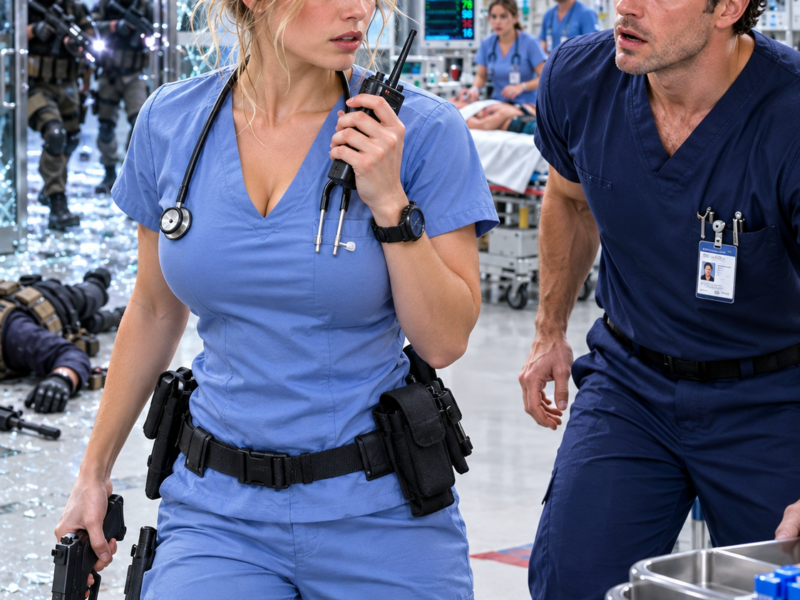
The surgeon who had spent months treating Emily Jenkins like an incompetent beginner was hiding under an operating table
The first thing Emily Jenkins noticed after the gunfire stopped was the coffee.
It was still sitting on the counter behind the nurses’ station, untouched, its paper cup slowly losing heat beneath the fluorescent lights.
A few minutes earlier, the hospital had been a battlefield.
Now there was only the distant wail of sirens, the hurried footsteps of police officers, and the shaky breathing of people who were beginning to understand that they had survived something they might never fully forget.
Emily stood beside the treatment-room doorway, one hand resting against the wall.
Her blue scrubs were stained. A small cut marked her cheek. Her shoulder ached from the force of the struggle, and her hands were beginning to tremble now that there was nothing left to fight.
She looked down at them.
They were the same hands that had held pressure on a bleeding patient, stabilized an injured colleague, and disarmed a man who had entered the hospital believing no one would dare stand against him.
They were also the hands that had once worked beneath the rotors of military helicopters, treating wounded soldiers in places most people would never see.
Emily flexed her fingers.
Then she heard someone call her name.
“Emily?”
She turned.
Dr. Hayes stood at the end of the corridor, his white coat rumpled and his expression still pale. He had been helping the surgical team stabilize the wounded patient while Emily kept the armed men away from the treatment area.
For a moment, neither of them spoke.
Then Hayes walked toward her.
“Are you hurt?”
“Nothing serious.”
“That’s not what I asked.”
Emily glanced at her shoulder.
“It’ll be fine.”
Hayes shook his head. “You always say that.”
She almost smiled.
It was an ordinary exchange. The kind of conversation they might have had after a difficult shift, when someone had lifted a patient incorrectly or stayed too long in an uncomfortable position.
But nothing about the day was ordinary anymore.
Hayes looked toward the waiting area, where several officers were speaking with hospital staff.
“Emily, the police want to talk to you.”
“I know.”
“They also want to know how you did what you did.”
Emily lowered her eyes.
“I did what was necessary.”
“That’s not going to satisfy them.”
“It doesn’t have to.”
Hayes studied her face.
He had worked with Emily for nearly two years. He knew she was dependable, calm under pressure, and unusually good at recognizing danger before anyone else noticed it.
He had always assumed those qualities came from experience.
He had never imagined the experience was anything like this.
“Who were you before you came here?” he asked quietly.
Emily looked at him.
“I was a medic.”
“That’s not all.”
“No,” she said. “It isn’t.”
Before Hayes could ask another question, a police officer approached.
“Ms. Jenkins?”
Emily turned.
“I’m Detective Harris. We spoke briefly earlier. I’d like to ask you a few questions about what happened.”
“Of course.”
“Somewhere private, if possible.”
Emily nodded.
As she followed him down the corridor, she passed the nurses’ station. One of the younger nurses, Megan, was sitting in a chair with a blanket around her shoulders.
Megan had been working in the emergency department for only six months. She had been terrified when the armed men entered the hospital.
Now she looked at Emily as though she were seeing her for the first time.
“Emily?”
Emily stopped.
“Yeah?”
Megan swallowed.
“Thank you.”
Emily’s expression softened.
“You did exactly what you were supposed to do. You got people out of danger and followed instructions. Don’t second-guess yourself.”
“But you—”
“You’re here. That’s what matters.”
Megan nodded, her eyes filling.
Emily gave her shoulder a gentle squeeze and continued down the hall.
She didn’t want to be anyone’s hero.
She just wanted everyone to go home.
The police interview lasted nearly two hours.
Emily answered questions about the attackers, the patient they had been pursuing, the hospital layout, and the sequence of events.
She described what she had seen without embellishment.
She didn’t call herself brave. She didn’t describe the confrontation as a victory.
When the detectives asked how she had recognized the attackers’ movements and anticipated their actions, she gave them a simple answer.
“Training.”
“What kind of training?”
“Military medical and operational training.”
Harris glanced at the paperwork in front of him.
“Your employment record lists you as a registered nurse with emergency and trauma experience.”
“That’s correct.”
“It doesn’t mention military service.”
“No.”
“Why not?”
Emily took a breath.
“Because I applied for a nursing job. They asked about my medical qualifications, and I gave them the information relevant to the position.”
“Your military background wasn’t relevant?”
“Not to the work I was hired to do.”
Harris leaned back.
“Ms. Jenkins, you understand that most people don’t walk into a room full of armed men and respond the way you did.”
“I wasn’t thinking about how most people would respond.”
“What were you thinking about?”
Emily’s answer came immediately.
“The patient. The staff. The exits.”
Harris looked at her for a long moment.
Then he closed his notebook.
“One more thing. The man you protected is expected to survive. His doctors say his condition is stable.”
Emily nodded.
“Good.”
“He may be able to provide information about the people who came after him.”
“That’s between him and the police.”
“Understood.”
Harris stood.
“Thank you for your cooperation.”
Emily rose as well.
“Can I go back to work?”
The detective looked surprised.
“You’re serious?”
“I have a shift.”
“Ms. Jenkins, the hospital just went through an armed assault.”
“And people are still in the hospital.”
For the first time, Harris smiled faintly.
“I suppose they are.”
By late afternoon, the hospital had begun to settle.
Police officers remained stationed near the emergency department. Security personnel checked entrances, and administrators arranged temporary support for employees who needed to go home.
The wounded patient had been transferred to intensive care after surgery.
His name was Marcus Reed.
Emily had heard it from the surgical team, although she had not asked for details. The police were still investigating why armed men had targeted him, and she understood that his situation was complicated.
But whatever he had done, whatever someone believed he knew, he had been a patient inside a hospital.
That was enough.
Emily returned to the emergency department.
Megan was still there, though she looked more composed now.
“You shouldn’t be working,” Megan said when she saw her.
“Neither should you.”
“I’ve been told to take the rest of the day off.”
“Then why are you still here?”
Megan looked down.
“I don’t know. I guess I didn’t want to leave.”
Emily understood.
After something frightening, leaving the place where it happened could feel almost as difficult as staying.
“Go home,” she said gently. “Get something to eat. Take a shower. Try to sleep.”
“What about you?”
“I’ll finish my shift.”
Megan shook her head.
“You’re impossible.”
“Occupational hazard.”
That earned a small laugh.
It was the first one Emily had heard since the incident.
She was glad.
At 6:40 p.m., Emily finally retrieved her coffee.
It was cold.
She stared at it for a moment, then poured it into the sink and made a fresh cup.
The ordinary routine felt strangely important.
A clean cup. Hot coffee. The familiar sound of the machine.
For a few minutes, she could almost pretend the day had been nothing more than a difficult emergency shift.
Then her phone vibrated.
A message from an unfamiliar number appeared.
This is Daniel Reed. I’m Marcus’s brother. I was told you helped save him. I don’t know how to thank you.
Emily read it twice.
She typed a response.
Your brother is stable. The surgical team did excellent work. Stay close to him if you can.
She paused, then added:
You’re welcome.
She put the phone away.
There were many things she could have said.
She could have told him that she had not been alone in that room. That other staff members had done their jobs under terrifying circumstances. That the surgeons and nurses who cared for Marcus after the confrontation deserved as much gratitude as anyone.
But she didn’t know Daniel.
And she didn’t want him to feel that he owed her something.
She took a sip of coffee.
This time, it was still hot.
The next morning, the hospital held a staff briefing.
The conference room was crowded. Nurses, physicians, technicians, administrators, and security personnel filled the chairs and stood along the walls.
The hospital director, Dr. Patricia Collins, stood near the front.
She looked exhausted.
“First, I want to thank every member of this team,” she began. “Yesterday was an extraordinary security emergency. Several of you were placed in situations no healthcare professional should ever have to face.”
She paused.
“We are reviewing the response, the security failures, and the steps we need to take to protect our patients and staff. But before we discuss procedures, I want to acknowledge what happened.”
Her gaze moved across the room.
“People were protected because employees acted with courage, discipline, and compassion.”
Emily sat near the back.
She preferred it there.
Dr. Collins continued.
“Some employees went far beyond what could reasonably be expected of them. One of those employees is Emily Jenkins.”
A few heads turned.
Emily felt her shoulders tighten.
Dr. Collins looked directly at her.
“Emily, would you stand for a moment?”
Emily considered pretending she hadn’t heard.
But everyone was already looking.
She stood.
The director continued.
“Your actions prevented further injuries and helped protect a patient who was under immediate threat. We are grateful.”
Several people began to applaud.
The sound grew until the entire room was clapping.
Emily stood still.
She didn’t know where to look.
When the applause finally faded, Dr. Collins said, “I also understand that your background includes military medical service. If you’re comfortable sharing more with us, we’d like to recognize that service as well.”
Emily took a breath.
“I appreciate that. But yesterday wasn’t about my background.”
She glanced around the room.
“It was about people doing their jobs. Megan helped move patients. The emergency team kept treating people. Security staff responded. The surgical team worked on Marcus. Everyone had a part in keeping people alive.”
She looked back at the director.
“That’s what I’d like people to remember.”
There was a brief silence.
Then Dr. Collins nodded.
“That’s fair.”
Emily sat down.
For the rest of the meeting, she listened to the hospital’s updated security procedures and the plan for employee counseling.
She wrote down the new emergency contact numbers.
She asked whether the emergency department would receive additional security personnel.
She wanted to know how staff should respond if a similar threat occurred in another part of the building.
She didn’t ask for a medal.
She didn’t ask for special treatment.
She asked questions that might help prevent another day like yesterday.
Three days later, Emily visited Marcus Reed in intensive care.
He was awake, though still weak.
A nurse was checking his monitors when Emily entered.
“You’re the nurse from the emergency department,” Marcus said.
Emily nodded.
“How are you feeling?”
“Like I got hit by a truck.”
“You were injured. That’s not surprising.”
He managed a small smile.
“I hear you kept those guys away from me.”
“I helped keep the room secure.”
“That’s a modest way to describe it.”
Emily checked the chart.
His vital signs were stable, and the surgical team was satisfied with his progress.
“You need to focus on recovering,” she said.
Marcus looked at her.
“Can I ask you something?”
“Sure.”
“Why did you help me?”
Emily looked up.
“Because you were a patient.”
“That’s it?”
“That’s enough.”
He was quiet for a moment.
Then he looked toward the window.
“I don’t know if I deserved it.”
Emily pulled the chair closer to the bed.
“Deserving medical care isn’t a question we ask when someone comes through the doors.”
Marcus looked back at her.
“Even if someone is dangerous?”
“Then we take appropriate precautions. But we don’t let fear decide who gets treated.”
He nodded slowly.
“Thank you.”
Emily stood.
“You’re welcome. Get some rest.”
As she reached the door, Marcus spoke again.
“Wait.”
She turned.
“Those men weren’t supposed to come after me here.”
Emily said nothing.
“I thought I was safe in a hospital.”
“You were supposed to be.”
“People put you in danger because of me.”
“People made choices that put everyone in danger,” Emily replied. “Those choices belong to them.”
Marcus looked down.
Emily understood that he was carrying more than physical pain.
But she wasn’t his investigator, and she wasn’t his judge.
She was a nurse.
“Your brother is coming later,” she said. “You should be awake for him.”
A faint smile appeared on his face.
“I’ll try.”
Emily left the room.
The following week, the hospital held a small recognition ceremony.
Emily had tried to avoid it.
She had even asked Dr. Collins whether the recognition could be included in a general staff appreciation announcement rather than a separate event.
The director had listened politely and then ignored the request.
“You can stand in the back,” she had told Emily. “But you’re attending.”
So Emily attended.
The gathering took place in the hospital auditorium. There were no news cameras, no elaborate decorations, and no speeches from outside officials.
Just employees.
Dr. Collins spoke briefly about the importance of protecting healthcare workers and maintaining hospitals as places where patients could receive care without fear.
Then she called several staff members forward.
Megan was recognized for helping evacuate vulnerable patients.
Two security officers were acknowledged for their response.
A respiratory therapist received praise for continuing treatment during the lockdown.
Then Dr. Collins called Emily.
Emily walked to the front.
The director handed her a framed certificate.
“On behalf of the hospital,” she said, “thank you for your courage, professionalism, and dedication to the safety of our patients and colleagues.”
Emily accepted it.
“Thank you.”
The room applauded.
When the ceremony ended, several colleagues approached her.
One asked about her military service.
Another wanted to know whether she had ever considered returning to that line of work.
A third simply shook her hand.
Emily answered what she could and politely declined what she couldn’t.
Eventually, she found herself beside the refreshments table with a cup of water.
Hayes appeared next to her.
“Not bad,” he said.
“What?”
“Being recognized.”
“It’s uncomfortable.”
“You’re allowed to accept a thank-you.”
Emily looked at the certificate in her hand.
“I know.”
He leaned against the table.
“Can I ask you something?”
“You’ve been asking me that all week.”
“Then I’ll make it count.”
She waited.
“Are you going to tell us more about your past?”
Emily looked toward the auditorium doors.
For a few seconds, she didn’t answer.
“I might,” she said eventually. “When it feels relevant.”
Hayes nodded.
“Fair enough.”
He took a drink of water.
“But I hope you know you don’t have to hide everything.”
Emily looked at him.
“I don’t think I hide everything.”
“No?”
“No. I just don’t bring my entire life into the break room.”
Hayes laughed.
“That’s probably wise.”
For the first time since the incident, Emily laughed with him.
It felt good.
A month passed.
The hospital returned to its usual rhythm, although additional security measures remained in place.
The emergency department was still busy. Patients arrived with broken bones, chest pain, fevers, and injuries that seemed to occur in the most ordinary ways.
The coffee machine continued to break down.
The supply closet continued to run out of gloves at inconvenient times.
People complained about schedules.
Someone kept leaving half-eaten food in the staff refrigerator.
Life resumed.
Emily was grateful for that.
She had also begun to notice small changes.
Megan was more confident when responding to emergencies. Hayes had started consulting her when discussing department security. A few colleagues who had barely spoken to her before now treated her with a new kind of respect.
Some of them seemed almost afraid of her.
That bothered her more than she expected.
One afternoon, she found Megan standing outside the supply room.
“Can I ask you something?” Megan said.
Emily smiled faintly.
“Apparently, that’s contagious.”
Megan smiled back.
“Do you ever miss it?”
“Miss what?”
“The military.”
Emily thought about the question.
She could have answered quickly.
Instead, she considered what Megan was really asking.
“Sometimes I miss the people,” she said. “The sense that everyone beside you understands exactly what the job requires. The trust.”
“And the action?”
Emily shook her head.
“Not the action.”
Megan looked surprised.
“But you were so good at it.”
“Being good at something doesn’t mean you want to keep doing it forever.”
Megan nodded.
Emily continued.
“I spent years in an environment where the next emergency could happen anywhere. I learned how to function under pressure. I learned how to take care of people when there wasn’t much time and the situation wasn’t fair.”
She paused.
“But eventually, I wanted to work somewhere people came to be safe. Somewhere the goal was to get them better and send them home.”
“Like here.”
“Like here.”
Megan looked down at her hands.
“Sometimes I feel like I’m not ready for this job.”
“Nobody is ready for every situation.”
“But you always seem ready.”
Emily smiled.
“That’s because you usually see me after I’ve already figured out what needs to happen.”
Megan laughed.
“That makes me feel a little better.”
“Good. Now stop worrying and help me find the missing saline supplies.”
They walked into the storage room together.
It was a normal conversation.
Emily treasured it.
One evening, as Emily was leaving work, she received a call from an unknown number.
She almost ignored it.
Then she answered.
“Hello?”
“Emily Jenkins?”
“Yes.”
“This is Daniel Reed. Marcus’s brother.”
Emily stopped near the hospital entrance.
“How is Marcus?”
“He’s doing much better. He’s out of the hospital now. Still recovering, but he’s home.”
“That’s good news.”
“He’s asked me to call you a few times. He wanted to thank you in person, but he wasn’t sure whether you’d be comfortable with that.”
Emily looked out through the glass doors.
A cold wind moved through the parking lot.
“I’m glad he’s recovering,” she said. “But he doesn’t owe me anything.”
“I know. I told him that.”
Daniel paused.
“There’s something else. The police investigation is still going on. Marcus has been cooperating with them.”
Emily listened.
“I don’t know all the details, and I don’t think I should tell you things that aren’t mine to share. But I wanted you to know that he hasn’t forgotten what happened.”
“That’s kind of him.”
“Actually, he said something I thought you should hear.”
Emily waited.
“He said that when those men came into the hospital, he thought he was going to die. Then he saw you standing between them and the treatment room. He said you looked completely calm.”
Emily looked down.
“I wasn’t completely calm.”
Daniel gave a quiet laugh.
“I figured.”
“He was injured. I was focused on keeping him alive.”
“That’s what he remembers. He said he didn’t feel alone anymore.”
Emily was silent.
Daniel continued.
“I know you probably hear thank-yous all the time. But I wanted you to know what that meant to him.”
“Thank you for telling me.”
“Would you be willing to meet him sometime? Just for coffee?”
Emily considered the request.
She didn’t particularly enjoy being thanked. She didn’t want the encounter to become something larger than it needed to be.
But Marcus had been through something terrible, and she understood that people sometimes needed to close a chapter in person.
“Maybe,” she said. “When he’s feeling stronger.”
“That’s all I wanted to ask.”
They exchanged goodbyes.
Emily slipped her phone into her coat pocket and stepped outside.
The air was cold.
For a moment, she stood beside her car and looked back at the hospital.
A place full of emergencies.
A place full of people who had chosen to spend their lives helping strangers.
A place where she had found a kind of purpose she hadn’t expected.
She opened her car door.
Then she remembered the framed certificate still sitting in her locker.
She had almost forgotten to take it home.
That night, Emily placed the certificate on a shelf in her apartment.
It looked strangely formal in the small room.
She stepped back and examined it.
The words were carefully printed. Her name appeared in bold letters. The hospital seal sat at the bottom.
She had received other recognition during her military service, but those awards had never meant quite the same thing.
This one represented a different kind of accomplishment.
Not a mission completed.
Not a position held.
Not a difficult operation survived.
It represented a patient who had lived, coworkers who had gone home, and a hospital that had continued caring for people after a terrifying day.
Emily turned off the light.
Before going to bed, she checked her phone.
There was a message from Megan.
Made it home. Ate dinner. Slept for nine hours. I think I’m officially recovering.
Emily smiled.
She typed back.
Good. Don’t make a habit of working through exhaustion.
A second message arrived.
One more thing. Thank you for showing me that being brave doesn’t mean not being scared.
Emily read it carefully.
Then she replied.
It means doing what needs to be done while you’re scared. And remembering you don’t have to do it alone.
She put the phone down.
For a long time, she stood by the window, watching the city lights.
Some memories never disappeared.
Some sounds stayed with you long after the danger was gone.
Emily knew that.
She also knew that the past did not have to determine every choice she made in the present.
Tomorrow, she would return to the hospital.
She would check patient charts, answer questions, help frightened families, and probably argue with someone about the coffee machine.
She would wear blue scrubs instead of a flight suit.
She would carry a stethoscope instead of the equipment she had once relied on in the field.
And if another emergency came, she would respond.
Not because she needed to prove anything.
Not because she wanted recognition.
But because someone would need help.
Several weeks later, Emily finally agreed to meet Marcus and Daniel for coffee.
They chose a small café not far from the hospital.
Marcus arrived slowly, still moving carefully. He looked thinner than he had in the intensive care unit, but his color was better, and he was able to walk without assistance.
Daniel stood when Emily approached.
“Emily. Thank you for coming.”
“Of course.”
Marcus extended his hand.
She shook it.
“Good to see you out of the hospital,” she said.
“Believe me, I’m glad to be anywhere else.”
They sat down.
For a while, the conversation was simple.
Marcus talked about physical therapy. Daniel joked about how his brother had become impossible to live with during recovery. Emily asked about his appetite and whether he was following his discharge instructions.
Marcus admitted he wasn’t always doing either.
“Then you’re making your nurses work harder than necessary,” Emily said.
He laughed.
Eventually, the conversation grew quieter.
Marcus looked at his coffee.
“I’ve thought about that day a lot.”
Emily waited.
“I keep remembering how quickly everything happened. One minute I was in a hospital room. The next, there were men coming through the door.”
He looked up.
“I didn’t know what to do.”
“Most people wouldn’t.”
“I thought I was going to die.”
Emily didn’t interrupt.
Marcus continued.
“Then you came in. You didn’t know me. You didn’t know why they wanted me. You just stood there and refused to let them get to me.”
He swallowed.
“I don’t know how to repay that.”
“You don’t have to.”
“People always say that.”
“Because sometimes it’s true.”
Marcus looked at her.
“Do you know what I remember most?”
Emily shook her head.
“Your voice. You kept telling everyone what to do. Not shouting. Not panicking. Just giving instructions. I remember thinking that if you were still standing there, maybe I had a chance.”
Emily lowered her eyes.
She had heard similar things before.
People remembered the person who remained calm when everything else fell apart.
But she never knew what to do with that kind of gratitude.
“Marcus,” she said, “the people who treated you afterward are the reason you’re sitting here. The doctors, the nurses, the surgical team. They did extraordinary work.”
“I know.”
“And your brother stayed with you.”
Daniel nodded.
“I wasn’t going anywhere.”
Marcus looked at his brother.
“I know.”
For a moment, all three were quiet.
Then Marcus reached into his jacket and pulled out a folded card.
“I wrote this. I wanted to give it to you.”
Emily accepted it.
She didn’t open it immediately.
“Thank you.”
Marcus nodded.
“That’s all I wanted to say.”
They finished their coffee and talked about ordinary things.
When they left the café, Daniel thanked Emily again.
She smiled.
“Take care of him.”
“Always.”
Marcus gave her a final nod.
“See you around, Emily.”
“Hopefully somewhere less exciting.”
He laughed.
“Agreed.”
On the drive home, Emily stopped at a traffic light and opened the card.
The handwriting was uneven.
She read the message slowly.
It wasn’t long.
Marcus thanked her for protecting him, but he also thanked her for treating him like a person rather than a problem that needed to be solved.
He wrote that, during the worst moments of his life, she had made him feel that his life still mattered.
At the end, he had written one sentence.
You reminded me that a hospital is supposed to be a place where people are given another chance.
Emily folded the card and placed it in the glove compartment.
The traffic light changed.
She drove on.
Months later, a new nurse joined the emergency department.
His name was Jordan. He was young, capable, and visibly nervous during his first few shifts.
On his third day, he accidentally entered the wrong information into a patient’s chart and looked as though he might disappear into the floor.
Emily helped him correct it.
“It’s okay,” she said. “Fix the mistake, learn from it, and keep going.”
Jordan nodded.
“Sorry. I’m still getting used to everything.”
“You’ll get there.”
Later that afternoon, he watched her calmly coordinate a difficult patient transfer.
When the situation was under control, he approached her.
“Can I ask you something?”
Emily smiled.
“Of course.”
“How do you stay so calm when everything gets chaotic?”
She thought about the question.
There was no single answer.
Part of it came from training. Part came from experience. Part came from learning that panic rarely helped anyone.
But there was something else.
“You focus on the next thing that needs to happen,” she said. “Not everything at once. Just the next thing.”
Jordan considered that.
“That sounds simple.”
“It isn’t always easy.”
He nodded.
Emily added, “And you trust the people around you. You’re part of a team. Don’t try to carry the whole situation by yourself.”
Jordan smiled.
“Thanks.”
“Now go check on your patient.”
He hurried away.
Emily watched him for a moment.
Then she returned to her workstation.
On the anniversary of the hospital incident, the emergency department received a delivery.
It was a large box of pastries with a handwritten note.
The note was from Marcus and Daniel.
It thanked the entire emergency department for the care Marcus had received and wished the staff a safe year ahead.
Megan carried the box into the nurses’ station.
“Look at this!”
People gathered around.
Hayes read the note aloud.
Someone immediately opened the box.
Emily took a pastry and placed the note beside her computer.
Megan looked at her.
“Remember that day?”
Emily glanced at the note.
“Yes.”
“Do you ever think about how close things came to being much worse?”
“Sometimes.”
Megan lowered her voice.
“I still remember being afraid.”
Emily nodded.
“That’s understandable.”
“But I remember you telling me to get the patients out first. I remember thinking you weren’t afraid of anything.”
Emily looked at her.
“I was afraid.”
Megan seemed surprised.
“You were?”
“Of course.”
“Then how did you do it?”
Emily considered her answer.
“Because being afraid doesn’t change what needs to be done.”
Megan looked down at the pastry in her hand.
“I think I’ll remember that.”
Emily smiled.
“Good. Now eat something before Hayes takes the rest.”
Across the room, Hayes raised his hands.
“I heard that.”
Everyone laughed.
For a few minutes, the nurses’ station was filled with the sound of ordinary happiness.
Then a monitor alarm sounded.
A patient needed attention.
The laughter faded.
Emily set down her coffee and stood.
“Let’s go.”
The team moved.
No dramatic speeches.
No applause.
No cameras.
Just a nurse walking toward someone who needed help.
That evening, Emily stayed a few minutes after her shift ended.
She checked on the last patient in her assignment, finished her notes, and returned the equipment to its proper place.
Then she walked to the break room.
Her coffee was still warm.
She sat by the window and looked out at the city.
She thought about the years before the hospital.
The flights. The emergencies. The people she had treated. The friends she had lost contact with. The people whose names she still remembered.
She thought about the life she had built afterward.
It wasn’t a perfect life.
She still had difficult nights. She still woke sometimes from dreams that left her disoriented. She still found herself listening too carefully when an unfamiliar sound came from somewhere behind her.
But she had found something meaningful.
A place where she could use what she had learned without needing to return to the world she had left.
A place where the work was difficult, but the purpose was clear.
Her phone vibrated.
A message from Hayes appeared.
You left your certificate in the staff office again.
Emily smiled.
She typed back.
It’s not going anywhere.
He replied almost immediately.
Neither are we. See you tomorrow.
Emily slipped the phone into her pocket.
She finished her coffee, stood, and turned off the break-room light.
Outside, Chicago continued moving.
Cars passed beneath streetlights. People hurried home. Somewhere, an ambulance crossed an intersection, its siren rising above the traffic.
Emily paused at the hospital entrance.
She listened for a moment.
Then she stepped outside.
She had once flown into dangerous places to bring wounded people home.
Now she walked into a hospital every day to help strangers find their way back to their lives.
Different uniform.
Different mission.
The same promise.
No one who came to her for help would be treated as disposable.
And no matter what had happened before, she would keep showing up.
Because courage was not always loud.
Sometimes it wore blue scrubs, carried a paper cup of coffee, and quietly returned to work.
The end.









