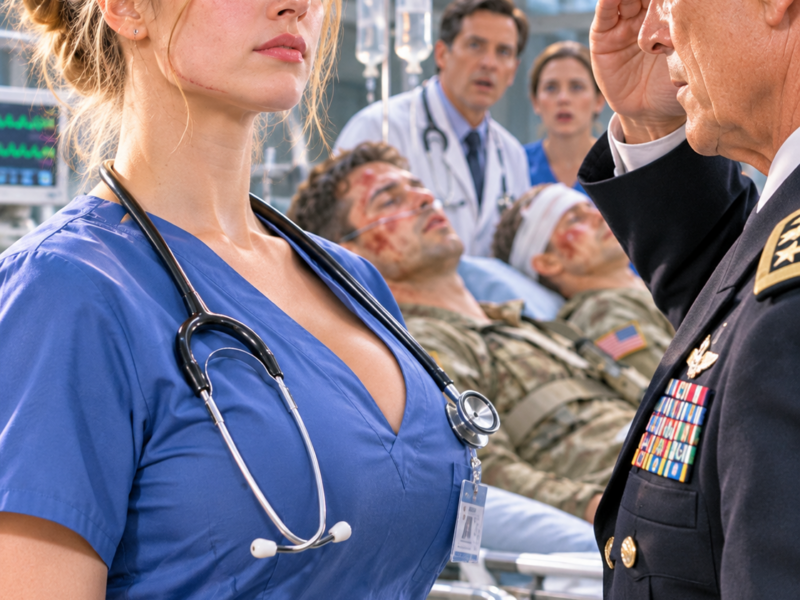
“The surgeon laughed when I asked him to let me treat the two wounded soldiers before their condition became irreversible
“Then I need you to tell me what you saw,” Admiral James Whitaker repeated.
I looked at the two wounded soldiers.
Tyler’s breathing had become shallow, and Marcus was barely responding to the nurses trying to keep him conscious.
“Sir, I need two trauma teams, immediate surgical assessment, and authorization to coordinate the military medical transfer records. We can discuss everything else after these men are stable.”
Whitaker nodded without hesitation.
“Captain Lewis, give Commander Morgan whatever support she needs.”
Dr. Bennett stepped forward.
“Admiral, with respect, this is a civilian hospital. I am responsible for medical decisions here.”
Whitaker turned toward him.
“Then I suggest you make the right ones.”
Bennett’s jaw tightened.
I didn’t wait for another argument.
“Sarah, take Tyler. I want continuous monitoring and immediate preparation for surgical intervention. Michael, stay with Marcus. Check his airway and prepare the emergency equipment.”
Both nurses moved immediately.
For the first time that afternoon, nobody questioned my instructions.
I approached Tyler.
His skin was cold, and his eyes kept drifting closed.
“Tyler, can you hear me?”
He gave a faint nod.
“My name is Rebecca. We’re going to take care of you.”
His fingers moved against the blanket.
“Marcus?”
“He’s right beside you.”
“Don’t… let them…”
His voice disappeared.
I leaned closer.
“Don’t let them what?”
But his eyes had already closed.
I checked his response and looked toward the team.
“We need to move.”
The next several minutes were a blur of coordinated work.
The surgeons arrived.
The trauma team reassessed both patients.
The hospital’s blood bank was contacted, and additional emergency supplies were brought in.
I remained beside Tyler until the surgical team took over.
When I finally stepped back, Sarah touched my shoulder.
“You were right.”
I looked through the glass at the operating room doors.
“I wish I hadn’t been.”
At 5:08 p.m., the first surgeon came out.
“Tyler is alive. We found significant internal bleeding and were able to control it.”
I let out a breath.
“And Marcus?”
“He’s still in critical condition. We’re working on him.”
I nodded.
There was no celebration.
Not yet.
Admiral Whitaker was waiting near the nurses’ station.
He had removed his service cap and was holding it against his side.
“Commander, we need to talk.”
I looked at the operating room doors.
“About the files?”
“Yes.”
I followed him into a small consultation room.
Dr. Bennett attempted to join us.
Whitaker stopped him.
“Not you, Doctor.”
Bennett’s face reddened.
“I am the senior physician responsible for this department.”
“And I’m the senior officer responsible for the personnel involved in this investigation.”
Whitaker closed the door.
For several seconds, neither of us spoke.
Then he placed a folder on the table.
Inside were photographs of the three men who had arrived that afternoon.
I recognized Tyler and Marcus.
The third photograph showed Commander Daniel Foster in his Navy uniform.
“These men were part of a military logistics investigation,” Whitaker explained.
“They were assigned to review discrepancies in medical evacuation records connected to several military facilities.”
I remembered Foster’s words.
Don’t let them separate the files.
“What kind of discrepancies?”
“Patients who disappeared from official transfer records. Medical supplies billed to facilities that never received them. Emergency transports that were recorded twice.”
I leaned back.
“Fraud?”
“Possibly much more.”
He opened another document.
“Six months ago, we noticed that medical equipment intended for military hospitals was being redirected through private contractors. Some of the equipment was never delivered. Some was resold.”
“And the soldiers found the evidence?”
Whitaker nodded.
“Tyler and Marcus were assigned to verify the transportation records. Foster was supervising their investigation.”
I looked at the photographs again.
“Why were they involved in a training exercise?”
“They weren’t supposed to be investigating anything during that exercise. Their transport was attacked after they recovered a storage device containing original records.”
I looked up.
“An attack?”
“The official report calls it a vehicle accident.”
I thought about the incomplete ambulance paperwork.
The twelve-minute gap.
The missing information.
The commander’s warning.
“Someone changed the report.”
“That’s what we suspect.”
Whitaker slid another page toward me.
It contained a list of names and shipment numbers.
At the bottom was a signature I recognized.
Dr. Paul Bennett.
I stared at it.
“Why is his name here?”
The admiral’s expression became serious.
“That’s what we’re trying to establish.”
I felt the room grow smaller.
Bennett had been dismissive, arrogant, and unwilling to listen.
But a signature on a document wasn’t proof of a crime.
“Does he know we’re investigating?”
“I believe he does.”
I looked toward the door.
“Then we need to be careful. If he is involved, he may already know that the soldiers survived.”
Whitaker nodded.
“That’s why I want you to stay close to them.”
I shook my head.
“Sir, I’m a hospital nurse. I can help with their medical care, but I’m not going to conduct a military investigation inside an emergency department.”
“I didn’t ask you to.”
He paused.
“I asked you to help me understand why those men trusted you.”
I looked down at my hands.
That question brought back a memory I hadn’t visited in years.
A field hospital in Afghanistan.
A young Navy corpsman.
A night when three wounded men arrived with incomplete medical information and the evacuation aircraft was already waiting.
I had been a lieutenant then.
And I had made a decision that changed the course of my career.
“I knew Tyler and Marcus before today,” I said quietly.
Whitaker looked up.
“How?”
“Not personally. But I recognize the way they were trying to communicate.”
I pointed to the photographs.
“They were trying to tell us something without saying it aloud.”
The admiral studied me.
“Why would they trust you?”
I hesitated.
Then I answered.
“Because I once saved someone they knew.”
The admiral’s expression softened.
“Michael?”
I looked at him sharply.
“How do you know that name?”
Whitaker closed the folder.
“Because the man you saved is now a senior Navy medical officer. He recommended you for the assignment that brought you to this hospital.”
I said nothing.
For years, I had believed that recommendation was simply a reference from someone I had treated.
I hadn’t known it had been part of a larger plan.
“Sir, what assignment?”
Whitaker leaned forward.
“Six months ago, we identified several hospitals that might be vulnerable to the same medical records manipulation. Your experience with military evacuation procedures made you a strong candidate to help assess emergency continuity practices.”
I stared at him.
“Are you telling me I was placed here?”
“Not as a spy, Rebecca. You were recruited because you were an excellent nurse with specialized experience. The hospital knew you were a former Navy officer. It did not know the details of your advisory role.”
I looked away.
I had accepted the job because I wanted an ordinary life.
I wanted to wake up, go to work, care for people, and return home without wondering whether someone was waiting to tell me another friend had died.
Now the past had found me again.
“Why didn’t anyone tell me about the investigation?”
“Because we didn’t know which facilities were compromised. We didn’t want to expose people unnecessarily.”
I gave a bitter laugh.
“And now two soldiers are in surgery.”
Whitaker lowered his eyes.
“Yes.”
For a moment, the only sound was the air conditioner.
Then I stood.
“Where is Commander Foster?”
“Still being treated.”
“I want to see him when he’s stable enough to speak.”
Whitaker nodded.
“Of course.”
I returned to the emergency department.
Dr. Bennett was standing at the nurses’ station, speaking with the hospital director over the phone.
When he noticed me, he immediately ended the call.
“Rebecca, we need to discuss your conduct.”
I looked at him.
“Now?”
“Yes. You disregarded a direct instruction and allowed military personnel to interfere with hospital operations.”
“I helped stabilize two critically injured soldiers.”
“You exceeded your authority.”
I glanced at the operating room.
“Both patients are alive.”
“That doesn’t give you permission to undermine the attending physician.”
I lowered my voice.
“Then perhaps the attending physician should explain why he ignored repeated signs of internal bleeding.”
His expression hardened.
“Be careful.”
I studied his face.
“Is that a medical instruction or a threat?”
For a moment, he didn’t answer.
Then he turned and walked away.
Sarah appeared beside me.
“I don’t like him.”
“Neither do I right now.”
She looked toward the corridor.
“Something else happened while you were with the admiral.”
“What?”
“Someone called the nurses’ station asking for the medical records of Tyler and Marcus.”
“Who?”
“They said they were from hospital administration.”
“Did you give them anything?”
“No. I told them the records were restricted.”
I nodded.
“Good.”
Sarah lowered her voice.
“They already knew the patients’ names. They asked whether both men had survived surgery.”
I looked at her.
“Did you tell them?”
“No.”
I glanced toward the operating room again.
Someone was already looking for information.
And I had a feeling the investigation was moving faster than anyone expected.
At 6:21 p.m., the surgeon returned.
Marcus had survived the operation.
His condition remained serious, but the immediate danger had passed.
When I heard the news, I sat down in the break room and covered my face with both hands.
Sarah brought me a cup of water.
“You can breathe now.”
I took it.
“Thank you.”
“You saved them.”
“The surgeons saved them.”
“You recognized what was happening before anyone else did.”
I looked at her.
“That’s part of nursing.”
She smiled.
“Maybe. But not everyone would have stood their ground like you did.”
I didn’t know what to say.
My phone vibrated.
An unknown number.
I opened the message.
STOP ASKING ABOUT THE FILES. YOU HAVE ALREADY DONE ENOUGH.
I stared at it.
Then I showed Sarah.
She looked frightened.
“Should we tell security?”
“Yes.”
I immediately forwarded the message to Admiral Whitaker.
He called within thirty seconds.
“Do not respond to that number. Preserve the message and stay with hospital security.”
“Understood.”
“Rebecca, I need you to hear me. This is no longer just an administrative investigation.”
“I know.”
“Someone believes those records are worth threatening a nurse over.”
I looked through the glass at the emergency department.
“Then someone is afraid of what we’ll find.”
The next morning, Tyler woke up.
I was checking his vital signs when he opened his eyes.
He looked confused at first.
Then he recognized me.
“You’re the nurse.”
I smiled.
“That’s what my badge says.”
He tried to laugh but winced.
“Am I alive?”
“Very much so.”
He looked toward the empty chair beside his bed.
“Marcus?”
“He’s in the next room. He’s alive, too.”
His eyes filled with tears.
He turned his face toward the window.
I gave him a moment.
Then he whispered, “They took it.”
I pulled the chair closer.
“What did they take?”
“The drive.”
I kept my voice calm.
“What drive, Tyler?”
He looked at me.
“The one we recovered before the accident.”
I remembered the admiral’s explanation.
“Was it the original medical transfer data?”
He nodded weakly.
“Everything was on it. The names. The shipments. The payments.”
“Who attacked your vehicle?”
He swallowed.
“I didn’t see their faces.”
He closed his eyes.
“But I heard one of them say something.”
“What?”
“Make sure the hospital gets the files before the Navy does.”
My stomach tightened.
“Who was he talking about?”
Tyler shook his head.
“I don’t know.”
He tried to move, then stopped.
“Commander Foster had a second copy.”
“Where?”
His eyes moved toward the door.
“Marcus knows.”
I didn’t press him.
He needed rest.
But before I left, he caught my hand.
“Please don’t let them say we made it up.”
I looked at him.
“I won’t.”
Later that afternoon, Marcus was awake enough to speak.
I entered his room with Sarah.
He looked exhausted.
“Tyler?”
“He’s recovering.”
Marcus nodded.
“Good.”
I checked his monitor and adjusted his blanket.
“Tyler mentioned a second copy of the records.”
His expression changed.
“Where is it?”
“He said you knew.”
Marcus looked toward Sarah.
“Can we speak privately?”
Sarah nodded and stepped outside.
I sat beside the bed.
Marcus reached beneath his pillow and pulled out a small folded piece of paper.
It was a photograph of a handwritten code.
At the bottom was a short sequence of numbers.
“Commander Foster gave this to me before the vehicle went off the road,” he whispered.
“What does it mean?”
“Locker number. Naval storage facility.”
I studied the numbers.
“Is the drive there?”
“No. The code opens a secure container. The drive is inside.”
“Why didn’t you tell the investigators?”
Marcus looked toward the doorway.
“Because someone knew where we were going before the accident happened.”
I understood.
The men investigating the missing records suspected that information was being leaked.
And they had no reason to believe every person involved in the investigation was trustworthy.
“Who did you suspect?” I asked.
Marcus hesitated.
Then he said something I hadn’t expected.
“Dr. Bennett.”
I stared at him.
“Why?”
“He was at the base two days before the accident. He met with someone from the transportation contractor.”
“Did you see him?”
“No. Commander Foster did.”
I folded the paper.
“Did Foster tell you anything else?”
Marcus closed his eyes.
“He said the person behind everything wasn’t a stranger. It was someone who knew how military hospitals worked.”
That evening, Admiral Whitaker returned.
I gave him the information.
He studied the handwritten code.
“That’s a Navy storage location.”
“Can you verify it?”
“Yes. But I want to understand something first.”
He looked at me.
“Did Marcus mention Bennett?”
I nodded.
Whitaker was silent.
Then he said, “We have been watching Dr. Bennett for several weeks.”
I felt a knot tighten in my stomach.
“Why didn’t you tell me?”
“Because we didn’t have enough evidence.”
“He’s treating military patients in this hospital.”
“I know.”
“Then you should have warned the staff.”
Whitaker looked down.
“You’re right.”
For once, the admiral didn’t try to defend the decision.
He took the paper and placed it in a secure folder.
“We’ll verify the storage container tonight.”
I watched him leave.
I wanted to believe that the truth was finally close.
But something about the way Marcus had spoken stayed with me.
The person behind everything wasn’t a stranger.
It was someone who knew how military hospitals worked.
The following morning, Dr. Bennett was absent from the hospital.
His office was locked.
His personal belongings were gone.
The hospital director said he had taken emergency leave.
But nobody had approved it.
At 10:15 a.m., Sarah called me into the medication room.
“Rebecca, you need to see this.”
She showed me a photograph on her phone.
It was an image from the hospital’s internal scheduling system.
Bennett’s name had been removed from the duty roster.
In its place was a temporary entry:
ADMINISTRATIVE REVIEW — EFFECTIVE IMMEDIATELY.
“Who changed it?” I asked.
“I don’t know. But look at the timestamp.”
The change had been made at 2:13 a.m.
I checked my phone.
At 2:13 a.m., I had received another message from the unknown number.
THIS IS YOUR LAST WARNING.
I showed Sarah.
She looked at me.
“Someone has access to the hospital system.”
I nodded.
“And they know when I’m working.”
Before we could say anything else, the overhead announcement sounded.
“All available emergency personnel to the main entrance.”
We hurried toward the emergency department.
A black SUV had pulled up outside.
Two Navy officers stepped out.
Between them was a man in a wheelchair.
Commander Daniel Foster.
He was pale, still recovering from his injuries, but conscious.
I approached him.
“Commander.”
He looked up.
“Rebecca Morgan.”
His voice was weak, but his eyes were alert.
“I was hoping you’d still be here.”
“I’ve been waiting to talk to you.”
He glanced toward the two officers.
“Then let’s not waste time.”
I helped position his wheelchair near the consultation room.
Admiral Whitaker joined us.
Foster looked at him.
“Sir, I need to report that the medical records were deliberately altered before the transport accident.”
Whitaker nodded.
“We know.”
“No, Admiral. You don’t know everything.”
Foster reached into the pocket of his jacket and removed a small folded document.
He handed it to Whitaker.
“This is the original authorization.”
The admiral unfolded it.
His expression changed.
“What is this?”
“Proof that the transfer operation was approved by someone with access to the highest levels of the military medical system.”
I leaned forward.
“Who signed it?”
Foster looked at me.
Then he answered.
“Vice Admiral Robert Hayes.”
Whitaker slowly lowered the paper.
Hayes was a senior officer who oversaw several military medical logistics programs.
He had been one of the public faces of a national initiative to modernize military hospitals.
He had attended conferences with hospital executives.
He had given speeches about protecting service members.
And his signature appeared on the authorization.
“Are you certain?” Whitaker asked.
Foster nodded.
“I saw him approve the original transfer order.”
“Why would he be involved?”
“Because he was the person who created the private contractor network.”
Foster looked exhausted.
“Shaw was handling the money. Bennett was handling the hospital access. Hayes was making sure the military records stayed quiet.”
I looked at the admiral.
“Then this goes much higher than we thought.”
Whitaker folded the paper.
“Yes.”
He immediately contacted military investigators.
For the first time, the room felt different.
We weren’t chasing a missing document anymore.
We were looking at a network that had used the medical system to hide the movement of injured service members and divert public money.
But Foster wasn’t finished.
He looked directly at me.
“There’s something else.”
I leaned closer.
“What?”
“Your name is in the original report.”
I stared at him.
“My name?”
He nodded.
“Your former field hospital assignment. Fifteen years ago.”
My throat tightened.
“What does that have to do with this?”
Foster glanced at Whitaker.
The admiral looked uncomfortable.
“Rebecca, there’s something we should have told you earlier.”
I waited.
Foster continued.
“One of the first medical evacuation records altered by this network belonged to a corpsman you saved in Afghanistan.”
Michael.
I felt the room go quiet.
“Michael is alive,” I said.
“Yes,” Foster replied. “And he has been helping us investigate.”
I gripped the edge of the table.
“Then why is my name in the report?”
Foster looked at me.
“Because the original record proves that you authorized an emergency transfer when the official system was down. Someone later changed the documentation to make it appear that the patient had been moved through a different facility.”
I remembered that night.
The injured corpsman.
The missing authorization.
The decision to act.
I had never known that the record had been altered.
“Why?”
“Because the contractor network used your original emergency procedure as a template. They claimed that later unauthorized transfers were legitimate emergency movements.”
I looked at Whitaker.
“You’re telling me they used my name to justify moving patients?”
He nodded.
“That’s why your involvement matters.”
For a long moment, I couldn’t speak.
The system I had helped build to protect injured people had been used to conceal their movements.
And someone had turned one of the hardest decisions of my life into a tool for deception.
I stood.
“Then I want to see the original records.”
Whitaker nodded.
“We’ll arrange it.”
“No. I want to see them with the people who were there. I want Michael present.”
The admiral studied me.
Then he agreed.
Two days later, we met in a secure conference room at the Navy medical command facility.
Michael arrived first.
He was forty now, with a little gray at his temples.
When he saw me, he stood.
For a moment, neither of us spoke.
Then he smiled.
“Still saving people, Lieutenant?”
I laughed softly.
“Still ignoring medical advice, Corpsman?”
He shook his head.
“I heard what happened at the hospital.”
I looked at him.
“You heard about the soldiers?”
“I heard about the nurse who refused to walk away.”
He pulled out a chair.
“I owe you more than I ever told you.”
I sat opposite him.
“You don’t owe me anything.”
“Yes, I do.”
He placed a photograph on the table.
It was the original evacuation record from fifteen years earlier.
My signature was at the bottom.
Beside it was a second document showing the altered version.
Someone had copied my authorization number and changed the destination facility.
I examined both carefully.
The differences were small.
A changed date.
A different receiving hospital.
A transfer code that looked almost identical to the original.
But those small changes had allowed dozens of later transactions to appear legitimate.
Michael watched me.
“You were never supposed to see this.”
“Why?”
“Because the people responsible knew you would recognize the pattern.”
I looked up.
“Who discovered it first?”
“Daniel Foster.”
“And Tyler and Marcus?”
“They found the financial records.”
I closed the folder.
“Then why did the network attack them?”
Michael leaned forward.
“Because the storage device contained the original patient identities. It connected the altered transfers to real people.”
The room was silent.
I thought about the patients.
The families.
The people who had waited for calls that never came.
“How many?”
Michael looked at Whitaker.
The admiral answered.
“Twenty-seven confirmed cases so far. The investigation is still expanding.”
I lowered my eyes.
Twenty-seven people.
Twenty-seven lives that had become entries in a fraudulent system.
“Are they all alive?”
“Most have been located,” Whitaker said. “Some are receiving treatment under different identities. A few cases remain under investigation.”
I pressed my fingers together.
“Then we find every one of them.”
Michael nodded.
“That’s why we need you.”
I looked at the two officers.
For years, I had wanted to believe that leaving active duty meant I had done my part.
But the truth was that the people I had once served with were still carrying the consequences of decisions made long after I left.
“I’ll help,” I said.
“On one condition.”
Whitaker waited.
“Nobody treats the patients as evidence. They are people first. Every family gets answers, and every person found receives proper medical care.”
The admiral nodded.
“Agreed.”
The investigation moved quickly after that.
The storage container was recovered.
The original files were intact.
The Navy investigators identified the contractor network and traced payments through several private companies.
Vice Admiral Hayes was placed under investigation.
He was eventually removed from his position and charged alongside several civilian executives.
Dr. Bennett was located two states away and arrested after investigators recovered messages connecting him to the unauthorized hospital transfers.
He initially denied everything.
But the records told a different story.
He had received payments from a private contractor in exchange for altering patient transfer documents and providing access to restricted hospital systems.
The evidence also confirmed that he had known about the attack on Tyler, Marcus, and Foster.
He had not planned the accident himself, but he had provided information that helped the people responsible intercept their transport.
The hospital terminated his employment.
He later entered a cooperation agreement and admitted his role in the scheme.
Victor Shaw was also charged with financial fraud and obstruction.
The investigation took almost a year.
It was not clean or simple.
Some families were angry that the truth had taken so long.
Some patients refused to speak to investigators.
Others simply wanted their medical records corrected and their lives left alone.
I understood all of them.
The hospital established a permanent military patient oversight program.
Every transfer involving military-funded emergency care would now require independent verification.
No single administrator could authorize, alter, and approve the same record.
And the original emergency protocols were rewritten so that no nurse or physician would have to choose between following a broken system and responding to a dying patient.
Tyler and Marcus eventually recovered.
Marcus had a long rehabilitation ahead of him, but he regained most of the movement in his injured arm.
Tyler returned to limited duty after several months.
Commander Foster recovered more slowly.
His injuries had been severe, and he spent weeks in physical therapy.
But he never stopped asking about the other patients.
One afternoon, he visited Harbor Point Medical Center.
I was finishing a shift when I saw him standing near the nurses’ station.
He was walking with a slight limp.
“Commander Morgan,” he said.
I smiled.
“You’re looking better.”
“That’s because you aren’t allowed to order me around anymore.”
I laughed.
“Don’t tempt me.”
He handed me a small envelope.
Inside was a photograph of Tyler, Marcus, Michael, and several other service members.
They were standing outside a military rehabilitation center.
On the back, someone had written:
WE ARE HERE BECAUSE SOMEONE REFUSED TO LOOK AWAY.
I looked at Foster.
“Thank you.”
He shook his head.
“No, Commander. Thank you.”
I placed the photograph inside my locker.
That evening, Admiral Whitaker called me.
He had a new offer.
A permanent position overseeing military medical continuity and emergency response coordination.
It would involve training hospital teams, reviewing evacuation procedures, and helping ensure that no patient disappeared between military and civilian care.
I listened carefully.
Then I asked the question that mattered most.
“Would I still be able to work with patients?”
He smiled through the phone.
“That was the first condition I included.”
I accepted.
But I didn’t leave Harbor Point.
I arranged a schedule that allowed me to continue working regular emergency department shifts while helping the Navy improve its medical evacuation system.
Some people thought I was making life unnecessarily complicated.
Sarah thought it was perfect.
When I told her, she laughed.
“So you’re a commander again?”
I clipped my hospital badge to my uniform.
“I’m still Rebecca.”
She smiled.
“I know. That’s why I like working with you.”
Six months later, Harbor Point held a small recognition ceremony for the emergency team that had treated the soldiers.
Dr. Bennett’s name was never mentioned.
Instead, the hospital recognized the nurses who had stayed at the bedsides, the technicians who had prepared the operating rooms, and the surgeons who had worked through the night.
I was asked to speak.
I stood in front of the staff, looking at familiar faces.
I didn’t talk about medals.
I didn’t talk about my former rank.
I didn’t tell them how many years I had spent in the Navy.
I spoke about Tyler.
About Marcus.
About the moment when a patient reaches for your hand because he is afraid.
And about how important it is that someone reaches back.
After the ceremony, Sarah found me near the emergency entrance.
“Can I ask you something?”
“Of course.”
“That day, when Dr. Bennett told you that you were just a nurse, did you ever consider walking away?”
I thought about it.
“Yes.”
She looked surprised.
“Really?”
“Of course. I’m human. I was tired, angry, and I knew he could make my life difficult.”
“What stopped you?”
I looked through the glass doors toward the trauma bays.
“Tyler was trying to breathe. Marcus was looking for his friend. I couldn’t make their emergency about my pride.”
Sarah nodded slowly.
“That’s probably the best answer I’ve ever heard.”
I smiled.
“Don’t tell the admiral. He’ll put it in a speech.”
She laughed.
A few minutes later, my shift ended.
I walked to the parking garage, carrying my coffee cup and a small bag of belongings.
The evening air was cool.
The hospital lights glowed behind me.
For years, I had believed that my military service was something I needed to put away to become the person I wanted to be.
But that day taught me something I hadn’t understood before.
Being a nurse had never made me less of a commander.
Being a commander had never made me more important than the patients I served.
Titles could open doors, and authority could help people listen.
But neither one could replace the simple decision to stand beside someone when they were frightened and in pain.
The next morning, I returned to the emergency department.
Sarah was already there.
She handed me a fresh cup of coffee.
“Morning, Commander.”
I raised an eyebrow.
“Good morning, Sarah.”
She grinned.
“Sorry. Habit.”
I took the coffee and walked toward the trauma bays.
A new patient was arriving.
The paramedics were giving their report.
The monitors were beeping.
A family member stood near the entrance, holding a jacket and trying not to cry.
I put on my gloves.
There was work to do.
And somewhere behind me, on the wall beside the nurses’ station, hung a framed photograph of two young soldiers standing together after their recovery.
I had saved their lives that afternoon, but they had reminded me why I had chosen this profession in the first place.
I was not ashamed of my rank.
I was not defined by it, either.
I was Rebecca Morgan.
A nurse.
A commander.
And when someone needed help, I would never need a title to know what to do.
The end.









