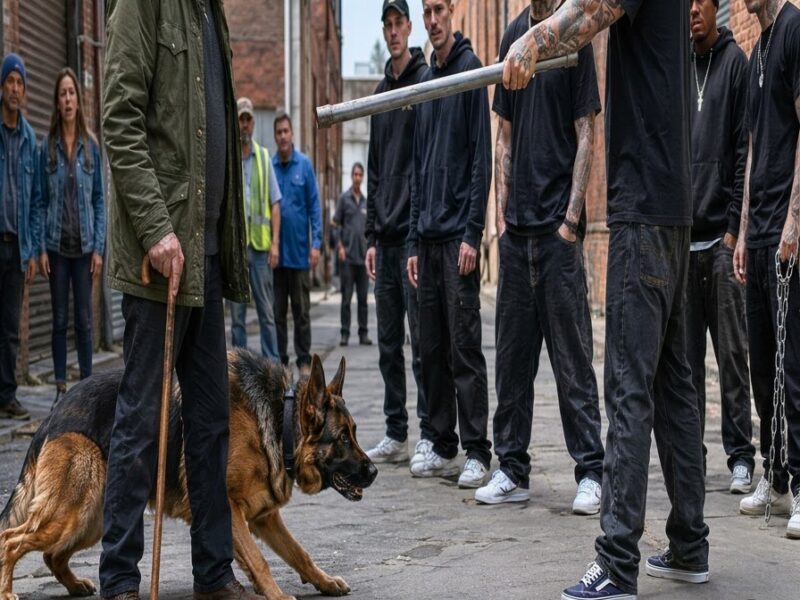
The street thugs surrounded me and my K9 beneath a flickering streetlamp in downtown Baltimore, laughing when they realized I couldn’t hear their threats
Rain dripped from the frayed brim of my waterproof jacket, each heavy drop falling silently onto my shoulders as I stood outside a closed convenience store in downtown Baltimore. The yellow neon sign overhead flickered frantically, casting long, jittery shadows across the wet pavement. Beneath my hand, the firm, reassuring ridge of Rex’s tactical harness remained steady.
Rex, a ninety-pound Belgian Malinois with a silver-muzzled black face, pressed tightly against my left calf. I felt the rhythmic rise and fall of his chest, the faint, heat-filled vibrations of a dog trained to read my heartbeat long before I even realized my pulse was rising.
Three men stepped out from the shadows of an adjacent brick alleyway, cutting off the narrow sidewalk.
The leader, a thick-set man wearing a mud-splattered leather jacket, took a aggressive step toward me. His mouth opened, his jaw moving in animated, exaggerated jerks. He waved a gloved hand mockingly in front of my face, his eyes wide with cruel amusement.
“Can’t hear us, huh?” I read his lips easily.
The world had gone entirely silent four years ago in the desert outside Fallujah. A pressure-plate IED had detonated beneath our light tactical vehicle, shattering my ear canal and tearing through the auditory nerves. The explosion hadn’t just stolen my hearing; it had ripped away my career, my team, and my purpose.
When I woke up in Bethesda Naval Hospital, the doctors told me I was dead to the world of sound. But Rex had been there when I woke up. He was a retired Navy SEAL multi-purpose canine who had lost his first handler in the same deployment. We were two broken veterans cast aside by the machine of war, learning to navigate an endlessly silent world together.
The tallest thug stepped into my personal space, his hand lunging out to grab my left shoulder, spinning me slightly.
Rex immediately stiffened, his body transforming from a passive companion into a coiled spring of pure muscle. His dark eyes locked onto the man’s throat, a deep vibration running through his harness that I felt directly in my palm.
I raised my right hand, palm flat, holding it at chest height—a universal sign to back off.
The leader threw his head back and laughed, his chest heaving with silent amusement as he turned to his two companions.
“What’s wrong, soldier? Dog gonna save you?” his lips formed the words with deliberate, mocking slowness.
His two friends moved smoothly to flank us, stepping onto the curb to block any escape back toward the main avenue.
I felt my pulse quicken, but eleven years of elite military training bypassed the panic. My eyes shifted into tactical assessment mode, reading the geometry of the street, the slickness of the rain-soaked asphalt, the dark mouth of the alley behind them, and the distance between the three targets.
I looked down at Rex.
Without moving my head, my hand dropped to my side. My index and middle fingers twitched twice against my thigh—a precise, silent hand signal developed in the dark corridors of overseas combat houses.
Execute non-lethal displacement.
Rex moved before the men even registered a threat. He didn’t bark; he didn’t growl. He launched his body forward with explosive speed, slamming his reinforced chest directly into the leader’s sternum. The impact drove the man’s breath from his lungs, sending him flying backward onto the wet pavement with a sickening thud.
The other two thugs froze in absolute shock, their cocky smiles evaporating instantly.
I stepped fluidly between the men and my dog, placing my body as the shield. My right hand formed another swift signal in the air—a sharp, downward knife-hand pointing toward the alley behind us.
Rex turned ninety degrees instantly, his ears pinned back, his body lowering into a low strike stance as he faced the darkness.
A fourth man materialized from the shadow of a brick dumpster, holding a rusted iron pipe raised high above his head. He had been lurking in the alley, sneaking up on my blind spot while his friends distracted me.
In my silent world, there was no sound of boot squeaks on wet brick, no warning scrape of metal against concrete. I couldn’t hear his approach.
But Rex could.
Rex sprang into action, intercepting the line of attack. The man with the pipe swerved to hit the dog, but I stepped inside his reach. As the pipe swung downward, I pivoted on my heel, caught his wet wrist with my left hand, and used his own forward momentum against him.
I drove my elbow into his ribs and slammed his upper body violently against the exposed brick wall of the store.
The iron pipe clattered silently onto the pavement and rolled into the gutter.
The remaining thugs looked at their leader writhing on the ground, looked at me, and then looked at the lethal efficiency of the Belgian Malinois glaring at them with cold, calculated intelligence. They turned on their heels and scattered into the night, disappearing around the corner.
For a moment, I stood beneath the flickering neon streetlamp, my chest heaving, the cold rain washing over my face. Beside me, Rex sat down on the wet pavement, his eyes never leaving the alley, his ears twitching as he scanned the ambient vibrations of the city.
Then my boot brushed against something hard on the ground.
I looked down. Lying near the iron pipe was a small, black leather bi-fold wallet that had fallen from the fourth attacker’s jacket during the struggle.
I leaned down, picked it up, and flipped it open under the amber glow of the streetlamp.
Inside, protected by a clear plastic sleeve, was a military identification card.
I stared at the black-and-white photograph printed on the plastic. It was my face—younger, unscarred, wearing my Navy dress whites. Printed across the bottom in clear, bold letters was my name: CAPTAIN JACK MORGAN – US NAVY SEAL – RETIRED.
My blood turned to pure ice.
This wasn’t my wallet. My actual ID was tucked safely in my inside jacket pocket. Someone had created an exact, high-level military duplicate of my identification card. Someone had handed it to a street thug in downtown Baltimore.
Someone had known exactly where I would be standing tonight.
Rex suddenly let out a low, vibrating growl that vibrated straight through his leash into my hand.
I followed his gaze down the dark, narrow length of the alleyway.
A large black SUV sat parked fifty yards away, idling silently in the shadows with its headlights completely off. As I watched, the dark, tinted glass of the driver’s window slowly slid downward.
A pale hand reached out of the open window into the dim streetlight.
The fingers curled into a specific, highly classified hand signal—a thumb tucked under three extended fingers, followed by a sharp outward flick of the wrist.
It was the private tactical signal of my former K9 handler—Senior Chief Miller.
My heart stopped beating. My lungs refused to take air.
Miller had been standing three feet from the IED four years ago. I had helped carry his closed casket onto the C-17 transport plane at Bagram Airfield. I had attended his military funeral at Arlington. I had cried silently beside his widow as the bugle played Taps.
Rex’s head whipped around. He stared at the hand sticking out of the SUV window, his tail giving a single, hesitant wag. He recognized the signal. He recognized the man.
I froze, locked in place as the figure inside the SUV leaned forward into the faint glow of the dashboard lights. His face was covered in jagged burn scars, but his piercing blue eyes were unmistakably Miller’s.
He didn’t speak into a radio. He looked directly through the rain at me and mouthed three distinct, unhurried words through the glass.
“Your wife survived.”
My world exploded into white noise.
Rex let out a low, desperate whine. And somewhere in the dark interior of that black SUV, the life I thought had ended four years ago came screaming back from the grave.
My mind shattered into a thousand jagged pieces as I stared at the face in the SUV.
My wife, Sarah.
Four years ago, three months after I returned home from Iraq deaf and broken, our home in Northern Virginia had been destroyed in a sudden, catastrophic gas explosion. The fire investigators had found her wedding ring in the ash and small bone fragments. I had buried what was left of her in a quiet cemetery overlooking the Potomac, slipping into an endless, soundless depression that eventually drove me out of society and onto the cold streets of Baltimore with Rex.
“Your wife survived.”
The words repeated in my mind like a terrifying litany.
I took three fast steps toward the alley, my boots splashing through deep puddles, but before I could narrow the gap, the driver’s window of the SUV snapped shut. The vehicle’s heavy V8 engine roared—a vibration I felt as a deep tremor through the soles of my shoes—and the SUV reversed out of the alley at high speed, its tires shrieking against the wet asphalt as it vanished into the midnight fog of the harbor district.
“No!” I lunged forward, but the dark street was already empty.
Rex pulled against his harness, barking silently in my mind as he tracked the scent of exhaust and burning rubber down the mouth of the alley. He stopped at the edge of the main road, looking back at me with wide, expectant eyes.
I stood under the pouring rain, holding the forged military ID card in my left hand, my knuckles white, my breathing fast and ragged.
Miller was alive. Sarah was alive.
My entire life for the last four years had been a carefully engineered lie. The explosion that tore my ears apart, the fire that consumed my house, the quiet grief that had hollowed out my soul—it wasn’t a series of tragic military accidents. It was a scrub operation.
I knelt in the rain, grabbing Rex’s head between my hands, pressing my forehead against his wet, fur-covered brow.
“Find him, Rex,” I whispered, my voice rough and hoarse from years of disuse. “Find Miller.”
Rex licked my cheek once, then turned, his nose dropping to the rain-slicked pavement. He caught the lingering scent trail near the curb—the distinct chemical signature of synthetic hydraulic fluid and high-octane fuel dripping from the fleeing SUV.
He tugged hard on his lead, pulling me down Pratt Street toward the abandoned industrial shipyards of the Inner Harbor.
We moved through the silent city like two specters. The rain began to fall harder, washing away the dirt of the street fight, but my body felt hot, fueled by an adrenaline burn I hadn’t experienced since my days in the Teams.
Twenty minutes later, Rex stopped near the perimeter chain-link fence of Pier 42.
The pier was an old, crumbling naval storage yard that had been decommissioned in the late nineties. Rotting wooden pylons stuck out of the dark water like broken teeth, and massive, rusted shipping containers were stacked three high across the concrete apron.
Sitting deep in the shadow of a derelict crane was the black SUV.
Its engine was off. Its tail lights were dark.
I crouched behind a rusted steel dumpster forty yards away, unhooking Rex’s primary lead and switching him to his short, tactical handle. I checked my body—no weapons except my combat folding knife and the iron pipe I had picked up from the alley, which I now had tucked into my belt.
I looked at Rex and gave him a single, complex hand command: Flank left. Reconoiter. Silent alert.
Rex melted into the darkness like a ghost, his dark coat blending seamlessly with the shadows as he circled around the left side of the shipping containers.
I stayed low, keeping to the shadows on the right, my eyes constantly scanning the elevated walkways and crane platforms above. In a silent world, situational awareness isn’t a skill; it’s survival. Every shadow that shifted, every ripple in a puddle, every movement of rain-driven wind was a signal I had to read with absolute precision.
As I rounded the edge of a blue shipping container, I saw a pale light flickering from inside an open office trailer perched on steel stilts near the edge of the dock.
A man was standing on the trailer’s narrow wooden porch, smoking a cigarette.
The red cherry of the cigarette glowed in the dark. As he leaned against the railing, the light from the open door illuminated his profile.
It wasn’t Miller.
It was a man wearing tactical clothing, a sidearm holstered at his hip, and a heavy radio unit clipped to his shoulder. He was scanning the perimeter with night-vision binoculars.
Then, I felt a heavy tap on my shoulder from behind.
I spun around instantly, my right hand driving upward with a palm-heel strike aimed at the attacker’s throat.
A hand intercepted my wrist in mid-air, blocking the strike with terrifying, familiar speed.
I found myself staring directly into the scarred, weathered face of Senior Chief Miller.
He held my wrist tight, his eyes fierce and intense. He didn’t raise a weapon. He didn’t call for help.
He released my wrist, stepped back into the dark shadow of the container, and brought his hands up into the dim light.
His fingers moved rapidly, forming the swift, fluid motions of military sign language—a skill our entire squad had learned after my injury in Fallujah.
“Jack,” his hands signed desperately. “Lower your guard. We have ninety seconds before the patrol sweeps this sector.”
I stared at him, my heart hammering against my ribs like a trapped bird. My hands trembled as I signed back.
“You died. I buried you.”
Miller shook his head, a grim, bitter smile touching his scarred lips.
“You buried an empty box provided by the Department of Defense,” Miller signed back rapidly. “The explosion in Fallujah wasn’t an insurgent bomb, Jack. It was an internal hit. Our unit uncovered a rogue intelligence network operating inside Naval Special Warfare—Project Cerberus. They were selling advanced military tracking software to foreign syndicates.”
My breath hitched. “And Sarah?”
Miller reached into his jacket, pulled out a small, waterproof digital camera, and clicked the screen on.
He held it out to me.
On the small LCD screen was a live video feed. It showed a lit room with concrete walls. Sitting at a small wooden table, reading a book under a soft lamp, was a woman with dark brown hair and a silver necklace I had bought her on our third anniversary.
It was Sarah. She looked thinner, tired, but she was alive.
“They staged her death to keep you compliant,” Miller signed, his eyes burning with fury. “They knew if you thought she was dead, you would break and walk away. But if you ever started asking questions… they kept her as an insurance policy.”
Tears mixed with the rain on my cheeks. My wife was alive.
“Where is she?” my hands signed frantically. “Where are they holding her?”
Before Miller could sign back, a red laser dot suddenly danced across his chest.
Miller didn’t hesitate. He slammed his body into mine, shoving us both flat onto the wet concrete as a high-velocity round whined through the air, punching a clean, smoking hole through the steel wall of the shipping container right where his head had been a second ago.
There was no sound in my world—just the sudden, violent vibration of the impact against the steel frame.
Above us, on the crane platform, two more red laser sights swept across the dark dock.
The door of the office trailer burst open. Three armed men in dark tactical gear flooded out onto the porch, their rifles raised.
Miller pulled a suppressed SIG Sauer from his holster, leaned around the edge of the container, and fired three rapid shots. The shooter on the porch crumpled over the railing, falling thirty feet into the dark harbor water below.
I reached down to my belt, pulled out the iron pipe, and looked at Miller.
“How many?” I signed with one hand.
“Eight,” Miller signed back, his face grim as he reloaded his weapon. “Mercenaries hired by Cerberus. They tracked my SUV from the convenience store. They knew I was coming to find you.”
Suddenly, a massive shape exploded out of the shadows on the left walkway.
Rex!
My dog landed directly on the chest of a mercenary who was raising a submachine gun toward Miller. Rex’s jaws locked around the man’s forearm, dragging him violently off the elevated catwalk. They crashed onto a pile of wooden pallets below, neutralizing the shooter instantly.
“Rex! Cover!” I signaled with a sharp sweep of my arm.
Rex released the man, scrambled over the broken wood, and took cover behind a stack of steel barrels, his eyes fixed on me, waiting for the next command.
The remaining four contractors on the ground level began advancing in a tactical wedge, fire pouring from their weapons as they suppressed our position behind the shipping container. Spark showers rained down as bullets chewed through the rusted iron walls.
We were pinned. We had no heavy cover, no long-range weapons, and the perimeter fence was locked.
Miller looked at me, his eyes filled with a dark, desperate resolve. He reached into his tactical vest and pulled out a small, heavy steel flash-drive wrapped in waterproof tape.
He shoved it into my hand.
“This is the master file,” Miller signed rapidly with his left hand while keeping his pistol trained on the corner. “It contains the GPS coordinates of the black site in West Virginia where Sarah is being held. It has the encryption keys for Cerberus’ financial network.”
“We go together,” I signed back fiercely.
“I can’t run, Jack,” Miller signed, pulling back his pant leg to reveal a heavy, mechanical prosthetic leg that was dripping hydraulic fluid from a bullet graze. “My gear is shot. I can buy you two minutes. You take Rex, you take the drive, and you get to the safehouse in Annapolis.”
“No!” I signed, gripping his collar. “I lost you once! I’m not leaving you again!”
“You aren’t leaving me, Captain!” Miller signed, his hand slamming against my chest with immense force. “You are going to save your wife! That’s an order!”
A flash-bang grenade landed three feet from us.
Even in my silent world, the pressure wave of the detonation hit me like a physical hammer, slamming my head against the steel container, sending my vision spinning into a dizzying vortex of white light and blinding disorientation.
I fell sideways into the wet dirt, my hands scraping against the gravel.
Through the haze of my blurred vision, I saw Miller step out from behind the container, his SIG Sauer roaring as he engaged the advancing mercenaries head-on, placing his body between the shooters and me.
Rex sprinted to my side, grabbing the shoulder of my jacket in his powerful jaws, physically pulling my heavy, disoriented body back into the deep shadows of an open drainage culvert that ran beneath the perimeter fence.
“Jack… move…” Miller’s lips formed the words one last time through the smoke before a heavy burst of fire forced him back.
I looked at the steel flash-drive in my hand. I looked at Rex, whose eyes were wide with urgency, his teeth gently tugging at my sleeve.
I squeezed the drive into my palm until the metal bit into my skin.
I turned on my stomach, crawled through the narrow, rain-flooded drainage culvert with Rex right beside me, and emerged onto the dark, overgrown railway tracks behind Pier 42.
Behind us, the flickering flashes of gunfire inside the shipyard slowly faded into the thick, silent darkness of the night.
I didn’t look back. I couldn’t look back.
I ran down the train tracks into the storm, my dog at my side, carrying the key to my wife’s life in my fist.
The safehouse was a small, dilapidated brick rowhome tucked away in a forgotten alley near the Annapolis docks.
By the time Rex and I reached the back door at 03:00 a.m., the rain had turned into a freezing drizzle that soaked through to my bones. My left shoulder throbbed from the fall at the pier, and my vision was still occasionally swimming with static from the flash-bang shockwave.
I slid the hidden key out from behind a loose brick near the foundation, unlocked the door, and slipped inside, Rex moving ahead of me to sweep the dark interior.
He cleared the kitchen, the narrow living room, and the basement stairs, returning to give me a single, firm nudge against my knee.
Clear.
I locked the heavy deadbolts, pulled the thick blackout curtains across the windows, and collapsed onto a wooden kitchen chair.
The room was pitch black until I turned on a small, battery-powered desk lamp sitting on a dusty table.
My hands were shaking as I pulled the steel flash-drive from my pocket. Beside the lamp sat an old, modified military-grade rugged laptop—part of the emergency cache Miller had prepared years ago.
I booted up the laptop. The blue light illuminated the tiny, sterile kitchen.
I plugged the flash-drive into the USB port.
An encryption prompt instantly flashed across the screen:
[PROJECT CERBERUS – SECURITY LEVEL 5]
[ENTER PASSPHRASE:]
I stared at the blinking cursor. Miller hadn’t given me a password. He hadn’t had time.
My mind raced back through every memory, every mission, every hand signal Miller had ever shared with me.
Think, Jack. Think.
What was the one thing Miller had said to me right before the bomb went off in Fallujah? What was the motto our small two-man K9 reconnaissance team had lived by?
I reached out and typed eight letters into the keyboard:
S-I-L-E-N-T-L-Y
[ACCESS GRANTED]
The screen transformed into a dense matrix of maps, satellite imagery, architectural schematics, and personnel files.
My eyes scanned the screen frantically until I hit the central folder labeled: ASSET RETENTION – SITE OMEGA.
I clicked it open.
A high-resolution satellite map appeared on the screen, zooming in on a heavily forested mountain ridge in West Virginia, ten miles outside the small town of Franklin.
Nestled deep in a ravine was an abandoned Cold War-era subterranean bunker facility. According to the schematics, the site had been purchased by a shell corporation six years ago and converted into a private black-site detention center.
Below the map was a live status report:
[SUBJECT: MORGAN, SARAH]
[STATUS: ACTIVE / DETENTION BAY 3]
[GUARD DETAIL: 12 CONTRACTORS]
[SECURITY OVERRIDE CODE: 4492-DELTA]
I pressed my hands against my face, a ragged, silent sob tearing through my throat. She was there. She was alive, breathing, held in a concrete box two hours away from where I sat.
Below her profile was another file folder labeled: EXECUTION PROTOCOL.
My heart stopped. I clicked the file open.
[NOTICE: IF SYSTEM DETECTS UNAUTHORIZED TELEMETRY LEAK FROM PIER 42, SITE OMEGA WILL INITIATE PURGE PROTOCOL WITHIN 6 HOURS OF SYSTEM COMPROMISE.]
A digital countdown clock was running at the bottom of the screen:
[TIME REMAINING UNTIL PURGE: 02:41:18]
They weren’t going to hold her anymore. Now that Miller had broken protocol and handed me the drive, Cerberus was moving to erase the entire facility—and everyone inside it.
Two hours and forty-one minutes.
I closed the laptop, pulled the drive, and stood up from the table. The fatigue that had been weighing down my muscles vanished, replaced by an absolute, icy resolve.
I walked over to the closet at the back of the kitchen, pulled away a false wooden panel, and reached into the hidden armory compartment inside.
Inside were two tactical vests, a suppressed MP5 submachine gun with six loaded magazines, a combat tactical knife, night-vision goggles, and a custom reinforced Kevlar harness for Rex.
I didn’t have a team. I didn’t have air support. I didn’t have hearing.
I had a submachine gun, a three-hour window, and a ninety-pound war dog who would follow me into the gates of hell.
I strapped the Kevlar harness onto Rex, adjusting the buckles until they sat snug against his chest. I looked into his dark, intelligent eyes.
“We’re going to get her, buddy,” I whispered into his ear.
Rex let out a low, confident huff, pressing his cold nose against my hand.
I grabbed the gear bag, opened the back door into the rainy night, and stepped out onto the road toward West Virginia.
The rain had stopped by the time we reached the pine-covered ridge overlooking Site Omega at 05:15 a.m., but a thick, milky mountain fog hung low over the trees, swallowing the forest in ghostly shadows.
I lay prone on a muddy ridge fifty yards above the bunker entrance, my night-vision goggles down, looking through the optic of my suppressed MP5.
Beside me, Rex lay completely flat in the wet pine needles, his body blending with the dark brush, his ears rotating like radar dishes toward the valley below.
The facility entrance was simple—a reinforced steel blast door set directly into the sheer face of a granite cliffside. Two heavy security SUVs were parked on a gravel pad outside, and three guards in winter tactical gear stood near an exterior guard shack, holding automatic rifles.
Through my night-vision scope, I could see the red digital timer on my tactical watch glowing on my wrist:
[PURGE COUNTDOWN: 00:22:10]
Twenty-two minutes.
There was no time for a slow, stealthy breach. There was no time to wait for guards to rotate.
I looked at Rex and gave him the ultimate operational sign—a hand flat against my chest, followed by a sharp, forward index-finger thrust.
Full assault. No restraint.
Rex rose silently from the brush.
I didn’t shoot from the ridge. I slid down the muddy slope, using the thick pine trunks as cover, closing the distance to thirty yards before the guard near the shack even noticed the brush moving.
By the time he raised his rifle, Rex was already in the air.
Rex hit the guard with violent force, tearing him to the ground before he could press his radio button.
I stepped out from behind a pine tree, bringing the suppressed MP5 up to my shoulder.
Thwip-thwip-thwip!
Three rapid rounds eliminated the second guard near the SUV. The third guard turned toward me, raising his weapon, but I closed the distance in two fast strides, sweeping his rifle barrel aside with my left hand and driving the butt of my submachine gun hard into his jaw. He collapsed unconscious onto the gravel.
I pulled the keycard off the first guard’s belt, ran to the steel blast door, and slammed the card into the reader.
[ACCESS GRANTED – WELCOME OPERATIVE]
The heavy steel door unlocked with a loud, mechanical thud that sent vibrations through the floorboards under my boots. I shoved the door open, slipping into the concrete corridor inside, Rex right at my heels.
The hallway was lit by harsh red emergency lights. A strobe light was flashing near the ceiling—a visual alarm indicating the purge sequence had been initiated.
Down the main corridor, two guards came sprinting out of a side room, raising their handguns.
I fired a double-tap into the first shooter, while Rex launched himself down the hall, tackling the second shooter into a metal supply rack.
I moved fast, my boots flying down the concrete stairs, following the yellow line painted on the wall that pointed toward DETENTION BAY 3.
I reached the heavy steel cell door at the end of the lower hallway.
The digital lock on the cell door was flashing red:
[PURGE IMMINENT – GAS VENTING IN 02:00 MINUTES]
My heart pounded frantically. I pulled the keycard, but the reader flashed error. The purge override required a manual code entry.
I remembered the text file on the flash drive: 4492-DELTA.
My trembling fingers slammed the numbers into the keypad: 4-4-9-2. I hit the DELTA key.
CLICK-CLACK!
The heavy hydraulic bolts inside the door retracted.
I grabbed the steel handle, threw the door open, and stepped into the room.
Sitting in the corner of a small, windowless concrete cell, cowering behind a wooden cot as white gas began hissed out of an overhead ceiling vent, was Sarah.
She raised her hands to protect her face, her eyes wide with terror, expecting another executioner.
Then she looked up. She saw the tactical suit. She saw the dog. She saw my face through the dim light of the emergency lamps.
Her hands dropped. Her mouth opened in a silent scream of disbelief.
“Jack?” she gasped, her lips forming the name I hadn’t seen them form in four endless years.
I dropped my submachine gun onto the floor, fell to my knees in front of her, and pulled her tightly into my arms.
I couldn’t hear her weeping. I couldn’t hear the sound of her voice calling my name. But I felt the heat of her tears against my neck, the desperate, crushing grip of her hands holding onto my back, and the wild, beautiful rhythm of her heart pounding against my chest.
Rex pushed his silver muzzle between us, letting out a joyful, whining bark that vibrated through both of our bodies.
I pulled back, holding her face in my hands, looking directly into her tear-filled eyes.
“I found you,” I mouthed slowly, clearly, so she could read every word. “I found you, Sarah.”
She smiled through her tears, nodding frantically, pressing her forehead against mine.
Ten minutes later, as the morning sun broke over the West Virginia mountains, casting brilliant golden rays through the thick fog, we walked out of the blast doors of Site Omega into the fresh, cold mountain air.
Behind us, the black site sat silent, its secrets exposed to the military intelligence teams Miller had alerted before his last stand at the pier.
Ahead of us stretched an open, endless road leading away from the shadows, away from the lies, and back into the light of a life we had both thought was lost forever.
I held Sarah’s hand tight in my right fist. In my left, I held Rex’s lead.
The world around me was still completely silent, but as I looked at my wife and my dog walking beside me into the rising sun, I realized I didn’t need sound to hear the sweetest, most beautiful truth of my life.
We were home.
The end.









