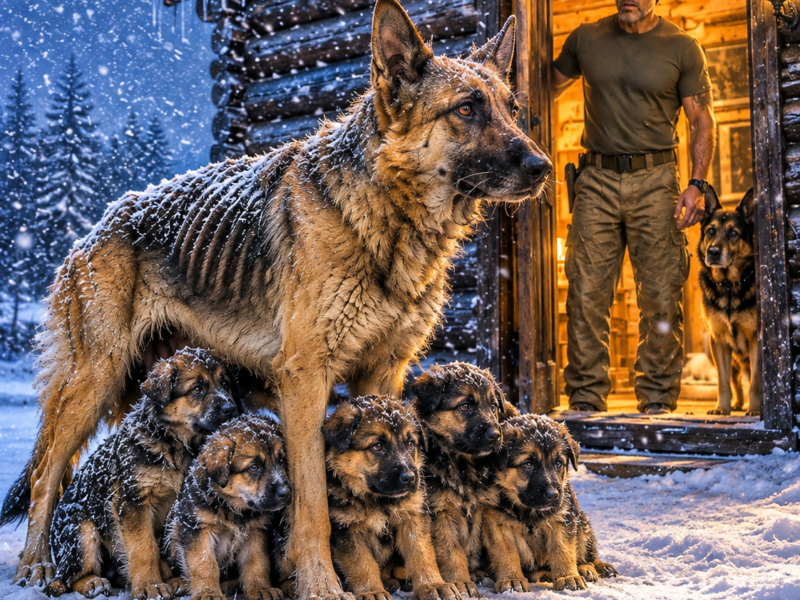
The starving German Shepherd mother appeared outside Ellis Varden’s house with five trembling puppies during one of the worst snowstorms Silver Basin had seen in years
The first time Ellis Varden saw the German Shepherd, she was standing at the edge of his property with snow collecting along her back.
She was thin enough that her ribs showed beneath her yellow-and-black coat. One ear stood upright while the other angled outward, as though it had never quite healed from an old injury. A pale stripe ran down her chest. She had no collar, no leash, and no visible sign that anyone had been looking after her.
Behind her, five puppies huddled together.
They were barely three months old, their little bodies trembling in the wind. One had a dark patch across its muzzle. Another had a pale mark on one front paw. The smallest had a nearly white rear nail that stood out against the rest of its dark feet.
Ellis counted them twice.
Five.
He glanced toward the forest road. Nothing moved beyond the falling snow.
His own German Shepherd, Bram, watched from the doorway. Six years old, retired from patrol and base security, Bram had spent much of his working life learning when to move and when to remain still. An old injury in his left shoulder had ended his service, but it had not taken away his attention to detail.
He stood quietly beside Ellis.
The mother dog looked at the two men—one human, one canine—and then lowered her head.
Ellis did not approach.
He had learned long ago that fear could not be hurried out of an animal. Especially not one that had survived long enough to bring five puppies through a mountain winter.
He carried a bowl of food to the edge of the yard, set it down, and stepped away.
The mother waited until he had disappeared inside before moving toward it.
The puppies followed.
Ellis watched through the kitchen window as they ate. The mother took only a few bites at first, repeatedly lifting her head to scan the yard. Once she was satisfied that no one was coming, she began eating more quickly.
The puppies pressed against one another around the bowl.
Ellis filled another container with warm water and brought out blankets. He placed them inside the old equipment shed, leaving the entrance open.
The family had shelter now.
But they did not stay.
Every evening, after eating and drinking, the mother gathered her puppies and disappeared into the trees.
Every morning, they returned.
It became a routine that Ellis could not explain.
He lived at a former forest observation station in Silver Basin, far enough from town that the nights were usually quiet. His house had been built for workers who monitored the surrounding timberland decades earlier. The old equipment shed remained beside it, and a narrow road connected the property to the main mountain route.
Ellis had spent years in the Navy before retiring. After that, he had worked with search-and-rescue teams and trained working dogs. He understood how animals behaved under stress, how hunger changed their decisions, and how quickly a frightened dog could turn a harmless encounter into a dangerous one.
He also knew that the mother had a reason for leaving.
He simply did not know what it was.
He named her Lark.
It was a small thing, but giving her a name helped him think of her as more than a problem waiting to be solved.
The puppies received no names. Not yet.
He photographed them, recorded their markings, and kept notes about when they appeared and how much food they consumed. He did not try to touch them. He did not close the shed door. He did not attempt to corner Lark.
Each day, he moved the food a little farther inside.
Each day, she considered it.
And each day, she eventually brought the puppies back.
Bram noticed the changes before Ellis did.
At first, he watched the family from the kitchen doorway. His ears shifted whenever a puppy squeaked. He would look toward Ellis as if waiting for an instruction, then return his attention to the yard.
He was not aggressive, but he was not welcoming either.
His world had been carefully arranged around his injury and retirement. His bed occupied a warm corner of the house. His food and water bowls stood in their usual places. His daily walks followed a predictable route.
Ellis had no intention of allowing five young dogs to turn Bram’s remaining years into a constant struggle.
One afternoon, the smallest puppy wandered toward Bram’s food bowl.
Bram lowered his head.
A quiet warning rumbled in his chest.
The puppy froze.
Lark immediately stepped between them and guided the little one away with a gentle nudge.
Nothing more happened, but Ellis understood the message.
The mother was teaching her puppies boundaries.
He needed to do the same.
That evening, he moved Bram’s bed, food, and water to a quiet corner of the kitchen. He fed Bram first and kept the puppy area separate. The older dog watched him make the changes, then settled onto his blanket without protest.
It was not a perfect arrangement.
It was a workable beginning.
And for now, that was enough.
Word about the dogs spread through Silver Basin.
Nora Bell, who owned the grocery store, told Ellis she had seen Lark near the dumpsters behind her building. She had left a bowl of water there, but the dog had disappeared before she could get close.
A fuel delivery driver remembered seeing a mother German Shepherd and several puppies crossing the mountain road.
A maintenance technician had spotted them near a group of old cabins on the eastern slope.
Nobody knew where they had come from.
Nobody recognized them as belonging to a local family.
Ellis began to suspect that the dogs had been moving between several places, surviving on scraps and whatever shelter they could find.
The weather was getting worse.
The puppies were growing, but they were still too young to withstand prolonged exposure to the cold. Lark was exhausted. Her coat looked dull, and her ribs remained visible despite the food Ellis provided.
The danger was no longer just hunger.
A frightened puppy could wander into the road. A sick animal could deteriorate quickly. A sudden storm could close the mountain route and leave the family without help.
That was why Ellis did not object when Calvin Marorrow came to his property.
Calvin owned livestock land farther down the slope. He was a practical man who had spent years protecting his property from predators and loose animals.
He stood near the fence and watched the puppies.
“Those dogs can’t keep wandering around,” he said.
“They’re not bothering anyone here.”
“Not yet. I have chickens. Hungry puppies grow into hungry dogs.”
Ellis looked at him.
“They’re not looking for trouble.”
“Neither is a bear until it gets into a chicken run.”
Calvin was not entirely wrong. Ellis knew that. But he also knew that panic and impatience could make a difficult situation worse.
“I’ve got food and shelter for them,” Ellis said. “I’m working on getting them assessed.”
Calvin shook his head.
“You can’t just feed strays forever.”
“No. But I can keep them alive long enough to figure out what happens next.”
Calvin left without agreeing.
The following morning, June Halpern arrived from County Animal Control.
She carried a folder, a portable fencing kit, and the serious expression of someone who had already been told that the situation was becoming difficult.
She asked Ellis how long the dogs had been on his property, whether anyone had attempted to handle them, whether the puppies appeared injured, and whether the mother had shown aggression.
Ellis answered every question.
June examined the shed from a distance.
“Do you know if they’ve been vaccinated?”
“No.”
“Any history of bites?”
“Not that I’ve seen.”
“Have you tried trapping her?”
“No.”
June looked up.
“Why not?”
“Because she doesn’t trust us. If I put a trap where she’s eating, she may stop coming. If she stops coming, the puppies lose the only reliable food source they have.”
June studied him for a moment.
“You’re worried about traumatizing them.”
“I’m worried about making a bad situation worse.”
She nodded, although she did not look fully convinced.
The two of them walked the property, discussing possible risks. They agreed that the dogs needed veterinary assessment, but they also agreed that forcing the issue too early could separate the mother from her puppies.
After nearly an hour, they settled on a temporary plan.
For seventy-two hours, Ellis would continue feeding the family while June arranged a controlled observation area. The fencing would form a broad curve around part of the yard, with open exits rather than a closed enclosure. Cameras would monitor the dogs’ movements. Food and water would remain available, and the area would be kept clean.
If the puppies weakened, if the weather became more dangerous, or if the family approached the highway, Animal Control would intervene.
Ellis would be listed as a temporary care assistant.
June wrote everything down.
“Seventy-two hours,” she reminded him.
“Understood.”
“And if anything changes, you call me.”
“I will.”
She looked toward Lark, who was watching them from the shed.
“She’s been surviving a long time out there.”
“Yes.”
“That doesn’t mean she’s safe.”
Ellis knew that, too.
The next few days brought a small change.
Lark began approaching the shed before Ellis had finished putting the food down. She still waited until he stepped away, but she no longer disappeared the moment he opened the door.
The puppies became bolder.
They tumbled around the straw, chased one another through the snow, and occasionally wandered toward Bram’s side of the yard.
Bram continued to watch.
One afternoon, Ellis noticed that the old dog had taken something from his room.
It was an old braided tug rope, worn soft from years of use.
Bram carried it outside and placed it near the edge of the yard.
Then he lay down.
Ellis stopped what he was doing.
He knew that rope. Bram had carried it during training exercises, long before the shoulder injury had ended his working life. It had been one of the few toys the dog still seemed to care about.
The puppies noticed it almost immediately.
One approached, then stopped.
Another came closer, sniffed the rope, and darted away when Bram shifted his weight.
Bram did not growl.
He simply watched.
Ellis felt a quiet relief.
It was not friendship. Not yet.
But it was a sign that Bram was beginning to tolerate the new arrivals.
And that mattered.
Because the older dog had earned the right to feel safe in his own home.
The first real warning came on the eighth night.
The storm had grown stronger after sunset. Wind moved through the trees with enough force to shake the old observation station, and snow began piling against the lower windows.
Ellis checked the food containers and secured the shed door so it could not swing shut.
Lark was not there.
Neither were the puppies.
He stood outside for several minutes, scanning the dark tree line.
They had left before.
But something about the night made him uneasy.
He went inside and checked the weather radio. The forecast warned of worsening conditions and possible road closures. He returned to the kitchen and looked at Bram.
The old dog was standing beside the door.
Ellis opened it.
Bram stepped onto the porch, sniffed the air, and turned his head toward the forest.
Ellis followed his gaze.
Nothing.
He called Lark’s name once, though he knew she would not understand it the way Bram did.
Then he went back inside.
He slept lightly.
Just after midnight, a sound from the porch woke him.
Scratching.
Not the frantic movement of a small animal.
Something deliberate.
Ellis got up, pulled on his coat, and opened the door.
Lark stood beneath the porch light.
She was alone.
Snow clung to her fur. Her breathing came in short, uneven bursts. There was a dark stain along one side of her body, and she held one front leg carefully above the ground.
Ellis crouched.
“Easy, girl.”
Lark did not move toward the food.
She did not look at the shed.
She looked directly at him.
Then she turned toward the trees.
She took a few steps and stopped.
Looked back.
Ellis understood.
She was asking him to follow.
He grabbed his field pack, a flashlight, a thermal blanket, and the emergency beacon. He called Bram inside the house, but the older dog remained at the doorway, alert and unwilling to let the moment pass without him.
Ellis hesitated.
The trail would be dangerous. Bram’s shoulder could not withstand a long climb through deep snow.
But Lark was already moving.
Ellis clipped a light to Bram’s harness.
“Stay close.”
They followed.
The path climbed toward the eastern slope, where several abandoned cabins stood among the trees.
Lark moved slowly, stopping whenever her injured leg failed her. Ellis kept his distance so he would not frighten her. Bram followed behind, his nose close to the ground.
The snow was deeper than Ellis expected.
Branches hung low beneath the weight of it. The wind erased their tracks almost as quickly as they made them.
After several minutes, Lark left the path.
She moved toward an old house that Ellis recognized from previous maintenance reports. It had been abandoned for years, though he had heard that someone occasionally stayed there.
The roof was partially collapsed.
One side of the porch had fallen inward, leaving a tangle of broken boards and snow-covered debris.
Lark began scratching at the base of the porch.
Ellis approached carefully.
Then he heard something.
A faint breath.
He knelt beside the debris and moved a loose board.
A man’s hand appeared beneath it.
“Can you hear me?”
A weak sound came from the darkness.
Ellis brushed snow away from a narrow opening.
An elderly man lay trapped beneath part of the collapsed porch structure. A heavy beam had fallen across the area near his legs, and broken boards pressed against his chest and shoulder.
His face was pale.
His lips were nearly colorless.
Ellis did not try to lift the beam.
That could shift the entire structure and crush the man before anyone could reach him.
Instead, he cleared loose snow and debris from around the opening, careful not to disturb the supports. He activated the satellite beacon and called for mountain rescue.
The emergency responder who answered was Miles Denby.
Ellis gave him the location, described the collapsed structure, and reported the man’s condition as best he could.
Miles confirmed that a rescue team was being dispatched by snowcat.
“Keep him warm,” Miles instructed. “Don’t move the main beam. Don’t try to lift the roof.”
“Understood.”
Ellis took out the thermal blanket and eased it over the man’s exposed upper body. He used a tarp to block some of the wind without sealing off the opening.
The man tried to speak.
Ellis leaned closer.
“What is it?”
The old man’s lips moved.
“Dogs.”
Ellis looked at Lark.
She was standing beside the opening, watching the man.
“You’re worried about the dogs?”
The man tried to point.
His hand barely moved, but his finger directed Ellis toward a small outbuilding farther back from the house.
Ellis followed the gesture.
Bram was already looking in that direction.
He moved toward the shed, slower than he once would have, but with unmistakable purpose.
Ellis followed him.
Inside, the five puppies were huddled together in a pile of straw and old blankets.
They were alive.
Cold, frightened, and hungry, but alive.
A water container lay on its side nearby. The heating source had stopped working, and the food pan was empty.
The puppies lifted their heads when Ellis entered.
The smallest tried to stand, then sank back into the straw.
Ellis crouched and counted them.
One.
Two.
Three.
Four.
Five.
All there.
He let out a breath he had not realized he was holding.
Lark had left them here.
She had brought them to a sheltered place before going back to the old man.
And when the man became trapped beneath the collapsed porch, she had remained beside him.
She had not abandoned her puppies.
She had found a place where they could survive, then gone looking for the one person who could not save himself.
Ellis looked back toward the house.
The dog had crossed the mountain in a storm, injured and exhausted, because someone needed help.
And somehow, she had known where to bring it.
The rescue team arrived forty minutes later.
Their snowcat pushed slowly through the storm, its lights cutting across the trees. Miles Denby stepped down with two other responders, carrying equipment and medical supplies.
Ellis met them near the porch.
“He’s under the right side,” he explained. “Main beam across the lower section. I haven’t moved it.”
Miles examined the structure and signaled the others.
They worked carefully, setting supports and clearing debris around the trapped man. A hydraulic lifting tool was positioned beneath a section of the roof.
The team raised it less than two inches.
It was enough.
One responder reached through the opening and secured the man’s shoulder while another worked to free his lower body.
When they finally pulled him clear, he barely moved.
A medic checked his pulse.
“Weak, but steady.”
The man was suffering from hypothermia and dehydration. His breathing suggested a possible rib injury, and a deep cut ran along his forearm.
They wrapped him in additional insulation, secured him to a rescue sled, and began preparing him for the trip down the mountain.
Ellis watched Lark approach.
She moved slowly, favoring her injured leg.
The old man turned his head when he heard her.
For the first time since Ellis had found him, his expression changed.
He lifted one trembling hand.
Lark lowered her head and touched her nose to his fingers.
The man closed his eyes.
“Good girl,” he whispered.
Ellis looked from the dog to the man.
“What’s your name?”
The old man swallowed.
“Silas.”
“Silas what?”
“Row.”
Ellis nodded.
“All right, Silas. You’re going to get some help now.”
Silas looked toward the puppies’ shed.
Ellis understood the question before he asked it.
“They’re safe,” he said. “All five of them.”
Silas’s eyes closed again.
The rescue team carried him down the mountain.
Lark followed for a few steps, then stopped.
Ellis looked at her.
“You did it.”
She stood in the snow, exhausted and shaking.
He looked back toward the rescue sled.
“I didn’t find him,” he said quietly.
Lark had.
By morning, the storm had begun to weaken.
Ellis returned to his observation station with Bram and the dogs. The puppies were brought inside the equipment shed, where he arranged fresh blankets and warm water. Lark was given a quiet place to rest.
June Halpern arrived later that day.
She had already heard about the rescue.
She examined Lark from a safe distance and arranged for veterinary assistance. The mother dog had a deep abrasion along her side and an injury to one front leg. She was exhausted and underweight, but she was not in immediate danger.
The puppies were also assessed.
They were cold and dehydrated, but all five had survived.
June stood beside Ellis while they watched Lark settle near the shed entrance.
“She brought you to him,” June said.
“Yes.”
“And the puppies were here the whole time?”
“That’s what it looks like.”
June shook her head slowly.
“That’s an extraordinary thing.”
Ellis glanced toward Bram.
The old dog was lying nearby, his head resting on his paws. The puppies had begun moving around him again. One of them approached the braided rope and sniffed it.
Bram watched without moving.
“Maybe,” Ellis said.
He did not want to turn Lark into a story about a miraculous animal. She was a dog who had been hungry, frightened, and forced to make decisions that no mother should have to make in a storm.
She had done what she could.
That was enough to earn his respect.
Silas Row was transported to a regional hospital.
The first report came through Miles.
Silas was stable, though his injuries would require time to heal. He had severe hypothermia, dehydration, a suspected rib fracture, and a deep wound on his arm.
He had survived because help had arrived before the cold finished what the collapsing porch had started.
Ellis visited the hospital once the roads reopened.
He found Silas sitting upright in bed, his arm bandaged and a blanket pulled across his lap.
The old man looked smaller without his coat.
But his eyes were clearer.
“You’re the man from the mountain,” Silas said.
“Ellis Varden.”
Silas nodded.
“I remember.”
Ellis pulled a chair closer.
“How are you feeling?”
“Like a house fell on me.”
Ellis smiled.
“That’s not far from what happened.”
Silas looked toward the window.
“Where’s the dog?”
“With the puppies. She’s getting treatment.”
“And the little ones?”
“All five are alive.”
Silas closed his eyes.
For several seconds, he said nothing.
Then he asked, “Did she bring you to me?”
“She came to my porch. She wanted me to follow.”
Silas looked down at his hands.
“I thought she’d never come back.”
Ellis waited.
Silas took a slow breath.
“I found her near the old road months ago. She was thin. She’d been living around the cabins. I started leaving food. Then she had the puppies.”
“You were looking after them?”
“As best I could.”
Silas explained that the mother dog had begun visiting his property regularly. He had given her food, water, and shelter. When the puppies were born, he made space for them in the shed.
He had not been able to bring them into the house.
His own health had been declining, and he did not have the strength to manage five growing puppies. He had hoped to find someone who could help.
Then the storm came.
The porch roof had been weakened for years. When the snow accumulated, part of it gave way. Silas had been outside checking the shed when the structure collapsed.
He had been trapped beneath the boards.
He remembered calling for help.
He remembered Lark barking.
Then he remembered nothing until Ellis spoke to him.
“I told her to get the puppies somewhere safe,” Silas said. “I don’t know if she understood the words. But she kept looking at me.”
Ellis thought of the shed.
The blankets.
The empty food pan.
The puppies huddled together.
“She did keep them safe.”
Silas looked up.
“She’s a good dog.”
“She is.”
“Don’t let anyone take them somewhere they’ll be separated.”
Ellis considered the request.
“June is handling the veterinary assessment and placement. I’ll make sure she knows what you want.”
Silas nodded.
He seemed relieved.
Before Ellis left, Silas reached for his hand.
“Thank you for going after her.”
Ellis shook his head.
“She brought me to you.”
The next week was not easy.
Lark did not immediately become a trusting house dog. She still startled when someone moved too quickly. She still preferred the open shed to the warmth of the house. She ate cautiously, always watching the doorway.
But her injuries began to heal.
The puppies grew stronger.
Their coats became cleaner and fuller, and their energy returned. They began playing in the snow, chasing one another around the shed and tumbling into piles of blankets.
June arranged veterinary examinations and vaccinations. She also checked the dogs for identification, but no microchip or reliable ownership record was found.
Silas’s situation was more complicated.
He would need rehabilitation before returning to his property. The old house was unsafe, and the porch would have to be repaired or removed.
He had no immediate family nearby who could take over his care.
When June mentioned that the dogs might need a permanent placement, Ellis felt a familiar discomfort.
He had not planned to take in six animals.
His life had been quiet for years. Bram had been his only responsibility, and even that responsibility had required careful adjustments as the older dog aged.
But the thought of Lark and her puppies being scattered across different homes troubled him.
He looked at Bram.
The old dog was lying near the kitchen doorway.
A puppy had curled up beside his front paws.
Bram’s eyes were open, but he was not moving away.
Ellis crouched.
“You’re getting used to them, aren’t you?”
Bram blinked.
The puppy shifted closer.
Bram lowered his head and rested his chin on the floor.
Ellis smiled.
He knew better than to assume that one peaceful moment meant everything would be easy. Bram still needed his space. Lark still needed time. The puppies would need training, veterinary care, and homes that could handle their needs.
But perhaps the answer did not have to be all or nothing.
Perhaps they could begin with a temporary arrangement.
And perhaps, if it worked, they could make it permanent.
When Silas was finally able to leave the hospital, June and Ellis arranged a meeting.
They brought him to the observation station in a county vehicle. He walked slowly, using a cane, with his injured arm held close to his body.
The moment Lark saw him, she stood.
Her ears lifted.
She did not rush forward.
She simply watched him.
Silas stopped a few feet away.
“Hello, girl.”
Lark took one step.
Then another.
She pressed her nose against his hand.
Silas bent carefully and touched the side of her neck.
For a long moment, neither moved.
Then one of the puppies came running from the shed.
Silas laughed softly.
“There’s my little troublemaker.”
The puppy bumped into his boot.
The other four followed.
Suddenly, Silas was surrounded by small, excited bodies. He crouched as much as his injuries allowed, smiling as they pushed against his legs.
Ellis watched from the porch.
He had seen animals recognize people before. He had seen working dogs reunite with handlers after long separations.
But this was different.
There was no command.
No trained response.
Just recognition.
Silas looked up at Ellis.
“I don’t suppose you could keep them together for a little while longer?”
Ellis glanced at the dogs.
“That’s what we’re trying to work out.”
June stepped forward.
“We’ll need to make sure the placement is safe and that the dogs have proper care. But we can discuss a plan that keeps the family together.”
Silas nodded.
“I don’t need all of them to live with me. I just don’t want them separated because nobody has time to figure something else out.”
Ellis understood.
He looked at Lark.
She had spent months keeping her puppies alive, moving between whatever shelter she could find. She had trusted no one easily. Yet when the man who had helped her became trapped, she had gone looking for help.
Now the people around her had to make sure that trust was not wasted.
Over the following weeks, the arrangement became clearer.
Lark and the puppies would remain with Ellis while they completed their veterinary care and early training. June would continue monitoring their welfare. Silas would receive help repairing his property and deciding whether he could safely return.
The puppies would not be separated while the family adjusted.
Ellis made changes to the shed, added better insulation, and installed a secure outdoor area where the dogs could play without reaching the road.
Bram’s routine remained protected.
He still ate first.
His bed remained in the quiet kitchen corner.
The puppies were taught not to approach his food or crowd him when he was resting.
At first, Ellis had worried that the old dog would resent the disruption.
Instead, Bram became something of a quiet teacher.
He did not play roughly with the puppies. He did not chase them. But when they became too excited, he would rise, move a few steps away, and wait until they settled.
They learned to watch him.
They learned that a low growl meant stop.
They learned that his bed was not a toy.
And Bram learned that the small creatures were not there to take his place.
One afternoon, Ellis found the old braided rope lying in the middle of the yard.
A puppy was holding one end.
Bram held the other.
Neither was pulling very hard.
The puppy shook its head with all the seriousness of a much larger dog. Bram simply stood there, letting the little one tug.
Ellis leaned against the doorway.
He did not interrupt.
The puppy finally lost its grip and stumbled backward into the snow.
Bram lowered his head and sniffed it.
Then he stepped away.
The puppy followed.
It was not a game that would impress anyone who had watched Bram in his working years.
But Ellis knew what it meant.
Bram was choosing to share something he had once kept entirely for himself.
Silas visited again when the weather improved.
He brought a small bag of treats approved by June and sat on the porch while the dogs played in the yard.
Lark stayed near him for most of the visit.
The puppies took turns climbing onto his boots.
He looked healthier than he had during their first meeting at the hospital, although he still moved carefully.
“I’ve been thinking about the house,” he told Ellis.
“The repairs?”
“Some of them. But I don’t think I should live up there alone anymore.”
Ellis nodded.
Silas looked toward the shed.
“I thought I could keep everything going. The house, the dogs, all of it. I didn’t realize how much I was struggling.”
“Sometimes it takes something like that to make it clear.”
Silas smiled faintly.
“Or a German Shepherd with better judgment than mine.”
Ellis laughed.
They sat quietly for a while.
Then Silas spoke again.
“I’d like to stay involved with them. If that’s all right.”
“Of course.”
“I can’t take six dogs home. I know that. But I’d like to visit. Help where I can.”
“That sounds reasonable.”
Silas watched Lark approach.
She stood beside his chair and leaned her shoulder against his knee.
“She saved my life,” he said.
Ellis looked at the dog.
“She made sure someone knew you needed help.”
“That’s more than enough.”
Spring came slowly to Silver Basin.
The snow melted first along the road, then around the equipment shed. Water ran from the roof in steady drops, and patches of grass appeared beneath the trees.
The five puppies grew into strong young dogs.
Their personalities became clearer.
One was bold and endlessly curious. Another preferred to stay close to Lark. The smallest, still marked by that pale rear nail, was the most determined of them all.
They learned basic commands and became comfortable with people they saw regularly. Their veterinary records were completed, and June was satisfied that the placement was working.
The family remained together.
Silas began visiting twice a week.
Sometimes he brought treats. Sometimes he simply sat outside and watched the dogs play.
He and Ellis developed a friendship that neither had expected.
They talked about the mountain, about their past work, about the strange ways life could change without warning.
Silas told stories about the years he had spent in the valley. Ellis shared memories of Navy service and the dogs he had worked with.
Bram usually slept nearby.
He had become more patient with the puppies, although he still made it clear when he wanted peace.
One warm afternoon, Ellis sat on the porch while Lark rested in the grass.
The puppies chased each other around the yard.
Bram lay in the shade with his old rope beside him.
Silas was sitting in a chair near the shed, laughing as one of the young dogs tried to steal his glove.
Ellis watched the scene.
A few months earlier, the property had been quiet.
He had expected it to stay that way.
Then a starving dog had appeared in the snow with five puppies behind her. He had given her food because it was the right thing to do. He had offered shelter because the weather was dangerous.
He had never expected anything in return.
He had certainly never expected to follow her through a blizzard to rescue a man whose name he did not yet know.
But Lark had not come to him for food that night.
She had come because she needed help.
And Ellis had followed.
He looked toward her now.
Lark lifted her head.
For a moment, their eyes met.
Then she lowered her chin back onto her paws.
No fear.
No urgency.
No need to run.
Ellis smiled.
She had finally found a place where she did not have to leave every evening.
Bram shifted in the grass.
One of the puppies approached and curled up beside him. The old dog glanced down, then rested his head again.
The mountain was quiet.
The shed was warm.
Silas was safe.
And six dogs who had once survived by moving through the snow now had a place to call home.
Ellis had spent much of his life learning how to protect others.
He had trained dogs to search, to guard, to respond when someone called for help.
But Lark had reminded him of something his years of service had never quite taught him.
Sometimes courage did not look like charging into danger.
Sometimes it looked like a tired mother walking through a blizzard, trusting that one person might follow.
Sometimes it looked like an old dog making room beside his favorite rope.
And sometimes the smallest act of kindness—a bowl of food left in the snow—became the beginning of something much larger.
Ellis leaned back in his chair.
Lark was asleep.
The puppies were safe.
Bram was home.
For the first time in a long while, the old observation station did not feel like a place where the world had stopped.
It felt like a place where life had begun again.
The End.









