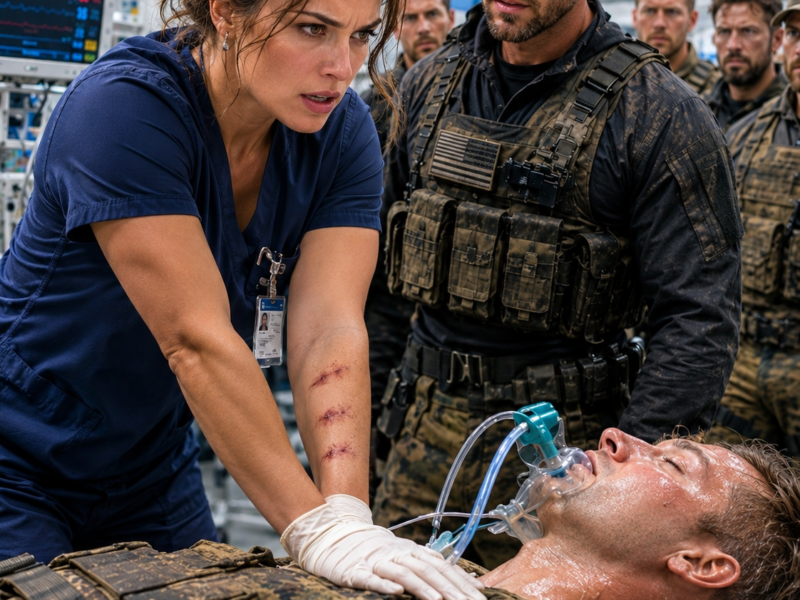
The soldier was losing his life in a Georgia hospital when the night-shift nurse did something that made a former Special Forces medic stop breathing for a moment
The morning shift was beginning to arrive when Laurel Mets walked away from the waiting room.
Behind her, Donovan Ree remained seated beneath the fluorescent lights, his hands resting on his knees. He watched the automatic doors close and wondered whether he had just met someone who had spent years trying to become invisible.
Staff Sergeant Briggs stood near the entrance to the waiting area.
“Who was that?”
Ree didn’t immediately answer.
“She’s the charge nurse.”
Briggs looked toward the doors.
“I gathered that. I mean, who is she really?”
Ree glanced at him.
“That’s all you need to know.”
Briggs studied his face, recognized the end of the conversation, and let it go.
But Ree couldn’t.
For the next several days, he kept thinking about Laurel Mets.
He had seen extraordinary medical professionals during his military career. Some were brilliant because they had exceptional training. Others were brilliant because they had spent years learning how to remain functional when everything around them was falling apart.
Laurel belonged to the second category.
There was something about her movements that didn’t come from working in a hospital.
It was the way she positioned herself in the trauma bay. The way she assessed the room before concentrating on the patient. The way she never seemed to waste a movement, even when the situation became chaotic.
And then there were the three scars.
Ree knew better than to confuse a collection of clues with proof. He also knew that certain combinations of details were too specific to dismiss.
He had seen that vaccination pattern before.
He had heard those words before.
And he had received a message that told him more than an official confirmation ever could.
Her name did not appear in any database the contact could access.
That was not the same as saying Laurel Mets had never existed.
It meant there were places where ordinary searches ended.
And people who knew how to look beyond them.
Laurel arrived home shortly after seven that morning.
Her gray pickup sat in the driveway of a modest rental house on the outskirts of town. The house had two bedrooms, a small kitchen, and a back porch that needed repainting.
Nothing about it suggested that its owner had ever lived an extraordinary life.
There were no military photographs on the walls. No medals displayed in a case. No framed certificates from institutions that would have impressed people who knew their significance.
The living room contained a couch, a bookshelf, and a television that Laurel rarely watched.
She placed her keys in a ceramic bowl beside the door.
Then she removed her shoes.
Her feet hurt.
That was the first thing she noticed after a long shift.
The second was the silence.
She stood in the kitchen for several seconds, listening to the refrigerator hum.
For most people, silence was simply the absence of noise.
For Laurel, it was something she had deliberately built.
She made coffee, though she knew she should have gone straight to bed. She stood by the kitchen window and watched the morning fog lift from the neighboring yards.
Her thoughts returned to Donovan Ree.
He had recognized the sequence.
He had recognized the language.
And he had seen the scars.
She had known that someone would eventually recognize something. The past was not erased simply because a person stopped talking about it.
Still, she hadn’t expected it to happen in a hospital in Georgia.
She took her coffee to the bedroom and opened the bottom drawer of her dresser.
Inside was a small envelope.
It contained several documents, a folded photograph, and an old identification card that had not been used in years.
Laurel didn’t take them out.
She simply looked at the envelope.
Then she closed the drawer.
There had been a time when she believed that leaving would be the hardest part.
She had been wrong.
Leaving was a decision.
Staying away was a discipline.
And building an ordinary life afterward required a different kind of courage.
She turned off the bedroom light and went to sleep.
Three days later, Donovan Ree returned to Halford Regional.
His arm had been cleaned and properly dressed. The cut above his eyebrow was healing, and the physician had finally convinced him that ignoring an injury didn’t make it disappear.
He had another reason for visiting.
Specialist Greer was still recovering, and Ree wanted to check on him before the unit returned to its regular schedule.
He found Greer sitting upright in his hospital bed, looking considerably better than he had on the night of the convoy.
A television was playing quietly in the corner.
“You look terrible,” Ree said.
Greer smiled.
“Good to see you too, Sergeant.”
“How’s the breathing?”
“Better.”
“Pain?”
“Enough to keep me from getting comfortable.”
“Then you’re probably doing fine.”
Greer laughed, then shifted carefully against the pillows.
“Did they tell you anything about what happened?”
“You’re alive. That’s the important part.”
Greer looked down at the blanket.
“I heard somebody say my oxygen was in the seventies.”
“It was.”
“That sounds bad.”
“It was.”
Greer shook his head.
“I don’t remember much. Just somebody telling me to breathe.”
Ree nodded.
He didn’t explain how close the young soldier had come to dying.
He didn’t describe the moment Laurel relieved the pressure in his chest.
And he didn’t tell him about the woman who had performed the procedure.
Greer had enough to process without hearing a story about a mysterious nurse.
Before leaving, Ree asked whether Greer’s wife had visited.
“Yesterday,” Greer said. “She brought pictures of Willa.”
He smiled.
“She’s getting bigger every time I see her.”
Ree looked at him for a moment.
“Make sure you get home to watch that happen.”
Greer nodded.
“I intend to.”
That evening, Laurel returned to work.
April Quan was waiting at the nurses’ station with a cup of coffee and a stack of charts.
“You’re back.”
“Apparently.”
April smiled.
“How’s your day off?”
“Quiet.”
“Good. You needed one.”
Laurel checked the staffing schedule.
April leaned closer.
“By the way, that soldier from Thursday? The one with the chest injury? He’s doing better.”
“I heard.”
“His family came in yesterday. His wife was asking who treated him.”
Laurel continued reading.
“Did she get an answer?”
“She got the names of the attending physician and the nurses on duty.”
“Good.”
April watched her for a moment.
“You really don’t like attention, do you?”
Laurel looked up.
“Is there a reason I should?”
April laughed.
“Most people would want someone to know they helped save a life.”
Laurel returned her attention to the paperwork.
“His family knows he’s alive. That’s enough.”
April didn’t argue.
She had worked beside Laurel long enough to understand that some questions weren’t invitations to continue.
The shift began.
A patient arrived with abdominal pain. Another needed medication adjusted. A family member became upset about a delayed test.
The hospital moved through its ordinary rhythm.
Laurel moved with it.
Nobody looking at her would have guessed that three nights earlier, she had recognized a dying soldier’s physiology before the physician reached the bedside.
Nobody would have guessed that a former Special Forces medic had spent an entire night wondering where she had learned to do it.
And Laurel intended to keep it that way.
Donovan Ree, however, was having difficulty returning to ordinary business.
A week after the incident, he contacted the same person he had messaged on the night of the convoy.
He didn’t ask for Laurel’s personnel file.
He didn’t request a photograph or a service record.
He simply wrote:
I need to know whether there is anything I should be concerned about regarding the nurse at Halford Regional.
The response came the following afternoon.
There is no indication of a current threat. Do not pursue the matter through ordinary channels.
Ree read the message twice.
Then another message appeared.
If she is who you suspect, she has already been through more than enough.
That was all.
Ree leaned back in his chair.
He had expected a warning, perhaps even an instruction to stop asking questions.
Instead, he had received something that sounded almost like respect.
He considered sending another message.
He didn’t.
For the first time since that Thursday night, he began to understand that his curiosity might be the one thing that could cause trouble.
He had recognized Laurel.
But recognition did not give him ownership of her story.
Two weeks passed.
Laurel continued working nights.
She treated a diabetic patient whose blood sugar had become dangerously unstable. She helped a young nurse through her first difficult pediatric emergency. She spent twenty minutes explaining medication instructions to an elderly man whose daughter couldn’t be present.
She did all of it without expecting recognition.
Then, one Tuesday evening, April noticed something unusual.
Laurel was standing near the staff entrance, looking at a man in a dark jacket who had just walked into the hospital.
He wasn’t wearing a uniform.
He wasn’t carrying medical equipment.
And he didn’t appear to be visiting a patient.
He spoke briefly with the receptionist, who pointed toward the nurses’ station.
Laurel’s expression remained unchanged.
But April noticed that her shoulders had become still.
“Do you know him?” April asked.
Laurel looked away.
“No.”
The man approached.
“Ms. Mets?”
“Yes?”
“My name is Daniel Voss. I’d like a moment of your time.”
Laurel didn’t move.
“Is this about a patient?”
“No.”
“Then you’ll need to speak with hospital administration.”
Voss glanced toward the waiting room.
“I think this is something you’d prefer to discuss privately.”
April looked between them.
Laurel closed the chart she was holding.
“April, can you cover the station for a few minutes?”
“Of course.”
Laurel followed Voss into a small consultation room.
He waited until the door closed.
Then he placed a plain envelope on the table.
Laurel looked at it but didn’t touch it.
“Where did you get my name?”
“From someone who knew where to look.”
“That doesn’t answer my question.”
Voss nodded.
“You’re right.”
He sat down.
“I was asked to confirm that you were safe and that no one had approached you improperly.”
Laurel’s expression hardened slightly.
“Who asked?”
“Someone who was concerned.”
“That’s not an answer either.”
Voss studied her.
“You haven’t changed much.”
Laurel remained standing.
“You’re mistaken. I changed everything.”
He looked down at the envelope.
“I believe that.”
For several seconds, neither spoke.
Then Laurel asked the question she had been avoiding.
“Does anyone else know?”
“Not that I’m aware of.”
“Then why are you here?”
Voss took a breath.
“Because the man who contacted you through the hospital is not the only person who remembers that work.”
Laurel’s eyes shifted toward the envelope.
“What do you want?”
“Nothing.”
“People don’t travel to a hospital to deliver nothing.”
Voss almost smiled.
“I wanted to tell you that your decision has been respected.”
Laurel looked at him.
“By whom?”
“By the people who still understand what happened.”
She finally picked up the envelope.
It was sealed.
She turned it over.
There was no return address.
Inside was a single sheet of paper with a short handwritten message.
You gave everything you were asked to give. No one has the right to ask for more.
There was no signature.
Laurel read it once.
Then she folded the paper and returned it to the envelope.
“Thank you,” she said.
Voss stood.
“There’s one other thing.”
She waited.
“The soldier from the convoy, Specialist Greer, is recovering well.”
“I know.”
“He has a wife and a daughter.”
“I know that too.”
Voss nodded.
“Then you understand why I came.”
Laurel placed the envelope in her pocket.
“No,” she said. “I understand why you think you came.”
He accepted the distinction.
Then he left.
Laurel remained in the consultation room for another minute before returning to the nurses’ station.
April looked up.
“Everything okay?”
“Yes.”
“Who was he?”
“Someone from a long time ago.”
April nodded.
She didn’t ask anything else.
That night, Ree received a call from an unfamiliar number.
He answered cautiously.
“Ree.”
“Master Sergeant.”
The voice was familiar.
He sat straighter.
“Voss?”
“Yes.”
Ree looked toward the door of his quarters.
“What’s going on?”
“Nothing you need to worry about.”
“That usually means I should worry.”
Voss gave a short laugh.
“You have a talent for making simple conversations difficult.”
“What’s this about?”
“I spoke with her.”
Ree was silent.
“And?”
“She is fine.”
“Did she say that?”
“She didn’t need to.”
Ree understood.
There was a particular way of assessing another person that required no formal questions. He had learned it in places where words could be dangerous and expressions often revealed more than answers.
“Did you tell her I contacted you?”
“No.”
“Good.”
A pause followed.
Then Voss said something that made Ree look down at his hands.
“Donovan, if you ever have to work beside someone like her again, remember something.”
“What?”
“Some people survive by becoming visible. Others survive by deciding that nobody needs to know they exist.”
Ree said nothing.
“Don’t confuse the second kind with weakness.”
The call ended.
By late April, Specialist Greer was home.
He was still recovering. His movements were slower than before, and certain tasks left him exhausted.
But he was alive.
His wife had arranged his medication on the kitchen counter. Willa slept in a small crib near their bedroom, unaware of how close she had come to growing up without her father.
One afternoon, Greer sat at the kitchen table with a blank thank-you card.
He had been thinking about the hospital.
He remembered fragments.
The cold ambulance bay.
The bright lights.
A voice telling someone to move faster.
A hand holding his shoulder.
He didn’t remember the face.
His wife sat across from him.
“What are you writing?”
“A thank-you note.”
“To the hospital?”
“Yeah.”
He looked at the card.
“I don’t remember the names.”
“That’s okay. You can address it to the staff.”
Greer nodded.
He wrote slowly.
He thanked the emergency department for treating him. He thanked the nurses for staying with him. He thanked the doctors and paramedics who had worked to keep him alive.
Then he added one more sentence.
I don’t remember much about that night, but I remember someone staying calm when I couldn’t. I hope she knows what that meant to my family.
He signed his name.
His wife read it.
“That’s nice.”
Greer looked toward the nursery.
“She’ll ask about this someday.”
“Who?”
“Willa.”
His wife smiled.
“About what?”
“Why I have a scar on my chest. Why I couldn’t carry her for a while. Why everybody was so happy when I came home.”
He looked at the card.
“I want to remember enough to tell her properly.”
The card arrived at Halford Regional three days later.
April opened the mail at the nurses’ station and read it during a quiet moment.
She smiled.
“That’s sweet.”
Laurel was reviewing a medication order.
April placed the card beside her.
“Look.”
Laurel read it.
She didn’t say anything for a moment.
Then she folded the card carefully and placed it on the desk.
“That’s nice,” she said.
April tilted her head.
“You saved him, you know.”
“The team saved him.”
“You know what I mean.”
Laurel continued reviewing the chart.
April waited.
Finally, Laurel said, “His daughter gets to grow up with her father. That’s what matters.”
April looked at the card again.
“Still. It’s nice when someone remembers.”
Laurel didn’t answer.
But she kept the card.
It remained in the top drawer of her desk for several weeks.
Not because she needed recognition.
Because it reminded her of something she had once struggled to believe.
That the work could matter without the world knowing who had done it.
Donovan Ree visited Halford Regional one final time in early May.
He had no medical reason to be there.
He had simply found himself passing through town and decided to stop.
Laurel was at the nurses’ station.
She looked up when he approached.
“Master Sergeant.”
“Ms. Mets.”
“You’ve healed.”
“Mostly.”
“That’s good.”
He glanced at the desk.
A folded card lay beside her medication log.
“Greer’s?”
“Yes.”
“His wife sent it?”
“He sent it himself.”
Ree nodded.
For a moment, they stood without speaking.
Then he said, “He’s home.”
“I heard.”
“His daughter is doing well.”
Laurel smiled faintly.
“Good.”
Ree looked at her.
“I never told anyone what I recognized.”
“I know.”
He wasn’t surprised by her answer.
“How?”
“You wouldn’t be standing here if you had.”
Ree considered that.
“Fair enough.”
He looked toward the trauma bay.
The same room where Greer had arrived in critical condition. The same room where Laurel had worked with the kind of precision that had unsettled him.
“I’ve seen a lot of people who could do what you did,” he said.
Laurel waited.
“But not many who could do it and walk away like it was just another shift.”
She placed her pen on the desk.
“That’s because it was another shift.”
Ree smiled.
“You’re good at that.”
“At what?”
“Making a complicated thing sound simple.”
Laurel looked at him steadily.
“Sometimes simple is the only way to carry something without letting it take over everything else.”
Ree understood more than he wanted to.
He nodded.
Then he asked the question he had wanted to ask since the night of the convoy.
“Do you miss it?”
Laurel looked toward the trauma bay.
A nurse was adjusting a monitor. Another was preparing a patient for transport. Somewhere down the hall, a child was crying.
For a moment, she seemed to be listening to all of it.
Then she answered.
“I miss the people.”
Ree waited.
“Not the work?”
“No.”
She considered the question.
“I don’t miss the circumstances. I don’t miss the uncertainty. I don’t miss what happens when people are forced to discover how much they can endure.”
She looked back at him.
“But I remember the people.”
Ree nodded slowly.
He had expected that answer.
He also knew there was more she wasn’t saying.
He didn’t ask.
Instead, he held out his hand.
Laurel shook it.
“Take care of yourself, Master Sergeant.”
“You too, Ms. Mets.”
He turned toward the exit.
Halfway down the corridor, he stopped and looked back.
“Laurel?”
She raised her eyes.
“Thank you.”
She gave him a small nod.
Then she returned to her work.
Years earlier, Laurel had been taught that a good medic never allowed personal feelings to interfere with the task.
It was a useful lesson.
It was also incomplete.
She had learned that the people who survived were not simply the ones whose injuries were treated correctly.
They were the ones who had someone waiting for them.
A spouse.
A child.
A parent.
A friend.
Someone who would notice an empty chair.
Someone who would keep looking at the door.
Someone who would remember their voice.
That Thursday night, when Specialist Greer arrived at Halford Regional, Laurel had not thought about medals, records, or the people who might someday recognize her.
She had seen a young man whose body was failing.
She had seen a problem that needed to be solved.
And she had done what she knew how to do.
Nothing more.
Nothing less.
Her coworkers continued to see her as the quiet night charge nurse who drove an old gray pickup and never discussed her personal life.
April still occasionally tried to persuade her to join the nurses for breakfast after a shift.
Dr. Harrington still complained about the hospital coffee.
The emergency department continued to receive patients at all hours, often in circumstances nobody could have predicted.
And Laurel continued showing up.
She never displayed the old identification card.
She never explained the three scars.
She never told her colleagues about the foreign words she had whispered beside a dying soldier.
The envelope from Daniel Voss remained in the bottom drawer at home.
The thank-you card from Greer stayed in her desk.
Sometimes, during particularly difficult nights, she would open the drawer and read the final sentence.
I hope she knows what that meant to my family.
She did.
That was enough.
In November, Specialist Greer’s daughter celebrated her first birthday.
Her name was Willa.
There were balloons in the living room, a small cake on the table, and photographs taken by relatives who wanted to remember every moment.
Greer sat in a chair with his daughter on his lap.
His recovery had taken longer than expected, but he was back to work and had regained most of his strength.
At one point, his wife noticed him watching Willa play with a ribbon.
“What are you thinking about?” she asked.
He smiled.
“That I almost missed this.”
She sat beside him.
“You didn’t.”
“No.”
He looked down at his daughter.
“I didn’t.”
Later that evening, after everyone had gone home, Greer placed Willa in her crib.
He watched her sleep.
Then he thought about the hospital again.
He still couldn’t remember the nurse’s face.
But he remembered the voice.
Calm.
Certain.
Unhurried in a room where everyone else seemed to be moving too fast.
He wondered whether she was still working nights.
He wondered whether she had ever read his card.
And he hoped she had.
At Halford Regional, Laurel was working another Thursday night.
It was nearly midnight when a new patient arrived.
An elderly man had fallen at home and injured his shoulder. His wife followed the paramedics into the emergency department, frightened and struggling to keep up.
Laurel approached the bed.
She checked the patient’s breathing, examined the injury, and asked the questions necessary to understand what had happened.
Then she turned toward his wife.
“He’s in the right place,” she said. “We’ll take care of him.”
The woman nodded, visibly relieved.
Laurel returned to the chart.
Outside, the parking lot was quiet.
The hospital lights reflected off the wet pavement. Somewhere beyond the ambulance bay, a truck passed on the highway.
Another night had begun.
Another patient needed help.
Another family was waiting for someone to come home.
And Laurel Mets was exactly where she had chosen to be.
Not because anyone had ordered her there.
Not because she expected gratitude.
Not because she wanted the past to return.
She was there because, after everything she had seen and everything she had left behind, she had discovered that helping people did not need to be complicated.
The work could be ordinary.
The setting could be ordinary.
The people around her could know almost nothing about who she had once been.
And the difference she made could still be enormous.
Donovan Ree never told Briggs who Laurel Mets really was.
He never shared the message from his encrypted contact. He never described the three scars or the words she had whispered over Greer’s hospital bed.
When someone occasionally mentioned the night charge nurse who had saved a soldier’s life, he simply nodded.
He had learned something from Laurel.
There was a difference between honoring someone’s service and demanding that they explain it.
Some people wanted their names remembered.
Others wanted their work to speak for itself.
And some had given so much that the greatest kindness anyone could offer was to let them live quietly.
Ree understood that.
He had spent years carrying memories he rarely discussed. He knew what it meant to leave a world that had shaped every part of you and then attempt to build another one.
He also knew that a person didn’t become less extraordinary simply because the world stopped noticing.
Specialist Tomas Greer went home to his wife and daughter.
Laurel returned to her night shifts.
Donovan Ree returned to his unit.
The hospital kept running.
And the official records remained exactly as they were.
Laurel Mets was a charge nurse at Halford Regional Medical Center.
She was 38 years old.
She drove a gray pickup.
She preferred quiet mornings and kept her personal life private.
Those facts were all true.
They were also nowhere near the whole story.
But perhaps that was the point.
Not every person who has done extraordinary things wants to be remembered for them.
Sometimes the greatest achievement is not returning to the battlefield, receiving recognition, or hearing your name spoken with admiration.
Sometimes it is walking into an ordinary hospital on an ordinary night, seeing someone who needs help, and knowing that you still have something valuable to give.
Without asking who will notice.
Without asking who will remember.
Without asking for anything in return.
And somewhere in a small Georgia hospital, beneath fluorescent lights that never quite stopped humming, a woman with three small scars on her forearm continued doing exactly that.
She was simply the night charge nurse.
For the people who understood, that was more than enough.
The end.









