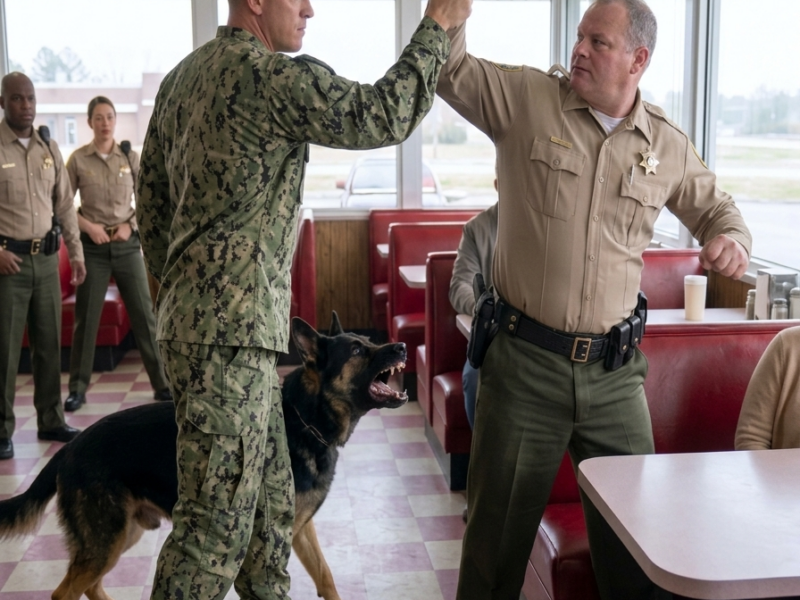
The sheriff raised his hand to slap me outside the courthouse in Savannah, Georgia, while everyone watched in silence, but before his palm reached my face
The morning sun over Savannah, Georgia, was thick and heavy, hanging in the air like a wet wool blanket that smelled of stagnant river water and diesel exhaust. Outside the Chatham County Courthouse, white marble steps stretched up toward Greek columns, reflecting a harsh, blinding glare.
I stood on the fourth step from the bottom, my knuckles white as I gripped the worn leather straps of my purse. My heart rattled against my ribs like a trapped bird.
Sheriff Thomas Cole stood two steps above me. He was a broad-shouldered man with a neck thicker than his head, his tan uniform pressed so sharp the creases looked like blades. For twenty years, Cole had run Chatham County like a personal fiefdom. His family had owned timber mills and riverfront property since before the Civil War, and his badge was less a public trust than an inherited signet ring.
“You need to learn your place, Denise,” Cole said. His voice was a low, gravelly rasp that barely carried past the two deputies flanking him, but every person gathered on the sidewalk heard it.
Lawyers carrying leather briefcases, court clerks on smoking breaks, and local shopkeepers taking the morning air had all stopped. In Savannah, when Sheriff Cole raised his voice, people paid attention.
I kept my chin up, though my knees felt hollow. “I know exactly where I belong, Sheriff. Inside that clerk’s office, filing a report for the stolen estate documents and the land deeds taken from my mother’s home three nights ago.”
Cole’s jaw tightened. A dark, flush of red crept up from his collar, painting his thick neck and jaw. He took one step down, closing the distance between us until I could smell the stale coffee and tobacco on his breath.
“Your mother was a confused old woman who died of a heart attack, Denise,” Cole sneered, his voice dropping to a harsh whisper meant only for me. “And you’re turning into a hysterical nuisance. I’m giving you one warning. Get off these steps, get in your car, and leave town before I find a reason to throw you in a cell.”
“I’m not leaving,” I said, my voice steady despite the sheer terror clawing at my throat. “Not until I find out who broke into her house while her body was still at the funeral home.”
Cole didn’t answer with words.
His eyes narrowed to thin slits. He pulled his right hand back, his thick, heavy palm swinging upward in an arc aimed directly at my face. It was a open-handed strike meant to humiliate, to break my posture in front of half the town.
I flinched, pulling my shoulders tight, my eyes squeezing shut as I braced for the impact.
The slap never came.
Instead, a sudden, explosive rush of movement cut through the muggy air, accompanied by a sound so primal and terrifying it froze every breath on those marble steps.
A massive German Shepherd launched himself up the stairs. He didn’t bark. He didn’t snap his jaws violently in the air. He surged forward in a blur of black and tan fur, landing squarely between Cole and me. His massive front paws struck the stone with a heavy, hollow thud.
The dog stopped inches from the sheriff’s knees, his chest deep and broad, his back locked into a rigid line of absolute combat readiness. A guttural vibration rattled from his throat—a low, rhythmic growl that vibrated straight through the stone steps into the soles of my shoes.
Sheriff Cole froze mid-swing, his hand hovering in the empty air, his face draining of color as he looked down into a pair of dark, unblinking eyes.
“Back up,” a voice said.
The command was spoken softly, almost lazily, but it carried an authority that cut through the humid silence like a razor.
I opened my eyes and looked down the steps.
Standing at the base of the staircase was a man holding a heavy tactical leash. He wore a faded gray Navy SEAL sweatshirt with the sleeves pushed up to his forearms, dark jeans, and worn combat boots. He was tall—easily six-foot-two—with broad shoulders, a lean frame, and a dark beard trimmed tight to a sharp jawline. His eyes were a pale, piercing gray, completely unbothered by the morning sun or the three armed lawmen standing above him.
Cole swallowed hard, his hand slowly descending to hover two inches above his sidearm holster. His deputies moved instinctively, their leather holsters creaking as their hands rested on their batons.
“You don’t want trouble here, veteran,” Cole growled, trying to recover his posture, though his eyes remained glued to the dog’s bared teeth.
The man in the gray sweatshirt didn’t move an inch. He didn’t reach for a weapon. He simply flicked his thumb against the leather leash.
“Neither does he,” the man replied quietly. “But if your palm touches her skin, he won’t wait for my word. And I won’t stop him.”
The crowd on the sidewalk began whispering, a low rustle of murmur passing through the onlookers.
I looked down at the German Shepherd standing inches from my legs. The dog’s ears were pinned forward, his dark coat gleaming in the sunlight. Across his left ear was a distinct, jagged scar—a hairless white line that ran from the tip down to the cartilage, splitting the dark fur.
My breath hitched in my throat. I knew that scar.
My mother, Elena Carter, had spent fifteen years working as a head physical therapist and trauma specialist at the Hunter Army Airfield civilian rehabilitation facility. She worked with wounded soldiers returning from Iraq and Afghanistan, but her real passion had been the K9 handler units. She spent her weekends working with retired military working dogs who were too psychologically damaged to be re-homed.
She had talked about one dog constantly during the winter of 2024. A specialized multi-purpose canine assigned to a Navy Special Warfare element. A dog named Ghost.
Ghost was supposed to have been euthanized after a mortar strike in Syria left his handler dead and the dog severely traumatized. My mother had fought the contractor board for three months to take custody of him. But two years ago, right as the paperwork was cleared, Ghost had vanished from the airfield kennels overnight. The official report said he had escaped into the marshlands and drowned.
My mother had wept for a week.
The dog shifted his weight, pressing his heavy flank against my shin. He didn’t look back at me, but his presence was a solid, warm wall of protection.
The man walked up the steps, his boots striking the marble in a steady, measured rhythm. The two deputies stepped back slightly, instinctively giving him space.
He stopped two steps below me, his gray eyes locking onto my face.
“Your mother was Elena Carter?” he asked.
My lips trembled. “Yes. I’m Denise.”
The man reached inside the inner pocket of his faded sweatshirt and pulled out a small, square glassine envelope—the kind used by military medical units to store physical records. It was yellowed at the edges and sealed with red electrical tape.
“She told me to give you this if anything ever happened to her,” he said softly.
My hands shook so violently I nearly dropped the envelope as he handed it to me. I peeled back the sticky tape with a fingernail and pulled out a single photograph.
It showed my mother standing in a sunlit pine forest behind our old house in Tybee Island. She was smiling, her arm wrapped around the neck of the same massive German Shepherd sitting beside me now. On the back of the photograph, written in my mother’s neat, flowing cursive ink, were five words:
Trust the man with Ghost.
A cold, sharp shiver ran down my spine, washing away the humid heat of the Georgia morning.
I looked up at the man. “Who are you?”
His eyes flicked past my shoulder, locking onto Sheriff Cole, who was watching us like a cornered animal.
“My name is Daniel Hayes,” he said quietly. “Former Chief Petty Officer, SEAL Team 7. Your mother saved my life six years ago when the Navy doctors said I’d never walk again.”
Sheriff Cole stepped forward, his boots heavy on the stone, his face contorting into an expression of sheer authority. “I don’t give a damn who you are or what team you served with, mister. This is Chatham County. You are interfering with an official investigation, and you’re harboring a dangerous animal. Hand over that dog and step aside, or I’ll have my deputies put you both on the pavement.”
Daniel didn’t flinch. He didn’t even look at Cole’s weapon. He leaned in slightly toward me, his voice dropping to a low tenor that only I could hear over the hum of the city traffic.
“Your mother wasn’t robbed, Denise,” Daniel said. His eyes were cold, hard, and terrifyingly certain. “And she didn’t die of a heart attack.”
He looked directly at Cole.
“She was silenced.”
Behind us, at the top of the courthouse steps, Ghost let out a sharp, sudden bark that echoed off the white marble pillars like a pistol shot.
The heavy brass doors of the courthouse swung open. Three men in crisp dark suits, wearing yellow visitor badges and carrying leather document cases, walked out onto the plaza. They stopped dead when they saw the scene unfolding on the stairs.
Sheriff Cole’s face went completely ash-white. His hands dropped away from his belt, his shoulders sagging as if he had just been struck by a physical blow.
“Federal prosecutors,” Daniel muttered under his breath, his gray eyes tracking the men in suits. “They’ve been auditing the county land records for six weeks. Cole knew your mother had the original deeds to the marshland reserves—the ones his family illegally sold to a foreign logistics firm.”
The puzzle pieces of the last three days began to slam together in my mind with brutal, terrifying clarity. My mother’s sudden “stroke” while working alone in her garden. The ransacked study. The missing iron box from beneath her floorboards. The sheriff showing up at her house twenty minutes before the ambulance arrived, claiming he was just “checking in.”
“My mother…” My voice broke. “They killed her?”
“They tried to bury her truth,” Daniel corrected softly.
He stepped up onto the stair beside me, placing his large, calloused hand lightly on my shoulder. The contact was solid, grounded, and steadying.
“There’s one more thing your mother never told you, Denise,” Daniel whispered, his gaze dropping to the scar on Ghost’s ear before rising back to meet my eyes.
Ghost pressed his heavy shoulder firmly against my knees, resting his chin against my forearm.
Daniel lowered his voice until it was barely a whisper against the morning breeze.
“Your father didn’t die in that boating accident twenty years ago. He’s still alive. And he’s the reason Ghost came back.”
The hum of the tires on the asphalt was the only sound inside Daniel’s beat-up dark green Ford F-150 as we sped east toward Tybee Island.
In the back seat, Ghost sat with his head resting between the two front bucket seats, his dark eyes watching the side mirror with relentless vigilance. Every few minutes, he would press his wet snout against my shoulder, letting out a soft, hot breath that reminded me I was still alive.
I gripped the edge of the dashboard, watching the low, flat salt marshes of the Georgia coast fly past the window. The gray water of the tidal creeks snaked through the tall Spartina grass like silver ribbons under the mid-day sun.
“Start from the beginning,” I said, turning to Daniel. My voice felt dry, like swallowing sand. “You said my father is alive. My father was Richard Carter. He was a marine biologist who drowned in the Wilmington River when I was six years old. They found his boat capsized near the sound.”
Daniel kept his eyes fixed on the narrow two-lane highway ahead. His hands rested on the steering wheel at ten and two—steady, relaxed, but ready to react.
“They found his boat,” Daniel said flatly. “They never found his body.”
“That happens in the marshes!” I insisted, my voice rising as panic threatened to break through my composure. “The tides out here can carry a body into the deep Atlantic in six hours! The police report—”
“The police report was written by Thomas Cole,” Daniel interrupted, flicking his gray eyes toward me for a fraction of a second. “Cole was a senior detective back then. Your father wasn’t just a biologist, Denise. He was working for the State Department’s environmental crime division. He was investigating an illegal deep-water dumping operation run by a coalition of local politicians and private defense contractors.”
I sat back in the vinyl seat, my brain spinning.
I remembered my father dimly—a tall man with sun-bleached hair who smelled of salt water, old paper, and cedarwood. I remembered him sitting at his desk in our old river house, writing furiously in leather-bound notebooks while radio static hummed in the background.
“If he survived,” I whispered, “why didn’t he come back? Why did he leave my mother and me alone for twenty years?”
“Because staying dead was the only way to keep you alive,” Daniel said quietly. “Cole’s people threatened to burn your mother’s house down with you inside it if Richard ever set foot in Chatham County again. So he went underground. He lived under an assumed identity in South America for fifteen years, working as a maritime surveyor. But he stayed in touch with one person.”
“My mother,” I realized.
“Your mother,” Daniel nodded. “She was his operative on the ground. She stayed in Savannah, played the quiet, grieving widow, and spent twenty years slowly gathering the physical paper trail—land titles, corporate registries, toxic dump logs—that Cole and his partners thought had been destroyed.”
Ghost let out a low, whimper-like whine from the back seat, pushing his snout further between us. I reached back and buried my fingers in his thick fur, feeling the steady, rhythmic pulse of his heart.
“Where is he now?” I asked.
Daniel didn’t answer immediately. He turned the truck off the main highway onto a rutted gravel lane that led deep into a hammock of maritime forest—dense live oaks draped in thick grey blankets of Spanish moss. The trees met overhead, casting long, dark shadows across the windshield, cutting off the bright glare of the Georgia sun.
“He came back three weeks ago,” Daniel said, slowing the truck as we approached an old, rusted iron gate marked with a faded NO TRESPASSING sign. “His health is failing. He knew Cole was preparing to sell the final portion of the marshland reserves to a foreign buyer, which would have permanently sealed the land titles and buried the evidence forever. He came back to finish what he started.”
Daniel reached out, pressed a button on a black remote clipped to his visor, and the heavy iron gate swung open with a screech of rusted hinges.
We pulled up to an old salt-bleached wooden cottage sitting on concrete stilts above the marsh grass. The house looked abandoned—screens torn, paint peeling, the tin roof rusted to a dark reddish-brown. But as Daniel parked the truck beneath the oak canopy, I noticed subtle details.
Thermal reflective film on the inside of the dark windows. Two high-definition security cameras concealed inside hollowed-out birdhouses hanging from the trees. A reinforced steel door set into the weathered wooden frame.
“This was your mother’s safe house,” Daniel said, turning off the ignition. “She built it under a shell company fifteen years ago. Nobody in the county knows it exists except me, Richard, and Ghost.”
Ghost didn’t wait for us. The moment Daniel unlocked the truck doors, the German Shepherd slipped out, trotting forward to take up a guard position at the base of the wooden steps leading up to the house. His nose worked the humid air, sweeping left to right, testing every draft coming off the marsh.
We climbed the stairs. Daniel unlocked the heavy steel door using an electronic keypad hidden behind a loose piece of cedar siding.
The door opened into a cool, air-conditioned space that looked nothing like an abandoned fishing shack.
The interior was a high-tech command post. Three large computer monitors glowed on a long plywood table, displaying live satellite feeds of the Savannah riverfront and Chatham County courthouse. Filing cabinets lined the walls, filled with color-coded folders.
Sitting in a heavy leather armchair in the corner of the room, lit only by the blue glow of the monitors, was an old man.
He was thin—frighteningly thin—his frame swallow-tailed under an oversized flannel shirt. His hair was pure snow-white, his skin lined with deep, sun-etched wrinkles. Oxygen tubing ran into his nose from a small portable concentrator humming beside his chair.
At the sound of the door closing, the man turned his head slowly.
His eyes were the exact same shade of pale blue as mine.
He stared at me through the dim blue light, his lower lip trembling violently. He raised one thin, liver-spotted hand, his fingers shaking in the cool air.
“Denise,” he rasped, his voice a dry, papery whisper that sounded like wind rustling through dead grass. “My sweet girl…”
My knees gave way. I dropped my purse on the floor and stumbled across the room, collapsing onto my knees beside his chair. I took his cold, thin hand in both of mine, tears finally breaking through my dam of control, streaming down my cheeks.
“Dad?” I sobbed. “Is it really you?”
He pulled me close, resting his frail chin on the top of my head. He smelled of menthol, rubbing alcohol, and that same old cedarwood I remembered from twenty years ago.
“I’m so sorry,” he wept quietly into my hair. “I’m so sorry I had to leave you in the dark, baby. I’m so sorry about your mother…”
“She loved you,” I sobbed, holding his frail body tight, terrified that if I let go he would turn into a ghost again. “She never stopped talking about the work you did.”
“She was braver than any of us,” my father whispered. “She held the line while I was running in the dark.”
Daniel stood by the door, his arms crossed over his chest, his face shadowed as he watched us. Ghost walked over to my father’s chair, resting his scarred head gently on the old man’s knee, letting out a soft, contented sigh.
“We don’t have much time, Richard,” Daniel said softly, breaking the emotional silence. “Cole knows Denise was at the courthouse. He saw the federal prosecutors. He’s going to panic.”
My father pulled back, wiping a tear from his eye with a trembling thumb. His expression hardened, the frail old man suddenly replaced by the sharp, ruthless investigator he had once been.
“Let him panic,” my father said, his voice regaining a sliver of its old authority. “The federal prosecutors have already issued sealed indictments for the land fraud. But we need the physical master key—the encrypted hard drive your mother hid before she was taken.”
I looked at my father, my breath catching in my throat. “The iron box under her study floorboards was empty, Dad. When I went back to the house after the funeral, the locks were broken and the box was gone.”
My father smiled—a thin, bitter turn of his lips.
“That iron box was a decoy, Denise,” he said softly. “Your mother knew Cole’s deputies would search the house the moment she was gone. She didn’t hide the drive under the floor.”
He reached out and touched the scarred left ear of the German Shepherd sitting beside him.
“Ghost carried it out three nights ago.”
The sun dipped below the horizon, painting the coastal sky in streaks of deep crimson, bruised purple, and indigo. Night fell fast over the Georgia marshes, bringing with it a wall of darkness interrupted only by the distant, rhythmic flash of the Tybee Island lighthouse.
Inside the safe house, Daniel was preparing tactical gear on the plywood table.
He moved with the practiced, silent efficiency of a man who had spent a decade operating in the darkest corners of the world. He checked the action on a suppressed 9mm pistol, sliding a loaded magazine into the grip with a soft click. He strapped a tactical knife to his chest rig and adjusted the night-vision optics mounted to a lightweight helmet.
I stood near the window, watching him. “Where did she hide it?”
Daniel glanced up from his gear. “Ghost’s collar. When your mother realized her health was failing and Cole’s men were watching her house 24/7, she didn’t risk digital transmissions. She used a micro-SD drive embedded inside the leather lining of Ghost’s tactical harness. The dog was trained to trek six miles through the marsh creeks from her house to this safe house using established game trails.”
“That’s why Ghost disappeared two years ago,” I realized, the picture finally coming into full focus. “He didn’t drown. You and my mother faked his disappearance so he could be used as a blind courier.”
“Ghost was a tactical asset,” Daniel said, cinching a strap on his chest. “In Syria, he was trained to carry encrypted intelligence drives through enemy territory when satellite communications were jammed. To Cole’s deputies, he was just an old, runaway war dog. To us, he was the only un-hackable data channel in Chatham County.”
My father leaned forward in his armchair, tapping a keyboard on the center monitor.
The screen flickered to life, showing a complex schematic of a deep-water shipping terminal located four miles upriver along the Savannah River channel—the Ogeechee Maritime Terminal.
“This is where Cole is holding his final card,” my father said, pointing a frail finger at a highlighted red section of the map. “For fifteen years, Cole and his corporate backers have used this decommissioned commercial dock to store hundreds of tons of illegal industrial waste—pesticides, heavy metals, chemical solvents—brought in by foreign cargo ships looking to avoid federal EPA dumping fees.”
“They buried it in the marshland,” I whispered, horror rising in my chest.
“They dumped it directly into the water table,” my father corrected bitterly. “It poisoned the oyster beds, contaminated the coastal fisheries, and caused cancer clusters in three rural communities downriver. Your mother spent five years secretly collecting water samples, soil core records, and shipping manifests. It’s all on that micro-SD drive.”
“If the federal prosecutors get that drive,” Daniel added, “it isn’t just a land fraud case anymore. It’s a federal racketeering and environmental murder indictment. Cole and his entire syndicate will spend the rest of their lives in a federal penitentiary.”
Suddenly, a sharp, high-pitched beep chimed from the right-hand monitor.
Daniel froze. He stepped quickly to the desk, his eyes scanning a red flashing text box that had just appeared over the satellite feed.
“Perimeter breach,” Daniel said, his voice completely flat. “Sensor tripped at the outer gate.”
I rushed to the window.
Down the gravel lane, through the dense canopy of live oaks, three sets of headlights appeared through the fog. They weren’t using sirens or emergency lights. They were moving slow, dark, and heavy—two blacked-out police cruisers and a heavy Ford F-250 pickup truck with a reinforced steel brush guard.
“How did they find us?” I gasped, my stomach dropping into a pit of ice.
“Cole’s deputies tracked Daniel’s truck,” my father said, his voice remarkably calm despite the impending danger. “They have license plate readers on the island causeway. They knew he was heading into the south marsh sector.”
Daniel reached down, pulled a heavy tactical radio from his belt, and tossed it to me. “Denise, take your father down into the sub-floor shelter through the trapdoor under the desk. It’s reinforced steel with an independent air supply. Lock it from the inside and don’t open it for anyone except me.”
“What about you?” I asked, panic surging through me. “There are at least six of them out there!”
Daniel looked at me, his gray eyes completely devoid of fear. A cold, predatory calm seemed to settle over his features—the face of a warrior stepping back into his natural element.
“I have Ghost,” Daniel said simply. “And they’re on our ground now.”
He reached down, unclipped Ghost’s leash, and looked into the dog’s dark eyes.
“Ghost,” Daniel whispered, his voice smooth as ice. “Hunting protocol. Silent clear.”
The German Shepherd’s ears flattened against his skull. His posture shifted instantly, dropping low to the floor, his muscular body coiling like a steel spring. He didn’t bark. He didn’t make a sound. He simply moved to the side door, slipping out into the dark ocean breeze like a phantom.
Daniel racked the slide of his suppressed pistol, stepped out onto the porch, and closed the heavy steel door behind him.
“Denise, move!” my father commanded, his trembling hands pulling back a heavy rug in the corner of the room to reveal a square steel hatch set into the floorboards.
I helped my father lower himself down the short ladder into the cramped, concrete-lined bunker beneath the house. The air smelled of damp earth and oil. I climbed down behind him, grabbing the heavy iron handle of the hatch door.
Before I pulled it shut, I heard the distant, muffled crack of a gunshot outside, followed immediately by a man’s terrified, screaming voice echoing through the pine trees.
Then came the silence.
The sub-floor bunker was dead silent except for the low, rhythmic hum of my father’s oxygen concentrator and the heavy, ragged sound of my own breathing.
Ten minutes felt like ten hours.
Down in the dark concrete space, every second stretched into an agonizing eternity. I stood at the base of the iron ladder, my hands holding the cold steel handle of the hatch, every muscle in my body coiled tight.
Muffled sounds filtered down through the floorboards above us.
The dull thud of boots on the wooden porch. The sharp, rapid burst of suppressed gunfire—pop-pop-pop. A heavy crash as someone smashed through a window. Then a long, horrific scream that cut off abruptly with the sound of snapping timber.
My father sat on a folding stool in the corner, his eyes closed, his rosary beads slipping through his thin fingers as he prayed silently in the dark.
Then came three distinct, heavy knocks on the steel hatch.
Knock… knock-knock.
It was the signal Daniel had given us.
I threw open the iron latch and pushed the heavy hatch upward. Light flooded into the dark bunker.
Daniel stood over the opening. His sweatshirt was torn at the shoulder, smudged with black mud and pine needles, but his face was completely calm. Behind him, Ghost sat on the rug, licking a small cut on his front paw.
“Is it clear?” I asked, scrambling up the ladder and helping my father up behind me.
“The three vehicles are disabled,” Daniel said, wrapping a strip of black tactical tape around a scrape on his forearm. “Cole brought five men. Two are incapacitated, two ran into the marsh on foot, and Cole escaped in his pickup truck when Ghost took out his driver.”
“Where is he going?” my father asked, coughing weakly into his hand.
Daniel pointed to the glowing center monitor on the desk.
The satellite feed of the Ogeechee Maritime Terminal was flashing violently. A red warning banner had appeared across the screen: ALERT: FACILITY POWER DESTRUCTION IN PROGRESS.
“Cole knows he’s finished,” Daniel said, his gray eyes darkening. “He’s at the terminal right now. He’s setting industrial accelerants to burn the main administrative warehouse and the marshland staging site. If he ignites those chemical storage tanks, he’ll destroy every piece of physical evidence left on the river—and poison the entire county water grid in the process.”
My father gasped, clutching his chest. “The master hard drive… the micro-SD card in Ghost’s harness… it has the encryption keys to open the sealed federal server at the terminal! Without those keys, the prosecutors can’t stop the destruction sequence from the remote terminal!”
I looked at Daniel. “Can you stop him?”
“Not alone,” Daniel said, looking down at Ghost. “The terminal is a three-story maze of steel shipping containers, catwalks, and flooded drainage channels. Cole knows that layout better than anyone. I need someone who knows the physical access codes to the terminal’s main control room.”
My father looked up, his face pale, his blue eyes filled with bitter determination. “I designed those access codes twenty years ago when the terminal was built. The master manual override code is still burned into my memory.”
“You can’t go, Dad,” I said, grabbing his frail arms, tears spilling over my eyelashes again. “You’re too weak! You can barely stand!”
“I have to go, Denise,” my father said, his voice steady and resolute, taking my face in his thin, rough hands. “I spent twenty years hiding in the shadows while your mother carried this burden alone. I won’t hide in a hole while Thomas Cole burns her legacy to the ground.”
I looked from my father to Daniel, then down at Ghost, who stood up and pressed his scarred head against my hand, his dark eyes filled with a fierce, quiet courage.
“Then we all go,” I said.
Ten minutes later, we were crammed into Daniel’s F-150, speeding down the dark coastal highway toward the Savannah River channel.
The night sky ahead was no longer black. A deep, sickly orange glow was spreading across the horizon over the river—a towering plume of dark, greasy smoke rising into the clouds like a giant black claw.
Cole had already started the fires.
Daniel slammed his foot on the accelerator, the truck’s engine roaring as we blew through a red light at the terminal access road.
The Ogeechee Maritime Terminal loomed out of the dark—a massive, sprawling industrial graveyard of rusty crane towers, stacked shipping containers, and decaying concrete piers jutting out into the black water of the Savannah River.
Flames were already licking the roof of the main administrative building, sending showers of yellow sparks floating into the night sky. The air smelled atrocious—a toxic, chemical stench of burning rubber, sulfur, and melted plastic that made my throat burn instantly.
Daniel cut the truck’s lights and drifted to a stop behind a stack of rusted steel cargo crates a hundred yards from the main warehouse.
“Stay behind me,” Daniel ordered, pulling his suppressed carbine from the rack behind the seat. “Ghost, on my hip.”
We moved through the shadows of the shipping containers like ghosts. The heat from the burning warehouse was intense, washing over us in hot, suffocating waves.
Above the roar of the fire, a sudden voice echoed over the terminal’s outdoor public address system—a harsh, distorted loudspeaker screech that sent birds flying from the nearby marsh grass.
“I know you’re here, Richard!” Sheriff Cole’s voice boomed out over the burning docks, crackling through the static. “I know you brought your little girl! You should have stayed dead in South America, Carter! You lost twenty years ago!”
Daniel signaled us to halt behind a yellow forklift. He peeked around the corner, his night-vision optic lowering over his eye.
“He’s on the third-floor catwalk inside the main staging bay,” Daniel whispered, turning back to us. “He’s got three industrial fuel bladders rigged to electric detonators along the chemical storage wall. If those bladders blow, the entire dock collapses into the river.”
My father pulled a small leather-bound notebook from his pocket, his shaking fingers turning to a page filled with handwritten numbers. “The master override panel is inside the ground-floor pump room directly under the catwalk. If I can input the six-digit manual code, it will trigger the emergency halon fire suppression system and dump forty thousand gallons of river water onto the staging floor.”
“That will kill the fire before it reaches the chemical tanks,” Daniel nodded. “I’ll draw his fire from the upper gantry. Denise, you take your father to the pump room.”
“What about Cole?” I asked, my heart hammering against my ribs.
Daniel looked down at Ghost. The German Shepherd was crouching low to the wet concrete floor, his nose pointed toward the open steel doorway of the staging bay, his teeth bared in a silent, terrifying snarl.
“Ghost has been waiting two years to finish this conversation,” Daniel said softly.
He unhooked the dog’s tactical collar, pulling the tiny, silver micro-SD card from its leather lining and dropping it into my palm.
“Get the code into the system, Denise,” Daniel said, his eyes locking onto mine with an intensity that made my breath catch. “No matter what happens up there.”
Before I could answer, Daniel stepped out from behind the forklift, fired a three-round burst into the overhead lighting rig, plunging the lower bay into darkness, and roared into the smoke:
“COLE! NAVY SEAL SPECIAL WARFARE! SHOW ME YOUR HANDS!”
A wild, panicked volley of gunfire erupted from the upper catwalk as Cole began shooting blindly into the dark.
“GO!” Daniel yelled.
I grabbed my father’s arm, and together we sprinted through the dark, smoke-filled doorway toward the pump room, while Ghost vanished into the burning shadows like a streak of lightning.
The heat inside the main staging bay was suffocating. Smoke hung in thick, black blankets near the corrugated steel ceiling, turning the yellow emergency lights into eerie, glowing orbs.
My father and I burst through the heavy steel door of the pump room. The space was small, smelling of hydraulic oil and cold salt water. On the far wall, a heavy gray control box was flickering with red warning lights.
“There!” my father gasped, stumbling toward the box, his hand clutching his chest as he fought for breath in the smoke-laden air.
I helped him stand in front of the key-pad panel. His thin fingers hovered over the rubber buttons, his eyes squinting through the tears caused by the toxic smoke.
“Eight… four… nine…” my father rasped, his voice failing as he punched the keys.
Above us, the corrugated iron building shook with a deafening explosion.
The catwalk framework groaned loudly as steel beams twisted under intense heat. A volley of heavy rifle fire echoed from the upper level, followed by the sound of breaking glass and screaming metal.
“Dad! Hurry!” I cried, looking up at the ceiling as hot sparks rained down through the metal floor grates.
“Zero… two…” my father’s hand shook so violently he nearly missed the final key. “…SEVEN!”
He slammed his palm against the green ENTER button.
For a second, nothing happened.
Then, a massive, mechanical roar echoed from deep beneath the concrete floor. Heavy hydraulic pumps roared to life. High-pressure halon gas hissed violently from overhead nozzles, blanketing the lower bay in a thick white fog that instantly smothered the creeping flames. Seconds later, six massive industrial water cannons mounted to the roof girders opened fire, dumping thousands of gallons of river water directly onto the chemical storage tanks.
The intense, burning heat dropped twenty degrees in three seconds.
“It worked!” I screamed over the roar of the water cannons. “Dad, it worked!”
My father collapsed back against my shoulder, a weak, triumphant smile breaking across his pale, smoke-stained face. “Your mother… would be proud…”
A terrible, agonizing scream cut through the sound of the cascading water from the upper level.
I looked through the reinforced glass window of the pump room.
On the high catwalk thirty feet above the concrete floor, Sheriff Thomas Cole was stumbling backward through the white halon fog. His rifle was gone, his uniform torn and blackened by soot.
Standing on the narrow steel walkway directly in front of him was Ghost.
The German Shepherd hadn’t been touched by the fire or the bullets. He stood rigid, his bared teeth gleaming under the emergency lights, blocking the only exit from the gantry.
Cole reached frantically into his belt for a backup sidearm, his face contorted in absolute, primal terror. “Get away from me, you damn beast!” he shrieked.
Ghost didn’t hesitate. He launched himself across the steel walkway, hitting Cole squarely in the chest with the force of a battering ram.
The heavy steel railing of the old catwalk gave way under the impact with a sharp, metallic screech.
Both figures tumbled through the empty air.
Cole hit the flooded concrete floor of the lower bay with a heavy, sickening splash, his body rolling into the shallow pool of runoff water created by the fire cannons. He lay there, gasping for air, his leg twisted at an unnatural angle, completely broken and immobilized.
Ghost landed lithely on a stack of wooden pallets three feet away, springing down into the water without a sound. He didn’t attack the fallen sheriff again. He simply walked over, placed his massive front paws on Cole’s chest, and pinned him to the wet concrete floor.
Cole looked up into the dark, unblinking eyes of the dog he had tried to destroy two years ago. He let out a pathetic, whimpering sob, his hands dropping limply into the cold water.
Daniel stepped out from the white halon fog, his carbine lowered, his gray eyes looking down at the defeated sheriff.
“It’s over, Thomas,” Daniel said softly.
Outside the terminal, the night air was suddenly filled with the roar of dozens of sirens. Blue and red flashing lights cut through the heavy smoke as a convoy of federal vehicles, state trooper cruisers, and fire engines smashed through the terminal gates, surrounding the staging bay.
Federal agents in tactical gear flooded through the doors, their weapons raised, but they stopped dead when they saw the scene.
Sheriff Thomas Cole, pinned to the floor by a scar-eared German Shepherd, weeping in the shallow water.
A week later.
The morning sun over Tybee Island was clean and bright, carrying the sweet, crisp scent of the Atlantic ocean breeze.
I stood on the wide wooden deck of my mother’s old river house, watching the grey marsh grass ripple under the gentle wind. The house no longer felt empty or haunted. The windows were open, letting the salt air wash through the rooms that had been closed for so long.
Inside, my father was sitting in a comfortable armchair near the fireplace, reading a newspaper. The headlines on the front page were bold and uncompromising:
CHATHAM COUNTY SHERIFF INDICTED ON FEDERAL RACKETEERING AND FRAUD CHARGES.
HISTORIC MARSHLANDS PERMANENTLY DEEDED TO STATE CONSERVATION TRUST.
Special Agent Sarah Mercer and the Federal Department of Justice team had used the micro-SD drive from Ghost’s collar to unravel the entire syndicate. Cole and seven high-ranking county officials were currently being held without bail in a federal facility in Atlanta. The illegal dumping site at the terminal had been sealed, and a full environmental cleanup was already underway.
Footsteps sounded on the wooden steps of the deck.
I turned. Daniel was walking up the stairs, wearing his faded Navy SEAL sweatshirt and jeans. Beside him, trotting happily with a wooden stick in his mouth, was Ghost.
“Federal prosecutors just finished the final deposition in Savannah,” Daniel said, leaning against the wooden railing beside me, looking out over the water. “Your mother’s name has been officially cleared. The state is naming the new marshland nature reserve after her—The Elena Carter Coastal Preserve.”
I smiled, a warm tear slipping down my cheek, though this time it wasn’t a tear of grief. It was peace.
“And what about you?” I asked, looking up at Daniel’s sharp, handsome profile. “What happens to a retired SEAL and his dog now that the war in Savannah is over?”
Daniel looked down at Ghost, who had dropped his stick and was resting his heavy head against my knee, his dark tail thumping softly against the deck boards.
Daniel flicked his gray eyes toward me, a faint, rare smile touching his lips.
“Ghost told me he likes the fishing out here,” Daniel said softly. “And he thinks you need someone around to make sure the local law enforcement behaves themselves.”
I laughed—a genuine, light sound that felt like it belonged to a girl I hadn’t been in twenty years.
I reached down and buried my hands in Ghost’s thick fur, scratching him behind his scarred left ear. The old war dog let out a deep, contented sigh, closing his eyes as he leaned his weight into my leg.
We stood together on the porch, watching the tide come in over the Savannah marshlands, under a clear, endless blue sky where the shadows could never reach us again.
The end.









