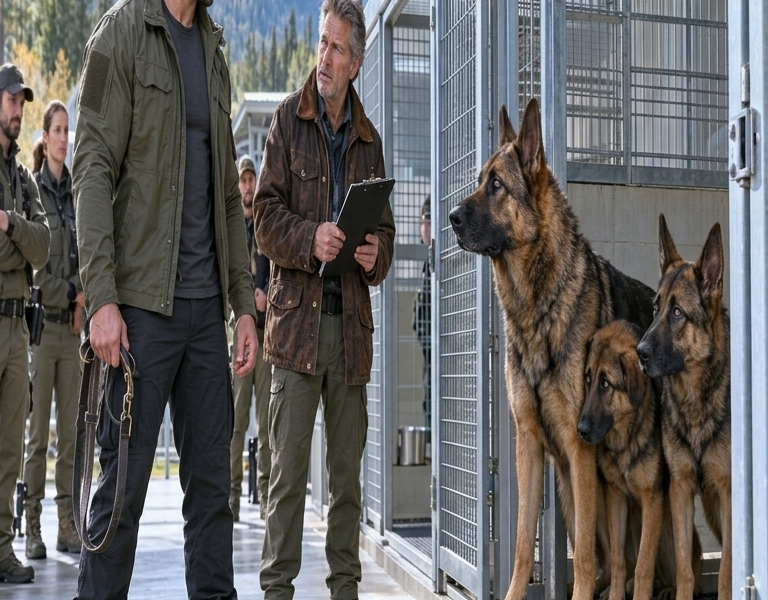
The shelter went silent when the Navy SEAL pointed at one of three trembling dogs, while the other two began crying behind their kennel door
The humidity inside the Southern California shelter was thick with the sharp tang of antiseptic and wet fur, but the air froze the instant the shelter doors swung open. I had been volunteering at this county facility outside San Diego for three years, long enough to see broken ribs, malicious neglect, and eyes that had surrendered to the dark. But I had never seen three creatures bound together by a terror so quiet it felt like an physical weight.
They had arrived at dusk in the back of a battered, rusted ford van left idling on the gravel driveway. No driver. No note. Just three dogs pressed so tightly into the corner of the transport cage that, at first glance, they appeared to be a single, trembling mass of tangled fur and exposed ribs.
The shelter manager, a weary man named Carl, stood beside me, shining a flashlight into the dark compartment. “Deputies found the van parked near the perimeter fence of the abandoned Naval Outlying Landing Field in Imperial Beach,” he whispered, his voice uncharacteristically low. “No tags. No registered owner. They’re filthy, exhausted, and if you try to separate them by more than an inch, they start hyperventilating.”
We moved them into Kennel 4—a reinforced enclosure usually reserved for reactive power-breeds. But these three weren’t aggressive. They were vigilant.
The largest was a Dutch Shepherd with a torn left ear and coat bleached by sea-salt and sun. He took the forward position, placing his muscular frame squarely between the wire door and the other two. Right behind his flank sat a Golden Retriever mix, his golden fur matted with dried mud, his brown eyes tracking every breath Carl and I took. And tucked beneath the Retriever’s chest, barely visible except for a pair of wide, bloodshot eyes, was a small, wire-haired terrier mix, shivering so violently its teeth chattered against the concrete floor.
That was when the heavy double doors of the lobby opened again, bringing with it the scent of rain and motor oil.
A man stepped into the corridor. He didn’t walk like the usual adopters who wandered in looking for a playful pup to round out a family weekend. He moved with a low center of gravity, his boots making no sound against the sealed concrete. He wore a dark grey zip-up jacket, but even under the heavy fabric, the broad sweep of his shoulders and the thick, weathered skin around his throat gave him away.
His name was Jake Mercer. He was a Navy SEAL stationed out of Coronado. Word around the shelter was that Jake had lost his service partner—a Belgian Malinois named Buster—during a maritime counter-terrorism deployment eight months prior. Since then, Jake had been a ghost, taking medical leave to clear the phantom gunfire from his ears. He hadn’t come to adopt. He had come because his therapist told him that staring at broken things might help him fix his own broken pieces.
Jake stopped in front of Kennel 4. He didn’t offer a hand to be smelled. He didn’t speak in the high-pitched baby talk most visitors used. He just stood there, his blue eyes cold and flat, staring down at the three animals.
The moment his shadow crossed the iron bars, the kinetic energy in the room shifted.
The Dutch Shepherd didn’t bark. He didn’t growl. Slowly, deliberately, the large dog stood up. He moved with a tactical precision that made my breath catch in my throat. He didn’t cower; he assumed a defensive wedge. The middle dog—the Golden mix—rose a fraction of a second later, stepping up until his shoulder was locked against the Shepherd’s hip.
The small terrier stayed back, its tiny body trembling like a leaf in a gale, but its eyes never left Jake’s face.
Jake crouched down. The motion was fluid, effortless, the movement of a predator evaluating another predator. He stared into the eyes of the middle dog for almost a full minute. The silence in the kennel aisle grew so dense I could hear the faint drip of a leaking faucet three rows down.
Slowly, Jake raised his right hand and pointed a single, calloused finger directly at the Golden Retriever mix.
“I’ll take him,” Jake said. His voice was raspy, dry as sun-baked leather.
The words had barely cleared his lips when the atmosphere shattered.
The moment the shelter manager inserted the key into the heavy lock to unlatch the door and separate the Golden Retriever, the kennel exploded—not into violence, but into pure, agonizing heartbreak.
The Shepherd and the small terrier didn’t lunge at Carl. They didn’t bite. They threw their bodies against the chain-link gate, pressing their faces through the wire diamonds until the steel bit into their skin. And then they began to cry.
It was a sound I will carry to my grave. It was not a bark, nor the needy whine of a dog wanting a treat. It was a high-pitched, guttural wail—a vocalization of absolute, catastrophic loss. It sounded human. It sounded like a mother screaming for a child pulled from her arms.
“Wait,” Jake said sharply. His hand shot out, grabbing Carl’s wrist before the manager could swing the gate open. “Hold on. Stop.”
Carl sighed, rubbing the back of his neck with a dirty hand. “Look, Chief, I know it’s tough to watch. But we can’t keep them together forever. We don’t have the space for a triple-adoption, and nobody takes three dogs at once. They’re strays. They have to move through the system.”
Jake didn’t answer. The cold, detached look in his eyes had evaporated, replaced by a sudden, sharp intensity. He sank lower to the floor, his knees resting in the grime of the aisle, and slowly reached two fingers through the bottom rung of the wire.
The tiny terrier, still shivering, dragged itself out from behind the Shepherd. It didn’t hesitate. It crept forward and pressed its small, wet nose against Jake’s index finger, gently licking his knuckle.
As the terrier reached up, the fur along its lower ribs shifted. Jake’s eyes narrowed. Beneath the matted grey fur, running parallel to the dog’s spine, was a pale, raised line about four inches long.
It wasn’t a tear from a fence. It wasn’t a bite mark from a dogfight. It was a clean, surgical incision—closed with medical-grade nylon sutures that had been hand-tied with military precision.
Jake’s jaw tightened until the muscles in his cheek twitched. Without a word, he pulled a handheld microchip scanner from the pocket of his jacket—a device he kept in his truck and had brought inside by habit. He reached over the gate and pressed the scanner against the base of the terrier’s neck.
The scanner beeped once. A serial number flashed across the tiny green LCD screen: 985141002884912.
Jake pulled out his smartphone, his thumbs moving across the glass with frightening speed. He logged into a secure, encrypted defense network database—a portal restricted to military working dog handlers and elite personnel.
I watched his face. In a matter of three seconds, every drop of color drained from his skin. His skin turned the greyish-white of chalk. He stopped breathing entirely, his chest locked in mid-expansion.
“Jake?” I stepped closer, my heart hammering against my ribs. “What is it? What does the chip say?”
He didn’t answer me. He looked as if he had just seen a ghost walk out of an open grave.
Slowly, as if operating in a dream, Jake reached out and gently took hold of the faded, grease-stained red bandana tied around the Dutch Shepherd’s neck. The fabric was so old it was rotting at the edges. Tucked deep within the folded lining was a tiny, flat piece of metal—not an official military dog tag, but a hand-cut piece of aluminum.
Jake turned the metal over in his trembling fingers. On the back, etched into the surface with the tip of a combat knife, were four words in tight, blocky handwriting:
FIND MY BROTHER. TRUST HIM.
Jake’s breath hit his throat in a ragged gasp. A single tear broke over his bottom lash and tracked down through the stubble on his cheek. He knew that handwriting. He had seen it on operational maps in Helmand Province. He had seen it on letterhead from combat zones in the Middle East.
It belonged to Master Chief Petty Officer Marcus Vance—Jake’s team leader, his mentor, and his closest friend. The man who had been officially declared dead eighteen months ago after a covert reconnaissance vessel exploded off the coast of Baja, California.
“They weren’t abandoned,” Jake whispered, his voice cracking like dry wood. He looked up at me, his eyes wide with a terrifying mixture of dread and realization. “They were deployed.”
Before I could ask him what he meant, the overhead lights of the shelter flickered twice and died, plunging the hallway into pitch darkness.
The three dogs instantly went dead silent. Outside, the rain began to lash against the corrugated tin roof like a hail of automatic gunfire.
The dark in the shelter felt absolute, heavy, and suffocating. The only illumination came from the faint glow of Jake’s smartphone screen, which cast sharp, blue shadows across his face.
“Stay behind me,” Jake commanded. The flat, emotionless tone of an operator took over his voice instantly. The grieving civilian was gone; the operator was back.
“It’s just the storm,” Carl stammered from down the hall, his footsteps shuffling against the concrete as he reached for his emergency flashlight. “The transformer at the corner always blows when the wind picks up off the coast.”
“It wasn’t a transformer,” Jake said quietly. He pointed his phone down the hall. “A transformer blow sounds like a shotgun blast. That was a clean breaker cut. Someone dropped the main power from the exterior box.”
In the wire enclosure, the three dogs had shifted positions again. They weren’t making a sound now. The Dutch Shepherd was standing on its hind legs, its front paws hooked through the top chain links of the kennel door, nose pointed straight toward the shelter’s back emergency exit. The Golden Retriever had positioned itself over the small terrier, shielding the little animal with its body. They weren’t acting like frightened strays; they were acting like a unit under fire.
“Carl,” Jake said, his voice dropping an octave. “Where are the security feeds routed?”
“To… to a local server in the front office,” Carl stammered, finally clicking on a dim plastic flashlight. “It has a ten-minute battery backup, but the cameras inside the kennels are hardwired.”
“Show me,” Jake ordered.
We moved quickly through the dark hallway, our boots squeaking on the damp floor. The shelter was eerie when the barking stopped. Hundreds of dogs in adjacent runs had gone completely silent, sensing the sudden spike in human adrenaline.
Inside the small, cluttered front office, a single monitor glowed dimly, powered by a small Uninterruptible Power Supply (UPS) unit sitting under the desk. The screen showed a grid of four black-and-white camera angles. Three of them were dead static.
The fourth camera—the one monitoring the exterior rear alleyway near Kennel 4—was still live.
The time stamp in the upper right corner read 02:12:58 AM.
At 02:13:00 AM, a figure appeared on the screen.
The man was tall, dressed in a dark, tactical jacket with the collar pulled high against the rain. He wore a low-profile baseball cap, shading his face from the camera’s infrared sensor. He wasn’t running. He was walking with a calm, deliberate stride toward the metal service door that led directly into the dog runs.
In his right hand, he carried something small and rectangular—a signal jammer, its tiny LED lights blinking red in the dark.
“Is that… is that the guy who dropped the van off?” Carl asked, his voice shaking.
“No,” Jake said, leaning in until his face was inches from the glass. “The man who dropped the van was terrified. Look at this guy’s posture. Balance centered, arms clear of his torso, eyes scanning the high corners. This man is hunting.”
Suddenly, on the monitor, the figure stopped. He stood right in front of the lens of Camera 4. Slowly, deliberately, he reached up with his left hand and tipped the brim of his cap back just two inches.
The infrared light caught his face.
A thick, jagged scar ran from the edge of his left eye down to his jawline. His right eye was milky white—blind from an explosion—but his left eye was sharp, dark, and fixed entirely on the camera lens.
Jake gasped. He stepped back from the monitor as if he had been struck in the chest. “Vance…” he breathed.
“What?” I asked, looking between the screen and Jake. “You said Marcus Vance was dead! You said his boat blew up!”
“That’s not Vance,” Jake said, his voice cold as ice. “That’s Miller. Ray Miller. He was Vance’s second-in-command on the Baja operation. The Navy reported that Miller’s body was recovered three days after the explosion. They held a full military honors funeral for him at Arlington!”
Before anyone could speak, Jake’s phone buzzed violently in his hand.
It wasn’t a standard ringtone. It was a single, high-frequency tone—a secure satellite ping. A text message popped up on the screen from a caller labeled UNKNOWN NUMBER.
The text read:
DON’T LET HIM TAKE MY DOGS. THEY HAVE THE COORDINATES. GET TO THE NEST.
Jake’s fingers flew across the glass as he tried to reply, but the moment he hit send, a red exclamation point flashed: SIGNAL BLOCKED.
“He’s jamming local cell towers,” Jake said, spinning around toward the office door. “Miller is inside the perimeter. He’s not here for the dogs to adopt them. He’s here to liquidate them.”
“Liquidate them?” Carl’s voice rose to a hysterical squeak. “They’re dogs! Why would a military operative be hunting three shelter dogs?!”
“Because they aren’t just dogs, Carl!” Jake shouted, grabbing a heavy tactical flashlight from the desk and snapping it on. “They’re courier assets! Look at the scar on the small one’s ribs! That wasn’t a surgery—that was a sub-dermal insertion! Whatever Vance found before he went dark, he hid it inside those animals, and he trained them to move through civilian channels until someone who recognized his tag found them!”
A loud, metallic CRACK echoed through the shelter’s rear corridor.
It was the sound of a crowbar forcing an exterior steel door.
Down the hallway, inside Kennel 4, the silence broke. The Dutch Shepherd gave a single, deep, resonant bark—a command. Instantly, the sound of scrambling paws echoed through the building as the three dogs threw themselves against the latch of their cage, realizing that the dark figure from the alley was now inside the building.
Jake looked at me, his eyes fierce. “You have a car?”
“A… a Subaru Outback,” I stammered, pulling my keys from my pocket. “Parked right out front.”
“Get to the driver’s seat. Crank the engine, turn off the headlights, and wait for my go,” Jake ordered, pulling a heavy iron pipe from a broken shelf in the office. “Carl, unlock Kennel 4. Right now.”
“Jake, if he’s armed—”
“HE IS ARMED!” Jake roared over his shoulder as he burst out of the office and into the pitch-black corridor. “NOW MOVE!”
The dark inside the kennel hallway was suffocating, punctuated only by the erratic beam of Jake’s flashlight cutting through the airborne dust. The smell of copper and salt filled the air. Ray Miller was moving fast.
I heard the heavy boot-steps before I saw him. Miller was moving down the center aisle, a suppressed sidearm held in a two-handed tactical low-ready position. The suppressor attached to the barrel made the weapon look impossibly long in the beam of the flashlight.
“Jake!” I screamed from the edge of the lobby.
Miller swung the gun toward my voice, but before he could acquire the target, Jake lunged out from an adjacent alcove. The iron pipe whistled through the dark, slamming into Miller’s right forearm with a sickening THUD.
The pistol clattered across the wet concrete floor.
Miller didn’t utter a sound. He didn’t gasp; he didn’t curse. He simply rotated his body with terrifying speed, driving a sharp, short-range elbow strike directly into Jake’s ribs. Jake stumbled back, air rushing out of his lungs in a ragged gasp, but he caught himself against the wire mesh of Kennel 2.
In Kennel 4, the chaos was absolute. Carl, his hands trembling violently, shoved the brass key into the padlock, turned it, and threw the wire gate wide open.
“GO! GET OUT!” Carl shrieked.
The three dogs didn’t scatter in panic. They emerged as a single, coordinated force.
The Dutch Shepherd—the largest—didn’t run for the front door. He launched his eighty-pound body directly at Ray Miller’s back just as Miller was reaching down to retrieve his dropped weapon. The Shepherd’s jaws snapped shut around the heavy ballistic fabric of Miller’s jacket sleeve, dragging the operative sideways onto the slick floor.
“Gah!” Miller growled—the first human sound he had made. He drove a heavy fist down onto the Shepherd’s ribs, but the dog held its grip with relentless tenacity, biting deeper into the shoulder pad.
“Buster, RELEASE!” Jake yelled, using his former dog’s command name by instinct.
The Shepherd instantly dropped his bite and sprinted toward the main entrance, followed closely by the Golden mix. The small, wire-haired terrier was right behind them, but its shorter legs struggled to find traction on the wet tile floor.
Miller rolled over, his face twisted in a snarl, his blind eye dead and milky under the flashlight’s glow. He reached into his tactical vest and pulled a backup blade—a five-inch combat knife with a serrated spine.
“They don’t belong to Vance anymore, Mercer!” Miller rasped, his voice sounding like two grinding stones. “You have no idea what’s inside those animals! You’re playing with fire that will burn down half the DoD!”
“Then let it burn!” Jake yelled.
Jake kicked a heavy metal trash can directly into Miller’s chest, creating a fraction of a second of space, then turned and sprinted toward the front lobby. “RUN!”
We hit the front glass doors together. I slammed my body against the push-bar, shoving the doors open into the pouring rain. The cold wind struck us like a whip.
My Subaru Outback was idling near the curb, its exhaust pipe puffing grey clouds into the night air. I hit the key fob to unlock the doors.
The three dogs didn’t wait for an invitation. The Dutch Shepherd leaped through the open rear passenger window that I had left cracked, followed instantly by the Golden Retriever. Jake grabbed the tiny terrier by the scruff of its neck, shoved it into the back seat, and threw himself into the front passenger side.
“DRIVE!” Jake screamed, slamming the door. “DON’T LOOK BACK, JUST DRIVE!”
I slammed my foot onto the gas pedal. The tires spun on the wet gravel, screaming in protest before finding traction on the asphalt. The Subaru surged forward, bursting out of the shelter driveway and onto the dark, rain-slicked suburban highway.
In the rearview mirror, I saw Ray Miller step out from the shelter lobby into the beam of a streetlight. He wasn’t running anymore. He stood under the pouring rain, holding his bleeding arm, watching our taillights recede into the darkness. He slowly raised his left hand to his ear, activating a comms headset.
“He’s calling his team,” Jake said, his breath coming in ragged, painful gasps as he held his injured ribs. “He knows this car now. We have less than twenty minutes before they put an encrypted ping on every license plate reader between San Diego and the border.”
In the back seat, the three dogs were huddled together again. The Dutch Shepherd was resting its head on the driver’s side headrest, its chest heaving, its dark eyes fixed on the road ahead. The Golden Retriever was licking the small terrier’s face, cleaning off the mud and blood from the shelter floor.
“Jake,” I said, my hands shaking so violently on the steering wheel that the car drifted slightly across the yellow line. “What is going on? Who was that man? What is inside that dog?!”
Jake reached back and gently lifted the small terrier into his lap. The dog didn’t fight him. It curled its small body against Jake’s stomach, letting out a long, shuddering sigh.
Jake pulled a tactical pen from his pocket—the kind with a small, high-intensity LED light on the tip—and carefully examined the surgical scar on the terrier’s ribs.
“Look closely,” Jake said, pressing his fingers around the edge of the scar tissue.
Beneath the skin, I could see a subtle, rectangular outline—no larger than a micro-SD card, housed inside a bio-compatible titanium capsule.
“It’s a hardened Encrypted Data Drive,” Jake said, his voice dropping to an awed whisper. “Military intelligence units use them for black-budget blackouts. When an operation goes completely off the grid and you can’t trust satellite communications, you write the hard data to a drive, seal it in medical-grade housing, and transport it via non-conventional means.”
“They used the dogs as living flash drives?” I asked, nauseated by the thought.
“Not just drives,” Jake said, looking back at the Dutch Shepherd and the Golden Retriever. “They’re a split-key system. You need all three to unlock the payload. Vance knew that if he fell, Miller’s rogue unit would trace his digital footprints. So he put the key in the animals he loved… because he knew Miller would think they were just collateral damage.”
Jake’s phone buzzed again.
This time, it wasn’t a text. It was a satellite map push, auto-downloading onto his device despite the lack of cellular service. A single point blipped green on the dark map of the Southern California coast.
The location was marked: THE NEST – POINT LOMA BLUFFS.
Below the map, a final message from Marcus Vance appeared:
BRING THEM HOME, JAKE. BEFORE THEY ERASE THE TRUTH.
The storm raged with brutal intensity as we drove south toward the rugged cliffs of Point Loma. The Pacific Ocean churned hundreds of feet below the narrow, winding coastal road, slamming white water against the jagged black rocks. The Subaru’s windshield wipers fought a losing battle against the torrents of rain, and the wind shook the frame of the car every time we rounded an exposed ridge.
“Turn off the GPS,” Jake said, staring out the side window into the black void of the ocean. “And turn off your cell phone. Pull the battery if you can. If Miller’s team has access to local law enforcement networks, they’re sweeping every cell tower within fifty miles.”
I reached over, ripped my phone from the dash mount, and powered it down completely. “Where are we going, Jake? There’s nothing out here except abandoned military bunkers and sheer drop-offs.”
“Exactly,” Jake said. “The Nest. It was an old World War II coastal artillery observation post. Off the books. Off the maps. Marcus and I used to use it as a safe house during black ops training back in ’18. If he’s still alive, that’s where he’d go to ground.”
We pulled off the main road onto an unmarked dirt track overgrown with wild mustard and ice plant. The car bounced violently over deep ruts filled with muddy water. Up ahead, perched on the absolute edge of the coastal cliff, loomed the squat, concrete outline of an abandoned bunker, half-buried in the soil and wrapped in rusted chain-link fencing.
“Stop here,” Jake commanded.
I hit the brakes. The car skidded to a halt in the mud.
The three dogs in the back seat instantly perked up. The Dutch Shepherd put his front paws on the dashboard, his ears pushed forward, his nostrils flaring as he caught a scent through the climate control vents. He didn’t bark. He gave a low, deep whimper of recognition.
“Stay in the car with the engine running,” Jake told me, reaching for his iron pipe. “If I’m not back in three minutes, or if you hear gunshots, take the car, head straight to the FBI field office in downtown San Diego, and tell them ‘Operation Black Tide’ is compromised.”
“Jake, don’t leave me here alone!” I pleaded, looking into the rear-view mirror at the pitch-black road behind us.
“You’re not alone,” Jake said, opening the door. “You’ve got them.”
He didn’t take all three dogs. He unlocked the door and let the Dutch Shepherd out. The large dog hit the ground running, disappearing into the sheets of rain like a ghost. Jake followed close behind, his flashlight beam swinging wildly across the wet brush.
Inside the car, the silence was agonizing. The Golden Retriever moved to the front seat, resting its heavy head on my knee. Its warm, dark eyes looked up into mine with an intelligence that felt unsettlingly human. The small terrier crept up onto my lap, its small body still cold, its tail giving a faint, hesitant wag against my forearm.
They weren’t just animals anymore. They were witnesses. They were survivors of something dark and dirty that had taken place far out at sea.
Suddenly, a brilliant red flare erupted from the dark near the edge of the bunker.
WHOOSH!
The stark crimson light illuminated the rain, casting long, dancing shadows across the concrete walls of the structure. A figure emerged from the entrance—not Ray Miller, but a man walking with a severe limp, leaning heavily on a wooden crutch. He was wrapped in a torn military poncho, his hair long and wild, his face covered in a thick, unkempt beard.
The Dutch Shepherd reached him first.
The large dog didn’t hit him with force. It dropped to its knees at the man’s feet, burying its head against his good leg, its tail beating violently against the wet earth. The man dropped his crutch, sank into the mud, and threw his arms around the dog’s neck, pressing his face into its wet fur.
“Marcus…” Jake’s voice carried over the sound of the storm.
I watched through the rain-streaked windshield as the man lifted his face into the red light of the flare. It was Marcus Vance. He was alive, but he looked like a skeleton—his cheeks sunken, his eyes burning with a dark, feverish intensity.
“You brought them, Jake,” Vance croaked, his voice raw from sea-air and screaming. “You brought my boys.”
“Marcus, what happened out there on the boat?” Jake demanded, reaching down to help his former commander to his feet. “Miller is hunting them. He’s got tactical teams on the road!”
“Miller didn’t work for the Navy anymore, Jake,” Vance said, his hand gripping Jake’s shoulder with desperate strength. “He sold out to a private defense cartel off Baja. They were running unregistered weapons platforms through international waters. When my team stumbled on their staging vessel, Miller turned his gun on us. He executed my men… one by one.”
Vance choked back a sob, his fingers digging into Jake’s jacket. “I barely made it over the side. The dogs… they were on the support vessel. I managed to load the acoustic encryption data into the surgical capsules before I dropped them at the coast. The drive inside the terrier has the video logs. The drive inside the Shepherd has the GPS telemetry. And the Golden… the Golden has the encryption key.”
“They’re a living dead-drop,” Jake whispered.
“They’re the only proof left that my team didn’t go rogue,” Vance said, tears cutting clean lines through the dirt on his cheeks. “Miller erased the official records. He told Navy Command that I was the traitor! If we don’t upload this data to the Defense Intelligence Agency server in the next hour, Miller’s contractors will wipe the remote servers and we’ll be branded traitors forever!”
Before Vance could finish his sentence, a blinding beam of light cut through the rain from the access road behind us.
A heavy, armored SUV—blacked out, with no headlights—had coasted down the dirt track and parked directly behind my Subaru, blocking the only escape route.
The high-power floodlights mounted on the SUV’s roof snapped on, illuminating the bunker, the car, and all of us in a harsh, merciless white glare.
A loudspeaker crackled to life, Miller’s distorted voice booming across the coastal cliffs over the sound of the thunder:
“End of the line, Master Chief. Step away from the assets.”
The floodlights were so bright they blinded me instantly. I threw my arm over my eyes, the glare burning through my eyelids as the engine of the heavy SUV roared in the darkness.
Through the car window, I heard the metallic CLACK-CLACK of multiple automatic weapons being charged. Ray Miller hadn’t come alone this time. He had brought a four-man tactical security team—mercenaries dressed in unmarked black gear, stepping out of the SUV with silenced rifles raised.
“Jake!” I screamed, pulling the small terrier tight against my chest as the Golden Retriever let out a low, terrifying growl from the passenger seat.
Jake didn’t hesitate. He grabbed Marcus Vance by his collar and hauled him back into the mouth of the concrete bunker, sheltering them behind three feet of reinforced World War II rebar.
“Get out of the car!” Jake yelled to me over the wind. “Get inside the bunker! NOW!”
I threw the driver’s side door open and scrambled out into the mud, holding the tiny terrier under my arm like a football. The Golden Retriever bounded out beside me, keeping its body low, shoulder-to-shoulder with my legs as we sprinted toward the bunker opening.
A sharp THWIP-THWIP-THWIP sliced through the air—the sound of suppressed 5.56mm rounds punching into the Subaru’s bodywork. Glass shattered as the rear window exploded into a thousand glittering pieces.
I fell onto the slick concrete floor of the bunker just as another volley of rounds chipped dust off the entrance archway.
“You okay?!” Jake asked, grabbing my jacket and dragging me deeper into the dark interior.
“I’m fine! I’m fine!” I gasped, wiping rain and mud from my eyes.
Inside the bunker, the air was cold and smelled of ozone, rust, and damp earth. Marcus Vance was sitting against a curved concrete wall, his face pale as paper, holding a modified satellite uplink terminal that was wired to a heavy car battery on the floor.
“I need five minutes,” Vance gasped, his blood-soaked fingers typing wildly on a weatherproof keyboard. “The server connection is live, but I need the data drives from the dogs. I can’t start the transmission without the physical interface!”
“They’re coming in!” Jake warned, peering around the concrete frame of the bunker entrance.
Through the sheet of rain outside, I could see four dark silhouettes advancing in a tactical wedge, their weapon-mounted lights cutting through the red glare of the fading flare. Ray Miller was leading them, his blind eye reflecting the light like a dead marble.
“Mercer!” Miller’s voice echoed into the concrete room. “You don’t have to die for a dead man’s reputation! Give us the dogs, and you walk! The girl walks!”
“He’s lying, Jake!” Vance spat, plugging a USB reader cable into his terminal. “The moment he gets the drives, he’s collapsing this bunker with thermite charges! He can’t leave witnesses!”
Jake turned to me, his blue eyes burning with an absolute, terrifying clarity. “Give me the terrier.”
I handed the tiny grey dog to him. Jake reached into his pocket, pulled out a small tactical knife, and looked at the dog. “I’m sorry, buddy,” he whispered.
He didn’t cut the dog. With surgical precision, he used the tip of the blade to slice the heavy nylon stitches holding the micro-capsule in place beneath the skin. The terrier didn’t even flinch. It stayed perfectly still, trusting the hands that held it. Jake pulled out the tiny, silver titanium cylinder and slapped it into Vance’s waiting hand.
“Shepherd! Up!” Jake commanded.
The large Dutch Shepherd stepped forward, raising its neck. Jake repeated the process, extracting the second capsule from the dog’s thick leather collar lining, where a second micro-drive had been concealed.
“Now the key,” Vance rasped, his hands trembling as he slotted the first two drives into the terminal. A progress bar on the green screen shot to 66%. “Where’s the Golden’s drive?!”
Jake looked at the Golden Retriever mix. He ran his hands along the dog’s spine, over its ribs, down its neck. Nothing. No scar. No capsule.
“Marcus!” Jake yelled as a burst of automatic fire kicked up sparks at the bunker entrance. “There’s no scar on the Golden! Where is the key?!”
Vance looked up, his eyes wide with horror. “What do you mean there’s no scar?! I placed it in his—”
Vance stopped. His face went completely blank.
“The transport van…” Vance whispered, his voice falling off a cliff. “I didn’t implant the Golden. The key isn’t in a drive. It’s a voice-print code embedded in the dog’s behavioral training! The Golden only vocalizes the frequency when the unit is complete!”
Outside, boots crunched on the gravel right outside the entrance.
“Clear the doorway!” Miller’s voice barked. “Flashbang going in!”
A dark cylinder bounced through the opening, rolling across the concrete floor toward our feet.
“COVER!” Jake screamed.
Jake threw his heavy frame over Vance and the satellite terminal. I threw myself over the small terrier and the Golden Retriever, pressing my face into the cold dust.
BANG!
A blinding flash of white light and a deafening shockwave exploded inside the bunker. My ears rang with a high-pitched, agonizing scream. My vision turned into a cloud of red and white static.
Through the haze, I saw Ray Miller step through the smoke, his rifle raised, pointing the barrel directly at Marcus Vance’s head.
“Game over, Marcus,” Miller said, his thumb flicking the safety selector off. “The Navy gets its scapegoat. And I get my payday.”
In that split second, as Miller’s finger tightened on the trigger, something incredible happened.
The Golden Retriever didn’t attack.
It stood up in the center of the smoke, raised its head toward the cracked concrete ceiling, and let out a single, prolonged, high-frequency howl. It wasn’t a bark. It wasn’t a cry. It was a precise, multi-tonal vocalization—a specific pattern of pitches that hit the satellite terminal’s built-in microphone.
On the screen of Vance’s terminal, the red lock icon turned bright green.
ENCRYPTION KEY VERIFIED.
UPLOADING BLACK TIDE PROTOCOL TO PENTAGON SERVER…
PROGRESS: 100%
TRANSMISSION COMPLETE.
A loud, automated beacon chimed from the terminal—a high-pitch signal that sent an immediate, un-jammable distress priority distress call to every Naval Air Station in San Diego County.
Miller’s eyes went wide. He looked at the terminal screen, then at Vance, realizing what had just happened. “No…”
“It’s sent, Ray,” Vance whispered through the blood on his lips, smiling weakly. “Every admiral at Fleet Forces Command is watching your execution video right now.”
Miller’s face twisted into a mask of pure rage. “Then you go down with me!”
He swung his rifle toward Vance, but before he could squeeze the trigger, the Dutch Shepherd launched itself from the shadow of the bunker wall.
The eighty-pound Shepherd hit Miller at full speed, taking him off his feet and slamming his head violently against the jagged concrete floor. The rifle flew out of his hands, skittering across the dust and dropping off the edge of the cliff into the crashing ocean below.
Outside, the air began to thrum with a deep, bone-rattling vibration.
The heavy, rhythmic THUMP-THUMP-THUMP of dual-rotor blades cut through the storm. Twin searchlights descended from the clouds as two MH-60S Seahawk helicopters dropped through the rain, their heavy mini-guns trained directly on the surviving mercenaries outside the bunker.
“U.S. NAVY SPECIAL WARFARE!” a voice boomed from the lead helicopter’s loudspeaker, shaking the ground beneath us. “DROP YOUR WEAPONS AND SURRENDER IMMEDIATELY! DROP YOUR WEAPONS!”
Miller’s mercenaries instantly threw their rifles into the mud, raising their hands above their heads as heavily armed Navy SEALs rappelled down ropes onto the cliffside, securing the perimeter in seconds.
Inside the bunker, the noise was overwhelming, but inside our small circle, everything had gone quiet.
Miller lay pinned under the Dutch Shepherd, staring up at the ceiling in defeated silence as tactical team members swarmed the bunker, taking him into custody.
Jake dropped to his knees beside Marcus Vance, holding his friend’s shoulders as naval corpsmen rushed in with medical kits.
“It’s over, Chief,” Jake said softly, his voice trembling. “It’s over.”
Vance didn’t look at the doctors. He didn’t look at the soldiers flooding the room. He reached out his thin, bruised hands toward the three dogs.
The Dutch Shepherd stepped off Miller and walked over, resting his broad head in Vance’s lap. The Golden Retriever sat on his left side, leaning its body heavily against his ribs. And the tiny grey terrier hopped right onto his chest, licking the salt and sweat from his chin.
I stood by the concrete wall, tears streaming down my face, watching the three animals wrapped around the man who had risked everything to save them—and who they had saved in return.
Six months later, the shelter outside San Diego received a full federal grant, named in honor of three unsung heroes.
And if you ever drive out to the quiet hills behind Coronado on a clear evening, you might see a small cottage overlooking the Pacific. There are no wire kennels there. No brass locks or concrete floors. Just three dogs running free across the grass, untethered, unbroken, and finally home.
The end,









