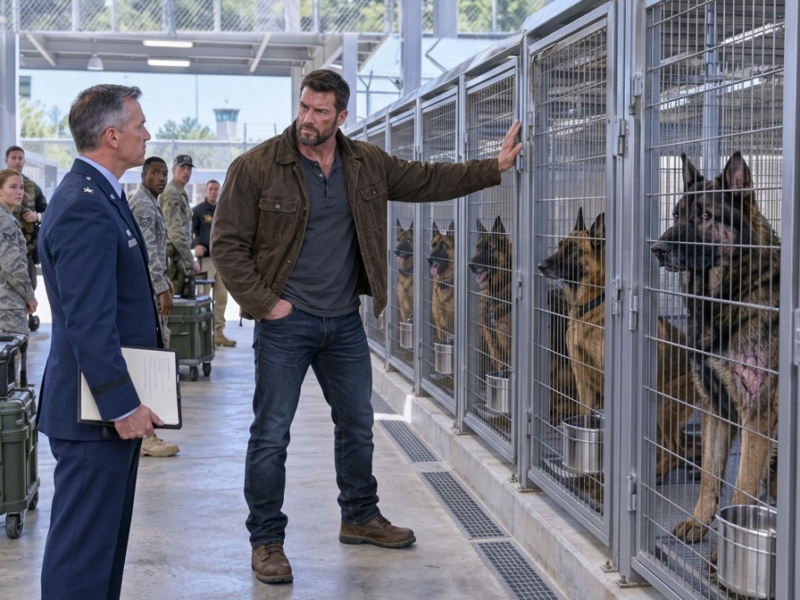
The shelter doors slammed behind me as the retired K9s were lined up for adoption, and when I said, “I’ll take all of them,” the director laughed in my face
The shelter doors slammed shut behind me, the heavy steel latch echoing across the concrete floor like a bolt sliding into a rifle chamber. The sound set my teeth on edge. Inside, the air smelled of industrial bleach, wet concrete, and the unmistakable, stale musk of anxious animals. In front of me, arranged behind heavy chain-link partitions under the buzzing glare of flickering fluorescent tubes, were seven retired military working dogs.
They were not the sleek, lethal predators the civilian world saw in recruitment posters or Hollywood films. These animals were broken veterans. One Dutch Shepherd had a milky, blind right eye, the skin around his socket puckered from shrapnel. A black German Shepherd dragged his left hind leg slightly, his hips ruined by years of airborne drops and rocky patrols. But in the furthest enclosure sat a massive Belgian Malinois. His muzzle was grizzled with gray, his left ear was torn in half, and deep, pale scar tissue mapped across his broad chest. He sat perfectly upright, motionless, refusing to make eye contact with me, the shelter staff, or the world outside his cage.
“I’ll take all of them,” I said quietly.
The shelter director, a woman named Miller who looked exhausted down to her bones, stopped writing on her clipboard. She looked at me, blinked, and then let out a dry, humorless laugh right in my face.
“You’ll take all seven?” She shook her head, tapping her pen against the metal board. “Mister, I don’t know what kind of hero fantasy you walked in here with, but these aren’t golden retrievers looking for a suburban backyard. They’re Tier-One tactical working dogs. They have severe post-traumatic stress, bite triggers, chronic pain, and specialized dietary needs. They’re retired for a damn good reason.”
“I know,” I answered, keeping my voice steady.
“You understand the state liability alone?” she pressed, crossing her arms. “The county doesn’t just hand over high-drive military K9s to anyone with a soft heart. You military guys always think you can put on your uniform and save every broken piece of gear left behind.”
That sentence dug into my chest like cold steel. I looked down at my dress greens, the Navy SEAL trident pinned above my ribbon racks, and the faded corner of a glossy print sticking out of my breast pocket. She thought I was trying to play the savior. She had no idea that I wasn’t there to save anyone. I was there because one of those dogs had already saved my life three years ago, and I had spent every waking hour since trying to pay that debt.
Three years earlier, in the dusty, godforsaken valleys of the Helmand Province, an improvised explosive device had torn through the lead vehicle of our convoy. I remembered the blinding white flash, the violent concussion that turned my lungs to ash, the smell of vaporized diesel fuel, and the screams of dying men over the radio. Then, darkness. When I regained consciousness hours later beneath a mountain of twisted chassis metal, trapped and bleeding out from a severed femoral artery, I wasn’t alone.
A Belgian Malinois had crawled through the burning wreckage. He had pressed his heavy body over my chest, shielding my vitals from falling shrapnel, taking a jagged piece of steel through his own shoulder. He had snarled at approaching insurgents and barked relentlessly into the smoke until the medevac chopper homed in on his voice. When the medics dragged me onto the stretcher, he fought them with his last ounce of strength just to stay beside me. His name was Ranger.
By the time I woke up from a coma at Landstuhl Regional Medical Center in Germany, Ranger had been patched up and transferred back into another specialized task force. The military bureaucracy swallowed him whole. Every inquiry I submitted was kicked back as classified or lost in administrative purgatory. For thirty-six months, I searched every base manifest, kennel registry, and contractor database across the country. Dead end after dead end. Until yesterday morning, when a low-level supply clerk flagged a disposal manifest for a private holding kennel in eastern Virginia.
I took three slow steps toward the last kennel. My boots scuffled against the concrete. The Malinois did not flinch. His dark amber eyes were fixed on the opposite wall, his breathing shallow and disciplined.
“Ranger,” I said. It was barely a whisper.
The dog’s ears twitched. One stood straight; the torn one angled forward. Slowly, with the deliberate, heavy grace of an old warrior, he turned his head. His eyes locked onto mine.
The air left my chest. The world around us seemed to drop into absolute silence. For three years, I had seen those eyes every time I closed mine.
“Ranger, buddy. Look at me.”
His chest expanded with a deep, shuddering inhale. He caught my scent. The rigid tension that held his spine like rebar suddenly broke. His hind leg trembled. He rose to all four paws, walked directly to the chain link, and let his tail give a single, deliberate wag.
I dropped to my knees on the cold, bleached floor, pressing my face right against the metal mesh. Ranger shoved his broad, scarred muzzle against the wire, whining a low, guttural note that sounded like an ancient grief finally finding its release. I slipped my fingers through the links, digging into his thick fur, feeling the hard ridge of scar tissue running across his neck. My throat tightened so violently I couldn’t speak.
Behind me, the sound of Director Miller’s pen dropping to the floor broke the silence. She stared at the dog, her face pale.
“Oh my God,” she whispered. “He… he hasn’t let anyone touch that cage in four months. The handlers have to use bite poles just to feed him.”
“He was my partner,” I said, my voice thick. “I promised him I’d come back. It just took me too long.”
I pulled myself up, keeping one hand pressed against Ranger’s muzzle. He leaned his entire weight against the fence, refusing to break contact. I turned my head toward the director, looking at the other six kennels. The Dutch Shepherd, the limping German Shepherd, the two combat trackers with clipped ears—all of them were watching us now.
“They’re coming too,” I said.
Miller frowned, stepping forward with genuine concern in her eyes. “Lieutenant, look, I get it. I see the bond. You can take Ranger today if the paperwork clears. But taking seven high-risk Tier-One K9s? The food, the medical bills, the liability insurance, the facility requirements… you can’t possibly afford this. You’re talking thousands of dollars a month just to keep them alive.”
“I’ve already paid,” I said, reaching into my jacket.
“Paid who? Paid for what?”
I pulled out the photograph. It was a worn, matte-finish print that had arrived in my mailbox three days ago inside an unmarked manila envelope. The image showed eight Navy SEALs in full desert camouflage, standing shoulder to shoulder in front of an unmarked hangar at an airfield in Jordan. Beside each operator sat their assigned K9. Eight men. Eight dogs.
Seven of the men were smiling, dirt-streaked and young, their eyes bright with the cocky invincibility of elite operators. But the eighth man—standing on the far right beside a younger, unscarred Ranger—had his face violently scratched out with a heavy black razor. The gouge went so deep it tore through the paper fiber.
Miller looked at the photo, her brow furrowing. “Who is that?”
“Chief Petty Officer Marcus Vance,” I replied, the name tasting like ash in my mouth. “My best friend. Ranger’s original handler.”
“What happened to him?”
“The Navy told his mother and me that he was killed instantly when our lead Humvee hit a triple-stacked anti-tank mine in the Helmand riverbed. They said there was nothing left to recover. Closed casket. Full honors at Arlington.”
“And you don’t believe that?” she asked softly.
I flipped the photograph over. On the back, written in erratic, shaky blue ink, were nine words:
Your friend didn’t die when they told you he did.
Miller sucked in a breath. She looked from the jagged ink on the photo to the scarred dog pressed against my leg, then back to my eyes. She didn’t ask another question. Ten minutes later, she pulled the master keys from her belt, bypassed the administrative review boards, and signed the emergency release documentation.
By sundown, I had all seven dogs loaded into the back of my retrofitted heavy-duty crew cab truck. I drove forty miles out to my isolated property on the edge of the Dismal Swamp—a five-acre parcel surrounded by dense pine forests, secured by eight-foot chain-link fencing I had spent the last two years reinforcing. The property had originally been intended as a quiet place for me to disappear and nurse my own physical and mental wreckage. Now, it was a sanctuary.
We unloaded the pack into the climate-controlled pole barn. The dogs were exhausted, their defensive walls worn thin by months in small shelter runs. I set out water troughs and bowls of high-protein feed. The Shepherd with the bad hip ate slowly, glancing at me with guarded gratitude. The one-eyed tracker curled into a deep bed of cedar shavings. None of them growled. None of them fought. In the military, these animals had operated as an integrated pack unit; their instincts ran deeper than the trauma that had sidelined them.
Ranger, however, would not leave my side. He ignored the food bowl until I sat down at the heavy oak kitchen table inside the main cabin. Only then did he drop down beside my boots, his chin resting heavily across my steel-toed work shoes, his breathing deep and steady.
The house was dead quiet. The wind off the swamp whistled through the eaves, rattling the storm windows. On the table lay my service pistol, the scratched-out photograph, and the envelope it had arrived in. I stared at the scarred face in the picture. Marcus had been the best man at my brother’s wedding. He had dragged me out of bar fights in Coronado and kept my head straight through the brutal grind of BUD/S training. If he hadn’t died in that blast… where was he? Who had kept him? And why send this photo now?
At 11:42 PM, the silence shattered.
My burner phone, a prepaid flip device sitting untouched beside my wallet, began to vibrate against the wood. The screen flashed UNKNOWN CALLER.
I picked it up, hit the speaker button, and brought it to my ear. I didn’t say a word.
For three seconds, there was only the sound of heavy, labored breathing on the line, accompanied by the faint, rhythmic clinking of industrial machinery in the background.
“Lieutenant Hayes,” a voice whispered. It was raspy, stripped raw, like vocal cords scarred by smoke or surgical intubation. “You collected the pack. Good.”
My knuckles turned white against the plastic casing. “Who is this?”
“Names don’t matter anymore. Truth does,” the voice wheezed. “If you really want to know what happened to Marcus… if you want to know what they did to him after they took his dog… bring Ranger to the abandoned naval drydock at Pier 9 tomorrow night. Midnight. Come alone. No badges. No backup.”
“Give me proof,” I demanded, leaning forward, my heart hammering against my ribs. “Give me one reason not to trace this call and bring a federal warrant to your door.”
“Proof?” The caller let out a short, wet cough that sounded like a death rattle. “Ask Ranger where the bullet under his ribs came from. It wasn’t Taliban lead, Hayes. It was 5.56 green tip. Standard issue.”
The line went dead with a harsh, flat dial tone.
The hair on the back of my arms stood straight up. Before I could process the words, a deep, bone-rattling vibration started at my feet.
Ranger had raised his head. His scarred lips peeled back, exposing long, yellowed canines, and a low, murderous growl rolled out of his chest. His amber eyes weren’t looking at me. They were locked onto the heavy, deadbolted front door of the cabin.
Through the double-paned glass beside the frame, a thin red laser dot drifted silently across the wood, settling directly on my chest.
The red dot burned against my flannel shirt like a drop of fresh blood.
In combat, you don’t think; your nervous system takes the wheel before your brain can formulate fear. The moment I registered the laser, I shoved myself backward out of the chair, throwing my full weight sideways. My shoulder hit the floorboards just as a sharp, suppressed thwip-thwip cracked through the night air.
Two high-velocity rounds punched clean through the solid oak door, showering the entryway in splinters and gouging deep craters into the plaster wall directly behind where my head had been a fraction of a second before.
Ranger didn’t cower. The instant the wood shattered, the Malinois exploded off the floor, his claws tearing into the hardwood as he launched himself toward the breach, barking with a savage, deafening fury that shook the small cabin.
“Ranger, down! Platz!” I bellowed, using the German command hammered into him during his early tactical training.
The dog skidded to a halt two inches from the door, his chest heaving, his hackles raised in a jagged ridge along his spine, but he held his ground. He was a disciplined instrument of war, even when every instinct urged him to rip out the throat of whatever was on the porch.
I scrambled across the floor on my belly, reaching up blindly to yank the heavy iron master switch on the wall. The cabin plunged into pitch blackness.
Silence followed. Heavy, suffocating silence.
Outside, the crickets had stopped chirping. The wind through the pine trees carried no sound of footfalls, no engines, no snapping twigs. Whoever was out there was trained. They understood light discipline, noise discipline, and target acquisition. They were professionals.
I dragged myself into the kitchen, keeping low beneath the window line, and reached into the bottom drawer of the pantry. My hand closed around the cold, textured grip of my customized Sig Sauer P226. I racked the slide, chambering a nine-millimeter hollow point with a soft, metallic click, and thumbed the safety off.
From the pole barn seventy yards away, a chorus of deep, territorial barking suddenly erupted. The six other K9s had caught the scent. The German Shepherd’s booming bay mingled with the sharp, frantic challenge of the Dutch Shepherd. The swamp was no longer quiet.
I crawled to the edge of the living room window, carefully lifting one corner of the blackout curtain. I peered through the glass, letting my eyes adjust to the darkness.
Under the pale glow of a sliver of moon, three figures dressed in sterile black tactical gear and night-vision goggles were retreating from the perimeter fence. They weren’t pressing the assault. They had fired two rounds to gauge my reaction, realized I was awake and armed, and were falling back into the shadows of the tree line. One of them held a compact carbine at the low ready, while another hurried toward an unmarked dark SUV idling with its lights off on the dirt access road.
They weren’t trying to breach the house. It had been an assassination attempt designed to look like a home invasion, or perhaps a test of my defenses.
Beside me, Ranger pressed his broad shoulder against my ribs, his low growl continuing in his throat, vibrating through my own bones. He wasn’t looking out the window. His nose was pointed at the base of the broken front door.
I waited five agonizing minutes until the low hum of the SUV’s engine faded completely down the county road. Only then did I stand up, keeping my back to the solid corner wall, and approached the entryway.
The two bullet holes were tightly grouped, less than an inch apart. Expert marksmanship. But on the floor, directly beneath where the rounds had penetrated, lay something the shooters had slipped under the weatherstripping before pulling the trigger.
It was a small, military-grade digital audio recorder, its casing scratched and coated in dried mud.
My hands shook slightly as I knelt down and picked it up. Ranger sniffed the plastic casing once, then let out a sharp whine, his tail dropping between his legs. The scent on that recorder meant something to him. It was a scent he recognized.
I pressed the small rubber Play button.
The speaker crackled with heavy static, followed by the muffled hum of an aircraft engine and the harsh clatter of metal tools. Then, a voice cut through the white noise. It was hollow, exhausted, and fractured by pain, but I knew that voice better than my own.
“Hayes… if you’re hearing this, they found the kennel manifests,” Marcus Vance’s voice whispered. “They’re scrubbing the roster. They’re putting the dogs down so the paper trail dies. Don’t go to the authorities. Don’t call the command. Langley has eyes inside the squadron. The mine… the mine wasn’t an ambush, brother. It was an extraction. They needed me dead on paper so they could use what we found in that valley. Pier 9. Don’t trust the dockmaster. Look for the white lantern. I’m sorry… I’m so sorry I couldn’t bring Ranger with me.”
The recording ended with the harsh thump of a door opening, followed by a voice barking an order, and then static.
I stood frozen in the dark hallway, the recorder heavy in my palm.
Extraction. The word echoed in my skull like a siren.
Three years ago, our unit had been assigned to secure an ancient subterranean tunnel complex near the Pakistan border. Officially, our objective was a high-value Taliban weapons cache. But Marcus had been tasked with carrying a specialized K9 harness fitted with environmental sensors and classified imaging gear. He and Ranger had gone into the lower chambers alone while the rest of us held the perimeter. When they came back up, Marcus looked sick to his stomach. He wouldn’t talk about what they found. Two hours later, our Humvee was routed down an unscheduled path, and the blast threw me into a coma.
They hadn’t killed him. They had stolen him.
Ranger sat down heavily, pressing his head against my thigh. I looked down at him in the darkness, remembering the mysterious caller’s words: Ask Ranger where the bullet under his ribs came from. It wasn’t Taliban lead.
I dropped my weapon on the counter, grabbed a tactical flashlight from the hall drawer, and knelt beside the dog. “Easy, boy. Steady.”
I ran my fingers down his left ribcage, feeling beneath the dense undercoat until my thumb located the raised, fibrous lump of an old bullet wound—the one the field surgeons in Afghanistan had claimed was a ricochet from an AK-47. I pressed gently. Ranger flinched, leaning into the pressure. With the flashlight between my teeth, I examined the entry scar closely. It was small, precise, and had entered at a downward angle.
The military uses 5.56x45mm NATO rounds. The Taliban used 7.62x39mm. A 7.62 slug would have shattered three of his ribs and torn him in half. A 5.56 round, fired from an elevated platform—like the top hatch of an escort vehicle—would leave exactly this footprint.
Ranger hadn’t been hit by enemy crossfire. Someone in our own convoy had tried to put him down when he refused to leave my body.
A cold, burning rage began to settle in my gut, replacing the shock, replacing the fear. The men who had left me to die, the men who had stolen Marcus and caged these seven dogs like surplus trash, were the same men who had just painted a red laser across my chest.
I walked out to the pole barn. The moment I cracked the door, the barking ceased. The six retired K9s stood in their runs, their postures alert, their eyes glowing in the amber beam of my flashlight. They smelled the gun oil on my hands. They smelled the adrenaline.
“Change of plans, team,” I said softly to the dark barn.
I wasn’t going to Pier 9 as a victim walking into an ambush. I was going as a team leader conducting an assault.
For the next four hours, I worked in silence. I laid out tactical vests, nylon harnesses, and heavy-duty leads. I inspected the limping German Shepherd’s paw; his pads were tough, his drive intact. The Dutch Shepherd’s blind eye didn’t stop him from tracking movement with pinpoint precision using his ears. These animals weren’t pets. They were soldiers whose service had been stolen from them.
I cleaned my rifle—a suppressed Daniel Defense M4 carbine I had kept locked in my gun safe since leaving the service—and packed three magazines of armor-piercing ammunition. I prepped medical field kits, tourniquets, and a heavy set of bolt cutters.
As the first gray streaks of dawn cut through the swamp mist, the house phone didn’t ring again. There were no more lasers. But I knew the window was closing. Midnight at Pier 9 wasn’t an invitation; it was a deadline.
I loaded the dogs back into the reinforced truck bed. Ranger jumped into the front passenger seat without waiting for a command, his eyes locked forward through the windshield.
“Let’s go find our boy,” I told him.
Ranger gave a low, determined huff, resting his chin on the dashboard as the truck rumbled down the long gravel driveway, heading toward the coast.
Pier 9 was an industrial graveyard.
Located on the forgotten edges of the Norfolk naval complex, the pier jutted out into the black, oily waters of the Chesapeake Bay like a rotting finger. Decades of salt spray had turned the corrugated steel warehouses into rusted shells. Derelict drydocks, abandoned cranes, and piles of discarded shipping containers formed a maze of sharp shadows beneath the low, sulfur-yellow glow of distant highway lamps.
It was 11:45 PM when I cut the truck’s headlights and rolled into the perimeter road of the decommissioned shipyard. Rain had begun to fall—a cold, needles-sharp November drizzle that slicked the pavement and muffled the sound of my tires.
I killed the engine behind a stack of rusted freight containers three hundred yards out from the main pier.
In the bed of the truck, the dogs were silent. They had picked up on my posture hours ago. During our time in service, combat dogs were trained to read their handler’s heart rate, breathing, and scent. They knew we were in hostile territory.
Ranger sat beside me, his ears swiveling toward the water.
I pulled my thermal monocular from my tactical vest and scanned the warehouse ahead. The building was vast, roughly two hundred yards long, with cracked skylights and shattered bay doors facing the water. The structure was cold, showing mostly deep blues and greens on the thermal sensor.
Then I spotted it.
Near the southern loading ramp, hanging from a rusted forklift mast, was a solitary white hurricane lantern, its flame flickering weakly against the driving rain.
Look for the white lantern.
I scanned the perimeter around the lantern. Nothing. No heat blooms from sentries, no idling vehicles. But that only made my skin prickle more. Professional security doesn’t stand in the rain; they conceal themselves in thermal-blind hides or wait inside the kill zone.
“Stay,” I whispered to the six dogs in the truck bed, locking the reinforced canopy grate so they had airflow but couldn’t breach until I released the mechanical safety latch from my remote fob. “You hold the line.”
I opened the passenger door. Ranger slipped out without making a sound, his paws finding purchase on the wet gravel. He was wearing his black Kevlar load-bearing harness, fitted with a tactical strobe and a heavy steel D-ring.
I slung my suppressed carbine across my chest, thumbed the selector switch to semi-automatic, and moved forward into the shadows.
The wind off the bay brought the sharp reek of diesel, dead fish, and oxidized iron. Ranger moved five paces ahead of me, his body low to the ground, his nose working the swirling air currents. Every ten feet, he paused, lifted his head, checked my position, and moved forward. The years of trauma and isolation in that shelter run seemed to vanish; the animal was back on mission.
We reached the edge of Warehouse 4, adjacent to Pier 9. The southern pedestrian door was cracked open an inch, held in place by an old wooden wedge.
Ranger halted. His ears pinned flat against his skull, and his upper lip twitched.
Scent confirmed.
I stepped up behind him, pressing my back against the corrugated metal siding. With my left hand, I gently pushed the door open. It swung inward without a squeak, its hinges freshly oiled.
That was the first red flag. An abandoned warehouse doesn’t have oiled hinges.
I brought my carbine to my shoulder, clicking on my weapon-mounted infrared illuminator. Through my night-vision goggles, the cavernous interior exploded into eerie monochrome green.
The floor was littered with rotting pallets, rusted machine parts, and pools of stagnant rainwater. In the center of the warehouse, directly beneath a massive steel gantry crane, sat a single metal folding chair under the beam of an overhead work light.
Tied to the chair was a man.
He was slumped forward, his head hanging limp against his chest, wearing a torn, oil-stained flight suit. His wrists were bound behind him with heavy industrial zip-ties.
My heart felt like it was trying to punch through my ribs. “Marcus?” I whispered.
Ranger broke discipline. He let out a sharp whine and surged forward across the concrete floor, his paws splashing through the puddles toward the chair.
“Ranger, heel! Halt!” I hissed, darting after him.
The dog reached the chair first. He didn’t jump up. He stopped dead two feet away, dropped his belly to the concrete, and began to back away slowly, a frantic, confused whine vibrating in his throat.
That wasn’t how Ranger greeted his handler.
I skidded to a halt ten feet back, sweeping my rifle barrel upward. I looked at the man in the chair.
The flight suit bore the name patch VANCE. But the shoulders were too narrow. The hands tied behind the back were smooth, missing the distinctive anchor tattoo Marcus had inked across his right thumb in San Diego. And taped across the man’s chest was a block of military-grade C4 explosive, wired to a digital receiver blinking with a steady green light.
It was a decoy. A trap.
Before I could turn, the massive metal rolling doors at both ends of the warehouse slammed shut with a concussive crash that rattled the concrete foundation. High-powered halogen stadium lights bolted to the rafters snapped on simultaneously, blinding my night-vision goggles with searing, white-hot glare.
I ripped the goggles off my helmet, blinking through the sudden agony of light.
“Drop the weapon, Lieutenant Hayes!” a voice boomed over the warehouse public address system. The voice was smooth, cultured, and utterly devoid of emotion. “Drop it now, or I detonate the decoy and turn both you and that mangy beast into red mist.”
From the elevated catwalks thirty feet above us, four men stepped out of the shadows, their rifles trained directly on my skull. They were dressed in sterile, dark gray tactical fatigues—the uniform of a private maritime security contractor operating under classified government charters.
I slowly lowered my carbine, letting it hang by its sling, but kept my fingers inches from the pistol grip. Ranger remained pressed against the floor, his eyes darting between the catwalks, his body coiled like a steel spring.
A fifth man walked out from behind an office partition on the ground floor. He was in his mid-fifties, wearing a tailored charcoal overcoat over a suit, his silver hair neatly parted. In his right hand, he held a sleek remote detonator.
I recognized him instantly.
Colonel Thomas Sterling. Former deputy commander of Naval Special Warfare Group Two, who had retired abruptly eighteen months ago to head a private defense logistics firm called Aegis Meridian.
“Sterling,” I spat. “You son of a bitch.”
Sterling smiled thin and cold, stopping twenty yards away. “Always the blunt instrument, aren’t you, Hayes? You never did understand the larger theater. You just kick down doors and pull triggers.”
“Where is Marcus?”
“Marcus was an asset who outlived his utility,” Sterling said smoothly, glancing down at Ranger with mild disgust. “Just like that animal. You were supposed to let them rot in that county kennel, Hayes. The dogs were flagged for euthanasia. A quiet, administrative disposal. Nobody investigates dead dogs. But you had to play the righteous brother. You had to pull the manifests.”
“What did Marcus find in that valley, Sterling?” I demanded, taking half a step to the side, positioning myself between Sterling and Ranger. “What was worth staging an ambush and burying an active-duty SEAL under a fake grave?”
Sterling laughed softly. “He found a localized distribution hub for unregistered advanced weapons systems. Systems developed by our own black-budget laboratories and sold off-the-books to maintain regional leverage. Marcus had a conscience. He thought he was going to report it to the Inspector General. He didn’t realize the IG works for the people who signed my contracts.”
“And the photo?” I pressed, stalling for time, my thumb slowly sliding down toward the pocket of my tactical vest where my remote vehicle fob was secured. “Who sent the photo to my house?”
Sterling’s smile faltered for a fraction of a second. A flicker of genuine irritation crossed his face.
“Marcus had an accomplice inside our processing facility,” Sterling said, his voice tightening. “A sympathizer who managed to smuggle out that image before we plugged the leak. We tracked the envelope’s delivery route to your cabin. We knew you wouldn’t be able to resist digging. Which is why you’re here. A tragic suicide pact between a PTSD-ridden veteran and the dog he couldn’t let go of.”
Sterling raised the detonator with his thumb resting on the red toggle. “Kill them both. Make it clean.”
On the catwalks above, the four contractors brought their rifles up to cheek weld.
In that split second, I didn’t reach for my gun. I hit the red button on the remote fob in my vest pocket.
Outside the warehouse, the heavy-duty rear grate of my truck popped open. And the horn blasted a continuous, deafening pulse.
The horn blast outside triggered a reaction that Sterling’s men could never have anticipated.
A hundred yards away, six Tier-One combat dogs had spent the last two hours listening to the sounds of their handler walking into hostile territory. When that horn sounded—the pre-set recall and breach alert—they didn’t hesitate.
Through the cracked, ground-level fiberglass windows along the warehouse’s northern wall, glass exploded in a violent shower of shards.
The Dutch Shepherd hit the floor first, rolling through the debris and coming up at a dead sprint. Right behind him came the two combat trackers, their muscular frames clearing the broken sills effortlessly. The scarred German Shepherd with the bad hip smashed through the rotted wood of a service door, his jaws snapping with terrifying power.
Six battle-hardened K9s poured into the warehouse like a black and tan wave, their furious, collective war cry echoing off the corrugated iron walls like thunder.
The contractors on the catwalks panicked. Their sightlines had been locked onto me; suddenly, the warehouse floor was swarming with fast-moving, lethal targets moving in tactical bounding pairs.
“Suppress them! Suppress them!” a shooter on the gantry yelled, pivoting his rifle downward.
Crack! Crack!
Rifle rounds sparked off the concrete floor, kicking up chips of stone. One round grazed the shoulder of the Dutch Shepherd, but the animal didn’t even slow down. The tracker hit the base of the metal stairs leading to the catwalk, taking the steps three at a time with terrifying speed.
“Ranger! Fass!” I roared.
Ranger launched. He didn’t go for the contractors on the stairs. He went straight for Sterling.
Sterling’s eyes dilated in sheer terror. He dropped the detonator, clawing wildly at the holster beneath his charcoal coat, screaming for his men to fire.
I didn’t give them the chance. I swung my carbine up, sighted the lead contractor on the catwalk who was aiming at Ranger, and squeezed the trigger twice. The suppressed shots cracked dull and flat. The contractor tumbled over the handrail, crashing thirty feet down onto an empty wooden crate below.
Ranger hit Sterling at full speed, eighty pounds of muscle and teeth slamming into the colonel’s chest.
They both went down hard onto the slick concrete. Sterling shrieked as Ranger’s jaws clamped onto his right forearm, crunching through the tailored wool and biting down to the bone. The dog began violently thrashing his head, applying thousands of pounds of pressure, using the full weight of his neck to pin the larger man to the deck.
Above us, the chaos escalated. The second contractor fired wildly down the stairs as the tracker reached the top platform. The dog tackled him by the thigh, dragging him screaming against the steel grate. The limping German Shepherd and the Dutch Shepherd took positions at the base of the scaffolding, cutting off any retreat, barking with a ferocity that shook the rusted rafters.
The remaining two contractors on the catwalk realized their tactical position had collapsed in less than fifteen seconds. They looked down at their downed comrades, looked at the five dogs surrounding the catwalk exits, and looked directly down the barrel of my M4 carbine.
“Drop your weapons and kick them over the rail!” I shouted, my voice carrying the absolute, uncompromising authority of a combat officer. “Now! Or I release the rest of the pack!”
The men looked at the snarling Dutch Shepherd staring up at them with his milky blind eye, his bloody shoulder forgotten in the heat of drive. Slowly, carefully, both men released their rifle slings and kicked their weapons over the edge. The rifles clattered uselessly onto the concrete floor below.
“Get your hands on your heads and face the wall!” I ordered.
They complied instantly.
I lowered my rifle slightly and stepped toward Sterling. The colonel was sobbing, his face pressed against the filthy concrete, his legs kicking uselessly as Ranger held him pinned. Blood was soaking through his expensive coat sleeve, pooling beneath his wrist.
“Out, Ranger. Aus!” I commanded.
Ranger released his grip instantly, stepping back two inches, his chest heaving, a string of bloody saliva dripping from his jowls. His amber eyes remained fixed on Sterling’s throat. If the man twitched, Ranger would take his life in half a second.
I knelt down, grabbed the collar of Sterling’s coat, and yanked him up until his face was inches from mine. His silver hair was wild, his skin ashen, tears of agony cutting through the grime on his cheeks.
“You’re going to talk to me, Colonel,” I said, my voice dead and quiet. “Where is Marcus Vance?”
“You’re dead, Hayes…” Sterling wheezed, clutching his crushed arm to his ribs. “You have no idea who is backing this… you can’t touch them…”
I pulled my tactical blade from my vest, its matte-black edge catching the harsh glare of the halogen lights, and laid the flat of the cold steel against his jugular. Ranger stepped closer, letting out a low, vibrating growl that vibrated directly against Sterling’s ear.
“I don’t care about your backers,” I said softly. “I care about my brother. Give me the facility, or I leave you in this room with seven dogs who haven’t been fed since yesterday morning. Choose.”
Sterling stared into my eyes, saw that I wasn’t bluffing, and his remaining resolve crumbled like dry sand.
“Sub-level four…” he stammered, his teeth chattering uncontrollably. “The old naval annex… out by St. Julien’s Creek. It’s an unregistered black site. They… they’re preparing him for transport out of the country tomorrow morning. On an unmarked cargo transport to Dubai.”
“Why did you keep him alive?” I demanded, pressing the blade slightly until a single drop of crimson formed on his skin. “If you wanted to bury the story, why not put a bullet in his head three years ago?”
“Because he knew the decryption keys!” Sterling cried out, squeezing his eyes shut. “The weapons data we pulled from that valley… it was locked inside a quantum-encrypted biometric drive. Marcus used his own blood and tactical cipher to lock it before we could secure it. We needed him alive to crack it. For three years, our medical team has been working on him… trying to break his psychological resistance.”
My stomach turned. For thirty-six months, while I was drinking myself to sleep in a cabin, mourning him, Marcus had been strapped to a gurney in an underground concrete bunker, resisting torture to protect this country from the traitors standing in front of me.
“Who has the master keycards for the annex?”
“Inside my coat…” Sterling sobbed. “Inner pocket. The silver keycard with the blue magnetic strip.”
I reached into his coat, pulled out a heavy biometric access badge bearing the Aegis Meridian crest, and shoved it into my vest.
I stood up, stepping away from the broken officer. I whistled sharply—a short, three-tone blast.
The six dogs on the perimeter immediately shifted their stances, forming a loose, disciplined perimeter around the catwalk stairs and the exits, keeping the remaining contractors pinned in place.
I walked over to the dummy tied to the folding chair. With a single slice of my knife, I cut the wires connecting the green digital receiver to the C4 block, pulling the blasting cap free and disarming the trap.
I looked down at Ranger. The Malinois was watching me, his tail giving a slow, steady wag.
“We’re going to get him, boy,” I whispered.
I pulled out my secure military satellite phone—the one I hadn’t used since retiring from the service—and dialed a direct line to the Director of Naval Criminal Investigative Service in Washington, a man who had served with my father in Vietnam.
“Admiral,” I said the moment the line connected. “This is Lieutenant Hayes. I have four hostile private military contractors, Colonel Thomas Sterling, and twenty pounds of untraceable C4 secured at Pier 9. Send the federal marshals. And send a medevac chopper to St. Julien’s Creek.”
I hung up before he could answer.
I looked at the seven dogs standing in the fluorescent glare of that rusted warehouse. They were bleeding, tired, and scarred. But they stood tall, shoulder to shoulder, waiting for their next command.
“Pack up,” I ordered. “We have one more breach.”
St. Julien’s Creek Annex lay buried beneath a nondescript commercial park surrounded by dense marshland and towering chain-link fences topped with razor wire. To a casual observer, the facility looked like an outdated municipal water treatment facility. But the security cameras perched on the perimeter poles were military-grade thermal sensors, and the blast doors leading into the hillside were forged from three-inch ballistic steel.
It was 3:15 AM when my truck smashed through the outer security gate.
The heavy steel bumper tore through the chain link like paper. I didn’t stop. I accelerated across the tarmac, sliding the truck sideways in front of the reinforced bunker entrance.
The NCIS tactical team was still twenty minutes out. I didn’t have twenty minutes. If Sterling’s handlers caught wind of what happened at Pier 9, Marcus would be executed before the first federal siren cleared the highway.
I jumped out of the cab, carbine raised, with Ranger right on my heels. The other six dogs remained in the bed, guarding our exit route, their snarls echoing through the cold night mist.
I pressed Sterling’s silver keycard against the biometric scanner beside the reinforced blast door.
The scanner flashed amber, beeped three times, and then turned a solid, glowing green. With a heavy pneumatic hiss, the hydraulic seals disengaged, and the massive door slid open, revealing a brightly lit, sterile white corridor that sloped downward into the earth.
The smell hit us immediately. Antiseptic, ozone, and the distinct, metallic stench of fear.
Ranger’s head shot forward. A sound left his throat—not a bark, not a growl, but a wild, desperate cry of recognition that echoed off the tile walls.
“Ranger, with me!”
We moved down the corridor at a combat sprint. Two private security guards in gray uniforms stepped out of a monitoring station at the end of the hall, their hands reaching for sidearms.
“Federal operation! On the ground!” I shouted, firing a warning burst into the drywall between them.
The guards took one look at my weapon, looked at the snarling, eighty-pound war dog bearing down on them like an enraged missile, and threw themselves face-down onto the floor, locking their fingers behind their heads.
I cleared them without breaking stride, moving deeper into the subterranean maze.
Sub-level four.
We took the emergency stairs down, bypassing the elevator. My boots hammered against the steel steps. Ranger was practically airborne, his claws scrabbling against the metal as he led the way, pulled by an invisible tether of scent that three years of separation couldn’t sever.
At the bottom of the fourth stairwell stood a heavy reinforced observation door with a small, wired-glass window.
Ranger slammed his body against the door, scratching frantically at the frame with his front paws, whining at the top of his lungs.
I raised the rifle, shattered the lock housing with three point-blank rounds, and kicked the door open with all my strength.
The room inside was a windowless, concrete medical cell.
In the center of the room sat a heavy iron hospital bed. Strapped down by thick leather restraints at his wrists and ankles was a man. He was skeletal, his skin paper-white from years without sunlight, his beard long and tangled with gray. His chest was covered in monitor leads, and his arms bore the dark, purple tracking scars of countless intravenous injections.
He looked like a ghost. But across his right thumb, faded and blurred, was the tattooed anchor of a Navy SEAL.
“Marcus,” I choked out.
The man’s head moved weakly. His eyes, sunken deep into bruised sockets, fluttered open. He looked at me through a haze of heavy sedatives, his cracked lips parting slightly.
“Hayes…?” he whispered, his voice nothing more than a dry rasp. “Am I… am I dreaming again?”
Before I could answer, a dark shadow leaped past me.
Ranger didn’t attack. He didn’t rush. The moment he reached the side of the bed, the massive, lethal combat dog became impossibly gentle. He stood on his hind legs, rested his heavy front paws carefully on the edge of the mattress, and pressed his scarred muzzle directly against Marcus’s cheek.
A deep, continuous whimper broke from the dog’s throat. He began to lick the tears that suddenly poured from Marcus’s eyes, his tail beating a frantic, rhythmic tattoo against the metal frame of the bed.
Marcus let out a ragged, broken sob that tore through my heart. With trembling, emaciated fingers, he reached out, digging his hand into Ranger’s thick neck fur, pulling the dog’s face into his shoulder.
“Ranger…” Marcus wept, his entire body shaking under the restraints. “My boy… my good boy… you found me. You came back.”
I dropped my rifle, pulled my combat shears from my vest, and began furiously slicing through the leather straps binding his limbs.
“I didn’t find you alone, brother,” I said, tears blurring my own vision as I freed his wrists. “He led me right to you. The whole damn pack did.”
Marcus gripped my arm with surprising strength, his knuckles white, his hollow eyes burning with an intensity that thirty-six months of torture couldn’t extinguish. “Sterling… the files…”
“It’s over, Marcus,” I said, putting my arm around his frail shoulders, pulling him up into a sitting position. “Sterling is in irons. NCIS is outside. The black site is done.”
Outside the facility, the distant wail of federal sirens began to rise through the night, growing louder with every passing second. Rotor wash from heavy military transport helicopters began to rattle the overhead ventilation ducts.
We made it up the stairs slowly. I supported Marcus’s weight on my right shoulder, while Ranger walked glued to his left hip, leaning his body inward to provide extra balance, refusing to let the man fall.
When we stepped out through the blast doors into the cool dawn air, the scene was extraordinary.
A dozen federal tactical vehicles and two Black Hawk helicopters were cordoning off the facility. Armed NCIS agents and naval commandos were securing the perimeter. But none of them approached the truck.
Sitting in a perfect semi-circle around the truck bed were the other six retired K9s. The blind Dutch Shepherd, the limping German Shepherd, the combat trackers—they sat side by side, heads held high, chests broad, guarding the perimeter like an impenetrable wall of honor.
When they saw Marcus emerge, supported between me and Ranger, not a single dog barked.
One by one, they stood up. The Dutch Shepherd gave a soft, low chuff of respect. The old German Shepherd stepped forward, nudging Marcus’s limp hand with his gray nose.
Marcus looked at the seven scarred, broken animals surrounding him in the morning light, then looked at me, a faint, weary smile touching his lips.
“Look at them, Hayes,” he whispered softly. “Nobody leaves a man behind.”
“Nobody,” I agreed, watching the rising sun paint the Virginia sky in streaks of gold and crimson.
The war had taken our youth, our bodies, and three years of our lives. It had scarred our minds and broken these animals down to their bones. But as Ranger leaned his heavy head against Marcus’s lap, letting out a deep, contented sigh of peace, I knew that the bleeding had finally stopped.
We were broken pieces, every single one of us. But standing together in the dawn, we were whole again.
The end.









