The SEALs were pinned against a shattered ridge in eastern Afghanistan when their radios went silent, and after three aircraft failed to reach them, the team leader muttered that nobody was coming
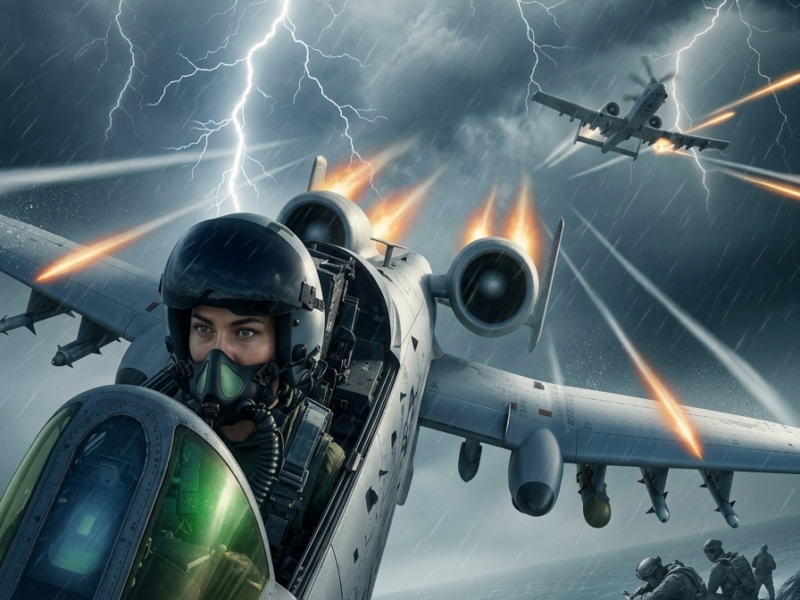
The storm over the Hindu Kush did not resemble rain so much as a wall of wet gravel suspended in the dark. At thirty thousand feet, the canopy of my A-10C Thunderbolt II—the heavy, ugly, twin-engine ground-attack jet known simply as the Warthog—vibrated with a low, bone-deep hum. Outside, the night was pitch black, illuminated only by sudden, violent flashes of jagged mountain lightning that revealed the knife-edge granite peaks lurking just beneath the cloud deck.
Inside the cockpit, the amber glow of the flight instruments cast deep shadows across my visor. I was Major Mark Vance, though nobody on base called me by my name, and nobody spoke my old callsign anymore. For eight years, I had been a ghost in the flight line—a pilot relegated to routine border patrols and logistics escort, assigned the maintenance-heavy jets that no one else wanted to fly.
The tactical radio in my headset cracked through the static, a voice strained by adrenaline and choked by the sharp, metallic tang of burning cordite.
“Any aircraft, any station, this is Team Alpha-Six! We are pinned on the eastern slope of Ridge 404! Taking heavy automatic fire and mortar impact! We have two wounded, ammo is critically low, and our primary comms are down! We need help!”
Then, a sickening burst of static, followed by the dull, rhythmic thump-thump-thump of high-caliber machine-gun fire, before the signal died completely.
I leaned forward, my gloved hand pressing against the digital tactical display. Ridge 404 sat deep inside the Shahi-Kot Valley—a jagged, narrow corridor notorious for unpredictable downdrafts, heavy fog, and dense networks of anti-aircraft positions. Three aircraft had already attempted to reach the area earlier that evening: two Army Blackhawks had been forced to turn back due to severe icing and zero visibility, and a fast-jet F-16 escort had been driven off after taking small-arms fire through its air intake.
The coordinates flared bright orange on my navigation screen.
Too low. Too narrow. Too dangerous.
A sharp, authoritative tone cut through the cockpit frequency. It was my commander, Colonel Robert Sterling, speaking directly from the Combined Air Operations Center in Bagram.
“Vance, hold position at Orbit Point Bravo,” Sterling ordered, his voice cold and clipped. “Do not engage. Weather conditions are below operational minimums, and ground intelligence reports heavy radar-guided AAA in the canyon. Maintain thirty thousand feet until relief arrives.”
I stared at the storm clouds churning below my wingtips. Through a brief tear in the grey fog, I could see the faint, rhythmic flicker of muzzle flashes lighting up the base of the ridge like angry fireflies.
“They’re still alive down there, Sir,” I said, my thumb hovering over the throttle assembly. “If they wait for relief, they’ll be wiped out before the next orbit cycle.”
“We can’t risk another aircraft, Vance!” Sterling snapped, his voice rising in volume. “That valley is a meat grinder. You know what happened the last time a pilot tried to punch through a zero-visibility storm in that exact sector. You do not have authorization to descend!”
I knew what he was referring to. Eight years ago, in that very same valley, my wingman—Captain David Miller—had gone down during a night strike. I had been the flight lead. When the storm rolled in, I was ordered to break off, but David’s jet took a hit to the tail assembly. He spiraled into the clouds, and despite a two-week search through the frozen snowdrifts, neither his body nor the wreckage of his A-10 was ever recovered. The formal board of inquiry had blamed me for losing formation discipline in bad weather. They said I had abandoned my wingman in the dark.
I tightened my leather gloves until the seams strained against my knuckles.
“I can,” I whispered.
Before Sterling could reply, I slammed the dual throttles forward, kicked the left rudder pedal, and rammed the nose of thirty thousand pounds of titanium and steel directly into the teeth of the storm.
The A-10 dropped like an anvil through the cloud deck.
The transition from upper-altitude calm to low-level hell was instant. Rain slammed against the armored Plexiglas canopy with the sound of thrown marbles. The airframe shuddered violently, thrown sixty feet vertically in a split-second downdraft that caused the altitude warning tones to chirp in my headset. Lightning flashed right off my port wingtip, illuminating the razor-sharp rock walls rising on either side of the jet.
For several horrifying seconds, I saw nothing. The instruments spun in a blur of artificial horizons and tumbling compass needles. I was flying completely blind inside a narrow stone box at four hundred miles per hour.
Then, a faint, pulsing crimson dot appeared on my Heads-Up Display (HUD).
It was a handheld infrared emergency beacon—the faint, desperate signal of a ground team marking their last stand.
I pulled the stick back, leveling the jet just three hundred feet above the floor of the gorge. The rain whipped across the glass as I swept around a massive rock promontory.
There, clinging to a narrow shelf of shattered rock on the side of the ridge, were four figures in torn camouflage gear. They were surrounded on three sides by dozens of insurgent fighters crawling up the steep slopes under the cover of the heavy rain, pouring continuous automatic fire into the team’s dwindling rock breastwork.
On the ground, the SEAL team leader—a veteran sergeant covered in mud and blood—looked up through his night-vision goggles as the low, guttural roar of twin TF34 turbofan engines echoed off the mountain walls. Through the sheet of water, he saw the dark, predatory silhouette of the A-10 emerging from the cloud ceiling, its twin vertical stabilizers cutting through the fog.
“Who the hell is that?” the SEAL muttered into his tactical radio, his voice barely audible over the chatter of incoming rounds.
His radio crackled back, bypassing the jammed operational channels and cutting through on an old, forgotten emergency frequency.
“Raven,” the voice said over the speaker.
The team leader froze, his hand tightening around the radio grip. “Raven?”
I hadn’t heard that callsign spoken aloud in eight long years. It was the name I had carried before the court-martial, before the reprimands, before I became the pilot who was never allowed to lead again.
The team leader pressed his chest microphone, his eyes locked onto my approaching aircraft. “Raven… we’re running out of time. They’re thirty yards from our perimeter.”
I pulled the stick to line up the HUD reticle directly over the advancing line of enemy muzzle flashes, my index finger resting against the trigger of the 30mm GAU-8 Avenger rotary cannon mounted in the nose of my jet.
“So am I,” I replied.
The nose of the A-10 pitched down, pointing straight into the mouth of the valley.
The GAU-8 Avenger cannon isn’t just a weapon; it is the center around which the entire aircraft is built. A seven-barrel gatling gun capable of firing seventy armor-piercing depleted uranium rounds per second, its heavy recoil is strong enough to noticeably slow the aircraft down when fired in sustained bursts.
I adjusted the rudder pedals by a millimeter, aligning the flight path marker with the dark treeline just forty yards below the SEALs’ defensive position.
“Head down!” I shouted into the radio. “Friendly ordnance on the way!”
I squeezed the heavy metal trigger.
BRRRRRRRRRRRRRRRRRRRRRRRRRRRRRRRTTTT!
The roar of the cannon filled the cockpit, a sound like tearing sheet metal mixed with deep, rolling thunder. The airframe vibrated so intensely that my vision blurred for a fraction of a second. A line of 30mm explosive shells tore into the rocky slope, churning the granite boulders, mud, and vegetation into a white-hot slurry of dust and fire.
The impact zone erupted. The advancing enemy line vanished behind a wall of pulverized rock and high-explosive detonations. The heavy suppressor fire that had been pinning the team down stopped instantly.
“Good hits! Good hits!” the SEAL leader screamed over the radio, his voice crackling with disbelief as he watched the slope below his position turn into an inferno. “You cleared the lower ridge! We have an opening!”
“Move! Move to the saddle point at the end of the ridge!” I ordered, hauling back on the control stick to pull the heavy jet out of its dive. “I’ll cover the northern flank!”
The four men scrambled out of their shattered breastwork. They ran through the mud and loose shale, two of them dragging a third man whose leg was wrapped in a blood-soaked field dressing. The team leader stayed behind for three seconds, laying down suppressive fire with his carbine to cover their retreat, before grabbing the injured man’s harness and pulling him upward toward the extraction saddle.
They were fifty yards from the flat clearing at the top of the ridge where a heavy-lift chopper could potentially land. One of the SEALs lost his footing on the slick rock and fell hard, his helmet tumbling into the ravine below. His teammate turned back immediately, grabbing him by the body armor and hauling him to his feet just as a volley of machine-gun fire kicked up the mud around his boots.
Then, the red emergency beacon on my display flickered twice and died.
A second later, a high-pitched, deafening audio tone shrieked through my flight helmet.
BEEP-BEEP-BEEP-BEEEEEEP!
The Master Caution light flashed bright orange on the main panel, accompanied by the flashing red text on the threat display: RADAR LOCK – SURFACE TO AIR.
An automated, mobile SA-13 missile system, hidden deep within a concealed cave entrance on the opposite side of the canyon, had just acquired my aircraft’s heat signature through the rain.
I kicked the A-10 into a steep bank, dumping a sequence of burning magnesium flares into the night sky behind me.
WHOOSH-WHOOSH-WHOOSH!
A bright white streak of rocket motor fire ignited from the mountain wall below. A surface-to-air missile cut through the rain, trailing a spiraling plume of grey smoke as it accelerated straight toward my tailpipe at Mach 2.
“Missile launch! Missile launch!” the SEAL leader yelled from the ground, watching the fiery trail cut through the darkness.
I pulled six Gs, pulling the heavy control stick hard into my stomach. The wingtips groaned under the aerodynamic stress, the metal skin rippling as the A-10 sliced through the storm. The missile hit the cloud of flares fifty yards behind my left engine, exploding in a blinding ball of orange flame that slammed a wave of compressed air against my rudder controls.
The jet rocked violently, the left wing dipping toward the rock wall before I fought the controls and leveled her out.
A second missile warning tone immediately began to scream in my ears.
Standard military doctrine was simple: dump remaining heavy ordnance, punch the emergency climb thrust, and break out of the valley into the safety of the upper clouds. I had given the SEALs their opening. I had done more than anyone could have asked of an old pilot in a broken storm.
I put my hands on the throttles to climb away.
Then, I looked across the dark, rain-swept valley toward the jagged, inaccessible northern peak of the mountain—the exact site where Captain David Miller’s jet had vanished eight years ago.
As my eyes scanned the black granite walls illuminated by the lingering glow of my flares, I noticed something impossible on my tactical display.
The navigation system, which had been erratic due to the storm’s electromagnetic interference, suddenly locked onto an ultra-low frequency transponder signal.
The digital coordinates blinking on my screen were identical to the ones recorded in my flight log from eight years ago.
My commander’s voice cut through the static on the main frequency, sharp and panicked. “Raven! Break off immediately! We have multiple enemy vehicles moving into the lower valley! Get out of there now! That is a direct order!”
I didn’t answer. I couldn’t.
Because beneath the swirling fog at the base of the northern cliff, I saw a faint, rhythmic amber light pulsing through the trees.
It wasn’t an enemy vehicle. It wasn’t the infrared strobe of the SEAL team.
It was the specific, encrypted distress beacon assigned exclusively to the emergency survival vests of USAF flight officers—a signal that could only be activated manually from inside an aircraft’s seat harness.
And someone was transmitting it from deep inside a cavern carved into the roots of the mountain.
My breath caught in my throat. The cockpit seemed to shrink around me, the rain pounding on the canopy canopy sounding like a distant, irrelevant noise.
Eight years. Eight years of carrying the weight of a dead man. Eight years of listening to officers at Bagram whisper that I had panicked, turned tail, and left my wingman to freeze in the snow.
“Raven, acknowledge!” Colonel Sterling shouted over the radio, his voice cracking with operational authority. “You are low on fuel and your airframe has taken structural stress! Disengage and return to base!”
I reached out and clicked the primary communications channel off. The room went silent except for the low, steady hum of my own engines and the faint, rhythmic beep… beep… beep… of the encrypted emergency transponder on my tactical display.
I keyed the local ground-team frequency. “Alpha-Six, this is Raven. An extraction heavy-lift chopper is ten minutes out on the southern approach. The lower ridge is clear. Can you make the saddle?”
The SEAL leader’s voice came back, heavy with exhaustion but clear. “We’re at the saddle point now, Raven. We’ve got a perimeter set. But what about you? That missile battery on the northern cliff is still active!”
“I have one more run to make,” I said quietly. “Get your men on that chopper when it arrives. Don’t wait for me.”
“Raven, wait—”
I cut the feed, pulled the A-10 into a tight, low-altitude bank, and rolled the jet directly toward the northern wall of the canyon.
The rain was falling harder now, turned into a thick sheet of ice by the dropping temperatures at six thousand feet. My windshield began to freeze around the edges, the defroster blowing at maximum capacity to keep a small circle of clear glass in front of my eyes.
I dropped the jet to fifty feet above the canyon floor, skimming the tops of the pine trees that clung to the frozen slopes. The terrain-following radar was chirping continuously, warning me of approaching rock faces every three seconds.
Up ahead, embedded in the sheer granite wall of the mountain, was a massive, semi-concealed opening—a natural limestone cavern that had been reinforced with heavy concrete pillars during the Soviet-Afghan war. It was large enough to fit heavy military trucks, its entrance partially hidden behind a thick curtain of pine trees and fallen rock.
And sitting right at the lip of that cavern, hidden beneath camouflage netting and thick snow, was the radar-guided SA-13 missile launcher that had just fired on me.
“Target acquired,” I muttered.
I didn’t use the cannon. I didn’t have the angle for a strafing run without slamming directly into the cliff side.
Instead, I selected a heavy Maverick AGM-65 laser-guided missile mounted beneath my right wing. I locked the electro-optical camera directly onto the center of the cavern entrance, pressed the weapon release button, and pulled up hard.
FWOOSH!
The heavy missile detached from the wing rail, its rocket motor illuminating the dark trees in a blinding flash of yellow flame. It traveled three hundred yards in less than a second, slamming directly into the missile launcher and penetrating deep into the cavern opening before detonating.
A colossal explosion shook the entire mountain. A wave of orange fire, smoke, and shattered rock spewed out of the cave mouth, collapsing the heavy concrete pillars and sealing the entrance under hundreds of tons of falling granite.
The missile threat warning on my panel died instantly.
I circled back around the smoking ruins of the entrance, bringing the A-10 into a slow, high-angle hover-turn. Through the clearing smoke and rain, I looked at the lower ledge just twenty yards below the collapsed cavern.
There, sheltered inside a narrow, secondary rock alcove that had been exposed by the blast, was the scorched, stripped aluminum tail section of an A-10 Thunderbolt II.
The flight numbers painted on the tail were faded, pitted by eight years of arctic winds and salt, but they were still legible in the light of the burning brush below:
AF-04-212.
David’s jet.
He hadn’t crashed into the open snow. He had been shot down over the cavern network, his plane breaking apart as it slammed into the mountain ledge, the remains of his airframe preserved inside the frozen shadow of the rock overhang for nearly a decade.
And standing on the narrow rock ledge right outside the wreckage, holding a flickering, hand-wired emergency transponder unit connected to the jet’s surviving battery housing, was a figure dressed in a heavy, threadbare sheepskin coat and worn flight boots.
The figure wiped the rain from his face, looked up through the dark sky directly at my circling aircraft, and slowly raised a gloved hand to his forehead in a sharp, crisp military salute.
My hands froze on the control stick. The breath left my lungs in a sharp, painful gasp.
It was David.
He was alive.
Eight years of military court records, eight years of condolences to his family, eight years of carrying the label of the pilot who let his wingman die—all of it shattered in a single, terrifying second in the middle of an Afghan storm.
He was thin, his beard long and streak-grey, his face lined with the deep, permanent marks of cold and survival. But as the landing lights of my A-10 swept across the ledge, his eyes caught the glare—clear, sharp, and unmistakably alive.
He had been captured or sheltered by local mountain tribes after his crash, held in the unmapped, lawless border region where no search-and-rescue team had ever dared to venture. He had survived in the shadow of the mountain that had eaten his plane, waiting for the one thing he knew would eventually come back for him: the low, thunderous roar of a Warthog flying through a storm.
“Alpha-Six, this is Raven!” I screamed into the radio, my voice breaking with an emotion I hadn’t felt in a decade. “I have a survivor! Repeat, I have a pilot down at Grid Reference Delta-Nine! I need that extraction chopper at my position immediately!”
The radio crackled back instantly with the heavy, beating sound of rotor blades in the background. It was the pilot of an MH-47 Chinook heavy transport helicopter that had just entered the valley.
“Raven, this is Rescue Flight Three-One! We have Alpha-Six secured on board! We are tracking your beacon now, but that northern ledge is surrounded by steep cliffs! We can’t land a heavy bird on that rock face!”
“You don’t need to land!” I yelled, bringing the A-10 into a low, defensive orbit directly over David’s position. “Drop a hoist line! I’ll fly cover until he’s hooked!”
“Copy that, Raven! We are two minutes out!”
Below me, the storm was making its final, desperate attempt to claim the valley. The wind velocity surged to sixty knots, throwing sheets of freezing rain against my jet’s control surfaces. To make matters worse, dark silhouettes began moving along the lower tree line beneath David’s ledge—the remaining insurgent forces, alerted by the explosion of the missile battery, were advancing up the narrow goat paths toward his position.
They saw David standing on the ledge. They opened fire.
Tracers began snapping through the air around the small rock alcove, ricocheting off the granite walls and sending clouds of stone splinters flying past his face.
David ducked behind the scorched aluminum hull of his old cockpit, pulling an ancient, rusted service pistol from beneath his coat and firing three shots back down the slope.
“Not today,” I growled through my teeth.
I slammed the A-10 into a zero-visibility dive, flying so low that the tip of my belly-mounted cannon cut through the highest branches of the pine trees.
BRRRRRRRRRRRRRRRRRRRRRRRRRRRRRRRTTTT!
I walked a continuous wall of 30mm explosive shells along the perimeter of the lower slope, creating a barrier of churning mud and pulverized rock fifty yards below David’s ledge. The sheer volume of fire was so intense that the advancing forces were completely halted, forced to dive for cover into the deep ravines as the ground shook beneath their feet.
“Rescue Three-One is on scene!” the Chinook pilot called out over the radio as the massive twin-rotor helicopter dropped out of the clouds directly above the ledge, its powerful searchlights cutting through the rain.
A steel cable dropped from the side door of the Chinook, the rescue swimmer rappelling down through the rotor wash to the rock face below.
I watched from the cockpit as the swimmer reached the ledge, grabbed David by his shoulders, and secured the heavy leather harness around his chest. David looked up into the storm one last time, his eyes searching the dark clouds for the shape of my jet.
He raised his thumb toward the sky.
I dipped my wings in reply, turning my jet into the wind as the hoist cable pulled him up into the belly of the rescue helicopter.
“Survivor secured!” the Chinook pilot shouted. “We are clear! Repeat, we are clear! Heading for home base!”
The climb out of the Shahi-Kot Valley was a blur of silver rain, breaking clouds, and the sudden, breathtaking arrival of the dawn sky.
As the A-10 punched through the top of the dark cloud deck at twenty thousand feet, the violent turbulence vanished instantly. The morning sun burst over the eastern horizon, bathing the snow-capped peaks of the Hindu Kush in brilliant, blinding rays of gold and amber light.
The canopy of my jet was covered in a thin sheet of frost that glistened like millions of crushed diamonds in the morning sun.
My fuel gauge was sitting dangerously close to the red line. My left wing was pockmarked with bullet holes from small-arms fire, and the barrels of my heavy nose cannon were black with soot. But the twin engines behind my cockpit hummed with a smooth, unbroken rhythm—a deep, steady heartbeat that seemed to echo through the sky.
The radio panel in my cockpit lit up with a burst of static, followed by the voice of Colonel Sterling at Bagram Command.
His voice was no longer sharp or angry. It was heavy, quiet, and thick with an emotion that no military commander was ever supposed to show.
“Raven… this is CAOC Command,” Sterling said slowly. “Search and Rescue confirms… Captain David Miller is on board Rescue Three-One. He is weak, but stable. He just asked the medics to pass a message to his flight lead.”
I took a deep breath, resting my gloved hand on the flight stick. “Go ahead, Command.”
“He said… ‘Thanks for keeping formation, Mark.'”
A single tear cut a clean line through the dried salt and dust on my cheek, dripping onto the collar of my flight suit.
“Copy that, Command,” I said softly, my voice clear and steady for the first time in eight years. “Raven is returning to base.”
Below my aircraft, the heavy storm clouds over the valley were beginning to break apart, scattered by the morning wind into soft, white plumes that drifted away over the quiet mountains. The dark, terrifying valley that had held my past for eight long years was now just a quiet, distant shadow receding beneath my wingtips.
I looked out over the wide, open sky stretching toward the horizon—a sky that no longer felt empty, a sky that no longer belonged to a ghost.
I nudged the throttles forward, aligned the nose of my Warthog with the rising sun, and flew home.
The end









