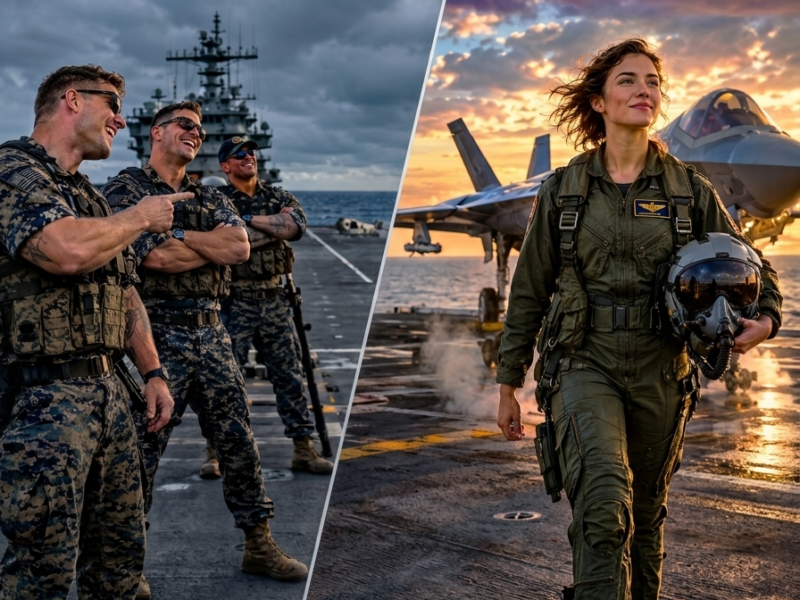
The SEALs Laughed at the Shy Pilot—Then She Landed the Jet No Man Could Ever Control Alone Now!
The concrete floor of Hangar 4 at Naval Air Station Oceana radiated the unrelenting heat of late July, smelling of burnt jet fuel, hydraulic fluid, and salt air drifting in from the Atlantic. Outside, the midday sky above Virginia Beach was an uninterrupted sheet of hazy blue, but inside the shadow of the massive steel beams, the atmosphere was suffocating. I sat on an overturned yellow wheel chock near the rear landing gear of an F/A-18E Super Hornet, a polishing rag wrapped tightly around my hand, mechanically buffing the dark visor of my flight helmet.
Fifty feet away, a crowd had gathered around Lieutenant Commander Blake Morrison. He stood with his flight suit unzipped to his waist, revealing a sweat-stained green undershirt, his arms crossed over a broad chest that seemed built specifically to wear medal ribbons. Surrounding him were six members of SEAL Team 2, visiting the base for joint carrier-qualification exercises, alongside half a dozen senior fighter pilots from Strike Fighter Squadron 103—the famous “Jolly Rogers.”
“I’m just saying,” Morrison’s booming voice echoed off the high corrugated ceiling, punctuated by the metallic clatter of mechanics working three bays over. “We’ve got standard aviators, we’ve got top-tier dogfighters, and then we’ve got our human furniture.”
A low rumble of laughter rippled through the group.
Morrison gestured vaguely in my direction with a half-empty aluminum water bottle. He didn’t even bother to look directly at me; I was merely a convenient prop for his routine. “Careful around Carter, boys. Don’t make any sudden movements or speak above a whisper. She might lose a dogfight against a rogue weather balloon. Hell, I think a heavy gust of wind on the flight line might knock her right out of the sky.”
Master Chief Petty Officer Miller, a hardened SEAL with a scarred jaw and a combat knife strapped to his vest, grinned and shook his head. “That’s a real pilot? I thought she was the squadron typist.”
More laughter rolled across the hangar. It was loud, open, and utterly unbothered by my presence.
I didn’t flinch. I didn’t stop the smooth, rhythmic motion of my hand against the fiberglass helmet. I had spent three years as a Lieutenant at Oceana earning a reputation as the quietest, most unremarkable transport-qualified instructor on the East Coast. I took the dawn shifts nobody wanted. I logged the grueling simulator hours training green recruits who would go on to get the combat deployments I was never offered. I ate my meals alone at the corner table of the mess hall, and when senior officers spoke to me, I answered in short, monotone sentences that invited no further conversation.
They thought my silence was timidness. They thought my refusal to engage in mess-hall chest-thumping meant I lacked the bloodthirsty edge required to fly high-performance jets.
They didn’t know about the high-desert runways of China Lake, California. They didn’t know about the blacked-out hangars where I had spent two years flying unflagged, experimental prototypes with experimental fly-by-wire flight-control algorithms—aircraft designed to push the boundary between human reaction and automated computer survival. They didn’t know that I had logged hundreds of hours in cockpits where a single glitch in the digital control architecture meant instantly spinning out of control into the sagebrush at Mach 1.5.
And above all, they didn’t know about Daniel.
My younger brother, Daniel, had been a civilian aerospace systems engineer embedded with the Naval Air Systems Command. He was twenty-four, brilliant, obsessed with flight dynamics, and possessed the kind of gentle, unshakeable laugh that could dissolve any tension. Two years ago, Daniel was the lead test engineer aboard an experimental stealth prototype designated the X-49 Vanguard. During a night test over the Nevada Test and Training Range, the aircraft went into an unrecoverable, violent pitch-up oscillation and disintegrated in mid-air.
The official Department of Defense inquiry took less than three weeks to publish its findings: Pilot disorientation resulting in controlled flight into terrain. Human error.
They blamed the dead pilot. But forty-eight hours before that fatal flight, Daniel had called me from a encrypted satellite phone. His voice had been shaking. He told me he had uncovered a critical design flaw in the core flight-control logic—a hidden feedback loop that, under specific conditions of high angle-of-attack combined with asymmetrical yaw, would lock the horizontal stabilizers and ignore all manual overrides from the pilot’s stick. He said he had brought it to the program executives, but they had ordered him to move forward with the test anyway. He told me he was copying the raw telemetric source code onto an external drive to force a formal safety audit.
When the crash happened, that drive vanished. The telemetry logs provided to the investigative board were completely clean, stripped of the system error flags Daniel had promised me existed. The Navy buried the program, closed the case, and expected everyone to move on.
I couldn’t move on. I resigned from the experimental testing wing, requested a transfer to a quiet instructor role at Oceana, and began my patient, meticulous search for the truth. For twenty-four months, I had been an invisible ghost in the machine, quietly cross-referencing flight maintenance logs, monitoring software updates across carrier squadrons, and waiting for the flaw to surface again. Because I knew software like that never truly dies—it gets recycled, rebranded, and buried inside commercial and military subcontracts.
“Hey, Carter!” Morrison’s voice broke through my thoughts. He was walking toward me now, flanked by two of his junior pilots. “You listening? Go grab the pre-flight checklists for the afternoon training sortie from the duty office. Jump to it.”
I looked up slowly, meeting his gaze with an expression devoid of any emotion. “Yes, sir.”
I stood up, set my helmet down on the wing panel, and walked toward the administrative hallway. Behind me, I heard one of the SEALs snicker. “Man, she really doesn’t have a soul, does she?”
Before I reached the double doors, a piercing, high-pitched warble shattered the mundane background noise of the base.
It wasn’t the standard maintenance horn or a routine PA announcement. It was the Primary Emergency Air Control siren—a sound that only rang when an airborne asset was in immediate, life-threatening distress.
Instantly, the casual atmosphere in the hangar evaporated. Morrison’s posture straightened, his grin vanishing. Mechanics dropped their wrenches. The SEALs stood shoulder-to-shoulder as the hangar squawk-box crackled to life with the panicked, rapid-fire voice of the Base Air Traffic Controller.
“All squadron commanders and senior flight leads, report to Tactical Operations immediately. We have a declare-emergency asset inbound. Repeat, wildcat in the dark.”
I froze in the doorway. “Wildcat in the dark” was the unspoken jargon for a combat jet experiencing total control loss in instrument flight conditions.
Morrison strode past me, brushing my shoulder without a word as he sprinted toward the control center. I didn’t wait for permission. I turned on my heel and followed the group of officers as they flooded into the darkened, screen-lit room of Tactical Operations.
The room was dominated by a massive wall display showing the radar track of the Atlantic approach corridor, fifty miles off the coast of Norfolk. A bright red blip was moving erratically, leaving a jagged, stair-stepped trail across the digital grid. Outside, the clear sky of midday was rapidly vanishing as a sudden, violent cold front swept in from the north, bringing heavy grey rain clouds and roaring crosswinds that were already tearing across the carrier landing zones.
“Status!” Morrison barked, shoving his way to the front console where the Air Traffic Controller was frantically typing commands.
“It’s Joker 21,” the controller said, his voice laced with sweat and adrenaline. “An F/A-18E returning from a solo systems validation flight over the offshore range. Pilot is Lieutenant Ryan Vance. He’s suffering from a catastrophic flight-control system degradation. He has no pitch authority, his roll rate is erratic, and he’s trapped in heavy IMC—instrument meteorological conditions. Visibility out there just dropped to less than a quarter-mile.”
“Tell him to punch out,” Morrison said coldly. “Eject over the ocean. We’ll send a SAR helicopter to pick him up.”
“Negative, sir!” the controller replied, pointing at a streaming telemetry display. “The ejection seat circuit is throwing a bus failure error! If he pulls the curtain, the primary charge might not detonate. He’s stuck in the cockpit.”
A heavy silence descended over the room. The SEALs stared at the screen, their bravado completely gone.
“What about the carrier?” a captain asked from the back. “The USS Gerald R. Ford is forty miles out.”
“The Ford is rolling in twenty-foot seas with thirty-knot crosswinds,” the controller answered. “Their deck is currently red. No landings permitted. If he can’t get control of the nose, he can’t make an airfield ashore, and he can’t trap on the carrier. He’s got less than twelve minutes of fuel before he starves.”
Morrison grabbed a microphone, his knuckle turning white. “Vance, this is Morrison. Can you fly an approach using manual trim tabs?”
The speaker crackled with deafening static, followed by the sound of heavy, rapid breathing and the loud, rhythmic chime of master warning alarms ringing in the background cockpit.
“Negative, Boss!” Vance’s voice was borderline hysterical. “The… the stick is fighting me! Every time I try to level the wings, the plane pitches up violently! The digital flight computers are overriding my manual inputs! It feels like… it feels like the plane is trying to tear itself apart! I can’t hold her straight!”
My blood turned to ice.
Pitch-up oscillation. Digital flight computer overriding manual inputs. Delayed control loop.
It was Daniel’s crash. It was the exact same ghost in the code.
Morrison turned to the assembled flight instructors in the room—men with thousands of hours, decorated combat veterans, weapons school graduates. “Who’s current on the storm recovery protocols? Who can take a chase plane up right now, rendezvous with him in the soup, and talk him down to a visual approach?”
The senior pilots looked at each other. The radar screen flickered as Joker 21 plummeted another eight hundred feet in a sudden, violent dive before pulling up wildly.
“Blake, look at that weather,” one seasoned commander murmured, stepping back from the console. “You go into that cloud deck with twenty-knot shears and a jet that’s bouncing around like a loose missile, you’re risking two aircraft and two lives. There’s no protocol for a runaway fly-by-wire computer in zero visibility. Nobody can land that aircraft in these conditions. Not safely. It’s a death trap.”
“He’s right,” another pilot added, shaking his head. “It’s suicide.”
Morrison bit his lip, his eyes darting across the radar map. He was out of answers. The grand military chest-thumping had collapsed in the face of a cold, mathematical nightmare.
I stepped out from the shadow of the back wall and walked directly to the primary radio console.
“I can do it,” I said.
The entire Tactical Operations room turned to look at me. For a moment, nobody spoke. The silence was absolute, broken only by the incessant warning pings coming through the speaker from Vance’s cockpit.
Morrison looked at me as if I had suddenly begun speaking in an ancient, dead language. “What did you just say, Carter?”
“I said I can try,” I repeated, my voice steady, flat, and entirely devoid of the nervousness they had assumed was my default state for three years. “And I won’t just try. I will bring him down.”
Morrison let out a harsh, disbelieving laugh, though it lacked any real humor. “Sit down, Lieutenant. This isn’t a simulator ride for flight cadets. That’s a haywire fighter in a zero-visibility storm. You fly a C-2 Greyhound transport. You aren’t even combat-rated on the latest E-model flight software.”
“I am familiar with that control system,” I said, stepping closer until I was standing directly opposite him, looking straight into his eyes. “More familiar than anyone in this room. More familiar than the engineers who installed it.”
“You’re a transport instructor, Carter!” Morrison snapped, his face flushing red with sudden anger. “Not a miracle worker! I am not giving a high-performance jet to a pilot who spends her weekends dusting manuals just so you can get yourself killed!”
“Sir,” I said, my tone dropping to a quiet, dangerous frequency that made the nearby controller flinch. “If you don’t give me a jet in the next ninety seconds, Lieutenant Vance is going to pitch up to forty degrees, stall out at six thousand feet, and enter a flat spin into the Atlantic Ocean. His flight control architecture has entered a closed-loop diagnostic logic error triggered by an uncalibrated pressure sensor. The stick isn’t broken; the control computer is reading a phantom angle-of-attack and trying to ‘correct’ a pitch that doesn’t exist.”
Morrison blinked, stunned by the sheer speed and hyper-specific technical clarity of my words. “How… how could you possibly know that?”
“Because I helped design the emergency recovery override protocols for that exact control sub-routine,” I lied—or rather, I shifted the truth. I hadn’t designed it; Daniel had. And I had spent two years memorizing every single line of his code until it was burned into the back of my eyelids. “Now clear me for takeoff in Chase-1, or watch your pilot die on that screen.”
Morrison stared at me for three long seconds. He looked at the radar track, where Joker 21 was losing altitude fast, then looked back at my face. He didn’t see the shy, silent girl who polished helmets in the corner. He saw someone who was utterly unaffected by his authority, someone operating on a plane of certainty he couldn’t begin to comprehend.
“Get her a flight suit and a helmet,” Morrison ordered, turning to his duty officer. “Prepare Super Hornet Viper 04 on the hot pad. Clear the airspace.”
Six minutes later, I was strapped into the cockpit of an F/A-18E Super Hornet, the twin General Electric F414 engines roaring beneath me with a deafening, vibrating thunder that shook my spine. The canopy closed, sealing me in a cocoon of digital displays, glowing green heads-up indicators, and the smell of pure oxygen.
“Viper 04, you are cleared for immediate takeoff, runway three-zero,” the tower barked into my headset. “Wind three-three-zero at twenty-eight knots, gusting to forty. Godspeed, Carter.”
I slammed the throttles forward into full afterburner.
The jet surged forward like an unleashed predator, slamming my back into the ejection seat. The runway lights blurred into solid white ribbons as the speed climbed through ninety, one-twenty, one-sixty knots. I pulled back on the stick, and the aircraft smashed into the dark, churning cloud layer at three hundred knots.
Instantly, the world outside dissolved into a swirling wall of grey chaos. Heavy rain slammed against the plexiglass canopy with the force of gravel. The turbulence hit me like a physical blow, tossing the jet violently left and right, but my hands were utterly calm on the controls. I wasn’t fighting the aircraft; I was feeling it, anticipating the atmospheric shears before the sensors could even register them.
“Joker 21, this is Viper 04,” I said, switching to the tactical discrete channel. My voice was calm, measured, almost soothing. “I am eight miles out, climbing through six thousand feet to intercept your position. Do you copy?”
“Viper 04… I copy…” Vance’s voice was ragged, choked with panic. “I can’t… I can’t hold the horizon! The control stick is kicking back like an unpaved road! The nose keeps violently pulling up! I’m pulling full forward stick just to keep from stalling!”
“I know what it’s doing, Ryan,” I said softly. “Listen to my voice. Take a deep breath. Stop fighting the flight computer with raw force. If you fight it, the automated control loop amplifies your inputs and makes the oscillation worse.”
“What do you mean, don’t fight it?!” he screamed as a burst of static cut his voice. “If I let go of this stick, the plane will loop into the ocean!”
“You aren’t going to let go,” I replied, bringing my throttles back slightly as my radar locked onto his radar signature. “You’re going to trick it. I am coming up on your left wing now. Look for my lights.”
I broke out of a dense wall of black clouds at eight thousand feet. A quarter-mile ahead of me, Joker 21 was plunging through the sky like a wounded beast. Its tail lights were flickering wildly as the aircraft violently pitched its nose toward the heavens, shuddered near a stall, and then slammed its nose back down as the pilot fought for control. It was painful to watch—it was like watching a ghost relive the final, agonizing moments of my brother’s life.
Not today, I swore to myself. Not again.
I slid my fighter into a tight, aggressive formation, closing the distance until I was flying barely thirty feet from his left wingtip. Through the rain-slicked glass of his canopy, I could see Vance’s helmeted head jerking around in sheer terror.
“Ryan, look at me,” I commanded, turning my head toward him. “Don’t look at your instruments. Look at my aircraft. You are going to mirror my movements.”
“Carter?! Is that… is that you?!” Vance stammered in shock. “What are you doing up here?!”
“Saving your life,” I said flatly. “Now pay attention. Your flight computer has locked into a secondary fallback safety mode because it thinks your primary pitot tubes are iced over. It’s reading a false angle-of-attack. To break the control loop, you need to execute a manual override sequence that isn’t in the standard operating manual.”
“What sequence?! There is no manual override for a total FCS logic lock!”
“There is,” I said, my chest tightening. “It was developed during experimental flight testing at China Lake. It was never published in the fleet handbooks because the program executive board withheld the data.”
Silence filled the radio for two seconds.
“You’re going to pull your primary Flight Control System Circuit Breaker number four—the one behind your right elbow—hold it out for three seconds, and then cycle your secondary digital flight computer switch from AUTO to MECH,” I instructed, my eyes locked on his jet’s control surfaces.
“Pull a flight control circuit breaker while airborne in a storm?!” Vance gasped. “That goes against every naval aviation safety rule ever written! If it fails, I lose all digital stability controls!”
“If you don’t do it, you will die in less than four minutes when your fuel runs out,” I said, my voice cutting through his panic like a scalpel. “Trust me, Ryan. I know this system better than the people who built it. On my mark. Three… two… one… PULL IT.”
Through the storm, I saw Vance reach back in his cockpit.
For a horrifying fraction of a second, his jet froze in mid-air. Its control surfaces flapped wildly, and the nose dipped sharply toward the churning black Atlantic three thousand feet below. The jet plunged into a terrifying nose-dive, disappearing into a wall of dense cloud.
“Ryan! Pull MECH switch NOW!” I screamed into the radio, shoving my throttles forward and diving straight into the dark cloud deck after him.
The storm swallowed us whole. Rain slammed into my radome like a barrage of miniature bullets. My attitude indicator whirred as I pushed my Super Hornet through a sixty-degree dive, tracing the disappearing wake of Joker 21. The digital sensors on my HUD flickered wildly as heavy crosswinds hit my airframe, trying to twist my fighter out of line.
For five agonizing seconds, there was nothing but grey darkness and roaring wind.
“I’ve got no control! She’s spiraling!” Vance’s voice screamed over the radio, choked by G-forces. “It didn’t work! It didn’t work!”
“Hold the switch in MECH!” I yelled, pulling my stick to the left to intercept his vector. “The computer takes four seconds to flush the volatile cache memory! Count it out! ONE! TWO!”
Down below, through a sudden tear in the cloud layer, the white-capped, terrifying swells of the Atlantic Ocean appeared, rising rapidly to swallow his jet. Two thousand feet. Fifteen hundred feet. He was dropping at eight thousand feet a minute.
“THREE! FOUR!”
Suddenly, the wild, erratic fluttering of Joker 21’s horizontal tail elevators ceased. The control surfaces locked into a stable, neutral position. The pitch-up oscillation vanished.
Slowly, agonizingly, the nose of Vance’s fighter began to pull up out of the dive, leveling off barely eight hundred feet above the raging black water. The jet stabilized, its wings holding level for the first time in an hour.
“I… I have control,” Vance sobbed into his mask, his chest heaving. “The stick… it’s heavy as lead, but it’s responding. The computer stopped fighting me. Oh God… I have control.”
“I told you,” I said, letting out a long, quiet breath that I felt like I had been holding for two years. “Now stay on my wing. The mechanical backup mode won’t allow you to execute a complex automated landing approach. I am going to lead you in on a visual formation approach to Runway Thirty-Left at Oceana. You will fly my wing, matches for speed and slope. When I pull back, you pull back. When I cut power, you cut power. Do you understand?”
“Understood, Viper 04. I’m locked on your wing.”
We turned as a pair, banking hard over the tempestuous waters of the coast, heading back toward the mainland. I lined us up six miles out from the airbase, piercing through the bottom of the cloud deck at four hundred feet. The glowing green arrival lights of NAS Oceana appeared through the veil of rain like welcoming beacons.
“Keep it steady, Ryan,” I murmured, watching his starboard wingtip resting barely twenty feet from mine. “Three degrees glide slope. Speed one-forty knots. Wind is coming hard from the left, compensate with right rudder… now.”
Both of our jets crabbed sideways into the howling crosswind, our noses pointed away from the centerline to offset the storm’s push. The ground rushed up to meet us. The perimeter fence flashed beneath our belly.
“Cut power in three… two… one… flare.”
We touched down simultaneously.
THUMP-THUMP.
The tires slammed onto the wet, grooved asphalt. A massive plume of white water spray erupted behind our landing gear as our brakes engaged. Vance’s aircraft wobbled violently, skidding dangerously close to the grass margin as the crosswind caught his tail, but he stamped on his anti-skid brakes, wrestling the multi-million-dollar fighter to a complete stop just fifty yards from the end of the runway.
I rolled my jet past his, turned onto the taxiway, and came to a stop facing his aircraft.
For a long moment, neither of us spoke. The only sound was the high-pitched whine of our twin engines winding down to idle power.
Over the radio, the frequency suddenly erupted into a deafening wall of noise.
“HOLY SHIT! THEY MADE IT!” someone shouted in the background at Tactical Operations. Cheers, applause, and relieved yelling echoed through the headset. Controllers were cheering, officers were slapping desks, and the operational channel was chaos.
I didn’t cheer. I sat in my cockpit, hands resting quietly in my lap, looking at the rain streaming down my canopy glass. My mind wasn’t on the miraculous recovery of a forty-million-dollar aircraft, nor was it on the praise that was surely waiting inside.
My mind was on the telemetry data recorder inside my avionics bay.
During the entire recovery flight, I had routed Vance’s erratic control signals through my own aircraft’s data bus, recording the raw, unencrypted bitstream of the system failure. I had captured the proof. The exact software signature that had killed Daniel was now stored on a flash memory card inside my jet.
Ten minutes later, I shut down the engines in Hangar 4.
As the canopy swung open, a crowd of dozens of people—mechanics, fuel handlers, junior officers, and the visiting SEALs—flooded out onto the wet concrete. They were clapping, whistling, and yelling my name.
Ryan Vance was already out of his cockpit, tumbling down his ladder. He stumbled toward my jet, tears visible in his eyes, his flight suit soaked with sweat. “Carter! Emily!” he yelled, grabbing my hand as I stepped down the ladder. “You… you saved my life! How the hell did you know that system code?! Nobody knew that!”
I pulled my helmet off, shaking my wet hair loose. “I knew,” I said simply.
The crowd parted. Lieutenant Commander Blake Morrison walked through the onlookers. His face was pale, his posture rigid. The arrogant smirk that had defined his mouth for three years was completely gone. The SEAL commander, Master Chief Miller, stood behind him, looking at me with a stark, quiet respect that felt heavy in the air.
Morrison stopped two feet in front of me. He looked at me, then looked at the aircraft, then looked down at the ground.
“Lieutenant,” Morrison said, his voice unusually quiet, devoid of its usual booming resonance. “I… I owe you a profound apology. I don’t know what to say. I’ve never seen airmanship like that in my twenty years in the Navy.”
I held my helmet under my arm and stared at him, my eyes cold and unblinking.
“I don’t need your apology, Lieutenant Commander,” I said, my voice cutting through the lingering cheers of the crowd, turning the immediate area dead silent once more. “I need answers.”
Morrison frowned slightly, stepping closer. “Answers? About what?”
“About why an aircraft with a known, lethal flight-control system bug was authorized to take off from this base today,” I said, stepping right up to him. “And why the report that killed my brother two years ago called this exact software glitch ‘pilot error’.”
Morrison’s face drained of color so fast it looked as though he had been hit by a physical shockwave. He glanced nervously left and right at the surrounding crowd of sailors and SEALs.
“Carter…” Morrison whispered, his tone suddenly guarded, defensive, and laced with genuine alarm. “What the hell are you talking about?”
“Come with me,” I said.
I led Morrison and Master Chief Miller into the small, windowless maintenance diagnostics office at the back of Hangar 4. I slammed the heavy steel door behind us, turning the lock.
The room smelled of hot circuit boards and ozone. I walked over to the primary terminal, pulled the ruggedized memory card from my flight suit pocket, and jammed it into the drive bay. The screen flickered to life, lines of glowing green telemetry code cascading down the monitor.
“Look at line 404,” I said, pointing a sharp finger at the glass screen. “This is the raw system log I intercepted from Vance’s flight computer while we were in formation.”
Morrison leaned over the desk, squinting at the hexadecimal code. Miller stood near the door, his hand resting casually near his side, his sharp eyes darting between me and his commander.
“I don’t read raw assembly code, Emily,” Morrison said, his voice strained. “Speak English.”
“This section of code contains a proprietary sub-routine called Project Aegis-Nine,” I said, my voice trembling slightly with two years of suppressed rage. “It’s a legacy stability algorithm developed by defense contractor Valenti Dynamics. It was installed in experimental aircraft three years ago. When the primary sensor array experiences sudden thermal moisture shifts—like entering a storm cloud—it triggers an infinite mathematical loop that locks the elevator controls up by fourteen degrees.”
I brought up a second file on the screen, opening a side-by-side comparison.
“This,” I continued, pointing to the second window, “is the telemetry file from the X-49 Vanguard—the aircraft my brother Daniel died in over Nevada. Look at the code signatures, Commander. They are identical down to the last digit.”
Morrison stared at the dual screens. Even without a degree in software engineering, the matching patterns of highlighted red error flags were unmistakable.
“My brother found this flaw,” I said, leaning over the desk toward Morrison. “He tried to stop the tests. He was murdered by negligence, and his reputation was destroyed to protect Valenti Dynamics’ multi-billion-dollar contract with the Navy. And today, you almost let Ryan Vance die for the exact same reason.”
Morrison stood up slowly, wiping a hand over his mouth. He looked deeply shaken, but as he stared at the screen, his expression shifted from shock to something much darker—something that looked eerily like dread mixed with resignation.
“Emily…” Morrison said, his voice dropping to a whisper so low I had to strain to hear it over the hum of the computer fans. “You don’t understand what you’re touching.”
“I understand completely,” I snapped. “I have the evidence now. I’m uploading this file directly to the Naval Inspector General and the Armed Services Committee.”
“You can’t,” Morrison said flatly.
I froze. “What did you say?”
“I said you can’t,” Morrison repeated. He turned to face me fully, his hands behind his back. “You think this was just a mistake by some civilian contractor? You think your brother just happened to stumble upon a technical glitch?”
“What are you saying, Morrison?” Master Chief Miller stepped forward, his brow furrowed in sudden suspicion, his calm demeanor hardening into a combat stance. “Commander, what do you know about this?”
Morrison let out a heavy, tired sigh. “Three months ago, I was approached by representatives from the Naval Air Systems Command procurement division. They gave me a quiet briefing. They told me that the Aegis-Nine sub-routine wasn’t an accidental glitch.”
My heart stopped beating. “What?”
“It was a back-door mechanism,” Morrison said, his eyes filled with a sickened weight. “A hardcoded override designed to allow ground-based signals to take remote command of a tactical fighter in the event of pilot incapacitation or defecting assets. It was an experimental black-budget cyber-warfare tool. But the encryption was flawed. It was susceptible to atmospheric radio interference, which caused the system to trigger accidentally.”
“They put an untested cyber-weapon into active fleet aircraft?!” Miller growled, his hand tightening into a fist. “Are you out of your damn mind?!”
“I didn’t authorize it!” Morrison shouted defensiveness back. “It came from the top of the Defense Advanced Research Directorate! They couldn’t pull the code without admitting they had illegally installed unverified cyber-architecture on operational fleet jets! They were quietly patching them one by one during scheduled overhauls. Vance’s jet was scheduled for maintenance next week!”
I stared at Morrison, a nauseating mix of horror and clarity washing over me. Daniel hadn’t just uncovered a software bug. He had uncovered an illegal, black-market military override program—and he had been killed because he was going to expose it to Congress.
“And my brother?” I asked, my voice barely a whisper, cold as ice. “What happened to Daniel?”
Morrison looked away, unable to meet my eyes. “He refused to sign the non-disclosure agreement. He threatened to go public the next morning. They… they didn’t sabotage his plane, Emily. They intentionally sent him up in a test frame with the override active, knowing the risk, to prove the system could overwrite a pilot’s input. When it failed and crashed, they used his death as a cover to bury the program’s paper trail.”
A violent silence filled the small room.
My whole body shook with a rage so profound it felt like poison in my veins. My brother hadn’t died in a tragic accident. He had been used as a disposable test subject by corrupt officers and corporate executives who cared more about black-budget power than human life.
“Who authorized it?” I demanded, stepping toward Morrison until I was inches from his face. “Give me the names, Morrison. Give me the names or I will burn this entire base to the ground with the press.”
Morrison looked at me, his lip trembling slightly. “Emily… it’s not a list of names you can just arrest. It’s…”
BZZZZZ.
Morrison’s personal encrypted phone, sitting on the metal desk beside the computer, vibrated violently.
The screen lit up with a harsh, high-contrast white light.
Morrison glanced down at it. The moment his eyes hit the screen, every remaining drop of color drained from his face. His knees seemed to buckle slightly, and he reached out to steady himself against the edge of the desk.
“What is it?” Miller barked, reaching down to grab the phone.
Morrison didn’t stop him. Miller lifted the device and held it so both he and I could see the screen.
It was an automated security alert from the base’s internal network monitoring system.
On the screen was a message consisting of three stark, capital words:
SHE KNOWS TOO MUCH.
And right beneath those words was a high-resolution, live-feed photograph of me, taken less than ten seconds ago from a hidden surveillance camera positioned right inside the ceiling vent of the very room we were standing in.
“Cover!” Master Chief Miller roared, moving with the terrifying speed of a trained operator.
Before the final syllable left his mouth, he grabbed my tactical vest and threw me violently behind the heavy steel server rack in the corner of the room. Simultaneously, he drew his SIG Sauer sidearm from his hip holster, racking the slide in a single fluid motion as he shoved Commander Morrison toward the ground.
CRACK! CRACK! CRACK!
The reinforced glass window of the maintenance office shattered into a thousand spiderweb fractures as high-velocity rounds punched through the drywall. Dust, insulation, and concrete dust exploded into the air, filling the small room with a choking grey cloud.
The room went completely dark as the overhead fluorescent lights were shot out.
“Who the hell is shooting at us?!” Morrison screamed, crawling on his belly toward the base of the desk, pulling his arms over his head. “This is a secure military installation!”
“It was a secure installation!” Miller yelled back, kneeling behind the steel door frame, his weapon trained on the hallway outside. “Whoever built that back-door code just realized Carter dragged their secret into the daylight! They’re wiping the board!”
Outside in the hangar, panic erupted. Alarms began screaming across the base, and shouts of military personnel echoed over the sound of blaring sirens. But through the chaos, I heard the deliberate, disciplined tactical steps of heavy combat boots advancing down the hallway toward our door.
These weren’t ordinary base guards. This was a private tactical team—cleaners deployed to sanitize the site before the base could go into full lockdown.
“Emily!” Miller shouted over his shoulder, his eyes fixed on the corridor. “Can you pull that data onto a physical drive right now?!”
“I need thirty seconds!” I shouted back, crawling on my hands and knees back to the glowing terminal under the shattered desk.
The computer monitor was cracked, but the terminal was still running. My hands flew across the keyboard, bypassing security prompts, forcing a raw bit-stream dump of both Vance’s flight logs and Daniel’s original X-49 telemetry onto an encrypted military flash drive.
10%… 35%… 60%…
A tactical flashbang grenade slammed through the shattered window, bouncing off the concrete floor.
“FLASHBANG! EYES SHUT!” Miller roared.
I slammed my eyes shut and pressed my face against my arm.
BOOM!
A blinding flash of white light and a deafening, skull-splitting concussion wave slammed through the room. The air was sucked out of my lungs, and my ears filled with a high-pitched, roaring ringing.
Through the haze of smoke and ringing ears, I saw a black-clad tactical operative in unmarked body armor break through the door, his suppressed carbine raised.
THWACK! THWACK!
Miller fired twice from his knees. The bullets struck the intruder in the center chest plate, driving him back into the wall. Miller sprang forward, tackling the operative to the ground, disarming him with a brutal wrist-twist, and slammed his heavy fist into the attacker’s helmet, knocking him unconscious.
Miller snatched the operative’s radio from his tactical vest.
A cold, synthesized voice spoke through the earpiece: “Team Alpha, confirm target Carter is neutralized. We have five minutes before base security seals the perimeter.”
Miller looked at me, his face covered in drywall dust and sweat. “They’re here for you, Carter. And they aren’t leaving any witnesses.”
100% – DOWNLOAD COMPLETE.
The green light on the flash drive turned solid. I snatched the drive out of the USB port, shoved it into my inner flight suit pocket, and zipped it tight against my chest.
“I have it,” I said, my voice cold, steady, and utterly devoid of fear.
“Morrison, get up!” Miller grabbed the terrified commander by his collar, dragging him to his feet. “You wanted to cover this up? Now you’re on their hit list too! You want to live? You follow Lieutenant Carter!”
“Where are we going?!” Morrison stammered, blood trickling from a small cut on his forehead. “The exits are locked down!”
I looked through the shattered office window toward the hangar bay. Outside, two more black-clad operatives were moving rapidly between the parked aircraft, heading directly toward our position. But beyond them, sitting on the central tarmac under the pouring rain, was Viper 04—my Super Hornet, its engines still ticking hot from my landing, its auxiliary power units still humming.
“We aren’t taking the front door,” I said, reaching down to grab a dropped tactical sidearm from the unconscious operative on the floor. I racked the slide, checking the chamber with practiced, lethal precision. “We’re taking the sky.”
Miller grinned through the dust on his face—a terrifying, predatory hunter’s smile. “Now that’s my kind of pilot.”
“Miller, you cover the left flank,” I commanded, stepping toward the door. “Morrison, you stay between us. If you fall behind, we leave you.”
We broke out of the office into the smoke-filled hangar.
CRACK-CRACK-CRACK!
Automatic gunfire ripped through the air, punching holes into the fuselage of a nearby transport plane. Miller returned fire with terrifying accuracy, suppressing the two operatives behind a row of tool carts.
I fired three controlled shots down the center aisle, forcing a third shooter to dive behind a towing tractor. “MOVE!” I yelled, shoving Morrison forward.
We sprinted across the wet concrete, our boots splashing through puddles of rain and hydraulic fluid. Bullets ricocheted off the steel girders above us like angry hornets. We reached the open tarmac, bursting into the torrential downpour.
The rain hit my face, cold and crisp, washing away the grey dust of the explosion.
I leaped up the ladder of Viper 04, scrambling into the front cockpit. “Miller! Get Morrison into the rear seat of Vance’s jet right next to us! Get his engines started!”
“I’ve got him!” Miller yelled, shoving the pale commander up the ladder of the adjacent F/A-18. “Fire ’em up, Carter! We’ll be right on your tail!”
I flipped the battery switches, slammed the APU generator, and engaged the dual engine starters. The twin turbine engines roared to life with a deafening, earth-shaking howl, blowing a wave of heat and water across the tarmac.
Down on the flight line, three black SUVs blew through the perimeter security gates, skidding across the wet pavement toward the jets, their doors flying open as armed men stepped out, raising heavy weapons.
“Not today,” I growled.
I didn’t wait for taxi clearance. I didn’t wait for tower approval.
I slammed the throttles straight into full AFTERBURNER.
Twin fifty-foot columns of blue fire erupted from the rear of my Super Hornet. The massive jet lurched forward with violently terrifying acceleration, tearing across the wet taxiway, blowing one of the advancing SUVs completely onto its side with the sheer force of the jet wash.
The airframe shook violently as I crossed two hundred knots on the taxiway itself. I pulled back hard on the stick.
The jet tore free from the earth, launching vertically into the stormy night sky like a spear of thunder.
Right behind me, a second set of afterburners lit up the darkness as Miller and Morrison took to the air, breaking through the cloud layer into the clear, starry night above the tempest.
Ten thousand feet above the storm, the sky was silent, crystal clear, and endless.
I leveled off, setting my heading directly toward Washington D.C.—toward the Pentagon, toward the press, toward the final reckoning.
I reached inside my flight suit, my hand wrapping around the cold, metallic drive containing the truth about my brother, about Project Aegis-Nine, and about the corrupt men who had tried to hide in the shadows.
They had thought I was weak because I was quiet. They had thought my silence was fear.
They didn’t realize that silence is just the calm before the storm.
I looked down at the glowing digital flight display, my hand firm and unshakeable on the control stick, as my jet carved a path of fire through the night.
“I’m coming for you,” I whispered into the quiet cockpit. “And this time, nobody is hiding.”
The end.









