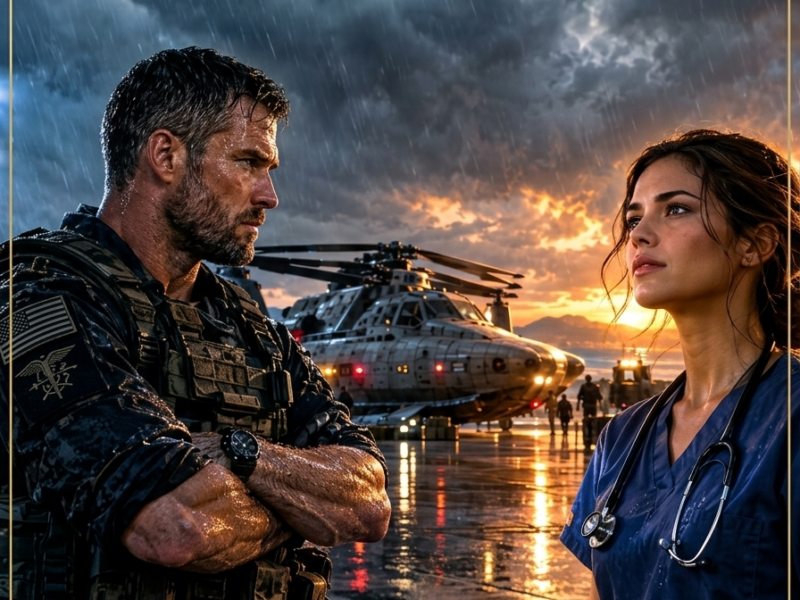
The SEAL commander shoved me away from the cockpit in front of his entire team, calling me “just a nurse,” but when the experimental aircraft began losing altitude over the Pacific
Rain hammered the reinforced glass windows of the naval hangar, each drop sounding like a bullet against the metal roof. The storm outside was a Category 3, brewing over the Pacific with a violent intensity that matched the tension inside. The massive aircraft sat beneath the harsh halogen lights like a sleeping monster. Its black fuselage was scarred from years of classified missions, absorbing the light rather than reflecting it. It was an experimental VTOL—Vertical Take-Off and Landing—craft, designed for insertions that did not officially exist.
Captain Jake Mercer stood beside it. He was a mountain of a man, clad in tactical gear, radiating the kind of arrogant authority that only came from years of surviving impossible odds. Six Navy SEALs stood behind him, checking their weapons with quiet, practiced efficiency. They were a ghost team, and tonight, they were grounded.
“We need a pilot,” Mercer said, his voice cutting through the ambient hum of the hangar’s generators.
Nobody answered. The base commander looked at his clipboard, his face pale. The primary pilot was down, and the secondary was stranded on the mainland due to the hurricane. The mission window was closing. Millions of dollars in intelligence, and potentially thousands of lives, were hanging on the next sixty minutes.
Then, I stepped forward from the shadows of the medical bay staging area.
“I can fly it,” I said.
My voice was not loud, but it carried. The hangar went dead silent. Several men in the SEAL team laughed, a short, sharp sound of disbelief. Jake Mercer slowly turned his head. His eyes scanned my standard-issue blue scrubs, the stethoscope around my neck, and the tired, pale lines of my face.
“You’re a nurse,” he said. It was not a question.
“I know.”
“This isn’t an ambulance,” Mercer stepped closer, towering over me. “That is an X-49 Nightwing. It doesn’t transport patients. It penetrates hostile airspace at Mach 2.4.”
“I know that too.”
He scoffed, pointing a thick, scarred finger toward the exit. “Go back to the medical bay. Let the adults figure this out.”
I did not argue. I lowered my eyes, turned on my heel, and walked away. Arguing with men like Mercer was a waste of breath. They only saw what they were trained to see.
But twenty minutes later, the base’s emergency siren screamed through the hangar, painting the walls in flashing crimson light. The aircraft had been moved onto the runway by the ground crew. The base commander had ordered a desperate attempt with a backup pilot from a transport squadron. It was a fatal mistake. As the massive engines spooled up, the transport pilot collapsed over the console, suffering a massive stress-induced seizure.
Mercer sprinted toward the cockpit, cursing into his comms. The engines were already turning, feeding off the volatile experimental fuel. The control system was caught in an automated loop, malfunctioning violently.
“We’re losing thrust!” someone shouted from the ground crew, diving away from the landing gear. “The intake is jamming!”
I stopped walking. I was halfway to the medical ward, but the sound of the engines whining out of sync hit my ears. It was a sound I remembered from another life. A sound that preceded a catastrophic turbine explosion.
I turned around and ran.
I pushed past the ground crew and scrambled up the boarding ramp just as Mercer was trying to pull the convulsing pilot from the seat. The digital displays were flashing red. The cockpit was filled with the deafening roar of failing machinery.
“Get away from the controls,” I yelled over the noise.
Jake stared at me, his face tight with panic and rage. “Absolutely not. Get the hell out of here!”
I stepped closer, shoving him back with surprising force. “You have eight seconds before the left engine locks and detonates this entire hangar.”
His expression changed. The absolute certainty in my voice broke through his panic. “How do you know that?”
“Seven.”
He moved. He grabbed the unconscious pilot by the vest and hauled him backward into the cargo hold. I climbed into the pilot’s seat.
The controls felt unfamiliar for exactly three seconds. The console had been updated, the displays modernized, but the core mechanics of the beast remained the same. Then, my hands remembered. Muscle memory, buried under a decade of bandages and blood pressure cuffs, snapped awake.
I bypassed the digital safety locks, manually isolating the left fuel line. I slammed the throttle forward and pulled the heavy yoke back just as the left engine sputtered and failed. The sudden burst of power from the right engine jolted the aircraft. We scraped the concrete runway, sparks flying into the storm, and then we were airborne.
The SEALs in the back were thrown against the bulkheads, grabbing their crash seats in shock.
Jake Mercer stood in the cockpit doorway, holding onto the frame, staring at me from behind. The rain slashed against the canopy as we broke through the cloud cover.
“You’ve done this before,” Mercer said, his voice low, barely audible over the stabilizers.
I said nothing. I kept my eyes on the horizon, adjusting the pitch to compensate for the dead left engine. I engaged the auxiliary thrusters, balancing the weight. The aircraft leveled out, slicing through the violent winds with predatory grace.
Then, a warning light flashed across the central console. The radar screen blipped. A single red triangle appeared, moving toward us at an impossible speed.
INCOMING TARGET.
Mercer leaned forward, gripping the back of my seat. “Who is that? Air traffic control said the skies were clear. Is it a missile?”
I looked at the coordinates. I looked at the flight trajectory. My blood went cold, freezing the air in my lungs.
“That isn’t a target,” I whispered.
“What is it?” Mercer demanded.
I tightened my grip on the controls, my knuckles turning white. “It’s the reason I stopped flying.”
The cockpit went completely silent. The only sound was the howling wind outside.
Jake looked at me, really looked at me for the first time. “Who are you?”
Before I could answer, the comms system crackled with static. The frequency was heavily encrypted, a military-grade channel that no one should have been able to access. A voice came through the headset, cold, smooth, and chillingly familiar.
“Raven Two. We’ve been waiting twelve years for you.”
Jake slowly turned toward me. The blood drained from his face. And for the first time that night, I saw genuine fear in the eyes of the battle-hardened commander. Because he knew the callsign. Every pilot, every special operator knew the legend of Raven Two.
And apparently, the quiet nurse he had just dismissed had been dead for twelve years.
Before Mercer could speak, a massive explosion rocked the right side of the aircraft.
The shockwave threw the X-49 violently to the left. Alarms wailed inside the cockpit, a cacophony of electronic shrieks warning of hull breaches and pressure loss. The sky outside the canopy spun in a dizzying blur of black clouds and lightning.
“Brace!” I shouted, wrestling with the yoke.
The controls were fighting me, heavy and unresponsive. The right auxiliary wing had taken a glancing hit from a kinetic projectile, not a missile. Someone was shooting at us with railgun technology, something that was strictly in the prototype phase back when I was supposedly buried with full military honors.
Mercer was thrown against the bulkhead but managed to secure himself in the co-pilot’s jump seat. “Talk to me!” he roared over the alarms. “Who the hell is shooting at us, and why do they think you’re a dead pilot?”
“They don’t think I’m dead, Captain,” I grunted, kicking the rudder pedals hard to force the nose down. “They know exactly who I am. And they know I’m alive.”
I slammed my palm against the emergency manual override. The digital displays flickered and died, leaving only the analog instruments glowing faintly in the dark. I preferred it this way. Flying blind, flying on instinct.
“Raven Two, do not attempt evasion,” the voice echoed through the encrypted channel again. It was Elias Thorne. My former commanding officer. The man who had ordered the strike on my squadron twelve years ago to cover up a black-ops weapons sale. The man I had spent a decade hiding from in plain sight. “Your vessel is damaged. Surrender the cargo, and you may live.”
“He wants the aircraft,” Mercer realized, his eyes wide as he looked at the central hard drive locked into the console. “This flight… it wasn’t just an insertion. We’re carrying the new guidance algorithms.”
“He doesn’t want the algorithms, Mercer,” I said coldly, banking the aircraft into a steep, stomach-churning dive toward the churning Pacific ocean below. “He wants to finish the job he started.”
I pushed the throttle past the redline. The surviving engine screamed, vibrating through the floorboards. We were dropping at three hundred feet per second. The black water of the ocean rushed up to meet us.
“Pull up!” Mercer yelled, his hands hovering over the dual controls, instinctively wanting to take over, but he knew he didn’t know how to fly this machine. “You’re going to kill us!”
“I’m going to save you,” I snapped.
At five hundred feet above the crushing waves, I leveled out. The G-force pressed us heavily into our seats. The ocean spray lashed against the glass. We were flying beneath their radar floor, skimming the tops of the massive hurricane swells.
In the back, the SEALs were eerily quiet. They were professionals. They knew when to fight and when to let the pilot work.
I kept the X-49 hugging the water, maneuvering through the troughs of the giant waves to mask our heat signature. For ten agonizing minutes, there was nothing but the roar of the storm and the strain of the metal hull.
“We’re off their scope,” I said finally, my breathing heavy. I flicked a series of switches, rerouting power from life support to the stealth baffles. It was going to get cold in the cabin, but we would be invisible.
Mercer unbuckled his harness and leaned toward me. The anger had faded from his face, replaced by a sharp, calculating intensity. “Twelve years ago, an entire squadron of experimental fighters went down over the Bering Sea. The official report said catastrophic system failure due to extreme weather. All hands lost. You were one of them.”
“The official report was a lie,” I replied, keeping my eyes fixed on the dark horizon. “Thorne sold us out. He fed our flight paths to a mercenary group. They ambushed us. I watched my entire team burn up in the sky. I took a hit, went down in the ice. By the time I crawled out of the wreckage, I knew if I went back, Thorne would finish me. So I vanished. Changed my name. Got a medical degree. Became a ghost.”
Mercer stared at me, processing the weight of the revelation. “And now he found you.”
“No,” I corrected him, glancing at the blinking light on the console. “He didn’t find me. He found this plane. He didn’t know I was flying it until I bypassed the left engine lock. That maneuver is my signature. I invented it.”
A sudden, violent shudder tore through the aircraft. It wasn’t an attack. It was the engine. The stress of the high-speed dive and the damage to the wing were taking their toll. Smoke began to filter into the cockpit, carrying the acrid smell of burning wiring.
“We’re losing altitude,” I said, my hands flying across the panels, desperately trying to balance the fuel flow. “The compressor is failing.”
“Can you get us to the drop zone?” Mercer asked, his tone shifting. He was no longer giving orders to a nurse; he was asking a pilot for a miracle.
“Negative. We won’t make it another fifty miles.” I scanned the emergency topographical maps on the backup screen. We were hundreds of miles from the mainland, deep in uncharted waters. But a small cluster of jagged rocks appeared on the edge of the display. “There’s an atoll ten miles northeast. Abandoned naval refueling station from the Cold War. I’m putting us down there.”
“A crash landing?”
“A controlled impact,” I corrected grimly.
Before Mercer could warn his team, the engine sputtered, coughed, and died completely. The heavy aircraft immediately dropped like a stone. The silence in the cabin was terrifying, broken only by the sound of the wind rushing past the dead metal.
“Hold on!” I screamed, pulling the yoke back with all my strength.
Through the rain, the jagged black teeth of the atoll appeared. We were coming in too fast, too steep. I deployed the landing gear, knowing it would snap, but needing it to absorb the initial shock.
The X-49 slammed into the rocky beach. The world exploded into violence. Metal shrieked as the landing gear sheared off. We skidded across the uneven ground, the belly of the aircraft tearing open. Sparks filled the cabin as we violently spun, smashing through concrete barriers of the old outpost.
Then, everything abruptly stopped.
The silence that followed was heavy and thick with the smell of aviation fuel. I unbuckled my harness, my body aching, but unbroken. I looked over at Mercer. He was bleeding from a cut above his eye, but he nodded.
“Everyone alive?” Mercer yelled back into the cargo hold.
Grunts of confirmation came from the dark. The SEALs had survived.
But as I looked out the cracked canopy into the storm, a bright light pierced the darkness. A spotlight sweeping across the rocks. A heavily armed gunship was hovering just offshore, its weapons trained directly on our wreckage.
Thorne had followed us. And we were trapped.
The blinding beam of the gunship’s searchlight pinned us in the wreckage like insects under a microscope. Rain drove sideways across the beam, illuminating the heavy caliber barrels of the rotary cannons taking aim at the downed X-49.
“Move! Out of the bird, now!” Mercer roared.
The SEAL team didn’t need to be told twice. They moved with terrifying speed, kicking open the jammed side ramp and spilling out into the storm, their weapons already raised. Mercer grabbed my arm, his grip like iron.
“Can you shoot?” he asked, thrusting a compact sidearm toward my chest.
“I’m a nurse,” I said, catching the weapon seamlessly. “I save lives.”
“Tonight, you might have to take a few,” he grimaced, pulling me toward the exit.
We threw ourselves out of the crushed fuselage into the freezing mud just as the gunship opened fire. The deafening brrrrt of the rotary cannons tore the night apart. The space where we had just been sitting was shredded into twisted metal and burning fiberglass.
We scrambled behind the thick, moss-covered concrete walls of a ruined Cold War bunker. The old naval outpost was a labyrinth of decayed structures, half-swallowed by the jungle that had reclaimed the island.
Mercer’s men had already established a defensive perimeter, their night-vision goggles glowing faintly in the dark.
“Status!” Mercer barked over the sound of the rain and distant gunfire.
“We’re pinned, Boss,” one of the operators, a heavy-set man named Miller, reported. “That gunship has thermals. If we move into the open, we’re red mist.”
“It’s not just the gunship,” I said, crouching low against the crumbling concrete. I pointed toward the shoreline. Black rubber zodiacs were slicing through the surf, cutting through the waves with predatory stealth. Dozens of heavily armed mercenaries were pouring onto the beach, their weapons equipped with laser sights cutting through the gloom.
“Thorne sent a ground team,” Mercer observed grimly. He looked at me. “How badly does he want you dead?”
“He doesn’t want me dead,” I whispered, the realization dawning on me. “Not yet. He wants the data drive from the console. The guidance algorithms. Without them, whatever weapons he’s developing are useless. He needs the plane’s black box.”
Mercer cursed softly. “We left it in the cockpit.”
“It’s encrypted to my biometrics,” I told him. “Even if he takes it, he can’t unlock it without my handprint and retinal scan. That’s why he didn’t blow us out of the sky with a missile. He needs me alive, or at least, he needs my hands and eyes.”
The sheer brutality of the statement hung in the humid air.
“Alright,” Mercer said, drawing his combat knife and checking his rifle. “We hold this bunker. We don’t let them take the pilot. Miller, Jackson, set up a crossfire at the main causeway. The rest of you, tight perimeter.”
The SEALs moved silently, melting into the shadows of the ruins.
I leaned against the cold concrete, my breath coming in shallow gasps. The adrenaline was wearing off, replaced by a cold, creeping dread. I had spent twelve years washing blood off my hands, stitching people back together, trying to balance the scales for the lives lost under my command. Now, the violence had found me again.
Footsteps sloshed in the mud outside our perimeter. The mercenaries were moving up, systematically clearing the ruins.
“They’re flanking,” Mercer whispered, his eyes locked on a thermal scope. He glanced at me. “Stay behind me. If they breach, you run deep into the jungle. Don’t look back.”
“I’m not running, Captain.” I checked the magazine of the pistol he had given me. It was fully loaded. Fifteen rounds.
Before he could argue, a flashbang grenade sailed over the concrete wall and detonated with a blinding flash and a concussive roar. My ears rang violently.
In the chaos of the flash, three mercenaries vaulted the wall.
Mercer took the first one down with a swift, brutal burst of rifle fire to the chest. The second mercenary tackled him, sending them both crashing into the mud, a desperate struggle of knives and fists.
The third mercenary saw me.
He raised his assault rifle, a cruel smile spreading beneath his tactical mask. “Got the package,” he barked into his comms.
He lunged forward to grab me. Twelve years of peace vanished in a microsecond. The muscle memory of a tier-one operative overrode the bedside manner of a trauma nurse.
I didn’t shoot. I sidestepped his clumsy grab, grabbed his extended wrist, and twisted it violently against the joint. The bone snapped with a sickening crack. He screamed, dropping the rifle. I pivoted, driving my elbow hard into his throat, collapsing his windpipe. As he fell, I stripped a combat knife from his chest rig and spun around to see Mercer struggling.
The second mercenary had Mercer pinned, raising a blade to drive it into the Captain’s neck.
I threw the knife. It rotated once in the air before burying itself deep into the mercenary’s shoulder. He howled in pain, dropping his weapon. Mercer instantly seized the advantage, throwing the man off and knocking him unconscious with a heavy strike from the butt of his rifle.
Mercer stood up, panting heavily. He looked at the man I had neutralized, then looked at me, his eyes wide with a mixture of shock and newfound respect.
“Where exactly did you do your nursing residency?” he asked, wiping mud from his face.
“Kabul,” I replied flatly. “Trauma ward.”
“Right.” Mercer picked up his dropped rifle.
Suddenly, a voice echoed through a heavy megaphone from the beach, cutting through the storm.
“Captain Mercer!” Thorne’s voice boomed. “You are heavily outnumbered and outgunned. Surrender the pilot and the drive, and your team walks away. Refuse, and I will level this entire island with naval artillery.”
Mercer looked at me. “He’s bluffing.”
“He’s not,” I said softly. “I know him. He’ll turn this island to glass just to erase his mistakes.”
The ground beneath us trembled as if validating my words. Far out at sea, the silhouette of a heavy destroyer broke through the fog.
We were out of time, out of ammo, and backed against the wall.
The low, rumbling thud of distant artillery sounded like a heartbeat in the earth. A second later, the jungle canopy three hundred yards to our left erupted in a towering geyser of fire and pulverized rock. The shockwave threw dirt and debris over our concrete bunker. Thorne wasn’t bluffing. He was walking his artillery fire closer, dialing in our coordinates.
“Boss,” Miller’s voice crackled over the short-range radio. “We can’t hold this. There’s fifty of them pushing the perimeter, and that destroyer is going to turn us to ash in less than three minutes.”
Mercer crouched low, mud smeared across his tactical gear, his mind working furiously. He looked at the wreckage of the X-49 down on the beach, swarmed by mercenaries trying to pry open the reinforced cockpit to get the data drive. Then he looked at me.
“You said the drive is locked to your biometrics,” Mercer said rapidly.
“Yes. It’s useless to them without me.”
“Can you wipe it?”
I stared at him. “Wipe the drive? It holds the only copy of the next-generation targeting algorithms for the entire Pacific fleet. If I wipe it, decades of research are gone.”
“If Thorne gets it, he sells it to the highest bidder and shifts the global balance of power,” Mercer shot back, grabbing my shoulders. “Can you wipe it?”
“Yes,” I nodded. “But I have to be in the cockpit to initiate the purge sequence. It requires my hand on the biometric scanner while the manual override is pulled.”
Mercer looked back toward the beach. The wreckage was fifty yards away, surrounded by heavily armed killers, illuminated by the harsh spotlight of the hovering gunship. It was a suicide run.
“Alright,” Mercer said, his voice dropping into the terrifying calm of a man who had accepted his fate. “I’ll draw their fire. You get into the cockpit, wipe the drive, and run for the caves on the north ridge. My team will cover your extraction.”
“You’ll die,” I said plainly. “They have a heavy gunner on the dune, and the gunship will cut you in half before you make it ten yards.”
“That’s my job, Nurse,” Mercer said, offering a grim smile. “I protect the asset.”
“I am not an asset. And I’m not a nurse anymore.” I grabbed the assault rifle from the mercenary I had incapacitated earlier, checking the chamber with a sharp clack. “I’m Raven Two. And I lead from the front.”
Before Mercer could stop me, I tapped my comms earpiece, accessing the open emergency frequency I knew Thorne would be monitoring.
“Thorne. This is Raven Two.”
The artillery fire paused. The island went eerily quiet, save for the pounding rain.
“Sarah,” Thorne’s voice slithered through the earpiece, dripping with false warmth. “I knew you were too stubborn to die in the ice.”
“Call off your dogs and ground the gunship. I’m coming out. I’ll unlock the drive for you.”
Mercer grabbed my arm, his eyes furious. “What are you doing? You can’t give it to him!”
I covered the mic and looked Mercer dead in the eyes. “Trust me.”
Thorne chuckled softly over the radio. “Very sensible, Sarah. Walk out slowly, hands empty. My men will escort you to the wreckage.”
I stood up, dropping the rifle into the mud. I raised my empty hands and stepped out from the cover of the bunker. The heavy rain instantly soaked through my thin scrubs. Three dozen laser sights immediately snapped onto my chest, painting me in red dots.
I walked slowly down the muddy embankment toward the crushed black hull of the X-49. Mercenaries stepped out of the shadows, their weapons trained on my head, forming a corridor. At the end of the line, standing near the cockpit, was Elias Thorne. He looked older, his hair graying, wearing a sleek waterproof trench coat over body armor. He smiled.
“Welcome back to the world of the living, Captain,” Thorne said as I approached.
“Cut the poetry, Elias,” I said, my voice dead. “Let the SEALs go. You have what you want.”
“I will,” Thorne lied effortlessly. He gestured to the smoking ruin of the cockpit. “Open the console.”
I climbed up the jagged metal ramp. The interior of the cockpit was destroyed, but the central console, housed in a titanium shell, was intact. A red light blinked slowly, waiting for authorization.
Thorne climbed up behind me, pressing the barrel of a pistol against my spine. “No tricks, Sarah. Hand on the scanner.”
I placed my right hand flat against the glass panel. A green laser swept over my palm, reading the prints, then flashed up to read my retina.
BIOMETRICS CONFIRMED. RAVEN TWO. WELCOME.
The mechanical locks disengaged with a heavy clack. The titanium shell slid back, revealing the glowing data drive.
Thorne’s breathing hitched with greed. He reached out to grab it.
“Elias,” I said softly, my hand hovering over the manual override lever. “Do you remember why they called this aircraft the Nightwing?”
Thorne paused, frowning. “Because of the stealth coating.”
“No,” I whispered. “Because of its defensive flare dispersion system. It’s wired to the primary fuel cells.”
I didn’t pull the data drive. I slammed my fist into the emergency flare deployment button, simultaneously ripping the manual override lever backward.
The automated system screamed.
Instead of ejecting countermeasures into the air, the damaged, crushed launch tubes inside the belly of the aircraft fired directly into the ruptured aviation fuel pooling beneath our feet.
“No!” Thorne screamed, realizing what I had done.
I threw myself backward out of the shattered canopy, diving into the deep mud just as the entire belly of the X-49 ignited. The magnesium flares hit the raw fuel.
A blinding, roaring wall of white-hot fire erupted from the aircraft. The blast wave threw Thorne and half a dozen mercenaries backward into the surf, their screams lost in the roar of the explosion.
The concussive force of the explosion knocked the wind out of my lungs, pinning me into the mud. The beach was instantly transformed into a hellscape of white-hot magnesium fire and burning jet fuel. The mercenaries closest to the blast were incapacitated, stumbling blindly through the smoke.
“Move! Move! Move!” Mercer’s voice bellowed through the chaos.
The SEALs capitalized on the distraction instantly. Suppressing fire rained down from the ruins, cutting through the remaining disorganized mercenaries. Mercer bounded through the smoke, hauling me to my feet by the webbing of my tactical vest.
“You blew the drive!” he shouted over the roar of the flames.
“I blew the whole damn plane!” I coughed, wiping mud and blood from my mouth. “Thorne’s down, but the gunship is still in the air!”
As if on cue, the heavy attack chopper banked sharply, its spotlight cutting through the thick black smoke. The pilot had realized what happened and was repositioning to wipe us off the beach. The heavy rotary cannons began to spool up with a terrifying, mechanical whine.
“Cover!” Mercer shoved me toward a jagged outcrop of black volcanic rock at the edge of the shoreline. We dove behind it just as a line of heavy caliber rounds shredded the sand where we had been standing seconds before.
We were trapped on the beach. The SEALs were pinned in the ruins. The gunship was hovering fifty feet above the water, preparing for a final strafing run that would annihilate all of us.
“We need anti-air!” Miller screamed over the radio.
“We don’t have any!” Mercer yelled back, checking his rifle. He had half a magazine left. He looked at the hovering gunship, then at his men pinned in the ruins. He was doing the math of a commander who knew he was out of options. He turned to me. “When I break cover, you run for the tree line.”
“Your rifle won’t dent that armor, Mercer!”
“It’ll buy you three seconds,” he said fiercely. “Make them count.”
Before I could stop him, Mercer stood up to draw the gunship’s fire.
Time seemed to slow down. I looked at the burning wreckage of the X-49. The explosion had severed the cockpit from the fuselage, throwing it on its side. Inside the shattered canopy, the auxiliary backup battery was still sparking, connected to the port-side weapon systems. The X-49 was a prototype. It wasn’t just built for stealth. It was built for a fight.
“Mercer, get down!” I screamed.
I didn’t run for the trees. I sprinted back toward the burning wreckage. The heat was unbearable, singeing my hair and blistering my skin. The gunship pilot saw me moving and pivoted the chopper, bringing the cannons to bear on my running figure.
I slid through the mud, diving headfirst into the overturned, flaming cockpit. The heat was suffocating. I scrambled over the tilted seat, my hands desperately feeling for the weapon control panel in the smoke.
The gunship opened fire. Rounds hammered the titanium hull of the cockpit, deafening me, tearing through the metal inches from my head.
My fingers found the manual targeting joystick. The digital displays were dead, but the analog mechanical linkage was still intact. Through the shattered glass, I could see the silhouette of the gunship hovering just over the water.
I slammed the auxiliary power switch. A single green light flickered to life on the stick.
PORT MISSILE POD: ARMED.
“Got you,” I whispered.
I pulled the trigger.
The crushed wing of the X-49, buried half in the sand, violently shuddered. A single short-range Sidewinder missile ignited, blowing the sand and debris away in a massive cloud. It shot out of the wreckage on a blind, unguided trajectory, streaking directly toward the hovering gunship.
The pilot never had a chance to react. The missile impacted the tail rotor of the chopper at point-blank range.
The explosion was spectacular. The gunship violently spun out of control, a flaming wreck spiraling into the dark, churning waters of the Pacific with a massive splash.
Silence fell over the beach, save for the crackling of the fires and the heavy rain.
I crawled out of the smoking cockpit, falling onto my back in the wet sand, staring up at the dark sky. I couldn’t hear anything. My ears were ringing, my vision swimming.
A shadow loomed over me. Mercer dropped to his knees beside me. He was battered, bleeding, and covered in ash. He grabbed my shoulders, pulling me into a sitting position, his mouth moving, but I couldn’t hear the words.
Slowly, the ringing faded, replaced by the sound of the ocean.
“…you alive? Sarah! Are you alive?”
I coughed, a ragged, painful sound. “Still here, Captain.”
Mercer let out a heavy breath, falling back onto the sand next to me. The rest of the SEAL team emerged from the shadows of the ruins, sweeping the beach. The mercenaries were dead, fled, or drowning. Thorne was gone, vanished in the blast or washed out to sea. The data drive was melted slag. The threat was neutralized.
“Naval command is on the horn,” Miller jogged up, holding a bulky satellite radio. “They tracked the blast. Extraction choppers are inbound. Thirty minutes.”
Mercer nodded slowly. He looked at the burning wreckage of the billion-dollar aircraft, then looked at me.
“They’re going to have a lot of questions about what happened here tonight,” Mercer said quietly. “They’re going to want to know how a nurse managed to steal an experimental aircraft, fly it through a hurricane, and take down a rogue military operation.”
I looked out at the dark water. The ghost of Raven Two had finally been put to rest. I had stopped running.
“Tell them the truth,” I said, wiping the mud from my face, feeling the cold rain wash over me. “Tell them the nurse didn’t make it.”
Mercer looked at me, a slow, genuine smile breaking through the dirt and exhaustion on his face. He extended a hand and helped me to my feet.
“Copy that, Commander,” Mercer said.
We stood together on the burning beach, waiting for the choppers, ready to go home. Not as ghosts, but as survivors.
The end.









