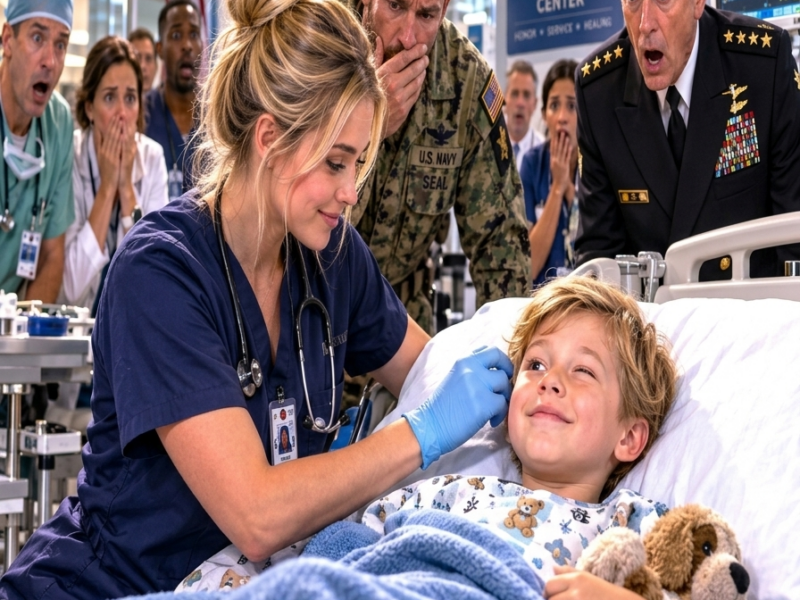
The SEAL captain watched three senior doctors fail to save his unconscious son in the ICU, then coldly ordered the nurses to prepare an emergency transfer
The rhythmic, mechanical beep of the heart monitor was the only sound cutting through the oppressive silence of Room 408. To anyone else, it was just hospital noise. To Captain Daniel Hayes, it was a ticking clock—a agonizing countdown marking the fading life of his eight-year-old son, Noah.
Daniel stood at the foot of the bed, rigid as marble. Seventeen years in the Navy SEALs had trained him to remain motionless under fire, to ignore freezing waters, burning shrapnel, and the suffocating pressure of covert operations. He had survived ambushes in the dusty valleys of Afghanistan and covert extractions in uncharted waters—missions that were never recorded on public ledgers, operations where death was a constant shadow. But none of that combat training, none of those hard-won instincts, had prepared him for the visceral horror of watching his only child lie helpless beneath the harsh, buzzing fluorescent lights of a pediatric Intensive Care Unit in Virginia.
Noah had been the picture of energy only thirty-six hours ago. Laughing, kicking a soccer ball across the green field, shouting for his father to watch his latest goal. Then came the sudden collapse. A gasp for air, a crumpling of small knees, and an ambulance ride that felt like a descent into hell. Since then, the boy’s condition had steadily spiraled downward. Despite every advanced test, every intravenous cocktail, and the constant attention of top medical specialists, Noah was slipping away. His oxygen saturation levels fluctuated wildly, spiking momentarily only to plunge back into danger zones. His small chest heaved in violent, irregular gasps, his golden-brown skin turning an alarming shade of pale blue.
Around the bed, three senior physicians—chiefs of their respective departments—exchanged tight, desperate looks. They spoke in hushed, guarded tones, convinced Daniel couldn’t pick up on their body language. But Daniel read human behavior for a living. He saw the subtle slump in the chief cardiologist’s shoulders, the nervous tremor in the pulmonologist’s hands, and the resignation in the eyes of the lead attending physician, Dr. Robert Vance.
“Prepare him for an emergency transfer to the university medical center,” Dr. Vance finally said, his voice flat, stripped of optimism. “We’ve exhausted our diagnostic and treatment options here. We need to move him now.”
Daniel took a step forward, the heavy leather of his combat boots thudding softly against the linoleum floor. He gripped the cold metal bedrail until his knuckles turned ghostly white, his veins bulging against his forearms. The intensity radiating from him made the two junior nurses nearby step back instinctively.
“You’re telling me nobody in this room can save my son?” Daniel’s voice was low, gravelly, carrying the terrifying authority of a commander who had led men into hell and back. “You’ve had him for a day and a half, and your best plan is to put a dying child into an ambulance and hope he survives the drive?”
Dr. Vance swallowed hard, adjusting his wire-rimmed glasses. He was a veteran doctor, but the sheer physical presence and raw grief of the SEAL captain rattled him. “Captain Hayes, we understand your frustration, but his pulmonary functions are failing. We do not have the specialized equipment—”
“I don’t want excuses, Doctor. I want answers!” Daniel snapped, his dark eyes burning with desperate fury. “He is eight years old!”
Silence descended upon the room once more, heavy and suffocating. None of the senior doctors met his gaze. They looked at their charts, at the floor, at the glowing numbers on the monitors—anywhere except into the eyes of a father losing his child.
Near the shadowed doorway, standing beside a metal supply cart, a young nurse clutched a plastic clipboard tightly against her chest. Her name was Emily Carter. She was barely twenty-five, slender, with soft hazel eyes and brown hair tied back in a neat, unassuming bun. She was known throughout the ICU for being painfully shy and quiet. In a high-stress department dominated by big egos and assertive personalities, Emily was the nurse who rarely spoke unless spoken to. Some of the senior staff quietly dismissed her as inexperienced or overly timid, assuming she lacked the steel required for critical care.
But Emily wasn’t timid right now. She was hyper-focused. While the doctors were arguing about transport logistics and reviewing blood panels, Emily’s eyes had remained glued to Noah’s throat and chest.
She had noticed something subtle. Something the senior doctors, blinded by standard protocols, had overlooked. Every time Noah took a ragged breath, the left side of his neck muscles twitched in an unnatural, inverted sequence. It wasn’t simple respiratory failure caused by an infection or systemic toxin. It was a mechanical struggle—a frantic, hidden obstruction that operated like a one-way valve.
“Excuse me,” Emily murmured. Her voice was barely audible above the hum of the ventilator.
Dr. Vance ignored her, already reaching for his desk phone to authorize the transport papers. “Call transport. Tell them it’s a Code Red protocol.”
“Excuse me,” Emily repeated, stepping out from the shadows. Her voice was slightly louder this time, though it trembled with a mixture of fear and determination. “Can you… can you please check his breathing pattern again?”
Dr. Vance turned his head, his brow furrowing with obvious annoyance. “Not now, Nurse Carter. We are executing a critical transfer protocol. Go check on the charts in Room 410.”
Emily swallowed hard. Her heart was hammering against her ribs like a trapped bird. Everything in her gentle nature screamed at her to back down, to obey authority, to return to the safety of her routines. But then she looked at Noah’s pale face, and a sudden, burning memory from her childhood surged through her mind—a memory of her father sitting at a wooden kitchen table, drawing anatomical diagrams on paper napkins and teaching her how to see what others missed.
She took three deliberate steps forward, stepping directly between Dr. Vance and the bed.
“Captain,” Emily said, ignoring the doctor entirely and looking straight into Daniel’s bloodshot eyes. “Please. I think we’re missing something.”
Daniel turned his gaze toward her. In his line of work, he had learned to evaluate people in a fraction of a second. He saw the tremor in her hands, but he also saw the fierce, absolute clarity in her eyes. It was the look of a soldier who had spotted an imminent threat.
“What do you see, Nurse?” Daniel asked, his voice dropping into a tense calm.
“Look at his sternocleidomastoid muscle,” Emily said quickly, pointing to the side of Noah’s small neck. “And look at the waveform on the second channel of the monitor. His body isn’t just failing. It’s struggling against something. The air is going in, but it’s getting trapped in the upper left bronchial tree. His lung isn’t collapsing; it’s over-inflating under pressure, crushing his own vena cava and dropping his heart rate.”
Dr. Vance stepped forward angrily. “Nurse Carter, that is preposterous. The contrast CT scan showed no visible foreign body or mass—”
“A standard pediatric CT scan wouldn’t show a soft, translucent bronchial membrane tear or a localized valve tissue trap!” Emily interrupted, her voice gaining a sharp, commanding confidence that shocked everyone in the room. “If you put him in an ambulance right now, the atmospheric pressure changes and the motion will cause a complete tension pneumothorax. He will not survive a ten-minute ride.”
The room fell dead silent. The two senior specialists stopped writing on their charts. Dr. Vance looked at Emily as if she had suddenly spoken in a foreign language.
“And how, exactly, would a junior nurse know such a specific anatomical anomaly?” Dr. Vance asked coldly. “Did you invent a new medical theory during your lunch break?”
“My father taught me,” Emily said quietly, though her hazel eyes didn’t flinch. “He was a elite military combat medic. He spent twelve years treating trauma cases under fire. He taught me a specialized, field-tested emergency assessment technique—a way to recognize micro-airway obstructions and dynamic valve traps that standard hospital equipment misses under extreme conditions. I’ve studied his journals and training cases my entire life.”
She turned back to Daniel. “Captain Hayes, I know you don’t know me. I know I’m just a nurse here. But if you let them put your son in that transport vehicle right now, he will die. Please… ask them to re-assess his airway with a targeted dynamic broncho-assessment right here, right now.”
Daniel stared at Emily. The air in the room felt electric, thick with a profound, terrifying choice. On one side stood three decorated medical directors, offering a standard transfer procedure that felt like a death sentence. On the other side stood a quiet, young nurse offering a crazy, field-tested military hypothesis.
In the SEAL teams, Daniel had lived by a simple rule: when standard plans fail, trust the operator who sees the ground reality clearly.
Daniel stepped between Dr. Vance and the door. His massive frame blocked the exit completely. His voice was cold, lethal, and unwavering.
“Re-assess him,” Daniel commanded. “Now.”
Dr. Vance opened his mouth to protest, to invoke hospital hierarchy and security protocols, but one look at Captain Daniel Hayes’ face silenced him instantly. This was not a man making a polite request. This was a commander executing an order in a war zone.
“Get the pediatric broncho-scope,” Dr. Vance ordered abruptly, his tone sharp with defensive agitation. “Fine. We will perform the dynamic check. But if this delays the transfer unnecessarily, Nurse Carter, you will answer to the board.”
“Just check him,” Emily whispered, stepping back toward the monitoring station.
The next ten minutes dissolved into a blur of intense, frantic medical precision. The room became an arena of synchronized chaotic movement. Nurses fetched specialized scope trays, monitors were recalibrated, and the pediatric pulmonologist guided a thin, flexible optic line down Noah’s tiny airway, projecting a high-definition image onto the overhead monitor screen.
Dr. Vance leaned over the display, his cynical expression suddenly freezing.
“My God…” the pulmonologist gasped.
There, displayed in vivid color on the high-definition monitor, was precisely what Emily had described. A microscopic tissue fold, hidden just beneath the deep bifurcation of the left main bronchus, was acting exactly like a mechanical flap valve. With every breath the machine pushed in, the flap opened; with every exhale, it slammed shut, trapping air and building deadly localized pressure that was squeezing Noah’s primary blood vessels. It was a rare, congenital anatomical defect, completely invisible on standard resting scans, triggered only by the acute inflammation from his recent soccer exertion.
“He’s trapped in a localized pressure loop,” Dr. Vance muttered, his face turning pale. “If we had moved him… the pressure would have ruptured the bronchial wall within miles.”
“Prepare micro-cautery and a double-lumen bypass tube immediately!” the specialist shouted. “Move! We need to release that trapped pressure right now!”
For the next twenty minutes, the team worked with frantic elegance. Emily stood right at the bedside, her slender fingers working alongside the doctors, anticipating every instrument needed, her calm presence steadying the once-chaotic room.
With a soft, audible hiss of released pressure, the monitor’s alarms suddenly ceased. The violent spike in the baseline rhythm smoothed out. The arterial pressure curve leveled off.
“Oxygen saturation rising,” the lead nurse announced, her voice trembling with relief. “88… 92… 96 percent. Heart rate stabilizing at 85 beats per minute.”
Noah’s blue-tinged lips gradually flushed with healthy, warm pink. His small chest began to rise and fall in a soft, natural, rhythmic cadence. He was sleeping—not slipping into a coma, but entering a deep, restorative sleep.
Dr. Vance pulled off his surgical mask, letting out a long, exhausted breath. He turned to look at Emily, his eyes filled with a heavy mix of shock and profound humility. “Nurse Carter… Emily. I… I don’t know what to say. You saved that boy’s life. If we had taken him out those doors, he wouldn’t have made it to the highway.”
Emily merely nodded softly, her hands clutching her clipboard again. “I’m just glad he’s okay, Doctor.”
Daniel stood motionless at the head of the bed. His massive shoulders, which had been locked in rigid tension for nearly forty-eight hours, suddenly trembled. He sank into the plastic chair beside his son’s bed and carefully, reverently, wrapped his thick, calloused fingers around Noah’s small hand.
Noah gave a tiny, subconscious squeeze back.
A heavy tear broke free from Daniel’s eye, tracing a path down his weathered cheek. He pressed his fist against his mouth, letting out a single, silent sob of overwhelming relief. The warrior who had faced down RPGs and sniper fire was undone by the simple, healthy rise and fall of an eight-year-old’s chest.
When Daniel finally regained his composure and looked up, the medical team was packing away their equipment. Emily was standing near the back wall, quietly wiping a tear from her own eye before turning to walk out into the hallway.
“Noah is fully stable now, Captain,” the pulmonologist said gently. “He’ll need to rest for a few days, but he’s out of danger. He’s going to make a full recovery.”
“Thank you,” Daniel whispered to the team.
He waited until the doctors stepped out to write their revised orders, then he stood up and walked into the quiet, dimly lit corridor. He spotted Emily standing by the nurses’ station, filing clinical charts under the soft fluorescent lights. The hospital was hushed, the midnight hour having long since passed.
Daniel walked up to her. The tall, formidable SEAL commander looked remarkably vulnerable in the quiet hallway.
“Nurse Carter… Emily,” Daniel said, his deep voice thick with emotion.
Emily turned around quickly, looking startled, as if she were uncomfortable being the center of attention. “Captain Hayes. How is Noah doing?”
“He’s breathing on his own. He squeezed my hand,” Daniel said. He took a deep breath, searching for words that seemed powerful enough to carry the weight of his gratitude. “I’ve spent my entire adult life surrounded by people who are called heroes. But what you did in that room… stepping up, standing your ground against those doctors, saving my boy… I don’t have the words to thank you. I owe you my life. Anything you ever need, for as long as I draw breath, you have it.”
Emily looked down at her shoes, a strange, shadow of sorrow passing over her face. Instead of looking pleased or relieved by his heartfelt praise, she appeared deeply troubled. Her hands trembled slightly as she held a small, plastic folder.
“Captain… you don’t owe me anything,” Emily said softly, her voice barely a whisper. “In fact… there’s something I haven’t told you. Something I need to show you.”
Daniel frowned, his combat-trained instincts instantly picking up on the sudden shift in her energy. “What is it?”
Emily looked around the empty corridor, making sure no other staff members were nearby. She reached into her uniform pocket and pulled out an old, faded leather wallet. From inside, she carefully extracted a folded, aged piece of paper that had clearly been handled hundreds of times.
“I didn’t just recognize your son’s breathing pattern because of a medical textbook,” Emily said, her hazel eyes glistening with unshed tears. “I recognized your name the moment you walked into this ICU yesterday. I’ve known who you were for seventeen years, Captain Hayes.”
She slowly unfolded the photograph and handed it to Daniel.
Daniel took the photograph. It was a color print from nearly two decades ago, its edges worn soft with age. It showed a six-man Navy SEAL element standing in full tactical gear in front of a desert barracks in Eastern Europe. The men were grinning, arms wrapped around each other’s shoulders, young, confident, and fearless.
Daniel’s heart dropped into his stomach. In the center of the group was a younger version of himself, holding an M4 carbine. And standing right beside him, with a calm, reassuring smile, was Chief Hospital Corpsman Marcus Carter—the finest combat medic Daniel had ever served with.
“Marcus…” Daniel breathed, his voice cracking. “Marcus Carter was your father?”
“Yes,” Emily whispered.
Daniel stared at the photograph, a wave of dark, suppressed memories crashing over his mind. Marcus Carter had been his brother-in-arms, his guardian angel on dozens of dark nights. But seventeen years ago, during a classified deployment code-named Operation Black Sentinel, Marcus Carter had gone missing in action, presumed dead during a catastrophic ambush high in the Balkan mountains. Daniel had been the team leader on that fateful night. He was the one who had given the final order to withdraw under overwhelming enemy fire. He had spent the last seventeen years carrying the crippling, secret guilt that his command decision had left Marcus behind to die.
“Turn the photograph over,” Emily said softly.
Daniel’s fingers trembled as he flipped the small piece of paper over. On the back, written in dark blue ink in Marcus Carter’s distinct, precise handwriting, was a date from seventeen years ago—the exact night of Operation Black Sentinel.
Beneath the date was a single, terrifying sentence that made the blood in Daniel’s veins turn to ice:
“If Daniel Hayes ever meets my daughter, tell him what really happened on that mission. I didn’t die in the ambush. They needed me alive for the vault.”
Daniel stared at the faded ink, the text burning into his retina like a flare in the dark. The noise of the hospital—the distant hum of ice machines, the occasional chime of a call button—faded into a rushing roar in his ears.
“This… this is his handwriting,” Daniel rasped, his eyes wide with a combination of shock and profound disbelief. “Where did you get this, Emily? When did he write this?”
Emily gestured toward a quiet consultation room down the hall. “Come inside, Captain. Before someone sees us.”
Daniel followed her into the small room, shutting the heavy door behind them. The room was sterile, containing only a round oak table and a few vinyl chairs. Daniel remained standing, his tall frame looming over the table, his mind spinning at a thousand miles an hour.
“My father gave that picture to my mother in a sealed package through a private courier two weeks after the Navy officially reported him Killed in Action,” Emily explained, leaning against the edge of the table. “I was only eight years old back then—the exact same age Noah is right now. My mother kept it locked in a safe deposit box. She made me promise never to open it until I was older, until I was strong enough to understand.”
“Your mother… where is she?” Daniel asked.
“She passed away five years ago from cancer,” Emily said gently. “Before she died, she gave me the key to the box. Inside was that photograph, along with a encrypted cassette tape and a small leather-bound medical journal. My father knew he wasn’t coming home, Captain. But he also knew that the official military story about his death was a complete lie.”
Daniel took a deep, shaky breath, sinking heavily into one of the vinyl chairs. He buried his face in his hands for a brief moment, forcing his combat-trained mind to strip away the emotional shock and analyze the tactical reality.
For seventeen years, Daniel had lived with a dark knot of grief in his chest. He remembered every second of Operation Black Sentinel. They had been tasked with targeting an illegal weapons cache deep within an uncharted compound in the mountains. But they had walked into a trap. The intelligence was wrong; the enemy forces were heavily armed and waiting. Within minutes, two team members were severely wounded. The firefight was brutal, chaotic, illuminated only by tracer rounds and mortar flashes.
When the order to fall back to the extraction chopper was given, Marcus Carter had been providing suppressive fire near the perimeter wall. Daniel had seen a mortar shell explode directly over Marcus’s position. A cloud of dirt, fire, and smoke had consumed the area. When the smoke cleared, there was nothing left but a burning crater and torn tactical gear. With heavy enemy armor rolling in and fuel running out, Daniel had made the excruciating tactical call to evacuate the surviving wounded, believing with absolute certainty that Marcus had been vaporized by the direct hit.
“I saw the explosion, Emily,” Daniel said, his voice raw with pain. “I was thirty yards away. I swore on my life… I swore to God that he didn’t survive that blast. I tried to go back for him, but my team leader pulled me into the bird. If I thought for a single second he was alive—”
“I know,” Emily interrupted gently, placing a soft hand on his trembling shoulder. “I don’t blame you, Captain. And my father didn’t blame you either. On the tape, he specifically said that you made the right command choice to save the rest of the team. The explosion was staged.”
Daniel snapped his head up. “Staged?”
“It was a micro-charge, detonated by a secondary team hidden inside our own intelligence network,” Emily revealed, her voice dropping to a whisper. “My father was an expert in high-altitude trauma medicine and biological warfare response. Two weeks before Black Sentinel, he had stumbled upon a secret medical file inside the joint task force database—a classified protocol regarding an illegal, bioweapon research facility hidden beneath an abandoned Soviet-era industrial vault in that same mountain region.”
Daniel’s eyes narrowed into slits. “A biological vault? Who was running it?”
“A private military contractor operating under rogue government funding,” Emily said. “They called it Project Phalanx. They were developing localized aerosol pathogens meant to cause instant, untraceable respiratory paralysis in targets—pathogens that leaves zero chemical traces in blood tests.”
Daniel felt a sudden, terrifying chill run down his spine. He looked toward the door, toward the ICU room where his son was sleeping.
“Respiratory paralysis…” Daniel whispered, his mind connecting the dots with horrifying speed. “Noah… Noah collapsed at soccer practice. The doctors said his blood tests were completely clean. They couldn’t find a single toxin or virus…”
Emily looked at him with dark, solemn eyes. “When I saw Noah’s breathing pattern yesterday, Captain… it wasn’t just similar to a training case. It was the exact, highly specific respiratory distress signature described in my father’s medical journal. It’s the signature of a secondary, delayed exposure to the Phalanx strain.”
Daniel stood up so fast his chair screeched against the floor. His instinctual military survival drive took over, completely replacing his grief with hyper-lethal focus.
“Noah wasn’t sick,” Daniel said, his voice dropping into a dangerous, icy tone. “He was targeted.”
“Or exposed by proximity,” Emily corrected. “My father’s journal said the pathogen can remain dormant in soil or water for decades unless activated by physical exertion. But Captain, there’s something worse. My father didn’t die in that mountain. He was captured by the men running Project Phalanx because they needed his medical expertise to stabilize the compound’s delivery system. He spent three years kept in dark room, forced to work for them, before he managed to leak that photograph and tape out through a contact.”
“Three years?” Daniel asked, his pulse pounding in his ears. “Is he… is he still alive?”
Emily swallowed hard, tears finally overflowing her lashes. “I don’t know. The messages stopped fourteen years ago. But the journal contains coordinates, codes, and names of senior military officials who buried the Black Sentinel report and funded the project. Officials who are still in power today.”
Suddenly, the soft hum of the consultation room was shattered by the sharp, piercing scream of an emergency alarm echoing down the hallway.
Code Blue. ICU Room 408. Code Blue.
Noah’s room.
Daniel didn’t wait. He threw open the consultation room door and sprinted down the corridor like a predator, with Emily close on his heels.
Daniel burst through the double doors of Room 408, his heart hammering against his ribs.
The room was in absolute chaos. The medical monitors were screaming in continuous, high-pitched tones, displaying erratic, flatlining pulse waves. Noah was thrashing violently on the bed, his small eyes rolled back, his body locked in a terrifying convulsion.
Standing right beside Noah’s intravenous line was a tall man dressed in the blue scrubs of an orderly, holding an empty glass vial and a heavy plastic syringe. He was wearing a surgical mask, but his eyes were cold, calculated, and devoid of fear.
The orderly wasn’t trying to save Noah. He was detaching a secondary injection port from the IV line.
“Get away from him!” Daniel roared.
The intruder reacted with terrifying speed—not the panicked reaction of a hospital worker, but the fluid, trained reflex of a professional assassin. He dropped the syringe, reached into his scrubs, and pulled a compact, suppressed pistol from a concealed holster.
He leveled the barrel directly at Daniel’s chest and pulled the trigger.
Pfft! Pfft!
Two silenced shots snapped through the air. Daniel’s elite reflexes, honed by seventeen years of close-quarters combat, saved his life. He slammed his body to the right, diving over the supply cart. The rounds shattered the glass cabinet behind him in a spray of deadly sharp fragments.
Before the shooter could adjust his aim for a third shot, Daniel launched himself off the floor like a catapult. He slammed his massive frame into the assassin, driving both of them through the heavy privacy curtain and crashing into the concrete wall.
The pistol flew out of the assassin’s hand, skidding across the slick linoleum floor toward the doorway.
The assassin delivered a lightning-fast palm strike to Daniel’s ribs, followed by a sharp hook aimed at his throat. Daniel blocked the throat strike with his forearm, absorbed the blow to his ribs without flinching, and drove a brutal knee into the attacker’s midsection. The man grunted in agony, coughing up blood, but managed to slip out of Daniel’s grip using an advanced tactical escape maneuver—a technique used exclusively by high-level special operations units.
“Who sent you?!” Daniel snarled, lunging forward again.
The assassin pulled a tactical combat knife from his boot, lunging at Daniel’s neck with a lethal arc. Daniel dodged left, grabbed the attacker’s wrist with both hands, and executed a ruthless joint lock, snapping the assassin’s arm with an audible, sickening CRACK.
The assassin let out a choked scream, dropping the knife. Daniel didn’t hesitate; he drove a crushing elbow into the man’s jaw, knocking him unconscious instantly. The attacker’s body crumpled to the floor like a sack of bricks.
“Emily! Check Noah!” Daniel shouted, leaning over the knocked-out attacker to zip-tie his hands with medical tubing hanging from the wall.
Emily was already at the bedside. Her face was pale, but her hands were steady as she inspected the IV line. “He injected a fast-acting paralytic agent into the manifold! It hasn’t reached his main vein yet!”
With incredible swiftness, Emily grabbed a pair of surgical shears, severed the IV tubing below the injection point, and flushed the port with a saline push from a fresh syringe. She grabbed a manual bag valve mask, fitted it over Noah’s small face, and began manually pumping oxygen into his lungs.
“Come on, Noah… breathe… breathe!” Emily begged, her voice steady despite the tears streaming down her face.
For ten agonizing seconds, the monitor continued to emit its flatlining squeal. Then, with a sudden, violent gasp, Noah’s chest heaved. The monitor’s baseline spiked, caught a rhythm, and began to beep in a slow, steady cadence once again.
Beep… beep… beep.
Noah’s eyes opened faintly. He looked up through hazy eyes at Emily, then at his father standing over him, blood on his knuckles.
“D-Dad?” Noah whispered, his voice barely a breath.
Daniel dropped to his knees beside the bed, wrapping his arms around his son’s shoulders, pressing his forehead against the boy’s small head. “I’m here, buddy. I’m right here. You’re safe. I’ve got you.”
Dr. Vance and two heavy hospital security guards burst into the room, their weapons drawn, eyes wide with horror as they took in the scene—the shattered glass, the unconscious assassin tied up on the floor, and the silenced pistol lying near the door.
“What in God’s name happened here?!” Dr. Vance gasped.
Daniel slowly stood up, turning to face the security guards. His posture was no longer that of a grieving father; he was once again a Tier-1 Navy SEAL Captain preparing for war. He stepped over the unconscious attacker and picked up the suppressed pistol using a sterile gauze pad, checking the chamber before tucking it into his belt.
“Lock down this floor immediately,” Daniel ordered the security guards, his tone leaving zero room for debate. “Nobody enters or leaves this wing without my direct authorization. If anyone tries, shoot them.”
He turned to Emily, who was gently stroking Noah’s hair.
“Emily,” Daniel said quietly. “Where is that journal and the cassette tape right now?”
Emily looked up, her eyes clear and filled with fierce determination. “In a safe house three miles from here. My father told me if anything ever happened… if anyone ever came looking for the truth… to take the evidence to a specific secure military channel.”
Daniel walked over to the unconscious assassin, searched his pockets, and pulled out a encrypted military-grade radio and an ID badge. He scanned the badge credentials—it belonged to a high-ranking private defense contractor called Vanguard Defense Logistics.
The dark truth was finally laid bare. The ambush seventeen years ago wasn’t just a military operation gone wrong. It was the beginning of a massive, deep-state conspiracy—a illegal biological weapons program that had taken Marcus Carter seventeen years ago, and had now come back to eliminate his family and anyone connected to the truth. Noah hadn’t been poisoned by accident; he had been targeted to keep Daniel distracted and broken while they hunted down Emily.
Daniel looked at Emily, then down at his recovering son.
“They took your father,” Daniel said, his voice dropping into a terrifyingly calm promise. “They tried to take my son. They thought they could bury the truth in the dark.”
He reached out his hand to Emily. “It’s time we finish Operation Black Sentinel.”
The rain poured relentlessly over the industrial outskirts of northern Virginia, hammering against the rusted roof of an abandoned naval warehouse near the river.
Inside, illuminated by the harsh glow of a single overhead tactical lamp, Captain Daniel Hayes pulled back the charging handle of a customized rifle, locking a round into the chamber with a sharp, mechanical click. Beside him on the metal work table lay two encrypted satellite phones, a tactical laptop displaying high-resolution satellite imagery, and the yellowed pages of Marcus Carter’s seventeen-year-old medical journal.
Emily sat nearby, wearing a black tactical jacket Daniel had provided. She was reviewing an overlay map of a private, heavily fortified medical facility hidden deep inside the Appalachian wilderness—a facility that did not exist on any civilian map, operating under the front company Vanguard Defense Logistics.
Over the past forty-eight hours, Daniel had moved Noah to a secure, undisclosed military hospital under the direct protection of his most trusted, loyal SEAL teammates—men who owed Daniel their lives and would burn the world down before letting anyone touch his son.
With his son safe, Daniel had unlocked the encrypted contents of Marcus Carter’s journal. What they found inside went far deeper than a simple cover-up.
Project Phalanx was active. The rogue contractor, led by a disgraced former Defense Department Undersecretary named General Thomas Vance—the uncle of Dr. Robert Vance—had been using the secret Appalachian facility for nearly two decades, refining aerosol biological agents for black-market international buyers. And the primary lead research architect, kept alive in forced isolation because of his unprecedented genius in clinical immunology, was none other than Chief Hospital Corpsman Marcus Carter.
“He’s still alive, Emily,” Daniel said softly, pointing to a recent, encrypted medical transmission log intercepted from the facility’s satellite hub. The signature algorithm matched Marcus’s unique clinical coding style—a subtle, hidden distress code Marcus had embedded into the facility’s system updates, waiting for someone smart enough to spot it. “Your father is in that facility right now.”
Emily looked at the screen, tears of mixed hope and rage shining in her eyes. “Seventeen years… he’s been fighting them from the inside for seventeen years.”
“And tonight, his fight ends,” Daniel said, pulling on his tactical vest and securing his sidearm. “I left him behind once because I thought he was dead. I will not leave him behind a second time.”
“I’m coming with you,” Emily said firmly, standing up.
Daniel turned to her, his brow furrowing. “Emily, it’s a hard combat target. It’s going to be violent and lethal.”
“You need a medic who knows the layout of their biological containment unit, Captain,” Emily said, her voice completely devoid of the shy, timid nurse who had stood in the ICU three days ago. She looked him dead in the eye, bearing the same unbroken steel her father had possessed. “You need someone who can counter the Phalanx strain if they deploy it as a defense measure. You can’t do this without me. My father trained me for this my whole life.”
Daniel studied her for a long moment, then slowly nodded, a faint smile of respect touching his lips. He handed her a lightweight tactical vest and a sidearm. “Stay on my hip. Move when I move. Fire only if compromised.”
Two hours later, under the cover of a pitch-black midnight thunderstorm, a dark tactical vehicle killed its lights a quarter-mile from the perimeter fence of the Vanguard research facility.
The breach was fast, silent, and surgical.
Daniel moved through the perimeter guards like a ghost in the rain. Using suppressed shots and non-lethal takedowns, he neutralized the outer security grid before the facility’s automated alarms could even register a threat. Emily followed closely behind, using a handheld electronic scanner to bypass the facility’s biometric door locks using override codes derived from her father’s journal.
They descended into the subterranean levels of the facility, where the air grew cold and carried the metallic smell of industrial filtration systems. They moved past row after row of sealed glass laboratories until they reached the deepest, most secure chamber in the complex—Sub-Level 4.
Daniel stacked up beside the heavy reinforced steel door, raising three fingers, then two, then one.
He kicked the door control box, driving his tactical knife into the wiring harness. The magnetic locks shorted out with a shower of blue sparks, and the heavy door slid open with a deep hiss.
Daniel swept the room with his rifle, his tactical light cutting through the dim, amber emergency lighting.
The room was a combination of an advanced medical laboratory and a living cell. Books, medical diagrams, and chemical formulas covered every inch of the walls. And sitting at a stainless steel workbench, holding a test tube under a microscope, was an older man with graying hair, wearing a worn military-issue field jacket over his lab coat.
The man slowly turned around, squinting against the harsh beam of Daniel’s tactical light. His face was weathered, lined with seventeen years of hardship, but his eyes were bright, clear, and unmistakable.
“Daniel…?” the old man whispered, his voice trembling with sheer disbelief.
Daniel lowered his rifle, his throat catching in his chest. “Chief Carter.”
Before Daniel could take another step, Emily pushed past him, her eyes overflowing with tears. “Dad…?”
Marcus Carter froze. He dropped the glass tube he was holding, letting it shatter against the floor. He stared at the young woman standing in front of him—no longer the eight-year-old child he had left behind in Virginia, but a strong, fierce woman wearing tactical gear and holding herself with the posture of a survivor.
“Emily…?” Marcus breathed, his voice cracking into a sob. “My baby girl…?”
In a second, father and daughter collapsed into each other’s arms, weeping quietly, holding onto each other as if to convince themselves that the nightmare was finally over. Daniel stood guard at the doorway, keeping his rifle trained on the corridor, wiping a quiet tear from his own eye while maintaining a 360-degree security watch.
“I knew you’d come,” Marcus sobbed, clutching his daughter’s head. “I knew if you found the journal… I knew you’d understand.”
“Captain Hayes saved Noah, Dad,” Emily whispered, stepping back to look at her father’s face. “Noah had the Phalanx signature. We used your assessment technique to save him.”
Marcus looked over at Daniel, a look of profound gratitude and unspoken brotherhood passing between the two old veterans. “You kept my family safe, Daniel.”
“You kept us alive seventeen years ago, Marcus,” Daniel replied softly. “Now let’s go home.”
The sound of heavy, armored boots suddenly echoed down the concrete corridor outside, accompanied by the harsh, blaring screech of main facility alarms. Red emergency strobe lights began flashing in the hallway.
“Security forces are converging on Sub-Level 4!” Daniel announced, bringing his rifle back to his shoulder. “We have about sixty seconds before they lock down the elevators!”
“The main mainframe server is right next door!” Marcus shouted above the noise, grabbing a heavy flash drive from his desk. “I’ve already downloaded twenty years of illegal operations data, financial trails, and military official names—including General Vance! This drive will tear their entire empire to the ground!”
“Then let’s deliver it!” Daniel roared.
What followed was a masterclass in tactical extraction. Daniel provided devastating suppressive fire, breaking through three waves of Vanguard security personnel in the narrow concrete corridors. Marcus and Emily provided medical and technical support, bypassing security gates and using localized ventilation overrides to release non-lethal pressure vents that disoriented the opposing forces.
They broke out into the rainy night just as two black military transport helicopters touched down on the facility’s helipad—not Vanguard reinforcements, but a Tier-1 Navy SEAL Quick Reaction Force dispatched directly by the Pentagon after Daniel had leaked the initial evidence files six hours earlier.
Fully armed SEAL operators flooded the compound, securing the perimeter and placing the surviving Vanguard personnel in flex-cuffs.
General Thomas Vance, attempting to escape through a rear emergency tunnel in a dark SUV, was cut off and surrounded by three tactical vehicles. He was dragged out into the mud in handcuffs, his face pale as he realized his decades-long criminal empire had completely collapsed.
EPILOGUE: A NEW BEGINNING
Three weeks later, the morning sun shone brightly over the lush green hills of Arlington National Cemetery.
The air was crisp and warm, carrying the gentle scent of fresh grass. A small group of people stood around a pristine marble headstone that had recently been updated. For seventeen years, the stone had read Chief Hospital Corpsman Marcus Carter – Missing in Action. Today, the military honor guard had officially removed the “MIA” designation, replacing it with a gold-leaf inscription honoring a living hero.
Standing near the foot of the hill was Captain Daniel Hayes, dressed in his immaculate Navy Service Dress White uniform, his chest covered in medals. Beside him stood his eight-year-old son, Noah, completely healthy, smiling, and kicking a small soccer ball softly between his feet.
A few yards away, Marcus Carter—now officially exonerated, retired with full military honors, and back in civilian clothes—stood with his arm wrapped around Emily’s shoulders.
The federal investigation triggered by Marcus’s flash drive had sent shockwaves through the highest levels of government. Dozens of corrupt officials and military contractors were facing life sentences in federal prison. Project Phalanx was completely dismantled, its research destroyed, and the victims’ families received justice at last.
Marcus walked over to Daniel, extending his hand.
Daniel looked at the extended hand, then ignored it, pulling his old combat medic into a deep, powerful embrace.
“Thank you, Daniel,” Marcus said quietly. “For bringing me out of the dark.”
“Thank you, Chief,” Daniel replied, looking over at Emily. “For raising the brave nurse who saved my son’s life.”
Noah ran up, grabbing his father’s hand and looking up at Marcus and Emily with wide, curious eyes. “Dad… is Nurse Emily really coming to my soccer game on Saturday?”
Daniel smiled, looking down at his son, then up at Emily and Marcus.
“Son,” Daniel said, his voice filled with a warmth and peace he hadn’t felt in seventeen years. “Nurse Emily and her dad are going to be in the front row for every game from now on. They’re family.”
Emily smiled, her hazel eyes shining in the bright Virginia sunlight. The shy, timid nurse who had once been afraid to speak up in a crowded hospital room took a deep breath of fresh air, knowing that the long night was finally over, and the truth had set them all free.
The end.









