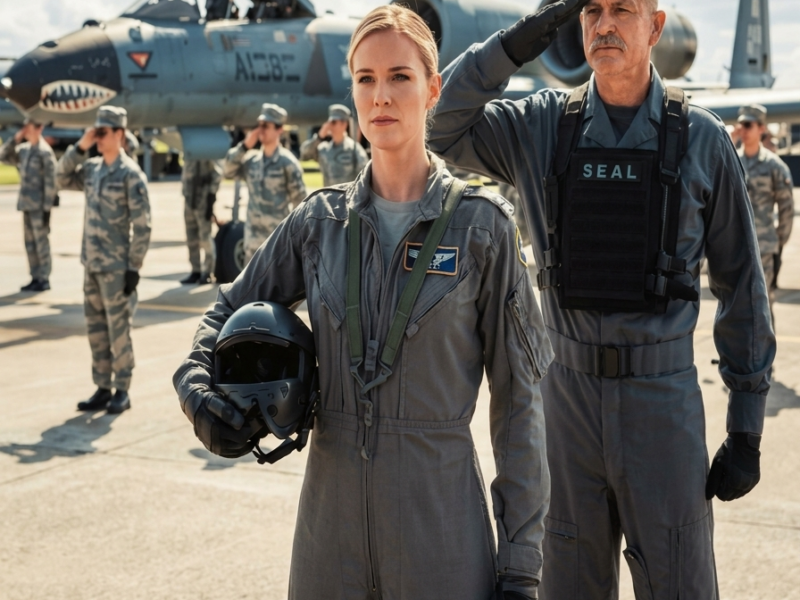
The SEAL captain asked, “Any combat pilots?” and the room went silent until I slowly stood from the back row, making the veterans laugh
The air inside the briefing room at Naval Air Station Coronado smelled of cheap filter coffee, stale sweat, and damp neoprene. It was 0200 hours. Outside, the Pacific surf slapped rhythmically against the concrete revetments, but inside, forty operators from Naval Special Warfare Development Group sat shoulder to shoulder, staring at a satellite composite projected onto a reinforced wall screen.
I sat in the very last row, tucked into the shadow between an equipment locker and a dead air duct. I was wearing an unbadged olive flight suit, stripped of nametags, unit patches, and rank insignia. My dark hair was pulled into a severe knot beneath the collar. I had kept my boots tucked under the metal folding chair, my hands deep in my pockets, my chin low.
To the men in the room, I was an anomaly—a civilian logistics liaison or a contractor who had wandered into the wrong vault. They hadn’t spared me more than a passing glance when the steel security doors hissed shut thirty minutes prior. That suited me fine. Anonymous was safe. Anonymous meant nobody was checking flight rosters from six years ago.
Captain Ryan Cole stood at the podium. He was a slab of a man with silver at his temples, a face carved by desert sun and sea salt, and a pair of pale, unforgiving eyes that didn’t blink when he spoke of casualty probabilities. He clicked a handheld remote.
The screen shifted from an orbital thermal view to a jagged topographical map of the Hindu Kush—specifically, a fracture of rock known in Soviet-era charts as the Sholuk Gorge. A fissure twenty miles long, bordered by limestone cliffs rising four thousand feet on either flank, with a floor barely wider than a two-lane highway.
“At twenty-three hundred hours, an asset carrying biometric ledgers for the entire regional network went dark inside this perimeter,” Cole said, his voice flat, devoid of theatrics. “He’s holed up in a dried riverbed at the southern terminus. The hostiles have deployed GPS-jamming suites across the ridge. Every satellite receiver within forty nautical miles is spitting garbled code. Furthermore, they’ve staged radar-guided antiaircraft batteries on the high peaks. If you fly above the rim, you are illuminated and splashed within four seconds.”
A senior chief petty officer in the second row—bearded, barrel-chested, his forearms inked with trident tattoos—leaned forward. “What about low-altitude rotary? A pair of modified Black Hawks with terrain-following radar?”
“Terrain-following systems require an active radar altimeter ping,” Cole replied coldly. “The canyon walls are jagged dolomite. The radar bounces off the overhangs, creates false ground returns, and flies the bird straight into the rock. Two crews ran this in the simulator at Fort Campbell yesterday afternoon. Both crews went into the mountain at two hundred knots.”
A heavy, suffocating silence settled over the room. These were men who kicked down doors in the dark, who swam into hostile harbors with rebreathers, who made a living in the red margins of human survival. But the air was different. You couldn’t shoot a mountain. You couldn’t breach a cliff face with explosive tape.
Cole placed both hands on the wooden edges of the podium, leaning into the room.
“We need someone who can put an unguided, unlinked fixed-wing transport through that slit in the dirt at night. No satellite navigation. No terrain-following radar. No lights. Just stick, rudder, and memory.”
A few operators exchanged skeptical, sidelong glances. One gave a low, dry whistle.
Cole surveyed the seated men, his gaze hardening. “Any combat pilots?”
Silence stretched, thick and mocking. The Navy had thousands of aviators, but nobody in Coronado’s tactical wing was stupid enough to volunteer for a suicide run through a blind gorge without navigation satellites.
I stood up.
The metal legs of my folding chair scraped softly against the polished concrete. The sound was tiny, but in that breathless room, it might as well have been a grenade spoon popping off.
Every head turned. Forty hardened operators pivoted in their seats, their expressions shifting from tension to pure, unvarnished bewilderment.
The senior chief who had spoken earlier blinked, then smirked. He looked me up and down, taking in my slight build, the unadorned suit, the absence of gold wings on my chest.
“You?” he muttered, shaking his head.
I kept my hands resting easily at my sides, my gaze fixed directly on the captain at the podium. “Me.”
A young petty officer two seats down let out a sharp bark of laughter. “Ma’am, with all due respect, this isn’t a supply hop to Fallon. We’re talking about threading a needle through a meat grinder.”
A ripple of quiet, derisive chuckles passed through the back rows. They thought I was an engineer who had spent too much time behind a computer screen, or maybe an administrative flight officer who thought flight hours were all created equal.
Captain Cole didn’t laugh. His pale eyes locked onto mine, unblinking, analytical, stripping away the silence until the laughter died in the throats of his men.
“What aircraft?” Cole asked.
“Anything with wings,” I said simply. “Turboprop, heavy twin, short-takeoff utility. Give me twin engines and manual hydraulic overrides, and I’ll put it on your riverbed.”
That earned another, louder scoff from the senior chief. “Sure you will, sweetheart.”
Cole ignored him entirely. He reached into a leather briefcase beside the lectern, pulled out a thick, unmarked red folder with a classified seal across the seam, and slid it across the front table.
“Prove it,” Cole said.
I walked down the center aisle. The operators leaned back slightly to let me pass, their eyes tracing my steps with open doubt and thinly veiled amusement. I reached the table, broke the paper seal with my thumb, and opened the dossier.
The first page was an overhead photographic run taken before the jamming went live. A narrow, serpentine gouge carved through gray limestone, shadows pooling like black ink beneath the overhanging precipices. A single red circle marked the extraction zone—a sandbar bordered by boulder fields.
Extraction window: twelve minutes.
Runway length: none.
Available stopping distance: four hundred and ten yards.
As my eyes traveled up the canyon path, tracing the contour lines along the eastern ridge, a familiar, glacial chill settled into the pit of my stomach.
I didn’t need the contour lines. I didn’t need the elevation markers.
I knew that gorge.
Six years ago, it had possessed no name on our maps, only a designated kill-box code: Grid Zulu-Seven. Six years ago, I had flown a twin-engine covert transport into that exact same cleft of stone under a moonless sky, hunting for a downed reconnaissance cell.
We had taken a missile to the starboard engine three miles from the exit. The hydraulics had bled into the bilge. The aircraft had pancaked into the rocks, bursting into an inferno that turned three men I loved into ash. I had crawled from the wreckage through a broken cockpit window, my ribs shattered, my collarbone snapped, dragging the blood-soaked flight logs behind me with my bare teeth.
The Pentagon’s board of inquiry had convened behind closed doors three weeks later. They called it pilot error. They said I had drifted off the glide slope, suffered spatial disorientation, and flown a thirty-million-dollar airframe into the dirt.
Within forty-eight hours, every paper record of my service had been classified top-secret and moved to an underground vault in Maryland. My military flight qualifications were revoked. My name was struck from the squadron rolls, scrubbed from the digital archives, and deleted from naval history as if I had never pinned on wings.
They had erased me to hide what had really brought that aircraft down.
And now, here it was. The same canyon. The same rock walls. The same impossible graveyard.
I stared at the black-and-white printout until the paper trembled slightly beneath my thumbs.
Captain Cole stepped closer, his shadow falling across the table. He was watching the micro-expressions on my face with the precision of a surgeon reading a heart monitor.
“You’ve seen this place,” he said quietly. It wasn’t a question.
I slowly closed the folder, pressing the seal flat with the heel of my hand. “Yes.”
“Where?”
I looked up, meeting his pale, piercing eyes without flinching. “From the air.”
Four hours later, the desert had swallowed us whole.
We were three hundred miles east, tucked into an unmarked dirt strip outside the perimeter of the Barry M. Goldwater Range in Arizona. The landscape had been chosen because its canyon topography mirrored the Hindu Kush with terrifying precision.
The SEALs—eight men from the briefing, including the smirking senior chief—stood by the edge of the scrub brush, night-vision goggles hanging unpowered from their helmets. Their rifles were slung, their bodies tense, watching the runway apron where an unpainted, matte-black C-145A Combat Skytruck sat idling.
The twin turboprop engines produced a low, guttural thrum that vibrated through the desert caliche. Every light on the aircraft was dead. The instrument panel inside had been stripped of its multifunction glass displays; the digital GPS receivers had been physically disconnected, their wiring harnesses taped off and tucked behind the kick panels. Only old, analog steam gauges remained—round faces with faint tritium needles that cast a ghostly, radioactive green glow over the throttles.
The senior chief crossed his arms, leaning toward Captain Cole near the tactical van. “Captain, this is suicide. You’re letting an unverified walk-in fly our insertion profile with blind instruments? If she clips a wing on the canyon pass, we lose the operational timeline.”
“Shut up, Miller,” Cole said softly, his binoculars trained on the black silhouette of the plane. “Watch.”
Inside the cockpit, I rested my left hand on the dual throttles and my right on the yoke. The leather grip was cold and worn smooth by hands that were no longer here. I didn’t close my eyes. I didn’t pray.
I remembered the landmarks from six years ago. Two fingers left of the northern star. Wait for the shadow of the Devil’s Tooth. Count twelve seconds at ninety knots. Dump the flaps.
I pushed the throttles forward.
The Skytruck leaped. Without modern computerized fuel metering, the twin Pratt & Whitney engines roared with unrefined violence, pinning me back into the sheepskin seat. The tires chewed through the gravel, cleared the ground in less than six hundred feet, and the desert floor dropped away into an ocean of pure black.
Ten miles out, the canyon mouth opened like the jaws of a subterranean leviathan.
Limestone walls reared up on either side, blotting out the stars. The air turned turbulent, vicious thermal downdrafts slamming the high-wing transport downward as if a massive hand were swatting us toward the boulders below.
Behind me, strapped into the jumpseats in the cargo bay, two test observers gripped their harnesses until their knuckles were white.
“She’s too low!” one of them yelled over the intercom, his voice cracking with panic. “Pull up! We’re below the safety floor! Pull up!”
I reached out and clicked the intercom switch to OFF.
The silence was absolute. Only the howl of the slipstream through the cockpit seams and the steady, rhythmic roar of the turbines.
Ahead, the canyon wall appeared to dead-end—a vertical slab of granite rising straight into the sky. To an untrained pilot relying on conventional flight doctrine, it looked like certain death. An instinctual reaction would be to haul back on the yoke, climb, and pancake straight into the unseen overhang forty feet above.
I didn’t climb.
I waited.
Three. Two. One.
I kicked the left rudder pedal to the floor stop and hauled the yoke hard over.
The aircraft knife-edged. The port wingtip sliced within twenty feet of the sheer rock, cutting through the stagnant pocket of air beneath the cliff. For a fraction of a second, the reflection of my own cockpit instruments flashed against the stone face, inches away.
Then, the gorge bent.
The rock fell away. The canyon opened into the narrow riverbed, exactly where my memory had carved it six years ago.
I dumped full flaps, hauled the throttles into reverse pitch, and planted the main gear onto the packed gravel with a heavy, bone-jarring slam. The brakes shrieked. The tires skidded, kicking up a rooster tail of silt and dust, and the aircraft slid to a dead stop.
The nose gear rested exactly four feet from the chalk line Cole had marked on the dry lake bed.
Total flight time: seven minutes, forty-two seconds.
Inside the cargo hold, nobody spoke. The observers sat frozen, their eyes wide, their breath rattling in their throats.
I pulled the fuel cutoff levers. The engines spun down, a high-pitched metallic whistle tapering off into the vast, cold stillness of the Arizona night. I unlatched my harness, stood up, and opened the pilot-side door.
The metal ladder clattered against the gravel. I climbed down into the darkness.
Captain Cole was already walking across the sand, his boots crunching rhythmically against the stone. Behind him, the SEALs followed at a distance, their earlier arrogance completely obliterated, replaced by a stunned, hollow reverence.
Cole stopped three feet from me. The wind off the desert whipped the edges of his jacket.
“Where did you learn to fly like that?” Cole asked. His voice wasn’t skeptical anymore. It was heavy, weighted with something ancient and unresolved.
I looked him dead in the eye, feeling the cold air burn in my lungs.
“From the man you blamed for my crash,” I said.
Cole’s jaw clenched. The muscles along his neck tightened until they looked like iron cables.
“My father,” I added, my voice cutting like a razor. “Commander Thomas Vance.”
I turned my back on him and began walking toward the maintenance sheds. I had proven my point. I had earned the right to fly their mission, to go back to the gorge that had claimed my life, and that was all that mattered.
“Wait,” Cole called out.
I didn’t stop. “The briefing is over, Captain. Have the fuelers top off the tanks. We leave at twenty-one hundred.”
“Mara, wait!”
The name hit me like a physical blow.
Nobody had called me Mara in six years. To the Defense Department, I was Subject Zero-Niner. To the contractors, I was Vance, M. But he said it with the voice of a man who had known me before the fire, before the board of inquiry, before the world ended.
I froze. Slowly, I turned back around.
Cole was standing under the pale beam of a work light mounted to the tactical van. He reached inside his breast pocket and drew out an old, creased photograph, its edges yellowed and cracked with age.
He held it out.
I walked back, my heart thudding a slow, heavy warning against my ribs. I took the photo.
It showed my father standing on an asphalt tarmac under a blazing midday sun, his arm resting over the shoulder of a much younger Ryan Cole. In the background was an airfield I didn’t recognize—arid mountains, razor wire, and rows of reinforced concrete hangars.
My father was smiling, that familiar, reckless grin that had terrified flight instructors from Pensacola to Miramar.
“I know this picture,” I whispered, my thumb tracing his face. “It was taken at Bagram before his final deployment.”
“Look closer,” Cole said, his voice dropping to a gravelly murmur. “Look at the corner. Behind the maintenance shed.”
I shifted the photograph toward the light.
In the deep shadow of Hangar Three, half-concealed beneath a camouflage netting canopy, sat a second aircraft. It wasn’t an operational Navy bird. It was an experimental, delta-wing airframe painted in non-reflective composite black, its edges sharp and predatory.
And painted in dull gray lettering beneath the cockpit sill was a call sign I had worn on my helmet when I was twenty-four years old.
VALKYRIE-ONE.
The breath trapped itself in my throat. My fingers tightened so hard on the photo that the paper creaked.
“That’s my call sign,” I whispered, staring up at him. “I never flew out of Bagram. I was stationed in Incirlik.”
“You weren’t there,” Cole said. His expression was no longer the face of a commanding officer. It was the face of a man carrying a corpse across a desert. “He was.”
“My father died six years ago,” I said, my voice rising, trembling with a sudden, vicious anger that felt like battery acid. “He died in the crash at Grid Zulu-Seven! I was in the cockpit! I dragged his body from the flames! I buried him at Arlington!”
“You buried a casket filled with lead weights and scorched titanium, Mara,” Cole said, taking a step toward me. “Your father didn’t die that night.”
The desert spun around me. The smell of the sagebrush, the heat of the cooling engines, the hum of the van—everything receded into a distant, deafening roar.
“What did you say?” I breathed.
“He disappeared because he was protecting you,” Cole said, reaching past me. He raised his hand toward the old corrugated metal hangar twenty yards behind us and clicked a handheld transmitter.
A heavy mechanical buzzer sounded.
The rusted, four-story steel doors of the hangar groaned, shuddered, and slowly began to roll back along their tracks.
Inside, bathed in the dim amber glow of industrial safety lamps, an aircraft sat waiting in the cavernous dark.
It was the same delta-wing airframe from the photograph. Matte black. Silent. Covered in a light film of preservative oil, but fully armed, its auxiliary power units humming with quiet, lethal readiness.
And on the vertical canted fin, stenciled in the exact font my father had used on every plane he had ever commanded, was the call sign he was supposed to have carried into the earth six years ago.
GHOST-LEAD.
“He’s waiting for you, Mara,” Cole whispered into the dark. “At the end of that canyon.”
The cold draft from the hangar smelled of dry preservative grease, hydraulic fluid, and high-altitude ozone. It was an impossible smell—the unmistakable scent of a pressurized cockpit that had touched the edge of space, sitting in an abandoned shed in the middle of the Arizona desert.
I couldn’t move. My boots felt as if they were bolted to the caliche gravel.
My father was dead. I had held the death certificate in my hands. I had watched the ceremonial firing party discharge three crisp volleys over a flag-draped box in Section 60 of Arlington. For six years, I had carried the guilt like shrapnel in my lung—the belief that my hands on the controls had killed him, that my hesitation on the stick during that low-altitude egress had doomed the three men in the back.
“He’s dead,” I repeated, but the word sounded thin, pathetic, hollowed out by the predatory black shape resting thirty yards away. “I signed the identification papers.”
“You signed what the Office of Naval Intelligence put in front of you while you were still on heavy painkillers in the Landstuhl intensive care unit,” Cole said, walking past me into the hangar. His boots echoed against the cracked concrete floor. “They gave you an honorable discharge, a closed-casket funeral, and a sealed file. You took the blame because you’re a good officer, and they needed a scapegoat to close the investigation before anyone asked the wrong questions.”
“What questions?” I demanded, following him into the amber light, my fists clenched at my sides. “What was he flying?”
Cole stopped beside the wing of the black aircraft.
Up close, the machine was unlike anything in the public naval inventory. The wings were swept back at an aggressive angle, blending seamlessly into a flattened, chine-edged fuselage designed to deflect both radar and infrared tracking. There were no visible rivets; the entire skin appeared to be a single, contiguous piece of carbon-bismaleimide composite.
Mounted beneath the fuselage were two specialized pod bays, their doors sealed with heavy mechanical clamps.
“In 2018, your father was assigned to Special Programs at Patuxent River,” Cole said, his voice dropping into the flat, rhythmic cadence of a classified briefing. “The Pentagon was running an off-the-books initiative known as Project Deep Well. The objective was the extraction of high-value human intelligence from non-permissive territories without leaving an acoustic or radar footprint. No satellites. No radio emissions. No electronic footprint that could be intercepted by Russian or Chinese monitoring stations.”
He ran a hand along the leading edge of the wing.
“Your father designed the low-observable flight profiles. He knew the terrain of the Hindu Kush better than any man alive. But three months into the program, he discovered what the CIA was actually transporting out of those valleys.”
“It wasn’t human intelligence,” I realized, the puzzle pieces clicking together with sickening speed.
“It was enriched fissile material,” Cole said, turning to face me. “Stolen from a Pakistani storage facility during the border skirmishes, brokered by a private defense syndicate that had infiltrated the Joint Special Operations logistics chain. They weren’t rescuing assets, Mara. They were running black-market uranium through our extraction corridors, using unmarked military airframes to bypass international customs.”
My throat was dry. “And the flight six years ago? The mission at Grid Zulu-Seven?”
“Your father found the ledger,” Cole said. “The complete list of names—admirals, senators, defense contractors—who were laundering the profits through shell companies in Geneva. He was going to turn it over to the Senate Select Committee on Intelligence. But someone in his chain of command tipped off the syndicate. That night, your flight wasn’t hit by an insurgent surface-to-air missile.”
“The starboard engine,” I whispered, the memory rushing back with blinding clarity—the sudden, deafening blast that had torn through the cabin, the smell of cordite, the failure of the primary flight computers. “It wasn’t a shoulder-fired rocket. The explosion came from inside the nacelle.”
“A barometric charge,” Cole nodded slowly. “Set to detonate the moment you crossed four thousand feet on your descent into the gorge. They meant to vaporize you, your father, and the ledger in one tidy, unrecoverable fireball in the mountains. But they underestimated your flying. You put that burning wreck onto the rocks instead of slamming into the cliff. You survived.”
“Then where was he?” My voice broke, tears of sheer fury stinging my eyes. “If he lived through that crash, why did he leave me? Why did he let them tear my wings off? Why did he let me spend six years believing I murdered my own crew?!”
“Because as long as you were disgraced, you were alive!” Cole shouted, his sudden anger matching my own, echoing violently off the hangar’s corrugated walls.
The SEALs standing by the open hangar doors shifted uncomfortably, their eyes wide, realizing they were listening to a conversation that could get every man in the room sent to a federal penitentiary for life.
Cole stepped closer, his chest heaving, his face inches from mine.
“The moment your board of inquiry adjourned, your father made contact with my unit,” Cole said, his voice dropping back to a fierce whisper. “He made a deal with the syndicate’s operational commander, General Vance Sterling—no relation to you, but the man who controlled Naval Air Systems Command at the time. Your father agreed to disappear into the black world permanently. He agreed to operate their covert flights off the books, never contacting his family, never speaking his name, in exchange for one thing: your absolute immunity.”
“They didn’t give me immunity,” I spat. “They destroyed my life.”
“They let you walk out of that hearing alive, Mara!” Cole hissed. “The other three people who knew about Deep Well died of mysterious heart attacks and car accidents within ninety days of that crash. You lived. You lived in San Diego, you worked your quiet contracting job, and you were safe. Until forty-eight hours ago.”
The silence returned, cold and heavy.
“What happened forty-eight hours ago?” I asked.
Cole reached into his pocket and pulled out a small, encrypted memory drive, tossing it to me. I caught it reflexively.
“General Sterling died,” Cole said. “A stroke at his home in Virginia. The syndicate is fracturing. The factions are cleaning house, purging every off-the-books asset before the Department of Justice unseals the grand jury indictments. Your father knew the purge was coming. Two days ago, he stole this airframe from a classified testing facility in Nevada and flew it straight into the Sholuk Gorge.”
“Why the gorge?”
“Because the physical ledger—the original paper flight logs with the signatures, the flight paths, the serial numbers of the uranium containers—is still buried in the wreckage of your crash,” Cole said. “He went back to get it. He went back to finish the mission.”
“And the asset you mentioned at the briefing?” I asked, my heart hammering against my ribs. “The man with the biometric data?”
Cole looked at me with an expression that made my stomach drop into a bottomless void.
“There is no asset, Mara,” Cole said softly. “The beacon transmitting from that riverbed doesn’t belong to a CIA operative. It belongs to Thomas Vance. He’s trapped in that canyon. A private mercenary force contracted by the syndicate has surrounded the rim with heavy weapons. They don’t have the aircraft to fly down into that slit, so they’re waiting for sunrise to send ground teams down the ropes.”
Cole stepped back, gesturing toward the black, predatory aircraft resting in the center of the hangar.
“The Pentagon thinks this is a standard rescue mission for an intelligence asset. The SEALs outside think they’re recovering a classified hard drive. But you and I know the truth. We have six hours before sunrise in the Hindu Kush. We have one plane that can penetrate the airspace undetected, and only one pilot on this earth who has the muscle memory to put it on that rock without killing everyone on board.”
I looked from Cole to the black delta-wing fighter.
On the nose, barely visible beneath the radar-absorbent paint, was the faint, stenciled silhouette of a Valkyrie—the same mark my father had painted on my very first trainer when I was seventeen years old at Pensacola.
The pain, the grief, the six years of quiet, suffocating shame—it didn’t vanish. It transformed. It hardened into something dense, cold, and lethal.
“Get the men geared up,” I said, my voice steady, stripped of all doubt.
Cole looked at me, a flicker of relief crossing his hardened face. “You’re taking the stick?”
“I’m taking the stick,” I said, walking toward the boarding ladder of the black aircraft. “And Captain?”
Cole stopped, his hand on the hangar door. “Yeah?”
“Tell your SEALs to leave their extra magazines at the door,” I said, stepping onto the first rung. “They won’t need them. If I miss that canyon, we won’t live long enough to pull a trigger. And if I hit it… nobody’s leaving that gorge alive except my father.”
At forty-five thousand feet, the air is thin, hostile, and sixty degrees below zero.
The modified delta-wing transport, designated in black-budget ledgers as the Ares-4, sliced through the high stratospheric wind like an obsidian scalpel. Outside the cockpit, the Hindu Kush was an ocean of jagged, snow-capped teeth bathed in the cold, silver light of an ancient crescent moon.
Inside the cockpit, it was pitch-black save for the faint green glow of my night-vision visor and the primary flight needles.
“Approaching boundary line,” Cole’s voice crackled through the secure intercom from the right-hand seat. He was monitoring the passive electronic warfare suite—a series of analog dials that measured radar emissions without radiating a single byte of signal back into the ether. “Two minutes to the descent window. The radar picket on the northern ridge is active. If we show even a square inch of thermal bloom above the rim, they’ll salvo four SA-15 Gauntlets into our belly.”
I didn’t answer. My hands were wrapped around the twin throttle grips, my fingers feeling the subtle, rhythmic pulse of the engines.
The Ares-4 was a masterpiece of clandestine engineering. Its engines were buried deep within the blended wing-body, their exhaust routed through serpentine, ceramic-lined troughs that cooled the gases with ambient air before venting them over the trailing edge. It was invisible to infrared. It was nearly invisible to radar.
But it was heavy. Fully loaded with eight SEALs, tactical gear, and maximum internal fuel, it handled like a brick wrapped in sandpaper.
“SEAL team, prepare for drop-down,” I said into the cabin mic.
Behind the armored cockpit bulkhead, in the cramped, red-lit cargo hold, eight men checked their restraints. There were no jokes now. No smirks. The senior chief, Miller, had spent the six-hour transit from Diego Garcia staring at the floorboards, his knuckles white against his rifle receiver. They had seen the topographic projections. They knew that if my hands slipped by three millimeters on the stick, their lives would end against a limestone wall at three hundred miles per hour.
“One minute,” Cole murmured. “Target coordinates locked. The valley is jammed solid. GPS signal is dead.”
“I don’t need GPS,” I said.
Ahead, the earth seemed to split open.
The Sholuk Gorge appeared as an ink-black fracture across the snow-dusted mountains. It didn’t look like a landing zone; it looked like an abyss. A vertical crack carved into the crust of the earth, shrouded in shadows that the moonlight couldn’t penetrate.
“Throttles to flight idle,” I commanded myself.
I pulled the levers back. The engine roar died to a low, sinister hiss.
I pushed the yoke forward.
The nose dropped forty degrees.
The transition from level flight to a near-vertical dive was brutal. The negative Gs lifted my body against the four-point harness, the blood rushing to my temples, my visor pressing against my eyebrows. The altimeter spun like the second hand of a broken watch.
Thirty thousand feet.
Twenty thousand.
Twelve thousand.
“Altitude warning,” the mechanical voice of the analog ground-proximity sensor squawked. “Pull up. Pull up.”
I reached out and clicked the circuit breaker, silencing the automated warning. In this gorge, the ground was everywhere. A computer couldn’t help you; it could only panic.
The cliff walls rose up around us like the walls of a collapsing tomb.
The moonlight vanished instantly, swallowed by the massive limestone overhangs. The cockpit was plunged into absolute, suffocating darkness. Through the night-vision tubes, the world turned into a grainy, ghostly green nightmare of jagged dolomite needles, rock spurs, and sudden, violent updrafts that slammed the aircraft’s wings with the force of hydraulic hammers.
“Left!” Cole yelled, his eyes glued to the optical rangefinder. “Spur at eleven o’clock!”
“I see it,” I said, my voice dead calm.
I didn’t flinch. I let the spur approach until it filled the left half of my windscreen, then kicked the rudder and applied opposite aileron. The Ares-4 slipped through the gap with barely twelve feet of clearance between the composite wingtip and the bare rock. The vortex from our passage stripped loose gravel from the cliff face, sending a rain of stones clattering across the lower fuselage.
Six miles to the crash site.
“Thermal bloom ahead,” Cole said, his voice tightening. “At the floor of the gorge. We’ve got campfires. Portable floodlights. The mercenaries have already established a perimeter around the wreckage.”
“How many?”
“At least twenty,” Cole said, zooming in with the nose-mounted forward-looking infrared camera. “They’ve got two technical trucks with heavy fifty-caliber machine guns mounted on the beds. They’re cutting through the fuselage of your old plane with thermal lances.”
“They haven’t found the ledger yet,” I said, bringing the throttles up just enough to maintain directional control.
“They’re close,” Cole muttered. “And they’ve got the riverbed covered with crossfire. If we try to land, they’ll chew this airframe to ribbons before the tires touch the gravel.”
“Then we don’t land,” I said.
Cole turned his head, his night-vision visor glowing green in the dark. “What?”
“Tell Miller to pop the cargo ramp,” I commanded, my hands tightening on the stick. “We’re going to give them something else to look at.”
“Mara, we’re eighty feet off the deck! If we drop them here—”
“Do it, Ryan!” I barked.
Cole hit the emergency cargo release.
Behind us, the hydraulic rams groaned, and the heavy composite ramp at the tail of the Ares-4 swung open into the sub-zero slipstream. A hurricane of freezing mountain air howled through the cargo bay, screaming against the aluminum bulkheads.
“Green light! Green light!” Cole shouted into the back.
The SEALs didn’t hesitate. They were professional killers who had practiced low-altitude extraction in their sleep. Led by Senior Chief Miller, the eight operators unhooked from their jumpseats, moved to the edge of the open ramp, and threw themselves into the black void sixty feet above the riverbed, deploying specialized static-line parachutes that snapped open with sharp, muffled cracks against the canyon walls.
Below us, the mercenary camp erupted into chaos.
They had expected an airborne insertion from high altitude. They had their radars pointed at the sky. They had never conceived that an aircraft with an eighty-foot wingspan would come screaming through the narrow canyon floor at two hundred knots, flying below the rim of the cliffs like an angry phantom.
The muzzle flashes of their fifty-caliber machine guns began to strobe against the rocks, firing wild, desperate bursts into the darkness.
Tracers—bright, glowing lines of red and amber—sliced through the air around the cockpit. A round punched through the thin composite skin of our left wing with a loud thwack, sending a shower of carbon dust into the slipstream.
“We’re taking hits!” Cole yelled. “Left fuel tank pressure is dropping!”
“Holding trim,” I said, gritting my teeth as the controls fought back, the heavy airframe vibrating violently from the damage.
I brought the nose up five degrees, banked hard around the final bend of the canyon, and cleared the mercenary camp, leaving the SEALs to hit them from the shadows behind.
Ahead, nestled in the shadow of a massive boulder field where the gorge widened by fifty yards, was the carcass of my old aircraft.
It was a skeleton of blackened aluminum and melted titanium, half-buried in river silt and overgrown with wild alpine brush. Six years of mountain blizzards had stripped the paint, but the silhouette was burned into my soul.
And standing on top of the crushed cockpit section, holding a flare that burned with a brilliant, blinding crimson light, was a lone figure in a tattered, ancient flight jacket.
My breath seized in my throat.
He wasn’t dead. He wasn’t a ghost.
He was standing there, his gray hair whipping in the turbine backwash, waving the red flare in the exact, rhythmic three-beat pattern he had taught me when I was a child waiting for him on the flight lines of naval stations across the world.
Come home, Valkyrie. Come home.
“Cole,” I whispered, tears finally breaking through my discipline and spilling down my cheeks into my mask. “Clear the gear.”
“Gear down,” Cole said, his own voice cracking.
The heavy hydraulic struts slammed into place with three mechanical thuds.
I cut the engines completely.
The Ares-4 dropped out of the sky, its tires slamming into the frozen mud of the riverbed fifty yards from the burning flare, sliding sideways, throwing up a curtain of ice, gravel, and rock, until the nose came to rest in the dirt—ten feet from the boots of Commander Thomas Vance.
The red flare sputtered and died, plunging the riverbed back into the freezing, moonlit gloom of the gorge.
The silence that followed the shutdown of the Ares-4 was broken only by the sharp, rhythmic pops of distant rifle fire echoing from the mercenary camp three miles north. Miller and his men were doing their work—methodical, quiet, and lethal.
I popped the emergency canopy latch.
The cold mountain air hit me like a slap across the mouth, sharp with the taste of sulfur, snow, and old ashes. I climbed over the sill, my boots hitting the rocky silt of the riverbed. My legs felt weak, the adrenaline draining from my limbs, leaving behind an unbearable, hollow ache.
He stood ten feet away.
My father looked older than the man in the photograph. His shoulders were slightly stooped, his face deeply lined by six years of mountain sun, cold winds, and isolation. His flight jacket was torn at the elbow, patched with silver duct tape, and a thick gray beard covered his jaw. But his eyes—those pale, unyielding gray eyes that had watched me fly my first solo circuit—were exactly the same.
He didn’t speak. He just looked at me, taking in my flight suit, my helmet held loose in my left hand, the way I stood on the rocks.
“You were high on the glide slope, Mara,” he said. His voice was gravel, scraped raw by years of speaking to nobody. “You took that last turn with too much rudder. You almost clipped the granite with your port stabilizer.”
A sound tore from my throat—halfway between a sob and a wild, hysterical laugh.
I took three long strides across the gravel, threw my arms around his neck, and buried my face into the rough wool collar of his jacket. He smelled of woodsmoke, gun oil, and cedar. Real. Solid. Alive.
His arms came around me, iron-hard, trembling with a restrained, desperate strength that broke the last of my defenses. He held me against his chest, his hand cupping the back of my head just as he had done when I was eight years old and had broken my arm falling from the tire swing in Pensacola.
“I’m sorry,” he whispered into my hair, his voice breaking into a ragged rasp. “God forgive me, Mara. I am so sorry.”
“You left me,” I choked out, my fingers digging into the fabric of his jacket. “You let them say it was my fault. You let them bury you.”
“I had to,” he said, pulling back slowly, his hands resting on my shoulders, his eyes searching my face with painful intensity. “The men behind Deep Well… they weren’t politicians you could expose in a newspaper. They were the men who controlled the logistics of the entire Pacific Fleet. If I had stayed, if I had fought them through the courts, they would have arranged an accident for you before the sun rose. A fatal training flight. A brake failure on the highway. I couldn’t protect you from inside a cell. I could only protect you by becoming a ghost.”
Captain Cole walked up, his rifle held across his chest, his eyes scanning the ridgeline above us. “Thomas.”
My father looked at him, nodding slowly. “Ryan. You brought her.”
“She didn’t give me a choice,” Cole said. “The moment she saw the canyon on the map, she knew. How much time do we have?”
My father turned and pointed toward the charred, twisted carcass of the old transport thirty yards away.
“The mercenary commander is Colonel Marcus Richter,” my father said, his voice instantly snapping back into operational focus. “Former British Special Boat Service, now running private contracts for the syndicate. He brought thirty men and three technicals into the valley through the southern pass. They were tasked with finding the physical flight recorder from this bird before the grand jury unseals the indictments tomorrow morning.”
“Did they find it?” Cole asked.
“No,” my father replied. He reached into his jacket, pulled out an old, olive-drab canvas bag wrapped in heavy plastic sheeting and secured with parachute cord, and handed it to me. “I pulled it from the auxiliary avionics bay an hour ago.”
I took the bag. It was surprisingly heavy. Through the plastic, I could feel the rectangular edges of a hardened steel data core and a thick, bound paper flight manifest with official Department of the Navy watermarks.
“This is the ledger,” I whispered.
“Every name,” my father said. “Every transfer code. Every serial number of the weapons-grade material they moved through Pakistan and Turkey. It contains the signatures of three sitting members of the House Armed Services Committee and the Deputy Director of Naval Intelligence. It’s enough to tear the syndicate out of the military by its roots.”
A burst of heavy machine-gun fire echoed down the canyon, closer this time. A tracer round ricocheted off the limestone wall five hundred yards away, whining into the night sky.
Miller’s voice crackled over Cole’s radio headset.
Captain, we’ve neutralized their outer perimeter, but Richter’s pulling back toward the southern mouth. He’s realized the insertion wasn’t a supply drop. He knows the Ares-4 is on the deck, and he’s bringing his last technical down the riverbed with a mounted fifty. We can’t stop him from the rocks. He’s going to ram the landing zone!
My father looked toward the narrow throat of the riverbed. “If they disable that aircraft, we’re trapped here. Sunrise is in forty minutes. When the sun comes up, the Pakistani air defense network will spot this black airframe on their high-altitude sweeps, and they won’t ask questions before they scramble their Mirages.”
“We need to get the engines spooled,” Cole said, turning toward the Ares-4. “It takes four minutes to run the auxiliary power unit and clear the turbine pre-heaters.”
“We don’t have four minutes,” my father said quietly.
He unslung an old, battered M14 rifle from his shoulder—a weapon he had carried since his days as an instructor at the Naval Strike Air Warfare Center. He checked the magazine, chambered a round with a heavy, metallic click, and looked at me.
“Get in the cockpit, Mara,” he said.
“No,” I said, cold dread seizing my chest once again. “No! I’m not leaving you behind a second time. You’re coming with us.”
“The technical truck is coming around that blind bend at forty miles per hour,” my father said, his voice completely level, completely devoid of fear. “If he clears that corner with that fifty-caliber gun, he will saw that composite wing in half before your turbines can even ignite. Someone has to hold the choke point.”
“We can tow you! We can—”
“Mara!” he barked, grabbing my face with both hands, forcing me to look directly into his eyes. “Listen to me! For six years, I have lived in a cave like a rat, eating dried rations and waiting for the day I could hand you this bag. My fight is finished. Yours is just beginning. You have to take this ledger to Washington. You have to clear your name. You have to make them put those wings back on your chest.”
“I don’t care about the wings!” I screamed into the freezing wind, tears streaming down my face. “I care about you!”
“I know,” he whispered softly, his thumb wiping a tear from my cheek. “And that’s why you’re going to fly that plane out of here. Because you’re the best pilot this Navy ever produced. You’re my daughter.”
He shoved me backward toward the boarding ladder of the Ares-4.
“Ryan!” my father shouted without looking back. “Get her in the seat! Spool the engines! If you let her stay on this ground, I will kill you myself!”
Cole grabbed my arm, his grip unyielding, dragging me toward the ladder.
“Let me go!” I fought him, kicking against the gravel, my nails clawing at his tactical vest. “Ryan, let me go! He’s going to die!”
“He’s giving us the runway, Mara!” Cole roared into my ear, his face twisted in agonized determination. “Honor the man! Honor the pilot! Get in the damn seat!”
He shoved me up the ladder into the cockpit, threw the canvas bag onto the center console, and slammed the pilot door shut behind me, dogging the mechanical latches with a violent heave.
Through the reinforced acrylic glass, I saw my father turn his back on us.
He walked alone into the center of the narrow riverbed, forty yards ahead of our nose, his rifle raised to his shoulder. He planted his boots into the frozen mud, a solitary gray-haired warrior standing against the dark, waiting for the headlights of the approaching technical truck to round the bend.
Behind me, the auxiliary power unit screamed into life.
The cockpit of the Ares-4 hummed with rising, violent energy.
I sat in the left seat, my vision blurred by hot tears, my chest hitching with ragged, suffocating breaths. My fingers trembled as they reached for the starter switches, but the moment my skin touched the cold aluminum toggles, something ancient and mechanical took over.
Muscle memory. The discipline my father had beaten into my bones since I was a child sitting on his knee in an SNJ Texan over the Florida keys.
Aviate first. Navigate second. Mourn last.
“Starting number one,” I rasped through the intercom.
The left turboprop whined, catching fuel with a deep, throaty whoosh. The propeller blades blurred into a silver disc against the night.
“Starting number two,” Cole said from the right seat, his hands flying across the overhead panel, throwing breakers, arming the hydraulic pumps, clearing the fuel feed lines.
Outside, the headlights of the mercenary technical truck exploded around the river bend three hundred yards away.
The vehicle was an armored Toyota pickup, its front end reinforced with welded iron bars, bouncing violently across the river boulders. In the bed, a gunner stood behind a heavy Browning .50-caliber machine gun, the long barrel swinging toward our aircraft.
My father didn’t move.
He stood squarely in the center of the beam of the truck’s high-power halogen lights, a lone, dark silhouette carved out of the mountain. He brought the heavy wooden stock of the M14 to his cheek.
Crack. Crack. Crack.
Three rapid, disciplined shots echoed above the rising howl of our turbines.
Two hundred yards away, the left front tire of the truck shredded into black ribbons. The pickup pitched violently to the side, its steel bumper digging into the gravel, throwing up a spray of frozen silt.
The gunner in the bed opened fire.
The heavy machine gun barked with a rhythmic, deafening roar—thump-thump-thump-thump—the muzzle flashes illuminating the gorge in violent, jagged bursts. The heavy half-inch slugs tore through the riverbed, chewing the frozen mud into powdered dust, walking a line of destruction straight toward my father’s position.
“Father!” I screamed, slamming both throttles forward to the taxi detent.
The Ares-4 lurched forward, its twin propellers biting into the sub-zero air, the nose gear rolling through the rocks.
My father fired four more rounds. The truck’s windshield spiderwebbed with white fractures; the driver slumped over the steering wheel, and the technical spun sideways, pinning itself against a massive granite boulder at the edge of the canyon wall.
The gunner swung the heavy fifty-caliber mount toward my father.
A single, vicious burst tore through the dark.
My father’s body jerked backward. His rifle spun from his hands, clattering across the river gravel. He fell to his knees in the dust, thirty yards ahead of our advancing nose.
“No!” The scream tore out of my throat, raw and animalistic.
I reached for the brakes, my feet stomping on the top of the rudder pedals to stop the plane.
“Don’t you dare!” Cole’s hand shot across the console, his palm slamming down on top of my hands, pinning the throttles wide open to maximum continuous thrust. “Look at him, Mara! Look at him!”
Through the windscreen, illuminated by our taxi floods, my father was on his knees in the dirt. Blood was soaking through the wool of his torn flight jacket, but he wasn’t looking at his wounds.
He was looking straight into the cockpit. Straight into my eyes.
With his remaining strength, he raised his right hand.
He didn’t signal for help. He didn’t wave goodbye.
He formed his hand into a blade, pointed it straight down the riverbed toward the northern exit, and chopped the air forward three times.
Takeoff clearance.
Then, his arm fell, his head dropped against his chest, and he collapsed forward onto the frozen mud of the Sholuk Gorge.
“Turbines at one hundred percent,” Cole shouted, his own eyes streaming with tears. “Rotation speed in four hundred feet! Go, Mara! Go!”
A sob tore through my chest, but my hands didn’t hesitate. I pulled back slightly on the yoke to lighten the nose gear, letting the twin propellers pull thirty thousand pounds of black composite through the mountain silt.
We roared past the spot where he lay.
The left wing passed within six feet of the burning wreckage of the technical truck. A stray burst from a dying mercenary pinged off our armored underbelly, but the momentum was unstoppable now.
Seventy knots.
Eighty knots.
Ninety.
“End of the riverbed!” Cole yelled.
Ahead, the river terminated in a sheer, vertical wall of limestone—a two-hundred-foot cliff rising straight out of the gorge floor. There was no runway left. Only rock.
“Rotate,” I whispered.
I hauled the yoke back into my ribs.
The Ares-4 leaped into the air. The landing gear clipped the top branches of a scrub cedar growing from the cliff’s lower ledge, but the high-lift delta wing caught the cold mountain updraft. The aircraft clawed its way upward, banking ninety degrees onto its port wing, sliding through the narrow vertical slit of the northern exit with barely inches to spare.
We broke through the gorge rim.
The suffocating, claustrophobic darkness of the canyon vanished.
Ahead of us, stretching across three hundred miles of jagged peaks, the first light of dawn was breaking over the horizon. The sky was an explosion of deep violet, amber, and burning gold, spilling liquid light across the snowfields of the Hindu Kush.
Behind us, in the cargo hold, Miller and the surviving SEALs collapsed against the bulkheads, gasping for air, their faces black with carbon and dirt, but every single man breathing.
I held the aircraft in a steady, unbroken climb toward thirty thousand feet, heading south-southwest toward the international airspace over the Arabian Sea.
Beside me, the green flight displays flickered to life. The jamming had cleared. The GPS satellites acquired our transponder, their digital handshakes populating the navigation screens with clean, precise flight paths back to civilization.
On the center console between our seats sat the canvas bag.
Cole reached out, his hand resting on the plastic wrapping. He looked at me, his weathered face softened by the rising sun.
“He won,” Cole said softly.
I looked at the bag, then down at my hands on the controls.
The trembling had stopped. The pain was there, sharp and permanent, carved into my heart like the rock walls of the gorge below. But the shame was gone. The shadow that had followed me for six years had been burned away by the dawn over the mountains.
I pulled back the throttle levers to cruising trim, letting the twin engines hum with a clean, effortless resonance.
“We both did,” I said.
Three weeks later, the East Wing of the White House was silent save for the clicking of camera shutters.
The room was filled with dress uniforms—admirals, generals, senators, and the Attorney General of the United States. Behind the podium, forty-two indictments lay sealed in leather folders, the direct result of the paper ledger that had been carried out of the Sholuk Gorge. Three high-ranking officers had already been escorted from the Pentagon in handcuffs before breakfast.
I stood at the center of the Persian rug, wearing a pristine, high-collared Navy Service Dress Blue uniform.
The Chief of Naval Operations stood before me, his face pale, his hands holding a small, velvet-lined mahogany box. He cleared his throat, leaning in so that only I could hear his words over the murmur of the press corps.
“Lieutenant Commander Vance,” the four-star admiral whispered, his voice trembling slightly with suppressed shame. “There are no words that can restore the six years this department stole from you. We can only return what was always yours.”
He reached into the velvet box, lifted out a set of tarnished, weathered gold naval aviator wings—the exact pair my father had worn during his thirty years of service, recovered from his flight locker at Miramar—and pinned them securely above the ribbons over my heart.
He stepped back and snapped a crisp, trembling salute.
I didn’t smile. I didn’t look at the cameras.
I returned the salute, my hand touching the brim of my combination cover, my eyes looking through the high French windows toward the clear, open sky above the Potomac.
A cool autumn wind was blowing from the north, carrying the faint, distant scent of jet fuel and open horizons.
And somewhere high above the clouds, where the air was cold and clean and the mountains couldn’t reach, I knew the lead aircraft was watching my wing.
The end.









