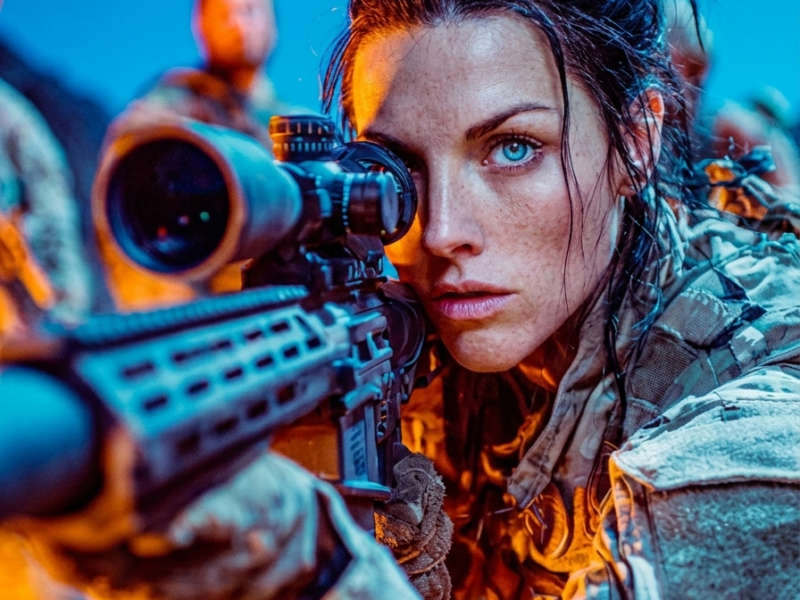
The SEAL admiral publicly dismissed me as a helpless new medic during a midnight briefing at a remote Afghan outpost
The air inside FOB Ozhbin smelled of stale diesel, copper, and mountain dust that forty-eight hours of continuous howling wind had forced through every crevice in the plywood barracks. It was 0110 hours, deep in the jagged black maw of the Kunar Province. Outside, the temperature had plummeted well below freezing, frosting the perimeter HESCO barriers with thin, spiderwebbing ice.
Inside the tactical operations center, the heat from two oversized propane burners made the air suffocatingly thick.
I stood near the corner medical cabinet, wearing an oversized, faded ACU field jacket bearing the insignia of a Navy Hospital Corpsman Third Class—a junior medic. My hair was tied back in a tight, nondescript bun, tucked beneath a fleece watch cap. Underneath the heavy canvas jacket, the sharp, cold steel of a customized titanium receiver pressed against my ribs, hidden beneath a loose thermal liner.
At the center of the sandbagged briefing table stood Rear Admiral Richard Hayes.
Hayes was a legendary figure in the Special Warfare community—a trident-wearing veteran of three decades who had commanded devgru squadrons before stepping into high-level joint operational control. He had arrived at this remote Afghan outpost four hours ago via a blacked-out MH-47 Chinook, flanked by six heavily armed DEVGRU operators acting as his personal security detail.
He was currently pounding a calloused fist onto a topographical map of the surrounding Shahi-Kot Valley.
“We are moving the target extraction window up to 0300,” Admiral Hayes barked, his voice carrying the rasp of a lifetime spent inhaling dust and cordite. He glared around the cramped room at the assembled team leaders. “The high-value asset in Sector Four is moving. If we wait until dawn, the Pakistani border network will absorb him, and six months of intelligence work goes up in smoke.”
Master Chief Miller, a weathered SEAL operator with a graying beard and a scar splitting his left eyebrow, leaned over the map. “Sir, with all due respect, Sector Four is a funnel. The surrounding ridges dominate every ingress route. If we don’t have dedicated long-rifle surveillance covering those high-altitude crests, the assault element will be walking into a three-sided kill box.”
Admiral Hayes let out a cold, dismissive laugh. He gestured toward the back of the room, his eyes brushing past me with a look of absolute, unadulterated contempt.
“We don’t have time to airlift a scout-sniper team from Bagram, Master Chief,” Hayes snapped. “And I’m not delaying a strategic directive because your men are jumpy about mountain shadows. The only reinforcement this outpost received today was a twenty-two-year-old corpsman sent to hand out band-aids and inventory penicillin.”
He looked directly at me then, his lip curling slightly.
“Look at her,” Hayes continued, his tone dripping with patronizing arrogance. “She looks like she weighs ninety pounds soaking wet and hasn’t seen a day of real combat in her life. She’s a helpless new medic who belongs in a hospital ship sickbay, not a forward tactical center. We execute the raid at 0300 with the assets on the floor. That is an order.”
I didn’t blink. I didn’t shift my feet. I kept my face utterly blank, my arms folded loosely across my chest, looking every bit the quiet, intimidated junior medic he assumed I was.
“Understood, Admiral,” Master Chief Miller grunted, though his jaw muscles clenched tight enough to pop a tooth.
Hayes turned back to the satellite map. “Now, regarding the internal routing—”
The room went black.
It wasn’t a flicker. It wasn’t a standard generator drop where the auxiliary backup kicks in after two seconds. The heavy diesel thrum of the main power unit outside abruptly died, followed immediately by the sharp, electrical pop of the secondary junction box being severed with a high-grade charge.
For three seconds, nobody moved.
In total subterranean darkness, the air in the room froze.
Then the first bullet smashed through the reinforced double-pane window frame.
CRACK-BOOM!
A high-velocity 7.62x54mm Armor-Piercing incendiary round tore through the glass, shattered the plywood briefing table into splintered kindling, and slammed directly into the concrete map-weight, showering the room with blinding white sparks and razor-sharp wood fragments.
Men dropped behind tables as alarms screamed outside.
“CONTACT! WE HAVE ENEMY FIRE FROM THE RIDGE!” someone screamed through the dark.
“Get the Admiral down! Shield the command element!” Master Chief Miller roared, the heavy metallic racking of SCAR-H rifles echoing through the confined space.
“Nobody move! Stay in cover!” Admiral Hayes shouted, his authoritative voice cracking slightly under the sudden, violent roar of secondary explosions detonating along the outer perimeter wall.
I was already moving.
While the SEAL operators scrambled to form a defensive ring around Hayes, dropping to their knees and reaching for their night-vision goggles, I slipped smoothly backward into the shadow of the medical storage alcove.
My hand reached down beneath the heavy wooden supply table, finding the custom, quick-release latches of a long, matte-black Pelican 1750 hard case that had been bolted to the lower frame forty-eight hours before the Admiral’s arrival.
With two silent flicks of my thumbs, the latches opened. I lifted the heavy rifle—a custom-built McMillan TAC-338 chambered in .338 Lapua Magnum, fitted with a thermal suppressed barrel and a digital ballistic computer—out of its custom foam casing.
I didn’t grab an ammunition vest. I pulled a single, heavy ten-round magazine from my inner field jacket pocket, slapped it into the well with a muted metallic clack, and pulled the bolt back.
I slipped through the rear emergency egress door before the first SEAL turned his head.
“Where are you going?!” Hayes yelled through the smoke and dust filling the command room, catching a brief glimpse of my silhouette against the doorway. “Medic, drop to the floor!”
I didn’t answer.
I stepped out into the freezing mountain air, letting the heavy steel door click shut behind me.
Outside, darkness covered everything.
No moon. No stars. The thick, heavy cloud cover typical of late-winter storms in the Hindu Kush had descended over the peaks, blinding every conventional night-vision device on the base.
The compound was a chaos of screaming sirens, running boots, and incoming fire. Heavy mortar shells were raining down on the motor pool, turning supply trucks into roaring pillars of orange flame.
CRACK-CRACK-CRACK!
Long-range machine gun fire from the northern ridge was chewing up the concrete walkways, sending blinding fountains of sparks into the night air.
Only distant muzzle flashes flickered across the black jagged peaks of the mountains three thousand yards above us.
My spotter found me near the eastern perimeter wall, crouching behind a stack of sandbags.
Sergeant Daniel Vance—a dark-eyed, quiet operator from a unit that didn’t officially exist on any Department of Defense roster—was already adjusting his handheld thermal rangefinder. He had been stationed at FOB Ozhbin for two weeks, posing as a communications technician.
He looked down at the matte-black rifle in my hands, then up at my face.
“You brought a rifle?” Vance asked, his voice calm, devoid of the panic echoing across the rest of the base.
“I always do,” I replied, stepping up onto the sandbag ledge, resting the cold titanium bipod onto the flat concrete rim of the wall.
Vance stared at me for a half-second, then a grim, tight smile flickered across his face. “Target sector is three-zero-zero to three-two-zero. Upper ridge line. They’ve got three heavy PKM machine gun nests established behind natural rock shelves. They’re suppressing the entire TOC.”
Another burst tore across the compound, chewing through the wooden roof of the barracks ten feet to our left.
I raised my scope, pressing my eye against the rubber eyepiece of the thermal optic.
There was almost nothing to see. The freezing rain and howling wind created a dense wall of thermal clutter, turning the mountain ridge into a shimmering, gray sea of static.
Almost.
A faint, microscopic glimmer appeared between two dark jagged rocks at two thousand four hundred yards. A heat signature no larger than a grain of rice—the thermal bloom of a hot machine gun barrel cooling off between bursts.
I calculated the wind velocity in my head: twenty-two knots from the northwest, six-degree elevation correction, density altitude four thousand feet.
I exhaled half a breath, letting my heart rate drop to forty beats per minute.
I fired.
The suppressed rifle didn’t roar like a conventional long weapon; it produced a low, metallic THUMP-CLICK that was instantly swallowed by the roaring mountain gale.
Two thousand four hundred yards up the mountain face, a .338 Lapua Magnum bullet traveling at nearly three thousand feet per second crossed the void in just under three seconds.
Through the scope, I watched the faint thermal bloom between the two rocks violently disintegrate. The hot machine gun barrel pitched backward into the dark, accompanied by the bright, white heat signature of a body collapsing over the ridge shelf.
The muzzle flash vanished.
“Target one down. Direct hit on the primary gunner,” Vance reported through his earpiece, his thumb adjusting the fine dial on his rangefinder. “Second gunner is active thirty mils to the left, slightly higher elevation behind a shelf.”
A second orange-red muzzle flash erupted farther left, sending another heavy volley of armor-piercing rounds tracing down toward the tactical operations center below us.
I worked the bolt with a smooth, practiced motion, ejecting the steaming brass casing into my palm and dropping it silently onto the sandbag wall.
I adjusted the elevation turret two clicks up, compensated three mils left for the mountain crosswind, and settled the crosshairs on a tiny heat pulse shimmering behind a sheet of ice.
I fired again.
THUMP-CLICK.
Three seconds later, the second muzzle flash died mid-burst. The thermal optic captured the heat signature of an ammunition drum exploding, blowing the second crew off the mountain shelf and tumbling eight hundred feet down the vertical cliff face into the abyss.
Inside the command room fifty yards behind us, Admiral Hayes stood near the shattered glass window, holding a pair of high-end AN/PVS-31 night-vision binoculars to his eyes.
The green-phosphor tubes showed him almost nothing through the storm—only the blinding flash of mortar impacts and the dark silhouettes of his SEALs taking cover behind sandbags.
“Who is that on the eastern wall?” Hayes demanded, his voice echoing out into the courtyard over the roar of the alarms. “Who the hell is shooting on the eastern perimeter?!”
Master Chief Miller, crouched near the door with his rifle raised, squinted through his optic toward the wall. He could see the dark, slender outline of a figure standing completely upright in the open, unbothered by the heavy incoming fire, working a bolt-action rifle with terrifying, robotic speed.
“It’s the medic, sir,” Miller whispered, his voice tinged with sheer disbelief.
“What?!” Hayes shouted. “That’s impossible! She doesn’t even have a combat deployment record!”
Nobody answered him.
I kept firing only when I had a confirmed target.
I didn’t waste rounds. I didn’t spray the ridge to suppress them. Every trigger pull was a calculated mathematical equation executed in the freezing dark—distance, wind, core temperature, Coriolis effect.
THUMP-CLICK.
A third sniper crew positioned near an old Soviet-era bunker door three thousand yards out collapsed before they could clear their barrel obstruction.
THUMP-CLICK.
A heavy mortar team assembling a tube behind a stone wall dissolved into a scatter of cold thermal debris as my bullet detonated their primary casing.
One by one, the enemy positions that had pinned down an entire joint special operations outpost disappeared into the darkness. The brutal, suffocating wall of incoming fire that had threatened to tear FOB Ozhbin apart began to falter, sputtering out into isolated, disorganized sporadic shots.
The wind shifted sharply from the west, bringing a heavy wall of sleet swirling down through the canyon.
I adjusted my posture, lowering my center of gravity, resting my elbow against the flat concrete edge of the wall to stabilize the extra four pounds of lateral torque created by the storm.
A final, faint muzzle flash appeared near the crest of the highest ridge—a solitary shooter using a heavy anti-materiel rifle, aiming directly down toward the satellite array on top of the command building.
“Target at three thousand two hundred yards,” Vance warned, his voice tightening slightly. “That’s beyond effective envelope in this wind, Miller. You’ve got cross-currents moving through three separate valleys between here and that peak.”
“I see him,” I said quietly.
I raised the scope elevation to its absolute limit, aiming three feet above the shooter’s position, holding the crosshairs far out into what appeared to be empty, pitch-black space to account for the forty-knot gale tearing through the center canyon.
I held my breath.
My index finger applied three pounds of pressure to the match-grade trigger.
I held.
THUMP-CLICK.
Four seconds passed in total, suffocating silence.
Through the optic, the tiny thermal shimmer near the ridge crest abruptly vanished. A solitary rifle tumbled over the cliff edge, striking the rocks four times before disappearing into the snowdrifts below.
Silence.
The shooting stopped.
The mountain range, which four minutes ago had been vomiting fire and lead onto the compound, went completely, utterly silent. The only sound remaining was the steady, rhythmic wail of the wind whipping against the iron perimeter fencing and the low idle of the surviving backup generator.
I lowered the rifle, keeping the muzzle pointed toward the earth, and worked the bolt one final time. A single, unspent .338 cartridge ejected into my hand. I caught it, slipped it into my field jacket pocket, and clicked the safety to ENGAGED.
Footsteps crunched over the icy gravel behind us.
Slow. Heavy. Hesitant.
Admiral Hayes stepped outside the command building, flanked by Master Chief Miller and three DEVGRU operators with their weapons resting at low-ready.
Hayes walked slowly across the courtyard, his boots stepping through pool of diesel and broken glass, his eyes fixed entirely on the figure standing on the sandbag ledge.
He looked at the long, matte-black suppressed rifle held loosely in my right hand—a weapon worth more than an entire platoon’s standard issue gear.
Then he looked at the insignia pinned beneath the collar of my open field jacket.
The small, silver Corpsman cross was pinned directly over a dark, embroidered cloth patch that he hadn’t noticed during the indoor briefing—a patch depicting a silver compass rose entwined with a strike dagger, the unlisted symbol of Sector 7 Special Reconnaissance.
Hayes stood frozen three feet from me, his face pale under the flickering orange light of the burning motor pool.
“You’re not a medic,” Hayes said, his voice barely audible over the wind.
“No, sir,” I replied, my voice cool, steady, and devoid of emotion.
“Then who are you?” Hayes asked, his eyes darting frantically from my face to the custom rifle, then to Vance standing silently in the shadows behind me. “What unit are you with? Who authorized your presence on this base?”
I looked away from him, turning my eyes back toward the black, silent peaks of the mountains three miles away.
“Someone you were never supposed to know about,” I said softly.
His expression hardened instantly, his military authority attempting to reassert itself over the sudden, terrifying realization that he had been manipulated.
“What does that mean?” Hayes barked, stepping closer, his jaw setting into a hard line. “I am a Rear Admiral in the United States Navy! I command this operational theater! There is no asset on this base that operates outside my chain of command!”
Before I could answer, the tactical radio harness strapped across Vance’s chest crackled violently to life.
A heavy wall of encrypted static burst through the small speaker, followed by a low, synthesized voice that sounded cold, metallic, and utterly detached.
The voice didn’t use standard military call signs. It broadcast across the closed, hard-encrypted emergency channel reserved exclusively for the Admiral’s personal command element.
“Tell Admiral Hayes the sniper isn’t the secret,” the voice said through the static.
I froze.
Every operator in the courtyard went rigid. Master Chief Miller’s hand instantly flew to his sidearm holster, his eyes sweeping the high perimeter towers.
Admiral Hayes’s face changed entirely. The color drained from his cheeks, his eyes widening in pure, unadulterated terror as he stared at the radio speaker on Vance’s chest.
The synthesized voice continued, slow and deliberate:
“The secret is who she’s protecting.”
Then the transmission died, returning to the high-pitched hiss of empty air.
For the first time that night, I lowered my rifle completely, letting the barrel rest against the side of my boot.
My chest tightened as a cold, sickening realization swept through my veins.
I looked at Hayes. I looked at Miller. Then I looked toward the darkened, unlit windows of the barracks buildings surrounding the central courtyard.
The sniper team on the ridge hadn’t been an ambush designed to destroy the base. They were a distraction—a high-intensity display meant to force the command element into lockdown and reveal the location of the long-range assets.
Whoever had sent that radio transmission wasn’t watching us from the mountains three miles away.
He was standing somewhere inside our own outpost.
The silence in the courtyard of FOB Ozhbin was heavy enough to crush bone.
Master Chief Miller was the first to react. With a single hand gesture, he signaled his three DEVGRU operators to form an immediate, tight defensive box around Admiral Hayes, their weapon muzzles sweeping thirty-six degrees across the dark windows of the surrounding barracks.
“All units, this is Master Chief Miller,” he barked into his tactical headset, his tone razor-sharp. “We have a compromised comms network and an unidentified hostile presence inside the wire. Initiate immediate lockdown on all quarters. Nobody enters or leaves the main gate.”
“Miller, wait,” Hayes said, his voice tight, hoarse. He raised a hand to stop his men, but his fingers were visibly trembling.
I stepped down off the sandbag ledge, my boots clicking softly against the frozen gravel. Vance moved up beside me, his thumb resting lightly on the safety catch of his sidearm.
“The transmission came from inside the local mesh network,” Vance whispered to me, keeping his voice low enough that the operators couldn’t hear. “It bypassed the external satellite relay entirely. Whoever broadcast that was using a tactical short-range burst transmitter within two hundred meters of this courtyard.”
I didn’t answer him immediately. I was replaying the voice in my head—the cadence, the slight, microscopic lag in the synthesis algorithm. It wasn’t a standard voice scrambler used by foreign intelligence networks. It was an internal Department of Defense speech masking program developed for dark-budget counter-intelligence operations.
I looked directly at Admiral Hayes.
“Sir,” I said, my tone dropping into a flat, deadly register. “Who else knew about your flight itinerary to Ozhbin tonight?”
Hayes turned his head slowly to look at me. The arrogance that had defined his demeanor an hour ago in the briefing room had completely vanished, replaced by the hollow, calculating look of a man who realized he was sitting on a landmine.
“My flight schedule was generated four hours before departure,” Hayes said quietly. “It was encrypted under Tier-One Special Access protocols. Only four people had the decryption keys: myself, my chief of staff in Bagram, the commander of Joint Special Operations Command, and…”
He stopped speaking. His jaw tightened.
“And who, Admiral?” I pressed, stepping closer until I was standing two feet from him.
“And the director of the Special Reconnaissance Division,” Hayes finished, his eyes fixing on the silver compass rose patch pinned beneath my jacket. “Your director.”
“Director Vance,” I murmured, glancing briefly at Daniel Vance beside me.
Daniel gave a single, slow nod. “My father didn’t leak your itinerary, Hayes. If he wanted you dead, you wouldn’t have made it off the tarmac at Bagram.”
“Then explain how an encrypted burst transmission just hijacked our internal frequency!” Hayes hissed, his eyes darting frantically between us. “Explain why a sniper team with three thousand yards of engagement capability was positioned on those ridges waiting for my Chinook to land!”
“They weren’t waiting for your Chinook,” I said, turning my eyes back toward the dark command building. “They were waiting for you to open the vault.”
Hayes went dead silent.
“What vault?” Master Chief Miller asked, looking between the Admiral and me with growing suspicion. “What is she talking about, Admiral? This is a forward refueling and intelligence station. There is no vault here.”
“There is no official vault,” I corrected Miller, walking toward the rear entrance of the tactical operations center. “There is, however, an auxiliary subterranean storage bunker built beneath the slab of the secondary communications shack in 2012. It was designed to hold hard-copy cryptographic ledgers and compartmented intelligence archives from the early days of the conflict.”
I pushed open the door to the command room, stepping over the shattered glass and splintered wood from the initial sniper strike.
The room was still dark, smelling of burnt powder and cold ozone.
I walked straight past the destroyed briefing table, past the overturned chairs, and stopped in front of the heavy steel medical cabinet where I had retrieved my rifle case thirty minutes ago.
I reached behind the bottom shelf of the cabinet, finding a small, unpainted steel lever flush with the concrete wall. I pulled it upward.
With a heavy, mechanical groaning sound, the entire floor-to-ceiling medical cabinet slid three feet to the left on concealed ball-bearing tracks, revealing a narrow, vertical concrete stairwell descending into total blackness beneath the floorboards.
Master Chief Miller stared at the opening, his mouth slightly open. “I’ve been stationed at this outpost for eight months… I never knew that was there.”
“You weren’t supposed to,” I said. “Neither was Admiral Hayes.”
Hayes stepped into the room, his security detail trailing close behind. He stared down into the dark stairwell, his face unreadable.
“The intelligence file sitting in the subterranean safe down there doesn’t belong to JSOC,” I said, looking Hayes dead in the eye. “It contains the complete financial and operational records of Project SILENT ARCH—the off-grid maritime procurement network operating through the Persian Gulf. The network that has been selling decommissioned naval ordnance to private military syndicates for the last seven years.”
I took a breath, letting the words sink into the room.
“And the lead signatory on every single transfer authorization in those records… is Rear Admiral Richard Hayes.”
The three DEVGRU operators instantly shifted their weight, their boots clicking against the floorboards, their hands tightening on their rifles as they looked at their commander.
“That’s a lie,” Hayes whispered, though there was no conviction left in his voice. “This is a setup. A rogue intelligence frame-job.”
“It’s not a frame-job, Admiral,” I said quietly. “I didn’t come to Ozhbin tonight as a medic. And I didn’t come here to act as your sniper cover.”
I pulled a small, silver micro-drive from my pocket and held it up between my fingers.
“I came here to recover the master ledger before your people could burn it.”
Suddenly, the lights inside the command room flashed bright white.
The primary power grid didn’t just kick back on—every electrical system in the building surged simultaneously, the fluorescent tubes overhead buzzing with a deafening, high-pitched whine before shattering one by one, showering the room in fine glass powder.
A heavy, electronic lock engaged at the top of the concrete stairwell with a loud, absolute CLANG.
The heavy steel door leading out to the courtyard slammed shut, its automated bolt-locks throwing into place.
We were sealed inside the command building.
From the dark stairwell leading down into the subterranean vault, a single set of slow, rhythmic footsteps began to echo upward.
Step.
Step.
Step.
Someone was walking up from the dark.
The footsteps echoed off the bare concrete walls of the stairwell, slow, measured, and entirely unhurried.
Master Chief Miller and his three operators immediately formed an arc in front of the open stairwell, their SCAR-H rifles raised, laser sights painting thin, bright crimson dots against the dark opening.
“HOLD YOUR POSITION!” Miller roared down into the blackness. “IDENTIFY YOURSELF OR WE WILL OPEN FIRE!”
The footsteps didn’t pause. They didn’t slow down.
A tall figure emerged from the shadow of the lower landing, stepping up into the dim, red emergency light of the command room.
He wore no military insignia, no tactical vest, and no helmet. He was dressed in a plain, charcoal-gray civilian field jacket, dark trousers, and worn leather boots. His hair was cropped short and silvered at the temples, his face pale and lined with deep, weathered scars across his left cheek.
In his right hand, held loosely at his side, was a silenced 9mm pistol. In his left hand, he carried a small, heavy steel briefcase stamped with a red wax security seal.
Admiral Hayes took a involuntary step backward, his boots crunching loudly over the shattered fluorescent glass on the floor.
“Vance…” Hayes breathed, his voice barely a rasp. “You… you were supposed to be in Norfolk.”
Standing beside me, Daniel Vance let out a breath he had been holding for ten minutes.
“Hello, Richard,” the man said quietly.
It was Director Thomas Vance—head of Sector 7 Special Reconnaissance, former commander of the 2nd Special Warfare Group, and Daniel’s father.
“Father,” Daniel said, stepping forward slightly, keeping his rifle lowered. “The perimeter is locked down. The NCIS tactical strike group from Bagram is twenty minutes out.”
Thomas Vance didn’t look at his son immediately. His dark gray eyes swept across the room, passing over the three DEVGRU operators whose laser sights were currently pinned to his sternum, before settling on me.
“Good shooting on the ridge, Lieutenant,” Thomas said, a slight, approving nod of his head acknowledging my work. “Three thousand two hundred yards in a forty-knot crosswind. Your father would have been proud of that hold.”
“Thank you, Director,” I replied, keeping my hands resting near my belt line.
“What is the meaning of this?!” Hayes demanded, his terror suddenly turning into a desperate, cornered rage. “Vance, you have committed high treason! You launched an unauthorized black operation against an active flag officer on foreign soil! You used a covert sniper asset to execute foreign combatants without operational clearance!”
Thomas Vance walked calmly past the raised muzzles of the SEAL operators, utterly unconcerned by the three red laser dots dancing across his chest. He set the heavy steel briefcase down on the edge of the shattered briefing table.
“I didn’t launch an operation against a flag officer, Richard,” Thomas said softly, his voice echoing in the dead quiet room. “I came here to collect a traitor before he could sell the last remaining piece of our division’s history.”
He tapped the steel surface of the briefcase.
“This case doesn’t contain financial ledgers,” Thomas continued, turning his gaze back to Hayes. “It contains the primary operational logs from Operation REDWING and the subsequent intelligence extractions in 2005. The logs that prove you deliberately delayed the QRF launch from Bagram to protect your own illegal arms network in the lower valley.”
Master Chief Miller’s head snapped around toward Hayes, his eyes wide with sudden, violent shock. “What… what did you just say?”
“He’s lying!” Hayes screamed, reaching for his sidearm. “Miller, shoot him! That’s a direct order! Shoot him now!”
Miller didn’t raise his rifle. He lowered the barrel two inches, his eyes fixed on Hayes with a cold, terrifying intensity. “Admiral… is that true?”
“It’s a dark-budget fabrication!” Hayes spat, his face turning red, sweat dripping down his temples despite the freezing temperature of the room. “These two are rogue assets! They’re part of an unmonitored dark unit that’s been operating without congressional oversight for a decade!”
“We operate without oversight because men like you sit on the committees, Richard,” Thomas Vance said calmly. He reached into his field jacket pocket, pulled out a small electronic key-card, and slid it into the briefcase lock.
The mechanical latches popped open with a heavy, satisfying click.
Thomas opened the lid, revealing a high-resolution portable monitor linked to a hard-encrypted satellite transmitter.
The screen illuminated instantly, displaying a live high-definition video feed from a conference room seven thousand miles away in Washington, D.C.
Sitting around a long mahogany table were six high-ranking military officers, including the Chairman of the Joint Chiefs of Staff, the Director of the Central Intelligence Agency, and the Secretary of the Navy.
The Chairman—a four-star Army General with silver hair and a stern, unyielding face—looked directly through the camera lens into the cramped command room at FOB Ozhbin.
“Admiral Hayes,” the Chairman’s voice boomed through the briefcase speaker, clear, crisp, and devoid of static. “We have been listening to every word spoken in that room for the last forty-five minutes.”
Hayes froze, his hand stopping inches from his sidearm holster.
“Your authority as Commander of Joint Special Operations Operations in Sector Four is hereby stripped,” the Chairman continued, his voice cold as iron. “You are ordered to surrender your sidearm immediately to Master Chief Miller. You will be transported under heavy guard to Bagram, where an NCIS escort will take you into federal custody to await trial for treason, grand larceny, and operational sabotage.”
Hayes stood paralyzed in the center of the room. The color was entirely gone from his face now; he looked smaller, older, and completely broken.
Master Chief Miller stepped forward, reached out his calloused hand, and smoothly pulled the sidearm from Hayes’s holster. Hayes didn’t resist. He let his arms fall limp to his sides, his eyes staring blankly at the floorboards.
“Master Chief,” the Chairman’s voice came through the speaker again. “Take the former Admiral into custody and secure the perimeter. The NCIS strike team is three minutes out.”
“Sir, yes, sir,” Miller replied, grabbing Hayes by the shoulder and steering him toward the corner of the room.
The Chairman’s eyes on the screen shifted away from Hayes, looking past Miller until they locked onto me.
“Lieutenant,” the Chairman said softly.
I stepped forward, coming to attention in front of the monitor. “Sir.”
“Your father was a good man,” the General said, his voice softening by a microscopic fraction. “And you did exceptional work tonight. Sector 7’s involvement in this operation will remain classified under National Security Directive 192. As far as the public and the press are concerned, FOB Ozhbin repelled a standard insurgent mortar attack without casualties.”
“Understood, General,” I said.
“Bring your team home, Thomas,” the Chairman added, looking at Director Vance. “The board is clear.”
The screen went black.
The sound of heavy twin rotors echoed over the mountain peaks twenty minutes later as three blacked-out MH-60 Blackhawk helicopters descended through the freezing sleet, their searchlights cutting bright, white shafts through the darkness of the Shahi-Kot Valley.
The NCIS tactical team cleared the compound with rapid, clinical efficiency, taking charge of former Admiral Hayes and securing the surviving insurgents captured along the lower slopes of the perimeter.
The storm was finally beginning to break over the Hindu Kush. To the east, over the jagged white crests of the Pakistani border, a pale, razor-thin line of gray light was beginning to touch the sky, signaling the coming dawn.
I stood near the open tail-gate of the lead Blackhawk, holding my long-rifle case in my left hand. My faded Corpsman field jacket was tossed over my arm, revealing the plain gray tactical uniform underneath.
Daniel Vance walked up beside me, carrying two cold travel mugs of thick, dark mess-hall coffee. He handed one to me.
“Not a bad night for a helpless new medic,” Daniel said, a genuine, rare grin breaking across his face as he took a sip.
I took the mug, letting the hot metal warm my frozen fingers. “I hated that watch cap anyway. It was two sizes too small.”
Director Thomas Vance stepped up to the helicopter ramp, his heavy leather boots clicking against the corrugated aluminum floor. He looked out over the quiet outpost, watching as the NCIS team loaded Hayes onto a secondary transport.
He turned his eyes to me, looking down at the matte-black case in my hand.
“The unit is moving to a new station in Okinawa next month, Lieutenant,” Thomas said softly. “We need a primary long-range marksmanship instructor for the maritime reconnaissance wing.”
I looked at him, then looked back toward the dark, beautiful, and deadly peaks of the mountains where I had just executed five world-record long-range eliminations in pitch darkness.
“Does it come with a sickbay assignment?” I asked, a tiny, subtle smile flickering at the corner of my mouth.
Thomas let out a low, rough chuckle—the first time I had ever heard the legendary Director laugh in the five years I had served under his command.
“No, Lieutenant,” Thomas replied, stepping into the cabin of the Blackhawk. “No more band-aids. No more sickbays. You’re done hiding.”
I looked down at the silver Corpsman cross pinned to my collar. I unclipped it, holding the tiny piece of brass in my palm for a moment, thinking of the five years I had spent wearing it as a shield to keep the world from knowing who I truly was.
I tossed the brass cross into the deep concrete drainage ditch beside the tarmac, watching it disappear into the dark, flowing mountain water.
I gripped my rifle case, stepped up onto the metal ramp of the Blackhawk, and took my seat beside Daniel.
The heavy turbine engines roared to life, the massive rotor blades turning overhead, kicking up a cloud of snow and gravel as the helicopter lifted smoothly off the frozen earth of FOB Ozhbin.
As the outpost shrank into a tiny, lit square against the vast, dark expanse of the Afghan wilderness below, I leaned my head back against the nylon web seat and closed my eyes.
The secret was out. The target was gone.
And for the first time in five years, as the sun broke over the mountain tops, I was no longer a ghost in the dark.
The end









