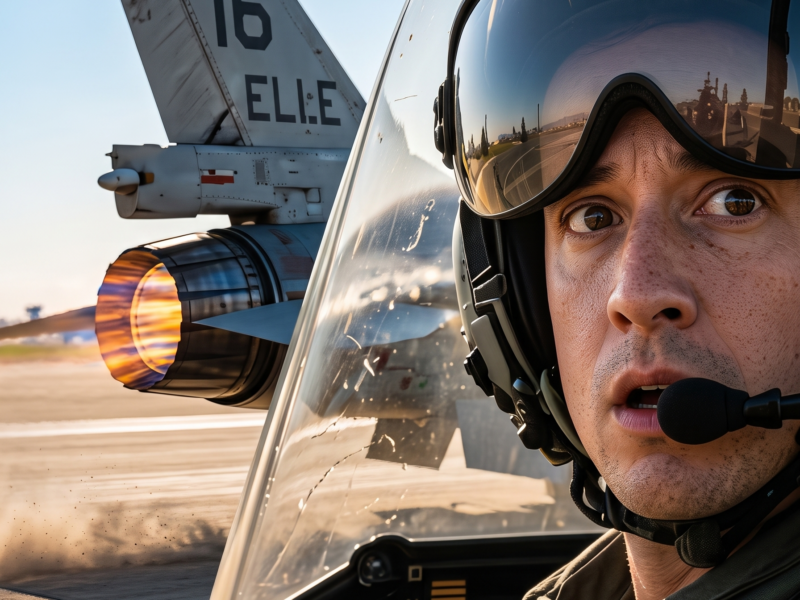
The runway at Davis-Monthan Air Force Base erupted in chaos when two F-16s forced my battered A-10 Warthog to land, but the pilots went completely silent the moment they saw my tail number
The Arizona sun beat down like a blacksmith’s hammer against the cracked concrete of Runway Two-Six at Davis-Monthan Air Force Base. Through the thick, scratched canopy perspex of my A-10 Thunderbolt II, the heat mirage turned the rows of mothballed B-52s, Hercules transports, and retired Phantoms into shimmering, liquid specters. But the two F-16 Vipers flanking my wingtips were not ghosts; they were very real, fully armed, and flying so close I could see the composite weave of the pilots’ dark visors.
“Airframe Seven-Two-Eight, you are down on active concrete,” the lead Viper pilot’s voice crackled through my helmet headset, stripped of military protocol and razor-sharp with adrenaline. “Throttle to idle cutoff. Disengage master arm. Ground security has you locked with heavy ordnance. Do not touch your emergency jettison, or you will be fired upon.”
“Copy that, Lead,” I replied calmly, my voice steady despite the adrenaline humming in my ears. “Engines coming down.”
I pulled both throttle levers back past the idle detent, cutting the fuel flow to the twin General Electric TF34 turbofans mounted high on the rear fuselage. The low, guttural roar that had accompanied me for three hundred miles across the Sonoran scrub began its descending whine, like an iron beast exhaling its dying breath.
The landing had been brutal. I had brought the Warthog down hard, five knots above standard touchdown speed, to counter a severed right hydraulic line that had made the rudder pedals feel like wet cement. The heavy Kevlar-reinforced tires had screamed in protest against the grooved asphalt, kicking up clouds of blue vulcanized rubber smoke that drifted into the surrounding desert wash.
Before the titanium fan blades stopped spinning, the perimeter fence gates blew open. Three olive-drab tactical trucks and two armored humvees swarmed onto the taxiway, screeching to a halt in an overlapping perimeter around my airframe. A dozen security forces airmen poured out, carbines raised, tactical optics aimed directly at my chest through the perspex.
“Step out of the aircraft!” a voice boomed through an external megaphone. “Hands visible at all times! Step clear of the ladder!”
I reached up, unlatched the heavy canopy lever, and shoved the heavy plexiglass hood upward. The desert air hit me instantly—one hundred and four degrees of dry heat, carrying the pungent stench of burned avgas, heated brake pads, and scorched hydraulic oil.
I disconnected my oxygen mask, unclipped the leg restraints of the ejection seat, and stepped over the sill onto the maintenance boarding ladder. My flight suit was soaked through with sweat, sticking to my ribs, but my back remained rod-straight. When you have spent eight hours wrestling sixty thousand pounds of bruised, unassisted steel across an electronic blackout zone, you do not slink out of the cockpit like a criminal.
My boots hit the concrete with a heavy, distinct thud.
The two F-16s had already rolled off the runway onto an adjacent taxiway, engines spooling down as their ground crews choked the wheels. The lead pilot had jumped down from his boarding ladder before the ground crew had even attached the safety pins. He walked toward me with aggressive, purposeful strides, still wearing his G-suit, carrying his lightweight flight helmet tucked beneath his left arm.
He was a major, late thirties, with an angular jaw, sharp blue eyes, and the golden command wings of an aggressor squadron pinned to his vest. He stopped five paces from me, his eyes sweeping over the jagged flak gouges along my engine nacelles, the scorched panels where the chaff-flare dispensers had fired, and the thick coats of desert grime baked onto the airframe’s green-and-gray camouflage.
“Captain,” he demanded, his voice thick with baffled fury, “where in God’s name did you get this Warthog?”
I turned slightly, looking back up at the blunt, terrifying snout of the tank-killer. The thirty-millimeter GAU-8 Avenger Gatling gun protruded from the nose like a rusted cannon from an ancient battleship.
“Maintenance assigned it,” I said simply. “Transferred out of deep preservation storage at Area Seven under an emergency operational readiness directive issued out of Nellis this morning.”
The major scoffed, taking a step closer. “Area Seven has been sealed since the Kosovo draw-down. Nothing flies out of there without three signatures from the Air Combat Command logistics branch.”
“Then you’d better check your automated network, Major,” I said. “Because the paperwork cleared, the ground chiefs fueled her, and I flew her.”
He looked like he was about to order his security team to zip-tie my wrists. But then his gaze drifted past my shoulder, moving from the Gatling barrels to the starboard side of the cockpit, just below the canopy rail.
His expression froze.
The aggressive tension completely vanished from his posture. His mouth fell slightly open. His chest stopped rising and falling. It was as though someone had pulled the master circuit breaker on his nervous system.
Beneath the pilot’s name rail, stenciled in faded black military block lettering that had oxidized into a dull, chalky gray under the Arizona sun, was the registration code:
AF-728.
Behind him, the second F-16 pilot—a younger captain with a flight suit bearing the patches of the 355th Operations Group—walked up, his helmet dangling from his hand. He looked at the tail, then at the number beneath the canopy, and took an involuntary step backward onto the tarmac.
“Mother of God,” the second pilot whispered, his voice trembling so violently it cracked against the desert wind. “That’s impossible.”
I looked between the two men. My fingers curled into fists against the seams of my flight trousers. The strange hostility from the tower, the scramble of two frontline fighters to force a maintenance ferry flight out of the sky, the armed perimeter—it wasn’t about an airspace violation.
“What?” I asked, my voice dropping. “What is impossible about an old airframe coming out of mothballs?”
The major slowly lifted his hand, pointing a trembling finger toward the tail number. He swallowed hard, his throat dry.
“My father flew that aircraft,” he said quietly.
I stared at him, a sudden, cold knot forming in the pit of my stomach. “When?”
“1999,” the major replied, looking at me with eyes that were suddenly completely stripped of anger, replaced by a ghost-ridden, unblinking horror. “Operation Allied Force. May twenty-fourth.”
The wind gusted across the runway, blowing fine dust against our visors. The date hit my skull like a lead weight.
May twenty-fourth, 1999.
That was the exact day my life had split in two.
I had been seven years old, sitting on the braided rag rug in the living room of our base housing unit at Pope Air Force Base in North Carolina, building miniature airplanes out of balsa wood while my mother hummed along to the radio in the kitchen. At seventeen hundred hours, an olive-drab staff car had pulled into our gravel driveway. Two men wearing service dress uniforms and black armbands had stepped onto our porch, carrying a folded American flag inside a triangular mahogany case and a single sheet of paper stamped RESTRICTED.
They told my mother that Lieutenant Colonel Thomas Morgan had suffered a catastrophic mid-air structural failure during a night interdiction sortie over the Dinaric Alps. They said the airframe had disintegrated over a deep ocean trench in the Adriatic Sea. There had been no recovery. No parachute beacon. No wreckage. No body to lay to rest in our family plot in Virginia. Just an empty casket, a bronze plaque, and a mother who spent the rest of her brief, broken life staring out the front window waiting for a car that never returned.
I had spent twenty-six years chasing that empty casket. I had joined the Air Force, endured the brutal physical weeding of officer candidate school, fought my way through undergraduate pilot training, and qualified on the A-10 because it was the only machine that still carried the scent of his world.
And now, standing on a boiling strip of concrete in Tucson, I was looking at the plane the Air Force had swore fell into three thousand feet of seawater twenty-six years ago.
“Why was it in the boneyard?” I demanded, my voice raw and cracking. “Why was it still flying?”
Neither pilot answered. They couldn’t. The Air Force they served was built on absolute record-keeping, and the aircraft behind us was a bureaucratic impossibility—a ghost made of twelve tons of titanium, aluminum, and depleted uranium.
Before either of them could speak, the rumble of an auxiliary tug broke the silence. An elderly Master Sergeant with grease-stained sleeves, gray hair showing beneath a faded ballcap, and an old military clipboard tucked under his arm walked through the cordon of security airmen. The guards didn’t stop him; they parted around him as if he were part of the concrete itself.
In his right hand, he carried a heavy, unpainted metal ammunition can, scorched along its lower seams and secured with an obsolete lead wire seal.
He stopped two feet from me. He looked at my name tape: MORGAN.
His eyes grew moist, but his weathered face remained an unreadable mask of military discipline. He held out the steel box.
“Chief Miller,” the major snapped, finding his voice. “What is that?”
The old sergeant didn’t look at the major. He kept his eyes locked on mine. “This was pulled out of the auxiliary survival compartment behind the ejection bulkhead when they took the seals off Seven-Two-Eight this morning, Captain. It has your family’s serial markings on the latch.”
My hands shook as I reached out and took the box. The metal was burning hot from the sun, but inside, I could feel something heavy shifting against the steel walls.
I broke the lead wire with my thumb, snapped open the twin latches, and pulled the lid free.
Sitting on a bed of dry, deteriorated foam was an old green canvas-bound pilot’s flight log. The edges were singed black, crusted with dried, oxidized sediment, and stained with long-faded waterlines.
I flipped the cover open. The first sixty pages were destroyed—illegible smears of black ink, chemical burns, and torn paper where operational records had been physically excised with a razor blade.
Except for the very last page.
On that final sheet, written in dark blue grease pencil that had defied twenty-six years of darkness, was my father’s handwriting—the distinct, aggressive, left-leaning strokes I had studied on his old birthday cards a thousand times:
If they ever give this aircraft back to my daughter, don’t let her trust the official story.
A tear slipped from my lash, hitting the dry paper with a soft hiss. My breath caught in my throat.
Beneath that single, haunting sentence, scrawled in the same hurried grease pencil, was an eight-digit military grid coordinate, followed by a radio transponder frequency and a single name:
PROJECT NIGHTFALL.
The F-16 major leaned over my shoulder, his breath hot against my collar. When his eyes locked onto the numbers, the last trace of color drained from his skin, leaving him looking like chalk.
“I know that place,” the major whispered, his hand drifting toward his sidearm as if an enemy were standing on the wing.
I spun to face him. “Where is it?”
The major swallowed, his jaw working as if the words were made of broken glass.
“That’s not in the Adriatic,” he said, his voice dropping so low the security guards ten feet away couldn’t hear. “Those coordinates are inside the Goldwater Bombing Range, fifty miles south of here, near the Baboquivari Mountains. That’s the decommissioned radar installation where the Air Force said your father’s service records were archived before they were burned in the 2001 fire.”
I looked up from the page, turning my head toward the shimmering purple wall of the distant mountains rising out of the Sonoran desert to the south.
For twenty-six years, I had believed I was an aviator flying in the noble shadow of a fallen hero.
Now, looking at the scarred wings of the machine he had flown into the dark, a cold, sickening truth settled into my marrow.
My father hadn’t died in a war over Europe.
He had flown this very aircraft into an American desert, hiding a secret so dangerous that the military had spent nearly three decades lying to a widow and an orphan to keep it buried.
And somewhere out there, hidden beneath the baking granite of those mountains, the ghost of my father was still waiting for someone to finish his flight.
Within twenty minutes of touching down, the open runway had turned into a clinical, high-security quarantine zone.
Two mobile command shelters were hauled onto the asphalt by heavy tracked tractors, their perimeter cables demarcating a three-hundred-foot exclusion radius around Airframe 728. The base commander, a two-star general named Robert Vance, had arrived under escort, his face drawn into a thundercloud of repressed fury. He had immediately placed the entire flight line under Delta-Three security lockdown: no fuel trucks moved, no maintenance data links operated, and every cellular antenna within four miles of Davis-Monthan was subjected to an active microwave noise floor that turned every civilian phone into a dead brick.
I sat in an unconditioned metal briefing room inside the primary flight-line hangar, my flight suit half-unzipped, a bottle of lukewarm distilled water untouched on the plastic folding table in front of me.
Across from me stood Major William Vance—the F-16 pilot who had intercepted me over the scrub. I had learned his full name ten minutes prior; he was the general’s son, a third-generation combat aviator who had grown up in the same cloistered officer communities I had.
“You don’t understand the fire you’ve stepped into, Captain Morgan,” William said, pacing the length of the concrete floor. His flight helmet sat on the table between us, reflecting the harsh glare of the ceiling strip lights. “My father was the squadron operations officer for the 354th Tactical Fighter Wing in 1999. When your father’s plane vanished, it wasn’t just a lost tail number. It nearly brought down the entire European theater command structure.”
“Because he carried tactical nuclear launch codes?” I asked coldly, leaning back in my chair.
“No,” William said, stopping and leaning his palms onto the table until his face was six inches from mine. “Because he was carrying the flight data recorder from an experimental low-observable reconnaissance platform that went missing over Serbia three nights before his departure. Acheron-Nine. The precursor to the modern autonomous drone fleet. The Air Force didn’t lose his plane, Claire. He stole it.”
The word hung in the humid air of the hangar like a drop of poison.
“My father was not a thief,” I said, my voice dangerously level. “He was a decorated command pilot with three Distinguished Flying Crosses.”
“He was an operative who realized what was being built behind the veil,” William retorted, his eyes flashing with an intensity that surprised me. “My father told me about that night once. Just once, after he drank half a bottle of bourbon on the anniversary of the crash. He said Thomas Morgan didn’t hit the water. He said your father made a low-level supersonic transit under the radar floor, linked with an unmarked KC-135 tanker over the Azores, and flew an airframe with empty transponders all the way across the Atlantic into the American southwest. The military spent fifty million dollars staging an underwater search in the Mediterranean just to keep the press from asking why an A-10 was missing from its revetment in Aviano.”
“And your father helped them bury it?”
“My father had a choice between burying it and spending thirty years in a federal penitentiary at Fort Leavenworth,” William said bitterly. “He chose stars on his shoulders. But he never forgot the coordinates your father gave him on the secure UHF channel before he cut his transponder.”
I reached into my pocket, my fingers brushing the corner of the scorched flight log. “The coordinates in this book. The ones under the mountain.”
“Yes,” William whispered. “Target Site Zulu. An underground strategic storage facility excavated into the granite beneath Mount Baboquivari during the height of the Cuban Missile Crisis. It was decommissioned in 1974. Officially, the access tunnels were collapsed with controlled dynamite charges in 1982. But they weren’t collapsed, Claire. They were converted.”
Before I could ask him to clarify, the heavy steel door of the briefing room swung open with a sharp metallic clatter.
General Robert Vance walked into the room, flanked by two armed Air Force Office of Special Investigations agents wearing civilian suits and carrying encrypted tablet computers. The general was tall, stooped with age, his hair entirely silver, and his uniform pristine despite the desert heat. But his eyes were exhausted—the eyes of an old commander who had spent decades guarding a tomb, only to find the door pushed open from the inside.
“Clear the room, William,” the general ordered, his voice low, dry, and hollow.
“Sir, we need to discuss the chain of custody on the airframe,” William protested, straightening his posture. “The maintenance manifest that authorized the ferry flight was routed through an unlisted server at ACC—”
“I said clear the room, Major,” General Vance repeated, not raising his voice by a fraction of a decibel.
William hesitated, his jaw clenching. He looked at me, then down at the table, before snatching his helmet and walking out into the corridor. The two OSI agents followed, pulling the heavy sound-dampened door shut behind them.
We were alone. The general stood at the head of the table, his weathered hands resting on the back of the empty chair opposite me. For nearly thirty seconds, neither of us spoke; only the distant hum of the hangar’s ventilation system filled the room.
“You look like him, Claire,” the general said softly. “You have his chin. And the same stubborn, reckless tilt to your head.”
“You knew him,” I said. It wasn’t a question.
“I gave him his check-ride in the A-10 back in 1988,” Vance said, a faint, melancholic smile touching the corners of his mouth before it was crushed by gravity. “Thomas was the finest low-altitude combat pilot I ever saw. He could put thirty-millimeter rounds into a breadbox from three miles out while pulling five Gs between two mountain spurs. But he had a flaw.”
“What flaw?”
“A conscience,” Vance said, pulling out the chair and sitting down slowly, as if his joints were filled with sand. “In our business, Captain, a conscience is an operational hazard. It blinds you to the greater architecture. It makes you think that individual lives matter more than structural stability.”
“Is that why you killed him?” I asked, my fingers resting on the edge of the table.
General Vance didn’t blink. He didn’t show anger. He simply took a deep, rattling breath and reached inside his service coat, withdrawing a sealed, Manila envelope bearing a scarlet classification stamp: EYES ONLY – TOP SECRET / NIGHTFALL.
“Nobody killed Thomas, Claire,” he said.
My heart hammered against my ribs like a trapped bird. “Don’t lie to me, General. Not after twenty-six years.”
“I am not lying,” Vance said, sliding the envelope across the table until it touched the base of my water bottle. “Thomas knew that Acheron-Nine carried an autonomous operational architecture designed to remove human command authority from theater nuclear deployments. The system was designed by a private defense consortium called Vanguard-Dynamics. They had infiltrated the logistics command structure. They wanted a weapon that couldn’t be recalled by a president or an act of Congress once a threshold was crossed. Thomas saw the test telemetry in Serbia. He realized what they were building. So he stole the core logic module and flew it out of Europe.”
“To Arizona,” I whispered.
“To the only place where the radio interference from the copper mines and the granite mass could mask the beacon,” Vance said. “He landed Seven-Two-Eight on an auxiliary strip near Sasabe, taxied the bird into an old mining warehouse, and disappeared into the Baboquivari complex. He traded the core logic module to Vanguard in exchange for your life.”
The breath left my lungs in a cold rush. “My life?”
“They were going to sanitize your family, Claire,” the general said, his voice dropping to a gravelly rasp. “Your mother. You. They had a team staged outside your base housing at Pope. Thomas knew it. The only leverage he had was that logic module. He agreed to enter voluntary deep containment—to exist as a non-person inside Target Site Zulu—in exchange for an absolute operational guarantee that you and your mother would be protected, funded, and left untouched.”
“And you let him do it?” I stood up, kicking my chair backward against the wall with a deafening crash. “You traded your best friend’s life to a defense contractor to protect your own career!”
“I traded one life to save two!” Vance yelled, his face suddenly reddening with a burst of ancient, unspent rage. “If I had fought them, Claire, all three of you would have ended up in a burn pit in North Carolina, and the world would have never known the difference! I did what I had to do to keep you alive!”
He stood up, his tall frame trembling with age and tension. He tapped the Manila envelope with a blunt, scarred finger.
“Three hours ago, the containment seals at Target Site Zulu suffered an external power interruption,” Vance said, his voice shaking. “Vanguard is liquidating the asset. The political landscape has shifted; the technology in that bunker is obsolete, and the people who signed off on the original operation are retiring or dying. They are cleaning the board, Claire. They brought Seven-Two-Eight out of storage because the airframe carries the original mechanical transponder keys required to unlock the facility’s pneumatic security vaults.”
“They used me to fly the key to the front door,” I realized, the horror washing through me in icy waves.
“Yes,” Vance said. “And within thirty minutes, Vanguard’s tactical recovery team will enter that complex to execute a final, irreversible thermal sweep. If anyone is left alive down there… they won’t survive the afternoon.”
I looked at the Manila envelope, then at the door leading back to the flight line where my father’s aircraft sat surrounded by armed men.
“Can you clear the runway?” I asked.
General Vance looked at me for three long, agonized seconds. The bureaucrat who had protected a conspiracy for a quarter of a century seemed to wither away, leaving only an old, broken pilot who had carried a debt for twenty-six years.
“My son is already pre-flighting a second bird in Hangar Twelve,” the general whispered. “God help you, Claire. Because the Air Force won’t.”
The taxiway lights of Davis-Monthan were dark when I cleared the revetment, running under black-out protocol with only my night-vision goggles illuminating the cracked asphalt in ghostly hues of emerald green.
Airframe 728 vibrated with a deep, primal hunger as the twin turbofans spooled to eight-five percent power. The ground crews had worked in frantic, terrifying silence under the direct orders of Major William Vance, pumping twelve thousand pounds of JP-8 into the internal fuel cells and securing two auxiliary thirty-millimeter ammunition drums into the cavernous belly bay. There were no smart bombs beneath my wings—only two pods of high-velocity unguided rockets and a pair of external drop tanks. This was not a modern digital strike; it was an iron-age assault on an iron-age fortress.
“Tower is dark, Seven-Two-Eight,” William’s voice crackled through my helmet comms. He was sitting on the auxiliary taxiway in an unmarked OA-10 forward air control variant, his engines already humming with low-level power. “Direct departure heading two-one-zero. Stay beneath fifty feet above ground level until you cross the Papago Indian Reservation boundary. Vanguard operates an active AN/MPQ-64 Sentinel radar array on the peak of Baboquivari. If you climb above the canyon rim, they’ll paint you five miles out.”
“Copy that, Two,” I replied, my hands settling onto the worn, rubberized grip of the cyclic stick. The stick had been polished smooth by the palms of men who had flown it through the skies of a dozen forgotten conflicts. My father’s palms.
“Claire,” William added, his tone softening for a single, fleeting second. “If my father’s right… if your dad is down there… don’t hesitate. They won’t.”
“I don’t plan to,” I said.
I slammed the twin throttles fully forward against the stops.
The A-10 surged down Runway Two-Six, its landing gear rattling against the uneven pavement as the massive engines shrieked into the dry desert night. At one hundred and thirty knots, I pulled back on the stick. The heavy nose lifted, the main gear snapped into their wheel wells with a reassuring mechanical thud, and Davis-Monthan dissolved into a blur of black desert and scattered city lights behind me.
I immediately pushed the nose back down, leveling off at thirty-five feet above the mesquite and saguaro scrub.
Flying an A-10 at night at extreme low altitude without an automated terrain-following computer is an act of pure, calculated madness. The desert floor rushed beneath my belly at three hundred knots, a terrifying carpet of shadows, jagged arroyos, and towering cacti that seemed to reach up like skeletal fingers toward my flight surfaces. Every buffeting wind shear off the mountain ridges slammed directly into the control linkages, requiring constant, micro-second corrections with my wrists and calves.
Twenty miles south, the massive granite bulk of the Baboquivari Mountains rose out of the desert floor like a broken jaw of black stone against the starry sky.
The peak was sacred to the Tohono O’odham people—the place where the Creator was said to have emerged into the world. But as my aircraft closed the distance, the emerald hue of my night-vision goggles revealed something decidedly profane: a sprawling, razor-wire-fenced perimeter cut into the southern flank of the mountain, surrounding a tiered concrete landing apron and a cluster of low, blast-hardened administrative bunkers.
Suddenly, a blinding strobe of yellow light flared on my threat receiver console.
RADAR LOCK: AN/MPQ-64. SECTOR TWELVE.
“We’re painted!” William shouted from two miles back on my left wing. “They’ve activated the automated defense battery! Ground fire incoming!”
From the darkened apron below, three twin-barrel automated thirty-five-millimeter anti-aircraft guns opened up simultaneously. The night erupted into brilliant, terrifying streams of glowing orange tracers that stitched across the desert floor, converging toward my flight path like hungry fingers of fire.
“Breaking right!” I screamed, kicking the right rudder pedal and banking the heavy airframe seventy degrees into the shadow of a dry limestone canyon.
The thirty-five-millimeter rounds tore through the air where my port wing had been half a second earlier, detonating against the canyon rim in concussive showers of rock, white-hot shrapnel, and pulverized stone. The shockwaves slapped against my empennage, throwing the A-10 into a violent, sickening roll toward the vertical cliff wall.
I fought the stick with both hands, muscles screaming against the aerodynamic load, pulling seven Gs until the edges of my vision narrowed to a pinprick of gray tunnel vision.
The titanium bathtub surrounding the cockpit groaned. The aircraft cleared the granite wall by less than twelve feet, the tip of my port wing shearing the top off a century-old pine tree before I leveled out over the dry riverbed that led directly into the primary compound.
“William! Suppress that battery!” I yelled into the mask.
“Engaging!”
From the darkness above, William’s A-10 dove out of the cloud deck like an avenging demon. A blinding tongue of yellow-white flame leaped from his nose as the GAU-8 Avenger Gatling gun fired its first combat burst.
The sound wasn’t gunfire; it was the terrifying, apocalyptic rip of tearing canvas that every ground soldier on earth dreads—a deafening BRRRRRRRRRRRTT that shook the very granite foundations of the mountain.
Four hundred rounds of high-explosive incendiary ammunition smashed into the automated radar dome in less than two seconds, vaporizing the dish into a cloud of burning plastic and exploding diesel fuel. The anti-aircraft tracers ceased instantly, replaced by a towering pillar of black, oily smoke that curled into the desert sky.
“Radar is dead!” William called, pulling up hard into the vertical. “You have the runway, Claire! Punch the clock!”
I brought my aircraft around the southern spur, dropping my gear and full flaps with a heavy clatter of hydraulic actuators.
Ahead lay the target: Target Site Zulu.
The main entrance to the underground complex was not a standard door; it was a pair of hundred-ton steel blast doors set into the vertical face of the mountain, fronted by an eight-hundred-foot strip of reinforced concrete.
Parked on that apron was a private civilian cargo transport, its rear ramp down, surrounded by four black tactical SUVs and dozens of men dressed in sterile gray combat gear. They were loading heavy, pressurized aluminum canisters into the aircraft’s belly, moving with the frantic urgency of men who knew their operational window was slamming shut.
And there, standing near the mouth of the open blast doors under the glare of mobile halogen floodlights, was an elderly man in an orange detention jumpsuit, his wrists chained to a concrete stanchion.
Even through the green tint of my goggles, through the distortion of the curved perspex and the drifting cordite smoke, the shape of his shoulders—the way he held his head despite the chains—was burned into my DNA.
My father.
“Target sighted,” I whispered, the words freezing in my chest as a tear cut a warm path through the dust on my cheek.
“They’re deploying shoulder-fired missiles on the ramp!” William warned over the net. “Pull up, Claire! You can’t land on that apron—it’s blocked with fuel trucks!”
“I’m not landing on the apron,” I said, my teeth baring in a feral, dangerous smile as my finger clicked off the master armament safety cover.
“Claire, what are you doing?”
“I’m parking in the driveway.”
I leveled the crosshairs of the optical sight directly at the engine block of the civilian transport plane, aligned my rudder pedals, and squeezed the two-stage trigger of the Gatling gun all the way to the second detent.
The cockpit vibrated with a violence that felt as though the airframe were tearing itself into ten thousand pieces. The heavy, rhythmic hammer of the GAU-8 shook my bones, filling the enclosed cockpit with the sharp, choking reek of burned cordite and vaporized aluminum.
A stream of three-hundred-ounce depleted-uranium armor-piercing penetrators erupted from the snout of my aircraft at four thousand feet per second.
The civilian transport plane on the apron didn’t just catch fire; it disintegrated. The high-density rounds punched through the composite skin, through the high-pressure fuel tanks, and through the titanium engine blocks like a sewing machine needle through silk. In less than two seconds, the entire aircraft exploded into a massive, rolling fireball of three-thousand-degree aviation fuel that washed over the perimeter SUVs and tossed armed security contractors twenty feet into the razor wire.
I cut the throttle, kicked the rudder, and brought the A-10’s main gear down onto the scorched, debris-littered concrete of the apron.
The tires shrieked as they hit the asphalt, skidding over burning rubber and shattered hydraulic lines. I stood on the wheel brakes with all the strength in my legs, hauling the reverse-pitch thrusters back. The A-10 slid sideways through a curtain of flame, the tip of my right wing clipping an overturned fuel tender before the heavy airframe ground to a shuddering halt fifteen feet from the open blast doors of Target Site Zulu.
I didn’t wait for the engines to spool down.
I popped the canopy latch, unclipped my harness, and vaulted over the side of the cockpit, landing in a defensive crouch on the boiling concrete. In my right hand was the standard-issue Beretta M9 service pistol; in my left was the scorched canvas flight log.
Through the drifting black smoke and the crackle of burning vehicle tires, two surviving Vanguard contractors leveled their carbines at me from behind an overturned security truck.
Before they could acquire a sight picture, the sky above the mountain ripped open again.
Major Vance’s A-10 roared fifty feet over the apron, the downwash from his twin engines blowing the burning wreckage into a blinding vortex of sparks that scattered the contractors. I fired three controlled double-taps into the engine block of the truck, the heavy nine-millimeter rounds sparking against the steel, pinning the men behind the wheel wells.
“Drop your weapons!” I roared, my voice cutting through the roar of the burning fuel. “United States Air Force! Drop them or you burn where you stand!”
The men looked up at the sky, where William was banking for a gun run with four barrels of high explosive ready to erase the entire apron, and threw their rifles onto the concrete, raising their hands into the air.
I turned toward the mountain.
The halogen floodlights had been shattered by the blast, leaving the mouth of the bunker illuminated only by the flickering orange glow of the burning transport plane.
Chained to the concrete stanchion was the man in the orange jumpsuit.
He had fallen to his knees during the airstrike, his hands covering his head to protect against falling shale. His hair was long, snowy white, and matted with dirt. His beard reached his chest, tangled and gray. His frame was thin—almost skeletal—his orange uniform hanging from his shoulders like a shroud over dry branches.
I walked toward him, my boots crunching on the spent thirty-millimeter casings littering the apron. With every step, the twenty-six years of my life—the funerals, the medals, the lonely nights spent studying flight telemetry in cold barracks—condensed into a single, agonizing heartbeat.
I stopped two paces away.
The man slowly lifted his head. His eyes were deeply set beneath a scarred, weathered brow, surrounded by a spiderweb of wrinkles earned in dark rooms and cold caves. But the color of those eyes—a bright, defiant, predatory blue—had not faded by a single shade.
He looked at my flight boots, then up the Nomex fabric of my flight suit, past the aviator wings pinned to my left breast, and finally locked onto the name tape sewn above my heart:
MORGAN.
A tremor started in his lower lip. His breath came out in a dry, rattling sob that sounded as though it had been trapped behind granite for a quarter of a century.
“Claire?” he whispered. His voice was cracked, ruined, barely more than the rustle of dry leaves in the desert wind. “Claire… baby?”
The gun slipped from my fingers, clattering onto the concrete.
I dropped to my knees in front of him, my hands reaching out, trembling uncontrollably, until my palms touched his hollowed cheeks. His skin was like weathered parchment, cold despite the heat of the fire, but beneath my thumbs, I felt the rhythmic, stubborn pulse of an artery that refused to quit.
“Dad,” I choked out, the word tearing out of my throat with all the grief of my childhood. “Dad… it’s me. I’m here.”
Thomas Morgan closed his eyes, leaning his forehead against my shoulder, and wept. His thin, chained arms wrapped around my neck with a strength that defied his starving frame, holding me as if the entire universe were collapsing around us and I were the only solid thing left in existence.
“You grew up,” he sobbed, his tears wetting the rough fabric of my collar. “God forgive me, Claire… you grew up, and you put on the wings.”
“You left a flight log,” I said, pulling the canvas book from my pocket and pressing it into his chained hands. “You told me not to trust the official story.”
He pulled back, his scarred hands tracing the scorched edges of the log with reverent awe. “I knew Vance would keep the plane. I knew he was too proud to scrap Seven-Two-Eight. I prayed every night that if you ever climbed into that seat, you’d find what I left for you.”
“We have to move, Dad,” I said, pulling an emergency maintenance pry-bar from my flight vest and wedging it into the shackle pins of his handcuffs. With a sharp, violent heave, the rusted brass pins sheared apart, and the chains fell clattering to the floor. “Vance’s son is covering our six, but Vanguard has reinforcements staged at Fort Huachuca. They have gunships inbound.”
Thomas grabbed my arm, his grip surprisingly firm. His eyes hardened with the unmistakable authority of a combat squadron commander.
“Not yet, Claire,” he said, pointing a trembling finger into the dark, yawning throat of Target Site Zulu. “The logic core is still in the subterranean vault. Raymond Cross—the head of Vanguard’s technical program—is down there right now. He’s initiating an emergency satellite uplink to transfer the autonomous launch protocols to an off-grid server bank in Zurich. If that transmission clears the terminal, everything I suffered… everything your mother endured… was for nothing.”
“Can we disable the antenna?”
“The antenna is hardwired into the mountain’s granite spine,” Thomas said, struggling to his feet with my support. He stood swaying on legs that had not walked in the open sun for twenty-six years, but his chin was lifted, defiant and proud. “The only way to stop the broadcast is to cut the primary power bus inside the command room.”
I looked at the old man who had traded his entire life to keep me safe from shadows, then down at the weapon on the concrete.
I picked up the Beretta, cleared the slide with a sharp snap, and looked my father in the eye.
“Then let’s go finish your flight, Colonel,” I said.
The descent into Target Site Zulu was like stepping backward through time into a tomb of cold concrete and buried secrets.
The emergency lighting along the tunnel walls had failed, leaving the cavernous passage illuminated only by the tactical light mounted beneath my service pistol. The air was bone-chilling, fifty degrees colder than the surface, carrying the sharp, metallic stench of old zinc paint, decomposing cable insulation, and the high-pitched ozone whine of high-voltage transformers running at dangerous over-capacity.
My father walked beside me, his hand resting on my left shoulder for balance. Despite his physical weakness, his tactical movements were instinctive; his eyes swept the intersecting maintenance shafts with the cold, practiced economy of an operator who had lived in the dark for a third of a lifetime.
“The command vault is three hundred yards down,” Thomas murmured, his breath forming faint white plumes in the subterranean chill. “Cross locked himself behind three-inch hardened manganese steel. We can’t breach it with handguns, Claire.”
“We don’t have to,” I replied, pointing my light toward the ceiling where thick bundles of gray high-voltage feeder cables were anchored to the rock face. “Those cables feed the primary transformers from the hydro-turbine line down in the canyon. If we drop the main junction box, the entire mountain drops its load before the satellite dish can synchronize its frequency.”
“And Cross?”
“Cross can explain his operational architecture to the Federal Bureau of Investigation in an unventilated interrogation room.”
We reached the heavy blast doors of the primary operations center. Through the narrow, reinforced quartz viewing slit, we could see the control room: a cavern of glowing blue monitors, cascading lines of green code, and a massive, round satellite synchronization terminal in the center of the room.
Standing before the terminal was a man in his late fifties, dressed in a sharp gray three-piece suit that looked absurdly out of place in the damp bunker. Raymond Cross. He had a secure satellite phone pressed to his ear, his fingers frantically entering override sequences into the main keyboard while a red progress bar on the master display ticked forward:
UPLINK SYNCHRONIZATION: 88%… 89%… 90%…
Cross looked up, catching the beam of my tactical light through the quartz glass.
A cold, mocking sneer crossed his features. He didn’t drop the phone; he simply walked toward the glass, tapped the intercom toggle on the interior wall, and looked at my father with the condescending pity of a master looking at a stray dog.
“Colonel Morgan,” Cross’s voice emerged through the external speaker, crisp, modulated, and entirely calm. “I must commend your endurance. Twenty-six years in a three-room suite without sunlight, and you still managed to crawl out to greet the dawn. But you brought your daughter to a slaughterhouse.”
“Shut it down, Cross,” my father said, his voice level, resonant, and devoid of fear. “The perimeter is taken. Vance’s fighters are circling the peak. You have no extraction coming.”
“I don’t need extraction, Thomas,” Cross laughed softly, tapping the glass with the signet ring on his finger. “In ninety seconds, the Acheron-Nine architecture will reside on fourteen private servers across three continents. The Department of Defense will have to buy their own operational logic back from us at four hundred million dollars a module. Your little display of family reunion doesn’t change the mathematical reality: human pilots are obsolete. You are dinosaurs barking at a comet.”
“Maybe,” I said, stepping past my father until my face was an inch from the quartz slit. “But dinosaurs have teeth.”
I turned my pistol upward, aiming directly at the primary high-voltage oil-filled circuit breaker mounted to the wall above the blast door frame—the breaker that regulated thirty thousand volts of raw current into the operations vault.
Cross’s smile vanished. His face went gray.
“Wait! Captain Morgan, that transformer is filled with polychlorinated biphenyl oil! If you breach that casing, the arc-flash will vaporize everything in this corridor!”
“Then you’d better hold your breath, Director,” I whispered.
I fired three consecutive rounds into the brass pressure-relief valve of the primary junction box.
The valve ruptured.
High-pressure transformer oil sprayed across the exposed copper busbars in a dense, atomized mist. A blinding, deafening electrical arc—a miniature lightning strike contained within a steel box—exploded with a roar that threw my father and me flat against the damp concrete floor.
The concussive wave blew the heavy quartz observation window inward in a million glittering diamonds of glass.
Inside the vault, the power died instantly.
The screens flickered, went red, and collapsed into black emptiness. The high-pitched whine of the satellite uplink groaned down through the octaves, dying into absolute, ringing silence.
UPLINK SEVERED: 94% INTEGRITY. FILE TRANSMISSION CORRUPTED.
The emergency halogen lights flickered twice and died, plunging the mountain into total darkness, save for the green-glowing tritium sights on my service weapon.
I stood up, coughing through the acrid white smoke of burned insulation, and stepped through the shattered window frame into the control room.
Cross was on the floor, his pristine suit shredded by flying glass, his hands clutched over his face as he groaned in agony from flash burns. The satellite phone lay shattered beside him, emitting only the rhythmic, dead hum of an open circuit.
I walked to the main terminal, pulled the heavy optical drive carriage from the central processor bay, and smashed it onto the concrete floor with the heel of my combat boot. The delicate glass wafers inside shattered into harmless dust.
“Flight canceled, Director,” I said coldly.
Ten minutes later, I supported my father as we walked out of the dark throat of Target Site Zulu into the blinding, glorious light of the Arizona morning.
The sun had climbed above the rim of the Baboquivari Mountains, washing the desert in rich tones of gold, amber, and deep crimson. The fire on the apron had died down to smoldering heaps of metal, and the air smelled of sagebrush, wet earth, and the cool morning wind blowing down from the peaks.
Circling three hundred feet above the valley was William’s A-10, rocking its wings in a slow, triumphant victory roll.
On the runway apron, two massive Air Force HH-60 Pave Hawk rescue helicopters were touching down in a swirl of rotor wash and golden dust, their olive-drab hulls bearing the distinct medical crosses of the military search-and-rescue service.
Stepping out of the lead helicopter was General Robert Vance. He wore no sidearm; his uniform was unbuttoned at the neck, and his shoulders were bowed as he walked across the scarred concrete toward the old friend he had betrayed to save.
My father stopped at the edge of the apron. He didn’t raise his fists. He didn’t speak. He simply stood tall, his snowy hair whipping in the rotor wash, his thin frame silhouetted against the rising sun.
General Vance stopped three paces away. His eyes were red, filled with tears that ran unchecked down his weathered, wrinkled cheeks.
Slowly, deliberately, the two-star general snapped a crisp, trembling, textbook salute to the starving captain in the orange jumpsuit.
My father looked at him for a long, silent moment. Then, with the slow, dignified precision of a man who had never lost his honor, Thomas Morgan lifted his bruised right hand and returned the salute.
“Welcome home, Thomas,” Vance choked out, his voice breaking into a ragged whisper.
“It took you long enough, Bob,” my father said softly, a faint, tired smile touching his cracked lips.
Twenty minutes later, my father and I sat on the rear cargo ramp of the lead Pave Hawk, wrapped in thick green wool medical blankets, holding metal canteens of warm, sweet black coffee.
Across the apron, Airframe 728 sat quietly under the desert sky. Its titanium skin was blackened with cordite, its wings were scarred with shrapnel, and its canopy was caked in Arizona dust. But as the morning sun hit the tail, the faded black numbers gleamed with a quiet, indestructible glory:
AF-728.
My father leaned his head against my shoulder, his rough, scarred hand covering mine as we watched the flight-line crews secure the old Warthog for the ferry flight back to the world of the living.
“You fly her well, Claire,” he whispered, his eyes closing as the exhaustion of twenty-six years finally overtook him. “Your landing was a little hot… but your approach was perfect.”
I smiled, feeling a single, warm tear trace a clean line down my dust-covered face, and looked out across the endless, open sky.
“I had a good instructor, Dad,” I whispered, holding his hand tight as the helicopter lifted into the morning light. “I had the best in the fleet.”
The end









