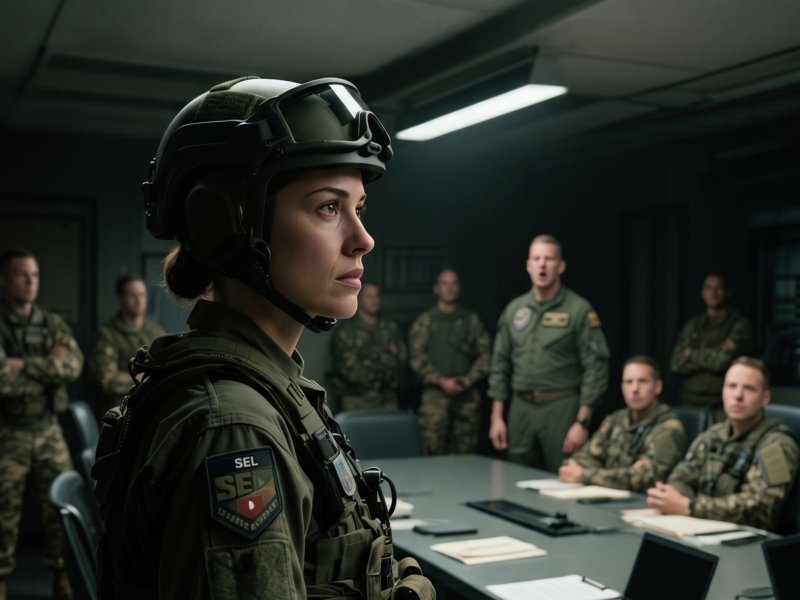
The room went silent when the SEAL captain asked, “Any experienced war pilots here?” and I calmly stood from the back row while men twice my size laughed
The fluorescent lights of the briefing theater at Naval Base Coronado hummed with an uneven, irritating buzz. Outside, the Pacific fog was rolling in thick and heavy across San Diego Bay, swallowing the gray hulls of guided-missile destroyers docked along the piers. Inside, forty-odd elite operators sat in stepped tiers of theater seating, smelling of wet wool, instant coffee, and weapon oil. They were men carved out of granite, veteran Navy SEALs and carrier aviators with broad shoulders, hardened eyes, and sleeves rolled high enough to display ink earned in every sun-scorched valley and contested waterway of the past two decades.
I sat in the very back row, tucked into the dimmest corner beneath the projector housing. I wore a washed-out charcoal fleece jacket that was two sizes too large, dark denim trousers, and scuffed leather boots. My brown hair was pulled back into a simple, functional knot behind my neck. My spine was straight against the hard molded plastic of the seat, but my hands remained loose and resting quietly on my knees. I looked like an auxiliary clerk, a logistics supervisor, or someone’s tired aunt who had wandered into the wrong auditorium while searching for the personnel office.
At the podium down on the polished wooden stage stood Captain Marcus Vance. Vance was a legendary figure within the special warfare community: broad-chested, crew-cut hair graying at the temples, and wearing service dress blues with ribbons stretching across his left breast like miniature tapestries of war. On the dry-erase board behind him was a stark tactical diagram of the Hindu Kush—jagged ridgelines, designated radar blind spots, and a thin red vector slicing directly through an unnamed gorge in Badakhshan Province.
Vance clicked a remote, plunging the theater into shadow as a high-altitude satellite map flickered onto the main display.
“The low-level mountain insertion window is ninety seconds wide,” Vance said, his voice deep and gritty. “Between 0200 and 0203 hours, the target valley experiences a seasonal barometric drop and high crosswinds that render automated terrain-following radar completely useless. The updrafts off the southern spur will throw an airframe seventy feet upward before a pilot can adjust the trim. We cannot run drone surveillance through the gorge without alerting their perimeter radar installations. We need manual stick-and-rudder mountain navigation. We need someone who knows how to fly through absolute blackness using nothing but the feel of the wind under the wings.”
He turned back to face the auditorium, setting his remote onto the lectern. His gaze swept the tiers.
“Any experienced war pilots here?”
Silence settled over the room. Three aviators in the third row exchanged skeptical looks. One of them, a lieutenant commander with an aviator badge gleaming on his chest, shook his head slightly. Everyone in that room understood what Vance was asking: he was asking for someone willing to commit an airframe to a sheer granite throat without instruments, at speeds that left zero margin for human reaction time.
I stood up.
My boots made a clean, sharp scuff against the linoleum. The sound cut right through the hum of the fluorescent fixtures.
Around me, men twice my size turned their heads. A murmur rippled through the middle rows, followed immediately by muffled chuckles. A towering petty officer sitting three seats down from me leaned over to his buddy, not bothering to lower his voice.
“She probably flew a Cessna in the Midwest,” he whispered, a smirk pulling at the corner of his mouth. “Maybe she got lost looking for the commissary.”
I kept my gaze fixed directly on the stage. I didn’t glance at him, nor did my expression shift by a fraction of an inch. When you have spent twenty months dragging yourself across frozen scree with shattered bones and surviving on rainwater squeezed from moss, men laughing in a climate-controlled auditorium register as nothing more than distant static.
Captain Vance frowned, shielding his eyes from the glare of the podium lamp as he peered up toward the shadowed back row. His voice bore the sharp edge of an officer whose valuable time was being wasted.
“Ma’am, I asked for experienced war pilots.”
“I heard you,” I said evenly.
The room grew a little quieter, though a few men still grinned into their coffee mugs. Vance sighed, irritated. He stepped away from the podium, took three deliberate steps toward the center aisle, and squinted up into the shadows. Something in my stance caught him—perhaps the levelness of my chin, or the fact that my eyes didn’t drop when his locked onto mine.
“Name?” he barked.
“Claire Morgan.”
Vance froze.
The pause lasted less than a single heartbeat, but I felt the atmosphere shift instantly. The casual irritation drained entirely from his posture. His shoulders locked. His fingers, which had been loosely tapping his side, curled into rigid fists.
Slowly, without taking his eyes off me, Vance reached down to the tablet resting on the edge of the stage table. He swiped across the screen twice. His jaw clenched so hard that the tendons in his neck flared against his starched collar.
“Claire Morgan?” he repeated, his tone dropping an octave.
“Yes, Captain.”
The entire room suddenly felt ten degrees colder. The chuckles ceased completely. The men in the rows between us felt the seismic shift in their commander’s demeanor; veteran soldiers possess an instinct for danger, and the silence in that room was suddenly heavier than artillery fire.
Sixteen years earlier, I had been Lieutenant Commander Claire Morgan, lead tactical pilot for an off-the-books Navy special operations aviation unit. On a night when the snow fell like powdered glass over the Hindu Kush, my modified transport had plummeted into a blind ravine while attempting an unsanctioned extraction of an ambushed reconnaissance team.
Officially, our plane had suffered catastrophic mid-air mechanical failure over open water during a transit flight. Officially, I was listed as missing in action, and eighteen months later, declared dead with an empty casket buried in an Ohio cemetery.
But I had not died. I had crawled from the burning fuselage into the snow, my left femur snapped and two ribs piercing my lung. I had spent sixteen months moving between mountain huts and border towns under the forged name of a vanished Canadian nurse. When I finally reached an allied consulate in Islamabad, I discovered the horrifying truth: our mission had never existed in official logs. Someone in the Pentagon had scrubbed our flight plans, deleted our voice recordings, and reclassified the entire airspace as empty sky. Returning as Claire Morgan would have meant a bullet from an unknown sniper or a quiet heart attack in a military hospital room.
So I stayed dead. I took odd jobs, stayed off digital networks, and watched from the edges of society as the world moved on without me.
Captain Vance stepped slowly up the carpeted aisle, his dress shoes landing with measured, deliberate rhythm. The SEALs watched him, bewildered. He stopped three paces from my row.
“Why didn’t you tell anyone who you were?” he asked, his voice low, raw, and stripped of rank.
I looked at the men around me—young, confident, utterly unaware of how easily their own command could erase their lives if the political winds shifted.
“Because the last time I did, people disappeared,” I said.
Nobody moved. Nobody laughed. The room was paralyzed.
Vance exhaled slowly through his teeth. He turned toward the tiered seats and snapped an order with an authority that left no room for hesitation. “Auditorium is cleared. All personnel, outside into the corridor immediately. Master at Arms, secure the perimeter doors. Nobody enters without my direct verbal authorization.”
The men scrambled. Chairs clattered as forty operators rose in silence, grabbing their notebooks and field jackets. They filed past me, their eyes wide with confusion and unease, avoiding my gaze now as if I were a ghost made of flesh. Within sixty seconds, the heavy double doors at the rear of the theater clicked shut, followed by the heavy thud of an electronic deadbolt engaging.
We were alone under the hum of the overhead fixtures.
Vance walked down to the front table, picked up an aged, olive-drab canvas folder, and walked back up the stairs. He placed it on the armrest table between my seat and the empty one beside me.
The edges of the cardboard folder were scorched and crusted with dried soot. My fingers began to tremble before I even touched the metal clasp.
I flipped the cover open. Inside was a high-resolution, black-and-white infrared reconnaissance photograph taken sixteen years ago. It showed the jagged spine of the Hindu Kush under heavy storm clouds. In the center was my aircraft, its distinctive delta-wing silhouette caught in the lightning flash moments before it plunged into the gorge.
My breath hitched in my throat. But as my eyes traced the margins of the photograph, my pulse hammered against my temples.
There was a second aircraft.
Hovering barely two hundred yards behind my tail, completely hidden within my radar wake, was an unmarked, twin-engine stealth platform running completely dark.
I stared at the glossy paper, the blood draining from my face. “That’s impossible. I cleared my six before descending into the pass. I checked every passive sensor on the console. There was nobody behind me.”
Vance’s voice dropped to a grim whisper. “That’s why I brought you here, Claire.”
“Who was flying it?” I demanded, my voice cracking beneath the weight of sixteen years of buried rage. “Who followed me down?”
Vance didn’t answer with words. He reached out with two fingers and flipped the photograph over.
Scrawled across the back in faded grease pencil was an official military callsign, followed by a name I had spoken only in my darkest nightmares—the name of the man whose wedding band I still wore on a chain beneath my gray fleece.
Commander David Morgan.
And beneath his name were four words written in familiar, jagged handwriting that made my heart freeze in my chest:
HE SAW EVERYTHING THAT NIGHT.
I stared at the handwriting, unable to breathe. David had been reported killed three days before my mission, supposedly ambushed in an embassy bombing in Kabul. His death had been the grief that made me volunteer for that suicidal flight in the first place.
I spun around toward the locked theater doors, the blood roaring in my ears. For the first time in sixteen years, I realized my husband had never died—and that the trap that had destroyed my life was still snapping shut.
The canvas folder lay heavy against my thighs, its presence burning through the thin fabric of my trousers. Captain Vance pulled down one of the auditorium seats across the aisle, sat down, and leaned forward with his elbows propped on his knees. He looked twenty years older than his official file suggested. Deep creases framed his mouth, and the harsh light emphasized the gray stubble along his jawline.
“David was never in Kabul,” Vance said, his voice flat and steady. “The embassy bombing was an engineered distraction, Claire. It was executed by a proprietary black-budget contractor operating out of Cyprus called the Acheron Group. They needed David off the public radar so they could commandeer his airframe and use him for escort intercept.”
“Escort intercept?” My throat felt raw, filled with ash. “He was my husband. We served in the same theater for three years. If David was alive, why would he shadow my bird into the gorge without making radio contact? Why would he let me crash?”
“Because you weren’t on a rescue mission,” Vance said quietly.
I stared at him, my knuckles whitening as I gripped the edges of the folder. “I was tasked by Task Force Blue to extract four downed recon operators who had been cornered in the Siah Koh valley. I had their transponder coordinates on my primary navigation display.”
“Those weren’t operators, Claire,” Vance replied, shaking his head slowly. “Those coordinates belonged to two automated transponder beacons tied to forty-eight crates of recovered telemetry data from an experimental telemetry array. The Chinese had shot down an orbital surveillance platform that drifted over northern Afghanistan. Acheron intercepted the recovery site before the regular military even knew it fell. You were sent to haul those crates out under the cover of a humanitarian rescue. And you were never meant to come home from that flight.”
The air left my lungs in a slow, painful hiss. Sixteen years of memories surged back: the frantic midnight briefing, the sealed orders handed to me by an intelligence officer with no name tape on his uniform, the sudden scramble to the flight line without standard pre-flight ground clearance. I had believed I was flying to save dying soldiers.
“If Acheron wanted the telemetry, why crash the plane?” I asked.
“Because you diverted,” Vance said. He pointed a scarred index finger at the scorched photograph. “Look at the vector, Claire. You realized the coordinates led to an abandoned mining facility, not an extraction zone. When you attempted to break altitude and verify your orders with central command, your flight controls were remotely severed by a dormant virus injected into your avionics. David was ordered to follow you to ensure the airframe impacted the mountain and the evidence was incinerated. But David did something else.”
Vance reached inside his dress uniform jacket and pulled out a battered, scratched silver USB drive. He placed it on top of the photograph.
“What is that?”
“David was flying a modified EA-18G Growler,” Vance explained. “He carried high-bandwidth electronic warfare pods. When he realized that your plane’s control linkages were being manipulated from an unauthorized satellite uplink, he burned out his own transmitter to jam the signal. He couldn’t save your airframe from crashing—you were already too low, too fast, and descending into the blizzard—but his jamming allowed your secondary hydraulic backup to engage for four seconds. Just enough for you to flare the nose and avoid a nose-first vertical collision with the cliff.”
My mind raced back to that terrible impact. The horrific screech of metal shearing apart. The sudden, miraculous flicker of the auxiliary hydraulic light on my dash that allowed me to pull the stick back with both hands, lifting the nose just high enough to skid along the snowy scree instead of slamming into the sheer granite face.
“He saved my life,” I whispered, the tears burning my eyes but refusing to fall. “And what happened to him?”
“He disappeared,” Vance said. “The moment his electronic warfare pod lit up the valley to jam the Acheron override, his transponder was marked as hostile by an automated perimeter defense battery located at an unregistered installation thirty miles to the north. He took ground fire through his right wing. He managed to limp his bird over the border into Tajikistan. After that, the trail went cold. Acheron declared him a rogue combatant. They purged both of your files from the master naval archives in Virginia. They buried everything.”
“And you?” I asked, looking Vance dead in the eye. “Who are you in this, Captain? You were just an operations commander back then.”
“I was David’s executive officer,” Vance said, his voice cracking with emotion. “And I was the coward who signed off on the initial transit paperwork because I trusted the brass above me. I spent the last sixteen years digging, hunting, and climbing the ranks until I had enough operational leverage to reopen this corridor. Acheron isn’t just a contractor anymore, Claire. They have embedded themselves into private aerospace defense programs. They operate out of a decommissioned naval airfield in Nevada called Red Sands.”
“Why did you ask for war pilots today?” I demanded. “Why the spectacle in front of those SEALs?”
“Because Acheron has something in Nevada,” Vance said, leaning closer, his eyes intense and desperate. “Three weeks ago, an encrypted burst transmission was intercepted by our deep-space monitoring array in Alaska. It used a twenty-year-old tactical cipher that only three people ever possessed: you, me, and David. The signal originated from an underground bunker beneath the Red Sands facility. The message contained a single sentence.”
“What was it?”
Vance took a deep breath. “The bird is still in the cage.”
My heart slammed against my ribs. “He’s alive. They’ve been holding him.”
“They didn’t just hold him,” Vance said grimly. “They used him. David was one of the lead test pilots for the original sub-orbital glide vehicle program before he met you. For sixteen years, they’ve kept him off-grid, forcing him to configure automated navigation algorithms that bypass military airspace controls. But the transmission indicates his health is failing. They are preparing to liquidate the Red Sands facility and move their assets to an offshore installation in the South China Sea within forty-eight hours.”
“You want me to fly into Red Sands,” I said, the realization settling into my gut like lead.
“The facility sits inside a restricted electronic exclusion zone,” Vance explained, standing up and tapping the satellite map on the auditorium screen. “Any conventional military aircraft entering that airspace will trigger automated surface-to-air missile batteries that operate on private, non-military protocols. But there is a topographical blind spot. The Amargosa dry riverbed runs through a canyon eighty feet deep, cutting directly beneath their radar floor. It requires flying at sixty feet above the ground, at four hundred knots, through a canyon sixty yards wide, at night.”
“The SEALs couldn’t do it,” I said. “That’s why you needed an aviator who flew the Hindu Kush.”
“None of them have flown manual terrain masking in an unassisted cockpit,” Vance admitted. “Every pilot under thirty relies on fly-by-wire and computer terrain mapping. Red Sands runs active microwave interference that fries modern digital avionics instantly. You need an analog bird. An old A-6 Intruder or a stripped-down Skyhawk with mechanical cables and analog dials.”
I looked down at the photograph of the burning aircraft, then at the grease-pencil handwriting of the man who had traded his freedom to give me a four-second chance at survival. The fear, the isolation, and the sixteen years of living as a ghost evaporated, leaving behind a cold, crystalline resolve.
“Where is the plane?” I asked.
Vance permitted himself a faint, humorless smile. “Hangar Four. Beneath the naval air station at North Island. We leave in twenty minutes.”
I closed the folder, picked up the silver USB drive, and stood up. But as Vance turned to unlock the auditorium door, the red emergency klaxon mounted to the concrete ceiling suddenly began to flash, painting the theater in pulses of violent crimson.
A mechanical voice echoed through the PA system: Security breach. Sector Two. Armed intrusion on Flight Line Alpha.
Vance froze, his hand on his sidearm. “They found us. Acheron has spotters on base.”
Before he could pull his weapon, the reinforced glass panel in the auditorium door exploded inward, showering the aisle with lethal, jagged fragments.
The shockwave knocked Vance flat against the wooden stairs. I threw myself sideways between two rows of theater seats as automatic gunfire shredded the acoustic paneling along the walls. Plaster dust exploded like smoke, thick and blinding in the dim auditorium.
Three figures dressed in sterile gray tactical gear and full-face respirator masks swept through the shattered doorway, their carbines fitted with heavy suppressors that turned lethal gunshots into rhythmic, coughing snaps. They weren’t military; they bore no patches, no rank insignia, and moved with the cold, mechanical precision of private contractors sent to sanitize a crime scene.
Vance drew his service pistol from the floor, firing twice. One of the contractors collapsed backward into the corridor, but a heavy burst of return fire chewed into the stage podium, pinning Vance behind the concrete lip of the orchestral pit.
“Claire! The service tunnel!” Vance roared over the roar of gunfire, pointing toward a narrow steel hatch behind the projection booth. “Under the stage! Get to North Island!”
I didn’t argue. In combat, hesitation is death. I scrambled low beneath the seats, shards of glass slicing through my fleece jacket, and kicked the steel maintenance latch open. It led into the cold, humid utility tunnels running beneath Coronado’s tarmac. As I dropped into the darkness, a round sparked against the iron rim of the hatch above me, missing my temple by inches.
I sprinted through the concrete conduits, guided only by the amber emergency bulbs spaced every fifty yards. My left leg, rebuilt with titanium rods sixteen years ago, throbbed with a dull, familiar ache, but my stride never broke. Behind me, the sound of muffled detonations signaled that Vance was fighting a delaying action to buy me seconds.
Ten minutes later, I emerged into the salty ocean air near the perimeter fence of North Island Naval Air Station. Rain was falling in sheets now, driven by gale-force winds whipping off the Pacific. Waiting beside an auxiliary fuel depot was an unmarked black government sedan, its engine idling silently.
The driver’s side door swung open. A young naval lieutenant with terrified eyes waved me in. “Commander Morgan? Captain Vance radioed from the command center before the lines were severed. Get in! Sir, please!”
I dove into the passenger seat. The sedan surged forward, accelerating through the driving rain toward the isolated perimeter of Hangar Four—a rusted, Cold War-era structure partially built into an earthen revetment at the extreme western edge of the runway.
Inside Hangar Four, bathed in the yellow glow of sodium-vapor lamps, sat a mechanical ghost.
It was an A-4 Skyhawk, painted in matte non-reflective black, stripped of all unnecessary external pylons. Its avionics bay was open, exposing thick bundles of analog, shielded copper wiring instead of delicate fiber-optic ribbons. There were no glass touchscreens in the cockpit; instead, mechanical needle dials, a magnetic compass, and a manual throttle linkage connected directly to a Pratt & Whitney J52 turbojet engine. It was an iron machine built for a time before computers ruled the sky.
“She’s fueled and armed with two dummy pods to spoof thermal tracking,” the lieutenant shouted over the roar of rain hammering against the corrugated metal roof. “Flight plan is pre-loaded onto mechanical paper tape. Red Sands is four hundred miles northeast. You have ninety minutes before their ground transport clears the bunker.”
I didn’t ask questions. I shed my torn fleece, pulled on a green Nomex flight suit and an old-fashioned high-altitude helmet with an analog comm link. I climbed the metal ladder, strapped myself into the Martin-Baker ejection seat, and felt the cockpit canopy lower and seal with a heavy, pneumatic hiss.
The familiar, sharp smell of aviation kerosene and hydraulic fluid filled my lungs. For sixteen years, I had believed this part of my soul was dead, buried under the snow of Badakhshan. But as my fingers flipped the fuel-pump switches and the starter generator whined into a high-pitched scream, the instinct returned with terrifying clarity.
The jet rumbled beneath me, vibrant with violent power.
“Tower is dark,” the lieutenant’s voice crackled through my analog headset. “Take runway three-one into the storm. Stay below two hundred feet until you clear the coastal radar.”
I slammed the throttle forward.
The Skyhawk surged down the wet concrete, tires throwing blinding plumes of spray into the night. At one hundred and forty knots, I pulled back on the stick. The heavy nose lifted, and Coronado fell away into a swirl of black water and driving rain.
I stayed dangerously low, skimming the tops of the white-capped ocean waves at three hundred feet, flying entirely by visual horizon and the green-glowing analog altimeter. Once clear of the San Diego civilian airspace, I banked sharply northeast, cutting toward the arid mountain passes of the Mojave Desert.
The flight was a nightmare of turbulence. As the terrain rose into the jagged ridges of the desert ranges, crosswinds slammed into the compact airframe, dropping the Skyhawk like an elevator before tossing it violently upward. My muscles strained against the control stick; without fly-by-wire computers to smooth out the airflow, every buffeting gust traveled directly into my arms and shoulders.
Fifty miles south of Red Sands, the night sky turned eerie.
Across the desert floor, an invisible dome of electronic interference blanketed the horizon. My auxiliary VHF radio hissed into dead static. The green needle of the compass began to spin erratically, caught in the high-frequency microwave emissions radiating from the private defense compound ahead.
I reached down and flipped the master switch to isolate the flight controls, cutting off all external antenna connections. I was completely blind to the world, relying solely on a paper topographic map strapped to my right thigh and the faint outline of the Amargosa canyon carved into the desert floor beneath the pale moonlight.
I pushed the nose down.
The walls of the gorge rose on either side of my wings like towering black teeth. Seventy feet. Sixty feet. Fifty feet.
The airspeed indicator hovered at four hundred and ten knots. Granite boulders rushed past my wingtips, separated by mere yards. The wind howling through the canyon threatened to roll the aircraft into the rock faces at every bend, but my hands moved with surgical, automatic precision. I felt the air pressure shift against the ailerons, riding the thermal cushions reflected off the canyon walls just as I had through the mountain passes of Afghanistan.
Suddenly, the canyon terminated into a wide, sunken desert basin surrounded by double-perimeter razor wire, watchtowers, and a cluster of low-slung, reinforced concrete hangars.
In the center of the tarmac sat a massive, unmarked C-17 Globemaster transport plane, its rear cargo ramp open and illuminated by floodlights. Armed men were frantically loading gray metal containers into the hold.
And there, standing near the foot of the ramp under heavy guard, was a man in a faded flight suit, his hands bound in front of him. Even from three hundred yards away, through the rain-streaked perspex of my canopy, I recognized the silhouette.
David.
I slammed the throttle to full military power, pulling the nose up into a vertical climb right over the center of the compound. The roar of the turbojet shattered the desert silence like an artillery barrage, blowing out the floodlights and sending armed sentries diving for cover.
As I banked hard to line up an extraction pass, the automated defense turrets along the perimeter whirred to life. Red tracer fire began to stitch across the black sky, reaching hungrily for my wings.
Tracer rounds ripped through the darkness, glowing like molten beads as they chewed into the night sky. The anti-air battery on the eastern watchtower was a rapid-fire rotary cannon, tracking my engine heat with radar-guided precision.
I shoved the stick forward, sending the Skyhawk into a violent negative-G dive that lifted me out of my seat against the nylon harnesses. A volley of twenty-millimeter shells passed through the empty air where my cockpit had been half a second earlier, exploding in concussive gray puffs behind my tail.
I had no live ordnance; my pylons carried only empty drop tanks and two obsolete magnesium flare pods designed for missile evasion. But an aircraft moving at four hundred knots is an eighty-thousand-pound kinetic weapon in itself.
Skimming five feet above the tarmac, I aimed the nose directly at the eastern watchtower. The gunners behind the armored glass saw the black intake of my turbojet bearing down on them and panicked. At the final possible fraction of a second, I hauled back on the stick and triggered the flare dispenser.
A blinding cascade of three-thousand-degree white magnesium fire blasted backward from my belly, washing over the watchtower and blinding the infrared optical sensors. The shockwave of my low-altitude flyby shattered the observation windows, silencing the cannon as the tower collapsed into smoke and twisted steel.
I banked hard around the perimeter hangars, dropping my landing gear with a heavy mechanical clunk.
The runway was too short, cluttered with maintenance carts and overturned fuel drums. I slammed the throttle to idle, kicked the rudder pedals to counter a vicious desert crosswind, and planted the main tires onto the broken asphalt with bone-jarring force.
The rubber screamed. Smoke boiled from the brakes as I fought the mechanical steering, wrestling the sliding jet through the debris field. The right wing clipped an abandoned baggage tug, shearing off the wingtip in a shower of sparks, but the airframe held. The Skyhawk ground to a halt thirty yards from the open cargo ramp of the C-17.
I popped the canopy latch. The desert wind rushed in, smelling of burnt cordite, ozone, and wet sand.
I drew the heavy automatic pistol Vance had tucked into my survival vest, kicked off my harness, and vaulted over the side of the cockpit, landing hard on the tarmac. My injured leg sent a sharp lightning bolt of pain through my hip, but adrenaline turned it to water.
Gunfire erupted from the shadow of the C-17. Two Acheron security operators moved to intercept me, their weapons raised.
Before they could acquire their targets, the man in the faded flight suit moved.
David swung his chained wrists with brutal, practiced violence, catching the first guard across the bridge of his nose with the heavy steel links. The guard staggered, and David drove his shoulder into the man’s chest, driving him off the elevated ramp.
I leveled my sidearm and fired twice, dropping the second contractor before he could bring his rifle to bear on David.
The tarmac fell into an abrupt, ringing silence, broken only by the crackle of burning magnesium and the distant wail of base alarms.
I stepped forward, my boots crunching on the spent brass casings littering the concrete. My hands were shaking, not from fear, but from the impossible reality standing ten paces away from me.
Sixteen years.
His hair was completely silver now, cut close to his scalp. Deep scars tracked across his left cheek and down into his collar, souvenirs of a cockpit fire that should have killed him. His frame was leaner, his shoulders bearing the permanent stoop of a man who had spent a decade and a half locked in underground bunkers. But his eyes—steely blue, intense, and unshakable—were the exact same eyes that had looked across a kitchen table in Virginia and promised to come home.
He looked at me, his chest heaving, his face pale beneath the grime of captivity.
“You’re late, Morgan,” he rasped, his voice cracked and ruined from disuse.
A sob caught in my throat, choking into a fierce, breathless laugh. “The weather was bad.”
I stepped across the remaining distance, reached out with a trembling hand, and pressed my palm against his scarred cheek. His skin was warm. He leaned into my hand, closing his eyes as a single, shuddering breath escaped his chest.
“I thought I watched you burn on that mountain, Claire,” he whispered, his forehead resting against mine. “Every night for sixteen years, I saw that fire.”
“You gave me four seconds of hydraulic pressure, David,” I said, my voice breaking. “That was enough.”
He held up his bound hands. I took a maintenance wrench from the pocket of my flight suit and pried the pin from the hardened steel cuffs until they clattered to the deck. He pulled me into an embrace that threatened to crack my ribs—an embrace that held all the grief, rage, and survival of sixteen stolen years.
“We have to move,” David said, stepping back and surveying the burning compound. “The facility commander fled to the primary subterranean bunker beneath Hangar Two. He’s initiating the remote data wipe. If that server array burns, every record of what they did—the political payoffs, the assassinations, the altered military manifests—is gone forever. We’ll spend the rest of our lives running as fugitives.”
“Vance was hit at Coronado,” I said, the weight of the mission crashing back down. “I don’t know if he survived. The entire naval command is compromised.”
David’s jaw set into hard stone. “Vance gave me an emergency fail-safe before they snatched me. The master encryption key to Acheron’s external drives isn’t digital. It’s hard-coded into an optical drive in the lower vault. If we secure that drive, we can broadcast their files directly to the Department of Justice and every major news network via satellite uplink.”
He bent down, picked up a discarded tactical carbine from the fallen guard, and checked the chamber with effortless familiarity. “Can you still clear a fatal funnel, Commander?”
I raised my pistol, meeting his gaze with a cold, unyielding fire. “After sixteen years in the dark? Try to keep up.”
We moved swiftly toward the reinforced concrete entrance of Hangar Two. The heavy steel blast doors were halfway closed, their emergency hydraulic motors whining as they sealed the vault. We slipped beneath the descending steel threshold into the fluorescent-lit corridor below, just as the blast doors hit the floor with a deafening, final thud.
Behind us, the exit was sealed. Ahead lay three hundred yards of sterile white corridors, guarded by the remaining desperate men who had erased our lives.
The air inside the underground complex was cold, sterile, and thick with the chemical stench of overheating server racks. Overhead, the emergency lighting had switched to a pale, clinical yellow. Red indicators pulsed along the ceiling, counting down the automated system purge.
Ten minutes to permanent data purge, a calm, synthesized feminine voice announced over the corridor speakers.
We moved in tight, synchronized formation, sweeping each intersection with the unspoken communication that only years of shared training and absolute trust could forge. David took point, his weapon held high, his boots making zero sound against the polished epoxy floor.
At the end of the central corridor, the heavy ballistic doors of the primary control room were barred from the inside. Behind the reinforced quartz glass stood the man responsible for our living deaths: Director Raymond Cross. He was a man in his late fifties, dressed in an immaculate charcoal suit, frantically typing commands into a master terminal while a row of heavy magnetic degaussers hummed with lethal power, wiping row after row of hard drives.
Cross looked up and saw us through the glass. A sickening, arrogant smile touched his thin lips. He picked up an intercom microphone on the console.
“Lieutenant Commander Claire Morgan,” Cross’s voice emerged through the wall speakers, smooth and unbothered. “And the prodigal husband. I must admit, when Vance pulled your file, I thought he was chasing a phantom. You should have stayed in the shadows, Claire. You survived an impossible crash, and you threw your freedom away to come die in a hole in Nevada.”
“Open the door, Cross,” David said, his voice flat and dead.
“Why would I do that?” Cross chuckled, tapping the terminal. “In eight minutes, every byte of operational data connecting Acheron to your little mountain mishap will be reduced to randomized magnetic noise. And the ventilation system in that corridor is equipped with an automated halon fire-suppression protocol. In sixty seconds, I will flood that hallway. You won’t even have air to scream with.”
“He’s stalling,” I murmured to David, noticing the optical drive bay to the right of the quartz panel. The master key—a heavy titanium-cased cylinder containing high-density optical glass—was still seated in the auxiliary port, pulsing with blue light as the transfer finished.
“We can’t breach the glass with small arms,” David whispered back. “It’s three-inch laminated polycarbonate. It’ll stop a fifty-caliber round.”
I looked at the quartz window, then up at the industrial high-pressure hydraulic line running along the ceiling directly above the doorframe. The line fed the emergency blast doors, operating at three thousand pounds per square inch of combustible hydraulic fluid.
“David,” I said quietly. “Shoot the coupling above the lintel.”
David didn’t hesitate. He raised his carbine and fired a three-round burst into the reinforced brass valve at the ceiling joint.
The hydraulic line ruptured with a catastrophic bang, spraying a dense, atomized fog of pressurized fluid across the face of the glass and through the ventilation intake of the control room.
“Down!” I screamed, pulling David flat against the deck.
I leveled my pistol and fired a single round into the sparking electrical conduit beside the blast door.
The spark met the atomized hydraulic oil.
A massive, concussive fireball erupted in the confined hallway. The blast wave shattered the structural mounts of the quartz window, blowing the three-ton frame inward into the control room with an ear-splitting roar of tearing metal and glass.
We surged through the smoke.
Cross was on the floor, his suit jacket singed, scrambling toward a drawer beneath the console. David crossed the room in two strides, his boot coming down hard on Cross’s wrist, pinning it to the linoleum. The small revolver Cross was reaching for skittered uselessly across the floor.
I lunged to the console, grabbed the titanium master key from the port, and ripped it free just as the timer hit zero.
The blue light on the cylinder remained steady: Transfer Complete. 100% Integrity.
“It’s over, Cross,” I said, standing over him, the heat of the fire reflecting in my eyes. “The Indian extraction, the Kabul bombing, the sixteen years of illegal detention—it’s all on this drive.”
Cross coughed, spitting blood onto the white floor, but his eyes were filled with bitter malice. “You think you can just walk this into a court? You think anyone in Washington wants this out? The men who signed off on your death sixteen years ago are sitting on the Senate Armed Services Committee now. They will bury you both. You are ghosts!”
“Ghosts don’t bleed, Cross,” David said coldly, leaning down until his face was inches from the director’s. “And they don’t stop hunting.”
A heavy thud resonated from the hallway above.
Footsteps—dozens of them, moving with disciplined, heavy cadence—echoed down the emergency stairwell. Tactical lights swept through the lingering smoke.
David and I raised our weapons, preparing for a final stand. We had survived sixteen years of separation and betrayal; we would not go back into cages.
“Hold your fire!” a thunderous, familiar voice bellowed through the smoke.
Stepping through the shattered entrance of the control room was Captain Marcus Vance. His left arm was held in an improvised sling, his dress uniform shredded and blackened with soot, but his eyes were sharp. Behind him were thirty fully armed, active-duty Navy SEALs—the very men who had sat in that Coronado auditorium three hours earlier.
The young petty officer who had mocked me about the Cessna stood near the front, his weapon lowered, his face pale with awe as he looked at the shattered vault, the captured director, and the two battered pilots standing side by side.
“Area secured,” Vance announced, his voice steady and commanding. “Federal marshals and the Inspector General’s office are touching down on the primary runway right now. Red Sands is officially under direct military authority.”
Vance walked forward, his boots crunching on the glass, and stopped before David. The two old friends looked at each other for a long, silent moment. No words were spoken; none were needed. Vance snapped a crisp, trembling salute.
David returned it with absolute precision.
Then, Vance turned to me. He held out his right hand, but instead of taking it, he looked down at the titanium cylinder clutched in my fingers.
“Commander Morgan,” Vance said softly. “The flight is officially over. Bring her home.”
I handed him the drive. The weight that had crushed my chest for sixteen years—the isolation, the terror, the grief of being erased from the world—lifted so suddenly that the room seemed to brighten.
Twenty minutes later, David and I walked out of the underground complex into the cool desert air. The storm had passed, leaving behind a sky washed clean and brilliant with a canopy of a billion stars over the Mojave.
On the tarmac, emergency vehicles, transport helicopters, and federal aircraft were landing in continuous sequence, their rotors beating a rhythmic hymn of victory.
David slipped his hand into mine, his rough, scarred fingers intertwining with mine. We stood by the wing of the battered black Skyhawk, watching the dawn begin to paint the eastern horizon in thin ribbons of gold, violet, and rose.
“What do we do now?” David asked quietly, his eyes fixed on the rising sun.
I looked at him, feeling the steady, unbroken beat of my own heart—the heart of a pilot who had flown through the dark and survived to see the morning.
“Now,” I said, a faint smile touching my lips as we walked toward the flight line, “we tell them who we are.”
The end.









