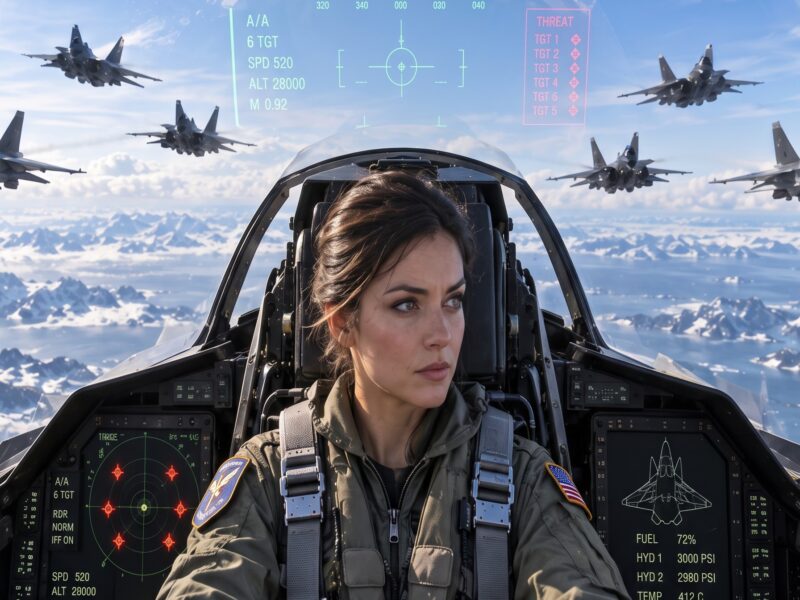
The room went silent when six hostile jets crossed our radar over the Pacific, and when my commander ordered me to surrender the captain’s seat to a “real combat pilot,”
The silence in the tactical operations room was absolute, broken only by the steady, rhythmic hum of cooling fans and the faint, high-frequency ping of the main radar dish scanning the dark horizon of the Pacific Ocean.
I sat near the corner of the long mahogany table, my standard-issue pilot clipboard balanced carefully on my knees. I was the captain, yet to anyone walking into the command center, I looked more like a auditor than an aviator. My flight suit was immaculate, pressed, and entirely free of decorative patches or elite squadron crests. While the younger aviators wore their combat experience like heavy armor, boasting of mock dogfights, tactical simulated kills, and G-force endurance, I maintained a strict, impenetrable quiet. I signed logistics reports, cross-checked fuel expenditure sheets, reviewed pre-flight weather bulletins, and listened attentively during tactical briefings without offering unsolicited opinions.
To the young men and women stationed at this forward operating base, Captain David Vance was a bureaucrat in a flight suit—a cautious, administrative officer who had somehow managed to keep his wings while avoiding the terrifying realities of modern aerial warfare. I never sought to correct their assumptions. The truth was an unbearable weight, a dark memory buried so deeply beneath layers of routine that even hearing the word “combat” made a cold, sharp blade of memory twist inside my chest.
That morning, however, the routine fragile quiet shattered into pieces.
It began with a subtle shift in the ambient sound of the room. Chief Petty Officer Miller, our senior radar operator, suddenly stopped mid-sentence. His fingers froze above his mechanical keyboard. The habitual chatter of the watchkeepers withered away within seconds.
“Six contacts,” Miller whispered, his voice stripped of all professional detachment. “Bearing zero-eight-zero, speed Mach one-point-two. Fast altitude drop. They just cleared the grey zone.”
The atmosphere in the room tightened instantly, like a wire stretched to its absolute breaking point. Air Command Headquarters had warned us about potential foreign power incursions in this remote vector, but no hostile aircraft had ever pushed this far past the neutral perimeter without broadcasting identification codes.
Commander Hayes, a stern, broad-shouldered officer who treated peace as a temporary inconvenience, pushed past two junior intelligence officers and leaned heavily over Miller’s terminal. His eyes tracked the green blips flashing across the dark glass screen. Six unidentified aircraft were sweeping fast toward our defensive patrol sector. Their flight geometry was aggressive, tight, and completely unlike any routine reconnaissance patrol we had logged that month.
Hayes straightened up, his face hardening as he turned toward the assembly of pilots waiting near the briefing boards. His eyes swept past me without a second thought and locked onto Lieutenant Marcus Mason—a talented, fiery twenty-five-year-old fighter pilot who had recently graduated top of his class at the strike weapons school. Mason was eager, brilliant, and utterly untested in real, deadly conflict.
“Vance,” Commander Hayes snapped, his voice sharp and dismissive as he gestured vaguely toward the main communications terminal behind me. “You stay right here at the desk. We need someone steady to coordinate logistics, process the radio logs, and keep the regional corridor clear. Hand over the lead tactical headset.”
He then looked directly at Mason. “Mason, you take the point. Suit up and get Flight Alpha into the air immediately. You’re our real combat pilot out there today. Do not let those hostiles cross the line.”
“Understood, Commander!” Mason replied, his face lighting up with intense adrenaline as he grabbed his helmet and motioned for his wingman to follow him toward the ready room.
I stood motionless beside my chair. “Yes, sir,” I replied softly, handing the tactical lead headset over to Mason’s back without a hint of anger or protest. I had no ego left to defend. Ego was a luxury for men who hadn’t seen what hot cannon fire does to human flesh at thirty thousand feet.
As Mason sprinted down the concrete corridor toward the hardened hangars, the main radar screen flashed with a high-density sweep. The six blips altered their formation. To Commander Hayes and the junior tracking staff, it looked like a simple aggressive sweep meant to force our defensive interceptors into a defensive circle.
But as I stepped closer to the primary tactical display under the pretext of handing Miller a notepad, my eyes locked onto the numbers. I didn’t see six random blips; I saw an ancient, terrifying choreography.
The micro-spacing between the second and third jets. The micro-adjustments in air speed. The deliberate three-hundred-foot vertical gap left between the lead element and the trailing pair. It was a precise, predatory layout.
My stomach dropped, falling into an abyss of sudden, overwhelming recognition.
“They aren’t preparing for a missile attack,” I said softly, my voice barely louder than a murmur.
Commander Hayes turned his head sharply, frowning at me with irritation. “What did you say, Vance?”
“They’re testing us, sir,” I said, stepping into the dim blue light of the main radar display, pointing a steady finger at the central vector. “Look at the speed variations. That isn’t an attack line. That’s a classic bait-and-trap sweep. They are running a diagnostic on our ground response speed, forcing us to launch our primary interceptors so they can map our exact tactical reaction timing.”
Hayes’s brow furrowed. “Testing what? They’re flying an offensive wedge, Vance. Don’t overthink administrative details when combat assets are moving.”
“They want us to launch Flight Alpha straight down the central corridor,” I urged, my voice growing colder, stripped of its usual passive politeness. “If Mason takes off and flies straight at them, they will split into three pairs and draw him into a radar blind spot behind the ridge line.”
Nobody answered. For three excruciating seconds, the only sound in the concrete room was the sharp, rhythmic beep of the automated radar threat warning.
Suddenly, the screen validated my warning. The lead hostile pair broke formation, dropping five thousand feet in a steep dive. Another pair climbed sharply into the thin upper atmosphere, while the final two hostiles dropped their transponder gain, fading almost completely beneath our ground radar’s horizon coverage.
Hayes’s face paled slightly. He grabbed the primary radio headset from the console. “Mason, do you have eyes on them? Report status!”
Mason’s voice crackled through the overhead speakers, laced with static and the sound of heavy flight breathing. “Commander, hostiles are splitting! I’ve lost visually on two of them! They’re moving too fast… I don’t have a clear lock! Requesting instructions!”
I stood frozen beside the main console, staring at the flashing green dots. Suddenly, the tactical room vanished around me. The smell of cold air and electrical ozone was replaced by the overwhelming memory of burning jet fuel, shattered cockpit glass, and screaming metal.
Twenty years ago. The dark sky over the Black Sea.
I was twenty-four years old then—a hotshot flight lead flying a night interception through thick storm clouds and heavy enemy jammer signals. I had taken the bait. I had chased a single target, ignoring the subtle spacing of the radar signatures, leading my flight straight into an ambush. My aircraft had been torn open by cannon fire; my instruments died one by one in a shower of sparks. I had managed to limp my crippled jet back home through a nightmare of rain and smoke, carrying my wounded wingman on my wing until his engine finally exploded two miles from the runway.
I survived that night. Captain Arthur Pendelton, my best friend, did not. His body was never recovered from the deep water.
After the court of inquiry cleared me of tactical error, I buried my decorations, locked my combat record behind high-security clearance doors, and asked for a quiet administrative transfer to a low-risk patrol station. I had sworn to God and to myself that I would never put another pilot into the jaws of that specific, merciless machine.
Now, that exact same machine was humming through the air right outside our door.
“Mason, stand by,” Hayes said, his hands sweating on the console. “Establish defensive orbit.”
“Negative, Commander!” Mason’s panicked voice cut back through the static. “They’re circling behind my lead wingman! I can’t break the lock! What do I do?”
I closed my eyes tightly for a fraction of a second, letting the ghost of Arthur Pendelton clear from my mind. When I opened them, the administrative officer was gone.
I stepped forward, brushed past the junior intelligence officer, and reached out, firmly snatching the primary command microphone directly from Commander Hayes’s hand.
Hayes gasped in shock. “Vance! What the hell are you doing?”
I ignored him entirely, pressing the push-to-talk button on the console. My voice came out flat, smooth, and devoid of any fear—the unmistakable, icy tone of a veteran flight commander in the middle of a dogfight.
“Flight Lead Mason, this is Captain Vance,” I commanded into the radio. “Listen to me very carefully. Do not turn toward the target in front of you. It’s a phantom track. I need you to push your throttle to military power immediately. Climb three hundred feet, execute an immediate hard break to thirty degrees left, and drop two clusters of defensive chaff. Do it now.”
Over the radio, there was a brief pause. Mason was confused by the sudden change in command voice, but the sheer, absolute authority in my instruction left no room for hesitation.
“Copy… climbing three hundred, breaking left!” Mason yelled over the roar of his engine.
On the main radar screen, Mason’s fighter surged upward, slicing sharply across the sky, dumping radar-reflective chaff right into the path of the diving hostiles. The two unidentified aircraft that had been sliding silently into his blind spot were suddenly caught out in the open, their ambush trajectory completely ruined by the sudden, mathematically precise evasive maneuver.
“It worked!” Mason screamed over the speaker, his breath ragged. “They missed the angle! They’re overshooting! They’re breaking off!”
The room went completely, hauntingly still.
Officers stared at the tactical table in utter disbelief. The green blips of the six hostiles altered their course, banking sharply back toward international airspace, unable to complete their trap once their tactical layout had been exposed.
Commander Hayes stood frozen, his eyes wide as he stared at me as if he were seeing a ghost. The quiet bureaucrat who organized fuel receipts had just outmaneuvered an advanced combat strike package with three sentences.
“Where…” Hayes stammered, his voice barely audible. “How did you know that flight pattern, Vance? That isn’t in any modern defense manual.”
I didn’t answer right away. I lowered the microphone back onto its cradle, my right hand trembling slightly as the cold adrenaline began to fade, leaving behind only the bitter ash of ancient memories.
“Because,” I whispered, looking directly into Hayes’s eyes, “I was the only man who survived it twenty years ago.”
Hayes swallowed hard, processing the words. “You’ve fought these people before.”
“Yes,” I said quietly.
“Who are they?”
I stared at the retreating radar tracks on the screen. “They belong to an elite black-ops experimental unit. A squad that doesn’t officially exist. They shot down my wingman in 2006.”
Hayes stared at me, his face pale. “My God…”
“But that’s not the worst part, Commander,” I added, my eyes narrowing as I pointed toward the extreme upper corner of the display screen, where a microscopic, unverified energy signature was slowly taking shape.
Hayes leaned in close. “What do you mean?”
Chief Petty Officer Miller suddenly let out a horrified gasp, his chair rolling back from the radar desk as his screen turned bright red.
“Captain… Commander…” Miller stammered, pointing a shaking finger at the screen. “There’s… there’s a seventh aircraft.”
The entire room seemed to lose its air. This seventh contact was not flying with the six retreating jets. It was not coming from international airspace. It had been flying silent, cold, and undetected right beneath our coastal air defense grid.
It was already positioned directly behind our base.
The warning siren on the main console didn’t just ring; it shrieked—a piercing, mechanical scream that shattered whatever shock was left in the command center.
“Seventh contact confirmed!” Chief Petty Officer Miller yelled, his voice rising an octave in pure panic. “High altitude, speed Mach two-point-four and accelerating! It was running completely dark until it powered up its targeting radar! It’s an advanced stealth prototype!”
Commander Hayes grabbed the desk to steady himself, his face drained of all color. “Behind us? How did a heavy strike aircraft get past the island radar fence without triggering the early warning network?”
“Because it wasn’t flying a normal vector,” I answered, my eyes fixed on the fast-moving red trail. “It was masking its engine heat behind the daily commercial cargo flight from Honolulu. It dropped out of the civilian air corridor five minutes ago and glided down into our radar shadow behind the mountain ridge. It’s a tactical ambush.”
The room descended into controlled chaos. Officers were running across the floor, shouting orders, frantically pulling up defense protocols, and dialing direct lines to Regional Air Command. But regional headquarters was twenty minutes away by air. Mason and his wingman were out over the open ocean, low on fuel, and hopelessly out of position to intercept a target already flying directly over our rear perimeter.
“Mason!” Hayes shouted into his headset. “Turn around! You have an emergency bandit on your six, heading for the airfield!”
“Commander, I’m at bingo fuel!” Mason’s voice came back, strained and distorted by high atmospheric interference. “If I turn back and engage at full burner, I won’t have enough fuel to land! And my radar can’t get a lock on that thing—it’s breaking my targeting lock every time I sweep!”
“He’s right,” I said quietly, stepping up to the tactical map board. “Mason’s F-16s don’t have the specialized radar filters required to lock onto a low-observable delta-wing aircraft. If he tries to dogfight that target, he’ll be shot out of the sky before he even sees the missile plume.”
Hayes turned on me, his eyes filled with a terrifying mix of desperation and sudden, profound respect. “Vance… Captain… you knew their tactics out over the water. You knew their bait pattern. Do you know what that seventh jet is?”
I looked at the primary radar trace. The flight profile was unmistakable—the sharp, erratic altitude shifts, the massive radar-cross-section suppression, the predatory patience.
“It’s a Phantom-9 experimental strike fighter,” I said softly, the words tasting like lead on my tongue. “Twenty years ago, it was just a dark rumor in classified intelligence briefings. A black-project aircraft designed specifically for deep-penetration decapitation strikes against command bunkers. They only built three of them. One of them destroyed my squadron.”
Hayes grabbed my shoulder, his fingers digging hard into the fabric of my flight suit. “Can we shoot it down with our ground-to-air missile batteries?”
“No,” I replied flatly. “The Phantom-9 uses an active radar spoofing array. The moment your ground batteries fire, the missile’s guidance system will be inverted and redirected straight back down the radar beam to destroy the launch bunker. If you fire a Patriot missile at that jet right now, you’ll blow up our own missile site.”
Hayes stumbled back half a step, looking around the room at his terrified, young watchkeepers. “Then what the hell are we supposed to do? We have three hundred personnel on this base, a fuel depot fully loaded with jet propellant, and our main air cover is stranded out over the ocean!”
I looked down at my hands. They had stopped shaking. The terrifying, paralyzing anxiety that had haunted my dreams for twenty long years had suddenly vanished, replaced by an absolute, icy clarity. The nightmare was no longer a memory trapped in the dark corners of my mind; it was right outside, cutting through the clouds at two thousand feet per second.
“Is Hangar 4 still operational?” I asked, my voice deadly calm.
Hayes blinked, surprised by the question. “Hangar 4? That’s the storage bay for retired aircraft. We only keep old maintenance hulks and decommissioned frames in there.”
“Not all of them are hulks,” I said, unzipping my administrative suit jacket and tossing it onto the command table, revealing the classic olive-drab G-suit I had secretly worn beneath my uniform every single day for two decades. “The airframe we pulled out of the Baltic operational zone fifteen years ago—the twin-engine interceptor with the mechanical mechanical-scan array radar. It doesn’t rely on modern digital microprocessors. It uses raw, analog radar frequencies.”
Hayes stared at me, his mouth open. “The old interceptor? Vance, that plane hasn’t flown an operational sortie in over a decade! It’s a flying museum piece! It doesn’t even have modern fly-by-wire flight stabilization!”
“Which means the Phantom-9’s digital spoofing array can’t affect it,” I replied, grabbing my flight helmet from the locker beside the door. “Digital stealth tricks don’t work against old-school high-power analog radar. It’s too crude, too loud, and too direct to be spoofed. It’s the only radar on this island that can see that ghost.”
“You can’t fly that thing alone!” Hayes protested, following me toward the door. “You haven’t been in a high-G cockpit in twenty years! Your body won’t take the physical strain, Vance! You’ll blackout during the first hard turn!”
I paused at the heavy blast door of the operations center, turning back to look at Hayes one last time.
“I spent twenty years sitting at that desk, Commander, dying a little bit every single day because I let my wingman fly into the dark alone,” I said, my voice echoing off the cold concrete walls. “I’m not sitting at that desk today.”
Without waiting for his response, I slammed the blast door open and ran down the sunlit tarmac toward Hangar 4.
The heat of the afternoon sun hit my face as I sprinted across the concrete runway. In the distance, high above the jagged mountain ridge behind the base, I could already hear the deep, thunderous rumble of a high-performance jet engine—a sound like tearing metal cutting through the sky. The seventh aircraft was descending, lining up its attack run.
I threw open the side access door of Hangar 4. The room smelled of old hydraulic oil, aviation gasoline, and dry dust. Standing in the center of the dim hangar, surrounded by wooden crates and old tools, was the black, sharp-nosed silhouette of the interceptor. Its skin was painted a dull matte grey, devoid of markings.
“Chief!” I roared at the elderly hangar master who was sitting at a workbench, staring at me in complete shock. “Power up the external starter cart! Connect the high-pressure air line to Engine One!”
“Captain Vance?” the old mechanic stammered, dropping his wrench. “Sir, this airframe isn’t cleared for flight! The fuel tanks were just flushed last month, and…”
“Is there jet fuel in the main tanks?” I interrupted, jumping onto the access ladder and swinging myself up into the narrow, cramped, analog cockpit.
“Well… yes, sir, forty-five hundred gallons of JP-8, but…”
“Then boot the starter cart!” I yelled, pulling the heavy leather helmet over my head and snapping the oxygen mask firmly across my face.
The cockpit was a dense jungle of mechanical dials, round glass needles, heavy toggle switches, and worn black paint. No sleek touchscreens. No digital displays. Just raw, mechanical machinery bound together by steel cables and hydraulic pressure lines.
Outside, the ground shook violently as the Phantom-9 executed a supersonic flyby over the northern perimeter of the base, its shockwave shattering glass windows across the administrative complex.
“Connecting power!” the chief yelled from below, hitting the big red button on the yellow starter unit.
With a high-pitched whine that rose into a deafening, terrifying scream, the interceptor’s twin engines began to spool up. The needle on the RPM gauge spun clockwise. Fuel pumps roared to life. Oil pressure surged into the green zones.
I snapped the canopy down, locking the heavy steel latch with a sharp metallic clack.
Through the clear acrylic glass of the canopy, I watched the massive hangar doors slowly roll open, revealing the blinding blue sky over the Pacific Ocean—a sky that was currently occupied by a predator that had hunted my memories for twenty years.
I shoved both throttle levers all the way forward into full military power. The old airframe trembled violently, its tires skidding slightly across the slick concrete floor as fifteen tons of raw thrust pushed against the brakes.
“Base control, this is Vance,” I said into my oxygen mask, my breath echoing loud and rhythmic in my ears. “I am rolling out on Runway Zero-Two. Clear the airspace.”
“Captain,” Hayes’s voice came back through the radio, trembling with anxiety. “God help you up there.”
I released the brakes. The interceptor shot out of the hangar like a bullet leaving a gun barrel.
The g-force slammed me back into the hard foam padding of the ejection seat as the twin engines roared into full afterburner, dumping raw jet fuel directly into the glowing exhaust nozzles.
The runway vanished beneath my wings in a blur of white paint and concrete seams. I pulled back hard on the heavy mechanical flight stick. The interceptor didn’t respond with the smooth, computer-assisted grace of a modern jet; it fought back, its mechanical controls stiff and heavy, demanding every ounce of physical strength in my arms and shoulders.
The aircraft pitched up sharply, climbing into the brilliant sky at an angle of seventy degrees. Below me, the base shrank into a tiny green and brown patch surrounded by the endless blue expanse of the Pacific Ocean.
“Vance! This is Mason!” the young pilot’s voice burst through my headset, filled with sheer panic. “I see you! You just launched in a museum piece! What are you doing? The bandit is sitting directly above you at twenty-five thousand feet! He’s already tracking you!”
“Mason, get your flight to low altitude and prepare to land,” I commanded coldly, adjusting the manual trim wheel beside my left hip. “You don’t have the fuel for this fight. Stay clear of the sector.”
“Sir, you can’t engage that thing alone! Its radar profile is invisible!”
“It isn’t invisible to me,” I replied.
I reached out with my gloved right hand and flipped a heavy, yellow-capped switch on the upper instrument panel. A sharp electrical whine vibrated through the cockpit floor as the old analog radar unit powered up, sweeping a powerful, raw electromagnetic beam through the sky ahead of me.
On the round glass radar scoop in the center of my dashboard, a chaotic wave of green static flashed. Then, suddenly, a sharp, solid black shadow cut through the noise—a distinct, steady return signal.
The Phantom-9 was there, soaring high above the clouds like a sleek, black diamond blade.
“I have contact,” I whispered, my thumb sliding over the red weapon-select switch on the flight stick.
Instantly, my radar warning receiver began to scream—a continuous, high-pitched tone indicating that the enemy jet had detected my radar beam and was locking its optical targeting system onto my aircraft.
A brilliant white flare burst from the wing root of the Phantom-9 as a long-range radar-guided missile detached from its belly bay, its rocket engine igniting with a blinding flash of orange fire.
“Missile launch! Missile launch!” Miller’s voice screamed from the ground station. “Vance, drop defensive countermeasures!”
“Not yet,” I murmured, watching the white trail of smoke streaking down through the blue sky directly toward my nose.
The missile was moving at Mach four, closing the distance in seconds. In a modern jet, the computer would automatically calculate the escape vector and drop chaff at the precise millisecond. But I had no computer. I had only my eyes, my instincts, and the brutal lessons paid for in blood twenty years ago.
I waited… held my breath… three seconds… two seconds…
“Now!” I grunted, slamming the flight stick all the way to the left while pulling full aft pressure, kicking the right rudder pedal to the floor.
The interceptor groaned in mechanical agony, rolling violently onto its back as its wings sliced through the air. The physical force slammed me sideways against the canopy frame, graying out my vision for a fraction of a second as five Gs of gravity pulled the blood from my brain.
The enemy missile tore past my cockpit canopy less than fifty feet away, its heat wash violently buffeting my aircraft before detonating harmlessly in the empty sky behind me.
“Direct miss!” Mason yelled over the radio, his voice cracking with utter disbelief. “He dodged a Mach four interceptor missile using a manual barrel roll!”
I leveled the wings, gasping for air inside my oxygen mask, my heart hammering against my ribs like a trapped bird. The physical strain was immense; my fifty-year-old body felt like it was being crushed under an anvil, but the flame inside my mind burned brighter than it had in two decades.
The Phantom-9, surprised by the maneuver, dove sharply, utilizing its immense thrust to roll behind my aircraft, setting up a gun track for a quick kill from behind.
“He’s sliding onto your tail, Vance!” Hayes shouted from the command room. “Break right! Break right!”
“No,” I muttered, my hands moving automatically across the control surfaces. “If I break right, he cuts the corner and takes the shot.”
Instead of turning away, I pulled the throttle levers completely back to flight idle and extended the heavy speed brakes along the fuselage.
The interceptor violently decelerated, its nose pitching up as the airspeed dropped precipitously from six hundred knots to under two hundred in a matter of seconds.
The pilot of the Phantom-9, expecting a high-speed defensive turn, was completely caught off guard by the sudden, dramatic loss of speed. The black stealth fighter overshot my aircraft, shooting past my left wing like a dark streak of lightning.
For a brief, frozen second, the two aircraft were flying canopy-to-canopy, less than thirty yards apart.
Through the dark-tinted visor of the enemy cockpit, I caught a glimpse of the pilot. Helmet painted completely black, devoid of national flags or squadron symbols. The same anonymous, cold killer who had hunted my friends through the skies of Eastern Europe.
The enemy pilot turned his head and looked directly at me.
I didn’t flinch. I stared back through the acrylic glass, my face rigid behind my oxygen mask.
“I remember you,” I whispered into the silence of my cockpit.
The enemy pilot immediately jammed his throttles into full afterburner, his jet’s twin engines erupting with violent blue flame as he pulled up into a vertical climb, trying to use his superior engine power to escape my sight lines.
“Not this time,” I snarled, pushing my throttles back to full afterburner and pulling the stick hard back, following the black shadow straight up into the deep vault of the upper atmosphere.
The engines roared, pushing us past fifteen thousand feet… twenty thousand… thirty thousand… into the thin, freezing air where the sky turned from bright blue to a terrifying, dark navy.
My airspeed indicator was dropping fast as gravity fought against the weight of my heavy interceptor. The engine temperature gauges began to creep dangerously into the red line. The air was too thin for sustained combustion.
“Warning! Engine compressor stall imminent!” a mechanical voice chattered in my headset.
“Quiet,” I snapped at the automated warning system.
The Phantom-9 was reaching the apex of its climb, preparing to hammerhead turn at forty thousand feet and plunge back down to destroy me from above.
If he completed that turn, I would be dead. My plane was losing lift; my controls were becoming soft and unresponsive in the thin air.
I had one single opportunity—a window of less than two seconds before my engines flamed out completely from air starvation.
I pulled the nose up past the vertical line, forcing the aircraft into a dangerous, uncontrolled Cobra maneuver—a high-alpha maneuver that forced the plane’s belly against the wind, momentarily locking the radar dish directly onto the ascending belly of the stealth fighter.
The analog radar scope illuminated with a solid, bright red targeting circle.
“Lock,” I whispered.
I squeezed the red missile trigger on the flight stick.
The heavy air-to-air missile detached from the underwing pylon with a violent, metallic clunk that rattled my teeth. Its solid-fuel rocket motor ignited a split second later, sending a torrent of white smoke and orange fire washing over my canopy.
The missile streaked upward through the thin, dark atmosphere, tracking the raw electromagnetic reflection bouncing off the Phantom-9’s underbelly.
The enemy pilot realized the danger instantly. The Phantom-9 rolled inverted, dumping clouds of brilliant magnesium flares and chaff bundles while executing an extreme high-G vector change designed to break any optical or radar lock.
BOOM!
The missile didn’t hit the stealth fighter directly, but its proximity fuse detonated twenty feet from the jet’s left wingtip. The high-explosive warhead shredded the black composite skin of the enemy aircraft, ripping away its primary control surface and setting its left engine ablaze in a trailing plume of dense black smoke.
“Hit! Target hit!” Miller’s voice echoed through the command room speakers down on the ground, accompanied by wild cheers from the watchkeeping staff. “Enemy aircraft has sustained critical damage!”
“He’s not down yet!” I warned, my voice raspy as I fought to regain control of my own aircraft.
My sudden, extreme Cobra maneuver had completely starved my engines of oxygen. The twin jet turbines sputtered, coughed, and died with a sickening, hollow metallic groan. The warning lights on my dashboard illuminated like a Christmas tree—red warnings flashing for fuel pressure, hydraulic failure, and dual engine flameout.
The heavy interceptor pitched over, its nose dropping into a terrifying, silent freefall toward the ocean thirty thousand feet below.
“Vance!” Hayes shouted, his voice laced with sudden panic over the radio. “Your engine telemetry just dropped to zero! You’re in an unrecoverable stall!”
“I know,” I breathed, fighting the heavy mechanical stick as the wind howled past the canopy frame. “Attempting engine restart.”
I slammed the fuel switches off, purged the fuel lines, and flipped the emergency starter ignition switch. The starter motor whined pathetically, but the cold air at high altitude prevented the engines from reigniting.
Twenty thousand feet.
The ocean was rushing up to meet me, a vast, blue plate of hard glass that grew larger by the second.
“Vance, eject! Eject immediately!” Hayes commanded, his voice shaking. “You’ve neutralized the threat! Get out of the plane!”
“Negative,” I grunted, my hands flying across the control panel in a rhythmic, practiced sequence. “If I eject now, this airframe crashes into the base’s radar facility on the coast. I’m riding it down.”
Fifteen thousand feet.
Through the cloud layer below me, I saw the damaged Phantom-9. Despite losing its left wingtip and trailing fire from one engine, the enemy pilot was still fighting for control, banking his smoking jet around in a wide, desperate arc, turning his nose back toward my falling aircraft for one final, kamikaze strafing run.
He knew he was going down, and he was determined to take me with him.
“He’s locking his cannons on you!” Mason yelled from his observation orbit five miles away. “Vance, he’s firing!”
Bright green tracer rounds cut through the clouds, slicing through the air around my cockpit like glowing spears. A high-explosive 30mm shell clipped my right wing, tearing away a three-foot section of metal trim and sending a violent shockwave through the control stick that nearly broke my right wrist.
Ten thousand feet.
The air was finally getting thicker, denser, richer in oxygen.
“Come on…” I growled, grabbing the emergency engine restart pull-handle with both hands and yanking it out until the steel cable locked. “Fire!”
With a deafening CRACK, the right engine roared back to life, sending a massive jolt of power through the electrical system. The hydraulic pressure needle flicked back into the green zone.
I slammed the throttle forward, pulled the stick back to my chest, and leveled the wings less than two thousand feet above the dark, white-capped ocean waves.
The damaged Phantom-9 overshot my position, unable to pull out of its steep dive due to its destroyed left wing controls. The black stealth fighter skipped across the surface of the ocean once, throwing up a massive wall of white water, before exploding into a brilliant fireball that lit up the coastal horizon.
Silence returned to the radio channel.
I banked my smoking, battered interceptor into a gentle climb, my breath coming in ragged, heavy hitches as the adrenaline slowly drained from my system. My right arm was bruised, my shoulder burned from the physical exertion, and my eyes were stinging with sweat, but my hands were completely steady.
“Ghost target destroyed,” I said into the microphone, my voice low and quiet. “Vectoring back to base.”
For five long seconds, no one spoke over the radio. Then, the voice of Commander Hayes came through, thick with emotion and an overwhelming sense of humility.
“Copy that, Captain Vance,” Hayes said softly. “Runway Zero-Two is cleared for your landing. Welcome back, sir.”
I looked out the left side of my cockpit canopy. The clouds were clearing, allowing the bright afternoon sunlight to stream through the glass, bathing the cockpit in a warm, golden light. For the first time in twenty years, the cold, suffocating weight on my chest was gone. The dark memory of the Black Sea had finally been laid to rest.
I brought the interceptor around, lining up the battered nose with the long grey strip of the base runway down below.
As my main landing gear touched the pavement with a soft squeak of rubber, a fleet of emergency fire trucks and command vehicles rushed along the taxiway to meet me, their red lights flashing bright against the blue sky.
I chopped the throttle switches, shutting down the single working engine, and pulled open the heavy canopy latch. The cool, ocean breeze filled the cockpit, smelling of salt water and fresh air.
Commander Hayes, Lieutenant Mason, and dozens of young ground crew officers were already standing near the edge of the tarmac, staring up at me as I unbuckled my flight harness and climbed slowly down the metal ladder.
Mason stepped forward first, his helmet held tightly beneath his arm, his eyes wide with profound respect and open confusion.
“Captain…” Mason stammered, looking at the scorched metal skin of the old interceptor, then looking back at my tired, weathered face. “Who… who are you really? Where did you learn to fly like that?”
I paused at the bottom of the ladder, looking down at the quiet, black administrative suit jacket hanging over Hayes’s arm, and then back at the young pilots surrounding me.
“I used to be a combat pilot, Mason,” I said quietly, a small, genuine smile finally touching the corners of my lips. “But today… I’m just a captain who made sure everybody came home.”
Commander Hayes stepped forward, snapped his head back, and executed a sharp, perfect military salute—a salute meant not for an administrative officer, but for a true tactical legend. One by one, every pilot and crew member on the tarmac followed his lead, coming to rigid attention in the fading light of the afternoon.
I stood tall, raised my right hand to the brim of my flight cap, and returned the salute.
The sky above us was peaceful, quiet, and clear.
Two weeks after the engagement over the Pacific, the high-level inquiry team from Pacific Air Command finally concluded their classified investigation into the incident.
The official public report released to the media spoke vaguely of an “unidentified navigational hazard and a successful interdiction exercise conducted by regional defense assets.” There were no mentions of the Phantom-9, no details about the experimental stealth technology, and no public names released to the press.
In the world of shadow warfare, victory was rarely celebrated with parades.
Inside the tactical operations center, however, everything had changed.
The old administrative desk near the back corner of the room was gone. In its place stood a brand-new, high-density tactical coordination hub, equipped with direct satellite links to every defense sector in the Western hemisphere.
I sat at the head of the briefing table, wearing a clean, fresh flight suit. Beside my standard administrative clipboard lay a new brass plaque presented to me by Regional Command, engraved with the insignia of my original, long-disbanded combat squadron.
The blast door opened, and Lieutenant Mason walked into the room, holding two cups of steaming black coffee. He looked different than he had two weeks ago—less arrogant, more focused, carrying himself with the quiet dignity of a pilot who had peered into the abyss of real warfare and understood its true cost.
“Morning, Captain,” Mason said respectfully, placing one of the coffee cups on the table beside my hand.
“Morning, Mason,” I replied, glancing up from the morning weather telemetry sheets. “How is Flight Alpha looking for today’s high-altitude training sweep?”
“Fully prepped, sir,” Mason said, taking a seat across from me. “We’re running the advanced intercept geometry protocols you drew up for us last week. The young guys are struggling with the manual radar trim adjustments, but they’re getting faster.”
I smiled softly, taking a sip of the warm coffee. “Manual adjustments take time, Mason. Modern computers make pilots lazy. When the digital systems go dark—and eventually, they always go dark—you have to be able to feel the air through your fingertips.”
“We learned that lesson from the best, sir,” Mason said quietly, his voice devoid of flattery, carrying only sincere gratitude.
He paused for a moment, looking at the wall behind my desk. Hanging there, mounted inside a polished glass frame, was a framed photograph taken thirty years ago—a group of four young, smiling pilots standing in front of a cold interceptor in Eastern Europe. Among them was a younger version of myself, standing shoulder-to-shoulder with Captain Arthur Pendelton.
“Do you still think about him?” Mason asked gently, pointing toward the photograph.
I looked up at the image of Arthur. For twenty years, that face had been a source of unbearable guilt, a constant nightmare that reminded me of my failure to protect my wingman. But now, as I looked at Arthur’s smiling face, the pain was gone. In its place was only a quiet, enduring honor.
“Every day,” I answered truthfully. “But I don’t look back in shadow anymore, Mason. He was a great pilot. He would have wanted us to keep teaching the next generation how to stay alive out there.”
The heavy door opened again, and Commander Hayes stepped into the room, carrying a thick leather folder stamped with TOP SECRET security clearances.
“Captain Vance,” Hayes said, nodding respectfully to me as he approached the table. “I just received a direct flash dispatch from the Pentagon.”
I set my coffee cup down. “What are their orders, Commander?”
Hayes opened the folder and placed a single sheet of paper in front of me. “The Chief of Staff of the Air Force has officially established a new tactical weapons instruction division—the Advanced Adversary Tactics Group. They want you to head the department as Chief Flight Instructor.”
Mason gasped quietly, a grin spreading across his face. “Chief Flight Instructor for the entire division? That’s an incredible command, sir!”
I looked down at the official document, reading the high-level signatures stamped at the bottom. The offer was a monumental recognition of my service, a chance to return to the top tier of military aviation leadership, complete with a promotion to full Colonel.
I closed the folder slowly, feeling the smooth leather beneath my palms, and then turned my eyes out the reinforced glass window of the command center, looking down at the long concrete runway bathed in the warm morning light.
Out on the tarmac, four F-16 fighters were idling, their engines whining softly as junior ground crew members checked their wing locks and fuel lines. Those young pilots out there didn’t need a high-ranking tactical theorist sitting in a distant war room in Washington. They needed someone right here—on the frontline, in the dust, ready to guide them through the dark when the unexpected radar blips appeared on their screens.
“Tell the Pentagon I accept the appointment as Chief Instructor,” I said, turning back to face Commander Hayes with a calm, unwavering gaze. “On one condition.”
Hayes raised an eyebrow. “What condition, David?”
“I direct the school right here from this base,” I replied firmly. “And I retain full operational command of Hangar 4 and its legacy airframes.”
Commander Hayes looked at me for three long seconds, then a warm, rare smile broke across his stern face. He reached across the table and extended his right hand.
“I think the Pentagon will find those terms entirely acceptable, Colonel Vance.”
We shook hands—a firm, binding agreement between two men who had faced the worst of war and emerged stronger on the other side.
An hour later, I stood out on the edge of Runway Zero-Two, wearing my flight helmet and gloves, watching Flight Alpha take off into the clear blue morning sky.
The roar of their engines shook the ground beneath my boots, a thunderous anthem of power, precision, and freedom. Mason’s aircraft led the formation, banking smoothly into a high-climb trajectory, maintaining the perfect, disciplined three-hundred-foot defensive spacing I had taught him.
I adjusted my helmet strap, stepped toward the access ladder of my interceptor parked nearby, and began my pre-flight inspection.
The sky above the Pacific was vast, deep, and unpredictable. Shadows would always loom on the horizon; threats would always emerge from the unknown dark. But as long as there were pilots willing to stand guard, willing to pass down the hard-earned wisdom of the past, those shadows would never prevail.
I climbed up into the cockpit, pulled the acrylic canopy down, and locked it into place.
The old analog needles fluttered to life. The engines spooled up with their familiar, roaring anthem. I smiled into my oxygen mask, pushed the throttles forward, and soared back into the sky where I belonged.
The end.









