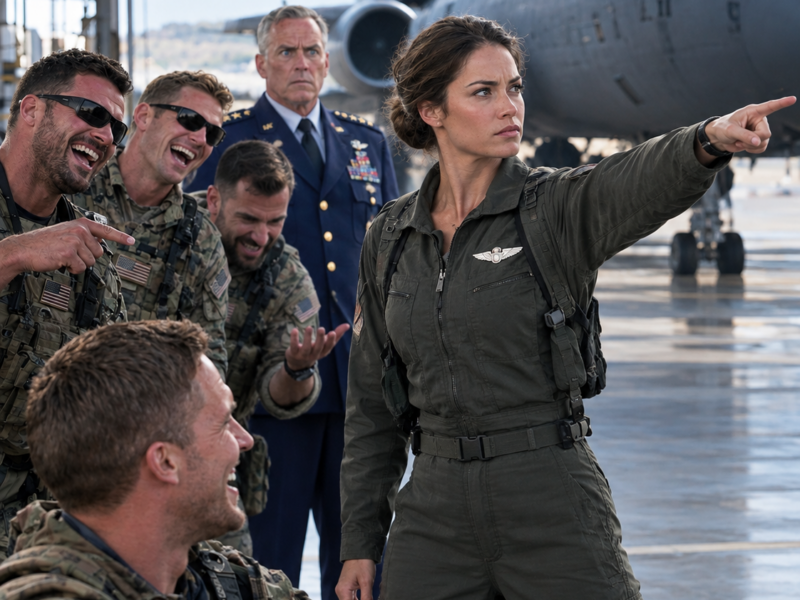
The room remained silent after General Thomas Whitaker whispered the name.
The room remained silent after General Thomas Whitaker whispered the name.
“Lieutenant Colonel Adrian Voss.”
Captain Rebecca Hayes felt her fingers tighten around the folder.
Voss.
The former operations officer who had helped write the report that ended her career. The man who had stood before a review board and testified that Rebecca had ignored a direct order during Operation Nightfall.
Three aircraft had entered the storm that night.
Two had returned.
Voss had called it a tragic consequence of her poor judgment.
Now he was part of the mission she had just been ordered to command.
“Where is he?” Rebecca asked.
“Already en route to Norfolk,” Whitaker replied. “He’s been appointed tactical coordinator for this operation.”
“You’re putting him in charge of the mission he helped destroy?”
“I’m putting him where I can watch him.”
Rebecca studied the general’s face.
“You think he’s involved.”
“I think someone falsified your report, concealed evidence from a classified operation, and arranged for twelve American personnel to disappear inside hostile territory. Voss had access to all three.”
Across the table, Lieutenant Mason Cole stood rigidly.
“Sir, with respect, if Colonel Voss is compromised, why include him at all?”
“Because the people we’re dealing with may already know we’re coming. If we remove him too early, whoever is behind this may disappear before we can identify them.”
Whitaker turned to Rebecca.
“And because Voss knows the original extraction plan better than anyone still serving.”
Rebecca looked at the satellite photograph again.
The mountain valley seemed unchanged in her memory. Jagged ridgelines. Narrow ravines. A river that vanished beneath a shelf of rock. Weather that could turn a clear afternoon into a white wall in minutes.
She had flown through that valley in the dark, trusting instruments, crew coordination, and intelligence reports that she now knew had been manipulated.
Three people had died.
She had spent two years wondering whether a different decision might have brought them home.
“Sir,” she said, “I need the original mission package. Not the sanitized version.”
Whitaker nodded to one of his aides.
“You’ll have it.”
“And I need full authority over the aviation portion of this operation. No last-minute changes from Colonel Voss. No rerouting an aircraft without my approval.”
“Granted.”
Rebecca looked toward Cole.
“Lieutenant, I need your team’s medical specialist, communications operator, and designated second-in-command in my briefing room in ten minutes. I want their equipment list, extraction requirements, and alternate plans.”
Cole nodded.
“Yes, ma’am.”
The general’s eyebrows rose slightly at how quickly the SEAL leader had complied.
Rebecca closed the folder.
“Then let’s stop wasting time.”
—
Twenty minutes later, the briefing room had transformed.
The mocking laughter was gone. Maps covered the walls, and a digital terrain model projected the valley in three dimensions.
Six SEALs sat around the table while two more checked equipment with the team’s support personnel. Cole stood beside the display, listening as Rebecca traced the ridgeline with a laser pointer.
“The reconnaissance team entered through this pass,” she explained. “Their last confirmed transmission came from the facility here. The primary extraction zone is exposed, and the weather forecast is deteriorating faster than the official report suggests.”
One of the SEALs, Chief Petty Officer Daniel Price, leaned forward.
“How do you know the forecast is wrong?”
“Because the wind readings don’t match the cloud movement in the satellite imagery. The report predicts a stable ceiling for another three hours. The cloud bank is already spilling over the western ridge.”
Cole studied the display.
“If the primary zone is unusable, we can move them to the northern shelf.”
“No,” Rebecca said.
His expression tightened.
“Why not?”
“Because the shelf is narrower than the image suggests. A helicopter could approach it, but the downdraft would push it toward the rock face. If the weather closes in, you could lose the aircraft before your team even reaches the landing point.”
Price exchanged a glance with another operator.
“What do you recommend?”
Rebecca highlighted a narrow corridor along the river.
“There’s an old service road on the eastern side. It leads to an abandoned mining platform. The ground is uneven, but the surrounding terrain gives us better options for an approach. We use it as the alternate extraction point.”
Cole crossed his arms.
“And if the intelligence team isn’t there?”
“Then we don’t force a landing into a place we can’t verify. Your team establishes contact from a protected position, and we adapt to what we know—not what we hope.”
For a moment, Cole seemed ready to argue.
Then he looked at the terrain model again.
“Understood.”
Rebecca continued the briefing, laying out the weather limits, communication contingencies, and conditions that would force the aircraft to abort. She refused to promise a perfect extraction. She promised only that every decision would be made with the best available information.
That, she had learned, was the difference between confidence and recklessness.
A knock interrupted the briefing.
An aide entered carrying a sealed envelope.
“Captain Hayes, the general says this is the original Nightfall mission file. He instructed me to give it directly to you.”
Rebecca took it.
The seal had already been broken.
Inside were weather reports, flight logs, radio transcripts, and a copy of the final investigation. Most of it looked familiar.
Then she found a page she had never seen before.
It was a handwritten message from her aircraft’s flight engineer, Staff Sergeant Paul Danner, recorded shortly before the final approach.
**CAPTAIN, THE ROUTE DOESN’T MATCH THE BRIEF. SOMEONE CHANGED OUR NAVIGATION DATA. I’M CHECKING IT NOW.**
Rebecca stopped breathing for a moment.
Danner had been one of the three people who never returned.
She read the message again.
“Where did this come from?” she asked.
The aide shook his head.
“It was recovered from a restricted archive this morning.”
“Who had access to it?”
“I don’t know, ma’am.”
Rebecca placed the page on the table.
Cole leaned closer.
“That changes things.”
“Yes,” she said. “It means our mission may have been compromised before we ever reached the valley.”
A new voice came from the doorway.
“Or it means someone wants you to believe that.”
Lieutenant Colonel Adrian Voss stood at the entrance, his uniform immaculate and his expression composed.
Two years had changed him very little.
His eyes moved from Rebecca to the open folder.
“Captain Hayes,” he said. “I see you’re still collecting evidence that supports your version of events.”
Rebecca met his gaze.
“And I see you’re still arriving after the important decisions have been made.”
Cole straightened, watching the exchange.
Voss stepped into the room.
“General Whitaker has appointed me tactical coordinator. I’ll be reviewing your route and extraction plan before we depart.”
“You can review the plan,” Rebecca said. “You won’t alter the flight route without consulting me.”
“Your authority is provisional.”
“My aircraft will be flying into a storm over hostile terrain. My authority over its safety isn’t.”
Voss smiled without warmth.
“Still convinced you’re the only person in the room who knows how to fly.”
“No,” Rebecca replied. “Just the person responsible for bringing the aircraft back.”
The smile disappeared.
For a second, something colder showed in his eyes.
Then Voss glanced at the handwritten message.
“Where did you get that?”
“The general gave it to me.”
He reached toward the paper.
Rebecca placed her hand over it.
“Why? Does it concern you?”
Voss withdrew his hand.
“It’s probably an unverified fragment. You shouldn’t build an operational plan around it.”
“Then you won’t mind if investigators examine it.”
His jaw tightened.
“Do whatever you want, Captain.”
He turned to leave.
At the doorway, he paused.
“One piece of advice. Nightfall ended badly because you believed a warning from your crew was more reliable than a direct order. Don’t make the same mistake twice.”
Rebecca watched him disappear down the corridor.
Then she looked at Cole.
“Get your team ready. We’re moving on schedule.”
Cole hesitated.
“Captain, do you believe Voss changed your navigation data?”
“I believe someone did. I also believe Voss knows more than he’s telling us.”
“And if he’s working against us?”
Rebecca sealed the original mission file.
“Then we find out before he gets anyone else killed.”
Outside, transport aircraft engines began roaring across the airfield.
The mission clock had started.
And as Rebecca gathered her papers, her secure phone vibrated with a message from an unknown number.
There was no greeting.
No explanation.
Rebecca Hayes read the anonymous message three times.
**IF YOU WANT TO KNOW WHO CHANGED YOUR ROUTE, ASK WHO ORDERED THE SECOND AIRCRAFT TO TURN BACK.**
For two years, she had believed the official account of Operation Nightfall.
Her aircraft had entered the mountain valley during deteriorating weather. The extraction corridor had become unsafe. She had allegedly ignored an order to abort, and the resulting crash had killed three members of her crew.
But there had been no mention of a second aircraft.
Not in the public report.
Not in the disciplinary hearing.
Not even in the classified summary she had been permitted to review.
Someone had deliberately removed it.
Rebecca walked into General Whitaker’s office without knocking.
He looked up from his desk.
“Captain?”
“Did a second aircraft participate in Operation Nightfall?”
The general’s expression changed.
It was subtle, but she saw it.
“Where did you hear that?”
She placed her phone on his desk.
“Someone just sent me this.”
Whitaker read the message, then closed the office door.
“Sit down.”
“I’d rather stand.”
“Fine.”
He opened a locked cabinet and removed a thin black folder. Its cover carried the same classification marking as her original mission file, but the document number was different.
“I wasn’t authorized to release this until the current operation began,” he said.
“Why?”
“Because the second aircraft was part of a compartmented surveillance mission. Its crew was ordered to remain outside the extraction corridor.”
Rebecca opened the folder.
A flight track showed two aircraft approaching the valley from different directions.
Her aircraft had been assigned to extract the reconnaissance team.
The second had been assigned to monitor the surrounding airspace and relay weather information.
A note appeared beside the second aircraft’s final recorded position.
**MISSION ABORTED BY DIRECT ORDER.**
Rebecca looked up.
“Who issued the order?”
Whitaker hesitated.
“Colonel Voss.”
The room seemed to grow smaller.
“Voss ordered the second aircraft to turn back while we were still in the valley?”
“Yes.”
“Why wasn’t that included in my investigation?”
“Because the surveillance mission was classified separately. The review board was told the second aircraft had never entered the operational area.”
“That means the board didn’t have the full picture.”
“Correct.”
Rebecca stared at the flight track.
The second aircraft had been close enough to observe the storm’s development. Its crew might have seen the navigation discrepancies, the sudden weather changes, or the aircraft’s struggle to maintain the assigned route.
They might have been able to help.
“Did the second crew submit a report?”
“They submitted a report that was sealed immediately.”
“Who sealed it?”
Whitaker met her eyes.
“Voss.”
Rebecca shut the folder.
“Then he isn’t just hiding something. He’s been controlling the evidence from the beginning.”
“That’s why I wanted you back in the field,” Whitaker said. “But I need you to understand something. We still don’t know whether Voss changed the navigation data, whether he was following someone else’s orders, or whether the second aircraft was recalled for a legitimate reason.”
“Then we find out.”
The general nodded.
“Your team departs in twenty minutes. I’ll have the second aircraft’s surviving crew identified and placed under protection.”
Rebecca turned toward the door.
“Sir, one more question.”
“Go ahead.”
“Who knew this file was being released today?”
Whitaker’s expression hardened.
“Only three people.”
“Who?”
“Me. My intelligence chief. And Colonel Voss.”
Rebecca left without another word.
—
At the airfield, Lieutenant Mason Cole was waiting beside the transport aircraft.
His team stood nearby, checking communications equipment and medical supplies.
When Rebecca approached, Cole noticed her expression.
“Something new?”
“Something old that someone worked very hard to hide.”
She handed him a copy of the second aircraft’s flight track.
Cole studied it.
“They turned back while you were still in the valley.”
“Yes.”
“Could they have helped you?”
“Possibly. We need the crew’s original report to know for sure.”
Cole looked toward the aircraft.
“Then let’s bring those twelve people home and get the truth afterward.”
Rebecca appreciated the simplicity of his answer.
The SEALs had mocked her jacket less than an hour earlier. Now Cole was treating her decisions as operational facts rather than challenges to his authority.
She climbed aboard and took her seat in the flight deck.
The familiar smell of aviation fuel and warm electronics settled around her.
For two years, she had avoided this moment.
She had convinced herself that the safest place for her was behind a desk, far away from the mountains and the memories.
But as she ran through the aircraft’s safety checks, she realized something important.
She wasn’t returning to prove that she had been right.
She was returning because twelve people needed someone who would question a bad order before it became a funeral.
The engines came alive.
“Captain,” the copilot said, “all indications are normal.”
Rebecca checked the final items on the departure checklist.
“Good. Let’s keep it that way.”
The aircraft taxied toward the runway.
As it lifted into the morning sky, Norfolk shrank beneath them, and the coastline disappeared into haze.
Rebecca watched the instruments.
She would not allow the memory of Nightfall to dictate her decisions. Every warning would be assessed. Every route would be verified. If conditions exceeded the aircraft’s limits, she would abort.
No matter who objected.
—
Three hours later, the mountain range emerged beneath a layer of broken clouds.
Rebecca studied the terrain display.
“Approaching the western corridor,” the copilot announced.
“Confirm our navigation against the independent system.”
“Confirmed. Position agrees.”
“Cross-check the latest weather report.”
The copilot worked through the readings.
“Cloud ceiling is lower than forecast over the central ridge. The eastern approach remains viable.”
Rebecca nodded.
“Tell the team to prepare for the alternate extraction point.”
Behind them, Cole’s voice came through the intercom.
“Understood. We’ll be ready.”
Then the secure radio crackled.
“Aircraft carrying Captain Hayes, this is tactical coordination. Alter course to the southern corridor immediately.”
Rebecca recognized Voss’s voice.
She checked the mission plan.
The southern corridor ran close to the same ridgeline where her aircraft had lost contact with the second surveillance aircraft during Nightfall.
“State the reason for the route change,” she replied.
“Updated intelligence. The eastern approach is compromised.”
“Provide the supporting report.”
“Captain, this is not a debate. Alter course.”
Rebecca looked at the copilot.
“Do we have any new intelligence traffic?”
“Negative. No updated threat report has reached our aircraft.”
She keyed the radio.
“Colonel Voss, we have no verified information supporting that change. Our current route remains within the approved plan.”
A pause followed.
Then Voss’s voice returned, colder this time.
“Captain Hayes, you are ordered to comply.”
Rebecca’s hands remained steady.
“Colonel, I will comply with a verified safety or mission requirement. I will not divert into a restricted corridor based solely on an unsubstantiated radio instruction.”
Behind her, Cole spoke quietly over the intercom.
“That’s the same kind of order you received at Nightfall, isn’t it?”
“Yes.”
“And you refused it?”
“I asked for the reason.”
The radio crackled again.
“You are jeopardizing this mission,” Voss said. “If you refuse the order, I’ll have your authority suspended.”
Rebecca looked out at the mountains.
“Then document my refusal and the absence of supporting intelligence.”
She switched back to the aircraft’s approved communications channel.
“Continue the planned approach. Monitor the weather continuously. If the corridor becomes unsafe, we divert to the alternate.”
The copilot nodded.
“Understood.”
For several minutes, the flight continued normally.
Then the navigation display flickered.
The aircraft’s position marker jumped several miles south before snapping back to its previous location.
The copilot leaned forward.
“That doesn’t make sense.”
Rebecca checked the independent instruments.
“Confirm our actual position.”
“Independent navigation agrees with our original track. The primary display is showing a discrepancy.”
A warning sounded.
The primary system displayed a new route that led directly toward the restricted southern corridor.
Rebecca felt her pulse quicken.
Someone was changing their route.
Again.
“Disconnect the affected navigation source from our route guidance and verify our position using independent data,” she instructed. “Don’t follow the new track until we establish what’s happening.”
The copilot began the procedure.
Behind them, Cole called from the cabin.
“Captain, we just received a message from our intelligence team.”
“What does it say?”
“There’s no evidence the eastern approach is compromised.”
Rebecca stared at the altered route.
The same trick.
The same attempt to push an aircraft into a dangerous corridor while someone else claimed it was necessary.
She keyed the radio.
“Colonel Voss, our navigation system has displayed an unauthorized route change. We’re investigating the discrepancy. Until it is resolved, we’re maintaining our verified position and approved corridor.”
For several seconds, there was no reply.
Then Voss spoke.
“Captain Hayes, you have no idea what you’re interfering with.”
Rebecca’s eyes narrowed.
“Then explain it to me.”
The channel went silent.
The copilot turned toward her.
“Primary navigation is stable again. Independent position checks agree. We can continue safely on the approved route.”
Rebecca nodded.
“Do that.”
She looked at the mountains ahead.
Someone had attempted to recreate the circumstances of Nightfall.
But this time, she had recognized the warning before it became a disaster.
Then the radio crackled one last time.
It wasn’t Voss.
It was a weak, broken transmission from the missing reconnaissance team.
“Any American aircraft receiving this transmission… this is Recon Element Seven. We have wounded personnel. Our position is compromised.”
Static swallowed the next few words.
Then the voice returned.
“Captain Hayes, if you’re out there, don’t trust the extraction coordinates.”
Rebecca leaned toward the radio.
“Recon Element Seven, say again. What is wrong with the coordinates?”
The reply came in fragments.
“Coordinates were transmitted by… someone inside our command channel…”
A burst of interference drowned out the rest.
Then one final sentence broke through.
“Captain… the person who betrayed you at Nightfall is here with us.”
The transmission ended.
Rebecca stared at the radio.
Behind her, Cole stood motionless.
The mountains were getting closer.
And somewhere below them, twelve Americans were waiting for an extraction plan that might have been designed to lead them into a trap.
The mountains rose beneath Captain Rebecca Hayes like the jagged teeth of a buried giant.
Inside the transport aircraft, red cabin lights washed over the faces of the SEALs. Nobody joked anymore. Lieutenant Mason Cole sat opposite Rebecca, studying her as she compared the terrain outside with the information displayed on her independent navigation system.
The primary display still showed the southern corridor.
Rebecca had already disconnected it from the flight decisions.
“Three minutes to the last known extraction point,” the copilot announced.
“Negative,” Rebecca replied. “Three minutes to the coordinates someone wants us to believe.”
Cole leaned forward. “You think the whole landing zone is compromised?”
“I think somebody went to extraordinary lengths to make sure we landed in the wrong place.”
She pointed through the window.
“Look at that ridge. The briefing says the facility is east of it. But the drainage pattern doesn’t match. The facility is on the opposite side.”
Cole checked the mission map, then looked outside.
“You’re right.”
“I usually am when the mountains disagree with a computer.”
Despite the tension, one of the SEALs almost smiled.
Cole didn’t.
“Captain, if the coordinates are false, where are our people?”
Rebecca pulled out a folded topographic map, its edges softened by years of handling. She had studied the region long before Operation Nightfall, back when she had still been trusted to plan routes instead of defend herself against accusations.
“There.” She tapped a narrow valley beyond a dark ridge. “An abandoned mining station. It has a service platform, a sheltered ravine, and a maintenance road that disappears into the forest.”
“That’s not on our briefing map.”
“No,” Rebecca said quietly. “It isn’t.”
The radio crackled.
“Unknown aircraft, this is Raven Actual. Do you copy?”
Every SEAL in the cabin straightened.
Rebecca reached for the headset.
“Raven Actual, this is Captain Hayes. Identify yourself.”
Static.
Then a strained voice answered.
“Hayes? My God. You actually came.”
Rebecca froze.
She knew that voice.
“Paul Danner?”
“Still alive, Captain. Although I’ve had better weeks.”
Staff Sergeant Paul Danner had been the flight engineer on her lead aircraft during Operation Nightfall. He had survived the mission, testified during the investigation, and then disappeared from the public record. Rebecca had been told he was transferred overseas.
She had never been allowed to speak with him again.
“Paul, confirm your position.”
“Old mining station. Lower valley. We’ve got nine people here, three more in a service tunnel. One is injured. We can’t hold this position much longer.”
“Twelve total?”
“Twelve Americans, Captain. Exactly as briefed.”
Rebecca closed her eyes for half a second.
Danner was alive.
And he had known something about Nightfall that someone had tried to bury.
“Paul, listen carefully. Are you being monitored?”
A pause.
“Yes.”
“By whom?”
Before he could answer, a second voice broke through the transmission.
“Captain Hayes, if you’re hearing this, do not trust the man wearing the silver insignia.”
The channel went dead.
Cole looked at her.
“Silver insignia?”
Rebecca didn’t answer immediately. Her gaze had locked onto a faint movement on the ridge ahead.
Three flashes.
Then two.
A signal.
“Someone knows we’re here,” she said.
Cole grabbed his rifle and motioned to his team. “Could be friendly.”
“Could be a trap.”
“You have a third option?”
“Yes. We don’t decide until we have evidence.”
For the first time since entering the briefing room, Cole gave her a small, respectful nod.
“Your aircraft, Captain. Your call.”
Rebecca coordinated the approach toward the mining station. The aircraft could not safely reach the platform without exposing itself to the ridge, and the terrain offered little room for correction. She chose a concealed approach that kept the mountain between them and the flashes.
As the aircraft descended into the valley, the radio came alive again.
“Raven Actual, abort your approach,” a familiar voice ordered. “Repeat, abort immediately. Divert to the southern coordinates.”
Lieutenant Colonel Adrian Voss.
His voice sounded calm, almost bored.
Rebecca keyed the microphone.
“Voss, this is Hayes. Our verified intelligence places the team at the mining station.”
“Your intelligence is outdated. You are approaching a hostile position.”
“Then provide a current source.”
“That’s an order, Captain.”
“An order without supporting intelligence is how aircraft disappear into mountains.”
The cabin went silent.
Voss’s voice hardened.
“You are not in command of the entire operation, Hayes.”
“No,” she replied. “I’m in command of this aircraft.”
She switched channels.
“Raven Actual, authenticate using the original Nightfall challenge phrase.”
Static.
Then Danner answered.
“Midnight never comes alone.”
Rebecca felt something tighten in her chest.
It was the response her old crew had used during Nightfall. It had never appeared in the public mission documents.
“Paul,” she said, “who is the person with the silver insignia?”
“Captain, it’s—”
A burst of interference swallowed his answer.
Then came a gunshot.
Cole was on his feet instantly.
“That’s it. We’re going in.”
Rebecca’s hands moved across the controls.
“Hold on.”
“Someone just fired at our people!”
“And if we charge into the obvious approach, we’ll give whoever is shooting at them a perfect target.”
She pointed to a narrow cut in the terrain.
“There’s a concealed approach behind that ridge. We can get the team close without exposing the aircraft to the station.”
“How do you know?”
“Because I flew this valley before someone rewrote my route.”
The words escaped before she could stop them.
For a moment, the cockpit filled with the memory of Nightfall: the storm swallowing the ridge, the warning lights, the sudden deviation in the navigation data, and the desperate voice of a crew member reporting that the route no longer matched the briefing.
Then the memory of the official inquiry.
The cold room.
The accusing faces.
The sentence that had ended her career.
Captain Hayes demonstrated a failure of judgment under pressure.
She forced the memory away.
Not now.
The aircraft settled into the concealed approach. The SEALs prepared to disembark near the mining road, where the terrain offered cover. Rebecca kept the aircraft ready to move, monitoring the ridge while Cole led his team toward the station.
Minutes passed.
Then his voice came over the radio.
“Hayes, we have visual contact with the facility. Two armed men on the upper platform. No clear view of the service tunnel.”
“Any sign of our people?”
“Movement in the lower structure.”
“Don’t enter until you confirm the alternate exit.”
Cole paused.
“You really think someone planted an ambush?”
“I think somebody knew exactly where we were supposed to land.”
A few seconds later, one of the SEALs reported a second access route behind the station. Cole moved his team into position.
Then Rebecca saw something that made her blood run cold.
A dark utility vehicle was parked beside the abandoned mine entrance.
Its windshield reflected the low clouds. Its rear doors stood open.
On the side panel was a small emblem: a silver wing over a black mountain.
Rebecca had seen it only once before.
On the equipment crate recovered after Nightfall.
The crate that investigators had insisted never existed.
She grabbed the radio.
“Cole, freeze your advance. Do not enter the main building.”
“What’s wrong?”
“Look at the vehicle beside the mine entrance. Tell me what you see.”
A moment later, Cole answered.
“Silver wing emblem. Same as yours?”
“No. Mine is a flight insignia. That mark belongs to a unit that was never listed in the Nightfall records.”
“Who does it belong to?”
Rebecca watched a figure emerge from the mining station.
The person wore a dark tactical uniform and carried a rifle at the ready. As the figure stepped into the light, Rebecca recognized the posture before she could make out the face.
A man she had watched board the second aircraft at Nightfall.
A man officially reported missing.
A man whose death had been used to support the case against her.
“Captain,” Cole whispered over the radio, “we have a man walking toward us. He’s holding something up.”
Through her optics, Rebecca saw a white cloth in his left hand.
In his right was a pistol.
He stopped beside the vehicle and raised his face toward the aircraft.
Even from a distance, she could read his lips.
Hayes.
Then he spoke into a handheld radio.
“Tell Voss she made it.”
Rebecca’s stomach dropped.
The man turned toward the mine entrance and shouted a command.
The upper platform erupted with movement. Armed figures appeared along the railing, and a red targeting light flickered across the rocks near Cole’s position.
“Contact!” Cole barked.
Rebecca keyed the radio. “Cole, fall back to the secondary access route! Do not pursue the man!”
The SEALs withdrew behind cover as the first rounds struck the abandoned platform. Rebecca kept the aircraft sheltered behind the ridge, searching for a safe way to support their withdrawal.
Then her headset crackled.
Voss’s voice returned, no longer pretending to be calm.
“Captain Hayes, stand down immediately. You are interfering with a classified recovery operation.”
“Recovery of what?” Rebecca demanded.
“You have no authority to ask that question.”
“Then why did you change my coordinates?”
Silence.
It lasted only a second, but it was enough.
Rebecca continued, her voice hardening.
“You knew where the team was. You knew the extraction coordinates were false. And you knew that man would be waiting for us.”
Voss lowered his voice.
“You have no idea what you’re standing in the middle of.”
“Then explain it.”
“Return to base. That’s your final warning.”
Rebecca stared at the mine entrance. The man with the silver-wing emblem had disappeared inside, but the utility vehicle remained beside the door.
A moment later, Cole’s voice came through the radio.
“Captain, we’ve reached the secondary entrance. We found the three missing personnel.”
“Are they alive?”
“Yes. But there’s something else.”
“What?”
“They’ve got a prisoner.”
Rebecca tightened her grip on the headset.
“Identify him.”
Cole hesitated.
“He says his name is Commander Daniel Mercer. He claims he was the pilot of the second aircraft during Nightfall.”
Rebecca stopped breathing for a moment.
Mercer had been the pilot ordered to turn back.
The man whose aircraft had supposedly abandoned her.
The man whose testimony had never been released.
Cole continued.
“Captain, he says he has proof that Voss ordered the navigation changes. But he won’t give it to anyone except you.”
Rebecca looked toward the mine.
“Why not?”
Cole’s reply came quietly.
“Because he says the person who changed your flight plan wasn’t Voss.”
Before Rebecca could answer, a new transmission cut through every channel.
It was not Voss.
It was a voice Rebecca had heard in her nightmares for two years.
The voice of her former copilot, Lieutenant James Holloway, who had been declared dead after Nightfall.
“Rebecca,” the voice said, “if you want the truth, don’t let them take Mercer back to base.”
A pause.
Then the final words came, barely audible beneath the static.
“Because Whitaker was there when they changed your orders.”
Rebecca stared at the mountain ridge.
The general who had restored her command might have been the only man trying to help her.
Or he might have been the man who had buried the truth from the beginning.
“Repeat that transmission,” Captain Rebecca Hayes ordered.
Static hissed through her headset.
“Rebecca,” the voice repeated, “don’t let them take Mercer back to base.”
Lieutenant James Holloway.
Two years ago, Rebecca had watched the storm swallow his aircraft. She had heard his final transmission, a desperate call cut off before she could respond. The military had declared him dead without recovering his body.
Now he was speaking to her.
“James, this is Rebecca. Where are you?”
No answer.
“James, authenticate. Give me the phrase.”
The radio crackled.
Then came a response.
“Three lights above the valley.”
Rebecca went still.
It was a phrase only their original flight crew knew. Holloway had invented it during a training exercise when they lost visual contact in the mountains. It wasn’t part of any official codebook.
Cole’s voice broke in.
“Captain, we need to move. Our position is exposed, and Mercer is losing blood.”
“Is he conscious?”
“Barely. He’s got a metal case chained to his wrist. Says it contains the original flight data from Nightfall.”
Rebecca looked toward the mine entrance. The armed men were repositioning, and the vehicle with the silver-wing emblem had begun moving toward the service road.
“Cole, get Mercer and the twelve personnel to the concealed access route. Avoid the main platform. I’ll coordinate your extraction.”
“What about Holloway?”
Rebecca swallowed.
“If that’s really him, he’ll contact us again.”
“And if it’s a trap?”
“Then we won’t give it the chance to become one.”
She cut the transmission and turned toward the cockpit instruments. The aircraft remained sheltered behind the ridge, but their window was closing. Whatever Voss was trying to recover, he had sent armed men to protect it.
And now someone was moving to remove Mercer.
Rebecca opened a secure channel to General Thomas Whitaker.
“General, I need an immediate answer. Were you involved in changing my orders during Operation Nightfall?”
The silence on the other end lasted long enough to tell her that the question had landed.
“Where did you hear that?” Whitaker finally asked.
“From a man you told me was dead.”
“Hayes, listen carefully. Do not transmit another word about Nightfall on an open channel.”
“That’s not an answer.”
“No. It isn’t.”
“Did you know the second aircraft was ordered to turn back?”
“Yes.”
“Did you know my navigation data had been altered?”
Another pause.
“Yes.”
Rebecca felt the cabin tilt around her, although the aircraft was steady.
“You knew?”
“I discovered it after the operation.”
“You testified that my route deviation caused the losses.”
“I signed the report.”
The words hit harder than any accusation she had endured in the inquiry.
Rebecca gripped the edge of the console.
“You let them destroy my career.”
“I did.”
“Why?”
Whitaker’s voice grew quieter.
“Because the alternative was to expose an operation that had been compromised at the highest level. I believed I could identify everyone involved before the truth became public.”
“You believed wrong.”
“Yes,” he said. “I did.”
For the first time since she had entered his briefing room, the general sounded less like a commander and more like a man who had spent two years living with a decision he could not undo.
“Hayes, I thought the altered flight data was an isolated act. I believed Voss had manipulated the route to conceal an unauthorized intelligence operation. I didn’t know Holloway might have survived.”
“You didn’t know, or you didn’t want to know?”
“I don’t expect you to trust me.”
“Good. Because I don’t.”
“Then trust the evidence. Mercer has a case. Inside it is the original flight recorder from the second aircraft, along with a copy of the orders issued that night. If Voss gets it, the only surviving record may disappear.”
Rebecca stared at the mountains.
“What was the second aircraft really doing?”
Whitaker exhaled.
“It wasn’t merely monitoring the weather. It was carrying a classified surveillance package designed to record communications at the facility you were sent to extract. The operation had a second objective, one that was never included in your briefing.”
“An objective that cost my crew their lives.”
“I believe so.”
“You believe?”
“I have suspicions, Rebecca. I have no proof of who authorized the final changes. That’s why I brought you back.”
She let out a bitter laugh.
“You brought me back because you needed someone who knew the route. Someone you could blame if this went wrong.”
“No,” Whitaker said. “I brought you back because you were the only person who questioned the flight plan before Nightfall, and the only person whose original notes survived the investigation.”
Rebecca looked at the battered jacket hanging from the seat beside her. Inside its lining, sewn into a small pocket, was a folded copy of her handwritten route observations. She had kept it after the inquiry, unable to explain why she couldn’t throw it away.
“General,” she said, “if I discover you were part of this, I will bring your name into the investigation myself.”
“You should.”
The transmission ended.
For several seconds, Rebecca sat motionless.
Then she checked the flight controls and keyed the tactical channel.
“Cole, report.”
“We have Mercer. He’s conscious now. The twelve personnel are accounted for, but the main exit is blocked. We’re moving through the service tunnel.”
“Any pursuit?”
“Two armed men have entered the lower structure. They’re moving toward us.”
Rebecca studied the terrain map.
“There’s a maintenance road north of your position. It leads to a clearing behind the ridge. Can you reach it?”
“Possibly. But we’ll need to cross an exposed section.”
“There’s a rock shelf above the road. It provides partial cover. Move when the patrol reaches the junction. I’ll keep eyes on the ridge.”
Cole paused.
“Captain, I owe you an apology.”
“Not now, Lieutenant.”
“I know. But I thought the jacket meant you were yesterday’s news. I thought you were here because someone wanted a pilot to take the blame.”
Rebecca watched the clouds moving across the peaks.
“That’s what they wanted people to think.”
“And now?”
“Now you have a job to do.”
“Understood.”
She monitored their progress as the SEALs guided the rescued personnel through the service tunnel. One by one, their identification signals appeared on the tactical display. Mercer was last, moving slowly with assistance.
Then a new signal appeared near the northern road.
A friendly transponder.
Rebecca frowned.
The signal was transmitting a valid military identification code, but its position was impossible. The aircraft associated with that code was supposedly grounded at a base hundreds of miles away.
She checked it against the mission records.
The identifier belonged to Voss’s personal command aircraft.
“Cole, stop your team.”
“What now?”
“Someone is transmitting a friendly code from the northern road. Do not approach it.”
A distant engine echoed through the valley.
The utility vehicle with the silver-wing emblem emerged from the mine entrance and accelerated toward the road. Its occupants had apparently abandoned the main platform.
Rebecca zoomed in on the vehicle.
The rear doors were open.
Someone inside was holding a radio.
“Cole, get your people behind the rock shelf. Move now.”
The SEALs hurried the survivors into cover. A moment later, the vehicle stopped near the junction. Two men dismounted and began moving toward the service tunnel.
One carried a rifle.
The other carried a compact black case.
Mercer saw them and began struggling against the SEAL supporting him.
“No,” he whispered. “No, they found it.”
“Found what?” Cole asked.
“The other recorder.”
Mercer looked directly into Cole’s face.
“The case I’m carrying isn’t the original. It’s a copy. The real recorder was hidden at the facility before we arrived.”
Rebecca heard every word.
“Mercer,” she called over the radio, “who hid it?”
He looked toward the mine.
“Your copilot.”
Before Rebecca could ask another question, a gunshot rang out.
The radio filled with shouting. Cole reported that one of the approaching men had fired toward the service tunnel. The SEALs returned fire from cover, forcing the men behind the vehicle.
Then Rebecca’s cockpit warning panel lit up.
A new transmission appeared on the command frequency.
“Captain Hayes, this is General Whitaker. Abort extraction. Repeat, abort extraction. Return to base immediately.”
Rebecca grabbed the microphone.
“General, confirm your authorization code.”
The code came through instantly.
It was valid.
“Hayes, you are to return to base with the aircraft and leave the ground team in place. That’s a direct order.”
She looked at the tactical display. Twelve rescued personnel. One injured commander. A SEAL team under fire. Two unidentified men carrying a recorder that could expose the truth about Nightfall.
And a general ordering her to abandon them.
“General,” she said, “I cannot comply without an explanation.”
“You don’t have time for one.”
“Then give me a reason.”
Whitaker’s voice broke with urgency.
“Because I am looking at a live feed from your extraction site, Captain. And the people approaching your team are not Voss’s men.”
Rebecca froze.
“Then whose men are they?”
“They belong to the unit that was authorized to conduct the surveillance operation during Nightfall.”
“Who authorized it?”
The general hesitated.
Then he answered.
“The order came from my office.”
Rebecca felt the world narrow to the sound of her own breathing.
Whitaker continued.
“But I did not authorize the route change. I did not order the second aircraft to turn back. Someone used my credentials to issue those commands.”
“Who has access to your credentials?”
“Three people.”
“Names.”
“Adrian Voss. My former chief of staff. And—”
The transmission abruptly cut out.
Every display in Rebecca’s cockpit went dark for half a second before the emergency systems restored power.
When the tactical screen returned, the friendly transponder had vanished.
A new message appeared on the secure terminal.
COMMAND AUTHORITY TRANSFERRED. ALL AIRCRAFT TO RETURN TO BASE.
Below it was a digital signature.
General Thomas Whitaker.
Rebecca stared at the signature. The system showed it had been authenticated using the general’s credentials, but the transmission had occurred while their secure channel was down.
Someone was issuing orders in Whitaker’s name.
Someone with access to the command network.
Her headset crackled again.
This time, the voice was faint and breathless.
“Rebecca?”
“Holloway?”
“Listen to me. The man you think is helping you isn’t the one who gave the order.”
“Which man?”
“The general.”
Rebecca’s hand tightened around the microphone.
“James, where are you?”
“Below the mine. I have the original recorder.”
“Can you get to Cole’s team?”
“No. They’re watching every exit.”
A loud metallic crash echoed through Holloway’s transmission.
He gasped.
“Rebecca, there’s something on that recorder you need to see before you decide who to trust.”
“What is it?”
His answer came in a whisper.
“Your signature.”
The radio went dead.
Rebecca looked down at her hands.
For two years, she had believed someone had forged her flight plan to destroy her career. Now the man she thought was dead was claiming that her own signature appeared on the original orders.
And the only person who might explain why was trapped beneath a mountain with armed men closing in.
Captain Rebecca Hayes stared at the dead radio.
Your signature.
Three words. After two years of disgrace, three words had reopened every wound Operation Nightfall had left behind.
Her signature had appeared on the original flight orders?
Impossible.
She had never authorized the altered route. She had never ordered the second aircraft to turn back. She had never knowingly flown her crew into a storm.
But somebody had made the evidence say otherwise.
And now somebody wanted her to abandon twelve rescued Americans in a mountain valley.
Rebecca keyed the tactical channel.
“Lieutenant Cole, status.”
“Still behind cover. All twelve personnel accounted for. Mercer is conscious, but we have two armed men between us and the northern road.”
“Can you hold your position?”
“For a little while. But our wounded need medical attention.”
“Understood. I’m coming to you.”
“Captain, your orders say to return to base.”
Rebecca glanced at the forged command on her screen.
“My orders have changed.”
She shut down the compromised communication interface and switched to an independent channel. The aircraft’s essential flight instruments remained operational, and she retained control of the aircraft.
She wasn’t going to let an unverified command abandon her people.
“Cole, we’re going to extract everyone. But first, I need you to find James Holloway.”
“Your former copilot?”
“Yes.”
“And if he’s dead?”
“Then we bring back the recorder.”
Cole paused.
“Copy that, Captain.”
Rebecca moved the aircraft toward the northern ridge, maintaining a safe distance from the exposed road. Through her optics, she searched the mine entrance and the surrounding structures.
There.
A narrow service opening beneath a rusted conveyor belt.
A figure emerged from the shadows, stumbled, and caught himself against the rock wall.
Rebecca recognized the flight jacket.
James Holloway.
He was thinner than she remembered, with a streak of gray in his hair and a deep scar running from his temple toward his jaw. But he was alive.
He raised one arm.
In his other hand, he carried a metal case.
“James,” Rebecca whispered.
The sight of him threatened to undo her concentration. For two years, she had replayed his final transmission, wondering whether she had missed a warning, made the wrong decision, or abandoned a man who might still have been saved.
Now he was standing beneath the mountain.
Alive.
She guided Cole’s team toward Holloway’s position while keeping the aircraft clear of the exposed approach. The SEALs reached him first and pulled him behind cover.
A moment later, Cole’s voice returned.
“Captain, we have Holloway. He’s injured, but he’s moving. And we have the recorder.”
“Good. Get everyone ready for extraction.”
“There’s a problem.”
“Tell me.”
“Voss is approaching from the west with additional personnel. He has ordered us to surrender Mercer and the case.”
Rebecca looked toward the ridge.
A second vehicle had appeared beyond the mine, followed by two more figures carrying radios.
The situation was deteriorating rapidly.
“Cole, do not surrender the recorder. Keep the team together and protect the rescued personnel. I’m looking for a safe extraction window.”
“Understood.”
Rebecca brought the aircraft around to the concealed approach, monitoring the terrain and the changing weather. She had learned long ago that courage could not compensate for a bad approach. Every movement had to be calculated. Every risk had to serve a purpose.
She wasn’t going to lose another crew because someone had rewritten the rules.
Then Holloway’s voice came over the radio.
“Rebecca, you need to see the recorder.”
“Tell me what it proves.”
“It proves your signature was copied from a flight authorization you signed three days before Nightfall.”
Rebecca frowned.
“Three days before?”
“You signed a routine contingency authorization. It allowed the operations center to adjust flight plans in an emergency, within specific safety limits. Someone copied your signature onto a separate order authorizing the southern corridor.”
“They made it look as if I had approved the route.”
“Yes. But that’s not all.”
Holloway took a breath.
“The original order contains the digital access record. It shows who created the altered flight plan and who transmitted it to the aircraft.”
“Who?”
“Adrian Voss created the file. But the transmission was authenticated through General Whitaker’s command terminal.”
Rebecca’s stomach tightened.
“So either Whitaker authorized it, or someone used his credentials.”
“Exactly.”
“Why would you disappear for two years instead of exposing this?”
“Because I tried.”
Holloway’s voice grew heavy.
“I sent the recorder to an investigator after Nightfall. Before he could open it, he was removed from the case. Then I was told the recorder had been destroyed. When I tried to contact you, I learned your communications were being monitored.”
“Who told you that?”
“Voss.”
Rebecca looked toward the mine entrance.
“He knew you were alive.”
“He wanted me to stay that way—as long as I stayed silent. He kept me isolated because he believed I was the only person who could authenticate the recorder.”
“And now?”
“Now he knows you’ve found me.”
A burst of gunfire interrupted the transmission. Cole ordered everyone down as the men near the western road moved closer.
Rebecca made her decision.
“Cole, prepare the extraction. Follow the secondary route to the clearing behind the ridge. I will keep the approach clear as long as it remains safe.”
“Roger.”
She moved the aircraft to the agreed position, keeping clear of the firing line and the steepest terrain. Below, the SEALs guided the twelve rescued personnel toward the clearing while Holloway and Mercer protected the metal case.
Then a new voice came through the secure channel.
“Captain Hayes, this is General Whitaker. Do not engage Voss. I repeat, do not engage Voss.”
Rebecca’s expression hardened.
“General, are you issuing that order?”
“Yes.”
“Are you aware that Voss has armed personnel attempting to seize the original Nightfall recorder?”
“I am.”
“Then why are you ordering me to stand down?”
“Because Voss is no longer operating alone.”
Rebecca looked at the mountain, where the figures were converging on the service road.
“Who else is involved?”
“The former chief of staff. He has control of the command network and has issued orders in my name. I have lost direct authority over several units.”
“So you’re telling me someone has stolen your credentials, compromised this operation, and is trying to recover evidence of an illegal flight order.”
“Yes.”
“And your solution is for me to stand down?”
“My solution is for you to get those Americans out alive. I am trying to restore control of the network.”
Rebecca’s jaw tightened.
“General, with respect, I have heard enough promises from command authorities to last a lifetime.”
“Then don’t trust my promises,” Whitaker replied. “Trust the evidence.”
A new file appeared on Rebecca’s independent terminal.
It was a copy of the original authorization chain, forwarded through a separate oversight channel. She opened the document and scanned the entries.
Voss had created the altered route.
The command terminal had transmitted it.
And a third authorization had been added minutes later, ordering the second aircraft to abort.
The third authorization carried the credentials of Whitaker’s former chief of staff.
But the most important entry came at the bottom.
A message had been attached to the transmission.
IF HAYES SURVIVES, THE INVESTIGATION MUST CONCLUDE THAT SHE ACTED WITHOUT AUTHORITY.
Rebecca read it twice.
The order hadn’t merely been designed to change her flight plan.
It had been designed to create a scapegoat.
“General,” she said, “I have the authorization chain.”
“Preserve it. Do not modify the original file. Forward a copy to the independent oversight address included in the packet.”
Rebecca did so through the separate channel, then verified that the transmission had been acknowledged.
For the first time in two years, evidence of the conspiracy existed outside the command structure controlled by Voss and his allies.
Below, Cole’s team reached the clearing.
“Captain, all twelve rescued personnel are here. Holloway and Mercer are with us. We need extraction now.”
Rebecca checked the approach.
The wind was rising. Visibility was falling. The available landing area was narrower than the briefing had suggested, and the aircraft could not remain indefinitely in the valley.
“Understood. Stand by.”
Then Voss’s voice erupted across the command frequency.
“Hayes, this is Lieutenant Colonel Voss. You are hereby relieved of operational command. Return to base immediately and surrender the recorder.”
Rebecca keyed the microphone.
“Negative.”
“You are disobeying a lawful order.”
“You are attempting to seize evidence of an unauthorized flight-plan alteration.”
“Your evidence is fabricated.”
“Then you won’t object to an independent investigation.”
Silence.
Then Voss spoke again, his voice cold.
“You have no idea what you are risking.”
Rebecca looked at the twelve Americans waiting in the clearing. She thought of the crew she had lost at Nightfall, of Holloway’s vanished voice, of the years spent wondering whether one decision had destroyed everything.
She had spent two years trying to prove she deserved her wings.
Now she understood that the real question was whether she would use them when it mattered.
“I’m risking my career,” she said. “I’ve already paid that price.”
She ended the transmission.
The aircraft moved into the extraction approach. The SEALs guided the survivors aboard in an orderly sequence, prioritizing the injured and maintaining control of the loading area. Holloway climbed aboard with the recorder secured against his chest.
Cole entered last.
“Everyone accounted for,” he reported. “Twelve rescued personnel, Mercer, Holloway, and the entire team.”
Rebecca checked the cabin.
“Secure everyone. We’re leaving.”
As the aircraft climbed away from the mountain, the weather closed in behind them. Rebecca held to the verified route, relying on independent instruments and direct observations rather than the compromised command display.
For several tense minutes, the valley disappeared into cloud.
Then the aircraft emerged into clear air.
Nobody cheered.
They were exhausted, injured, and shaken. But they were alive.
Cole approached the cockpit once the aircraft was stable.
“Captain?”
“Go ahead.”
“I owe you more than an apology.”
Rebecca kept her eyes forward.
“You don’t owe me anything.”
“I mocked you because I saw a battered jacket and assumed I understood the person wearing it.”
She glanced at him.
“And now?”
“Now I know the jacket survived something I couldn’t have imagined. And the person wearing it saved my team.”
Rebecca said nothing for a moment.
Then she nodded toward the cabin.
“Your people did their jobs. You did yours. That’s what matters.”
Cole extended his hand.
She shook it.
“Captain Hayes,” he said, “it was an honor to fly with you.”
For the first time since entering the briefing room, Rebecca smiled.
“Let’s get everyone home, Lieutenant.”
## Three weeks later
The hearing room at Naval Station Norfolk was full.
Senior officers, investigators, legal representatives, and members of the independent review panel sat beneath the American flag. The original Nightfall recorder had been authenticated. The authorization chain had been verified. Communications logs, mission records, and testimony from Holloway and Mercer had established that Rebecca’s signature had been copied onto an unauthorized flight order.
The inquiry had also confirmed that the second aircraft had been ordered to abort by someone other than Rebecca.
Lieutenant Colonel Adrian Voss had been detained pending a full investigation. Whitaker’s former chief of staff had been removed from his position and referred for prosecution. General Whitaker himself faced scrutiny for signing the original report without disclosing what he knew about the compromised operation.
No one was allowed to declare the matter settled.
Too many questions remained.
But one conclusion was no longer in dispute.
Captain Rebecca Hayes had not authorized the altered flight plan that had destroyed her career.
The chair of the review panel rose.
“Captain Hayes, this panel finds that the principal findings of the original Nightfall investigation were based on incomplete and falsified evidence. Your operational record will be corrected, and your command status will be restored, subject to the normal review process.”
Rebecca stood at attention.
“Thank you, Admiral.”
When the hearing ended, General Whitaker waited in the corridor.
He looked older than he had three weeks earlier.
“Captain.”
“General.”
“I won’t ask you to forgive me.”
“Good.”
He accepted the answer without protest.
“I should have told the truth when I first discovered the discrepancies. I convinced myself that protecting the operation was more important than protecting the people who carried it out.”
“And you were wrong.”
“Yes.”
Rebecca studied him.
“Why did you restore my authority?”
“Because the people in that valley needed someone who would question a bad order rather than blindly follow it.”
“Then you should have done that two years ago.”
“I should have.”
For a moment, neither spoke.
Then Whitaker handed her a sealed folder.
“Your command reinstatement documents. The panel has also recommended a review of the personnel decisions made after Nightfall.”
Rebecca accepted the folder.
“Thank you.”
“I hope you’ll consider returning to operational aviation.”
She looked down at the battered flight jacket draped over her arm.
For two years, she had worn it as a reminder of everything she had lost. Now it reminded her of something else: the difference between being blamed for a failure and accepting responsibility for what came next.
“I’ll consider it,” she said.
Whitaker nodded.
As Rebecca turned toward the exit, she heard footsteps behind her.
Lieutenant Mason Cole approached, carrying a small presentation case.
“Captain, the team wanted you to have this.”
Inside lay a pair of polished silver wings, mounted above a simple inscription.
FOR THE PILOT WHO BROUGHT THEM HOME.
Rebecca ran a thumb across the inscription.
“I don’t know what to say.”
“Don’t say anything,” Cole replied. “Just keep flying.”
She closed the case.
Outside, the afternoon sun shone across the naval station. Aircraft moved along the distant runway, their engines rising and falling like a familiar heartbeat.
Rebecca slipped into her battered flight jacket.
The scars were still there. The memories were still there. And the people lost during Nightfall would never return.
But the truth had finally begun to emerge.
She walked toward the hangar, where a crew was preparing an aircraft for its next mission.
A young pilot passing in the opposite direction noticed her wings and straightened.
“Ma’am.”
Rebecca returned the salute.
Then she kept walking.
Because a uniform could be taken away. A command could be stripped. A reputation could be destroyed by a lie.
But courage wasn’t something a committee could revoke.
And the wings she had earned were never really on her jacket.
They had always been in the way she chose to fly.
THE END









