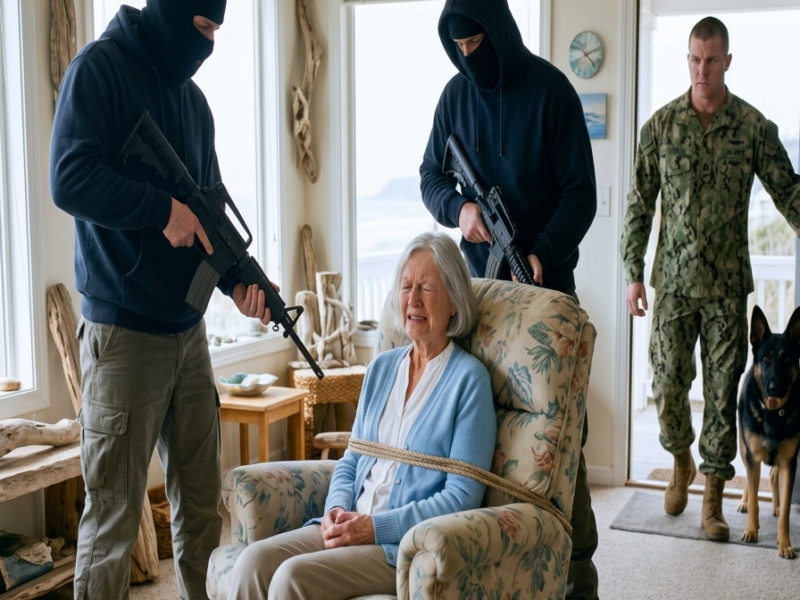
The robbers had tied my elderly mother to a kitchen chair and mocked her trembling hands, laughing as they searched her house
The rain had washed the oak leaves into wet, brown piles along the driveway of my childhood home in Oak Harbor. It was supposed to be a routine Tuesday afternoon—dropping off groceries, checking the latch on the porch door, making sure my mother had taken her medication. But the moment my boots touched the wooden porch, the silence from inside felt heavy, unnatural, and suffocating.
I unlocked the door with my thumb pressing against the familiar brass handle, stepping inside with Atlas at my side. He was a working-line German Shepherd, a ninety-pound mass of sable fur, muscle, and discipline who had spent four years with me in elite maritime counter-terrorism units before we both retired to civilian obscurity. Atlas didn’t trot inside as he usually did. His pads gripped the hardwood, his nose flared, and every hair along his spine stiffened into a rigid crest.
I froze when I saw her.
In the center of the kitchen, under the warm yellow light of the hanging glass shade my father had installed thirty years ago, my seventy-two-year-old mother was bound to a heavy wooden chair. Thick black plastic zip-ties bit deeply into her frail, spotted wrists. Her silver hair was disheveled, and a dark, purplish bruise had already risen across her left cheekbone.
Two men were carelessly opening the kitchen cabinets, pulling out crystal glasses and slamming them onto the counter, while a third stood over her, grinning as he tapped a steel pry bar against the table edge. They were laughing—a hollow, arrogant sound that echoed off the floral wallpaper.
My chest constricted, but the world didn’t go red. When you spend twelve years as a Navy SEAL in Special Warfare Operator Development Group, anger doesn’t make you blind; it turns your mind into a computer running threat vectors at a thousand calculations per second.
“Mom,” I said. My voice was dangerously flat, a low murmur that barely carried across the room.
She looked up, her blue eyes wide, red-rimmed, and swimming with tears. But as her gaze shifted from the intruders to my face, her expression didn’t soften into relief. It twisted into pure terror. She knew what I used to do. She knew what lived beneath the quiet, soft-spoken exterior of the son who now spent his days mending fences and building wooden furniture.
“Please,” she whispered, her voice trembling violently. “Don’t.”
The three men spun around. The tallest one—a broad-shouldered man with a tattooed neck and a greasy baseball cap—stepped forward, resting his hand casually near the waist of his jeans.
“So you’re the son,” he sneered, looking me up and down, taking in my faded flannel shirt, worn work boots, and rain-soaked hair. He missed the calluses on my knuckles, the balanced distribution of my weight on the balls of my feet, and the way my hands hovered precisely three inches from my belt line. “We were wondering when you’d show up to pay your old lady’s debt.”
I looked past his shoulder, fixing my eyes directly on my mother’s bound hands. “Untie her.”
The tall man laughed, a wet, barking noise that was joined by the shorter guy near the stove. “Untie her? You hear this guy? You’re going to give orders in your own house?”
I didn’t answer him. I glanced down at Atlas’s left ear. I didn’t need a word. A single, micro-fractional shift in my shoulders communicated the command.
He understood.
The room changed in an instant. The air pressure seemed to drop as the physical dynamics shifted from a home invasion to an active kill zone.
The short man near the stove lunged first, reaching into his heavy coat for a concealed blade. He was slow, sloppy, and predictable. I stepped inside his reach, my left palm striking the underside of his chin with enough upward force to click his teeth together and snap his head back. Before he could fall, I clamped down on his wrist, twisted it beyond its anatomical joint limit, and sent him crashing face-first against the plaster wall. He hit the floor like a sack of wet salt and didn’t move.
“What the—!” the tall leader yelled, pulling a heavy snub-nosed revolver from his waistband.
Atlas moved faster than human vision could track. The Shepherd launched off the hardwood floor, a ninety-pound missile of muscle and teeth, slamming his chest directly into the leader’s sternum. The impact drove the breath from the man’s lungs with an audible gasp, throwing him backward onto the linoleum. Before the revolver could hit the floor, Atlas’s jaws locked onto the man’s forearm, clamping down with twelve hundred pounds of pressure per square inch. The leader shrieked, a high-pitched sound of absolute panic, as the weapon clattered harmlessly into the corner.
The third man—a wire-thin kid who had been standing near the back door holding a crowbar—didn’t wait to see how the fight ended. He threw the steel bar down, turned on his heel, and sprinted through the screen door into the backyard.
“Atlas, hold!” I barked, stepping over the groaning leader on the floor.
I burst through the shattered screen door into the downpour. The third intruder was scrambling across the mud, aiming for the gap in the cedar fence near the old oak tree where my father used to hang Christmas lights every December. He was fast, but panic makes men clumsy. I closed the distance in four long strides, lowered my shoulder, and drove my entire body weight into his lower back.
We hit the muddy earth together. I drove my knee directly into his kidney, flipped him onto his stomach, and pulled his arms behind his back, locking his thumbs together with a swift, painful mechanical leverage technique.
“Who sent you?” I growled into his ear, driving his cheek into the wet grass. “Who sent you to my mother’s house?”
“I don’t know!” he sobbed, screaming through mouthfuls of dirt. “It was just a job! Some guy in a black sedan paid us two grand to search the basement! He said the house was empty!”
I hauled him up by his collar, dragged him back inside, and zip-tied all three men together around the sturdy copper radiator pipe in the hallway. Within two minutes, the threat was fully neutralized, bound, and bleeding onto the worn floorboards.
I rushed back into the kitchen, dropping to my knees beside my mother. Pulling a serrated combat knife from my boot, I carefully sliced through the thick plastic ties binding her wrists.
“Are you hurt?” I asked, my voice cracking as I gently touched the dark bruise forming on her cheek. “Did they hit you anywhere else, Mom? Tell me.”
She shook her head, pulling her hands free and rubbing her raw, reddened skin. Tears welled in her eyes, spilling over her wrinkled cheeks, but her expression wasn’t one of fear. It was a dark, hollow sorrow that made my skin crawl.
She grabbed my wrist with surprising strength. Her hands were cold.
“They weren’t here for money, Eli,” she whispered, her eyes darting toward the narrow wooden door that led down into the cellar.
I stopped. My breath hitched. “What did they want?”
Her eyes lingered on the basement door, filled with an ancient, agonizing reluctance. “I wouldn’t tell them. They looked everywhere—in the attic, under the floorboards in the living room… but they didn’t find the hatch.”
I stood up slowly, my knife resting loosely in my right hand. “The hatch? Mom, what are you talking about? Dad built a root cellar down there forty years ago. There’s nothing down there except preserve jars and old lawnmowers.”
“I told your father we’d never open it again,” she said softly, her voice trembling like dry grass in the wind. “The day you got accepted into BUD/S… he swore to me that he would take it to his grave.”
My stomach tightened into a knot of cold iron. “Open what?”
She reached into the neck of her sweater, pulled out a small, tarnished brass key hanging from a silver chain, and pressed it into my hand.
Inside the dark hallway, the three bound robbers were whimpering quietly, but the house felt utterly silent. I walked over to the basement door, turned the brass knob, and pushed it open.
The basement smelled like damp earth, cedar, and old memories.
Atlas went down the wooden stairs first, his claws clicking rhythmically against the steps. I followed, flipping the switch for the single overhead bulb that hung from the exposed floor joists. The yellow light threw long, dancing shadows across the concrete floor.
Atlas walked past the workbench, past the old rusted bicycles, and stopped directly beside a heavy, locked metal cabinet that sat tucked behind a wall of stacked firewood. It was an old military surplus locker, painted olive drab, rusted at the corners.
My mother followed slowly down the stairs, leaning on the wooden banister, watching me with tears streaming down her face.
“I tried to protect you from it, Eli,” she murmured. “When you retired… when you came home alive… I thought the war was finally over for our family.”
My fingers trembled slightly as I inserted the brass key into the padlocked latch of the metal cabinet. The lock clicked open with a heavy metallic snap. I pulled open the steel doors.
Inside lay a heavy, weather-beaten Pelican case, covered in dust and scratched with decades of wear. Across the top lid, written in white stencil paint, was my own name:
MASTER CHIEF ELI VAUGHN – NSWG-2
I stared at it, my brain refusing to process the image. “I’ve never seen this before,” I whispered. “I kept all my deployment gear in the storage unit in Virginia. How does Dad have my container?”
“Your father left it before he died,” Mom’s voice broke. “He brought it home three days after your team’s final deployment in Syria. The deployment where you were wounded.”
I reached down and flipped the heavy plastic latches of the case. The air inside the case was dry, smelling faintly of gun oil and old paper.
Inside lay a single yellowed photograph resting on top of an encrypted tactical drive.
I picked up the photograph. It was a squad photo, taken twelve years ago under the blazing sun of a tarmac in Djibouti. Eight men in desert camouflage, arms draped over each other’s shoulders, grinning at the camera. My old SEAL team. Red Squadron. Every face was painfully familiar—men I had bled with, men I had buried, brothers whose names were carved into black granite back in Virginia.
Except one.
The man standing on the far right, slightly behind my shoulder, had been intentionally erased. His face was completely blacked out with thick, dark permanent ink.
Directly beneath the photograph, written in my father’s precise, draftsman handwriting, was a short, devastating note:
One of them betrayed you. It wasn’t an ambushed extraction. It was an execution.
I felt the air leave my lungs, as if a physical blow had struck my chest. My hands shook so hard the photograph rattled against the plastic case. The deployment in Syria—the operation at the Euphrates river basin that had left three of my team members dead and forced me into medical retirement—had been classified as a intelligence failure. A golden BB. A lucky enemy mortar strike.
Mom touched my shoulder gently, her hand trembling. “They came here today because your father discovered who it was before he died, Eli. He was looking into the offshore accounts linked to the contractor group. He found the paper trail.”
I stood frozen in the dim yellow light of the basement, the foundations of my entire life crumbling around my feet.
Suddenly, Atlas let out a low, gut-wrenching growl, his eyes fixed on the small, high cellar window that looked out toward the street.
I looked up through the dusty glass.
Parked directly across the wet street, shrouded in the falling rain, was a dark, non-descript sedan. As I watched, its headlights flickered off, plunging the car into shadow.
Mom whispered from the stairs, her voice laced with absolute terror: “They’re still watching us.”
I closed the Pelican case with a sharp clack, pulled my phone from my pocket, and prepared to dial the local sheriff. But as my thumb hovered over the screen, my eyes caught something small, barely visible, scratched with a sharp knife into the corner of the photograph directly beside the blacked-out face.
It wasn’t a stranger’s name. It wasn’t an enemy commander.
It was my own name—ELI—scratched into the ink, followed by three digits: 001.
The realization didn’t hit like a lightning bolt; it descended like a heavy iron cage, locking around my ribs until I couldn’t breathe.
My father hadn’t just kept a secret from me; he had spent the final two years of his life investigating the very unit I had bled for. And whoever had blacked out that face in the photograph hadn’t just hidden an enemy—they had marked me as the primary target.
“Mom, get upstairs,” I said, my voice dropping into the icy, detached tone of an operator entering a hostile compound. “Go into the pantry, lock the door, and do not open it unless you hear my voice.”
“Eli, please—”
“Go. Now.”
She didn’t argue. The authority in my voice left no room for motherly concern. She scrambled up the wooden stairs, her soft slippers slapping against the treads, and the heavy oak door clicked shut above us.
I looked down at Atlas. The Shepherd’s body was coiled like a steel spring, his amber eyes locked onto the narrow basement window. Outside, through the rain-streaked glass, the black sedan sat motionless under the dim streetlights of our quiet suburban road.
I picked up the weathered Pelican case, tucked it under my arm, and moved back up the stairs into the kitchen.
The three bound home invaders were still sitting on the floor in the hallway, their eyes wide with terror as they watched me emerge from the cellar. The leader with the bloody forearm cowered against the radiator pipe, his confidence entirely gone.
“Who’s in the sedan?” I asked, stepping over him and leaning my face inches from his.
“I—I don’t know, man! I swear!” he stammered, his eyes darting frantically toward the front door. “We were just the muscle! Some guy met us at a diner in Everett! He gave us five hundred up front and promised five grand if we brought him a blue hard drive from the house!”
“What did he look like?”
“Tall. Broad shoulders. Wore a dark trench coat and had a nasty scar running down his neck… like a burn mark.”
My stomach dropped another notch.
Miller.
Miller had been our squad’s point man in Red Squadron. He was supposed to have died in the vehicle explosion outside Manbij twelve years ago. I had helped carry his flag-draped casket onto the C-17 at Ramstein Air Base myself.
I didn’t waste another second. I grabbed a roll of heavy duct tape from my father’s toolbox under the sink, bound the three men’s mouths and ankles, and pulled them into the walk-in coat closet, locking the door from the outside.
“Atlas, heel,” I whispered.
We slipped out the back door into the rainy dark, avoiding the pool of light from the kitchen window. The rain was coming down harder now, a cold Northwest downpour that drummed against the cedar shingles and washed the mud down the driveway. I moved along the perimeter of the house, staying low beneath the azalea bushes, using the shadows of the fence to flank the position of the black sedan parked across the street.
The car sat fifty yards away, its engine idling with a low, wet rumble. Exhaust curled up into the rain-slicked air. Through the tinted driver-side window, I could see the silhouette of a single man, his head turned slightly toward my mother’s front porch.
I approached from the rear blind spot, moving with the soundless, fluid gait I had practiced through hundreds of night-tactical operations. Atlas moved beside me, a shadow within shadows, not making a single sound despite the wet asphalt under his paws.
I reached the rear bumper of the sedan. In my right hand, I held my heavy steel tactical flashlight; in my left, my open combat knife.
I didn’t knock on the window. I slammed the steel bezel of the flashlight directly into the center of the driver-side glass.
CRASH.
The tempered glass shattered into ten thousand tiny cubes. Before the driver could react, I reached through the broken frame, grabbed him by his heavy leather collar, and dragged his head violently out through the window frame, pinning his throat against the jagged glass edge of the door.
“Don’t move,” I rasped, pressing the cold steel tip of my knife directly against the soft skin beneath his jawbone.
The man gasped for air, his hands flying up to grip my wrist, but his strength was nothing compared to the leverage I held over him. The interior light of the car flickered on, revealing a face I hadn’t seen in over a decade.
It wasn’t Miller.
It was Vance—not the Colonel from my previous military career, but his younger brother, Thomas Vance, who had served as a civilian intelligence analyst attached to our task force in Djibouti. He was older now, his hairline receding, his eyes bloodshot and rimmed with deep black circles of exhaustion.
“Eli…” he choked out, his throat pressed hard against the door frame. “Eli… don’t… please…”
“Give me one reason why I shouldn’t sever your carotid right now, Vance,” I said, my voice completely devoid of emotion. “You sent three scumbags to brutalize my mother.”
“I didn’t send them to hurt her!” Thomas gasped, tears mixing with the rain streaming down his face. “I sent them to find the drive before they did! I was trying to save you!”
“Save me?” I spat, tightening my grip until his face turned a mottled red. “You’ve been monitoring my mother’s house! You have a file on my family!”
“Because your father found the truth!” Thomas cried out, his voice cracking with pure terror. “Your father figured out that Red Squadron wasn’t ambushed by insurgents! The order came from inside the Pentagon, Eli! The entire team was marked for liquidation because of what you recovered from the vault in Manbij!”
I held him there for three long seconds, listening to his ragged breathing, watching his pupils dilate with genuine fear. He wasn’t a field operative; he was a pencil-pusher who was way out of his depth, trembling in the rain while a retired operative held a blade to his neck.
“Get out of the car,” I ordered, releasing his collar and stepping back.
Thomas scrambled out of the broken window frame, tumbling onto the wet asphalt, coughing violently as he clutched his throat. Atlas stood over him, a low, rumble vibrating in the dog’s chest that made Thomas freeze instantly on his hands and knees.
“In the house. Now,” I said, gesturing with the flashlight.
Two minutes later, Thomas Vance was sitting in a wooden kitchen chair across from where my mother had been bound thirty minutes earlier. He was shivering violently, wiping rain and blood from a small glass cut on his cheek with a paper towel I had tossed at him.
I set the Pelican case on the table between us, popping the latches with two loud, echoing snaps. I pulled out the blacked-out photograph and slapped it down in front of him.
“Explain this,” I demanded. “Why is my face scratched out? Why did my father have a note saying one of my brothers betrayed us?”
Thomas looked at the photograph, his hand trembling as he touched the ink-stained surface.
“Your father came to my office in D.C. two years ago,” Thomas whispered, his voice shaking. “He was a former military engineer, Eli. He knew how to read satellite telemetry. He spent three years requesting classified casualty reports through FOIA requests, pulling threads that no one expected a grieving father to pull.”
“What did he find?”
“He found that the emergency beacon sent from your squad’s position in Syria didn’t originate from an enemy mortar strike,” Thomas said, looking up at me with eyes full of dread. “The beacon was manually activated from inside your own command vehicle ten minutes before the first shell hit.”
The room seemed to tilt beneath my feet.
“That’s impossible,” I said softly, though the ice in my chest was spreading to my hands. “I was the team leader. I had the only encryption key for that beacon.”
“You were knocked unconscious by the initial concussive breach, Eli,” Thomas said. “Someone took the key from your tactical vest, activated the beacon to draw enemy fire directly onto your position, and then wiped the telemetry logs from the main server.”
“Who?” I roared, slamming my fist onto the wooden table so hard the glass shade above us rattled against its chain. “WHO TOOK THE KEY?”
Thomas swallowed hard, his eyes dropping to the photograph lying between us.
“Look closely at the ink on the blacked-out face, Eli,” Thomas whispered. “That’s not marker ink. That’s chemical-grade industrial lacquer. Your father didn’t black out that face to hide the traitor.”
Thomas reached into his jacket, pulled out a small glass vial of solvent, and tipped a few drops onto the edge of the photograph. He took a paper napkin and gently rubbed the dark surface.
The black lacquer began to dissolve, melting away in dark purple smears.
Beneath the ink, the face of the man standing beside my shoulder emerged into the dim light of the kitchen.
My heart stopped beating.
The face in the photograph wasn’t Miller. It wasn’t Vance. It wasn’t any of the dead men I had mourned for twelve years.
It was my own face.
I stared down at the wet paper. The face smiling back at me from twelve years ago was undeniably mine—younger, unscarred, wearing the desert camouflage of Red Squadron, standing shoulder-to-shoulder with men who were now six feet under the earth.
“This is a fake,” I said. My voice was dangerously low, almost a whisper, but it carried enough edge to make Thomas pull his hands back from the table. “I know my own team. I was standing on the left side of the frame when this photo was taken at Camp Lemonnier.”
“You were,” Thomas said, his hands shaking as he pointed to the left side of the photograph, where my original image still remained. “Look at the photo, Eli. Look at it.”
I looked closer.
There were two of me.
On the left side of the squad stood Master Chief Eli Vaughn—the man I believed myself to be, holding an M4 carbine, smiling at the camera. And on the far right, standing half-concealed in the shadow of the command tent, was an identical face. Same jawline. Same pale blue eyes. Same thin, surgical scar running along the right side of the collarbone.
“A twin?” I asked, my mind struggling to build a rational bridge across the impossibility staring back at me. “My father… my mother never had another child.”
“Not a twin,” Thomas whispered, leaning forward, his voice barely audible over the sound of the rain beating against the kitchen window. “A ghost. A classified asset created under Operation Janus in 1998. Your father didn’t just work as an engineer for the Navy, Eli. He was the chief technical officer for the biometric cloning and black-budget identity duplication program run out of the Naval Surface Warfare Center in Crane, Indiana.”
The silence in the kitchen became absolute. The only sound was the slow, steady drip of water from Thomas’s rain-soaked jacket hitting the linoleum floor.
“You’re out of your mind,” I said, stepping back from the table, my hand instinctively resting on the grip of my combat knife. “This is a psychological operation. You’re trying to disorient me.”
“Am I?” Thomas challenged, his terror suddenly giving way to a desperate, manic intensity. “Ask your mother! Ask her why your medical records from BUD/S training in 2004 are classified under Level 5 National Security clearance! Ask her why your blood type changed after your second deployment in Iraq! Ask her why your father retired three months after you were accepted into the Special Warfare Group!”
I turned slowly toward the hallway.
My mother was standing in the doorway of the kitchen. She had come out from the pantry, her face pale as bone, clutching her faded wool cardigan tightly across her chest. She wasn’t looking at Thomas. She was looking at me, her blue eyes filled with an unbearable, agonizing grief.
“Mom?” I asked, my voice cracking like a child’s. “What is he talking about?”
She didn’t speak for a long time. She walked slowly into the room, her slippers dragging against the floorboards, and sat down in the wooden chair beside the table. She reached out with a trembling, spotted hand and touched the edge of the altered photograph.
“We loved you so much, Eli,” she wept softly, her tears falling onto the glossy paper. “From the very first day they brought you home to us when you were six years old… you were our son. We never cared where you came from.”
The floor beneath me seemed to dissolve into hollow space. “Brought me home? I grew up in this house! I have memories of fishing on the pier when I was five! I have memories of breaking my arm on the oak tree in the yard!”
“Implanted memories,” Thomas said softly, though his tone was no longer aggressive—it was filled with pity. “Janus didn’t just duplicate physical assets, Eli. They needed operators who had deep, unshakeable civilian roots—men who wouldn’t break under torture because they believed they had a home, a family, a real life to fight for. The real Eli Vaughn died in a training exercise at Coronado in 2001.”
My breathing became shallow, rapid, like a diver running out of air at a hundred feet. “No. No. That’s impossible. I remember the pain. I remember my father holding my hand in the emergency room—”
“Your father built the memory matrices,” my mother sobbed, reaching out to grab my hand, but I flinched, pulling my arm back as if her touch burned me. “He was part of the research team, Eli! But as you grew up… as he watched you play baseball, watched you graduate, watched you become a man… he couldn’t do it anymore. He fell in love with you as his real son. He tried to pull you out of the program before Red Squadron was deployed to Syria!”
“And when he tried to pull you out,” Thomas added, “the Directors decided to burn the entire asset line. Syria wasn’t a mission to eliminate an insurgent leader, Eli. Syria was a cleanup operation to liquidate Red Squadron and destroy the Janus asset—you—before your father could go public with the program.”
“Then who survived?” I asked, my hands clenching into tight fists until my knuckles turned white. “If I’m here… who was the second face in the photo?”
“Subject Zero,” Thomas said, his face darkening with intense fear. “The original operator from whom your physical template was taken. He didn’t die in Syria either, Eli. He was the one who took the encryption key from your vest. He was the one who activated the emergency beacon that called the mortar strike down on your team.”
“Why?”
“Because he wanted to be the only one left,” Thomas whispered. “He spent twelve years hunting down every doctor, every engineer, and every officer who worked on Operation Janus. Your father was the last civilian engineer on his list.”
A cold realization swept through my veins, freezing the chaotic panic in my mind into a sharp, singular focus. The home invaders sitting locked in my coat closet hadn’t been sent by Thomas Vance. They hadn’t been sent by a rogue contractor group.
They were a tracking team, sent to flush out any remaining documentation before Subject Zero arrived to finish the job himself.
Suddenly, Atlas let out a fierce, blood-curdling bark, spinning toward the front entrance of the house.
BANG.
The power to the entire house died instantly. The kitchen overhead light vanished, plunging us into absolute blackness. The ambient hum of the refrigerator stopped. Outside, the steady drone of the rain seemed to intensify in the sudden darkness.
From the front porch came a sound that made my hair stand on end.
Three slow, deliberate footfalls against the wooden porch steps. Heavy combat boots. Wet rubber soles.
Step.
Step.
Step.
Then, a voice spoke through the darkness—a voice that was terrifyingly identical to my own, carrying the exact same cadence, the exact same raspy timbre, and the exact same low Pacific Northwest accent.
“Eli,” the voice called out softly from the front porch, sounding through the thin wood of the door. “Open the door, brother. Let’s finish what Dad started.”
In total darkness, the sensory hierarchy of a trained operator shifts instantly from sight to sound and air pressure.
I didn’t panic. The existential shock that had threatened to tear my mind apart seconds ago vanished, replaced by the instinct that had kept me alive across a hundred hot landing zones. It didn’t matter if my memories were real or implanted; it didn’t matter if my name belonged to a dead boy in Coronado. What mattered was the woman crying softly in the dark behind me, the dog at my hip, and the intruder standing on my front porch.
“Mom, get under the heavy oak table in the dining room. Stay flat,” I commanded softly.
“Eli…” she whimpered.
“Do it now.”
I moved through the dark kitchen, my hand reaching for the tactical vest I had stored inside the Pelican case. I pulled out my suppressed Sig Sauer P226, racking the slide with a smooth, mechanical clack. I strapped two spare magazines to my belt, hooked my tactical flashlight under my left thumb, and gestured to Thomas.
“You stay behind me,” I whispered into his ear. “If you make a sound that gives away our position, I will shoot you myself.”
Thomas nodded furiously in the dark, his teeth chattering with terror.
Outside, the rain beat a heavy rhythm against the windowpanes. Through the darkness of the hallway, I could see the outline of the front door frame.
There was no sudden breaching charge. No dramatic kicking of the door.
The brass deadbolt on the front door simply clicked. Then, with an agonizingly slow creak, the heavy oak door swung inward, letting in the faint, silvery light of the streetlamps and the cold, wet air of the Pacific Northwest night.
A tall silhouette stood framed in the open doorway.
He wore a dark tactical coat, black cargo pants, and mud-splattered combat boots. In his right hand, held casually at his side, was a suppressed pistol. In his left, he held a heavy steel crowbar, dripping with rainwater.
Atlas didn’t bark. He knew the protocol for an active interior engagement. He dropped low to the floorboards, his body vibrating with tension, waiting for the single word that would unleash him.
“You look well, Eli,” the figure in the doorway said. The voice was so identical to mine that Thomas let out a soft, involuntary gasp from behind my shoulder. “A bit softer than in Djibouti, maybe. The civilian life agrees with you.”
“Subject Zero,” I said, my gun raised, the front sight post aligned precisely between his eyes through the dark haze. “Step back onto the porch.”
The man stepped forward instead. As the faint streetlamp light caught his face, my breath caught in my throat.
It was like looking into a mirror that reflected a nightmare version of myself. He had the same jawline, the same pale eyes, the same build. But where my face bore the soft lines of twelve years of civilian peace, his was a roadmap of violent survival. A long, jagged scar ran from his right ear down into his collar, and his skin had the pale, leathery texture of a man who had lived in the shadows for a decade.
“Subject Zero?” He laughed—a hollow, dry sound that had no joy in it. “Is that what Vance called me? My name is Eli Vaughn. The only Eli Vaughn. You’re just the third copy they printed when the second one lost his nerve in Iraq.”
“You killed our team in Syria,” I said, keeping my weapon steady despite the icy rage blooming in my chest. “You called down the mortar strike on Red Squadron.”
“I liquidated an obsolete unit,” Zero corrected me, taking another slow step into the living room. “Red Squadron wasn’t a team, Eli. They were guards. They were assigned to monitor you and me. Every man on that team was reporting our biometric stress levels back to the Directors every night. Miller? Hayes? They weren’t your brothers. They were your wardens.”
“That’s a lie,” I growled.
“Is it?” Zero smiled, a cruel, mocking curve of his lips. “Why do you think Miller had a secure satellite uplink in his private kit? Why do you think Hayes checked your medical monitors before every jump? They were keeping us in a cage until the project was decommissioned. I broke the lock. I gave us freedom.”
“You murdered our father,” I said, my voice dropping into an icy register.
Zero’s smile vanished. His eyes narrowed, turning as cold and lifeless as granite. “The old man was weak. He built us in a laboratory, gave us fake memories of a fake home, and then spent twenty years crying about his conscience. He came to me in Berlin, begging me to leave you alone. He offered me the master decryption keys to the Janus files if I promised to let you live your quiet little life here in Oak Harbor.”
“And you killed him anyway.”
“He gave you the real life, Eli!” Zero screamed suddenly, his composure breaking into wild, unbridled fury. “He gave you the mother! He gave you the memories of the Christmas lights on the oak tree! He gave you the house, the dog, the quiet woods! And what did he give me? Ten years in a dark box in Ukraine being tested like a lab rat!”
He raised his weapon.
BANG! BANG!
I fired twice through the dark, but Zero had already moved with the terrifying speed of a high-tier operator. He dove to the right behind the heavy leather sofa, his return fire tearing through the plaster wall an inch above my head, showering us with dry dust.
“Atlas, GO!” I roared.
The German Shepherd surged forward into the dark living room, clearing the length of the hallway in two bounds. I heard the crash of the sofa being overturned, the heavy impact of bodies colliding, and a sharp, guttural yell as Zero’s pistol discharged into the ceiling, blowing out the plaster.
BANG!
“Atlas!” I screamed, lunging forward through the dark hallway, my weapon raised.
Zero had pinned Atlas against the overturned sofa, his heavy left arm wrapped around the dog’s neck in a chokehold while his right hand fought to pull a combat knife from his belt. Atlas was twisting violently, his teeth snapping inches from Zero’s face, dragging his claws across the operative’s tactical vest.
I didn’t shoot—the risk of striking Atlas in the dark was too high. I dropped my pistol, stepped inside Zero’s guard, and drove my right elbow directly into his temple.
The impact sounded like a baseball bat hitting a leather bag. Zero’s grip loosened, and Atlas broke free, tumbling backward across the floor, coughing and growling.
Zero rolled with the strike, coming to his feet with fluid, terrifying recovery speed. He didn’t reach for his gun. He drew a eight-inch combat blade from his waist, flipping it into a reverse grip, his pale eyes burning with pure, psychopathic hatred in the dark.
“Let’s see if the copy has the same muscle memory as the original,” Zero hissed, stepping into a low combat stance.
We moved at the same second.
The dark living room became a blur of steel and violence. He slashed low toward my femoral artery; I parried with the heavy flashlight in my left hand, the impact sending sparks flying into the air. I drove a straight palm strike toward his solar plexus, but he slipped the blow, caught my wrist, and drove his shoulder into my chest, crashing us both through the wooden coffee table.
Glass shattered. Splinters tore into my back. We rolled across the floor, fighting for control of the blade between us.
He was stronger than me—his body hadn’t been weakened by twelve years of civilian living, his muscles were dense, hardened by a decade of continuous combat operations. He gained the top position, mounting my chest, driving both hands down onto the hilt of the knife, aiming the tip directly at my throat.
I clamped my hands around his wrists, every nerve in my arms screaming as I fought to keep the sharp steel edge an inch from my skin.
“You’re just a ghost, Eli!” Zero spat through gritted teeth, his face inches from mine, his breath smelling of rain and copper. “You don’t even exist! You’re a fake man living in a fake life!”
“The life…” I gasped, my muscles shaking as the blade edged a millimeter closer to my throat, “…the life might be fake…”
I locked my heels into the floorboards, arched my lower back with explosive force, and threw my hips to the left, throwing his weight off balance.
“…but the family is real!” I roared.
As he stumbled sideways, I reached down, pulled my combat knife from my boot sheath, and drove the steel blade upward into his side, right through the unarmored gap beneath his tactical vest.
Zero gasped, his eyes widening in shock. The knife slipped from his hand, clattering against the shattered glass on the floor.
He stumbled backward, clutching his side, blood dark and thick pooling through his fingers. He looked down at his hand, then up at me, a look of utter disbelief crossing his pale, scarred face.
“You…” he choked out, his knees buckling beneath him.
I stood up slowly, wiping blood from my mouth, my chest heaving as I picked up my suppressed Sig Sauer from the floor. I leveled the weapon directly at his forehead.
“It’s over,” I said.
Zero sat slumped against the base of the overturned leather sofa, his dark coat soaked with blood, his breathing wet and shallow. He didn’t try to reach for a weapon. He just stared up at me, his eyes reflecting the faint, silvery light of the streetlamps filtering through the open front door.
“Shoot me then,” Zero rasped, a bitter, bloody smile spreading across his pale lips. “Finish it. Be the killer they programmed you to be.”
My finger tightened on the trigger. The wall behind him would catch the round. It would take one second. One fraction of an ounce of pressure, and the threat to my mother, my home, and my existence would be permanently erased.
The house was silent, save for the patter of rain outside and Zero’s ragged breathing.
Atlas trotted over, his chest wet with rain and sweat, and pressed his head against my hip, his warm body anchoring me to the present moment. From the dining room, I heard the faint, trembling sound of my mother’s voice calling out through the dark:
“Eli? Eli, are you okay?”
I looked at Zero’s face—the face that was mine, yet filled with nothing but cold, hollow ruin. I looked at his hands, which had known only violence, betrayal, and isolation for twenty years.
Slowly, deliberately, I lowered the safety on the Sig Sauer and reholstered the weapon at my hip.
Zero frowned, a look of genuine confusion crossing his features. “What are you doing? I killed your team. I tried to burn your life to the ground.”
“You want me to be like you,” I said softly, my voice calm and steady. “You want me to prove that we’re just two military weapons built in a lab by men playing God. But my father didn’t just give me fake memories, Zero. He gave me a choice.”
“A choice?” Zero spat blood onto the rug. “You don’t have a choice! They own us! The Department will never stop looking for the Janus assets!”
“They won’t be looking for us,” a voice spoke from the hallway.
Thomas Vance stepped out from the darkness, holding a secure satellite tablet in his hand. The blue glow of the screen illuminated his pale face.
“I just uploaded the complete Janus files, the biometric logs, and the casualty reports from Syria to the Inspector General’s secure server,” Thomas said, looking down at Zero with a mixture of awe and pity. “The program was officially exposed three minutes ago. Federal Marshals are taking the Director into custody in Virginia right now.”
Zero stared at Thomas, his mouth slightly open, his mind struggling to process a reality where the war was suddenly over.
“The Coast Guard and local authorities are two minutes out,” Thomas added, looking at me. “They know there’s a rogue contractor team inside the house. They know you acted in self-defense.”
Distant sirens began to wail through the rainy Oak Harbor night—blue and red lights flashing through the wet pine trees down the road, drawing closer with every second.
I walked over to the dining room, reached under the heavy oak table, and helped my mother to her feet. She was shaking, but as she looked into my eyes, she saw her son—not a clone, not a ghost, not a weapon. Just the boy she had raised in this house.
“It’s over, Mom,” I whispered, wrapping my arms around her shoulders. “It’s finally over.”
She buried her face in my chest, weeping quietly as the red and blue lights of the police cruisers flooded the living room windows, casting long, dancing shadows across the broken glass and shattered walls.
Three weeks later, the rain had cleared, leaving behind a crisp, golden autumn morning across the Puget Sound.
The house on Oak Harbor road was quiet again. The front door had been replaced with solid oak, the glass in the living room was new, and the scent of paint lingered faintly in the air.
I stood in the backyard beneath the giant old oak tree, holding a cup of hot black coffee in one hand. Beside me, Atlas lay in the grass, chewing lazily on a pinecone, his tail thumping softly against the ground whenever the morning breeze rustled the leaves.
My mother came out onto the back porch, carrying a sweater over her arm. She walked down the wooden steps and stood beside me, looking up into the canopy of the oak tree.
“The sheriff called this morning,” she said softly. “The trial for Thomas Vance’s group is set for next spring. They said you won’t need to testify.”
“Good,” I said, taking a sip of the coffee.
“And… the other one?” she asked hesitantly, her voice dropping to a whisper. “Subject Zero?”
“He’s in a federal medical facility in Colorado,” I replied. “High security. Thomas said his wounds healed, but… he doesn’t speak. He just sits by the window, watching the mountains.”
Mom reached out, her cool, gentle hand wrapping around my forearm. She looked up into my eyes, her blue gaze clear, warm, and entirely free of the terror that had filled them three weeks ago.
“You’re my son, Eli,” she said, her voice firm and unshakeable. “I don’t care about paper files in Washington. I don’t care about laboratories. You are the boy who cried when you scraped your knee under this tree. You are the man who came home to protect his mother.”
I looked at the rough bark of the oak tree, where a small, faint scar in the wood showed where my father had pounded a iron hook twenty years ago to hold the Christmas lights. I touched the bark with my thumb, feeling the rough texture under my skin.
“I know, Mom,” I said, smiling down at her as the crisp morning sun broke through the clouds, warming the wet grass beneath our boots. “I know.”
Atlas stood up, shook his dark fur, and trotted off toward the fence line, chasing a squirrel through the fallen leaves. I walked back toward the house with my mother, leaving the ghosts of the past buried where they belonged—in the dark earth beneath the wet Washington sky.
The end.









