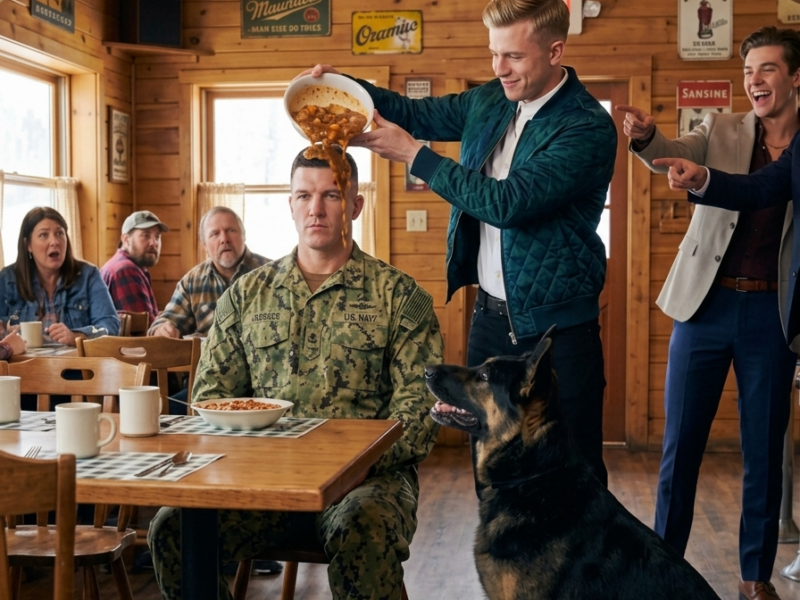
The rich kids laughed when they dumped a bowl of steaming chili over my head and my German Shepherd outside a Dallas steakhouse, but when they saw my dog freeze
The autumn wind whipping down Commerce Street carried the scent of woodsmoke, charred ribeye, and the metallic tang of an impending Texas thunderstorm. The neon glow of The Sovereign Oak, an upscale downtown Dallas steakhouse known for valet lines filled with European exotics and high-dollar lobbyists, spilled across the wet limestone pavement like spilled amber wine.
I was sitting on the low decorative retaining wall fifty yards down the block, where the light from the patio lanterns thinned out into cold gray shadows. My knees ached—a deep, rhythmic throb courtesy of three surgical pins in my right patella and four fragments of an Iranian-manufactured mortar shell lodged against my hip bone.
Ghost sat at my left boot, his broad chest pressed firmly against my shin.
He was a hundred-pound German Shepherd with a coat the color of smoked ash and iron. Across the bridge of his snout ran a jagged pink scar where a jagged shard of corrugated tin had clipped him during an extraction in the Kunar Valley. His left ear was notched, and the fur around his haunches was thin from old skin grafts. He didn’t wear a vest with high-visibility service patches. He wore a simple, unadorned collar made of heavy-duty olive-drab tubular nylon, fastened with a matte-black forged alloy buckle. To anyone passing on the Dallas sidewalk, he was just a battered, oversized dog belonging to a battered, quiet man wearing a faded canvas field jacket and scuffed work boots.
The laughter came from the restaurant’s outdoor patio first—a sharp, brassy sound fueled by high-end bourbon and unearned arrogance.
Four teenagers stepped off the curb near the valet stand. They were seventeen or eighteen, dressed in designer fleece pullovers, tailored denim, and sneakers that cost more than my monthly veteran disability check. The tallest of them, a blond kid with an athletic build and a heavy gold signet ring on his pinky finger, was carrying a heavy white ceramic bowl filled to the brim with takeout chili. Steam drifted off the thick red surface, carrying the sharp sting of cayenne and hot fat.
I didn’t look at them. Over fifteen years in Naval Special Warfare—ten of them with the Development Group—I had learned that ninety percent of civilian conflict can be avoided simply by looking at the ground and letting fools pass by. When you have spent half your life walking through rooms where every shadow might hide a suicide vest, teenage posturing in front of a steakhouse doesn’t register as a threat. It registers as noise.
“Hey, look at this bum,” the blond kid said, his voice loud enough to turn heads among the valet drivers. “Hey, old man. You look like you’re starving. Want some real food?”
I kept my eyes fixed on the puddle between my boots. “No thank you. Have a good evening.”
“Hear that, Carter?” one of the other boys sneered, pulling out an iPhone with a sleek carbon-fiber case. “He’s too proud for leftover brisket chili. Thinks he’s too good for The Sovereign.”
“Maybe he just needs a bath,” the boy named Carter said.
He didn’t stumble. He didn’t trip. With a deliberate, flicking motion of both wrists, Carter inverted the heavy ceramic bowl right over my head.
The ceramic rim struck my left clavicle with a dull, heavy thud before shattering against the limestone flagstones. The chili—boiling hot, thick with beef tallow and hot chiles—cascaded over my shoulder, soaking through the canvas of my collar, burning the side of my neck, and splashing across Ghost’s spine and flank.
The world stopped.
In my mind, for a terrifying fraction of a second, the smell of burnt beef fat and scorched spices didn’t belong to Dallas. It belonged to an orchard compound in eastern Yemen, where a fuel-air charge had collapsed a cinder-block wall on top of my assault team, the heat blistering our exposed flesh before the dust even settled.
Ghost went completely rigid.
He didn’t lunge. He didn’t snarl. His entire muscular frame began to shudder with violent, seismic tremors. It wasn’t pain from the hot grease. I knew that shudder intimately. It was the neurological shockwave of an animal thrown back into the dark—the deep, sensory nightmare of fire, heat, and sudden violence falling from above.
“Easy, buddy,” I whispered, dropping to one knee directly into the puddle of grease and shattered ceramic. “Easy. I’ve got you. Breathe.”
I reached out with trembling, grease-smeared fingers, gently wiping the scalding sauce from his eyes and the matted fur behind his neck. He leaned hard against my chest, his breath coming in short, ragged gasps against my neck.
Carter stepped closer, tossing the broken ceramic fragments into the curb with the toe of his designer shoe. “Look at him,” he laughed, turning toward his friends. “The dog’s shaking like a little bitch! Look at this guy!”
The boy with the camera stepped forward, holding the lens three inches from my face. “Hey, mister. Say something for the stream. Tell everyone how good the chili tastes.”
I looked up slowly. My eyes were cold, flat, and hollowed out.
“What are you going to do?” Carter challenged, puffing out his chest, stepping squarely into my personal space. “Huh? You going to call the cops? My dad owns the law firm that defends the police union, pal. You don’t have a voice here. You’re nothing.”
I rose to my feet with measured, deliberate slowness. My right knee clicked like a ratchet. I stood six feet two, wide in the shoulders, but my posture was loose, slumped, non-threatening.
“Nothing,” I said quietly.
The four boys burst into another round of triumphant laughter. To them, my silence was the ultimate proof of submission. They thought I was a broken drifter who knew his place at the bottom of the food chain. They didn’t know that three years earlier, my hand had controlled thirty-man direct-action strikes against fortified compounds in three hemispheres. They didn’t know that silence wasn’t fear; silence was the safety switch on a weapon that had spent fifteen years being taught how to kill men without hesitation.
“Let’s go, Ghost,” I murmured, taking his nylon lead. “Heel.”
We turned our backs to them, stepping toward the crosswalk.
Behind us, Carter shouted something vulgar about cowards, his voice bouncing off the glass front of the steakhouse.
Suddenly, Ghost froze.
His ears, which had been pinned flat in post-traumatic distress, snapped upright. His head turned forty-five degrees to the west, his nostrils flaring wide as he pulled the wet street air deep into his lungs.
A low, deep, baritone vibration began in the hollow of his chest—a sound so resonant it bypassed the air and traveled straight through the concrete sidewalk into the soles of my boots.
Across the four-lane boulevard, a black Chevrolet Suburban with heavy privacy glass and low-profile government antennas mounted along the roof rack had pulled smoothly against the curb, directly beneath the flickering halo of a broken streetlamp.
The engine idled with a muffled, high-compression hum.
Ghost took three stiff-legged steps forward, dragging the nylon lead taut. His eyes were locked on the Suburban’s rear passenger door with terrifying, unrelenting intensity.
“Ghost, hold,” I ordered, dropping back into the operational cadence of my old unit.
He ignored me. For the first time in five years, my dog broke a command.
The rear door of the Suburban clicked open, the heavy steel hinge groaning as it swung out into the mist.
A woman stepped out.
She wore a dark wool trench coat, her collar turned up against the wind, her chestnut hair cut short to the jawline. Her right cheek was split by a thin, surgical scar that ran from the corner of her eye down to the edge of her jaw—a scar I had seen closed with field sutures in the cargo hold of an MC-130 while flying through zero-visibility turbulence over the Arabian Sea.
My heart stopped beating. The breath died in my throat.
Her name was Dr. Claire Vance.
She had been the senior naval intelligence analyst assigned to Task Force Trident during our final deployment to the Horn of Africa. Three years ago, after our team’s helicopter went down in a swamp basin during an off-the-books reconnaissance mission, the Department of the Navy had declared her killed in action. I had attended her memorial service at Arlington. I had watched her sister receive a folded triangular flag.
Claire stood on the curb, the rain misting her pale face.
She didn’t look at the traffic. She didn’t look at the high-rise towers of Dallas.
She looked across the asphalt, her eyes locking squarely with mine.
Ghost let out a single, piercing whine that shattered into a short bark of recognition. On that terrible night three years ago, when the helicopter burned in the reeds, it was Ghost who had dug Claire’s unconscious body out of the burning tail boom while enemy small-arms fire chewed through the hull.
Claire raised one trembling hand, pointed her index finger straight across the street, and spoke.
Her voice wasn’t loud, but in the hush between traffic lights, the words carried like a gunshot across the wet pavement:
“They told you I was dead, Nathan.”
The world seemed to tilt on its axis.
Behind me, the sound of the teenagers’ laughter abruptly died.
I glanced over my shoulder.
Carter and his three friends were still standing by the valet curb, the iPhone still clutched in the boy’s hand. But the mocking grins had vanished from their faces. Their expressions were frozen in sheer, paralyzed shock.
Because Claire’s finger wasn’t pointing at me.
She was pointing directly at Carter.
“They’re the reason I disappeared,” Claire whispered, her voice tightening with a mixture of terror and white-hot fury. “And they’re the reason your team is in the ground.”
Ghost broke into a violent, protective bark, stepping forward to place his massive body directly between me and the sidewalk behind us.
The chill that hit my spine wasn’t from the autumn wind. It was the sudden, sickening realization that the bowl of chili hadn’t been a random act of teenage cruelty.
It had been a test.
They had been sent to push me. To see if the broken drifter on Commerce Street would flinch, if he would fight back, if he would show the reflexes of the operator who had vanished from the naval rolls three years ago.
Claire stepped off the curb, walked briskly through the stalled traffic, and stopped five feet in front of me. Ghost immediately pressed his wet, chili-stained snout into her open palm, his tail giving one frantic, emotional thump against my thigh.
She didn’t embrace me. She pulled a thick, moisture-sealed manila envelope from beneath her coat and thrust it against my chest.
“Open it,” she said.
My fingers were trembling as I tore the fiber tape.
Inside was a single eight-by-ten gloss photograph taken at night through a military-grade thermal optic. It showed the staging apron at an unmarked landing strip outside Camp Lemonnier, Djibouti. Standing beside our team’s MH-60 helicopter, twenty minutes before we lifted off for our final mission, was Carter’s father—United States Senator Thomas Hayes—surrounded by three private military contractors in sterile sterile-tan gear.
I turned the photograph over.
On the back was a date stamped in red ink: the exact night my team burned.
Beneath the date were six names hand-written in black marker.
Five of them—the five members of my assault element who had died in the swamp—were crossed out with thick red grease pencil.
The sixth name at the bottom of the list was clean. Uncrossed.
Chief Petty Officer Nathan Mercer.
Ghost threw his head back and let out a long, savage war cry of a bark that made every patron on The Sovereign Oak’s patio freeze in terror.
And for the first time in three long, silent years, the ghost that had been sleeping inside my chest opened his eyes.
The rain began to fall in heavy, deliberate drops, washing the greasy red stains from the canvas shoulders of my jacket and carrying the smell of chili into the storm drains.
Across the street, the black Suburban’s engine remained running. Carter and his three friends were slowly backing away from the valet curb, their eyes darting between Claire, my face, and the dog standing rigid between us. Carter’s hand was inside his pocket now, frantically typing on his phone without looking down.
“Get in the car, Nathan,” Claire said, her voice dropping into the low, urgent rhythm of a tactical briefing. “Now. Before Hayes’s security detail realizes the boy failed to draw a violent public response.”
“The boy?” I rasped, my throat raw. “That kid is Thomas Hayes’s son?”
“Carter Hayes,” Claire said, keeping her eyes fixed on the teenager. “His father uses him and his prep-school friends as spotters. Unassuming, rich, completely insulated from police scrutiny. If they provoke a veteran into an assault charge, the target gets locked up in county jail under high bond. And once an uncooperative former SEAL is inside a municipal holding cell, accidents are remarkably easy to arrange.”
I looked at Carter. The boy had stopped retreating. He was standing near the entrance of an alleyway adjacent to the restaurant, his phone held to his ear, his eyes wide and bloodshot with sudden panic.
“Ghost,” I said softly. “Truck.”
Ghost didn’t look back at the boys. He stayed glued to my left heel as Claire and I crossed the wet asphalt, slipping through the late-evening traffic.
The Suburban’s interior was warm, smelling of ozone, leather, and encrypted radio electronics. A man sat behind the steering wheel—broad-shouldered, wearing an unadorned charcoal suit and an earpiece, his face bearing the weathered, leathery look of a retired Green Beret. He didn’t introduce himself. He simply shifted the vehicle into drive the moment Ghost’s paws cleared the rubber floor mats and the heavy doors latched shut.
We turned north onto Central Expressway, accelerating smoothly into the river of taillights heading toward Richardson.
Ghost lay across the carpeted floorboard, his heavy head resting squarely across my combat boots. Claire reached into a small canvas medical kit wedged between the front seats, pulled out a stack of sterile saline wipes, and began gently cleaning the remaining chili sauce from Ghost’s eyes and ears. The dog closed his eyes, leaning his weight into her touch with a soft, shuddering breath.
“Where have you been, Claire?” I asked, staring at the photograph clutched in my grease-stained fingers. “I saw the wreckage report. The navy divers spent three weeks dredging that inlet. They found parts of your flight suit.”
“They found what Hayes’s contractors planted,” Claire replied, her voice trembling with cold rage. “When our helicopter took ground fire over the mangrove swamp, it wasn’t from local militia. It was an anti-aircraft missile fired from a patrol craft leased by a private maritime firm called Redoubt Solutions. Senator Hayes owned forty percent of that firm through an offshore shell company in the Cayman Islands.”
“Why our team?” I asked, my vision blurring at the edges as the faces of my five teammates flashed through my mind: Miller, the sniper who had taught me how to read mirage; ‘Doc’ Alvarez, who carried pictures of his twin daughters taped inside his helmet; Henderson, Diaz, and Kowalski. Men who had survived a hundred close-quarters gunfights only to drown in eight feet of stagnant marsh water.
Claire pulled a second document from her coat. It was a declassified manifest printed on DoD watermarked paper, stamped with red administrative cancellation seals.
“Two days before the crash,” Claire explained, “Task Force Trident was tasked with securing an abandoned logistics depot along the coast. We were told it was an Iranian weapons cache. But when your element breached the inner vault, you didn’t find Kalashnikovs or mortar shells. What did you find, Nathan?”
Memory slammed into me with the physical force of a breaching charge.
“Hard drives,” I whispered. “Four server racks. Sealed in maritime transport cases. We were ordered to leave them intact for the technical exploitation team.”
“Those weren’t Iranian servers,” Claire said, looking directly into my eyes. “Those servers contained the encrypted biometric archives and illegal transaction records for Redoubt Solutions. Senator Hayes was using naval logistics flights to move hundreds of millions of dollars in untraceable foreign military sales into private offshore accounts. Your team was never supposed to enter that vault. A clerical error by junior dispatch put Task Force Trident on the target instead of Hayes’s contracted security.”
She pointed to the photograph in my lap.
“The moment you cleared that depot, your entire squad became a liability. Hayes couldn’t bribe five active-duty SEALs and an intelligence analyst. So he paid Redoubt to bring down the bird on the egress route.”
“And you survived,” I said.
“Ghost found me,” Claire said softly, her hand stroking the dog’s scarred flank. “The fuselage broke in two when we hit the canopy. I was thrown fifty yards into the mangrove roots, pinned beneath the tail rotor gearbox. The water was rising. Ghost had a compound fracture in his rear leg, but he tracked my blood through the swamp water, dug through the mud with his paws until my head was above the waterline, and held my collar until a civilian fishing dory arrived. He saved my life, Nathan.”
Her eyes filled with unshed tears.
“When Redoubt’s search teams arrived at dawn, they recovered the five bodies from the main fuselage, but they couldn’t find mine. The fishermen hid me in a coastal village until I could contact trusted friends inside Naval Criminal Investigative Service. But by then, Hayes had already sealed the incident report. The team was dead. Ghost and you were medically discharged. Hayes thought he had contained the exposure.”
“Then why come after me now?” I asked, looking down at my hands. “I’ve spent three years living in a one-room apartment behind a diesel repair shop in Oak Cliff. I don’t talk to anyone. I don’t even check the mail.”
The driver spoke for the first time, his voice a low, gravelly baritone that rumbled through the vehicle:
“Because Hayes is running for the Senate Armed Services chairmanship next month. The committee is conducting a mandatory full-spectrum background audit. Two weeks ago, the forensic accounting team flagged twenty million dollars in missing naval logistics funds from the Djibouti theater. The investigators started pulling old manifests.”
Claire leaned closer, her voice dropping to a harsh whisper.
“The audit found your discharge file, Nathan. The original after-action report had your signature forged on a statement claiming the helicopter suffered mechanical failure due to pilot error. The forensic auditors noticed the discrepancy between your signature and your enlistment records. They sent a subpoena to Hayes’s office yesterday morning.”
The pieces fell into place with terrifying, mathematical precision.
“Hayes knows the auditors are coming to me,” I said.
“He knows you’re the only living witness who saw the markings on those server racks,” Claire said. “He needs you erased before the committee can depose you under oath. That’s why Carter was outside the steakhouse tonight. They wanted to create a public incident, have you arrested for assaulting a minor, and put you in a cell where Redoubt could stage an overdose or an inmate assault before sunrise.”
Suddenly, the driver’s head snapped toward his rearview mirror.
“We’ve got company,” he said calmly.
Through the rear privacy glass, three sets of high-intensity LED headlights appeared through the rain, closing the distance between our rear bumper at ninety miles an hour.
They weren’t police cruisers. They were matte-black pickups—heavy, armored, with steel replacement bumpers designed for high-speed PIT maneuvers.
Ghost stood up instantly, his front paws braced against the center console, a terrifying, rhythmic growl rising from his chest.
The hunt had come to Dallas.
The driver—whose name Claire quietly whispered was Miller, a former Special Forces warrant officer—didn’t hit the brakes. He slammed his left foot against the firewall, dropped the Suburban’s heavy transmission into third gear, and wrenched the steering wheel hard to the right.
The three-ton SUV lurched across three lanes of traffic, its heavy tires screaming on the rain-slick concrete as we took the exit ramp toward an industrial corridor of warehouses and freight terminals flanking the Trinity River bottoms.
Behind us, the lead black pickup truck didn’t bother using the exit lane. It hopped the concrete divider in a shower of sparks and shredded tires, landing hard on the access road with its high-intensity halogen bars illuminating the interior of our vehicle in blinding, clinical white light.
“Hold on!” Miller shouted.
The impact hit with the force of an artillery round.
The pickup’s reinforced steel bumper slammed directly into our left rear quarter-panel. The Suburban fishtailed violently, metal screeching against metal, sending us careening toward a row of rusty chain-link fences bordering an abandoned rail switching yard.
Ghost didn’t panic.
He didn’t scramble or yelp. In five combat deployments, he had survived vehicle ambushes in Fallujah, Ramadi, and the deserts of eastern Syria. He instinctively dropped his center of gravity, spreading his heavy front paws wide across the floorboard, leaning his eighty-pound frame against my knees to anchor me while his teeth remained bared, snapping at the rear window with cold, calculating fury.
I reached beneath my field jacket, my right hand settling onto the grip of my personal Sig Sauer P226. The steel was cold against my palm, a familiar, deadly comfort.
“Nathan, no!” Claire yelled, grabbing my sleeve. “There are traffic cameras on every pole along this access road! If you open fire on those trucks, Hayes’s public relations team will frame this as an unprovoked terrorist attack by a deranged veteran! They’ll have SWAT clearing this yard in seven minutes!”
“They aren’t trying to arrest us, Claire!” I barked, watching through the shattered rear window as the second pickup pulled alongside our passenger door, its tinted window sliding down to reveal the black muzzle of a suppressed submachine gun. “They’re here to sanitize the site!”
Miller reacted with terrifying professional violence.
Instead of swerving away from the shooter, he cut the wheel violently into the pickup’s flank. The two-ton Suburban became a battering ram, its reinforced rocker panels smashing into the smaller truck’s wheels. The impact sheared the pickup’s steering linkage with a deafening metallic snap, sending the vehicle rolling sideways across the ditch in a violent tumble of shattered glass, fiberglass, and spinning tires.
The lead pickup, however, was heavier.
It surged forward again, its steel cow-catcher ramming our rear tailgate with enough momentum to rupture our fuel tank strap. The Suburban’s rear tires began to shudder, the smell of vaporized gasoline filling the cabin as the vehicle lost traction on the wet mud of the switching yard.
“Out!” Miller roared, bringing the smoking SUV to a skidding halt against the rusted side of an old refrigerated boxcar. “Foot mobile! Move into the freight depot! I’ll draw them toward the rail bridge!”
The doors flew open.
The rain hit us like a wall of ice water. Ghost was the first out, hitting the wet limestone gravel in a low, predatory sprint, his nose sweeping the ground for two seconds before he spun back, placing his body squarely between Claire and the open roadway.
I grabbed Claire’s arm, hauling her through a gap in the rusted corrugated siding of Freight Terminal 4. My knee screamed with agony, the titanium pins throbbing under the impact of the gravel, but the operational adrenaline was burning through my bloodstream like jet fuel, incinerating the pain.
Behind us, Miller slammed the Suburban into reverse, threw a spray of mud into the face of the pursuing truck, and roared down the rail line toward the industrial bridge, leading two of the chasing vehicles away from our position.
Inside the warehouse, the darkness was absolute.
The air smelled of dry grain, machine oil, and fifty years of accumulated pigeon droppings. Broken skylights thirty feet overhead allowed thin shafts of blue moonlight to slice through the blackness, illuminating pools of stagnant rainwater on the cracked concrete floor.
Ghost didn’t make a sound.
He moved ahead of us like a shadow carved from the dark, his paws making no more noise on the wet concrete than falling leaves. Every twenty feet, he would pause, turn his scarred head, and wait until my hand touched the base of his neck before sweeping the next sector.
“Where does this terminal lead?” Claire whispered, her breath coming in ragged, shallow gasps. Her trench coat was torn, her hands smeared with rust and grease.
“Down to the barge canal,” I said, keeping my weapon held at the low ready. “If we can reach the maintenance docks, we can cross the levee into West Dallas. They can’t follow with vehicles across the footpaths.”
Suddenly, Ghost froze.
His front right paw hovered an inch above a pool of water. His ears pinned flat against his skull.
A soft, metallic snick echoed from the catwalk twenty feet above our heads.
The sound was unmistakable: the safety lever of an MP5 submachine gun being clicked from safe to semi-automatic.
“Down!” I roared, throwing my body over Claire as I dove behind a stack of rotted wooden pallets.
A three-round burst chewed through the floorboards where we had stood a fraction of a second before, sending sharp splinters of wet pine into the side of my face.
From the shadows near the loading dock doors, two figures moved in with tactical precision—suppressed weapons held high, thermal optics glowing faint green against their helmets.
They weren’t street punks like Carter. These were Redoubt’s primary shooters: deniable, lethal, and trained to kill without saying a word.
“Target acquired,” a voice whispered over a tactical throat mic, the sound carrying across the hollow room. “Two hostiles, one canine. Commencing terminal clearance.”
Ghost was already gone.
He hadn’t waited for a verbal command. In the close-quarters doctrine of the SEAL teams, an unsuppressed muzzle blast in an enclosed space is an automatic authorization for free-hunt engagement.
A terrifying, blood-freezing scream tore through the cavernous warehouse.
Ghost had circled through the shadow of a derailed hopper car, striking the flank of the lead shooter with ninety pounds of bone-crushing momentum. His jaws clamped down on the contractor’s weapon arm with five hundred pounds of hydraulic pressure, shattering the radius and ulna through the tactical nylon sleeve.
The contractor’s submachine gun clattered to the concrete.
The man swung his free fist, trying to drive a combat blade into Ghost’s ribs, but the dog didn’t fight like a civilian pet. He used his massive neck muscles to whip the man’s center of gravity sideways, slamming the contractor’s head against the steel wheel of the train car with a sickening, hollow thud.
The second shooter spun around, leveling his carbine toward Ghost’s silhouette in the shadows.
“Drop it!” I shouted, stepping out from behind the pallets with my Sig Sauer raised.
The contractor didn’t drop it. He shifted his muzzle toward my chest.
I squeezed the trigger twice.
The double-tap took him squarely in the center of his ceramic chest plate. The kinetic force threw him backward onto the wet concrete, knocking the breath from his lungs before he could squeeze his trigger.
Before he could recover, Ghost was on his chest, front paws planted on the contractor’s throat, teeth hovering a millimeter from his carotid artery, letting out a low, vibrating growl that promised immediate decapitation if the man moved an eyelid.
I walked over, my weapon steady, my eyes cold as slate.
I looked down at the man under Ghost’s paws. Beneath his tactical balaclava, I recognized the face.
It was Vance’s former logistics officer from Djibouti: Major Richard Cole, who had retired two years ago to take the chief of security position at Redoubt Solutions.
“Tell me about the meeting tonight, Cole,” I said, my voice barely louder than the dripping rain. “Why was Carter Hayes outside that steakhouse?”
Cole coughed, blood bubbling at the corner of his lips from a broken rib. He looked up into the yellow eyes of the dog pinned over his throat, his face twisting into a bitter, defeated grimace.
“Carter… Carter wasn’t the spotter, you idiot,” Cole wheezed.
“What do you mean?”
“The senator… the senator isn’t in Washington,” Cole whispered, his voice trembling under Ghost’s breath. “He’s in Dallas tonight. He’s having dinner inside The Sovereign Oak right now with the chairman of the audit committee.”
Cole looked at me, a dying spark of arrogance in his eyes.
“Carter was just the distraction to keep you pinned down on the street while we took your apartment. The senator didn’t just want you dead, Mercer. He wanted the hard drive your dog carried out of that swamp.”
My stomach turned to ice.
“The drive was in the swamp,” I said.
“No, it wasn’t,” Claire said from behind me, her voice trembling as she stepped into the moonlight. “I hid the backup micro-card inside Ghost’s service collar the night the helicopter went down. And Senator Hayes knows it.”
The silence in the freight depot was broken only by the steady drum of rain against the rusted roof and the shallow, whistling breaths of the contractor pinned beneath Ghost’s front paws.
I reached down, my fingers finding the heavy forged buckle of Ghost’s nylon collar.
For three years, that collar had stayed on his neck. I had washed it in fresh water after we ran along the shores of Lake Ray Hubbard; I had dried it by the woodstove in my workshop. I had never taken it off because it was the last piece of military equipment either of us had left from our old life.
I pressed the dual-release tabs on the alloy buckle. The heavy nylon strap fell into my palm.
Claire knelt beside me on the wet concrete, pulling a small multi-tool from her pocket. She slid the flat blade beneath the double-stitched webbing near the D-ring.
With a soft, tearing sound, the nylon parted.
Tucked into a waterproof neoprene pocket sewn directly into the core of the webbing was a military-grade, ultra-dense micro-SD drive encased in hardened titanium shielding—the exact size of a postage stamp.
“Project Cerberus,” Claire whispered, holding the tiny piece of metal in the moonlight. “The complete financial ledger of Redoubt Solutions. Every bribe paid to congressional staff, every illegal arms shipment routed through Djibouti, and the cockpit voice recordings from our helicopter.”
She looked at me, her eyes shining with tears.
“When our bird took the hit, the pilot’s final words on the intercom were recorded: ‘We have an inbound surface-to-air missile from Redoubt’s offshore platform. Code Red. Command has cleared our destruction.’ That recording alone is enough to send Senator Hayes to a federal penitentiary for the rest of his natural life on charges of treason and multiple counts of capital murder.”
I looked down at Cole, who lay motionless beneath Ghost’s watchful stare.
“Who else knows about the collar?” I demanded.
Cole spat a mouthful of dark blood onto the floor. “Nobody… except the senator and Carter. That’s why Carter dropped the chili on your dog, Mercer. He was trying to get you into a physical brawl so two of our plainclothes men could step in, separate you, and slice the collar off the animal while you were being pinned to the sidewalk.”
He gave a dry, rattling cough.
“The kid panicked when the dog didn’t fight back. You were supposed to lose your temper. You were supposed to act like a violent vet. When you walked away, Carter called his father directly. The senator gave the scrub order from his table inside the restaurant.”
I looked at my watch. It was 9:45 PM.
“How long is Hayes staying at The Sovereign Oak?”
“The dinner ends at ten,” Cole whispered. “His private jet is fueled and waiting at Love Field. If he gets on that plane with the audit chairman, the committee report will be signed before dawn, the investigation will be officially buried under national security redactions, and a federal warrant will be issued for your arrest as the primary suspect in the Al-Qaim logistics theft.”
I stood up slowly, the titanium pins in my knee screaming with every inch of vertical movement.
The rain had soaked through my clothes, chilling me to the bone, but inside my chest, the cold, dead vacuum of the last three years was completely gone. The phantom limb pain, the nightmares, the endless, hollow guilt of surviving when better men had died—all of it burned away into a clean, singular, terrifying focus.
“Get up, Cole,” I said.
The contractor groaned, struggling to his feet while Ghost shadowed his every twitch, his teeth bared in silent warning.
“Claire,” I said, turning to the analyst. “Can you patch that micro-card into the federal investigative network from Miller’s terminal in the Suburban?”
“Miller set up a secondary satellite node in the cargo bay,” Claire said, nodding firmly. “If I can get three minutes of clean signal, I can upload the raw audio files directly to the Department of Justice’s public integrity portal and the Inspector General of the Navy.”
“Do it,” I said.
“What are you going to do?” she asked, her voice tight with sudden concern as she looked at my face.
“I’m going to return a bowl of chili,” I replied.
Ten minutes later, we were moving back across the Trinity River levee.
Miller had survived the pursuit—his heavy Suburban had disabled the remaining chase vehicle by forcing it into a concrete bridge abutment before circling back to our extraction point. The truck was battered, its panels scarred and smoking, but the engine held together with the stubborn durability of military-spec steel.
While Claire sat in the rear seat, her fingers flying across the glowing keyboard of the encrypted field laptop, Ghost sat between the front seats, his nose pressed against the defroster vent, watching the Dallas skyline rise through the rain like an iron tomb.
I looked at him in the amber glow of the dash.
“One more mission, boy,” I whispered.
Ghost turned his head, looked directly into my eyes, and gave one low, affirmative chuff.
The scars on his face caught the passing city lights—the pink line across his nose, the notched ear, the graying fur around his muzzle. We were old, broken, discarded relics of an unacknowledged war, forgotten by the people who dined in four-hundred-dollar-a-plate steakhouses behind glass walls.
They thought our silence was an apology for existing.
They were about to find out it was mercy.
The black Suburban turned off the expressway, cruising smoothly onto Commerce Street.
Outside The Sovereign Oak, the rain had thinned to a fine mist. The line of European sports cars was still idling along the curb, their exhaust pipes sending white plumes into the cool air. Standing under the brass awning of the restaurant’s main entrance, surrounded by four private security guards in tailored dark suits, was Senator Thomas Hayes.
He was a tall, silver-haired man of sixty, wearing a bespoke three-piece wool suit, a heavy cashmere scarf draped over his shoulders, and a smile that had appeared on every Sunday morning news broadcast for twenty years. Beside him was Carter, his face still pale, his hands shoved deep into his fleece pockets, shifting his weight nervously from foot to foot.
They were waiting for their limousine to pull up from the underground garage.
Miller killed the Suburban’s headlights thirty yards out, letting the vehicle glide silently against the curb directly behind the senator’s security perimeter.
“Claire,” I said quietly. “Is the file up?”
She hit the return key with a decisive, mechanical click.
A green progress bar flashed on the screen: UPLOAD COMPLETE. RECIPIENTS: US DOJ PUBLIC CORRUPTION DIVISION / DOD INSPECTOR GENERAL / THE WASHINGTON POST INVESTIGATIVE DESK.
“It’s live, Nathan,” Claire whispered, her voice shaking. “Every newsroom and federal prosecutor in Washington has the voice recordings right now.”
I unlatched my door.
“Ghost,” I said, my voice dropping into the command tone that fifteen men had followed through the dark across five countries. “On me.”
The brass lanterns along the facade of The Sovereign Oak cast a warm, golden glow across the wet limestone pavement, turning the drizzle into falling embers.
Senator Thomas Hayes was laughing with an older gentleman in a tuxedo—the audit committee chairman—clapping the man on the shoulder with that effortless, patrician warmth that had bought him three terms in the United States Senate and fifty million dollars in off-book foreign defense contracts.
“I assure you, Arthur,” Hayes was saying, his voice rich, cultured, and perfectly modulated for the microphone, “the discrepancies in the Horn of Africa accounts were nothing more than clerical oversights during the transition to civilian contractor logistics. My office has already initiated a comprehensive internal review. By Monday morning, your committee will have every document you need to clear the nomination.”
“That’s good to hear, Thomas,” the older man replied, stepping toward an idling Town Car. “We need steady hands on the armed services gavel. There are too many loose ends in the Middle East.”
“No loose ends, Arthur,” Hayes said smoothly. “Everything is contained.”
“Not everything, Senator,” a voice said from the shadows of the awning.
The laughter died instantly.
The four private security guards reacted with immediate, professional speed, their hands moving inside their suits toward their shoulder holsters. Carter, standing two paces behind his father, let out a sharp, strangled gasp, his face draining of color until he looked like a corpse in a tailored fleece.
I stepped into the light of the brass lanterns.
I was still wearing my grease-stained, chili-splattered canvas jacket, my torn denim trousers, and my scuffed combat boots. My knuckles were bruised, my right knee dragged slightly with every step, and the side of my face was streaked with soot and dried blood from the freight depot.
And walking beside my left knee, his pace slow, measured, and terrifyingly deliberate, was Ghost.
He wasn’t on a lead. He wore no collar. He moved with that low, fluid, predatory stride that had cleared sixty-two rooms in the Helmand, his amber eyes fixed not on the security guards, not on Carter, but squarely on the center of Senator Hayes’s chest.
“Who the hell are you?” one of the guards snapped, taking a step forward to block the entrance. “Back off, drifter. Move along before we have the police throw you in a drunk tank.”
“Step aside, son,” I said, my voice quiet, flat, and carrying that specific, unnatural resonance that makes armed men hesitate. “This isn’t your fight.”
“Mercer,” Senator Hayes whispered.
The name barely made it past his lips. His patrician smile didn’t just fade; it disintegrated into an expression of sheer, disbelieving horror, as if a ghost had literally walked out of the red clay of the Yemen swamps and stepped onto Commerce Street.
“You’re dead,” Carter choked out, pointing a trembling, manicured finger at my chest. “They… they said you were taken care of at the depot!”
“Your contractors are in zip-ties inside Freight Terminal Four, Carter,” I said, looking at the boy. “And your father’s offshore accounts just hit the front page of the Washington Post.”
The audit committee chairman froze, his hand on the door handle of his Town Car, his eyes darting between my scarred face, the senator, and the dog standing in the center of the sidewalk.
“Thomas?” the chairman asked, his voice hardening with sudden, sharp suspicion. “What is this man talking about? Who is this?”
“He’s a deranged veteran, Arthur!” Hayes stammered, his composure cracking like thin ice over a black lake. He stepped backward toward the restaurant’s glass doors, his hands raised in front of him. “He’s been stalking my family for months! He’s mentally unstable! Guards, neutralize him! Neutralize that animal right now!”
The two lead security guards drew their sidearms—custom Glocks with laser modules—raising the muzzles toward my chest.
Ghost didn’t wait.
With a high-pitched, explosive bark that shattered the quiet of Commerce Street like a grenade, Ghost launched himself across the limestone flagstones.
He didn’t bite. He didn’t tear flesh. He hit the primary guard with ninety pounds of solid, unyielding muscle right at the hip line, sending the two-hundred-pound security man crashing backward into the plate-glass window of The Sovereign Oak. The heavy acoustic glass cracked in a massive, spiderweb pattern with a sound like a rifle shot.
The guard’s weapon clattered harmlessly across the wet pavement, kicking sparks into the gutter.
The second guard hesitated, his gun wavering between Ghost and me.
I closed the distance in two strides.
My left hand caught the guard’s wrist, twisting the firearm outward until the tendons snapped, while my right palm drove upward into his sternum with thirty years of muscle memory. The breath exploded from his lungs, his knees buckling as he collapsed into the ornamental planters flanking the entrance.
The remaining two guards took one look at my eyes, looked at the dog standing over their fallen teammate with teeth bared and hackles raised like black iron spikes, and took two deliberate steps backward, their hands held wide and empty in the air.
Silence fell over the street.
The valet drivers stood frozen beside their sports cars. The wealthy patrons inside the steakhouse were pressed against the cracked glass, their faces pale with shock.
Senator Thomas Hayes stood pressed against the mahogany doors of the restaurant, his expensive cashmere scarf dangling in the mud, his chest heaving with short, terrified breaths. Carter had dropped to his knees beside him, weeping openly, his face buried in his hands.
I walked up to the senator, stopping twelve inches from his face.
Ghost trotted over, his broad paws clicking against the wet stone, and sat down squarely on the toes of Hayes’s polished Italian leather shoes. The dog didn’t growl. He simply leaned his heavy, scarred head against the senator’s shin, looking up into his face with amber eyes that had seen fifty men die in the dark.
“Three years, Senator,” I whispered.
Hayes was trembling so violently that the gold signet ring on his finger was chattering against the brass door handle.
“Mercer… listen to me,” Hayes begged, his voice dropping into a pathetic, desperate whine. “I can make this right. I have twenty million dollars in a blind trust in Zurich. It’s yours. All of it. You can buy whatever life you want. You can disappear. Just tell the committee the recordings were an operational misunderstanding.”
I reached inside my canvas jacket.
Hayes flinched, squeezing his eyes shut, anticipating the cold steel of a pistol barrel between his eyebrows.
I didn’t pull a weapon.
I pulled the white ceramic fragment—the jagged piece of the chili bowl Carter had shattered across my shoulder an hour ago.
I reached out and took Hayes’s trembling right hand. I placed the broken ceramic piece into his palm, closing his expensive, manicured fingers around the cold, grease-stained clay.
“Give this back to your boy,” I said softly.
Across the street, the night was suddenly torn apart by the synchronized wail of federal sirens.
Four unmarked black sport utilities and three cruisers from the Dallas Police Department’s tactical division turned the corner off Main Street, their blue and red strobes painting the limestone walls of the steakhouse in sweeping strokes of crimson and sapphire.
From the lead SUV stepped two special agents from the Federal Bureau of Investigation, their credentials held high, their weapons drawn, followed by an active-duty Navy captain wearing the service dress blues of the Judge Advocate General’s Corps.
The audit committee chairman stepped away from his car, looking at the approaching agents, then turned his gaze back onto Hayes.
“The meeting is canceled, Thomas,” the chairman said, his voice cold as an open grave. “Don’t bother coming to the Senate floor on Monday.”
The federal agents moved onto the patio with practiced, lethal efficiency. Within thirty seconds, the zip-ties were locked around Hayes’s wrists, his cashmere scarf kicked aside into the wet dirt of the planter, his constitutional rights being read into the damp Texas air by an agent whose voice carried the finality of a prison door slamming shut.
Carter was escorted toward a second cruiser, his head hung low, his tears washing the grease from his hands as the reality of his family’s ruin closed around his throat like an iron chain.
The Navy captain walked past the line of arrested men, stopped three feet in front of me, and looked down at Ghost.
The captain didn’t ask for identification. He didn’t ask why we were covered in soot, grease, and dried blood.
He slowly brought his right hand to the brim of his cover in a crisp, unbroken, parade-ground salute.
“Chief Petty Officer Mercer,” the captain said, his voice ringing clearly over the dying sirens. “Task Force Trident’s records have been officially reopened by order of the Secretary of Defense. The citations for your fallen teammates have been restored to the active register with full honors.”
He lowered his hand and looked at Ghost.
“And as for the K9 asset,” the captain added softly, a faint, respectful smile touching his weathered lips. “The Department of the Navy has officially retired Dog Charlie-Seven-Seven from government service. Full medical pension. Full veteran benefits. Effective immediately.”
I stood straight, my heels together, my shoulders back, the old posture returning to my frame like armor settling onto an iron statue.
I returned the salute.
“Thank you, sir,” I said.
Ten minutes later, the cruisers pulled away into the Dallas night, their sirens fading into the distant hum of the freeway, carrying away the politicians, the contractors, and the lies that had poisoned three years of my life.
The rain had stopped completely.
A clean, cool wind blew down Commerce Street, sweeping the smell of woodsmoke and autumn rain across the empty sidewalk.
I walked down the steps toward the curb where Claire and Miller were waiting beside the Suburban.
Ghost walked at my left side, his stride loose, confident, and free. He didn’t have a collar on his neck. He didn’t need one. He was no longer an asset on a classified ledger. He was no longer equipment to be audited, tracked, or erased.
He was my brother.
When we reached the edge of the puddle where the ceramic bowl had shattered two hours ago, Ghost stopped.
He looked down at the dark, oily water, then looked up at me. He gave one soft, quiet chuff—a sound of deep, absolute peace—and nudged his cold nose against the back of my hand.
I smiled, reached down, and scratched the soft fur behind his scarred ears.
“Come on, Ghost,” I said, stepping off the curb into the cool morning air. “Let’s go home.”
The end









