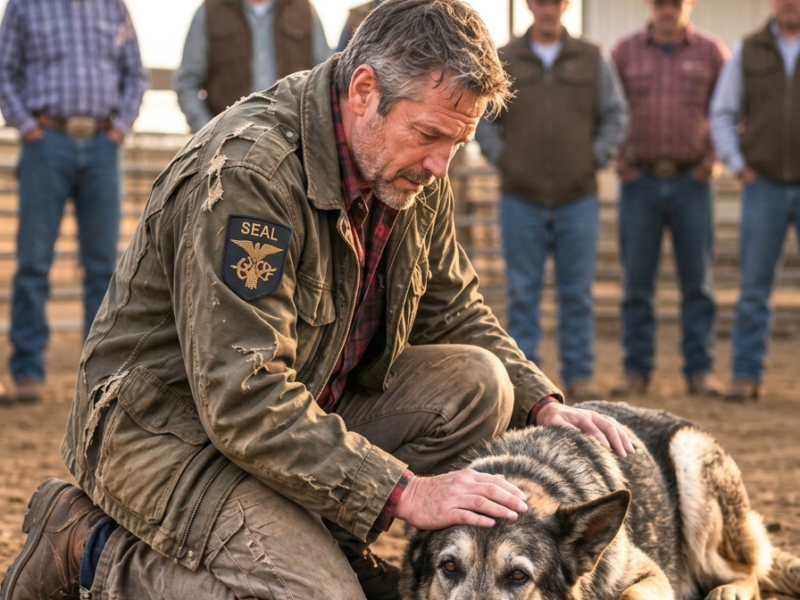
The retired Navy SEAL shelter volunteer handed me the ugliest, most frightened K9 in the kennel and laughed when I said I’d take him home
The heavy iron door of the shelter creaked open, admitting a gust of damp November air that failed to cut through the prevailing stench of chlorine, damp fur, and industrial floor wax. It was the kind of smell that adhered to the back of the throat, sour and antiseptic. I shoved my hands into the pockets of my canvas field jacket, walking slowly down the central aisle flanked by chain-link runs.
Dogs threw themselves against the wire on either side—husky mixes lunging with chaotic energy, pit bulls vibrating with desperate optimism, a three-legged hound howling an operatic complaint at the ceiling. I ignored them all. I wasn’t shopping for companionship. I was filling a void left by eight years of civilian life that felt less like peace and more like prolonged house arrest.
Then I reached the back corner, where the overhead fluorescent light fixture was burnt out, casting the concrete pen into perpetual dusk.
Inside lay an old black-and-tan German Shepherd. He was curled tight against the cinderblock partition, his spine ridged with visible vertebrae, his coat dull and patchy. One ear had a scalloped edge from an ancient tear, and his graying muzzle rested flat against his front paws. As I approached, he didn’t bark. He didn’t even shift his weight. He merely pivoted his eyes toward me.
They were amber, cloudy with the beginnings of cataracts, but unnervingly clear in their appraisal. He looked at me not with the begging submissiveness of a rescue mutt, but with the cold, assessing scrutiny of an old sentry checking a perimeter pass.
“You don’t want that one, chief,” a raspy voice called out.
I turned. An older man in faded navy blue coveralls was leaning on a mop handle, squinting through thick glasses. A faded trident tattoo peeked from beneath his rolled-up sleeve. A retired Navy SEAL, living out his retirement cleaning dog runs in coastal North Carolina.
“Nobody wants him,” the volunteer said, shuffling closer. “He’s eleven if he’s a day. Hips are shot, limps like he’s got lead in his hocks, and he spends half his waking hours staring at blank corners like he’s watching ghosts. Half the staff thinks he’s senile. The other half thinks he’s mean.”
“He doesn’t look mean,” I murmured, stepping closer to the mesh. “He looks exhausted.”
The dog didn’t flinch. But his nostrils twitched twice, pulling in my scent against the swamp of chemical cleaners. Something sparked behind the milky haze of those pupils—a faint, violent ember of recognition that made my chest tighten.
“I’ll take him,” I said.
The volunteer let out a dry, hacking laugh. “Seriously? You come in here looking to adopt, and you want the ugliest, most broken-down piece of scrap in the kennel? Mister, you’ll be paying vet bills for six months and burying him in seven.”
“Open the gate.”
The volunteer grunted, muttered something under his breath about stubborn jarheads, and unlatched the heavy brass padlock. The chain-link gate swung inward with a shriek.
Shadow—that was the name scrawled on the dry-erase card hooked to the cage—didn’t rise. He simply lowered his heavy head an inch closer to the cold concrete, his body tightening into a defensive knot. He was bracing for an impact, an injection, or a kick. A dog that expects violence knows how to fold itself to protect its ribs.
I dropped down onto one knee, ignoring the dampness seeping through my denim. “It’s okay, buddy. Easy now.”
I extended a slow, open palm. The dog’s breathing hitched. Slowly, millimeter by millimeter, he lifted his snout and pressed his dry, cracked nose to the skin between my thumb and forefinger. He didn’t lick. He breathed me in, drawing air so deep his ribs expanded against his hide. Then he shuddered.
I moved my hand up, gently sliding my fingers beneath the cheap nylon shelter collar to scratch the thick fur behind his ears.
My fingers froze.
Beneath the nylon, hidden deep beneath the guard hairs at the base of his skull, my fingertips caught on a raised ridge of fibrous, hairless tissue. Three parallel lines, each about an inch long, perfectly spaced.
My vision blurred. A sound like a distant artillery barrage rushed into my ears, deafening and immediate.
Eleven years ago. The Sangin Valley, Helmand Province.
I had been a twenty-four-year-old Marine Corps K9 handler attached to a reconnaissance unit. My partner was a two-year-old patrol and explosive-detection dog named Shadow, tattooed with tattoo serial number M-408 inside his left ear. During a night sweep through a dry riverbed, an improvised antipersonnel mine had detonated along an irrigation canal. The blast had severed an irrigation sluice gate, sending a sheet of jagged, stamped-metal shrapnel directly across Shadow’s neck.
I had packed the wound with QuikClot with my bare hands while the ambush rained down around us. The shrapnel had left three clean, parallel gouges right at the base of his skull.
During the frantic helicopter extraction under heavy machine-gun fire, a second blast had thrown me down a ravine. Medics dragged me aboard the bird with a fractured skull and punctured lungs. When I woke up forty-eight hours later at Bagram Airfield, the company commander sat on the edge of my cot.
He bled out before the dust-off reached the surgical tent, Miller. We buried him in the valley. Good dog. Did his job.
I had lived with that guilt for four thousand days. I had drunk away half my twenties trying to forget the feel of his blood on my gloves, cursing the god that let me fly home while my partner stayed in the dirt.
“Where did this dog come from?” My voice came out as a cracked, ragged rasp.
The volunteer, leaning against the doorway, looked startled by my tone. “What?”
“Where did you get him?” I stood up so fast my knee popped, crossing the distance to the administrative desk in two strides. I grabbed the yellow carbon intake folder lying on the clipboard. “Tell me where he came from.”
“Hey, watch yourself, pal,” the old sailor snapped, his spine stiffening into an instinctual defensive posture. Then, seeing the look in my eyes—a look he had probably seen on men who had stared too long into mortar pits—his voice dropped. “Military transfer. Two weeks ago. Dropped off by an unmarked transport from the annex out near Camp Lejeune.”
“Which unit?”
“Paperwork just says ‘Surplus property disposal.’ It’s an administrative surrender.”
I flipped the sheet over. My hands were shaking so violently the paper rattled. Near the bottom, stamped in faded black ink beneath a Department of Defense requisition seal, was an old identification line:
CANINE ASSET: PATROL/EXPLOSIVE. TATTOO: M-408.
“No,” I whispered. The word carried no breath. “No, this is impossible.”
From inside the run, the sound of scraping claws broke the silence.
Shadow had risen. He stood on trembling hind legs, his back arched slightly to compensate for the pain in his hips. He took two uneven, deliberate steps toward me, his head held level with his shoulders.
I took a breath that felt like breathing broken glass. The old language, buried under a decade of civilian deadness, surged to the front of my throat. I didn’t shout it. I didn’t raise my pitch. I used the low, flat whisper we used when creeping through the poppy fields under blackout discipline.
“Shadow… find me.”
The old dog’s ears didn’t just twitch; they snapped forward like bayonets. His gray-flecked muzzle lifted. His amber eyes locked onto mine with an intensity that burned the room down around us.
He didn’t run—his broken body couldn’t manage it—but he marched. Every step was heavy, purposeful, dragging that stiff left leg behind him, crossing the open doorway, closing the distance between the years.
I collapsed onto both knees on the filthy concrete.
Shadow didn’t jump. He didn’t wag his tail. He simply walked straight into my chest, burying his heavy skull into the hollow of my neck, pressing the crown of his head against my jaw with all the strength left in his body.
A low, vibrating groan tore from the depths of his ribcage, muffled against my skin.
I threw my arms around his neck, burying my face in the dust and chlorine of his coat, and I wept. I wept with the ugly, gut-wrenching sobs of a man who has suddenly discovered that the ghost haunting him for eleven years has a heartbeat, that the dead have walked back through the wire, and that the world I thought I understood was built on an unspeakable lie.
“You were supposed to be dead,” I choked out, my tears cutting clean tracks through the grime on his coat. “They told me you were dead.”
Shadow stayed motionless, his forehead grinding into mine, his breath hot and ragged against my collarbone.
The shelter volunteer stared down at us, the cynicism entirely gone from his face. He slowly reached up, took off his glasses, and wiped them with the hem of his blue coveralls. “Take him home, Marine,” he said softly. “The paperwork’s already cleared.”
The drive back to my small, isolated rental house on the outskirts of Jacksonville, North Carolina, was conducted in absolute silence. Shadow lay on the passenger seat of my beat-up Ford truck, his head resting across my thigh, his eyes open and watching the road ahead. Every time I shifted gears, my knuckles brushed his fur, and every time, his ears moved in acknowledgment.
He didn’t sleep. He watched the mirrors. He watched the tree line. Eleven years, and the conditioning had never left him.
By nine o’clock, we were inside. I cooked two pounds of unseasoned ground beef and white rice, setting the bowl down beside the kitchen counter. Shadow ate slowly, deliberately, stopping every few bites to glance up and verify my position in the room. When he finished, he didn’t explore the house. He walked into my small bedroom, circled the rug beside my mattress three times, and collapsed with a deep, shuddering sigh.
I sat on the edge of the bed for hours, a tumbler of cheap bourbon sweating on the nightstand, staring at the old dog.
Who kept him? Why lie?
In the military, K9s are categorized as equipment, but in Tier-One and reconnaissance units, the bond between a dog and his handler is treated with sacred reverence. If a dog survives an ambush, he goes to the veterinary hospital. If he recovers, he is reassigned or retired to his handler. You don’t forge a death certificate for a working dog. You don’t hide an injured animal for eleven years in classified annexes only to quietly dump him at a municipal shelter when he becomes too old to stand.
Unless that dog was evidence.
Unless the ambush in the Sangin Valley wasn’t an ambush at all.
I drifted into a light, uneasy sleep around midnight, my hand hanging off the mattress, resting lightly against the coarse fur of Shadow’s flank.
At 2:13 a.m., the bed shifted.
Shadow stood up. There was no hesitation in his movements now, no groggy waking stretch. His body was stiff, his tail held rigid, his ears swept forward into radar dishes.
A sound began deep in his throat—a wet, rattling growl that didn’t rise in volume, but remained locked at that subterranean frequency dogs use when they detect an immediate, lethal threat.
I was wide awake instantly, the muscle memory of a scout sniper kicking in before my conscious mind took over. I reached under my pillow, wrapping my fingers around the checkered grip of my Springfield 1911 .45 ACP, thumbing down the safety catch with a faint, oiled snick.
Shadow didn’t look at me. He moved toward the dark hallway, his nails clicking faintly on the pine floorboards. He stopped at the threshold, his muzzle pointing toward the front entry.
I slipped out of bed, bare feet cold against the wood, and followed him.
The house was black except for the amber ambient light leaking through the living room blinds from the solitary streetlamp three hundred yards away. Through the silence, I heard nothing. No footsteps on the porch, no car door closing, no rustle of grass.
Then Shadow stopped dead in front of the heavy wooden front door. He lowered his snout, sniffing the bottom weatherstripping. His hackles rose in a serrated line down his spine.
Hanging from the exterior brass doorknob, visible through the decorative frosted sidelight of the door, was a thin, white rectangle.
An envelope.
I kept the pistol lowered at the low ready, stepped to the side of the frame to avoid any incoming fire through the wood, and turned the deadbolt with my left hand. I yanked the door inward and stepped back into cover.
Nothing moved on the dark porch. The yard was still, the pines standing like jagged black teeth against the overcast sky.
I reached around the doorframe and snagged the envelope. It was thick linen paper, sealed with moisture, completely unaddressed except for five letters scrawled across the center in black grease pencil:
MILLER.
My hands cold, I stepped back into the living room and used the edge of the doorframe to shield my body while I slit the envelope with my thumb.
Inside was a single, glossy 5×7 photograph.
The image was grainy, taken with a long-range surveillance lens in harsh desert daylight. It showed four figures standing in the courtyard of a mud-brick compound.
On the left was a younger version of me, dressed in dusty desert MARPAT, holding a patrol rifle. Beside me sat Shadow, looking young, lean, and dangerous, his tongue lolling out of his mouth.
To my right stood a man I had never seen before in my life. He was dressed in sterile khaki combat trousers and a black polo shirt—no rank insignia, no unit patches, carrying a suppressed submachine gun.
And next to him stood a third soldier.
His face had been eradicated. Someone had taken a thick black industrial marker and aggressively, furiously colored over his entire head and neck, pressing so hard the marker tip had scored grooves into the photographic paper.
My breath stopped in my throat. I turned the photograph over.
On the back, written in the same hurried black grease pencil, was a single, devastating sentence:
He wasn’t the only one they said died that night.
Before I could process the words, a sharp, metallic sound sliced through the night.
Shadow suddenly lunged toward the living room window, his paws slamming against the low sill, and let out an ear-splitting, frantic bark—a combat warning, the pitch high and desperate.
I lunged forward, pressing my shoulder against the wall beside the window, and peeled the edge of the vinyl blind back half an inch.
Across the narrow two-lane country road, idling under the dripping boughs of a dead weeping willow, was a full-size black SUV. No headlights. No running lights. The windows were tinted opaque, blacker than the night around it.
Through the dark glass of the windshield, I caught the faint, unmistakable green glow of an infrared illuminator.
Beside me, the dog that had survived shrapnel, combat drops, and eleven years in the dark pressed his body hard against my legs. He wasn’t growling anymore.
He was trembling violently, his ears pinned flat against his skull, his eyes wide and milky with terror.
For the first time since I had brought him home, Shadow looked like he was staring at the men who had killed him.
The black SUV remained motionless under the willow tree, a silent, predatory silhouette against the wet asphalt. The green glimmer of the infrared optic lingered on my windowpane for three agonizing seconds, sweeping across the glass like an invisible finger, before the vehicle smoothly shifted into reverse, rolled twenty yards into the darkness, and swung around, accelerating down the county route without ever illuminating its headlamps.
The red taillights didn’t flare until the SUV was half a mile down the straightaway, disappearing into the coastal fog.
I let out the breath I had been holding, my lungs burning. My thumb remained locked against the safety of the 1911, the checkered walnut grips digging painfully into my palm. Beside me, Shadow’s chest was heaving in short, shallow gasps. His front legs were braced, shivering with the distinct tremors of an animal overwhelmed by a sudden flood of adrenaline his aged cardiovascular system could barely handle.
“Down, boy,” I whispered, resting my free hand on the nape of his neck. “Down. Platz.”
The old German command worked like a circuit breaker. Shadow dropped his belly to the pine floor, but his head stayed upright, his amber eyes fixed on the blank slats of the blinds. He was on watch. He wasn’t going back to sleep, and neither was I.
I walked through the dark house, methodically checking every lock, deadbolt, and window latch. I drew the heavy blackout curtains across the kitchen and living room, then retreated into my small home office—a converted spare bedroom at the back of the house with no exterior windows. Only then did I switch on a low-wattage desk lamp.
I laid the photograph on the green felt surface of the desk.
The harsh white bulb exposed every detail of the print. The photograph had been scanned from an original slide or high-resolution digital file, but the paper it was printed on was recent—heavy commercial-grade stock, still smelling faintly of solvent.
I grabbed a jeweler’s loupe from the drawer—a tool I used for cleaning the fine tolerances of rifle firing pins—and bent over the image.
First, I examined myself. I looked impossibly young. The lines around my eyes weren’t there yet; the perpetual tension in my jaw hadn’t set into stone. I was holding Shadow’s leather lead.
Next, Shadow. He was wearing his heavy nylon tactical harness, the old coyote-tan model with the steel grab-handle across the spine. Stitched to the chest plate was his call sign: K9-12.
Then I shifted the lens to the man in the center.
He was clean-shaven, perhaps thirty-five, with high cheekbones and cold, deep-set eyes that stared directly past the camera lens. He wasn’t military. His posture lacked the relaxed, slouching arrogance of line infantry, but it was too rigid for special operations. He held his suppressed MP5 with the casual, mechanical indifference of a private security contractor. On his left wrist, half-hidden by a sweatband, was a bulky digital transceiver—not standard tactical radio gear, but something designed for satellite telemetry.
Finally, I moved the loupe over the third figure.
The black marker had completely obliterated the face, but the clothing told a story the ink couldn’t hide. The uniform was Marine desert digital, identical to mine. On the left breast pocket, where the name tape should have been, the fabric had been violently cut away with a combat knife, leaving frayed threads.
I traced the man’s left hand, resting casually on the receiver of an M4A1 carbine.
On his middle finger was a heavy silver ring. The engraving was tiny, but under the loupe’s magnification, the design was unmistakable: a skull pierced by a dagger, flanked by the numerals 1/9.
The Walking Dead. First Battalion, Ninth Marines.
My stomach plummeted into free fall.
There were only four men from my sniper-scout platoon who wore that ring. Three of them were alive and living in Texas, Ohio, and California. We had spoken on the phone three months ago.
The fourth was Corporal David Vance.
Vance had been my spotter, my bunkmate, and the closest thing I had to a brother during that deployment. And on the night of the ambush in the Sangin Valley, Vance had been walking five yards behind me when the first blast went off.
When I had woken up in the hospital at Bagram, the commander had given me two pieces of news in the same breath: Shadow was dead, and Vance was dead. They said Vance had taken the brunt of the secondary blast when the irrigation canal blew, that there was nothing left to send home to his family in Montana except a sealed aluminum transfer case filled with sand and gravel to simulate body weight.
He wasn’t the only one they said died that night.
The words written on the back of the print began to scream in my ears.
I sat back in the wooden chair, the wood groaning beneath my weight. My mind raced backward through eleven years of scar tissue and repressed trauma, tearing through memories I had deliberately buried under alcohol and manual labor.
The night of the ambush had never made sense.
We weren’t supposed to be in that valley. Our squad had been rerouted at the last minute by a tactical operations officer who had arrived at our forward operating base in an unmarked helicopter three days earlier. We were told we were conducting an interdiction sweep for a high-level courier. But when we entered the compound—the very compound pictured in this photograph—there was no courier. There was only a reinforced subterranean cellar filled with crates of unmarked, black-anodized electronics and satellite communications equipment.
The man in the black polo shirt had been waiting inside that cellar.
I had thought he was a CIA liaison. He had handed Vance a ruggedized hard drive, ordered us to secure the perimeter, and then instructed Vance to take point on the egress route back through the canal.
Ten minutes later, the earth had torn open.
Shadow pushed his head under my hand, breaking my spiraling thoughts. He leaned hard against my shins, his tail giving a single, tentative thump against the floorboards. He knew that photograph. He knew the ghosts in it.
“Who took you, boy?” I asked him, my fingers tracing the scarred, notched edge of his left ear. “Where have you been for eleven years?”
The dog gave a low, questioning chuff, turning his snout toward the desk.
I picked up the phone. I knew the risk. If the black SUV had followed me from the shelter, my lines might already be flagged, but I didn’t have the luxury of time. Whoever had delivered that photograph had done it to send a message: The clock is running.
I dialed a number from memory—a number I hadn’t called in six years.
The line rang four times. Then a woman’s voice answered, crisp, flat, and instantly alert despite the three-in-the-morning hour.
“Speak.”
“Sarah,” I said.
A beat of absolute silence hung on the connection. I heard the faint rustle of bedsheets, then the sharp click of a lamp switch.
“Cole?” Sarah Vance’s voice lost its professional chill, replaced by a sudden, jagged edge of panic. “Why are you calling this number? Did something happen?”
Sarah was David Vance’s older sister. She was also a senior intelligence analyst with the Defense Logistics Agency in northern Virginia. When David had supposedly died, Sarah was the only person who had refused to attend the memorial service. She had spent two years filing Freedom of Information Act requests, demanding to see the casualty evacuation logs, until a formal reprimand from the Department of Defense threatened her security clearance and forced her into silence.
“Sarah, I need you to listen to me very carefully,” I said, keeping my voice level, watching the door frame of the office. “I need you to pull an asset disposal log from the Camp Lejeune annex. It was processed fourteen days ago.”
“Cole, what are you talking about? It’s three in the morning. I don’t work with Lejeune property manifests.”
“It’s about Shadow,” I interrupted.
Another silence. This one was longer, heavy with disbelief.
“Shadow died eleven years ago, Cole. You held his blood in your hands. You told me that yourself.”
“He’s lying on the floor three inches from my boots right now, Sarah.”
On the other end of the line, Sarah’s breath caught sharply. I heard her sit upright, the mattress springs groaning. “Cole… that isn’t funny. If this is some kind of sick anniversary breakdown—”
“Tattoo M-408,” I barked, cutting her off with tactical precision. “Three parallel shrapnel scars on the cervical spine from the Sangin canal. He limps on the left hind leg. He was transferred to a municipal shelter two weeks ago as surplus military equipment. I adopted him this afternoon.”
“My God,” she whispered. Her voice was shaking now. “Cole… that’s impossible. Military working dogs aren’t kept off-book. If an animal survives, it’s reassigned. The budget trail is public record.”
“Someone didn’t want him on the budget trail,” I said. “And someone just dropped an envelope on my front porch ten minutes ago. It’s a surveillance photo of the compound from the morning of the sweep. You, me, Shadow, a private contractor I don’t recognize… and David.”
“David?” Sarah’s voice cracked into a sob that she instantly choked back with the discipline of an analyst. “David was obliterated, Cole. The blast—”
“David’s face was scratched out with a marker,” I pressed, the words tumbling out with brutal clarity. “And the note says: He wasn’t the only one they said died that night.”
I heard Sarah get out of bed. The hollow click of a laptop lid opening came through the receiver, followed by the rapid clatter of keystrokes.
“Give me five minutes,” she said, her voice dropping into a cold, lethal register. “I’m logging into the secure DLA portal through my encrypted VPN. Give me the transfer routing code on the shelter intake sheet.”
I read the alphanumeric string from the bottom of the yellow paper: DOD-SUR-771-LEJ.
The typing stopped.
“What is it?” I asked.
“Cole… that routing prefix doesn’t belong to Camp Lejeune,” Sarah said slowly. The color seemed to drain from her words. “DOD-SUR-771 isn’t a military supply line. It’s an internal logistical designator for an unlisted facility operated by Vanguard Strategic Solutions.”
The name hit my ears like a cold bucket of water. Vanguard was one of the largest private military conglomerates spawned by the early days of the global war on terror. They handled everything from diplomatic security to black-budget logistics.
“Why would Vanguard have an active-duty Marine Corps K9 for eleven years?” I asked.
“They wouldn’t,” Sarah replied, the typing resuming with frantic speed. “Unless they weren’t keeping him as a dog. They were keeping him as a tracker. Shadow had the scent profiles of every target in that valley programmed into his training logs. Cole… look at the screen. I just pulled the facility location for that routing code.”
“Where is it?”
“It’s not at Lejeune,” Sarah whispered, her voice tightening with dread. “It’s an abandoned naval weapons testing facility forty miles south of your house, out on the edge of the Croatan National Forest. It was officially decommissioned in 1998, but the power grid manifests show high-voltage consumption as recently as yesterday.”
“And David?”
Sarah didn’t answer for several seconds. When she did, her voice was barely audible.
“Cole… three days ago, an unidentified Caucasian male, age thirty-four, was admitted under an alias to a private medical holding wing inside that facility. The admission order was signed by a civilian contractor named Marcus Kane.”
“Kane,” I repeated. “The man in the black polo.”
“Cole, don’t go there,” Sarah pleaded, realizing instantly what I was planning. “If Vanguard has been running an illegal black site on domestic soil for eleven years, they aren’t going to let you walk in with a handgun and ask questions. They will erase you. They will erase both of you.”
“They already tried to erase us once,” I said, looking down at Shadow.
The old dog had stood up again. He was watching me, his jaw set, his ears cocked, ready for the command that had been delayed for over a decade.
“Sarah, pack your things and get out of your apartment,” I ordered. “Go to a public place. A hotel lobby with cameras. Don’t go back to your office. I’m going to get your brother.”
“Cole, wait—!”
I hung up the phone.
I didn’t hesitate. I walked into the bedroom closet, pulled down the heavy canvas duffel bag from the top shelf, and unzipped it. Inside was the gear I had kept oiled and preserved in sealed Pelican cases: my old tactical chest rig, three spare magazines for the 1911, a customized Remington 870 12-gauge shotgun with a tactical sling, and a box of high-velocity copper-plated 00 buckshot.
I pulled out an old coyote-tan tactical collar, thick nylon with a heavy steel lead ring.
I knelt down in front of Shadow. I unclipped the cheap five-dollar nylon band the shelter had put on his neck and dropped it in the trash. Then I clicked the heavy tactical collar around his throat.
The dog stood taller. The gray in his muzzle seemed to fade against the rugged nylon. He lifted his head, nudging my chest, his tail wagging with a slow, powerful rhythm that shook his entire body.
“We have work to do, partner,” I whispered.
We walked out to the truck through the back door, cutting through the shadows of the pine trees, leaving the lights in the house burning as a decoy.
The rain turned from a mist into a punishing coastal downpour by the time the Ford reached the northern boundary of the Croatan National Forest. The highway had deteriorated thirty minutes ago into a narrow, rutted gravel corridor flanked by towering loblolly pines and stagnant blackwater ditches choked with cypress roots.
I killed the headlamps two miles before the coordinates Sarah had transmitted to my encrypted phone, relying entirely on the amber glow of the parking lights to trace the muddy ruts.
Shadow sat bolt upright in the passenger seat, his snout wedged into the three-inch gap of the lowered window. The freezing air swirled into the cab, bringing the heavy, rotting smell of peat moss, wet cedar, and something else—a faint, synthetic tang of ozone and diesel exhaust that didn’t belong in a wildlife preserve.
The dog let out a sharp, muffled puff of air through his nostrils. His jaws worked twice, tasting the current.
“You smell it, don’t you?” I muttered, keeping my foot light on the accelerator.
He glanced at me, his ears twitching in confirmation.
A hundred yards ahead, the gravel road dead-ended into a ten-foot galvanized steel chain-link fence topped with three strands of outrigged razor wire. A weathered sign, rusted through at the bolts, hung crookedly from the center of the gate:
UNITED STATES NAVAL SURFACE WARFARE CENTER – OUTLYING DETACHMENT. PROPERTY OF U.S. GOVERNMENT. UNLAWFUL ENTRY PUNISHABLE UNDER FEDERAL LAW.
Beside the gate, however, the heavy padlock was brand new, gleaming bright brass against the rusted iron latch. Fresh, deep tread marks from heavy commercial all-terrain tires were stamped into the mud, the water pooled in their tracks still cloudy. Someone had driven through within the last two hours.
I pulled the truck off the track, nosing it deep into a dense thicket of wax myrtles and sweetgum saplings until the vehicle was completely concealed from the road. I shut off the ignition, pulled the keys, and turned to the dog.
“Quiet time, Shadow. Blackout discipline.”
The dog dropped his ears instantly, lowering his body down onto the seat cushions without making a sound.
I reached into the back, pulling my tactical vest over my head. The weight of the ceramic plates pressed reassuringly against my chest. I strapped the drop-leg holster containing the 1911 to my right thigh, slid four thirty-round shotshell strips into the molle webbing, and racked a three-inch magnum shell into the chamber of the Remington 870. The sharp, mechanical clack-clack of the pump echoed in the closed cab like a miniature thunderclap.
I stepped out into the pouring rain. Shadow followed, dropping cleanly from the running board into the red clay mud.
We moved along the perimeter fence line, avoiding the main gate. Fifty yards into the tree line, the marsh had eroded the bank beneath the fence, creating an eighteen-inch gap beneath the bottom tension wire where the chain link had pulled away from the anchor posts.
I took out my heavy wire cutters, sliced the bottom two links to prevent any snags, and pointed beneath the wire.
“Through.”
Shadow dropped onto his belly, slithering beneath the rusted mesh with the practiced agility of a dog half his age, ignoring the mud that coated his chest. I followed on my back, dragging the shotgun across my ribs, rolling clear into the interior scrub.
We were inside.
Ahead, through the dense veil of pine trunks and driving rain, the compound emerged like an industrial fortress swallowed by the swamp.
The primary installation consisted of three massive, windowless concrete bunkers built during the height of the Cold War, their curved roofs camouflaged with overgrown turf and brush. But the surrounding apron was modern. Halogen perimeter lights were mounted on temporary aluminum scaffolding, illuminating a helipad where a sleek, unflagged twin-engine helicopter sat tethered against the wind.
Two prefabricated modular office trailers were hitched to the eastern flank of the largest bunker, linked by a labyrinth of heavy-duty black cables running to an industrial diesel generator purring inside a sound-dampened baffle.
I raised my compact thermal optic to my eye, scanning the apron.
Two heat blooms showed at the southern entrance of the modular trailers—two guards standing beneath an awning, smoking cigarettes, their carbines slung casually across their chests. A third sentry was patrolling the perimeter of the helipad, his thermal signature glowing orange against the cold rain.
Then my gaze shifted to the central bunker door.
Parked directly in front of the hydraulic blast gate was the black SUV from my street. Its hood was still radiating a massive bloom of thermal white; the engine had only just been shut down.
Shadow pressed his wet shoulder against my calf, his snout pointing directly toward the rear of that SUV. A low, ragged vibration started in his chest.
“Stay,” I breathed, my lips inches from his ear. “On my hip.”
We used the low berms of the old munitions drainage trenches to advance. The mud was ankle-deep, suctioning at my combat boots, but the sound of the rain against the metal roofs and the steady drone of the generator masked our movement.
We closed the distance to forty yards, slipping behind the rusted chassis of an abandoned naval crane.
The rear doors of the modular trailer suddenly banged open.
A man walked out onto the wooden platform beneath the floodlights. He wore a heavy waterproof parka over dark trousers, but even beneath the hood, I recognized the sharp, angular jaw and arrogant posture.
Marcus Kane. The man in the black polo from the photograph.
He didn’t look like he had aged a day. His hair was trimmed close, his movements precise and unhurried. He was holding a ruggedized tablet in one hand, tapping the screen with a stylus while the two smoking guards immediately straightened their posture and tossed their cigarettes into the mud.
“Is the transport fueled?” Kane asked, his voice cutting clearly through the rain.
“Rotor spin in twenty minutes, sir,” one of the guards replied. “Pilot’s completing the pre-flight checklist. The manifest is cleared through the private terminal in Savannah.”
“And the asset?”
“Sedated and packaged. We’re loading the crate into the bay now.”
Kane stopped tapping. He looked up, his cold eyes sweeping across the dark apron toward the tree line where we were hidden. I instinctively lowered my profile behind the crane’s steel wheel, my hand resting flat on Shadow’s skull. The dog didn’t breathe.
“What about the handler?” Kane asked. “The Marine who pulled the dog from the shelter?”
“Bravo team dropped the photograph on his porch three hours ago, sir. Per your instructions. He stayed in the house until forty minutes ago. Then his phone pinged off a tower heading south toward the coast.”
Kane let out a short, dismissive sigh. “He’s a predictable romantic. He’ll go to his old squadmates or try to contact the sister. It doesn’t matter. Once the transport clears domestic airspace, Vance’s biological markers will be integrated into the third-party client’s bio-metric lock systems. By sunrise, this site is scrubbed and burned. If Miller shows up, put two in his chest and throw him in the canal with the rest of the trash.”
“Understood, sir.”
Kane turned and walked down the wooden stairs, heading directly toward the rear bay of the central bunker.
Sedated and packaged.
The words burned through my skull like acid. They weren’t moving equipment. They were moving David Vance.
Eleven years. They hadn’t killed him. They had turned an active-duty Marine into a living cryptographic key, a human hostage holding classified access codes that Kane’s corporate masters had stolen from the Sangin Valley.
I looked down at Shadow. The dog’s eyes were locked on the bunker door. His upper lip was drawn back, revealing clean, yellowed canines, but he remained utterly silent. He understood the stakes.
“Shadow,” I whispered.
His ears twitched backward to catch my voice.
“You remember the breach? You remember the sweep?”
His tail gave one hard, deliberate tap against the wet clay.
“We go hard. We go fast. Fass.”
I didn’t wait for Kane to disappear into the bunker. I stepped out from behind the steel crane, raised the Remington 870 to my shoulder, and centered the ivory bead sight on the halogen floodlight mounted directly above the modular trailer.
BOOM.
The heavy magnum buckshot pulverized the halogen lamp in a blinding shower of sparks and shattered glass, plunging the central apron into chaotic darkness.
Before the echo of the shotgun blast had cleared the trees, Shadow was gone.
He exploded through the mud like an artillery shell, tearing across the twenty yards of open tarmac toward the two guards on the platform. The limp in his hind leg was gone, overridden by the terrifying, ancient surge of a Tier-One war dog unleashed on a target.
“Contact! We have contact—!” one of the guards screamed, reaching for his slung rifle.
He never touched the charging handle.
Shadow hit the wooden stairs, launched himself three feet into the air, and drove his eighty-pound frame directly into the guard’s chest. The man shrieked as Shadow’s jaws clamped onto his left forearm, the heavy teeth splintering the bone through the tactical jacket, dragging him bodily off the platform into the red clay below.
The second guard scrambled to draw his sidearm.
I closed the distance at a dead run, racking the shotgun slide with a brutal, mechanical rhythm.
BOOM.
A pattern of double-aught buckshot caught the guard in the shoulder, the concussive force lifting him off his feet and throwing him hard against the corrugated siding of the trailer. He slid down the wall, motionless.
“Kane!” I roared through the pouring rain, stepping over the downed man, my eyes locked on the open bay of the bunker. “Kane, step out!”
A burst of suppressed automatic gunfire answered me from the shadows of the blast door.
The rounds chewed into the wooden steps beneath my feet, showering my shins with splinters. I dove sideways, rolling across the slick concrete apron, coming up behind the bumper of the idling SUV just as the engine of the transport helicopter on the helipad whined into life, its massive rotors beginning to chop slowly through the driving rain.
The air smelled of burning jet fuel and blood.
Shadow released the unconscious guard in the mud, wheeled around, and sprinted to my side, sliding against the SUV’s tire, his muzzle coated in red, his chest heaving like a bellows.
“Good boy,” I gasped, slamming three fresh shells into the magazine tube of the Remington. “Now we take the door.”
The subterranean corridors of the Cold War bunker were narrow, constructed from three-foot-thick reinforced concrete designed to survive a near-miss from a Soviet warhead. The air inside was freezing, smelling of stale battery acid, damp mold, and the sharp chemical bite of pharmaceutical sedatives.
Red emergency lights flickered along the ceiling at ten-foot intervals, casting long, bloody shadows down the central hallway.
Shadow moved five paces ahead of me, his body pressed low to the damp floor, moving in a fluid, predatory crouch. His graying snout swept side to side, sorting through the swirling scents trapped in the subterranean tomb.
Suddenly, he halted. His right front paw remained suspended in mid-air. His head cocked toward a heavy blast-proof observation door twenty yards down the corridor on the left.
From inside the room came the frantic sound of metal instruments crashing onto a tray, followed by a harsh, panicked voice shouting orders.
“He’s coming out of the hypothermic block! Increase the midazolam drip or we’ll lose the neural response!”
“There’s no time, Kane said load him now! The shooter’s inside the bunker!”
I didn’t knock.
I stepped up to the door, raised the Remington, and drove the heavy steel muzzle brake directly into the deadbolt cylinder.
BOOM.
The lock blew inward in a cloud of shattered brass and concrete dust. I kicked the door open with the flat of my boot and entered the room with the shotgun leveled at eye level.
The chamber had been converted into a sterile, black-market surgical suite. Fluorescent surgical lamps hung low over a heavy stainless-steel gurney bolted to the center of the floor. Two men in white lab coats and surgical masks froze, their hands suspended over trays of plastic syringes and blood-collection bags.
On the gurney lay David Vance.
My heart seized in my chest.
He was emaciated, his skin the color of wet parchment, his cheekbones jutting out like knife blades beneath paper-thin flesh. His head had been shaved bald, covered in faint circular scars where biometric monitoring electrodes had been repeatedly attached. Heavy leather straps bound his wrists, chest, and ankles to the frame. A tangle of intravenous lines snaked from his arms to an automated infusion pump beside the bed.
He looked like a corpse that had spent eleven years waiting for a grave.
“Back away from him,” I said, my voice dropping into a register that made the two technicians instantly drop their instruments. The scalpels clattered against the tile floor.
“We… we’re just contractors,” one of them stammered, raising his gloved hands, his eyes wild with terror. “We don’t know who he is. We were hired through a medical broker in Atlanta—”
“Hands behind your heads. Face down on the floor. Now.”
They didn’t argue. Both men threw themselves flat against the bloody tile.
Shadow didn’t look at the doctors.
The old dog walked slowly, almost reverently, toward the side of the gurney. His tail was low, his head extended. He reached the edge of the stainless steel, rose onto his hind legs, and rested his scarred paws against the edge of the mattress.
He lowered his head and pressed his wet, graying muzzle directly against David Vance’s sunken cheek.
A low, trembling whimper broke from Shadow’s throat—a sound so filled with grief, relief, and ancient loyalty that it made the breath catch in my throat. He began to lick David’s jaw, his rough tongue sweeping away the beads of sweat that coated the unconscious man’s skin.
The heart monitor on the wall spiked wildly.
The flat, mechanical beep accelerated into a frantic, rhythmic chime. David’s eyelids, translucent and purple with exhaustion, fluttered violently.
A dry, cracked rasp tore from his throat. His fingers, skeletal and bruised from years of needles, twitched against the leather restraint straps.
“…Sh… Shadow?”
The whisper was barely louder than the hum of the fluorescent lights, but it filled the concrete room like a trumpet blast.
David’s head turned half an inch. His sunken blue eyes cracked open, clouded with the toxic fog of heavy sedatives, but they found the dog’s face instantly.
“Shadow… boy…”
Tears welled in the corners of David’s eyes, cutting through the yellowed grime on his skin. With an effort that made the tendons in his neck cord like iron wire, his trembling fingers reached out and dug into the thick fur behind the dog’s ears, curling into the very scar tissue I had touched in the shelter twelve hours ago.
“I have you, Dave,” I said, stepping up to the bed, pulling my combat knife from my vest. “I have you, brother.”
David’s eyes drifted toward my voice. He looked at my face, looked at the Marine Corps tattoo on my forearm, and a ragged, broken sob shook his emaciated chest. “Cole…? You… you’re dead. They said you died in the bird…”
“We’re both alive,” I said, slicing through the heavy leather strap binding his left arm with a single slash of the blade. “And we’re going home.”
Before I could cut the second strap, a sharp, concussive blast blew through the doorway behind me.
A flash-bang grenade.
The blinding magnesium flare and 170-decibel shockwave slammed into the small surgical room. My vision exploded into searing white agony; my equilibrium shattered as my inner ear blew out with a high-pitched, deafening squeal.
I was thrown against the side of the gurney, the shotgun ripped from my grip as I hit the floor.
Through the whiteout in my eyes, I saw a dark silhouette step through the shattered doorway.
Marcus Kane.
He wasn’t carrying a submachine gun now. He was holding a customized .45 tactical pistol, fitted with an extended magazine and an infrared laser module. His face was twisted into a mask of cold, murderous fury.
“Eleven years of investment,” Kane snarled, his voice muffled by the ringing in my ears. “Eleven years of keeping this broken piece of meat breathing so we could access the offshore accounts. And you ruin it for a goddamn stray dog.”
Kane raised the pistol, leveling the bore directly between my eyes.
My vision was swimming; my hands scrambled uselessly against the tile floor, trying to locate the fallen 1911. My fingers were numb. I couldn’t clear the leather. I was half a second away from a bullet in the frontal lobe.
He never pulled the trigger.
From the edge of the bed, eighty pounds of graying, scarred muscle launched itself through the air like a guided missile.
Shadow didn’t hesitate. He didn’t care about his arthritic hips. He didn’t care about the cataracts in his eyes or the decade of isolation he had endured in the dark. His partner was in front of him, and his handler was on the floor behind him.
The dog struck Kane full in the chest.
The impact drove Kane backward into the steel doorframe with a sickening thud. The pistol discharged wild, the bullet punching a hole through the ceiling plaster, showering the room in white dust.
Kane shrieked in agony as Shadow’s jaws clamped onto his right shoulder, the canine teeth tearing through the heavy waterproof fabric of the parka, seeking the artery beneath the clavicle.
“Get it off me! Shoot it! Get it off!” Kane screamed, smashing the heavy frame of his pistol into the dog’s ribs.
Crack. Crack.
The heavy steel slide slammed into Shadow’s side. The dog let out a sharp yelp of pain, but his jaws didn’t open. He clamped down harder, violently shaking his head, using his body weight to drag Kane to the floor.
The sound of those blows broke through my sensory overload.
The rage that surged through my veins was pure, cold, and primal. The ringing in my ears vanished. The numbness in my limbs turned to fire.
I surged off the floor, drew my combat knife in an ice-pick grip, and crossed the room in two strides.
I didn’t use the knife. I kicked the pistol from Kane’s hand, sending it skittering down the concrete hallway, grabbed the collar of his tactical jacket with both hands, and slammed his head backward into the concrete wall with everything I had.
Kane’s head bounced off the masonry with a wet, hollow crunch. His eyes rolled up into his skull, and his body went completely limp.
“Shadow, out! Aus!” I roared.
The old dog released his grip instantly, stepping back two paces, his breathing coming in ragged, bloody gasps. A thin trail of crimson was leaking from his left nostril—a fractured rib had punctured something inside—but his eyes remained locked on the unconscious executive.
I didn’t look at Kane again. I turned back to the bed.
With three quick cuts, I severed the remaining restraints binding David Vance. I stripped off my tactical vest, wrapped it around his shivering, emaciated torso, and pulled him upright.
He weighed nothing. A man who had once bench-pressed three hundred pounds felt like a sack of dry sticks in my arms.
“Can you stand, Dave?” I asked, pulling his arm over my shoulder.
“With you… and him?” David managed a faint, bloody smile through his cracked lips. “I can walk to hell and back.”
Outside the bunker, the rhythmic thump-thump-thump of heavy rotor blades tore through the storm.
Not the light twin-engine helicopter from the helipad.
These were heavy turbines. Twin-rotor CH-53 Sea Stallions, accompanied by the high-pitched whine of federal law enforcement gunships.
Sarah had made her calls. The Defense Logistics Agency and the Federal Bureau of Investigation had finally arrived at the perimeter.
I supported David with my right arm, my left hand holding my service pistol at the low ready. Beside us, dragging his back leg, his side bruised and bleeding, Shadow marched.
He didn’t limp like a broken stray anymore.
He walked with his head held high, his ears forward, leading the way out of the tomb and into the light.
The rain had stopped by the time we cleared the hydraulic blast doors of the bunker, replaced by a cold, gray dawn that broke through the weeping pines of the Croatan Forest.
The scene on the tarmac looked like an invasion force.
Four black tactical armored vehicles blocked the main gate, their blue and red emergency strobes painting the wet concrete in rhythmic streaks of light. Two dozen federal tactical agents in full body armor had already secured the apron, their rifles trained on the surviving Vanguard contractors who knelt in the mud with their hands flexed behind their heads.
Hovering fifty feet above the trees, a heavy military transport helicopter held its hover, the massive downwash flattening the sweetgum saplings and whipping the stagnant marsh water into a white spray.
As David and I emerged from the dark entrance of the bunker, every weapon on the perimeter seemed to freeze.
An agent wearing a windbreaker with FBI – CRITICAL INCIDENT RESPONSE GROUP emblazoned across the back started to raise a megaphone, but he was shoved aside by a woman who had broken through the tactical line.
Sarah Vance was soaked to the bone, her dark hair plastered to her cheeks, wearing a civilian trench coat over her clothes. She sprinted across the mud-slicked apron, completely ignoring the shouted commands of the federal agents behind her.
“David!” she cried, her voice cracking across the tarmac.
David’s knees buckled. I caught him under the arms, lowering him gently onto the dry concrete of the bunker loading ramp as Sarah hit the ground beside him.
She threw her arms around her brother’s emaciated shoulders, burying her face into his neck, weeping with a sound that felt like eleven years of suffocating silence finally shattering into pieces.
“You’re alive… oh God, Dave, you’re alive…”
David raised his trembling, scarred hand, resting it against the back of his sister’s head. He didn’t speak. He didn’t have the words. He merely closed his eyes, leaning his forehead against hers, letting the morning air fill his ruined lungs for the first time without the taste of sedatives.
A team of federal combat medics rushed forward, setting down trauma kits and folding litters, their movements efficient and respectful.
I stepped back, giving them room.
I felt a heavy weight lean against my left thigh.
I looked down. Shadow was sitting beside my boot. His breathing was dangerously shallow, each inhalation accompanied by a faint, wet clicking sound from his bruised ribcage. The blood had dried around his muzzle, and his milky eyes were staring out toward the pine trees, watching the sunrise turn the gray sky into pale amber.
I dropped down onto both knees beside him, wrapping my arm around his trembling shoulders.
“Medic!” I shouted, my voice carrying the full authority of a combat handler. “I need a corpsman over here! Now!”
A young Navy lieutenant with a medical kit slung across his chest turned from David’s gurney and ran over, dropping to his knees beside the dog. He pulled a stethoscope from his pocket, pressing it against Shadow’s scarred ribcage, his youthful face tightening as he listened.
“Tension pneumothorax on the left side,” the medic said, looking up at me with wide, serious eyes. “He’s got broken ribs and a punctured lung lobe. He’s drowning in his own chest, Sergeant.”
“Fix him,” I said. My hand was gripping the medic’s tactical vest so tightly my knuckles turned white. “You fix him. You understand me? He survived eleven years in hell to pull that man out of that hole. You do not let him die on this concrete.”
The medic didn’t flinch at my grip. He nodded once, firm and resolute. “We have a flight surgeon and a full surgical suite aboard the flagship at Norfolk. He flies with his handler.”
Ten minutes later, we were airborne.
The interior of the Sea Stallion was deafening, filled with the roar of twin jet turbines and the cold draft from the open crew door. David lay on the primary litter, an IV line dripping saline into his arm, Sarah holding his hand with a grip that looked like it would never loosen.
I sat on the non-skid aluminum floor beside the forward bulkhead.
Shadow lay between my legs, his head resting across my boots. The flight medic had inserted a chest decompression needle between his fourth and fifth ribs, relieving the pressure on his lung, but the old dog was fading. His body was cold, the internal fire that had driven him through the mud and the gunfire slowly guttering out like a candle in a drafty room.
I leaned down, pressing my lips against the scarred, hairless skin at the base of his skull—the three parallel lines that had brought us back together.
“You did it, buddy,” I whispered into his ear, my voice lost in the engine roar. “Mission complete. You brought him home. You brought both of us home.”
Shadow’s ear twitched.
With an effort that seemed to consume every remaining ounce of energy in his broken body, the old war dog lifted his head two inches. He looked at me, his amber eyes clear, the milky cataracts somehow burning away in the high-altitude morning light streaming through the cargo door.
He didn’t whine. He didn’t look afraid.
He pressed his forehead against mine, exactly as he had done in the Sangin riverbed eleven years ago, and exactly as he had done on the floor of the county shelter yesterday morning.
A long, deep, shuddering breath escaped his chest.
Then his body relaxed, going heavy and soft against my boots. His ears lowered. His tail gave one final, imperceptible twitch against the deck plates.
The flight medic looked down, reached out two fingers to check the femoral pulse at the dog’s groin, and slowly shook his head.
“He’s gone, Sergeant.”
I didn’t answer. I didn’t shout, and I didn’t let go.
I kept my forehead pressed against his, my hands buried in his coarse, gray-flecked fur, while the helicopter carried us out over the blue waters of the Atlantic, heading north toward home.
Six months later.
The wind off the Potomac River was warm, carrying the sweet scent of blooming cherry blossoms and fresh-cut grass across the green rolling hills of Arlington National Cemetery.
The small gathering stood beneath the shade of an ancient white oak.
David Vance stood upright, leaning lightly on a polished walnut cane. The color had returned to his face, though the scars on his wrists and temples would remain for the rest of his days. Beside him stood Sarah, her arm linked through his, her eyes hidden behind dark sunglasses.
A squad of six Marines in dress blues stood at attention ten paces away, their white gloves gleaming in the spring sunshine.
In front of us was a small, polished granite marker, set level with the turf among the heroes of the republic.
Carved into the stone, beneath the emblem of the United States Marine Corps, were three simple lines:
SHADOW
MILITARY WORKING DOG – TATTOO M-408
1ST RECONNAISSANCE BATTALION
HE NEVER LEFT THE LINE.
The squad leader barked a command. Six rifles rose in perfect synchronization against the blue sky.
Crack. Crack. Crack.
The three volleys of seven rounds echoed across the valley of the dead, sharp and clean, honoring an old warrior who had fought two wars and won both of them.
When the brass casings stopped clattering against the grass, a lone bugler raised a silver horn to his lips. The mournful, haunting notes of Taps drifted across the hillside, settling like a benediction over the white headstones.
When the ceremony ended, the others slowly drifted back toward the paved walkway.
I stayed behind.
I knelt beside the granite marker, running my fingers across the cool, carved letters of his name. In my pocket, I felt the heavy steel weight of his old tactical collar—the heavy nylon band with the scarred brass ring.
“You’re off the clock now, partner,” I whispered to the grass. “Stand down. I have the watch.”
I rose, adjusted the lapels of my dark suit, and turned toward the river.
The sun was warm on my face. The world was still broken, and the scars would never entirely heal, but for the first time in eleven years, the ghosts had stopped following me.
Behind me, as the wind rustled through the oak leaves, I could almost hear the faint, steady click of claws on pavement, marching beside me into the light.
The end.









