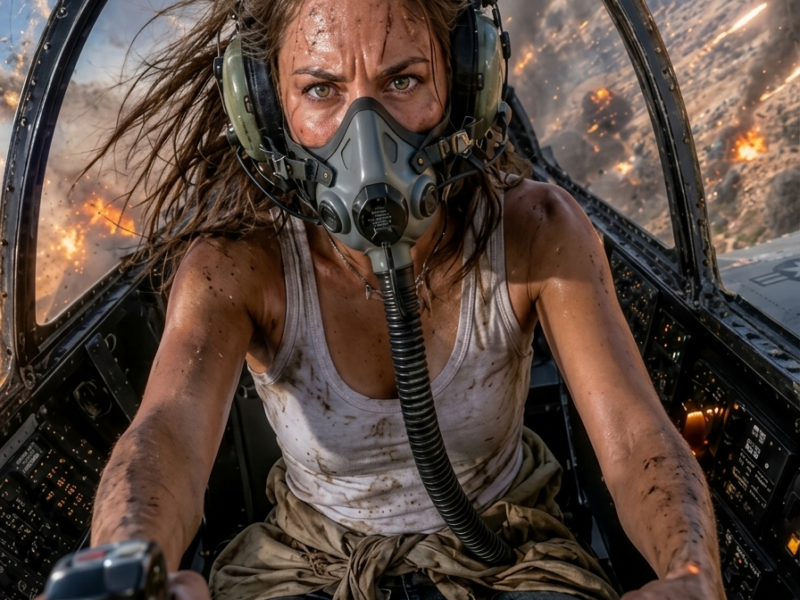
The radio crackled with screams as I watched 540 Navy SEALs get pinned down in a valley outside Kandahar, and when command ordered me to turn my A-10 around, my wingman whispered, “Ma’am, that’s a death sentence”
The radio crackled with screams as I watched 540 Navy SEALs and attached Army Rangers get pinned down in a narrow, razor-backed valley forty miles southwest of Kandahar. From the elevated bubble canopy of my A-10C Thunderbolt II—the heavily armored, twin-engine ground attack jet affectionately known as the Warthog—the world below looked like a churning cauldron of fire and dust.
Through my Lockheed Martin Sniper Advanced Targeting Pod, the thermal feed washed the terrain in harsh white and gray contrast. Hundreds of heat signatures were crammed together in a dry riverbed, completely surrounded on three sides by elevated heavy-machine-gun nests and rocket-propelled grenade teams digging into the limestone ridges.
Then came the order that froze the blood in my veins.
“All strike aircraft in sector, this is Red Crown Command. Disengage immediately. Turn heading zero-nine-zero and return to Kandahar Airfield. I repeat, disengage.”
I had been flying combat missions for eleven years, logging over two thousand flight hours across Iraq, Syria, and Afghanistan. I had heard chaotic radio chatter, panicked calls for close air support, and air traffic control gridlocks. But I had never heard silence like the one that followed that order.
“Command, say again?” I called out, my voice tight inside my flight mask. “This is Hawg Zero-One. I am holding six thousand rounds of 30mm armor-piercing incendiary, four Maverick missiles, and two GBU-12 laser-guided bombs. The friendly force on the ground is actively taking heavy envelope fire. Request clearance to engage northern ridge.”
“Hawg Zero-One, Red Crown,” the commander’s voice came back. It wasn’t distorted by adrenaline or the fog of war. It was flat, measured, and terrifyingly cold. “You are ordered to cease all offensive operations. Turn your aircraft around and vector back to base immediately.”
Below me, the valley burned. Red tracer rounds crisscrossed the night sky in lethal, overlapping geometric arcs. Through the targeting pod, I could see friendly troops dragging wounded men behind granite boulders. They were running out of ammunition. They were running out of time. And someone high up in the tactical operations center had just shut off their air cover and their extraction route.
“Command, I still have friendlies on the ground,” I said, my thumb hovering over the weapon release button on the flight stick. “They are being overrun.”
“Negative, Hawg Zero-One.”
I gripped the titanium-armored controls so hard my leather flight gloves stretched across my knuckles. “Confirm negative?”
There was a long, heavy pause on the encrypted satellite channel. Five seconds. Ten seconds. A lifetime when men are dying on the dirt.
“Leave the area, Captain Vance,” the voice replied. “That is a direct lawful order.”
My wingman, Lieutenant Chris “Grizzly” Miller, flying Hawg Zero-Two off my right wing, pulled his jet abreast of mine. Through the dark, I could see the silhouette of his aircraft floating against the star-pocked sky.
“Captain… ma’am, that’s a death sentence for those guys down there,” Grizzly whispered over our intra-flight radio frequency. “And if we disobey Red Crown, that’s court-martial. That’s Leavenworth. We have to go.”
I should have obeyed. Every standard operating procedure, every military regulation, and every instinct drilled into me since my days at the Air Force Academy told me to turn heading zero-nine-zero, throttle back, and let the command structure handle the battlefield.
Instead, I took one last look at the targeting display.
Amidst the swirling sand, exploding mortar shells, and chaotic infrared flares, a tiny, intermittent light caught my eye near the southern bank of the dry riverbed. It wasn’t an official strobe or a standard military beacon. It was a handheld infrared flashlight, filtered and dimmed, flickering against the dark earth.
Three short flashes. Pause. Three short flashes.
An emergency tactical code used exclusively by battalion casualty collection points.
My mind raced through the mission brief we had received four hours earlier at Kandahar Airfield. That specific grid coordinate contained the ground element’s forward medical team, emergency surgical unit, and battalion communications relay.
And my younger brother, First Lieutenant Jake Vance, an Army combat medic assigned to the joint special operations task force.
“Stay with me,” I whispered into my mask.
“What?” Grizzly asked, his voice cracking with sudden alarm. “Captain, what are you doing?”
“I’m going back in.”
“Captain, command just ordered us—”
“I heard them, Grizzly,” I snapped, flipping the master arm switch on my control panel from SAFE to ARM. The cockpit displays illuminated with bright green tactical overlays as the targeting computer locked onto the northern ridge. “Hold high cover. If you don’t want to roll with me, stay at twelve thousand feet and record the HUD feed.”
“I’m not leaving you, ma’am,” Grizzly gritted out after a two-second silence. “But God help us both when we land.”
I pushed the nose down. The twin General Electric TF34 engines behind my cockpit screamed as twenty tons of matte-gray steel plummeted toward the dark, hostile valley.
Enemy anti-aircraft fire—23mm anti-aircraft cannons buried in the mountain caves—instantly noticed my dive and swung their barrels upward. Bright, golden chains of heavy tracer fire climbed through the night toward my windscreen like burning sparks drifting up from a hellish furnace.
I ignored the flashing caution lights on my threat display, lined up the crosshairs of the HUD with the northern ridge, and squeezed the trigger.
BRRRRRRRRRRRRRRRRRRRRRRRTTTTT!
The hydraulic-driven GAU-8/A Avenger 30mm Gatling gun beneath my feet vibrated the entire airframe with catastrophic force. The sound wasn’t a mechanical burst; it was the iconic, terrifying roar of a tearing bedsheet amplified ten thousand times, vibrating through my boots, my spine, and my jawbone.
Seventy combat-proven armor-piercing shells per second tore through the air at three thousand feet per second, slamming into the limestone ridge. The mountain peak erupted in a cascading wall of dust, shattered rock, and flame. The heavy machine guns hammering the friendly position went instantly silent.
I pulled back hard on the stick, pulling five Gs as the A-10 leveled out barely two hundred feet above the valley floor, the wingtips shedding pale white vortex clouds in the damp night air.
I threw the jet into a sharp, banking turn to loop back around, dropping a cluster of infrared defensive flares to distract incoming shoulder-fired missiles.
The ground radio frequency, which had been silent under command jammer interference, suddenly exploded into a frantic chorus of crackling voices.
“Who the hell is that?”
“Aircraft overhead! Direct hit on the northern ridgeline!”
“Someone’s covering us! Ground force, move! Move to the secondary rally point!”
I didn’t answer. I didn’t identify my call sign. I lined up the crosshairs for a second strafing run, targeting a mortar pit that was dialing in on the medical clearing station.
BRRRRRRRRRRRRRRRRRRRRRRRTTTTT!
The second burst obliterated the mortar position, sending ammunition crates cooking off in a rapid series of secondary explosions. The immense pressure that had been crushing the trapped battalion broke just enough for the forward squads to start dragging their casualties toward the extraction zone.
“Hawg Zero-One, this is Red Crown Command!” the radio blared, no longer cold, but trembling with raw fury. “You are committing a major violation of the Uniform Code of Military Justice! Cease fire and abort immediately, or you will be intercepted by friendly air defense!”
I reached out and clicked the command channel off, switching entirely to the local Joint Tactical Air Control frequency.
Suddenly, a high-pitched, warbling scream echoed inside my helmet. The Missile Launch Warning System flashed amber across my primary multi-function display.
“Missile launch! Missile launch!” Grizzly shouted over the intra-flight radio. “Surface-to-air missile, seven o’clock low! She’s tracking you, Captain!”
I pulled the stick to my left hip, dumping full throttle and dumping chaff and flares. The heat-seeking missile streaked past my canopy by less than fifty feet, its solid-fuel rocket motor illuminating the inside of my cockpit with a blinding white flash before exploding uselessly in the upper atmosphere.
“They’re locking you again!” Grizzly screamed. “Radar-guided SAMs from the east ridge!”
“I know,” I said through gritted teeth, rolling the aircraft inverted and diving back toward the smoke-filled valley floor to use the terrain to mask my radar profile. “I need one more pass.”
I lined up on the eastern ridge, releasing a laser-guided GBU-12 bomb. The five-hundred-pound weapon glided down through the smoke, guided by my targeting pod’s infrared beam, and struck the heavy weapon bunker dead center, vaporizing the threat in a massive orange fireball.
As the smoke began to clear, I swept my targeting pod back down to the dry riverbed where the medical unit had been pinned down.
The small, flickering infrared flashlight—the three short flashes—had vanished.
My heart plummeted into my stomach. The warmth drained from my face, leaving me ice-cold despite the heat radiating off the aircraft engines.
“Medic team, respond,” I called over the local tactical frequency, my voice dropping its professional tone. “Medic team, this is air cover. Status update.”
Nothing. Only the soft hiss of static.
“Jake… Jake, respond!” I shouted, dropping all operational security protocols. “TOC Medic Vance, respond!”
Static.
I made one final, dangerously low pass over the burning valley, sweeping the terrain with my searchlights, searching through the drifting white smoke and burning vehicle carcasses.
Then, a faint, metallic click cut through the static on the tactical frequency.
A raspy, shallow voice whispered into the microphone, barely audible over the sound of wind and heavy breathing: “Tell Mom… I’m sorry.”
My hands went completely numb on the flight stick. The cockpit seemed to spin around me.
“Jake?” I cried out, my knuckles turning white. “Jake, talk to me!”
Silence returned to the frequency. Five excruciating seconds passed. Ten.
Then another voice, rough, exhausted, and bruised, broke through the channel. “Hawg Zero-One… this is SEAL Team Leader. We got the medic team. We found him.”
I couldn’t breathe. I pulled the aircraft back up to ten thousand feet, my eyes glued to the targeting display. “Is he alive? Report status!”
A pause stretched across the airwaves before the team leader replied. “He’s took shrapnel to the vest and leg… but he’s breathing. He’s alive, Captain. You pulled those bastards off us just in time. The battalion is moving to the secondary LZ.”
I closed my eyes for half a second, leaning my helmet back against the headrest, letting out a breath I felt like I had been holding for an eternity.
Below me, the surviving soldiers of the 540-man force were finally reaching the flat terrain where heavy transport helicopters could land under cover of the darkness.
Suddenly, the secondary radio console clicked back on as Red Crown Command bypassed my manual override using an emergency priority broadcast override.
“Captain Vance,” the cold, unyielding voice of the joint commander cut through the air. “You disobeyed a direct order from a flag officer during an active combat operation.”
I stared down at the burning valley, watching the black silhouettes of CH-47 Chinook helicopters dropping out of the clouds to evacuate my brother and his men.
“Yes, sir,” I said quietly, my voice steady and empty of regret.
“You will return to base, surrender your sidearm to security forces upon landing, and prepare for immediate arrest,” the voice continued. “We will deal with you the moment your tires touch the tarmac.”
“Understood, Red Crown.”
I turned the A-10 toward the north, setting a cruise vector back to Kandahar Airfield. Grizzly pulled his jet up alongside mine, matching my speed.
“Ma’am…” Grizzly’s voice came through the private inter-cockpit line, low and trembling with a realization that went far deeper than a fear of court-martial.
“What is it, Grizzly?” I asked, watching the distant lights of the airbase appear on the horizon.
“While you were making your second strafing run… I was monitoring the encrypted command satellite telemetry,” Grizzly said, his voice dropping to a near-whisper. “The order to abandon those men… the order to cut off their extraction and pull air support… it didn’t come from Central Command in Qatar.”
I frowned, looking across the dark sky at his aircraft. “What are you talking about?”
“It came from inside their own ground command element,” Grizzly revealed, his voice shaking. “A high-ranking officer inside the task force headquarters manually altered the satellite grid coordinates to trap those five hundred men in that valley. They didn’t just get caught in an ambush, Captain. They were set up. Someone wanted that entire battalion wiped out tonight.”
I stared at the navigation coordinates flickering green on my HUD screen.
And suddenly, standing up to command, diving through heavy anti-aircraft fire, and risking my career to save my brother wasn’t the most frightening thing I had done that night.
Finding out who inside our own military wanted five hundred American soldiers dead—and why—was.
The twin turbines of my A-10 whined down to a mournful, descending whistle as I brought the heavy aircraft to a complete halt on the isolated taxiway at Kandahar Airfield. Rain—a rare, cold high-altitude downpour—was slicking the concrete tarmac, reflecting the harsh yellow floodlights of the military flight line.
Before I could even turn off the primary avionics master switch, four black tactical SUVs pulled up, blocking my nose wheel. Twelve heavily armed Air Force Security Forces personnel, flanked by two men in dark civilian coats wearing tactical lanyards, poured out into the rain with their weapons raised.
“Hawg Zero-One, shut down engines and exit the aircraft with your hands visible!” a voice boomed through a megaphone.
Grizzly taxiing his jet fifty yards behind me, watched the spectacle in silence.
I took off my helmet, letting my sweat-soaked hair drop onto my shoulders. My hands were perfectly steady now. The terror of the dogfight had morphed into a cold, dangerous clarity. I unbuckled my four-point harness, grabbed my survival vest, and opened the side canopy.
As I climbed down the ladder built into the side of the nose section, the cold rain hit my face like a slap.
A tall man in a tailored dark suit stepped out from behind the security team, stepping through the puddles toward me. He didn’t wear a uniform, but his posture and the sharp, scar-marked angle of his jaw screamed retired special operations.
“Captain Sarah Vance?” he asked, stepping inside my personal space.
“Who wants to know?” I replied, standing straight, refusing to look at the weapons pointed at my chest.
“I am Special Agent Marcus Cole, Defense Criminal Investigative Service,” he said, pulling a leather credential case from his coat, revealing a brass badge. “You are being taken into custody under Article 90 of the Uniform Code of Military Justice: willful disobedience of a superior commissioned officer during war.”
“540 men were being slaughtered in a kill box,” I said, my voice cutting through the hiss of the rain and engine exhaust. “Your command ordered me to watch them die.”
Cole’s face didn’t register a single emotion. He didn’t look angry; he looked like an auditor reviewing a math error. “Your duty was to follow orders, Captain. You don’t get to audit the tactical decisions of the Joint Special Operations Command from the cockpit of a ground-attack jet.”
He gestured to the armed security guards. “Take her sidearm. Escort her to the secure briefing facility in Sector Four.”
Two guards stepped forward, unholstering my Beretta 9mm sidearm from my shoulder rig and clamping heavy steel flex-cuffs around my wrists behind my back.
As they marched me across the slick tarmac toward one of the black SUVs, I caught sight of a military ambulance speeding down the perimeter road toward the base hospital, its red lights flashing violently through the rain.
Jake.
“Is the casualty transport from the valley grounded yet?” I asked Cole, forcing my feet to keep moving. “Is Lieutenant Jake Vance in that ambulance?”
Cole opened the rear door of the SUV and gestured for me to slide inside. “Your brother’s medical status is currently classified, Captain. As of ten minutes ago, you no longer have security clearance to access task force casualty reports.”
“He’s my brother!” I shouted, slamming my boot against the running board.
Cole leaned down, his dark eyes level with mine. “And you are a suspect in a high-treason investigation. Get in the vehicle.”
The SUV ride to Sector Four—the most heavily guarded, windowless compound at the edge of the airfield—was executed in absolute silence. The compound was surrounded by twelve-foot concrete blast walls, topped with razor wire and automated satellite tracking arrays. This was the nerve center of JSOC in Southern Afghanistan—a place where missions were planned in dark rooms and records vanished into classified vaults.
They brought me into a small, windowless interrogation room constructed from prefabricated steel containers. A single fluorescent light tube hummed overhead, flickering intermittently. They locked my wrist cuffs to an iron ring bolted into the center of a heavy steel table.
I sat there for two hours in my wet flight suit, listening to the drip of rainwater from my boots onto the cold concrete floor.
Finally, the heavy reinforced door clicked open.
A man walked in carrying a thick, black leather binder. He was wearing an Army Brigadier General’s uniform, his chest covered in rows of campaign ribbons, including a Distinguished Service Cross and three Silver Stars. His hair was cropped short, graying at the temples, and his face was carved from hardened leather.
General Richard Vance—no relation to me, though he had been a legendary figure in special operations circles for two decades— sat down across from me, placing the black binder on the table.
He didn’t look angry. He looked exhausted.
“Captain Vance,” he began, his voice a deep, gravelly baritone. “Do you know who I am?”
“You’re General Vance, Commander of Task Force 77,” I answered, keeping my spine straight against the cold steel chair. “You’re the man who gave the order to pull air cover from the 5th Battalion tonight.”
General Vance opened the black binder, turning over a page of encrypted satellite communications transcripts.
“I didn’t give that order, Sarah,” he said quietly.
I blinked, thrown off balance by his use of my first name and the tired sincerity in his eyes. “What?”
“The order to disengage… the order to abandon those 540 men… came from my terminal,” General Vance continued, turning the binder toward me so I could read the high-priority transmission logs. “It was signed with my personal biometric authorization key at 0214 hours local time. Except I wasn’t in the Tactical Operations Center at 0214 hours.”
I leaned forward, the steel cuffs clanking against the table ring. “Where were you?”
“I was in an emergency secure video teleconference with the Joint Chiefs of Staff in Washington,” General Vance said, leaning his elbows on the table. “Someone forged my digital signature, accessed the primary satellite uplink, and sent a fake abort command directly to your squadron’s tactical frequency. They wanted that valley cleared of air cover before the ground force could realize they were walking into a prepared kill zone.”
My heart pounded against my ribs like a trapped bird. Grizzly’s warning over the radio echoed in my head.
“Why?” I asked, my voice barely a whisper. “Why would anyone inside JSOC want an entire battalion wiped out?”
General Vance reached into his inner uniform pocket and pulled out a small, encrypted flash drive, sliding it across the metal table toward my hands.
“Because three days ago, your brother’s team raided a Taliban compound near the Pakistan border,” General Vance said, his eyes darkening. “They weren’t looking for high-value targets. They were tracking an illegal arms shipment. But when Jake’s medical unit swept the basement, they didn’t find insurgent weapons.”
“What did they find?”
“They found four hundred million dollars in unregistered US bearer bonds and a series of logistics ledgers detailing illegal weapon sales,” General Vance whispered. “Sales conducted not by terrorists… but by senior officials within the United States Department of Defense. And those ledgers contained the names of every officer, contractor, and politician receiving a cut of the profits.”
The room seemed to shrink around me. The hum of the fluorescent light grew impossibly loud.
“Jake found the ledger,” I said, realization hitting me like a physical blow. “That’s why his team was sent into that valley tonight. It wasn’t an operational mission. It was a cleanup.”
“It was a massacre disguised as a military failure,” General Vance confirmed grimly. “And you, Captain, by disobeying that fake order and diving your A-10 into that valley, just ruined the most expensive cover-up in the history of the Afghan war.”
He reached down, inserted a small brass key into my cuffs, and unlocked them.
“Get up, Sarah,” General Vance said, standing up from his chair. “Your brother is awake in the ICU. And he has thirty minutes before the men who tried to kill him in that valley realize he survived the night.”
The smell of antiseptic, copper, and burning jet fuel hung thick in the corridors of the military field hospital at Kandahar Airfield. It was a sprawling network of interconnected medical tents and modular container units, humming with the sound of life support machinery and low, urgent conversations between trauma surgeons.
General Vance walked two paces ahead of me, his uniform serving as a master key that cleared every armed guard and security checkpoint without a single question. I kept my flight suit zipped up to my neck, hiding the flash drive he had slipped into my inner pocket.
We reached Sector B—the intensive care unit reserved for high-priority special operations casualties. Two Navy SEALs in torn, muddy combat uniforms stood guard outside Room 104, their faces caked with dried sweat and gunsmoke, their hands resting on their submachine guns.
When they saw General Vance, they snapped crisp salutes, but their eyes lingered on me—recognizing the flight suit of the pilot who had torn through the northern ridge five hours earlier.
“Is he conscious?” General Vance asked the lead operator.
“Yes, sir,” the operator replied, his voice hoarse from inhaled dust. “Surgeons pulled two pieces of mortar shrapnel out of his thigh and chest. He refused heavy sedatives until he spoke to the flight lead.”
General Vance turned to me, placing a heavy hand on my shoulder. “You have ten minutes, Sarah. I’m going to the TOC to track down the digital origin of the fake abort command. Keep that drive hidden.”
I nodded, pushed open the heavy insulated door, and stepped inside Room 104.
The room was small, lit only by the green and blue monitors monitoring heart rates and oxygen saturation. Lying on the narrow army cot, hooked up to IV drips and a ventilator line, was my younger brother.
Jake looked smaller than he had six months ago when we had shared a brief coffee break at Bagram. His face was pale, covered in small cuts and dirt, his right leg heavily bandaged and elevated. But his eyes—the same sharp hazel eyes as our mother’s—were wide open, staring at the ceiling.
When the door clicked shut, he turned his head slowly toward me. A weak, painful smile touched his cracked lips.
“You fly… like an absolute lunatic, Sarah,” he rasped, his voice barely audible over the hum of the heart monitor.
Tears welled up in my eyes before I could stop them. I stepped over to the side of the bed, reaching out to gently grab his uninjured left hand, wrapping my fingers around his.
“You’re a terrible medic, Jake,” I choked out, a wet laugh escaping my chest. “You’re supposed to stay in the back, not get pinned down in a dry riverbed.”
“We were… routed,” Jake said, his chest rising and falling in short, shallow breaths as he tried to sit up. I gently pressed his shoulder back onto the pillow. “Sarah… they knew where we were going before we even left the staging area. The Taliban teams were already dug into the caves before our Chinooks hit the ground.”
“I know,” I whispered, leaning down close to his ear so the microphone monitors couldn’t pick up my words. “General Vance told me about the ledger you found near the border.”
Jake’s eyes widened with sudden, sharp fear. He grabbed my wrist with surprising strength, his fingers digging into my flight suit.
“It wasn’t just a ledger, Sarah,” Jake whispered, his voice trembling with urgency. “It wasn’t just money. When we swept that basement… we found biometric access codes to the primary weapons vaults at Bagram Airfield. Someone is selling anti-aircraft systems and thermal sniper rigs directly to the Haqqani network. The manifest was signed by a call sign used in the regional intelligence fusion center.”
“Who?” I asked, my blood running cold.
“Call sign Odin,” Jake whispered. “He’s the chief intelligence officer for the entire Joint Special Operations Command in Afghanistan.”
My breath caught in my throat. Colonel Thomas “Odin” Vance—no relation to the General, but the man who controlled every classified briefing, satellite feed, and drone strike in the entire theater of operations.
Suddenly, the heart rate monitor on the table behind me emitted a sharp, rhythmic beep as Jake’s heart rate spiked to one hundred and forty beats per minute.
“Sarah…” Jake rasped, looking past my shoulder toward the small frosted glass window built into the hospital door. “Someone’s outside.”
I spun around instantly, reaching for my holster out of pure military instinct—forgetting that Agent Cole had confiscated my Beretta on the flight line.
Through the frosted glass, I saw the dark silhouette of a man standing in the corridor. He wasn’t wearing a military uniform. He wore a white lab coat over dark trousers, carrying a metal clipboard and a large plastic syringe in his right hand.
He didn’t pull the door handle. He slowly raised an electronic keycard to the door scanner.
The digital lock beeped once—a red light turning to green.
Click.
“Get behind me,” I snapped at Jake, grabbing a heavy stainless-steel IV pole from the side of the bed and wielding it like a two-handed combat staff.
The door swung open slowly.
The man in the white lab coat stepped into the room. He was tall, thin, with a cold, pale face and a sharp scar running along his hairline. Beneath his unbuttoned doctor’s coat, I could see the dark leather harness of a suppressed pistol strapped across his ribs.
He didn’t look surprised to see me holding an IV pole. He looked annoyed.
“Captain Vance,” the man said, his voice completely flat, devoid of any accent or emotion. “You’re supposed to be in a holding cell in Sector Four.”
“Who sent you?” I demanded, raising the heavy steel pole, my muscles tense, ready to strike. “Did Colonel Odin send you to finish what he started in the valley?”
The man didn’t answer. He raised the plastic syringe in his left hand, his thumb resting on the plunger, while his right hand reached slowly beneath his coat toward the suppressed pistol.
“Lieutenant Vance suffered sudden, fatal cardiac arrest from combat trauma,” the man recited, as if reading an official medical report that hadn’t happened yet. “A tragic loss for the family.”
Before he could draw the gun, I stepped forward and swung the steel IV pole with everything I had.
CLANG!
The heavy metal top of the pole smashed directly into the side of his jaw. The force of the blow shattered his cheekbone, sending him stumbling back against the doorframe, dropping the syringe onto the linoleum floor.
He cursed in Russian, recovering with terrifying speed, drawing his suppressed 9mm pistol from his shoulder holster.
I lunged forward, grabbing his wrist with both hands, jamming his gun arm up toward the ceiling.
PEW! PEW!
Two quiet, muffled shots blew holes through the ceiling panels, showering us in white drywall dust and fiberglass insulation.
I drove my knee hard into his groin, then slammed my forehead directly into his nose. I felt his nasal bone break beneath the impact. He stumbled backward, his grip loosening on the weapon.
I twisted his wrist, ripped the suppressed pistol out of his hand, kicked him in the chest, and brought the heavy steel butt of the gun down onto the back of his neck.
He crumpled to the floor in an unconscious heap.
Outside in the corridor, shouting voices and heavy combat boots echoed off the walls.
“Sarah!” Jake yelled from the bed, pointing to the open door. “They’re coming!”
I stepped over the unconscious assassin, picked up his dropped electronic keycard from the floor, and racked the slide of his suppressed pistol, chambering a round.
General Vance burst through the door three seconds later, accompanied by four fully armed SEALs with their rifles raised.
They took one look at the unconscious assassin on the floor, the two bullet holes in the ceiling, and me standing over him holding a suppressed weapon.
“He tried to kill Jake,” I said, my voice trembling with cold rage as I tossed the keycard to General Vance. “He had a master security card registered to the intelligence fusion center.”
General Vance caught the card, looked at the digital serial number printed on the back, and his face turned as white as a sheet.
“This keycard belongs to Colonel Thomas Vance,” the General said, looking up at me. “He just cleared the flight line for a priority transport departure. He’s heading to aircraft bay six right now.”
I looked at the gun in my hand, then at my brother lying in the bed.
“Go, Sarah,” Jake rasped from the cot, his eyes burning with fierce determination. “Stop him before he gets out of this airbase.”
I looked at General Vance. “I need my jet.”
The General didn’t hesitate for a single second. “Grizzly is already rearming your A-10 on the hot pad. Go.”
The thunderous roar of my A-10’s dual engines filled the rain-soaked darkness of Kandahar Airfield as I slammed the twin throttles forward to full military power.
My jet bounced down the wet runway, its wings heavy with a fresh load of ammunition, two additional Maverick missiles, and full fuel tanks. Beside me on the parallel taxiway, Grizzly’s jet was already airborne, climbing fast into the low overcast cloud deck.
“Hawg Zero-One, you are airborne,” Grizzly’s voice cracked over our direct intra-flight frequency. “I have the target on radar. A white, unmarked Gulfstream V transport aircraft lifted off from runway zero-three three minutes ago. Heading two-two-zero toward the Pakistani border!”
“I have him on my targeting pod,” I replied, pulling my flight stick back hard. The A-10 leaped into the rain-heavy sky, banking sharply to the left as I swept the clouds searching for the rogue transport.
Through the infrared lens of my targeting pod, the sleek silhouette of the private business jet appeared against the pitch-black sky. It was flying fast and low, ignoring all international air traffic control queries, turning off its navigation transponder as it approached the jagged, lawless mountain peaks along the Durand Line.
Inside that jet was Colonel Thomas “Odin” Vance—the man who had ordered 540 soldiers to be slaughtered, who had tried to murder my brother on a hospital bed, and who was now carrying the master digital keys to a billion-dollar illegal arms network across the border into safe territory.
“Target altitude eight thousand feet, speed four hundred knots,” I reported, closing the distance from behind. “He’s faster than us in a straight line, Grizzly. We won’t catch him before he crosses the border if he stays at full throttle.”
“Then lock him with a missile!” Grizzly shouted. “Splash the traitor!”
My thumb hovered over the weapon selector switch on my flight stick. The infrared seeker of an AIM-9 Sidewinder missile let out a low, growling tone in my helmet, signaling a solid heat lock on the Gulfstream’s twin engines.
I could end this right now, I thought. One pull of the trigger, and Colonel Vance, his records, and his secrets would explode into a million burning pieces over the mountains.
“Negative,” I said, my teeth clenched tight inside my mask. “If we shoot him down over the mountains, the ledger on his hard drives will be destroyed in the crash. We’ll never get the names of the men in Washington who backed him. We need that plane intact.”
“Captain, he’s two miles from Pakistani airspace!” Grizzly warned frantically. “If he crosses that line, we can’t follow him without starting an international incident!”
“I’m not shooting him down,” I said, dipping my nose and pushing my engines past their standard thermal limits. “I’m going to force him down.”
I dove the A-10 through the clouds, dropping beneath the Gulfstream’s altitude, accelerating down a mountain valley until my airspeed indicator hit three hundred and fifty knots. I pulled up directly in front of the transport jet’s nose—less than two hundred feet ahead of their cockpit windshield.
The wake turbulence from my massive jet engines hit the lightweight Gulfstream like a brick wall. The transport jet bucked violently, its left wing dipping sharply toward the mountain peaks below.
“Gulfstream transport, this is Captain Vance!” I broadcast over the emergency international frequency. “Your aircraft is locked on my weapons system! Lower your landing gear and bank thirty degrees north toward the military runway at Shindand, or I will force your flight envelope into the mountain!”
Inside the Gulfstream cockpit, Colonel Vance’s pilot panicked. The plane rocked wildly as it fought the massive downwash of my A-10’s wingtip vortices.
Suddenly, the voice of Colonel Thomas “Odin” Vance cut through the emergency radio frequency. It was smooth, arrogance dripping from every syllable.
“Captain Sarah Vance,” he chuckled, his voice clear and untroubled. “You really are a persistent nuisance. Just like your brother. But you’re too late. Look at your navigation display.”
I glanced down at my multi-function display screen.
A bright red line flickered across the map overlay—the official border between Afghanistan and Pakistan. The Gulfstream’s nose was less than five hundred yards from crossing into foreign airspace.
“You won’t shoot me, Captain,” Colonel Vance sneered over the radio. “You’re a decorated officer. You follow the rules. You won’t fire a missile across an international border without presidential authorization. And by the time you get that authorization, I’ll be sitting in a safe house in Islamabad.”
The Gulfstream’s engines roared as the pilot shoved the throttles to maximum, surging past my left wing, crossing the border line on my navigation map.
“Grizzly…” I said softly, my voice dropping into a cold, terrifying calm. “Switch your master arm to ON.”
“Captain?” Grizzly asked, hesitation in his voice. “We just crossed the border.”
“I don’t care about the line on a map,” I said, flipping the safety cover off my cannon trigger. “I care about the men in that valley.”
I rolled the A-10 inverted, pulling through a split-S dive that placed my aircraft forty feet directly above the Gulfstream’s fuselage, matching its speed item for item.
I lined up my HUD crosshairs not on the engines, and not on the cockpit… but on the Gulfstream’s giant vertical tail stabilizer and rudder assembly.
“Say goodnight, Colonel,” I whispered.
I squeezed the trigger for a split second.
BRRRRT!
A surgical, three-round burst of 30mm non-explosive practice training rounds tore through the air, punching three clean, precise holes through the hydraulic actuators of the Gulfstream’s rudder.
The transport’s tail control surface shattered. The plane instantly lost yaw control, spinning into a high-speed horizontal flat spin, losing altitude rapidly as it drifted back toward a flat desert plateau two miles inside the border.
“He’s spinning out!” Grizzly yelled. “He’s making a forced emergency belly-landing on the plateau!”
The Gulfstream slammed into the flat desert sand at one hundred and twenty knots, sliding on its belly in a massive cloud of dust and sparks, tearing off its left engine before coming to a complete halt in the middle of the desert plain.
The fuselage remained intact. The cabin door was undamaged.
I circled high above the crash site, watching through my targeting pod as the cabin door was kicked open.
Colonel Thomas Vance, bruised, bleeding from his forehead, but very much alive, stumbled out onto the sand carrying a dark metallic briefcase.
“Grizzly, hold high cover,” I ordered, lowering my landing gear as I lined up my A-10 with the long, flat dirt plateau right beside the crashed transport. “I’m going down there to pick up the trash.”
The rough desert sand threw up a massive cloud of yellow dust as I brought my A-10 to a miraculous, bone-jarring rolling landing on the flat plateau. I didn’t shut down the engines; I left them idling at flight idle, engaged the nose-wheel brakes, unbuckled my harness, and dropped out of the cockpit ladder into the cold desert night air.
In my right hand, I held my sidearm—a fresh Beretta 9mm pistol General Vance had handed me before takeoff.
The wind whistled across the desolate border plateau, carrying the smell of burning aviation fuel from the wrecked Gulfstream fifty yards away.
Colonel Thomas Vance was sitting on his dark metallic briefcase in the sand, clutching his broken ribs, wiping blood from his eyes with the sleeve of his expensive tactical jacket.
When he heard my boots crunching across the hard gravel, he looked up. His arrogant smile was gone, replaced by a mixture of shock and sheer, incredulous fury.
“You landed a forty-thousand-pound attack jet on an unmarked dirt strip in Pakistan… just to arrest me?” he rasped, coughing up dust.
“I didn’t land to arrest you, Colonel,” I said, stopping ten feet away from him, my pistol pointed directly between his eyes. “I landed to look at the man who tried to murder my brother.”
Colonel Vance spat blood onto the sand, looking up at the barrel of my gun without blinking.
“You think you’re a hero, Sarah?” he sneered, his voice raspy. “You think you saved the day? Do you have any idea how big this is? That briefcase doesn’t just contain my offshore accounts. It contains the financial footprints of three US Senators, two defense contractors, and four flag officers at the Pentagon.”
“I know,” I said coldly.
“If you open that briefcase, if you bring that evidence back to Kandahar, you won’t just destroy me,” Vance warned, leaning forward, his eyes burning with desperate intensity. “You will tear down the entire military establishment. They will label you a traitor. They will brand your brother a rogue operative. They will ruin your family name forever.”
“Our family name was already stained when you tried to turn 540 soldiers into target practice to protect your pocketbook,” I said.
I stepped forward, kicked him hard in the chest, sending him sprawling into the dirt, and picked up the heavy metallic briefcase from the sand.
I pressed my thumb against the biometric scanner on the lock. The system read my military clearance signature, processed for two seconds, and clicked open.
Inside lay three hardened, military-grade solid-state hard drives, alongside a stack of physical paper ledgers stamped with the highest level of national security classification.
I picked up the top ledger.
Scrawled across the first page, in neat black ink, were dates, serial numbers of stolen military equipment, and offshore bank account numbers—accompanied by the digital signatures of the men who had authorized the operation.
Including the digital signature of the Undersecretary of Defense for Intelligence.
The entire treasonous web was laid out in black and white.
“It’s over, Colonel,” I said, closing the briefcase and locking it tight.
Behind us, the thunderous roar of heavy helicopter rotors filled the night air. Two dark, unmarked MH-60 Black Hawk helicopters, bearing the insignia of the Joint Special Operations Command and escorted by General Vance’s personal security detail, dropped out of the clouds, landing twenty yards from my A-10.
General Vance himself stepped out of the lead helicopter, flanked by six federal officers from the Defense Criminal Investigative Service.
He walked over to where Colonel Vance was lying in the dirt, looked down at his former colleague with utter disgust, and nodded to his men.
“Put him in heavy restraints,” General Vance ordered. “Take him to the secure brig at Bagram. He doesn’t speak to anyone without a federal prosecutor present.”
The officers dragged Colonel Vance to his feet, slapping heavy steel handcuffs onto his wrists, and marched him toward the Black Hawk.
General Vance turned to me, looking at the heavy metallic briefcase in my hand, then at my idling A-10 jet resting on the dirt plateau.
“You saved five hundred and forty men tonight, Sarah,” General Vance said quietly, his voice filled with a deep, solemn respect. “And you just brought down the most dangerous corruption network inside our armed forces.”
“Is my brother going to be okay, sir?” I asked, the adrenaline finally leaving my body, leaving me feeling completely exhausted, my shoulders heavy.
General Vance smiled warmly. “Jake was transferred to the regional trauma center at Landstuhl, Germany an hour ago. The surgeons say he’s going to make a full recovery. He’s already demanding a satellite phone so he can yell at you for shooting up his hospital room.”
A long, slow breath escaped my lips. I looked up at the star-filled sky over the Afghan mountains, listening to the steady, comforting hum of my jet engines.
“What happens to me now, General?” I asked, looking down at my flight suit. “I disobeyed a direct order. I crossed an international border. I shot down a friendly transport.”
General Vance stepped over, reached out, and gently adjusted the captain’s bars on my flight suit collar.
“The fake abort order was proven to be fraudulent, Captain,” General Vance said firmly. “You didn’t disobey a lawful order—you exposed a war crime in progress. As far as the Air Force, the Department of Defense, and the President are concerned… you were carrying out an emergency tactical override to preserve human life.”
He stepped back and delivered a crisp, formal salute. “Your record is clean, Captain Vance. Now get back in that cockpit and fly your jet home.”
I returned the salute, my heart lighter than it had been in years. “Yes, sir.”
Ten minutes later, my A-10 was airborne once again, climbing high above the mountains, floating alongside Grizzly’s jet in the clear, quiet sky.
Below us, the valley outside Kandahar was silent. The fires had died down to glowing embers in the dark earth. The 540 soldiers who had been trapped in that kill box were safe, resting in base barracks and field hospitals, alive to see another sunrise.
I looked down at the coordinates flickering green on my HUD screen, then out at the eastern horizon where the first pale rays of dawn were breaking through the clouds.
The night of betrayal was over. The truth was out.
And as my jet banked smoothly toward the morning light, I knew that no matter what shadows lay ahead, as long as there were pilots willing to answer the call, no one on the ground would ever be left behind again.
The end.









