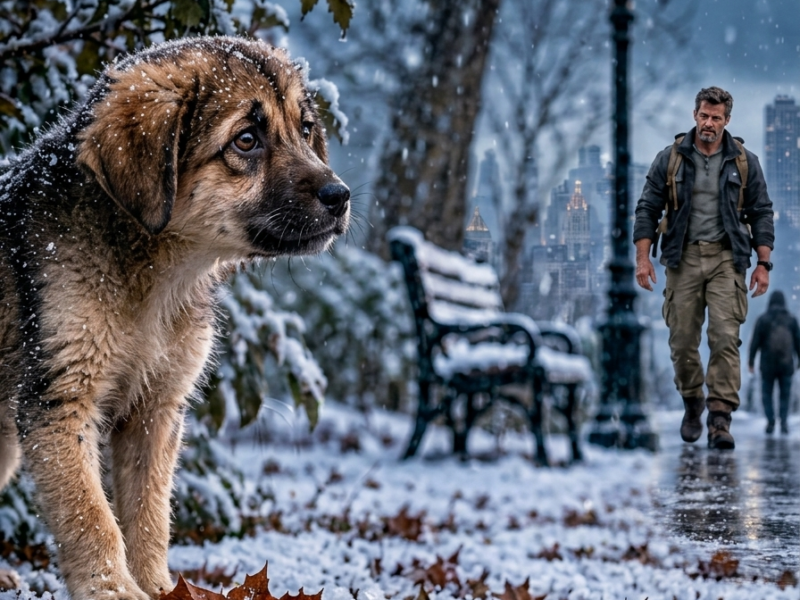
The puppy sat shivering beneath a broken streetlamp outside a closed gas station in Norfolk, Virginia, while people walked past him
The sleet fell in needle-thin slants against the cracked asphalt of Route 17, catching the yellow wash of the only functioning bulb outside an abandoned Citgo station on the southern edge of Norfolk. It was past two in the morning. The coastal air smelled of brackish river mud, motor oil, and coming snow. I had spent fourteen hours at the Naval Amphibious Base Little Creek running young BUD/S candidates through simulated cold-water breaches until my own bones felt brittle and waterlogged. I was forty-two years old, twenty years into a career that had taken everything from my cartilage to my marriage, and all I wanted was to crawl into an empty house in Chesapeake and sleep until the world forgot my name.
Then I saw the dog.
He was tiny, barely four or five months old, huddled in the shadow of a rusted soda vending machine that hummed a hollow, dying note. A shredded cardboard box lay two feet away, soaked through by freezing drizzle. The pup was shivering so violently that his ribcage rattled against the concrete. His coat was a patchwork of brindle and soot-gray, dusted with wet salt and dirt. He was not whimpering. He was not foraging through the grease-stained wrappers trapped against the chain-link fence behind him.
He was sitting upright, his spine straight, his dark eyes locked on the two-lane highway. Every time an eighteen-wheeler roared past, throwing a wall of dirty spray into the night, the dog did not flinch. He leaned forward slightly, as if waiting to recognize the grill of a specific truck, the tone of a specific engine. He was waiting with the stubborn, desperate discipline of a sentry who had been ordered to hold his post until relieved.
I pulled my truck onto the gravel shoulder, killed the headlights, and sat in the dark for a moment. “Leave it alone, Marcus,” I told myself aloud. “You can’t take care of a plant, let alone an animal.”
I opened the driver’s side door anyway.
The cold hit the back of my neck like a wet towel. I walked slowly across the gravel, keeping my hands outside the pockets of my canvas jacket, palms open, staying low to the ground. “Hey, buddy,” I whispered.
The pup’s ears twitched. He turned his head slowly. His nose was cracked from dehydration, his white paws stained pinkish-red from walking on frozen flint. When I reached within three feet, his small frame tensed. He took two deliberate steps back toward the tree line, maintaining an exact distance between us with an instinct that felt far too calculated for a stray.
“I’m not going to hurt you,” I said softly, crouching down on my heels. The wind whipped my collar against my jaw. “You’re going to freeze out here.”
I reached forward again, extending the back of my knuckles for him to sniff. He didn’t smell my hand. Instead, he lifted his chin, sniffing the air near my chest, his nostrils flaring wide. That was when the sodium-vapor lamp above sputtered, throwing a sharp spear of amber light across his throat.
A collar was fastened around his neck. It was thick, faded nylon webbing—tactical coyote tan that had been dyed deep indigo with fabric marker years ago, fraying at the edges where the synthetic fibers had broken down under sun and salt. Hanging beneath the buckle was a hand-stamped brass casing tag, the kind armory technicians at Dam Neck used to punch out on surplus shell casings during long deployments.
My chest constricted so fast I couldn’t draw air.
I moved my hand forward, not caring if the dog snapped. He didn’t. He stood rigid as stone as my fingers brushed the wet fur beneath his jaw. I lifted the brass disc. It was coated in river grime. I dug the edge of my thumb across the face of the metal, scraping away the crusted loam until the uneven letters bit into my skin.
Two words: COME HOME.
Underneath, stamped with a heavy, uneven hand: 10.14.20.
My fingers locked into a cramp. October 14, 2020.
I hadn’t seen that handwriting in six years. I hadn’t said that date out loud since the day three officers in dress blues stood on my mother’s porch in Virginia Beach, holding their white service caps against their bellies, waiting for her to stop screaming.
Daniel had been twenty-six years old. My little brother. The kid who followed me through high school wrestling, through enlistment, through the punishing hell of Coronado’s grinder, all the way into the Teams. He was supposed to be the smart one. The one who read philosophy in the berthing compartments while the rest of us cleaned weapons and drank cheap whiskey. Six years ago, his detachment had vanished off the coast of Socotra during a maritime interdiction operation that had never been declassified. We were told there was an explosion aboard a blockade-runner. We were told the hull collapsed into five hundred fathoms of water. We were told the recovery was impossible.
We were handed a polished mahogany box containing a tri-folded ensign and a citation with four paragraphs of blacked-out text.
“Where did you get this?” my voice cracked, raw and unfamiliar.
The puppy didn’t answer. He took two steps backward, turned his head toward the deep black wall of pine trees and cypress that marked the edge of the swamp behind the service station, and barked once—a dry, raspy sound that barely cleared his throat. Then he started walking.
He didn’t run. He walked ten paces into the brush, stopped, looked over his shoulder, and waited for me.
My heart was hammering against my ribs like a trapped bird. I reached into my truck, pulled my Glock 19 from the center console, racked a round into the chamber, and jammed it into my waistband. I grabbed a heavy tactical flashlight from the glove box and clicked it on. The white beam cut through the weeping Spanish moss and tangled sweetgum trees.
“Lead the way,” I murmured.
We moved deep into the lowland forest. The ground gave way beneath my boots, sucking at the rubber soles with wet, rotting peat. Branches whipped across my face, stinging my cheeks, but the puppy moved with impossible certainty, picking narrow animal trails through the briars as if he had run this ground a thousand times. The drone of the highway faded until there was nothing left but the steady drip of freezing rain through the canopy and the wet thud of my own breath.
We walked for nearly twenty minutes, crossing an old logging culvert that had long since rotted into the black water. Finally, the dog stopped in a small clearing surrounded by towering loblolly pines.
Sitting on a rise of dry earth was an old cedar-shake hunting cabin, so weathered and slumped it looked like part of the swamp floor. Its single window was blacked out from the inside with tar paper. The front door was unlatched, hanging open by two inches on rusted iron strap hinges.
The puppy trotted up the three rotten wooden steps, pushed the door open with his snout, and disappeared into the pitch black within.
“Buddy, come here,” I whispered, pulling the Glock from my waist, keeping the muzzle low and the flashlight tucked beneath my left wrist. My training took over, dulling the terror in my gut with cold procedural precision. I cleared the threshold, slicing the pie around the doorframe.
The smell hit me first. It wasn’t the smell of an abandoned shack. There was no musty rot of decaying canvas or rat droppings. It smelled of gun cleaning solvent—CLP—charcoal, wet wool, and cheap instant coffee.
I swept the light across the single room.
In the corner sat an aluminum cot draped with a standard-issue green military poncho liner. Beside it, on a rough-hewn pine table, sat a clean steel water bowl, dry and empty. But it was the floor that made my knees give out.
Dozens of glossy four-by-six photographs were scattered across the bare planks.
I fell to one knee, lowering the weapon, my flashlight beam shaking uncontrollably. I picked up the nearest photo.
It was taken in sunlight, outside a small clapboard marina with Spanish lettering on a distant awning. In the center of the frame stood Daniel.
He was not twenty-six anymore. His hair was long, pulled back in a short tail, his jaw covered in a thick, graying beard. A long, jagged white scar ran from his right temple down beneath his shirt collar—a burn from an explosive flash. But the eyes—bright gray, slightly narrowed with quiet amusement—were undeniably his. In his arms, he was holding the very same puppy I had followed from the gas station, a tiny ball of fur with oversized paws and a floppy ear.
I grabbed another photo. Daniel standing beside a workbench, stripping down a maritime satellite transceiver. Another of him looking exhausted, sitting on an overturned bucket in the very cabin I was standing in, looking directly into the camera lens with a weary, ferocious focus.
Underneath the pile of photographs lay a heavy manila envelope with my full name and service number printed across the center in black grease pencil: LCDR MARCUS VANCE – 0-4.
My fingers felt numb as I broke the seal. Inside was a single piece of lined yellow legal paper. Written across the center, in Daniel’s tight, deliberate engineering block print, were eight words:
If you’re reading this, they lied to you.
A floorboard groaned beneath heavy weight on the front porch.
The puppy, who had climbed onto the cot, suddenly sat up, his ears pinned back, his tail giving two slow, rhythmic thumps against the wool blanket.
My instincts screamed. I pivoted on my knee, raising the Glock toward the open doorway, centering the white light on the darkness outside.
“Step inside with your hands visible!” I roared, the command ripping from my chest before I could think.
A silhouette appeared against the gray fog of the doorway. Tall, broad-shouldered, moving with the silent, balanced roll of a man carrying combat weight. He didn’t raise his hands. He just leaned his shoulder against the rough timber of the doorframe and took a slow, rattling breath.
“You always were too loud on room clearance, Marc,” a low voice rasped through the dark. “Lower the iron before you put a hole in the only brother you’ve got left.”
The flashlight beam hit his face, and my entire reality fractured into jagged pieces.
It was Daniel.
He looked older, weathered by salt, wind, and years of sleeping with one eye open. The scar on his neck was thicker in person, puckered and violent, pulling at the corner of his throat. He was wearing an oilskin jacket over a faded thermal henley, his hands tucked loosely into his pockets, but his eyes never stopped moving. They swept from my weapon to my eyes, then over my shoulders, scanning the dark corners of the room behind me before settling back on my face.
My hand dropped. The pistol hung limply by my side. “You’re dead,” I whispered, the words sounding hollow and ridiculous even to me. “I buried an empty box in Arlington. Mom sat there in the rain for three hours, Daniel. She wouldn’t leave until the sod was replaced.”
A shadow crossed his face, a sudden, brutal twitch of pain around his mouth. “I know,” he said softly. “I was there. Sitting in an unmarked rental behind the maintenance sheds near Section 60. I wanted to walk down that hill, Marc. Christ, I wanted to take her hand so bad my teeth were cracking.”
“Then why didn’t you?” I screamed, stepping forward, every ounce of grief and betrayal boiling into fury. I grabbed the front of his jacket with my left hand, shoving him back against the doorframe. He let me do it. He didn’t resist. His frame was leaner than I remembered, his breath hitching slightly as his back struck the timber. “Why let us carry that for six years? Do you have any idea what you did to her? What you did to me?”
“Because if I came back, you would both be dead within forty-eight hours,” Daniel said, his voice flat, steady, and chillingly devoid of emotion. “And right now, by bringing you here, I might have just signed your death warrant anyway.”
The puppy gave a soft whine, hopped down from the cot, and pressed his head against Daniel’s boot. Daniel reached down without looking, his scarred fingers tangling into the dog’s thick coat, his touch gentle. “Good boy, Valor. You did it. Good boy.”
“Who is hunting you, Danny?” I asked, my voice dropping back to the low murmur of men who have spent their lives working in the shadows. “Who told us you died?”
“Blackthorn Vanguard,” he said, the name dropping like lead into the damp air.
I frowned, stepping back. “They’re a defense logistics contractor out of Northern Virginia. They run support corridors for CENTCOM.”
“They run off-book retrieval networks for the highest bidder, Marc,” Daniel said, walking into the cabin and pulling the heavy wooden door shut behind him. He threw a drop-bar across the jamb, locking it from the inside. “Six years ago, our team wasn’t intercepting a weapons shipment off Socotra. We were tasked by our own command to escort an asset who turned out to be an internal auditor from the Pentagon’s Defense Logistics Agency. He had three encrypted solid-state drives detailing four hundred million dollars in unaccounted black-budget arms transfers funneled through private contractors.”
Daniel walked to the rough table, clicked on a small battery-operated camping lantern, and turned off my flashlight to save the battery.
“Before we could make our extraction point,” he continued, “our command cut our comms. A flight of unmarked Little Birds intercepted our zodiac. They didn’t come to extract us. They hit us with fifty-caliber rounds and thermite. Miller died first. Then Hayes. The boat went up. The fire took my face and neck, but the shockwave threw me deep under the water. When I surfaced, Blackthorn contractors were executing Hayes in the water to make sure there were no survivors.”
My stomach turned. “Hayes had a six-month-old daughter.”
“They didn’t care,” Daniel said bitterly. “They salvaged the wreckage, took the auditor’s body, and left the rest of us for fish food. I floated on a fuel bladder for fourteen hours before a Yemeni fishing dhow picked me up. When I finally reached an embassy relay station three weeks later, I pulled the official records. We were listed as KIA. The official report said an unexploded ordnance on the target vessel detonated prematurely. And the officer who signed off on our death certificates, the man who sealed the case files and transferred all our operational logs to Blackthorn’s internal servers…”
Daniel stopped, his gray eyes locking onto mine with terrifying intensity.
“Who?” I demanded.
“Captain Cole,” Daniel said.
A cold chill ran down my spine. Captain Robert Cole. My commanding officer at Little Creek. The man who had handed my mother the folded flag. The man who had written my promotion recommendation three months ago.
“Cole is untouchable,” I said numbly. “He’s being vetted for rear admiral.”
“Cole owns twenty percent of Blackthorn’s holding company through an offshore shell in the Caymans,” Daniel spat. “He didn’t just cover it up, Marc. He built the pipeline. For six years, I’ve been living like a rat from Djibouti to Panama, piecing together the financial records, the satellite manifests, the names of the pilots who flew that hit. I had to stay dead until I had enough leverage to take down the entire network at once. If I showed my face before every link was documented, Cole would have had me erased in a federal holding cell before I could speak to a magistrate.”
“Why now?” I asked, looking down at the scattered photos. “Why did you send Valor to find me tonight?”
Daniel reached into his jacket pocket and pulled out a small, ruggedized thumb drive coated in matte black sealant. “Because three days ago, I finally broke into the secondary server at Blackthorn’s maritime depot in Wilmington. I got the master ledger. Every transaction, every payoff, every offshore account Cole and his board of directors have used for a decade. But their security grid flagged the download. They tracked me to Norfolk.”
He pulled his hand back, and I saw the dark, wet stain soaking through the right flank of his oilskin jacket.
“You’re hit,” I said, stepping forward.
“Grazed my ribs during the sprint across the rail yard last night,” he muttered, waving me off. “It’s not the bullet that worries me. It’s what came with it. I had to send Valor out with the collar because I couldn’t make it to your house without tripping their drone surveillance over Chesapeake. I knew if he sat at that station, you’d drive past it on your way back from Little Creek. You take that route every Tuesday night. You’ve taken it for ten years.”
A low, vibrating rumble suddenly echoed through the cabin floorboards.
It wasn’t thunder.
Valor immediately leaped to his feet, his hackles raised along his spine, a deep, warning growl rolling in the back of his throat. He looked toward the rear window facing the swamp.
Through the gaps in the tar paper, two sharp beams of infrared light cut through the mist, invisible to the naked eye but reflecting faintly off the water droplets outside. Above the canopy, the muffled, thrumming chop of a low-altitude rotor system began to beat against the trees.
Daniel’s face went dead white. “They didn’t track me by foot,” he whispered. “They bypassed the cellular grid. They’re running forward-looking infrared from a bird.”
A sharp, metallic crack shattered the silence.
The rear window of the cabin exploded into a spray of glass and splintered wood as a heavy-caliber round tore through the wall, ripping through the cedar planks three inches above my head.
“Down!” I roared, grabbing Daniel by the collar and driving him face-first into the pine floor as a synchronized volley of suppressed fire tore through the cabin’s cedar walls.
The rounds came in high-velocity bursts—5.56 green-tip penetrators chewing through dry wood like paper, filling the small room with choking clouds of powdered cellulose, sulfur, and insulation. The camping lantern shattered, plunging us into chaos illuminated only by the strobing muzzle flashes cutting through the swamp fog outside.
Valor didn’t panic. The young dog pressed himself flat into the depression between the cot and the floorboards, whining softly but keeping his teeth bared, his instincts keeping him pinned below the fatal funnel of incoming fire.
“Back door!” Daniel shouted over the din, coughing through the dust. “There’s an egress trench into the culvert!”
“How many?” I yelled, rolling onto my side and unholstering my Glock.
“Four-man fireteam, minimum,” Daniel coughed, pressing his hand against his bleeding ribs as he dragged himself toward the rear of the cabin. “Blackthorn contractors. They won’t be using standard rules of engagement. They’re here to sanitize the site.”
A heavy thud shook the front porch. Someone was kicking the drop-bar off the front jamb.
I didn’t wait for the door to breach. I leveled my pistol at the center of the heavy timber door and fired three rounds in rapid succession, double-tapping through the wood at chest height. A muffled grunt and the heavy clatter of tactical gear hitting the porch steps told me one of the shooters had taken the rounds.
“Move! Now!” I grabbed Daniel under his left shoulder, hauling him toward the small service hatch cut into the rear flooring behind the wood stove.
Daniel kicked the hatch open, revealing a muddy crawlspace that dropped two feet into the stagnant water of the marsh beneath the cabin stilts. “Valor, go!” he ordered.
The pup didn’t hesitate. He slipped through the hatch into the black muck below. Daniel followed, his face contorting in agony as his wounded side scraped against the rough edge of the opening. I fired the remaining rounds in my magazine through the splintered window frame to keep the perimeter shooters pinned, dropped the empty mag, slammed a fresh fifteen-round stick into the grip, and dropped through the floorboards into the freezing water.
The shock of the cold nearly stole my breath. The swamp beneath the cabin was three feet of black sludge and rotting vegetation, reeking of methane. Overhead, heavy boots hammered across the floorboards we had occupied seconds earlier. Flashlight beams cut through the gaps in the floor, sweeping across the dark water.
“Sweep the perimeter! They went under!” a gravelly voice barked from above.
Daniel was already moving, wading through the chest-high black water toward the cover of a massive fallen bald cypress fifty yards into the tree line. Valor was swimming beside him, his small head cutting through the scum with silent determination. I brought up the rear, wading backward with my weapon raised, keeping my eyes fixed on the illuminated underbelly of the cabin.
A contractor in a sterile black plate carrier and night-vision goggles rounded the corner of the stilts, his suppressed carbine coming up toward Daniel’s back.
I fired twice. The hollow-points struck him square in the center of his chest rig. The kinetic energy knocked him backward into the water with a heavy splash.
“Run!” I hissed.
We broke from the water onto a narrow spit of higher ground lined with thick blackberry brambles and loblolly saplings. Daniel was stumbling, his left hand clamped over his flank, his breathing coming in ragged, wet wheezes. The blood was running freely now, soaking through his trousers and staining the frozen mud beneath his boots.
“My truck is two miles north on 17,” I said, catching him around the waist as his knees buckled. “Can you make it?”
“Don’t have a choice,” he gasped, his teeth chattering from the freezing swamp water. “If we hit the highway, they have aerial coverage. They’ll paint the truck before you clear the county line.”
“We aren’t going to the highway,” I said, my mind racing through maps of the Tidewater area I had committed to memory over fifteen years of naval service. “There’s an old boatyard two miles east on the Southern Branch of the Elizabeth River. Belongs to an old master chief who retired after Desert Storm. He owes me his pension.”
We moved through the swamp like ghosts, running where the ground held, crawling through the thorn thickets when the low hum of the surveillance drone passed overhead. The dog moved between us, repeatedly nudging Daniel’s trailing hand with his nose, keeping him alert, keeping him moving. Every time Daniel slowed down, Valor would pause, turn his small body, and whine until Daniel forced his boots forward another ten yards.
By the time we cleared the marsh and hit the rusted chain-link fence of Thorne’s Marine Salvage, Daniel was leaning almost all his weight on me. His skin was gray, his lips tinged with blue from hypothermia, and his jacket was stiff with coagulated blood and swamp silt.
I cut the bottom of the fence with a pocket multi-tool, rolled the wire up, and shoved Valor through first. Then I dragged Daniel through the gap, pulling him into the shadow of a decaying sixty-foot steel tugboat dry-docked on massive timber blocks.
The yard was a graveyard of rusting winches, rusted propellers, and corrugated metal sheds. At the end of the gravel drive stood a two-story cinderblock workshop with a single yellow light burning in the second-floor office.
I helped Daniel toward the heavy steel side door of the shop and hammered on the metal with the butt of my pistol: three fast raps, a pause, two slow raps.
A slide bolt squeaked inside. The door swung open six inches, revealing the weathered, sun-leathered face of Silas Thorne, his thinning gray hair cut into a severe flat-top, a short-barreled twelve-gauge shotgun leveled directly at my sternum.
“You’re making an awful lot of racket for a man who’s supposed to be on leave, Commander,” Silas growled, his tobacco-stained voice rough as sandpaper.
Then his pale eyes dropped to Daniel’s face. The shotgun dipped an inch. The old master chief’s jaw slacked, his weathered hands tightening on the walnut stock until his knuckles turned white.
“Jesus, Mary, and Joseph,” Silas breathed. “That’s the ghost.”
“He needs a needle, thread, and about two pints of saline, Chief,” I said, my voice shaking with exhaustion. “And we have company on our six.”
Silas didn’t ask another question. He stepped back, swung the door wide, and hauled Daniel inside with the terrifying, wiry strength of an old sailor. “Bring the hound,” Silas ordered, locking the three deadbolts behind us. “Get him on the workbench.”
The workshop smelled of cutting oil, welding slag, and kerosene. Silas kicked a pile of hydraulic hoses off a heavy steel workbench, threw a clean canvas tarp over the metal, and helped me hoist Daniel up. Daniel groaned, his head lolling back against a wooden crate of brass fittings.
Valor immediately sat beneath the bench, his chin resting on Daniel’s dangling boot, his eyes fixed on the heavy metal door.
Silas grabbed a heavy first-aid kit from the wall, snapped on a pair of nitrile gloves, and used a pair of trauma shears to rip Daniel’s henley down the seam. When the fabric peeled away, I sucked in a sharp breath. The bullet hadn’t just grazed him; it had gouged a four-inch trough along his lower right ribcage, tearing through muscle and exposing the white sheen of the intercostal tissue. It was weeping thick, dark venous blood.
“Clean through the meat,” Silas muttered, pouring half a bottle of surgical iodine directly into the wound. Daniel arched his back, his fingers digging into the steel edges of the bench, a guttural scream caught behind his clenched teeth. “Didn’t shatter the bone, but he’s leaking bad. Hold him down, Marcus.”
I clamped my hands down on Daniel’s shoulders while Silas worked with terrifying speed, driving curved suture needles through the flesh, pulling the torn edges together with thick nylon thread.
“How long until they track you here?” Silas asked between stitches, not looking up.
“Twenty minutes, maybe less,” I replied, pulling the black thumb drive from Daniel’s pocket and setting it on the bench. “They have forward air support. They know he’s in the sector.”
“That drive,” Daniel rasped, his voice barely a whisper through the agony of the needle. “Silas… you still have that terminal? The air-gapped sat-com?”
Silas tied off the final knot, wiped the bloody sweat from his brow with the back of his forearm, and nodded toward a padlocked steel footlocker in the back corner of the office. “Never throw away good surplus, son. But if Cole is using military-grade surveillance, the moment I boot that transmitter, the Atlantic Fleet Watch Center is going to see the handshake.”
“Let them see it,” Daniel said, reaching down and weakly patting Valor’s head. “Because they aren’t going to see an SOS. They’re going to see Cole’s signature on the murder warrant for an entire SEAL team.”
Silas walked to the locker, spun the combination dial, and pulled out an old, olive-drab Panasonic Toughbook wired into a bulky satellite transceiver. He set it on the workbench next to Daniel, popped the lid, and connected the thumb drive.
The screen flickered to life, bathing the dark workshop in cold blue light. Rows of encrypted directories scrolled past, dozens of maritime logistics manifests, bank routing numbers, and satellite coordinates from the night Daniel disappeared.
“Look at the bottom,” Daniel whispered, pointing a shaking, blood-stained finger at the screen.
I leaned in.
Beneath the financial logs was an active, real-time tactical manifest dated three hours ago. It contained a list of twelve personnel mobilized for an “unauthorized recovery operation” in the Norfolk metropolitan area.
At the bottom of the order, signed with a digital cryptographic key from the Commander of Naval Special Warfare Group Two, was a single, terrifying authorization:
TARGET: MARCUS VANCE / DANIEL VANCE.
DIRECTIVE: SANITIZE UPON CONTACT. NO DETENTION AUTHORIZED.
SIGNING AUTHORITY: CAPT. R. COLE.
Silas cursed softly under his breath. “He isn’t just trying to cover his tracks, boys. He’s burning the whole house down.”
Before I could answer, the workshop’s exterior mercury lights cut out, plunging the windows into total blackness.
Down by the perimeter fence, the sudden, shrill shriek of tearing metal echoed across the gravel yard.
“They’re here,” Silas said, racking the slide of his Remington 870 with a sound that felt as heavy as a coffin closing.
Valor stood instantly, his small chest swelling as he issued a low, guttural bark toward the waterfront doors of the workshop. The boy wasn’t cowering; he was positioning himself between the bench where Daniel lay and the roll-up industrial door that led to the dry dock slips.
“Silas, kill the main breaker,” I commanded, drawing my Glock and pulling two spare magazines from the first-aid kit where Silas kept his tactical overflow. “If they have thermals, they’ll see our heat signatures through the corrugated tin. We need darkness and cold.”
The old master chief reached into the fuse panel and yanked the heavy iron lever. The hum of the satellite laptop died, its screen reverting to low-power battery mode, throwing a faint, eerie rectangular glow across our faces. The industrial fan in the ceiling sputtered to a halt. The only sound left was the slow, rhythmic slosh of the Elizabeth River slapping against the creosote pilings outside.
“They’ll hit from the water and the land simultaneously,” Daniel rasped, rolling off the bench despite my hand trying to keep him still. His boots hit the concrete floor with a wet smack. He leaned heavily against a metal shelving unit, his face pale as lard, but his fingers were already wrapping around an old Colt 1911 Silas kept tucked beneath the cash drawer. “Standard pincer. Two men on the perimeter gate, four coming off a fast boat on the slipway.”
“How are you moving?” I asked him.
“On hate and cheap painkillers,” Daniel whispered, racking the 1911’s slide with one hand against the edge of the shelf. “Give me the thumb drive.”
I pocketed the drive in my breast pocket, zipping the tactical pocket tight. “It stays with me. You focus on putting one foot in front of the other.”
“Listen to me, Marcus,” Silas interrupted, pointing toward the rear of the shop where a heavy canvas drop-cloth hung over an inland slipway. “I got a twenty-eight-foot aluminum hull patrol boat in the wet slip. Twin Yamaha outboards. Full tanks of aviation gas. She ain’t pretty, but she’ll do forty-five knots across the chop before their bird can re-acquire through the fog.”
“What about you?” I asked the old man.
Silas smiled, a terrifying, humorless baring of nicotine-stained teeth. “I’m seventy-one years old, Marcus. I got bad hips, no wife, and two months before the bank takes this yard anyway. I’m going to stay right here with this twelve-gauge and remind these Blackthorn mercenaries that you don’t breach an old salt’s shop without paying the slip fee.”
“Silas, no,” I said. “Come with us.”
“You need someone to hold the slipway winch, or you won’t even clear the harbor gate,” Silas snapped, his voice dropping into the unquestionable authority of a Master Chief who had led men through the Persian Gulf before I was out of middle school. “Now get your brother on that boat. When you clear the barrier island, point the bow straight toward the Atlantic Fleet Watch Center at Naval Station Norfolk. You crash that boat right into the pier of the flagship. You make so much noise the entire Seventh Fleet has to look out the window.”
A flashbang detonated outside the front office window, blowing the glass inward in a brilliant, blinding shower of white phosphor and concussive thunder.
“Move!” Silas roared.
He pumped a round into the darkness of the front bay, the twelve-gauge bellowing like a cannon in the enclosed space. The blast shredded the plywood partition, followed instantly by screams and the heavy rattle of suppressed automatic fire chewing through the tool racks.
I grabbed Daniel around his torso, hauling him backward toward the wet slip. Valor ran ahead of us, clearing the corners of the dark corridor, his nails clicking sharply on the damp concrete. We threw aside the heavy canvas curtain, revealing the black, oil-streaked water of the indoor slip where the gray aluminum patrol boat bobbed on the tide.
I dropped Daniel into the passenger seat behind the small fiberglass center console. “Stay low! Keep your head down!”
Valor leaped into the boat without waiting for a command, landing squarely between Daniel’s feet, curling his body protectively over Daniel’s wounded flank.
I jumped behind the wheel, clicked the master ignition, and hit the dual starter toggles. The twin outboards coughed once, sputtered in the freezing damp, and then roared to life with a deep, vibrating drone that echoed off the metal roof.
Behind us, in the main bay, the firefight reached a fever pitch.
Silas was shouting curses that could have peeled paint off a battleship hull, punctuating every insult with the rhythmic, heavy boom of the Remington. But through the gunfire, I heard the distinct, sharp zip-snap of professional sub-machine gun fire. Then, the sickening, wet thud of buckshot hitting masonry, followed by a heavy silence from the master chief’s sector.
“Silas!” Daniel cried, trying to stand.
“Stay down!” I shoved him back into the seat.
A shadow darted around the edge of the canvas curtain. It wasn’t Silas.
It was an operator dressed in full black tactical gear, his rifle leveled straight at the center of my chest. In the dim light of the boat’s dashboard, I saw the stylized crow-and-dagger patch of Blackthorn Vanguard on his shoulder.
Before I could clear my sidearm from its holster, Valor launched himself from the deck.
The four-month-old pup didn’t hesitate. He cleared the four-foot gap between the boat’s gunwale and the slipway concrete with a savage, desperate snarl, clamping his jaws down hard onto the operator’s extended gun wrist.
The shooter gasped in surprise, his first round going wild, punching a hole through the corrugated fiberglass skylight above. The weight of the dog pulled his aim off long enough for me to draw the Glock, steady the front sight against the bridge of the operator’s nose, and squeeze the trigger.
The shooter dropped like a sack of wet salt into the slipway water.
“Valor! Back! Get in!” I roared.
The pup let go of the downed man’s arm, spun on his haunches, and scrambled back over the metal gunwale, landing on the non-skid deck with a wet thud. I grabbed him by the scruff of his neck, pulled him into the console well with Daniel, and slammed the dual throttles forward.
The aluminum boat leaped forward, its props churning the brackish water into white foam. We hit the rusted steel harbor door at fifteen knots. The rotten iron buckled with a deafening screech of tearing rivets, the bow lifting as we burst through the metal into the wide, freezing blackness of the Elizabeth River.
The river was a void of fog and sleet.
To our left, the massive cranes of the Norfolk Naval Shipyard rose into the gray mist like skeletal dinosaurs, their warning lights blinking a dull, rhythmic red. Behind us, the salvage yard was already glowing with an orange aura as Blackthorn’s demolition charges began to consume Silas’s workshop.
“Bird’s inbound!” Daniel yelled over the roar of the engines, looking up through the mist.
A searchlight dropped from the clouds three hundred yards behind us, piercing the river fog like a solid pillar of light. The twin-turbine whine of an MH-60 Black Hawk—a sanitized, unmarked bird running off civilian contractor registration—tore through the sleet, dropping low over the water to match our speed.
“They’re going to minigun the hull!” Daniel shouted, pulling the slide of the 1911 back to check his chamber. “We won’t make the naval station! We’re sitting ducks on open water!”
“Hold on!” I screamed.
Instead of running down the main channel toward the bay, I hauled the wheel hard to starboard, throwing the patrol boat into a violent, skidding turn that nearly tossed Daniel and Valor over the port gunwale. We cut across the wake, heading directly toward the massive, towering silhouette of Dry Dock 4, where the supercarrier USS Harry S. Truman sat perched on her massive keel blocks for overhaul.
“What are you doing?” Daniel gasped, spitting saltwater from his lips.
“They can hunt a boat on an open river!” I yelled back, pushing the throttle levers to their mechanical stops. “They can’t fire a heavy gun inside a designated nuclear maintenance basin without triggering every perimeter defense system in the United States Atlantic Fleet!”
The patrol boat roared straight into the illuminated concrete mouth of the dry dock canyon.
The transition from the black river into the dry dock basin was like driving into a sports stadium lit by blinding magnesium flares. Towering concrete retaining walls rose eighty feet on either side of the basin, amplifying the roar of our twin engines into an ear-splitting howl. Industrial catwalks, heavy yellow cranes, and miles of temporary air lines crisscrossed the canyon above us.
Behind us, the pursuing helicopter flared violently, its rotors kicking up a hurricane of blinding spray as the pilot realized where we had led him.
The dry dock was a restricted federal enclave. The moment the unmarked chopper crossed the boundary perimeter, warning sirens across the naval station began to wail—a deep, undulating howl that signaled an unauthorized airspace breach over a nuclear-capable facility.
“Cut the engines!” Daniel yelled, pointing toward the heavy wooden bumper pier beneath the carrier’s stern overhang. “Cut ’em or we’ll ram the caisson gate!”
I pulled the throttles back to neutral and threw the helm hard over. The aluminum hull slammed against the massive creosote pilings with a bone-jarring shudder, the starboard side scraping along the timber before wedging solid into the narrow maintenance mooring beneath the carrier’s massive bronze propellers.
I grabbed Daniel’s arm, hauling him onto the slick wooden dock. Valor scrambled up behind us, his wet coat plastered to his shivering sides, his ears pinned back against the deafening shriek of the facility sirens.
“Move! Up the stairs to the watch tower!” I shouted.
We sprinted—Daniel half-dragging his right leg, his hand clutching his reopened suture line—toward the steel flight of industrial stairs that led to the dry dock master’s observation deck.
Footsteps pounded on the iron grating above us.
A voice cut through the rain, cold, amplified, and unmistakably familiar.
“That’s far enough, Commander Vance.”
We froze on the landing twenty feet above the water.
Standing on the platform above was Captain Robert Cole. He was not in uniform. He wore a heavy civilian tactical parka over dark trousers, his silver hair neatly combed beneath a black watch cap. Behind him stood three Blackthorn contractors, their short-barreled rifles resting in the low-ready position, their eyes dead and professional.
In Cole’s right hand was a satellite phone; in his left, a matte-black SIG Sauer P226.
“Captain,” I said, stepping slightly in front of Daniel, keeping my hand off my weapon. “You’re a long way from the administrative wing at Little Creek.”
Cole looked down at us with an expression of mild, weary regret, like a headmaster dealing with a pair of truant schoolboys. “I told you to take that leave, Marcus. I gave you thirty days in the mountains. If you had just taken your car and driven west, none of this would have touched you.”
“You murdered Hayes,” Daniel spoke, his voice hoarse, vibrating with six years of unspent venom. He stepped out from behind me, leaning against the safety railing, his gray eyes locking onto the man who had erased his existence. “You murdered Miller. You sold out your own detachment for a ledger balance in a shell bank.”
Cole didn’t flinch. “I secured funding for programs this country didn’t have the stomach to finance through Congress, Daniel. You were a twenty-six-year-old operator who thought the world ran on boy scout oaths and medals. The world runs on logistics. It runs on resources that don’t appear on congressional balance sheets. Your team was an unfortunate liability at the end of a very long, very necessary transaction.”
“And what am I?” I asked Cole. “Another line item?”
“You’re a good officer, Marcus,” Cole said calmly, raising the SIG Sauer until the bore was centered between my eyes. “Which is why it’s going to be so tragic when the base security police find you here. A disgraced commander who discovered his traitorous brother hiding in the swamp, tried to harbor him, and engaged in a fatal shootout with base defense contractors. The narrative is already written. The press releases are already drafted.”
“You forgot one thing, Captain,” Daniel said softly.
Cole’s eyes flickered toward Daniel. “And what would that be, son?”
“You forgot about the pup,” Daniel whispered.
At that exact second, Valor, who had slipped silently up the metal steps beneath the open grid while Cole was speaking, burst onto the platform from the shadow of an electrical junction box. He didn’t bark. He didn’t hesitate. He launched his forty-pound body straight at Cole’s right arm, sinking his teeth into the meat of the captain’s forearm with the full, unyielding fury of his working-breed blood.
Cole screamed, his shot discharging wild into the steel ceiling of the catwalk as he stumbled backward.
“Down!” I roared.
I tackled Daniel onto the grating as the three Blackthorn contractors reacted, their weapons coming up.
Before their fingers could touch the triggers, the heavy corrugated blast doors at the top of the dry dock observation tower were blown inward with a deafening concussive blast.
“FEDERAL AGENTS! NOBODY MOVE!”
A team of twelve NCIS Special Agents, accompanied by a full squad of Naval Base Norfolk Master-at-Arms personnel in full desert camouflage, swarmed the catwalk from the upper gantry, their shotguns and carbines leveled with terrifying precision.
“DROP THE WEAPONS! DROP THEM NOW!”
The Blackthorn contractors, realizing the trap they had walked into, froze. Their training told them the math was impossible. They were caught in an elevated crossfire with eighty federal badges pointing at their center mass. Slowly, methodically, they dropped their rifles onto the grating and laced their fingers over their heads.
On the lower platform, Cole was on his knees, striking at Valor with his free fist, but the young dog refused to let go, his jaws locked into the heavy fabric of the captain’s parka.
“Call him off!” Cole shrieked, his composure shattering into pathetic terror as federal agents swarmed down the metal stairs, their weapons trained on his head. “Call this animal off me!”
I walked slowly up the stairs, my boots ringing on the iron steps. Daniel followed right behind me, his arm draped over my shoulder, the two of us standing together on the deck.
“Valor,” Daniel commanded softly. “Out.”
The dog instantly released his grip, stepped back three paces, and sat down beside my boot, his tail giving a single, exhausted thump against the grating.
Two NCIS agents drove Cole face-first into the diamond-tread steel, twisting his bloody arm behind his back and snapping heavy steel cuffs over his wrists. An agent in a navy windbreaker—a senior field supervisor I recognized from Little Creek—walked over, picked up the black thumb drive that had fallen from my pocket during the scramble, and looked at me.
“We intercepted the data packet your Master Chief beamed through the fleet relay ten minutes ago, Commander,” the agent said quietly. “Silas Thorne is alive, by the way. He took two rounds to the shoulder, but he’s sitting on his porch right now smoking a cigar while the paramedics try to keep him from punching the fire chief.”
Daniel let out a long, ragged breath—a sound that carried six years of salt, blood, and loneliness out into the cold night air—and slumped against the railing.
The heavy sirens across the base began to wind down, their mechanical wail dying into the morning mist.
To the east, across the gray expanse of the Chesapeake Bay, the first sliver of dawn was beginning to break through the winter clouds. The freezing rain had finally stopped, replaced by a pale, golden light that washed over the massive gray hull of the aircraft carrier and the dark waters of the Elizabeth River.
A navy medic ran down the stairs with a trauma kit, falling to his knees beside Daniel to re-dress the mangled wound on his ribs.
Daniel winced as the medic applied the fresh gauze, but his eyes never left the horizon. He reached out with his right hand, his fingers tangling into the thick, wet fur on the back of Valor’s neck. The pup leaned all his weight against Daniel’s knee, his eyes closing in pure, unadulterated relief.
I stood beside them, looking down at the worn nylon collar still fastened around the dog’s neck.
The brass tag caught the first true ray of morning sun, the two stamped words glowing like gold against the wet dirt.
COME HOME.
I placed my hand on Daniel’s shoulder, feeling the solid, living warmth of my brother’s breath beneath the canvas jacket.
“It’s over, Danny,” I said softly, the words finally feeling real in the salt air. “Let’s go home.”
The end









