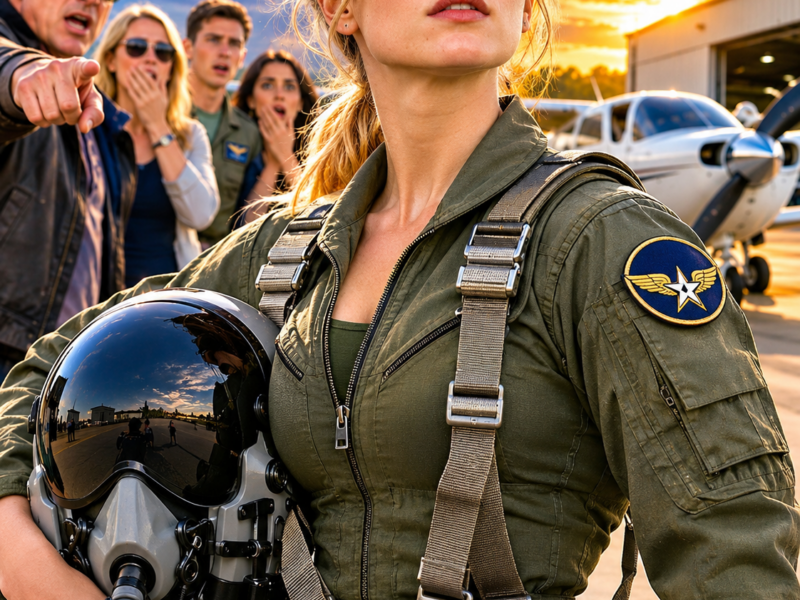
“I was standing in front of an entire flight school when the chief instructor looked at my worn-out shoes, glanced at my empty bank account
I turned toward Captain Hayes, still holding the scholarship folder against my chest.
“What happened to my father?”
He didn’t answer immediately.
The hallway had become strangely quiet.
The girl who had made the comment suddenly found something interesting on her phone.
Captain Hayes glanced at her, then motioned toward his office.
“Emma, come inside. We need to talk.”
I followed him, my shoes making soft sounds against the polished floor.
He closed the door and invited me to sit.
Instead, I remained standing.
“Please don’t tell me there’s something in my father’s past that will cost me this opportunity.”
Captain Hayes took off his glasses.
“Your father is Daniel Wilson, correct?”
“Yes.”
“He used to work in aviation?”
My throat tightened.
“He was a mechanic. He worked on aircraft years ago, before his health got worse. Why?”
Captain Hayes leaned back in his chair.
“Because I knew him.”
For a moment, I couldn’t find the words.
“You knew my dad?”
“Not personally at first. But I worked at the same regional airport where he was employed.”
I remembered my father’s stories about the airport.
He had mentioned old colleagues, late-night repairs, and a hangar that used to stay open long after midnight.
But he had never mentioned Captain Hayes.
“What happened?” I asked.
Hayes looked toward the window.
“Twenty-two years ago, there was an aircraft incident during a maintenance inspection. Your father was one of the mechanics involved.”
I sat down slowly.
“Was someone hurt?”
“No. The aircraft never took off. But the investigation became complicated.”
He paused.
“Your father was blamed for signing off on a maintenance issue that hadn’t been properly resolved.”
I shook my head.
“That doesn’t sound like him.”
“I didn’t say he was responsible.”
“Then why was he blamed?”
Captain Hayes folded his hands.
“Because someone needed to take responsibility, and the investigation was handled badly.”
I stared at him.
“Did my father lose his job?”
“Yes.”
“And his career?”
Hayes nodded.
I remembered my father sitting at the kitchen table, rubbing his hands whenever his old injuries bothered him.
I remembered asking why he never went back to the airport.
He always said, “Sometimes life takes a different runway, sweetheart.”
I had thought it was simply a way of making me feel better.
Now I wondered how much pain was hidden behind that sentence.
“Why didn’t he tell me?”
“Perhaps he wanted you to have a chance to love aviation without inheriting his disappointment.”
I looked down at my scholarship folder.
“Does this mean they won’t accept me?”
Captain Hayes shook his head.
“No. Your father’s history has nothing to do with your aptitude. But Margaret deserves to know the circumstances before someone else uses them against you.”
I stood.
“Then I want to tell her myself.”
He studied me for a moment.
“Are you sure?”
“I’ve spent years trying to prove I belong in that cockpit. I’m not going to let an old story about my father become another reason to hide.”
The next morning, I returned to the foundation’s office.
Margaret Collins was reviewing applications when I knocked.
“Come in, Emma.”
I sat across from her.
“There’s something I need to tell you before the final evaluation.”
She put down her pen.
“Go ahead.”
I explained what Captain Hayes had told me.
I told her about my father’s career, the maintenance incident, and the investigation that had ended his time in aviation.
I didn’t make excuses.
I didn’t accuse anyone.
I simply told her what I knew.
When I finished, Margaret remained silent.
Then she asked, “Did your father ever discuss the incident with you?”
“No. He doesn’t like talking about the airport.”
“Would you be willing to speak with him about it?”
I nodded.
“I would.”
She closed my application folder.
“Emma, I want you to understand something. This scholarship isn’t awarded to families. It’s awarded to individuals. Your assessment results remain yours.”
I exhaled.
“But there are still evaluations to complete.”
“I understand.”
“And I expect you to meet the same standards as everyone else.”
“That’s all I’ve ever wanted.”
When I left her office, I called my mother.
She answered while she was driving home from work.
“Everything okay, sweetheart?”
“Mom, I need to ask you something about Dad.”
There was a pause.
“What about him?”
“Did something happen at the airport years ago?”
I heard the turn signal clicking through the phone.
“Who told you?”
“Captain Hayes.”
My mother didn’t speak for several seconds.
Then she said, “Come home. We’ll talk.”
That evening, my father was sitting in his usual chair when I walked into the living room.
His old aviation photographs were stacked on the table beside him.
I sat on the edge of the sofa.
“Dad, did you lose your aviation career because of a maintenance investigation?”
He looked at my mother.
She lowered her eyes.
Then he looked back at me.
“Richard Hayes told you?”
I nodded.
My father rubbed his palms together.
“I was twenty-nine when it happened.”
He explained that he had been working as a maintenance mechanic at a small regional airport.
One evening, an aircraft had been brought in after a pilot reported an unusual vibration during flight.
The aircraft needed further inspection before it could return to service.
My father had identified a component that required additional attention.
He wrote the issue in the maintenance log and refused to sign the final release until the work was completed.
But another mechanic, a senior employee named Thomas Reed, later claimed that the repair had been finished.
The paperwork showed a signature that appeared to belong to my father.
My father insisted he hadn’t signed it.
The aircraft was eventually grounded again when another mechanic noticed the unresolved issue.
No one was injured.
But the investigation focused heavily on the maintenance records.
My father had no copy of the original work order.
The senior mechanic denied everything.
And the airport management decided the easiest explanation was that my father had failed to complete his responsibilities.
“Why didn’t you fight it?” I asked.
“I did.”
His voice was quiet.
“I hired a lawyer. I attended meetings. I gave them everything I had. But I was young, and I didn’t have the money to keep fighting people with better connections.”
“What happened to Thomas?”
My father looked toward the photographs.
“He kept his job.”
I felt something tighten in my chest.
“That’s not fair.”
“No, it wasn’t.”
“Did Captain Hayes know?”
“He was a young instructor at the airport then. He knew something wasn’t right, but he wasn’t involved in the investigation.”
My father looked at me.
“I don’t want you carrying my anger, Emma.”
“I’m not.”
He smiled faintly.
“Good.”
I reached for his hand.
“Why didn’t you ever tell me you wanted to fly?”
He looked surprised.
Then he laughed softly.
“I thought I told you.”
“You told me you used to work on planes.”
“That’s because I wanted you to love the sky, not feel responsible for what happened to me.”
I looked at the photographs again.
There was one of him standing beside a small white aircraft, wearing a blue maintenance uniform.
He looked younger than I had ever seen him.
Happy.
“Dad, did you ever stop wanting to become a pilot?”
He looked at the photograph for a long time.
“No, sweetheart. I just stopped believing I would.”
I couldn’t sleep that night.
I kept thinking about the little girl who had once pointed at airplanes from the backyard.
I had spent years trying to reach a place my father had once stood.
And now I understood that his silence hadn’t been indifference.
It had been protection.
The following week, the final scholarship evaluation began.
There were six applicants.
We were given navigation scenarios, weather reports, emergency procedures, and a series of simulated flight decisions.
I recognized one of the other applicants immediately.
The girl who had laughed at me.
Her name was Lauren Mitchell.
She came from a wealthy family and had been training at a private aviation facility since she was sixteen.
Before the assessment, she approached me near the simulator.
“Hey, Emma.”
I looked up.
“Hi.”
“I heard about your dad.”
I said nothing.
She shifted her weight.
“I didn’t mean for you to hear that.”
“But you said it.”
She looked uncomfortable.
“I was just repeating something I’d heard.”
“Then maybe you should stop repeating things you don’t understand.”
She glanced toward the instructors.
“Good luck.”
The assessment began.
Our first task involved planning a route through changing weather conditions.
I reviewed the forecast and marked the areas where visibility was expected to deteriorate.
The examiner approached.
“Miss Wilson, your proposed route adds twelve minutes. Why?”
“The original route crosses an area where thunderstorms are developing. The alternate route provides better separation and gives us more flexibility if conditions deteriorate.”
“What if fuel becomes a concern?”
“I’ve calculated the reserves. If the weather worsens beyond the forecast, I recommend diverting to the alternate airport rather than trying to maintain the original schedule.”
He nodded.
“Proceed.”
The next exercise involved a simulated instrument failure.
One of the displays began showing inconsistent information.
I resisted the temptation to chase every changing number.
Instead, I identified the affected instrument, cross-checked the remaining information, and followed the prescribed procedure.
When the exercise ended, the examiner looked at me.
“You didn’t rush.”
“I wanted to understand the problem before making a decision.”
He wrote something on his clipboard.
“Good.”
Lauren performed well, too.
I could see why she had been confident.
She knew the aircraft systems and had received excellent training.
But halfway through the final simulation, the conditions changed.
A weather system moved closer to the planned route.
Lauren attempted to maintain the original course.
The examiner asked her to reassess.
She adjusted her calculations but hesitated when the simulated fuel reserves began decreasing.
I could see the problem from the other side of the room.
She was trying to save the original flight plan instead of reconsidering the situation.
When my turn came, I received a similar scenario.
This time, the engine warning light appeared shortly after takeoff.
I followed the emergency checklist.
I maintained control, reviewed the indications, and prepared for the safest available course of action.
The instructor introduced additional complications.
A nearby airport reported changing weather.
The simulated aircraft began losing performance.
I didn’t try to be impressive.
I focused on the next correct action.
When the exercise ended, Captain Hayes was standing near the door.
He didn’t smile.
He simply nodded once.
That meant more to me than applause.
Three days later, all six applicants were called into the conference room.
Margaret Collins stood at the front with a folder.
My hands were cold.
“Thank you for completing the evaluation process,” she began.
“We reviewed your performance, your academic results, your commitment, and your ability to make decisions under pressure.”
She opened the folder.
“The scholarship recipient is…”
I held my breath.
“Emma Wilson.”
For a second, I thought I had misunderstood.
Then Captain Hayes began clapping.
Margaret smiled.
“Congratulations, Emma.”
I covered my mouth.
The girl who had laughed at me stared at the floor.
I looked at the scholarship letter.
My name was printed beneath the foundation’s official seal.
I had earned it.
Not because of my father.
Not because someone felt sorry for me.
Because I had done the work.
When I arrived home, my mother was preparing dinner.
I placed the letter on the kitchen table.
She read the first line.
Then she looked at me.
“Is this real?”
I nodded.
She covered her mouth and began crying.
My father came in from the garage.
“What happened?”
My mother handed him the letter.
He read it twice.
Then he sat down.
For a moment, he didn’t speak.
Finally, he looked at me.
“You did it, sweetheart.”
I knelt beside his chair.
“We did it.”
He pulled me into a hug.
And for the first time, I saw him cry.
Training began the following Monday.
The scholarship covered my primary instruction, ground school, and the required assessments.
It didn’t cover everything.
I still worked at the hangar on weekends and took extra shifts during the holidays.
Some days, I studied until midnight.
Other days, I came home so exhausted that I fell asleep with my textbooks open.
My mother kept leaving sandwiches beside my books.
My father helped me review aircraft systems whenever his hands weren’t hurting too much.
He couldn’t fly with me.
But he knew more about the machines than anyone I had ever met.
Captain Hayes became my primary instructor.
He was demanding, sometimes frustratingly so.
He corrected every careless habit.
He made me repeat checklists until I could complete them without rushing.
Once, after I missed a small detail during a preflight inspection, he stopped the entire lesson.
“Do you know why I’m making you start again?”
“Because I missed the inspection point.”
“Because you were thinking about getting airborne instead of making sure the aircraft was safe.”
I looked down.
“You’re right.”
“Never let your excitement make decisions for you.”
I started again.
Slowly.
Carefully.
And eventually, he trusted me with more responsibility.
My first solo flight came months later.
The morning was clear, with a light wind across the runway.
Captain Hayes stood beside the aircraft as I completed the preflight inspection.
“Fuel?”
“Checked.”
“Control surfaces?”
“Checked.”
“Documents?”
“On board.”
He watched me finish.
Then he handed me the keys.
“Emma, you’ve earned this.”
I looked at him.
“You’re sure?”
He gave me the stern expression I had learned to recognize.
“I’m not putting you in that aircraft unless I’m sure you’re ready.”
My mouth went dry.
“Thank you, Captain.”
He stepped back.
“Fly safely.”
I climbed into the cockpit.
For the first time, the passenger seat beside me was empty.
I adjusted my headset and looked down the runway.
My hands rested on the controls.
I remembered my father’s old photograph.
I remembered the kitchen table covered in bills.
I remembered the rejection letters in my drawer.
Then I heard my instructor’s voice over the radio.
“Cessna Seven-Two-Wilson, runway two-five, cleared for takeoff.”
I advanced the throttle.
The engine roared.
The aircraft accelerated.
And then, just like that, I was alone in the sky.
I followed the procedures exactly as I had been taught.
I maintained my heading, monitored the instruments, and completed the required checks.
There was no dramatic music.
No one cheering.
Just the steady sound of the engine and the sunlight spreading across the landscape.
But when I looked down at the tiny roads and houses, I understood something.
I wasn’t imagining it anymore.
I was doing it.
After landing, Captain Hayes met me beside the aircraft.
“How was it?”
I took off my headset.
“That was the best flight of my life.”
He smiled.
“Good. Now remember how it felt, but don’t expect every flight to feel like that.”
I laughed.
“Understood.”
My mother was waiting outside the hangar.
She hugged me so tightly that my headset nearly fell from my hand.
“You flew all by yourself!”
“I did, Mom.”
She touched my face.
“Your father is going to be so proud.”
I turned toward the parking lot.
My father was standing beside his old truck.
He had driven himself to the airport, even though the trip made his back hurt.
I walked toward him.
He looked at the aircraft, then at me.
“Well, pilot?”
I smiled.
“One flight down.”
He shook his head, smiling.
“Your mother is going to need a bigger refrigerator for all those certificates.”
I laughed.
Then he became quiet.
“I wish I could have finished what I started.”
I took his hand.
“You didn’t lose it all, Dad.”
He looked at me.
“You gave me the first reason to look up.”
He turned toward the aircraft.
For a long moment, neither of us spoke.
Then he nodded.
“That’s enough for me.”
A few weeks later, something unexpected happened.
Margaret Collins contacted the academy.
She had been reviewing historical records related to the scholarship program and discovered that the old maintenance investigation involving my father had been mentioned in an archived airport report.
She wanted to know whether he would be willing to discuss it.
At first, my father refused.
“I’ve spent twenty years trying to leave that behind.”
I understood.
But Captain Hayes asked to speak with him.
“Daniel, I was there when the incident happened. I always believed the investigation was incomplete.”
My father looked at him.
“Believing something and proving it are different things, Richard.”
“I know. But the airport still has some of the original records.”
After several days, my father agreed.
We met at the airport administration building on a Thursday afternoon.
A retired records manager had located an old maintenance folder.
The pages were faded, and some of the writing was difficult to read.
My father sat beside me as Margaret opened the folder.
There were inspection notes, maintenance requests, and copies of the final report.
Then Captain Hayes pointed to a page near the back.
“Daniel, look at this.”
My father leaned forward.
It was a duplicate of the original work order.
The entry showed that my father had identified the unresolved component and specifically requested additional inspection.
The date was two days before the aircraft was released.
Then came the next page.
It contained a handwritten note from another mechanic.
The signature belonged to Thomas Reed.
The note confirmed that the repair had not been completed when my father left his shift.
My father stared at it.
“I told them this.”
The records manager nodded.
“There is more.”
He pulled out another document.
It was an internal correspondence memo dated several months after the investigation.
The memo showed that management had received conflicting statements about the maintenance release.
One supervisor had questioned the signature attributed to my father.
But the issue had never been formally reopened.
My father’s hands began trembling.
“They knew?”
Margaret answered carefully.
“They knew there were unanswered questions. I can’t say everyone knew the full truth, but the record should have been reviewed.”
My father looked away.
For years, he had carried the belief that nobody had listened because nobody cared.
Now there was evidence that the investigation had been incomplete.
It wasn’t a perfect restoration.
It wouldn’t give him back the years he had lost.
But it mattered.
A few months later, the airport’s former management agreed to issue a written correction acknowledging that the records did not establish that my father had personally signed the disputed maintenance release.
They also acknowledged that his original inspection concerns had been documented.
My father read the letter at our kitchen table.
He didn’t celebrate.
He simply folded it and placed it beside the old photograph of himself in his maintenance uniform.
“Twenty years,” he whispered.
I sat beside him.
“I’m sorry, Dad.”
He shook his head.
“Don’t be. You helped me find something I thought was gone.”
He looked at the photograph again.
Then he smiled.
“Maybe it’s time I visit that hangar.”
I knew what he meant.
And I also knew he wasn’t asking to become a mechanic again.
He just wanted to stand somewhere he had once loved without feeling ashamed.
By the time I completed my private pilot requirements, I had accumulated enough hours to move into more advanced training.
Commercial training was another challenge.
The scholarship had given me a foundation, but the next stage required additional funding and many more hours in the air.
I applied for grants, worked extra shifts, and accepted every legitimate opportunity to build experience.
There were days when I wondered whether I had enough left in me.
One winter evening, I sat at my desk staring at a training schedule.
My mother knocked.
“Still awake?”
“Just trying to work out how I’m going to afford the next stage.”
She sat beside me.
“Your father used to sit right there doing the same thing with his old aviation books.”
I looked at her.
“Did you ever wish he had given up?”
She thought for a moment.
“No. I wished he hadn’t carried the disappointment alone.”
She touched my shoulder.
“Don’t make that mistake.”
I looked at the schedule again.
Then I picked up my phone and called the scholarship foundation.
There were still opportunities available.
I just had to keep looking.
Over the next several years, I earned additional flight hours, completed advanced training, and passed the examinations required for my commercial pilot certificate.
It wasn’t a straight path.
I had failed a written practice test, repeated a maneuver, and once had to postpone an evaluation because of weather.
But each setback taught me something.
Captain Hayes remained my instructor for much of the journey.
He never praised me simply for trying.
He praised preparation, judgment, and discipline.
When I finally passed my commercial checkride, he shook my hand.
“Congratulations, Emma.”
I smiled.
“Thank you for giving me a chance.”
He shook his head.
“I gave you an opportunity. You did the rest.”
I looked toward the aircraft outside.
“Still, I wouldn’t be standing here without you.”
He nodded.
“Then remember this when you’re the one in the instructor’s seat someday. Don’t judge someone by their shoes, their bank account, or the story attached to their family.”
I thought about the first day I had walked into the academy wearing my father’s old work boots.
“I won’t.”
The next challenge was finding a flying job.
I applied to regional operators and aviation companies.
Some rejected me.
Others required more hours than I had.
Eventually, I found work that allowed me to build experience while continuing toward my goal of flying for a major airline.
I spent long days preparing flight plans, reviewing weather, and learning how to work with crews.
The dream that had once seemed impossibly distant became a series of practical steps.
One morning, I received an email from an airline recruiting department.
They had reviewed my application and invited me to an interview.
I read it three times.
Then I walked into the kitchen.
“Mom?”
She looked up.
“What is it?”
I turned my phone toward her.
She read the email and immediately began crying.
My father came in carrying a mug of coffee.
“What now?”
I smiled.
“I have an airline interview.”
He put his mug down.
“Well, I guess we should find you a better shirt.”
I laughed.
The interview was difficult.
They asked about crew coordination, decision-making, safety procedures, and situations where I had needed to admit a mistake.
I didn’t pretend to be perfect.
I talked about the lessons Captain Hayes had taught me and the importance of knowing when to divert rather than trying to save a plan that was no longer safe.
A few weeks later, the offer arrived.
I had been selected for the airline’s first officer training program.
I called my parents from the parking lot.
My mother answered first.
“Emma?”
I could barely get the words out.
“I got it.”
She screamed.
My father took the phone from her.
“Got what?”
“The job, Dad. I’m going to fly for an airline.”
There was silence.
Then I heard him laugh.
Not a polite laugh.
The kind that comes from somewhere deep inside.
“I knew you would.”
I started training with the airline several months later.
The aircraft were larger, the systems more complex, and the responsibility greater.
I was no longer the girl hoping someone would let her touch the controls of a small training plane.
I was preparing to work as part of a professional flight crew.
During my final simulator assessment, the instructor introduced an unexpected systems problem.
I followed the procedures, communicated with the captain, and worked through the checklist.
When the session ended, the instructor removed his headset.
“Good job, Wilson.”
“Thank you.”
“You stayed ahead of the aircraft. That’s what matters.”
I thought of Captain Hayes.
I thought of my father.
And I thought of the words my mother had spoken when I was seven.
Never stop working for it.
The morning of my first scheduled airline flight arrived before sunrise.
I stood in the crew room wearing my uniform for the first time.
My jacket felt unfamiliar.
The silver wings on my chest caught the overhead light.
I checked my documents, reviewed the flight plan, and looked at the departure information.
My phone buzzed.
It was a photograph from my mother.
She had placed my father’s old aviation photograph beside my new airline wings.
Underneath, she had written:
“Your father says the sky finally has a Wilson it can be proud of.”
I smiled and saved the picture.
My captain approached.
“Emma Wilson?”
“Yes, Captain.”
“Ready for your first flight?”
I looked toward the terminal windows.
Beyond them, our aircraft waited beneath the early morning sky.
“Ready.”
We walked toward the gate.
Passengers were boarding.
Some were traveling for business.
Some were going home.
Some were beginning vacations they had planned for months.
None of them knew that the young woman walking toward the cockpit had once cleaned the floor beneath the very aircraft she dreamed of flying.
I completed the preflight preparations with the captain and reviewed our departure briefing.
When we received clearance, I settled into the right seat.
The familiar sounds of the cockpit surrounded me.
The captain glanced over.
“Everything good, First Officer?”
I checked the instruments one last time.
“All checks complete.”
We taxied toward the runway.
As the aircraft lined up, sunlight appeared along the horizon.
I thought about my father’s old truck parked outside the flight school.
I remembered the first time he had watched me take off alone.
I remembered the rejection letters.
And I remembered the people who had told me I would never make it.
The aircraft accelerated.
The nose lifted.
The ground began to fall away.
And there it was.
The sky I had been chasing since childhood.
Later that afternoon, after we landed safely, I called home.
My mother answered immediately.
“How was your first flight?”
I smiled.
“Mom, I think I finally understand why Dad used to stand in the driveway watching airplanes.”
“What do you mean?”
“Sometimes you can love something for years without knowing whether you’ll ever reach it. And then one day, you’re looking out the window from the other side.”
She began to cry.
My father came onto the line.
“How did she do?”
I laughed.
“Your daughter did just fine.”
He cleared his throat.
“I’m proud of you, Emma.”
I closed my eyes for a moment.
“Thank you, Dad.”
Then he said something I would remember for the rest of my life.
“You know, sweetheart, I never got to fly the way I wanted. But every time I see one of those planes overhead now, I don’t think about what I lost anymore.”
I waited.
“I think about where you’re going.”
I looked out at the aircraft resting beyond the terminal windows.
For years, I had believed becoming a pilot meant proving everyone wrong.
But standing there in my uniform, I finally understood that the best part wasn’t watching the people who doubted me change their minds.
It was knowing that my father could look at the sky again without feeling that his dream had ended there.
I still keep my first rejection letter in a drawer at home.
Not because I need to remember the people who said no.
I keep it because I want to remember the little girl who kept applying anyway.
And sometimes, when I see a child at the airport pointing toward an airplane, I stop for a moment and smile.
Because I know exactly what that child might be imagining.
I once stood on the ground looking up at the same sky.
Now, when I climb into the cockpit, I carry every person who helped me get there.
My mother.
My father.
Captain Hayes.
And the girl who refused to believe that an empty bank account meant an empty future.
They said I would never make it.
They were wrong.
And every morning, when the wheels leave the runway, I get to see just how wrong they were.
The End.









