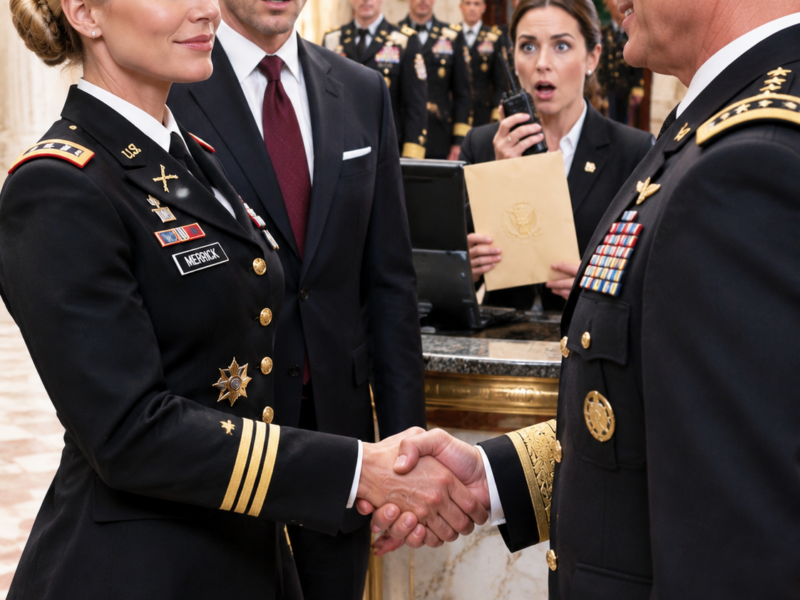
“The President looked directly at me and said my name—and my husband finally understood that the woman he had spent three years calling ‘the queen of spreadsheets’
Mitchell didn’t sleep that night.
I knew because every time I woke, the light beneath the bathroom door was still on.
At 2:17 a.m., I heard him pacing.
At 3:06, his phone rang.
At 3:08, he stepped onto the balcony to answer it.
And at 3:21, he came back into the room and stood beside the bed.
“Sloane?”
I opened my eyes.
“What?”
“Are you awake?”
“Obviously.”
He hesitated.
“Did you submit a report about me?”
I pushed the blanket aside and sat up.
“About you?”
“Don’t play games.”
“I submitted a report about procurement irregularities. It included several officers and vendors. You were listed because your name appeared in the approval chain.”
His jaw tightened.
“You knew it would affect me.”
“I knew the report needed to be accurate.”
“You could have warned me.”
I looked at him for a long moment.
“Would you have wanted a warning because you were concerned about the facts, or because you wanted time to change something?”
His expression darkened.
“That’s an accusation.”
“No. It’s a question.”
He turned away.
For three years, Mitchell had been comfortable asking questions he already knew how he wanted answered.
He had asked why I worked so late.
Why I needed to attend meetings.
Why I couldn’t simply let someone else handle the complicated parts.
He had never asked what those complicated parts actually were.
Now he wanted every detail.
“Who else knows?” he asked.
“About the report?”
“Yes.”
“The proper investigative authorities.”
He gave a short laugh.
“You sound like you’re reading from a briefing.”
“I am answering you carefully.”
“I’m your husband, Sloane.”
“And that doesn’t make you entitled to information connected to an active inquiry.”
He stared at me.
Then he picked up his phone and walked back into the bathroom.
I lay awake until sunrise.
At 6:30, I dressed in my Army uniform and checked the documents in my folder.
My meeting was scheduled for eight.
Mitchell was already sitting at the desk when I came out.
His uniform was immaculate.
His face looked exhausted.
“I’m coming with you,” he said.
“No.”
“I’m a colonel too.”
“Your meeting isn’t mine.”
He stood.
“Do you understand how this looks?”
I adjusted my cuffs.
“I understand exactly how it looks.”
“You’re walking into a room with people who may decide my entire career.”
“I’m walking into a room to discuss an assignment and answer questions about work I led. If the inquiry has questions for you, you’ll have a separate opportunity to answer them.”
He stepped in front of the door.
“Don’t do this.”
I looked at his hand resting against the frame.
“Move, Mitchell.”
He held my gaze for another second.
Then he stepped aside.
I left without looking back.
The meeting took place in a secure conference room at the Pentagon.
Admiral Hayes was there, along with two senior Army officers, a civilian official from the Department of Defense, and a woman introduced as Ms. Bennett from the investigative team.
No one offered me congratulations.
No one discussed the White House ceremony.
A thick file sat in the center of the table.
Admiral Hayes opened the meeting.
“Colonel Merrick, thank you for coming. We want to discuss the logistics modernization initiative and the procurement review you submitted.”
I nodded.
“Yes, sir.”
Ms. Bennett turned on a recorder after explaining the purpose of the interview.
“Colonel, do you understand that this discussion concerns potential irregularities in a procurement process and that you should distinguish what you personally observed from what you inferred?”
“Yes.”
“Did you personally witness Colonel Ashcroft directing a vendor to receive preferential treatment?”
“No.”
“Did you personally witness him accepting money or gifts?”
“No.”
“Then tell us what you did observe.”
I opened my folder.
For the next hour, I walked them through the records.
I explained how several shipments had been assigned unusually high priority despite lacking the required operational justification.
I showed them how projected transportation costs had increased sharply after a vendor was added to the approved list.
I explained that certain approval signatures appeared in the system before the corresponding review documents had been completed.
And I described how my team had discovered repeated exceptions to the standard verification process.
I never guessed.
I never embellished.
When I didn’t know something, I said so.
When a document supported a conclusion, I showed them the document.
When it didn’t, I refused to stretch its meaning.
At one point, Ms. Bennett asked, “Why did you include Colonel Ashcroft in the report?”
“Because his approval was attached to three of the transactions.”
“Did you include him because he is your husband?”
“No. I included him because his name was on the records. If another officer’s name had appeared in the same place, I would have documented that officer as well.”
Admiral Hayes watched me quietly.
Ms. Bennett made a note.
“Did you discuss the report with him before submitting it?”
“No.”
“Why not?”
I considered the question.
“Because I had no reason to believe discussing an active review with a person named in the records would be appropriate.”
“Did you believe he might be involved in wrongdoing?”
“I believed the records required investigation. That is why I submitted them.”
The room fell silent.
Then Ms. Bennett closed her notebook.
“Thank you, Colonel. That’s all for today.”
Admiral Hayes waited until the others had gathered their documents.
“Your leadership recommendation remains under consideration,” he said. “The inquiry will not determine your suitability for that role unless relevant evidence establishes a legitimate conflict.”
“I understand.”
“And one more thing. Your personal relationship with Colonel Ashcroft must remain separate from the investigation. If you believe he is pressuring you, report it through the appropriate channel.”
I nodded.
“Yes, sir.”
When I stepped into the hallway, my phone showed seven missed calls.
All from Mitchell.
There were also three messages.
MITCHELL: We need to get our stories straight.
MITCHELL: Don’t say anything else until we talk.
MITCHELL: Sloane, answer me.
I read the messages twice.
Then I forwarded them to Ms. Bennett through the contact information she had provided.
I didn’t add commentary.
I didn’t need to.
By lunchtime, I was back at my office.
My team was waiting.
Major Daniel Reeves stood when I entered.
“Colonel, how did it go?”
“Productive.”
He looked relieved.
“We finished the revised transportation model. I left the exceptions highlighted.”
“Good. Let’s review them.”
For the next few hours, I worked.
It was strangely comforting.
Numbers didn’t flatter people.
Supply chains didn’t care who had the better uniform or whose mother liked them more.
A delayed medical shipment remained delayed whether a colonel was charming or cruel.
A missing approval remained missing.
And a false record didn’t become true because someone with a commanding voice insisted it was.
At 4:40, I received a call from an unfamiliar number.
“Colonel Merrick? This is Lieutenant Colonel Price. I’m assisting the inquiry team.”
“Yes.”
“We’d like to schedule a follow-up interview. We’ve received additional records from the vendor.”
“What kind of records?”
“I can’t discuss the details over this line. But I want to make sure you preserve any communications related to the transactions you documented.”
“I have already preserved the records in accordance with the instructions.”
“Good. Please don’t access or alter any material outside your authorized duties.”
“Understood.”
When the call ended, I sat still for a moment.
Additional records.
That could mean almost anything.
But I knew enough about investigations to understand that the truth often arrived in pieces.
And the first piece was rarely the last.
I drove back to the hotel that evening.
Mitchell was waiting in the lobby.
He stood as soon as he saw me.
“Where have you been?”
“At work.”
“You’ve been avoiding me.”
“I’ve been following my schedule.”
He stepped closer.
“Do you have any idea what people are saying?”
“No.”
“They think I’m under investigation.”
“Then perhaps you should speak with the investigators.”
His eyes flashed.
“You know what this is doing to my career?”
I looked at him.
“Your career isn’t my responsibility.”
He lowered his voice.
“You’re supposed to be on my side.”
“I am on the side of the truth.”
“That sounds very noble.”
“It isn’t noble. It’s necessary.”
He glanced toward the hotel desk.
Then he took my arm.
I immediately pulled away.
“Don’t.”
He released me.
For a second, he looked genuinely surprised.
“I wasn’t hurting you.”
“You don’t get to decide what contact I’m comfortable with.”
His mouth tightened.
“Fine. Can we at least talk somewhere private?”
I considered refusing.
But I wanted to hear what he was prepared to say without an audience.
We went to the hotel lounge and chose a table away from other guests.
Mitchell didn’t sit immediately.
He looked around as if he expected someone to be listening.
Then he lowered himself into the chair.
“I didn’t know the vendor was doing anything illegal,” he said.
I didn’t respond.
He rubbed his forehead.
“They told me the costs were justified. They said the delivery schedule was unusually complicated.”
“Who told you?”
“People in the procurement office.”
“Names?”
He looked irritated.
“I’m not here for an interview.”
“Then what are you here for?”
He leaned forward.
“I need you to understand that my signature doesn’t mean I approved every detail.”
“I understand how approval chains work.”
“Then you know I could have signed a summary based on information provided by someone else.”
“Yes.”
His expression relaxed slightly.
I continued.
“And the investigators will need to determine whether that explanation is supported by the records.”
His face tightened again.
“You make everything sound like a courtroom.”
“I’m not the one asking you to explain a signature.”
He stared down at the table.
Then he said something I hadn’t expected.
“Your report was incomplete.”
I felt my attention sharpen.
“What do you mean?”
“You only included the transactions that went through my office.”
“Those were the transactions my team was authorized to review.”
“There were others.”
“Where?”
He hesitated.
“Different account codes. Different approval path.”
“Did you approve them?”
He looked away.
“Some.”
“Were they legitimate?”
“I don’t know.”
The answer came too quickly.
I held his gaze.
“Mitchell, if you know of additional transactions that may be relevant, you need to disclose them to the investigators. Not to me.”
He shook his head.
“You don’t understand.”
“Then explain it to them.”
“I can’t.”
“Why?”
His voice dropped.
“Because I signed something I shouldn’t have.”
The noise of the lounge seemed to fade.
I sat perfectly still.
“What did you sign?”
He swallowed.
“A certification.”
“What certification?”
“A statement that the vendor had met the required delivery benchmarks.”
“Had they?”
He looked at me.
“I was told they had.”
“Did you verify it?”
His silence answered before he did.
I felt a cold heaviness settle in my chest.
“Mitchell, did you sign a certification without reviewing the supporting evidence?”
“I was under pressure.”
“From whom?”
He looked toward the window.
“People above me.”
“Who?”
“I can’t tell you.”
“You can tell the investigators.”
He gave a short, desperate laugh.
“You really don’t know how this works, do you?”
I leaned back.
“I know exactly how this works. I know that if a shipment is recorded as delivered when it isn’t, somebody may make decisions based on supplies that don’t exist.”
He looked at me sharply.
“You think I wanted that?”
“I don’t know what you wanted. That’s why I’m not making assumptions.”
He lowered his head into his hands.
For the first time that evening, he looked less like the confident colonel who had walked into the White House and more like a man who had realized the ground beneath him was no longer solid.
“Can you help me?” he asked.
I didn’t answer immediately.
Three years ago, I might have said yes before he finished the sentence.
I might have called someone.
I might have searched for a way to protect him from the consequences of a decision he had made.
But that would have been wrong.
“I can tell you to be honest with the investigators,” I said. “I can tell you to get your own legal advice. I can tell you not to destroy or alter anything.”
He looked up.
“That’s it?”
“Yes.”
“You’re my wife.”
“I know.”
“Does that mean nothing to you?”
I thought about the thousands of small moments that had brought us here.
The jokes at dinner.
The dismissive introductions.
The nights he had complained that my work interfered with his plans.
The way he had smiled when his mother called me lucky to have a husband who understood the important things.
And the way he had looked at the White House when the admiral walked toward me.
“It means I won’t lie for you,” I said.
He stood abruptly.
“You’ve changed.”
I looked at him.
“I hope so.”
He walked away.
I stayed at the table until my hands stopped trembling.
Not because I wanted to protect him.
Because I was finally admitting that the man I had married might not be the man I thought he was.
The following morning, Mitchell left before I woke.
There was a note on the desk.
I need some time. Don’t contact my command.
I read it once and placed it in my folder.
I didn’t intend to contact his command.
I also didn’t intend to chase him.
At 10:15, Ms. Bennett called.
“Colonel Merrick, we’d like to meet today if you’re available.”
“I am.”
“Thank you. There’s been a development.”
The follow-up meeting was held in the same secure conference room.
This time, Lieutenant Colonel Price was there too.
Ms. Bennett placed several printed pages on the table.
“These are vendor communications obtained through the inquiry.”
I looked at the first page.
It was an email chain.
The vendor had been discussing delivery certifications with an Army procurement office.
One message contained a reference to a shipment that had not yet arrived.
Another suggested that the paperwork could be completed in advance to prevent delays in the reporting cycle.
Then I saw Mitchell’s name.
His response was short.
Proceed with the certification. We will reconcile the delivery records afterward.
I read it twice.
The words were plain.
There was no dramatic confession.
No explicit mention of a bribe.
But it was enough to raise serious questions about what he had approved and why.
Ms. Bennett watched me.
“Have you seen this email before?”
“No.”
“Does the wording resemble his usual communication style?”
“I can’t authenticate an email based on writing style. The investigators will need to verify the account and metadata.”
“That’s fair.”
She turned to the next page.
“This is a separate communication. It appears to show that the vendor offered to cover travel expenses for a private event attended by several procurement officials.”
I looked at the names.
Mitchell’s was there again.
“Was the trip approved through official channels?” I asked.
“That is one of the questions we’re investigating.”
I folded my hands.
“Then I recommend checking the travel disclosures and the vendor’s payment records.”
Lieutenant Colonel Price nodded.
“We’re doing that.”
I stared at the pages.
There was a strange distance between reading about something and realizing it might involve the person who slept beside you.
I had spent years building systems that depended on people telling the truth.
Now the evidence was suggesting my husband had been willing to certify something he had not verified.
“Colonel,” Ms. Bennett said gently, “we need to ask whether Colonel Ashcroft ever discussed these transactions with you.”
“No.”
“Did he ever ask you to review or approve them?”
“No.”
“Did he ever ask you to use your position to influence the review?”
I paused.
“Not before last night.”
“What happened last night?”
“He asked me to get our stories straight.”
Ms. Bennett made a note.
“Did he explain what he meant?”
“No. I told him I would not discuss the inquiry with him.”
“Do you have the message?”
“Yes.”
I provided the preserved screenshots and original message details.
Ms. Bennett thanked me.
Then she said, “We may need your cooperation again, but you should continue to perform only your authorized duties. Do not conduct your own investigation.”
“I understand.”
When I left the building, I felt as if the day had taken something from me.
Not my career.
Not my reputation.
Something more personal.
The belief that I had known the man I married.
That afternoon, Mitchell’s mother called.
I almost let it go to voicemail.
But I answered.
“Sloane,” she said, without greeting, “what have you done?”
I closed my office door.
“Hello, Margaret.”
“Don’t use that tone with me. Mitchell says you’re trying to destroy his career.”
“Mitchell should speak to the investigators about his career.”
“He says you submitted a report that named him.”
“I submitted a report documenting irregularities in official records.”
“You could have left his name out.”
“No, I couldn’t.”
Her voice sharpened.
“You’re his wife.”
“I am also an officer.”
“You’re supposed to support your husband.”
“Support doesn’t mean falsifying records.”
She went quiet.
Then she said, “You always thought you were better than him.”
I almost smiled.
“No, Margaret. I thought we were equals.”
“Then why did you need to make such a spectacle of yourself at the White House?”
I looked at the framed photograph on my desk.
It showed my logistics team standing together after a successful readiness exercise.
Twenty-three people.
Twenty-three careers.
And countless hours of work that had finally been recognized.
“I didn’t make a spectacle,” I said. “I attended an event I was invited to.”
“You embarrassed Mitchell.”
“He was embarrassed because he didn’t know what I did.”
“That’s because you never told him anything.”
I took a slow breath.
“I told him what I was allowed to tell him. I also told him about my responsibilities, my schedule, and the work I was proud of. He chose to call it spreadsheets.”
Margaret didn’t answer.
I continued.
“I’m not discussing the investigation with you. If Mitchell has questions, he can speak with his counsel.”
“You’re going to regret this.”
I ended the call.
My hands were shaking again.
But this time, I didn’t mistake that feeling for guilt.
A week later, the inquiry requested another interview.
The questions were more specific.
They wanted to know how my team had identified the discrepancies, whether our reporting system could have been manipulated, and how many deliveries might have been affected.
I answered each question.
I also learned that the issue was broader than the three transactions in my original report.
Investigators had identified several shipments recorded as complete before independent confirmation.
Some had eventually arrived.
Others had been delayed.
A small number had been redirected through secondary vendors.
The full impact was still being assessed.
No one had established that Mitchell had personally profited.
No one had established that he had knowingly caused harm.
But his approvals were part of the record.
And the evidence required him to answer for them.
During that week, he sent me a message.
MITCHELL: We need to talk about our marriage.
I stared at it for a long time.
Then I replied:
SLOANE: We can discuss our marriage with a counselor. We will not discuss the investigation together.
He responded almost immediately.
MITCHELL: You make everything so cold.
I put the phone down.
Maybe I did sound cold.
But I had spent three years trying to make my words soft enough that he wouldn’t dismiss them.
I was finished doing that.
The next development came from someone I hadn’t expected.
Major Daniel Reeves called me after work.
“Ma’am, I need to tell you something. It’s not about the investigation itself.”
“Go ahead.”
“Colonel Ashcroft contacted one of our analysts last week.”
My posture changed.
“What did he ask?”
“He wanted to know whether your team had retained the original delivery data.”
I felt my stomach tighten.
“What did the analyst say?”
“That the records were preserved under the retention policy. He didn’t provide anything else.”
“Did he ask for access?”
“Yes, ma’am. The analyst declined and referred him to the authorized records office.”
I closed my eyes briefly.
“Thank you for telling me. Please document the contact and follow the normal reporting procedure.”
“Yes, ma’am.”
When I hung up, I called Lieutenant Colonel Price.
I gave him the details and the analyst’s name.
He thanked me and said the inquiry team would follow up.
That evening, I found Mitchell sitting in the living room of our hotel suite.
He had returned from his own meetings.
A suitcase stood beside the couch.
“Are you leaving?” I asked.
“For a while.”
“Where are you going?”
“Somewhere I can think.”
I set my folder on the table.
He looked at it.
“Do you ever stop working?”
“Sometimes.”
“Not tonight, apparently.”
I didn’t answer.
He rubbed his face.
“I talked to the analyst because I wanted to understand what records your team had.”
“Why?”
“Because I needed to know what they had.”
“That isn’t an explanation.”
He looked at me.
“I thought there might be a way to correct the paperwork.”
“Correct it how?”
He didn’t answer.
“Mitchell, you cannot ask my team to give you access to records connected to an investigation.”
“I didn’t ask them to change anything.”
“I didn’t say you did.”
He looked away.
Then he sat down.
“I’m in trouble.”
I stood still.
“Then get legal advice.”
“I’ve spoken to counsel.”
“Good.”
“He says I need to cooperate.”
“That sounds appropriate.”
Mitchell gave a bitter laugh.
“You really have nothing else to say?”
I thought about all the things I could say.
I could tell him I was hurt.
I could tell him I had loved him.
I could ask why he had made jokes about my career when he knew so little about it.
I could ask whether he had ever been proud of me.
But none of those questions would change the records.
And I no longer wanted to spend my life trying to make him understand something he had never cared to learn.
“I hope you tell the truth,” I said.
He looked up.
“Is that all?”
“Yes.”
He stood, picked up his suitcase, and walked toward the door.
At the threshold, he stopped.
“Did you ever love me?”
The question caught me off guard.
I stared at him.
“Yes,” I said. “I did.”
He swallowed.
“Then how can you do this?”
I answered carefully.
“Because loving you doesn’t mean I can take responsibility for your decisions.”
He left.
The door closed quietly.
And for the first time in three years, I was alone in a room without feeling that I had failed someone.
The following month was difficult.
The investigation continued.
The Army placed Mitchell on temporary administrative restrictions while the review proceeded. He was not permitted to participate in certain procurement activities or access records connected to the matter.
The decision was not a final finding.
It was a precaution.
My own assignment review continued separately.
I kept working.
I attended briefings.
I answered questions.
I reviewed contingency plans.
And when the team needed me, I showed up.
One afternoon, Admiral Hayes called me into his office.
He gestured toward a chair.
“Colonel Merrick, the review panel has reached a decision.”
I sat.
He placed a document on the desk.
“Your work on the logistics initiative has been exceptional. The panel has recommended you for the position of Deputy Director of Joint Operational Logistics.”
I read the first page.
The position carried responsibility across multiple commands and would require coordination with senior leaders from all branches.
It was the kind of assignment I had worked toward for years.
I looked up.
“Sir, I appreciate the confidence.”
“You earned it.”
He paused.
“I also want to be clear that this recommendation is based on your performance and qualifications. It has nothing to do with the investigation involving Colonel Ashcroft.”
“I understand.”
“Your record speaks for itself.”
I nodded.
For a moment, I couldn’t find the right words.
Then I said, “Thank you, sir.”
He smiled.
“Don’t thank me yet. The work is going to be demanding.”
“I wouldn’t expect anything else.”
When I left his office, I stood in the hallway for a moment.
I thought about the kitchen where Mitchell had first held up his White House invitation.
I remembered the way he had laughed when I received mine.
The way he had told me to smile and stay quiet.
And I realized that I had once believed recognition would feel like winning an argument.
It didn’t.
It felt like being trusted with something important.
The formal announcement came two weeks later.
Mitchell wasn’t there.
He had been interviewed by investigators again and had retained separate counsel.
I received the assignment in a small ceremony attended by my team and senior leadership.
Daniel stood in the back, smiling.
When I thanked the people who had supported the initiative, I made sure to mention the analysts, transportation officers, medical planners, and logistics specialists whose work had made the program successful.
I didn’t mention my husband.
I didn’t need to.
That evening, I returned to our home.
Mitchell had moved most of his belongings out.
A few boxes remained in the guest room.
On the kitchen counter sat a folded note.
I know you think I never respected your work. I didn’t understand it. I thought you were hiding behind it. I should have asked more questions.
I read it slowly.
Then I placed it in a drawer.
It was an apology of sorts.
But it didn’t address the choices he had made.
And it didn’t undo the years of small humiliations.
The next day, I contacted a family law attorney.
I wasn’t making a decision out of anger.
I was making one after months of seeing the marriage clearly.
We began the separation process.
Mitchell didn’t fight it.
In fact, when the attorney sent the initial paperwork, he signed the acknowledgment without argument.
For a while, I thought that might be the final chapter.
Then, three weeks later, he asked to meet.
We chose a quiet restaurant away from the Pentagon and away from our usual circles.
He arrived early.
His uniform was gone.
He wore a plain navy sweater and looked older than I remembered.
“Thank you for coming,” he said.
I sat across from him.
“What do you want to discuss?”
He took a breath.
“The inquiry.”
I waited.
“My counsel advised me to cooperate fully. I’ve provided the records I have. I’ve also explained that I signed certifications based on information supplied by the vendor and the procurement office.”
“Did you verify the information?”
He looked down.
“Not properly.”
I nodded.
“That’s important.”
He looked up.
“I didn’t take money, Sloane.”
“I can’t determine that.”
“I didn’t.”
“I hope that’s true.”
He leaned back.
“You don’t believe me.”
“I believe the evidence should be examined.”
His mouth tightened.
Then he said, “I was trying to keep the program moving. We were under pressure. People wanted results. I thought if we reconciled the paperwork later, no one would be harmed.”
I looked at him.
“Did you ever consider what would happen if someone relied on a delivery report that wasn’t true?”
He didn’t answer.
I continued.
“Someone could plan an evacuation around supplies that weren’t there. A medical team could expect equipment that hadn’t arrived. A commander could believe a unit was ready when it wasn’t.”
“I know that now.”
“You should have known it then.”
He lowered his eyes.
For the first time, I believed he understood the seriousness of what he had done.
But understanding consequences after the fact wasn’t the same as having integrity before them.
“I also owe you an apology,” he said.
I said nothing.
“I made jokes about your work because I didn’t understand it. I thought people respected me more because I had a command position. I thought you were content staying in the background.”
“I wasn’t content. I was doing my job.”
“I know.”
He swallowed.
“And when you were recognized at the White House, I felt humiliated. I realized I had spent years making you seem smaller because I was uncomfortable with how much you accomplished.”
I studied him.
It was the closest thing to honesty I had heard from him in a long time.
“Why didn’t you ask me about my work?” I asked.
He stared at his hands.
“I think I was afraid I wouldn’t understand it.”
“That isn’t a reason to belittle it.”
“I know.”
We sat in silence.
Then he asked, “Is there any chance we could start over?”
I looked out the window.
I remembered the man who had once brought me coffee before a long planning session.
The man who had held my hand when my father died.
The man I had believed would always be proud of me, even when the world wasn’t watching.
I also remembered the man who had told me to stay quiet at the White House.
The man who had asked me to get our stories straight.
The man whose signature appeared on certifications that needed explaining.
“I don’t know what happens next for you,” I said. “But I know what happens next for me.”
He nodded slowly.
“I understand.”
“I hope you do.”
We finished dinner without arguing.
It was the last time we met as husband and wife.
Months passed.
The inquiry eventually reached its findings.
The investigation concluded that Mitchell had approved several delivery certifications without the required verification and had failed to disclose a vendor-funded benefit connected to an official event. The report found insufficient evidence to establish that he had personally accepted a bribe, but it identified serious failures of judgment and compliance.
Other officials and vendor representatives faced separate consequences.
Mitchell received formal administrative action and was removed from procurement-related responsibilities. His future advancement was affected, though his service record and the findings were considered through the appropriate process.
He was not convicted of a crime.
The facts did not support every rumor that had circulated.
But they did support the central truth:
He had signed what he had not properly verified.
And when the truth began to surface, he had tried to learn what evidence existed before facing the investigators.
I didn’t celebrate his consequences.
I didn’t call his mother.
I didn’t send anyone the report.
I simply let the process conclude.
My own assignment began in the spring.
The first morning, I entered the new office before sunrise.
There were maps on the wall, operational schedules on the screens, and a stack of planning documents waiting on my desk.
Daniel knocked.
“Ma’am, the team is ready.”
I looked at the briefing notes.
“Then let’s get started.”
He smiled.
“Yes, ma’am.”
For the next several months, I worked with officers from every branch to improve the way critical supplies moved during emergencies.
We strengthened verification procedures.
We created clearer reporting requirements.
We tested backup routes.
We made sure that a delayed shipment could not be quietly turned into a completed delivery on someone’s spreadsheet.
I thought about that often.
The joke Mitchell had made about my spreadsheets.
The thing he had treated as insignificant had been the foundation of a system that helped keep people alive.
One afternoon, I received an envelope from the White House.
It contained a photograph from the ceremony.
I was standing beside Admiral Hayes, shaking hands with the President.
My expression was calm.
My posture was straight.
Behind us, the room was filled with people applauding.
On the back, someone had written:
Thank you for making sure the people who serve have what they need to come home.
I placed the photograph in a frame.
Not because I needed proof that I had been important.
Because it reminded me that the work mattered.
A few weeks later, Mitchell sent me one final message.
MITCHELL: I watched the ceremony recording. I heard what the President said about your team. I should have been proud of you long before anyone else recognized you.
I read it.
Then I put my phone down.
There was no anger in me anymore.
But there was no desire to return to the marriage either.
I had learned that forgiveness, if it ever came, did not require reopening a door.
And respect could not be demanded after years of withholding it.
That evening, I stood by the window in my new office and watched the lights come on across the Pentagon courtyard.
My uniform jacket hung neatly behind the door.
My desk was covered in planning documents.
My phone was quiet.
I thought about the woman who had walked into the White House beside a husband who told her to keep quiet.
I wished I could reach back through time and tell her something.
That she didn’t need to prove her worth to the people who benefited from underestimating her.
That silence could be discipline, but it should never become surrender.
That the right people would eventually ask what she had done.
And when they did, she would be ready to answer.
I turned off the office light and picked up my bag.
Tomorrow would bring another briefing.
Another problem.
Another system that needed to work when lives depended on it.
And I was exactly where I had earned the right to be.









