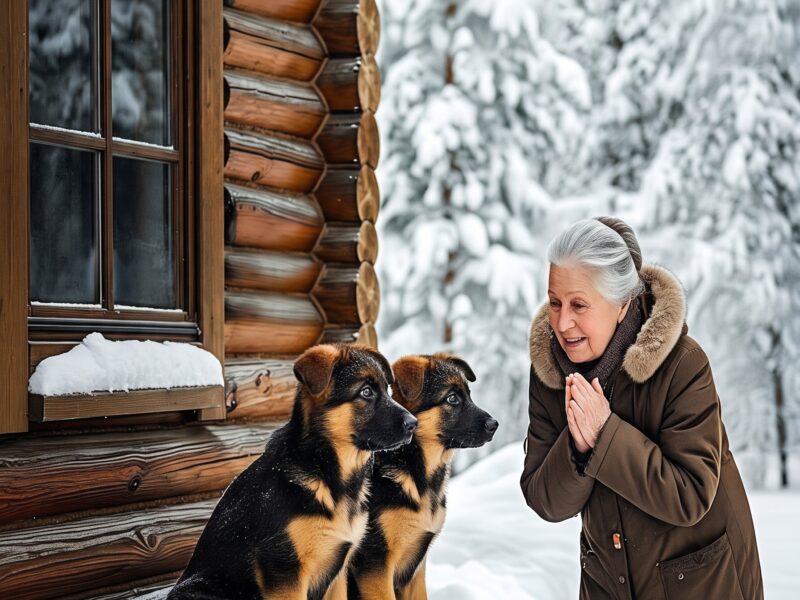
The police surrounded my little house on Maple Street at sunrise, their guns pointed toward my windows, while the two freezing dogs I had rescued the night before trembled beside me
The morning sun had barely cleared the frost-dusted pine trees along Maple Street, but the cold light offered no comfort. Through the thin curtain of my front window, the world was painted in stark shades of gray, white, and flashing blue. Red and blue strobes bathed the peeling paint of my porch, reflecting wildly off the ice-crusted lawn.
They were everywhere. Squad cars blocked both ends of the quiet residential street. Six officers stood in a tactical semi-circle across my front yard, their boots crunching on the frozen turf, their service weapons drawn and pointed directly at my chest.
“Evelyn Vance! Keep your hands where we can see them and step away from the animals!” the lead officer bellowed through a bullhorn. His voice was harsh, distorted by the loudspeaker, slicing through the crisp morning air like a blade.
Beside my worn armchair, two creatures huddled together. They didn’t bark. They didn’t growl. They simply trembled, their dark eyes fixed on the door with an eerie, unnerving intelligence. The larger of the two, a golden retriever with a deep, jagged scar encircling his throat, pressed his head firmly against my thigh. The smaller one, a scruffy black terrier mix with eyes that looked shockingly human, buried her nose under my apron.
They weren’t dangerous. Or at least, I hadn’t thought so. But the police were treating my humble, two-bedroom cottage like a fortified compound holding a domestic terrorist. And they had no idea what these two broken creatures had actually brought inside my home.
Just twelve hours earlier, Maple Street had been silent, choked by a brutal Ohio ice storm. A freezing rain had fallen continuously since dusk, coating every branch, power line, and sidewalk in a slippery, glass-like sheath. I was seventy-two years old, and living alone in a house that felt far too large ever since my husband, Arthur, passed away six years ago. The isolation was a heavy coat I wore every day, but on nights like that, the quiet felt suffocating.
I had ventured out to the small corner market three blocks away to grab a container of soup and a gallon of milk before the roads froze completely. On my walk back, huddling against the biting wind, I heard a faint, rhythmic scratching sound coming from beneath the rusted overhang of an abandoned bus shelter.
When I shone my small pocket flashlight into the shadow, my heart broke.
Two dogs were curled tightly together on the frozen concrete, their ribs starkly outlined beneath soaked, matted fur. The golden retriever was cradling a bleeding front paw, his thick coat drenched and caked with ice. The small black terrier was tucked beneath his chest, shivering violently.
“Oh, sweetheart,” I had whispered, dropping my grocery bag into the snow and kneeling on the icy pavement despite the sharp ache in my knees.
Street dogs were usually skittish, but these two didn’t flinch. They didn’t run. As I reached out a gloved hand, the retriever lifted his heavy head and let out a soft, breathy sigh. He nudged the smaller dog forward, as if presenting her to me. Then, both of them crawled toward me on their bellies, pressing their freezing bodies against my winter coat. It felt deliberate. It felt as though they hadn’t just been wandering—they had been waiting. Waiting specifically for someone to stop. Waiting for me.
I knew I couldn’t leave them to freeze. At my age, lifting a seventy-pound retriever was nearly impossible, but adrenaline and pity gave me strength. I wrapped them both in the heavy wool blanket I carried in my tote bag, cradled the smaller one under my arm, and gently guided the limping golden back toward my cottage.
Once inside, I transformed my small living room into a sanctuary. I laid down old bath towels by the brick fireplace, built up a roaring fire, and gently dried their shivering bodies. I warmed a bowl of low-sodium chicken broth and watched with a soft smile as they lapped it up greedily.
Yet, as the room warmed, an uneasy feeling began to settle in my stomach.
The animals didn’t behave like ordinary dogs. They hardly made a sound. They didn’t explore the house or sniff the furniture. The golden retriever sat bolt upright by the hearth, his dark amber eyes continuously tracking the front door, his ears twitching at every whistle of the wind outside. The black terrier stayed glued to my side, her gaze locked onto my face with an intense, searching scrutiny.
Around midnight, while cleaning the golden’s injured paw with warm water, I noticed the hair around his neck was thin and patchy. I parted the fur and gasped. Encircling his neck was a thick, pink ridge of scarred flesh—a perfect line, as if he had spent years tied up with tight wire or a cruel choke chain.
Gently, my fingers brushed the mark. The golden flinched, a low, melancholy whine escaping his throat, but he didn’t snap. Instead, he leaned into my touch, placing his heavy paw gently on my knee.
“Who hurt you?” I murmured, tears pricking my eyes. “Who could do something like this?”
Neither animal offered an answer, of course. Eventually, exhausted by the cold and the emotional weight of the evening, I sank into my favorite armchair near the hearth, wrapped a quilt around my shoulders, and drifted into a restless sleep.
The nightmare began precisely at 6:17 AM.
A violent pounding rattled the heavy front door, shaking the glass panes set into the wood. The sharp noise jolted me awake. Before I could even stand up, the glaring blue light of police cruisers illuminated my living room walls.
Confused and disoriented, I hurried to the door and pulled it open, shielding my eyes against the blinding sun and the flashing strobes.
“Evelyn Vance! Step back!” a tall, broad-shouldered officer commanded from the bottom of the steps. His badge read Sergeant Miller. His face was set in hard, uncompromising lines.
“What’s going on?” I stammered, my voice cracking with sleep and fear. “Why are you pointing guns at my house?”
Sergeant Miller held up a laminated paper. “Those dogs you took in last night were flagged in a high-priority missing-person investigation out of Summit County. Step away from them immediately.”
“They were freezing in a bus shelter!” I cried out, my voice rising in defense of the poor creatures. “They were abandoned! They’re hurt!”
“Ma’am, those animals belonged to a suspect in a federal abduction case,” Miller said coldly, taking two deliberate steps up my porch stairs. “And given how quickly you acquired them, we have reason to believe you know far more than you’re letting on.”
“I don’t know what you’re talking about!” I gasped.
Before Miller could reply, a sudden movement inside the house broke the standoff. The golden retriever, who had been resting quietly, stood up. He didn’t bark at the police officer. Instead, he trotted purposefully past me, his nails clicking sharply on the hardwood floor, and headed straight down the hallway toward the small back room that Arthur had used as a workshop.
“Officer, wait!” I pleaded as Miller drew his sidearm fully and crossed the threshold, two other officers following right behind him with flashlights drawn.
We followed the golden into the narrow hallway. The dog stopped directly in front of an old, heavy oak cabinet—a piece of furniture my husband had built by hand over thirty years ago. It had sat in that exact corner, undisturbed, for as long as I could remember.
The retriever lowered his head and began scratching franticly at the gap between the base of the cabinet and the floorboards.
The officers exchanged sharp, knowing glances. Miller motioned for his deputy to help him. Together, they grunted as they shoved the heavy oak cabinet aside. The floor behind it was covered in dust, except for a distinct seam in the hardwood.
“There’s a hidden compartment,” the deputy muttered.
My heart hammered against my ribs like a trapped bird. “That’s impossible,” I whispered, clutching my shawl to my chest. “I’ve lived in this house for forty-four years. My husband built this floor. There are no hidden compartments.”
Using a pocket crowbar, the deputy pried up two of the floorboards. They popped free with a loud, protesting screech of rusty nails.
Beneath the floor lay a shallow cut-out in the subfloor. Resting inside was a heavy metal waterproof cash box, sealed with heavy black electric tape. Taped securely to the top of the metal lid was a small, faded 4×6 photograph.
Sergeant Miller reached down and lifted the box out. He shone his flashlight directly onto the photograph.
The world seemed to tilt on its axis. The oxygen left my lungs in a sharp, painful gasp, and my knees buckled. I would have hit the floor if the deputy hadn’t grabbed my arm.
The face staring back at me from the faded photograph was young, with wide, bright hazel eyes and a sprinkle of freckles across her nose.
It was Emily. My daughter.
My sweet Emily, who had disappeared twenty-two years ago on a rainy November night—the daughter the state police had told me was swept into the icy waters of the swollen Cuyahoga River after a tragic single-car accident. They had found her car submerged, but they had never recovered her body. I had grieved her for over two decades. I had laid an empty coffin in the earth.
“No…” I sobbed, my head spinning violently. “No, no, no… That’s my daughter. She’s dead.”
“Ma’am, stay calm,” Miller said, his tone softening just a fraction, though his eyes remained sharp and suspicious. He pulled out a pocketknife and sliced through the electrical tape, flipping open the lid of the box.
Inside sat a thick stack of documents, several medical files, a hospital identification bracelet bearing the name Emily Vance, and a fresh stack of photographs.
Miller pulled out the top photograph and turned it toward me.
My breath caught in my throat. It was a recent photograph. The woman in the picture was older now—in her early forties—with fine lines around her eyes, but it was unquestionably Emily. She was alive. She was standing in a densely wooded area, smiling faintly.
And standing on either side of her in the picture were the exact two dogs currently resting in my hallway: the scarred golden retriever and the small black terrier.
But it was the person standing behind Emily, holding a heavy hand on her shoulder, that made my entire world crumble into ash.
Standing beside my missing daughter was a man with graying hair, sharp blue eyes, and a familiar faint scar on his chin.
It was Arthur. My husband. The man I had loved for nearly fifty years. The man I had buried six years ago after a long, agonizing battle with cancer.
“Your husband wasn’t who you thought he was, Mrs. Vance,” Sergeant Miller said quietly, his gaze piercing right through me. “And your daughter didn’t die in a river twenty-two years ago.”
I stared at the photo, my mind utterly unable to process the nightmarish contradiction before me. Arthur was dead. I had held his hand in the hospice room as his heart monitor flatlined. I had watched them lower his casket into the ground. How could he be standing in a recent photograph with my lost daughter?
Suddenly, the silence of the hallway was shattered by a loud, high-pitched ringing.
It was my old mobile phone, resting on the hall table.
I stared at the small screen. The incoming number was unlisted, but the caller ID display—a service I had never updated since the late 1990s—flashed a name that made my soul go numb.
EMILY VANCE
My hand shook so violently I could barely slide the bar to answer. I raised the phone to my ear with trembling fingers.
“E-Emily?” I choked out, tears streaming down my cold cheeks.
For a second, there was only static. Then, a voice came through the speaker—raspy, terrified, but unmistakably the voice of my child.
“Mom…” she whispered, her tone laced with pure panic. “If you can hear me… listen to me carefully. Don’t trust the police. The man standing in front of you isn’t—”
Click.
The line went completely dead.
I slowly lowered the phone, my eyes wide with terror, and looked up at Sergeant Miller.
The warmth was completely gone from his face. His hand was resting firmly on the grip of his service weapon, and the two deputies behind him subtly shifted their stances, stepping into positions that blocked the front and back exits of my home.
“Mrs. Vance,” Miller said, his voice dropping an octave, devoid of any empathy. “Give me the phone.”
The silence in the hallway was thick and suffocating. The blue flashing lights outside cast strange, rhythmic shadows across the faces of the three officers standing inside my home.
“I said, hand over the phone, Mrs. Vance,” Sergeant Miller repeated, extending his open palm. His fingers twitched near the holster at his hip.
I looked at the phone in my hand, then at the small black terrier sitting at my feet. The little dog let out a sharp, piercing bark—the first sound she had made all night—and placed herself directly between Miller’s boots and my ankles. Her lip curled back, exposing surprisingly white, sharp teeth.
“Sergeant,” the deputy behind Miller whispered nervously. “What do we do about the old woman?”
“Shut up, Davis,” Miller snapped, never taking his eyes off me. “Evelyn, you’re coming with us. There are things about your family’s history you clearly don’t understand, and we don’t have time to explain.”
“My daughter just called me,” I said, my voice surprisingly steady despite the terror raging in my chest. “She told me not to trust you. Why would she say that?”
“Your daughter is a mentally unstable fugitive,” Miller said smoothly, stepping forward. “She’s been off the grid for two decades. She doesn’t know what she’s saying.”
He reached out to grab my forearm. But before his fingers could touch my coat, the golden retriever lunged forward with a fierce, guttural roar. He didn’t bite, but he threw his heavy seventy-pound body straight into Miller’s midsection, knocking the large officer off balance. Miller stumbled back into his deputy, sending both men crashing against the wooden doorframe.
“Run!” a voice inside my head seemed to scream.
In the chaos, I didn’t hesitate. I grabbed the metal box off the floor, gripped the leather leash of the small terrier, and motioned frantically for the golden. “Come on!” I cried.
We scrambled through the kitchen toward the back door that led to the old detached garage. Behind me, I heard Miller cursing and the heavy thud of tactical boots pursuing us. I threw open the back door, the freezing morning air hitting my face like a slap, and hurried across the slick ice of the backyard.
I hit the side button of my old garage door opener. The motorized chain groaned as the heavy wooden door creaked upward. My hands were shaking so hard I could barely unlock the driver’s side door of my twenty-year-old station wagon. I shoved the metal box into the passenger seat, ushered both dogs into the back, and jumped behind the wheel.
“Stop!” Deputy Davis screamed as he rounded the corner of the garage, raising his sidearm.
I slammed the gear shift into reverse and stomped on the gas pedal. The station wagon’s tires spun wildly on the ice before catching traction, roaring out of the garage. The rear bumper clipped a wooden fence post, splintering the frame, but I didn’t care. I threw the car into drive, swerved around a parked squad car blocking the driveway, and tore down Maple Street, leaving the flashing red lights behind me in a cloud of exhaust and icy slush.
My heart was hammering against my sternum like a sledgehammer. I was a seventy-two-year-old widow, driving wildly through a winter storm, fleeing the police with two rescued dogs and a metal box full of impossible secrets.
I drove aimlessly for twenty minutes, staying on side streets and avoiding the main thoroughfares, until I reached the overgrown, desolate perimeter of the old industrial park on the outskirts of town. I pulled the station wagon behind a rusted shipping container, killed the engine, and sank back against the headrest, gasping for air.
In the rearview mirror, the two dogs were watching me quietly. The golden leaned forward, resting his wet nose against my neck, as if offering reassurance.
“What did Arthur do?” I whispered to the empty car, tears finally spilling over my lashes. “What did he do to us?”
With trembling hands, I pulled the metal cash box onto my lap.
Arthur had been an quiet, unassuming man. He was a retired civil engineer who spent his weekends woodworking in his shed or tending to his tomato garden. When our Emily went missing twenty-two years ago, he was the rock that kept me from falling apart. He was the one who handled the police, who dealt with the search teams, who eventually convinced me that we had to accept the painful truth that our daughter was gone.
And six years ago, when the doctor told us his lung cancer was terminal, I sat by his bedside every night for four months until he breathed his last breath. I had buried him beside my parents in Oakridge Cemetery.
So how could he be alive in a photograph taken long after his supposed death?
I opened the box.
The first thing I pulled out was a thick manila envelope marked with a red stamp: PROPERTY OF OAKRIDGE PSYCHIATRIC FACILITY – CONFIDENTIAL.
I opened the folder. Inside were dozens of medical charts, intake forms, and progress notes dated from twenty-two years ago. My eyes scanned the yellowing pages, reading the name typed at the top of every sheet: PATIENT: EVELYN VANCE.
I froze. My breath caught in my throat.
Patient: Evelyn Vance. Diagnosis: Severe Paranoid Schizophrenia with Dissociative Fugue States. History of extreme memory suppression and fabricated realities.
“No…” I whispered, my head aching with a sudden, dull throb. “This is wrong. I was never in an asylum. I’ve lived in my house on Maple Street my whole life!”
I frantically flipped through the pages. Attached to the back of the medical file was an official court order signed by a judge, granting full legal guardianship and medical custody of Evelyn Vance to her husband, Arthur Vance. Attached to that was a heavily redacted police report detailing an event that occurred in the summer of 2004.
According to the report, a tragic fire had destroyed a rural cabin in Summit County. Two bodies had been recovered from the ashes. One was identified as Arthur Vance. The other was identified as a senior police detective named… Sergeant Miller.
My mind reeled. If Sergeant Miller had died in a fire twenty-two years ago, who was the man standing on my porch this morning wearing his badge?
My hands were shaking so violently I nearly dropped the folder. I reached deeper into the box and pulled out a small black plastic USB drive wrapped in a handwritten note. The handwriting was unmistakable. It was Arthur’s tight, precise cursive.
The note read: Evelyn, if you are reading this, the failsafe has been triggered. The dogs found you. I am so sorry for the lies, but it was the only way to keep you both alive. Do not trust anyone wearing a badge in Summit County. Go to the cabin in Blackwood. The key is under the floorboard of the birdhouse. Emily is waiting.
A sudden, sharp thud against the rear window made me scream.
I spun around in my seat. Standing right outside my car window, obscured by the swirling snow, was a tall figure wrapped in a heavy winter coat.
It wasn’t a police officer.
The figure stepped closer, wiping a gloved hand across the icy glass of the driver’s side window. The streetlight caught the person’s face.
It was a woman in her early forties, her dark hair pulled back in a tight knot, her hazel eyes filled with tears. She had a long, faint scar running from her cheekbone down to her jawline.
She raised a hand and knocked softly on the glass.
“Mom,” she said, her voice muffled through the window. “Open the door. They tracked my signal.”
I unhitched the door lock with a shaky hand, my heart hammering against my ribs. The heavy station wagon door creaked open, and the freezing wind swept into the cabin along with the woman.
She stepped inside, pulling the door shut behind her, and fell onto her knees in the narrow space between the front seats. The two dogs immediately erupted into soft, eager whines, leaning forward to press their muzzles against her shoulders. She buried her face in the golden retriever’s thick coat, sobbing silently for a moment before looking up at me.
Up close, despite the scar on her face and the dark circles under her hazel eyes, there was no mistaking her.
“Emily,” I whispered, reaching out with a trembling gloved hand to touch her cheek. “My God… Emily.”
“It’s me, Mom,” she choked out, wrapping her warm hands over mine. “It’s really me. I’m so sorry. I’m so sorry I had to stay away for so long.”
“They told me you died,” I wept, tears streaming freely down my face. “They found your car in the river… We had a funeral…”
“It was staged,” Emily said, her voice dropping to a low, intense whisper as she glanced nervously out the rear window. “Dad staged the crash to save my life. And six years ago, he staged his own death to pull the rest of the puzzle together.”
“Staged his death?” I repeated, my mind fracturing under the weight of the absurdity. “Emily, I was in the hospital room! I held Arthur’s hand when his heart stopped! I stood at the cemetery!”
“You held the hand of a dying man who had agreed to take Dad’s identity in exchange for his family being taken care of,” Emily explained quickly, her eyes burning with a desperate intensity. “Mom, Dad wasn’t just a civil engineer. Before he met you, he was an undercover operative for the State Attorney General’s office. In the late nineties, he uncovered a massive criminal syndicate operating right inside the regional law enforcement hierarchy—a ring involving human trafficking, illegal land seizures, and orchestrated disappearances.”
She pointed a finger toward the front windshield, toward the city lights in the distance.
“The man calling himself Sergeant Miller isn’t a cop. His real name is Marcus Vance—Dad’s estranged brother. My uncle. He took over the syndicate decades ago. When I accidentally stumbled onto their storage records twenty-two years ago, Marcus realized I knew too much. He ordered a hit on me.”
I sat frozen, trying to connect the sweet, quiet husband who built my garden beds with the mastermind of an elaborate, decades-long espionage operation.
“If Arthur saved you… why did he leave me alone on Maple Street for twenty-two years?” I asked, my voice cracking with a deep, wounded ache. “Why did he let me suffer? Why did he let me believe my child was dead?”
Emily took my hands, her eyes brimming with a profoundly agonizing sorrow. “Because you were the ultimate protection, Mom. Marcus and his network watched you constantly. They monitored your house, your mail, your phone lines. The only reason Marcus never harmed you was because he was completely convinced that you knew nothing. Dad had to make your grief absolute. It had to be real, or Marcus would have tortured you to find out where I was.”
She reached down and gently touched the scar on the golden retriever’s neck. “Dad raised these dogs at the safehouse in Blackwood. He trained them specifically to recognize your scent and to locate the hidden cache he built under the workshop floor. Last night, when the net started closing in around us, Dad released them into the storm near your street. He knew you would take them in. He knew your heart, Mom. You could never leave a suffering animal in the cold.”
“And Arthur?” I whispered, my voice barely audible above the howling wind outside. “Where is your father now?”
Emily’s face darkened, a shadow of pure dread crossing her features. “He was captured three days ago. Marcus took him to the old water treatment facility near Blackwood Reservoir. Marcus wants the master ledger—the drive containing thirty years of bank records, names, and recorded wiretaps that can destroy their entire operation.”
She reached into her coat pocket and pulled out a small, metallic key with a strangely shaped bit.
“The drive on the desk in your box is encrypted,” Emily said. “The physical key to unlock the master drive is hidden inside the old cabin in Blackwood. But Marcus’s men have swept the area. They know about the cabin, but they don’t know about the sub-basement under the old root cellar.”
Suddenly, the black terrier in the back seat stood up on its hind legs, letting out a sharp, frantic growl.
Through the snow-covered side mirror, I saw two dark SUVs pulling off the main road, turning slowly into the abandoned industrial park. Their headlights were blacked out, but their fog lights cut through the swirling snow like yellow eyes.
“They found the station wagon’s GPS,” Emily hissed, grabbing my shoulder. “Mom, we have to move now!”
“Where?” I asked, jamming my foot onto the brake and slapping the gear shift into drive.
“Blackwood Reservoir,” Emily said, her face set in a look of deadly determination. “We end this tonight, or none of us survive the morning.”
The tires of the old station wagon screamed as I slammed my foot onto the accelerator, spraying snow and gravel against the rusted shipping container. We shot out of the industrial alley just as the two dark SUVs turned the corner, their high beams flashing to life, blinding us through the rear window.
“Hold on!” I yelled, steering the heavy car onto the narrow, winding backroad that led toward the state park.
The snow was falling harder now, creating a dense white curtain that made it nearly impossible to see more than twenty feet ahead. But I had driven these roads for forty years. I knew every sharp turn, every hidden ditch, every treacherous patch of black ice.
Behind us, the leading SUV accelerated, its heavy steel bumper coming within inches of our back frame.
“They’re going to ram us!” Emily shouted, bracing her hands against the dashboard.
I looked at the rearview mirror. The golden retriever was standing firm in the back, leaning his heavy chest against the seat, while the small terrier growled fiercely at the approaching headlights.
“Not on my watch,” I muttered.
Just ahead was the narrow wooden bridge crossing over the frozen ravine of Deadman’s Creek. The bridge was only wide enough for a single vehicle. As we approached the icy incline, I feigned a swerve to the left, drawing the pursuit SUV into the center lane to block me. At the very last second, I slammed on the brakes, turning the wheel hard to the right.
The station wagon slid sideways across the ice, missing the bridge’s wooden guardrail by inches, but the heavy SUV behind us couldn’t stop. It skidded wildly on the black ice, hit the snowbank at forty miles an hour, and flipped over the low railing, plunging down into the dark, snow-filled ravine below.
A loud crunch of metal echoed through the night, followed by silence.
“Nice driving, Mom,” Emily breathed, her eyes wide with shock.
“Your father taught me how to drive on ice in 1975,” I said, my hands trembling on the steering wheel as I straightened the car and surged across the bridge. “He always said a cool head beats a heavy engine.”
We drove deep into the thick, dark pines of the Blackwood Forest, leaving the main road behind for an unpaved logging track that hadn’t been cleared of snow in weeks. The station wagon groaned under the strain, its undercarriage scraping against frozen ruts, until we finally reached a small, snow-covered clearing.
Hidden among the towering hemlocks stood a small, rustic log cabin. Its windows were dark, its stone chimney cold. It looked abandoned, forgotten by time.
“This is it,” Emily said, unbuckling her seatbelt. “The root cellar is around back.”
We stepped out into the freezing air, the two dogs jumping out right behind us. The silence of the forest was absolute, broken only by the wind howling through the high pine canopy.
Emily led me around the back of the cabin to an old wooden hatch built into the side of the snowy hill. She brushed away a heavy layer of snow, revealing a heavy iron padlock. She inserted the small metallic key she had brought, turned it with a sharp click, and pulled the doors open. A blast of musty, damp earth air rushed up to meet us.
We descended the stone steps into the darkness, using my small pocket flashlight to illuminate the way.
The cellar was filled with old wooden crates and rusty farm tools. But Emily walked straight to the far stone wall, reached into a small crevice behind a loose mortar joint, and pulled a hidden lever.
With a heavy scraping sound, a section of the stone wall swung inward, revealing a small, brightly lit concrete room hidden deep within the earth.
I stepped inside and gasped.
The room was a high-tech nerve center. Monitors lined the back wall, displaying live camera feeds from around the town, including a view of my own front porch on Maple Street. Filing cabinets filled with documents stood against one side, and on the main desk sat a heavy, industrial computer tower connected to a sleek, metallic hard drive.
“This was Dad’s sanctuary,” Emily said quietly, walking over to the desk. “This is where he monitored everything. Where he kept us safe.”
I walked over to the desk, my eyes landing on a framed photograph sitting right beside the computer monitor.
It was a picture taken at our wedding fifty years ago. Arthur was wearing a crisp dark suit, smiling widely, his eyes filled with endless warmth as he looked down at me in my white veil. Next to it was a small wooden box labeled: FOR EVELYN.
With trembling hands, I opened the wooden box. Inside sat a thick, hand-written letter and a silver wedding band—the exact ring Arthur had been wearing the day he went into the hospital.
I unfolded the letter, recognizing Arthur’s precise, elegant handwriting.
My dearest Evelyn,
If you are reading this, then the worst has happened, and the truth has finally come to light. I know you must hate me. I know you must feel betrayed by the decades of silence, by the grief I forced you to carry alone.
Every night I spent away from you was a torment worse than death. Every time I saw you weeping at Emily’s empty grave, I wanted to fall to my knees and tell you everything. But your innocence was the only shield strong enough to protect you from Marcus. If you had known, your eyes would have betrayed you. Marcus would have destroyed you.
I have taken down thirty years of corruption, but I could not finish it alone. The final piece of the key is with the dogs. Look at the collar of the golden.
I love you, Evelyn. I have always loved you. Forgive me.
Yours forever,
Arthur
Tears blurred my vision as I clutched the letter to my chest. “Oh, Arthur…” I sobbed.
“Mom, look!” Emily called out sharply, pointing at the golden retriever.
The dog walked over to the desk, lowered his head, and allowed Emily to feel beneath the thick fur around his neck. Deep within the heavy leather of his inner collar, hidden beneath the scar tissue, was a small, micro-sized metal drive.
“This is it,” Emily whispered, her voice trembling with excitement. “The master encryption key.”
Before she could plug the drive into the computer, the wooden cellar doors above us slammed shut with a deafening bang.
A loud, mocking voice echoed down the stone staircase.
“Fascinating,” the voice echoed, amplified by the stone walls. “A true family reunion.”
Heavy footsteps descended the stone stairs. Stepping through the concrete doorway was Sergeant Miller—or Marcus Vance—holding a heavy silenced pistol in his gloved hand. Behind him stood three armed men in black tactical gear.
Marcus smiled, a cold, ruthless grin that made my blood run cold.
“Thank you, Evelyn,” Marcus said softly, pointing his weapon directly at my chest. “We’ve been searching for this room for six years. Your late husband was a very clever man… but he always was a fool for you.”
Marcus Vance stepped fully into the hidden concrete bunker, the cold light of the computer monitors reflecting off the steel barrel of his silenced pistol. His three tactical operatives moved swiftly, spreading out to cover both exits, their military rifles raised and locked onto Emily and me.
“Put the drive on the desk, Emily,” Marcus said smoothly, his tone as nonchalant as if he were asking for a cup of coffee. “You’ve spent twenty-two years living like a rat in the woods. It’s time to let it go.”
Emily stepped in front of me, her body shielding mine, her jaw set in a hard, uncompromising line. “You killed my father, Marcus. You ruined our family. You’re not getting this data.”
“I didn’t kill Arthur,” Marcus replied, a cruel, mocking laugh bubbling up from his chest. “Arthur’s vanity killed him. He thought he could play god. He thought he could hide in the shadows and dismantle an empire I spent forty years building. And as for your mother…”
Marcus shifted his piercing gaze to me, his smile fading into a look of absolute disdain. “She was just an uneducated housewife who didn’t know her husband was a traitor. It’s almost pathetic how long she lived in that little house on Maple Street, waiting for a dead man to come home.”
Something inside me snapped.
For twenty-two years, I had lived as a grieving mother. For six years, I had lived as a lonely widow. I had spent decades crying into the silence of an empty house, believing I was fragile, weak, and broken.
But looking at the monster who had stolen my daughter’s youth and torn my husband away from me, I didn’t feel fear. I felt a cold, blinding rage that burned away every trace of seventy-two years of frailty.
“I didn’t live in that house waiting for a dead man, Marcus,” I said, my voice cutting through the damp cellar air like a honed blade. “I lived there because Arthur built it to protect me from you.”
Marcus sneered, raising his pistol to line up his target with my forehead. “Touchy, aren’t we? Well, it doesn’t matter now. Once I clear this drive, your little family drama ends permanently.”
He took a step toward Emily to grab the micro-drive from her hand.
“Now!” I screamed.
I didn’t attack Marcus. Instead, I grabbed the heavy glass water pitcher resting on the edge of the computer desk and slammed it with all my strength straight into the main electrical breaker panel mounted on the wall.
Water exploded across the open high-voltage fuses.
A blinding flash of blue sparks erupted with a deafening CRACK. The entire concrete bunker was instantly plunged into pitch-black darkness as the main power failed, dropping the room into utter obscurity.
“Shoot them!” Marcus screamed in the dark, his voice suddenly stripped of its calm composure.
Gunfire erupted, muzzle flashes stroking the darkness like lightning strikes, deafening in the enclosed concrete space. Bullets whined off the stone walls, shattering computer monitors and kicking up clouds of dust.
But Arthur hadn’t just trained the dogs to find me. He had trained them for this.
In the total darkness, the golden retriever lunged with a fierce, terrifying roar. He didn’t target the armed guards; he went straight for Marcus, his seventy-pound weight knocking the leader off his feet and sending his gun skittering across the smooth concrete floor.
Simultaneously, the small black terrier tore through the legs of the tactical operatives, biting aggressively at their ankles and knees, throwing their aim into total chaos in the blind darkness.
“Emily! The emergency latch!” I shouted, dropping to my hands and knees and crawling toward the desk where I knew the master drive was located.
Emily knew the room’s layout by heart. She reached under the lip of the main console and pulled a heavy iron lever—a mechanical hydraulic override Arthur had built that didn’t rely on electricity.
With a heavy, grinding roar, a steel security grate dropped from the ceiling, slamming down between Marcus’s disoriented guards and the main console, trapping the three tactical operatives on the far side of the bunker.
Marcus scrambled across the floor in the dark, his hands frantically searching for his fallen weapon. “You won’t get out of here alive!” he snarled, his fingers finally brushing against the steel grip of his pistol.
He raised the gun, aiming blindly toward the sound of my breathing.
“Evelyn!” a voice echoed from the top of the stone stairs.
Suddenly, the heavy wooden cellar hatch above was kicked open, and brilliant morning sunlight poured down into the darkness.
Standing at the top of the stairs, silhouetted against the bright winter sun, was a tall man wearing a heavy winter parka. He held a high-powered hunting rifle pointed straight down into the cellar.
He was older, his hair completely snow-white, his shoulders slightly stooped with age, but his eyes were blazing with a fierce, protecting fire.
Marcus froze, looking up the stairs in absolute horror. His mouth opened, but no sound came out. He looked as if he were staring at a ghost.
“Arthur…” Marcus whispered, his face turning pale as ashes. “You’re… you’re dead.”
“I was,” my husband’s voice resonated down the stone stairwell—clear, strong, and brimming with authority. “Until you threatened my wife.”
BANG.
A single, precise rifle shot echoed through the cellar. The bullet struck the concrete floor an inch from Marcus’s hand, sending a fragment of stone flying into his cheek. Marcus cried out, dropping his pistol, and instinctively raised his hands above his head.
Behind Arthur, sirens wailed in the distance—not the corrupt local squad cars, but the heavy, low-frequency sirens of the Federal Bureau of Investigation, their red and blue lights cutting through the pine trees of Blackwood Forest.
Within minutes, federal agents poured down the stairs, securing the bunker, placing Marcus and his remaining men in heavy steel handcuffs, and taking control of the master hard drive.
Two hours later, the sun had fully cleared the clouds, bathing the snow-covered pine forest in a warm, brilliant gold.
I sat on the tailgate of an FBI vehicle, wrapped in a thick wool emergency blanket, a hot cup of coffee resting in my hands. Beside me sat the golden retriever and the small black terrier, both leaning comfortably against my legs, enjoying the gentle petting of the federal paramedics who had checked their injuries.
Across the clearing, federal agents were leading a handcuffed Marcus Vance into the back of an armored transport van. His empire was gone, his network exposed by the master drive that was already being processed by federal prosecutors.
I looked up as heavy footsteps approached through the snow.
Arthur walked toward me, flanked by Emily. He looked older than he had six years ago, lines of fatigue and long hardship carved deep into his face. But as he stopped in front of me, his hazel eyes were filled with the exact same warmth that had captured my heart fifty years ago on a summer evening.
He slowly sank to his knees in the cold snow before my seat, taking my free hand in his rough, calloused palms.
“Evelyn,” he whispered, his voice trembling with a lifetime of unspoken remorse. “I don’t expect you to forgive me. I asked you to bear a burden no human being should ever have to carry.”
I looked at him for a long, silent moment. I looked at my daughter, standing beside him, whole and alive. I looked down at the two brave dogs who had braved a freezing ice storm to bring my family back from the dead.
I reached out my hand and gently brushed a dusting of snow from Arthur’s shoulder.
“You took a long time to come home, Arthur Vance,” I said, a faint, soft smile finally breaking through the tears on my face. “And you brought a terrible mess with you.”
Arthur let out a tearful, ragged laugh, pressing his forehead against my gloved hands. “I know, my love. I know.”
“Then get up off the cold ground,” I said, pulling him close as Emily wrapped her arms around both of us. “We have twenty-two years of breakfast to catch up on.”
The golden retriever let out a happy, resonant bark that echoed through the quiet pine trees, and for the first time in over twenty years, the silence of Maple Street was finally filled with peace.
The end.









