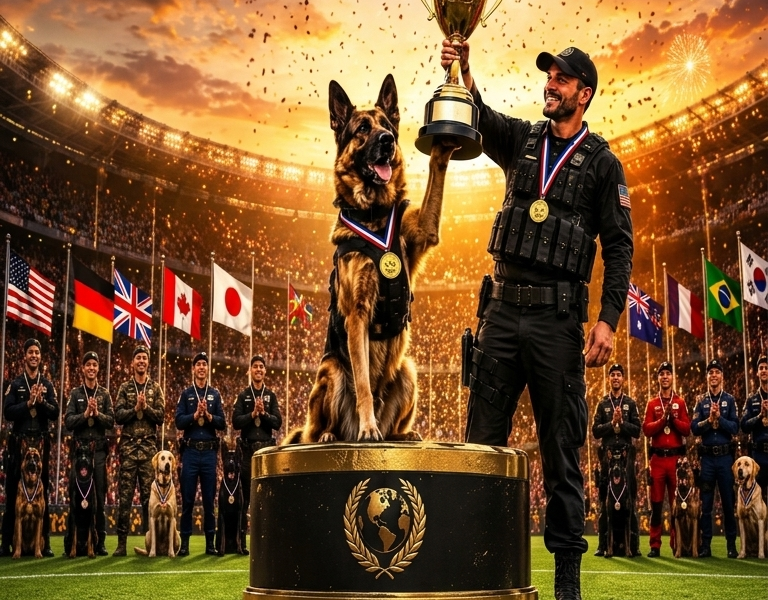
The police station went silent when the smallest K9 stumbled through the championship arena and collapsed during the final course
The fluorescent tubes in the intake corridor of the Cumberland County Animal Shelter hummed with a flat, depressing drone that set my teeth on edge. The smell was always the same: wet concrete, industrial pine disinfectant, and the sharp, sour tang of adrenaline from fifty terrified animals who had no idea what tomorrow held.
I was thirty-four years old, five years into my tenure with the Metro K9 Division, and my boots still carried the mud from the graveyard shift. Beside me walked Captain Vance, our unit commander, a man whose spine seemed constructed of rebar and whose tolerance for sentimentality was precisely zero.
“We need drive, Miller,” Vance said, his voice clipping like shears. “High prey drive, environmental neutrality, heavy bone structure. We need a Belgian or a high-line Czech shepherd. We don’t need a pet project. The city council gave us an equipment procurement grant, and if we blow it on an intake scrub that washes out in three weeks, the chief will cut our squad budget in half.”
“Just let me walk the pens, Captain,” I replied quietly.
Most of the dogs barked—furious, lunging displays against the chain-link fencing, snapping their jaws against the galvanized wire, desperate to dominate or escape. Some jumped four feet in the air, paws leaving muddy streaks on the mesh. Others curled into tight balls at the very back of their damp concrete runs, averting their eyes.
Then I reached Kennel 42.
He didn’t bark. He was small—scarcely fifty pounds, a scrawny cross of Dutch Shepherd and what looked like border collie, with charcoal-brindle flanks so thin you could trace his ribs like the slats of a broken blind. One of his ears stood erect while the other had a fold in the middle, notched at the rim by an old scar.
When a kennel assistant dropped a metal food pan on the concrete five yards away, the clatter echoed down the hall like a gunshot. The dog didn’t lunge. He violently flinched, tucking his tail between his legs, pressing his belly flat against the floor as if trying to melt into the stone. His eyes were wide, ringed in white, amber-gold irises trembling as he looked past me, fixed on the doorway.
“Look at him,” Vance scoffed, pausing with a clipboard tucked beneath his arm. “He’s gun-shy. He’s sound-reactive. He has zero nerve composure. A backfire from a city bus would send him into cardiac arrest. If you take that dog into an alleyway behind Fourth Street, you’re going to get yourself killed.”
I crouched down, turning sideways so as not to challenge him. I didn’t offer a hand. I didn’t make high-pitched noises. I simply exhaled slowly, resting the back of my knuckles against the cold wire.
The brindle dog lifted his chin. His nostrils flared once, twice. He smelled the salt on my skin, the faint residue of bore cleaner and dried leather on my duty belt. Slowly, one agonizing inch at a time, he dragged his front legs forward. He didn’t drop his ears in submission; he held them tilted back in deep calculation. When his damp nose lightly grazed the calloused edge of my thumb, he looked directly into my pupils.
There was no aggression in that stare. But there was something far rarer in a shelter run: an unbroken, stubborn intelligence. He wasn’t afraid of the world; he was terrified of whatever memory was playing behind his eyes.
“His name is Cooper,” the shelter attendant said, stepping up with a clipboard. “Surrendered two weeks ago. Left tied to a dumpster outside an old mechanic’s garage out on the county line. The owner never filed paperwork. He wouldn’t eat for four days.”
“He’s coming with me,” I said, standing up.
Vance rubbed the bridge of his nose, his sigh rattling in his throat. “Miller, this is professional suicide. The guys at the precinct are already placing bets on which dog from the European import kennel you’re going to pick. If you walk into the compound with an underweight mutt that shakes when a clipboard falls, they’ll laugh you out of roll call.”
“Then let them laugh,” I said.
The first month of training was an unmitigated disaster.
Our training field was an old industrial yard behind the depot, littered with crushed gravel, shipping containers, and agility frames. While the other handlers—men with massive, ninety-pound German Shepherds named Thor and Rex—practiced biting sleeves and clearing six-foot wooden scale boards, Cooper sat shivering beneath my squad car’s open tailgate.
“Hey, Miller!” Officer Higgins shouted, unclipping his heavy, snarling Malinois from a lead. “Did you bring that thing to sniff for lost lunchboxes? My dog took a bigger dump this morning than your whole patrol partner!”
A chorus of chuckles rippled through the handlers gathered around the water jug. Even the head trainer, Sergeant Dixon, shook his head as Cooper refused to cross the A-frame obstacle. Cooper wasn’t being defiant; his claws skittered on the painted wood, his body locked tight, his breathing shallow. Whenever someone yelled a command in the sharp, guttural German typically used in protection sports, Cooper’s hind legs trembled and he dropped flat to the grass.
“He’s broken inside, Marcus,” Dixon told me during week four, handing me a failure-to-certify slip. “He’s got no defense drive. He doesn’t engage the decoy sleeve. When the agitator screams, your dog shuts down. We have two weeks until the state patrol inspection. If he doesn’t bite, if he doesn’t track, Vance is going to order him surplused back to the county.”
“Surplused” was a polite bureaucrat’s word for euthanasia or a permanent chain in a rescue sanctuary.
That night, I took Cooper back to my small house outside town. I didn’t put him in the outdoor run. I let him into the kitchen. He lay on a braided rug beside the refrigerator, his chin flat on his paws, watching every move I made with those unsettling, amber eyes.
I sat on the floor opposite him, my back against the lower cabinets. I set aside the training collar, the heavy agitation whip, and the choke chain. I pulled a piece of dried venison from my pocket, laid it on the palm of my hand, and waited.
“You’ve been hurt by someone who shouted, haven’t you?” I murmured. “Someone who wore boots like mine.”
Cooper didn’t move for an hour. Then, as the grandfather clock in the hall struck eleven, he stood up, walked across the linoleum, and took the meat so gently I barely felt his teeth. Then, instead of retreating to his rug, he leaned his head against my chest, right over my breast pocket where my silver badge was pinned to my uniform shirt. He let out a long, shuddering sigh, his body softening against mine.
“Okay,” I whispered into his notched ear. “We do it your way. No shouting. No sleeves. Just you and me.”
The turning point came on a wet Thursday in November.
A four-year-old girl named Maya had wandered away from her parents’ farmhouse near the edge of the Dismal Swamp rail corridor. By the time the call came across the radio, she had been missing for over five hours. A sudden cold front had rolled in from the coast, dropping temperatures into the low thirties, turning the swamp loam into freezing black slush.
The primary tracking team—Higgins and his prized Malinois—had worked the railbed for three hours before the dog lost the scent in the rain-washed gravel. The search-and-rescue coordinator was calling for volunteer firemen to form a line-search, a slow, clumsy process that wouldn’t clear the acreage before hypothermia set in.
“Let me try him,” I told Vance over the radio.
A pause crackled on the channel, thick with static and hesitation. “He’s not certified for live search, Miller.”
“Higgins’s dog lost the track, Captain,” I snapped back. “The kid has thirty minutes before her organs shut down. Cooper doesn’t need to pass a state inspection to smell a damp coat. Let us on the ground.”
“You have twenty minutes,” Vance sighed. “Then the ground line moves.”
I knelt in the mud beside the rail embankment. I held a small, knit mitten to Cooper’s nose. “Find her, buddy. Find Maya.”
Cooper didn’t bolt like a sport dog on an agitation lead. He dropped his nose to the gravel, inhaled deeply, and his entire posture transformed. The fear vanished. The shivering stopped. His spine leveled out into a straight, predatory line.
He didn’t follow the railway where the wind was blowing the heavy rain. He turned ninety degrees, diving straight into the tangled briars and rotted timber of an abandoned railway spur that led to an old feed warehouse.
“He’s tracking off-wind!” Higgins yelled from the gravel path behind us. “He’s chasing deer scent! Miller, call your damn dog back!”
I ignored him. I trusted the dog. Cooper ran on a long twenty-foot tracking line, his paws cutting through the freezing mud without hesitation. He plowed through blackberry brambles that tore at his shoulders, ignoring the sharp thorns, his amber eyes locked forward in the darkness.
He reached the rusted iron doors of the old grain warehouse, slipped through a gap where the corrugated metal had pulled away from the frame, and vanished into the pitch black within.
I scrambled through the opening with my flashlight drawn, my heart hammering in my ears. The warehouse smelled of rusted iron, rat droppings, and damp grain dust.
“Cooper!” I whispered hoarsely.
No bark. But twenty yards back, behind a stack of rotted pine shipping pallets, I heard a rhythmic, slow sound: the soft thud of a dog’s tail against a wooden crate.
I rounded the corner with my beam cutting through the gloom.
There, in a hollow between two overturned fertilizer sacks, lay the little girl. She was curled into a ball, her lips pale blue, her little jacket soaked through.
Cooper was not pacing. He was not standing sentry. He was lying completely wrapped around her tiny torso, his chin resting gently on her shoulder, his own body heat pressing into her freezing clothes. As she sobbed weakly, Cooper gently licked the tears and cold rain from her cheeks, letting out a soft, rhythmic rumble from his chest to keep her calm.
When I knelt beside them, Maya opened her eyes and reached her tiny fingers into Cooper’s brindle fur. “The puppy came,” she whispered.
I lifted the girl into my arms, Cooper standing instantly, pressing his nose to her dangling shoe to maintain the connection. As we walked out of that warehouse into the glare of thirty emergency vehicle strobes, the silence across the clearing was absolute.
Higgins stood by his patrol car, his mouth slightly open.
Captain Vance walked slowly across the gravel, looked down at Cooper’s mud-caked legs, then looked at the little girl wrapped in my wool patrol jacket. The captain didn’t say a word. He simply reached down, patted Cooper’s head once with his bare hand, and walked away.
The next morning, Dixon cleared Cooper’s certification papers with a single stroke of his pen.
Nobody at the precinct laughed anymore. But none of us—not Dixon, not Vance, and certainly not I—had any idea what kind of fire had been ignited inside that broken shelter stray.
The invitation arrived six months later in an embossed white envelope from the National Law Enforcement Police Dog Association.
It sat on the briefing table at the precinct like a challenge thrown down before a room of skeptics. The National Police K9 Championship was held once every two years at the massive equestrian arena in Louisville, Kentucky. It was the premier arena of working dog competitions, dominated by multi-thousand-dollar imported European bloodlines, federal tactical units, and military special operations handlers who trained twelve hours a day with blank-fire weapons and bite suits.
“They have an open wildcard entry for search-and-rescue utility cross,” Captain Vance announced, leaning over the table, tapping the document with his middle finger. “Every department in the state nominated a team. The state association reviewed Cooper’s warehouse track and his three fentanyl interdictions from last month. They selected Miller and Cooper.”
A heavy silence settled over the squad room. Higgins shifted in his seat, looking at his boots.
“With all respect, Captain,” Higgins said, “that course isn’t a county fair obstacle run. It’s designed to break dogs. Sound cannons, flashing stadium strobes, ninety-foot catwalk traverses, chemical smoke obstacles. That brindle dog still jumps when the janitor drops his mop bucket. You put him in an arena with ten thousand people screaming from the bleachers, and he’ll bolt under the grandstand.”
I stood up, resting my hand on Cooper’s leather harness where he lay calmly beneath my desk. “Then let him bolt. But he earned the spot. And we’re going.”
The training for Louisville nearly broke both of us.
Cooper wasn’t built like the massive German lines that could hit a decoy at thirty miles per hour and snap a collarbone through an arm guard. He weighed fifty-four pounds soaking wet. His strength wasn’t mass; it was an uncanny, almost unnatural fluidity. He didn’t run around obstacles; he seemed to flow over them like dark water.
Every afternoon, while the rest of the squad went home, I stayed at the back lot with Dixon. We set up high-powered stadium halogen lamps, fired starter pistols behind metal drums, and filled the yard with dense, non-toxic training smoke.
Cooper struggled. In the beginning, the sharp bang of the starter pistol still made his eyes roll back, his paws sliding across the turf as he tried to wheel away toward the safety of the squad car.
“He’s anticipating the blow, Marcus,” Dixon observed, leaning against the fence with his arms crossed. “Whoever had him before he was dumped tied him up and beat him when they fired guns. That’s not genetic cowardice. That’s trauma memory. You can’t train that out of him with a choke collar. You have to replace the memory with something bigger than the fear.”
“Like what?” I asked, panting as I unclipped the tracking line.
“You,” Dixon said simply. “He doesn’t work for the department, Marcus. He doesn’t work for a green rubber ball or a piece of liver. He works because he thinks if he loses sight of you, he goes back to the chain by the dumpster.”
So I changed the calculus.
When the gun went off, I didn’t hold the leash taut; I dropped to my knees, opened my arms, and let him run straight into my chest. When the smoke canisters hissed, I went into the cloud first, calling his name in a low, calm voice until his cold nose bumped my palm. Slowly, agonizingly, the terror transformed into something else: a fierce, laser-focused devotion that bordered on the obsessive.
By June, we were driving the highway to Louisville in my old cruiser, Cooper’s head resting squarely on the armrest beside my elbow, watching the white dashed lines peel away beneath the tires.
The Kentucky Fair and Exposition Center was an ocean of concrete, red-and-blue banners, and barking dogs. Handlers from the LAPD, the Texas Rangers, the NYPD, and the Royal Canadian Mounted Police filled the staging tunnels with dogs the size of small wolves. Their fur was brushed to a mirror shine, their tactical collars fitted with titanium hardware, their handlers barking commands in four different languages.
When Cooper walked through the intake gate on his simple leather lead, heads turned. Not in admiration, but in genuine bewilderment.
“What class is that?” an LAPD sergeant asked, looking down from his ninety-five-pound sable Shepherd with a dry smirk. “Did they add an agility division for terriers?”
“Search and tactical utility,” I said without slowing down.
“Good luck, friend,” the sergeant chuckled, turning away. “You’re going to need a shovel to scrape him off the turf after the flash-bang course.”
The championship was structured into three brutal days of elimination.
Day one was scent discrimination and scent tracking through an indoor simulated disaster rubble pile—two hundred tons of concrete blocks, broken glass, and twisted rebar laced with hidden scent tubes containing narcotics, gunpowder, and simulated human remains.
The heavy dogs struggled with the shifting shale. Their weight caused slabs of drywall and cinderblock to slide beneath their paws, resulting in penalty points for hesitation.
Cooper was different. He moved across the jagged concrete like an alpine goat. His light frame barely shifted the loose bricks. When a concrete slab tilted beneath his right flank, he didn’t freeze; he leaped gracefully to an iron beam, balanced on a four-inch rusted flange, lowered his snout into a three-inch ventilation pipe, and sat with absolute stillness.
Zero penalty points. First place on the rubble heap.
The stadium announcers were silent for five seconds before Cooper’s time flashed on the digital scoreboard: One minute, forty-two seconds. Course record.
Day two was the tactical obstacle traverse. Dogs had to navigate an elevated catwalk fifteen feet above the arena floor, crawl through thirty feet of narrow corrugated pipe submerged in two feet of icy water, and clear an eight-foot vertical brick wall without handler assistance.
When Cooper stood before the eight-foot wall, the arena fell hushed. Dogs his size physically couldn’t generate the upward launch force without hitting the top lip with their chests and tumbling backward.
“He’s too light, Marcus,” Dixon whispered from the coaching rail. “He’ll slide off the brick.”
Cooper looked at me. I looked at the wall.
“Up, buddy,” I whispered, barely audible over the murmur of the ten thousand people filling the grandstands. “Clear it.”
Cooper ran. He didn’t hit the wall straight-on. He struck the vertical brick face at an angle, planted his back left paw on an iron mortar seam three feet up, kicked off with terrifying lateral spring, ricocheted his front paws against an electrical conduit pipe, and threw his hips over the top lip like a gymnast clearing a vaulting horse. He landed on the rubber mat on the other side with a soft, velvet thud, turning instantly to face the judge.
The crowd erupted into a roar that rattled the stadium girders.
By Sunday morning, forty-eight teams had been cut down to six.
On the massive LED leaderboard suspended above the center arena, the standings were impossible to believe:
K9 THOR – LAPD METRO (Score: 394)
K9 COOPER – CUMBERLAND COUNTY (Score: 392)
K9 BRUTUS – TEXAS RANGERS (Score: 388)
Captain Vance had driven six hours through the night to sit in the front row of the spectator box. When our eyes met across the arena barrier, the old commander didn’t smile, but he adjusted his tie, his chest squared, his gaze never leaving the thin brindle dog standing at my side.
“You’re in the final run, Miller,” the chief field judge announced, his clipboard resting on the gate. “The tactical stress simulation. High-velocity decoy, chemical haze, four simulated explosive charges, and a blind quarry extraction. If your dog breaks focus for three seconds, you’re disqualified.”
I looked down at Cooper. His notched ear was perked, his amber eyes calm, staring straight at the center tunnel where the final course waited beneath the glaring white lights.
“Ready, buddy?” I asked softly.
Cooper didn’t flinch. He leaned his shoulder against my knee, his tail giving one firm, decisive thump against my boot.
The final course was an absolute nightmare of sensory overload.
The arena floor had been transformed into a labyrinth of shipping containers, overturned police cruisers, burning metal drums, and three-tiered scaffolding towers designed to mimic an active industrial urban breach. The air was heavy with the white, sweet-smelling fog of smoke machines, pierced intermittently by the blinding strobes of red and blue tactical beacons.
Every four minutes, an acoustic sound cannon hidden in the upper rafters discharged an ear-shattering, low-frequency shockwave that mimicked the concussive thump of a twelve-gauge breaching charge. It was designed to rattle the inner ear of the dogs, testing whether their nervous systems would trigger an uncontrollable flight response.
Thor, the massive LAPD Shepherd, went before us. He was a mechanical marvel of a dog—fast, punishing, and relentless. He tore through the container maze like a freight train, hit the bite decoy with enough violence to rip the padded leather sleeve off the helper’s arm, and finished the run with a score of 488 out of 500. The crowd had given him a standing ovation that shook the concrete arena steps.
“That’s the gold medal right there,” Higgins murmured from the staging corral. “Nobody beats a 488 on this course. That dog was bred in Bavaria for three generations just for this fifteen-minute window.”
“Competitor 49, K9 Cooper,” the stadium speaker boomed, the announcer’s voice echoing across the rafters. “Cumberland County Sheriff’s Department. Handler: Officer Marcus Miller.”
The moment Cooper stepped through the gate, the murmurs from the crowd were distinct. He looked like an afterthought beside the massive animals that had run before him. His brindle coat looked charcoal in the blue halogen light, his single notched ear giving him the appearance of an alley fighter rather than a champion.
The horn sounded.
BZZZZZZT.
Cooper went off the line like an arrow released from a high-tensile recurve bow.
He didn’t charge down the center aisle where the smoke was thickest. He read the air currents, slicing along the container walls where the scent of the decoy was eddying in the air conditioning exhaust. He hit the first hurdle—a four-foot barricade of chain-link fence topped with barbed wire—clearing it by twelve inches without brushing a single link.
BANG.
The first sound cannon discharged directly above us.
The concussion hit the stadium like a slap, vibrating through the spectator handrails. In the old days, Cooper would have collapsed to his belly in terror.
Instead, he dipped his shoulders, tucking his body into a low, predatory crawl through a twenty-foot culvert pipe, his eyes wide and fixed, never breaking his forward vector. He emerged from the culvert into the open courtyard where two decoy agitators stood behind an overturned vehicle, waving padded shields and shouting in high, aggressive screams.
Cooper didn’t bite to inflict pain; he bit to neutralize. He bypassed the waving shield entirely, leaped over the hood of the sedan, and took the decoy’s forearm sleeve with a clean, centered latch that used the man’s own momentum to spin him down to the padded mat.
The crowd gasped. It was clean. It was surgical.
He released the sleeve the instant I called the German release command from forty yards back: “Aus!”
He spun, clearing the hood again, his eyes locking onto the final objective: the forty-foot open-girder scaffolding tower at the far end of the arena.
At the summit of that tower, perched on a narrow, three-foot platform open to the rafters, sat the final target: an enclosed tactical box containing the scented marker that marked the completion of the course. To get there, the dog had to sprint up a narrow, thirty-degree wooden ramp that had no safety rails, suspended thirty feet above the concrete arena floor.
Cooper hit the ramp at full tilt.
His paws sounded like a snare drum on the plywood—tap-tap-tap-tap.
Ten feet. Twenty feet. Thirty feet.
Then, the unthinkable happened.
A pyrotechnic ground charge, timed to simulate an explosive breach at the base of the tower, detonated two seconds early. A blinding flare of white magnesium light erupted from the base, accompanied by a concussive roar that blew a cloud of hot sparks across the upper deck of the ramp.
The sudden blast didn’t scare Cooper, but the slick, silicone residue from the smoke charge had drifted across the untreated plywood near the thirty-five-foot mark.
Cooper’s front left paw lost purchase.
A collective, horrified scream ripped from ten thousand throats in the grandstand.
His back legs skittered, looking for traction on the slick wood. He tried to arrest his momentum, his claws digging deep into the grain, but the angle was too steep. His body turned sideways. He hit the edge of the ramp, tipped over the lip, and fell.
“Cooper!” I screamed, breaking from the handler’s box, my boots slipping on the arena turf as I ran toward the base of the tower.
He fell twelve feet, crashing heavily onto the secondary staging platform constructed of steel pipe and aluminum planking. The impact sounded sickening—a dull, hollow crack of bone and flesh striking metal.
He rolled twice, his small body tumbling over the edge of the aluminum deck before landing on the dense safety matting on the arena floor below.
He didn’t make a sound. No yelp. No whimper.
He lay on his side in the sawdust, his ribcage heaving, his left front paw twisted beneath his chest at an unnatural, awkward angle.
The arena went completely, terrifyingly silent.
The sound cannons stopped. The smoke machines died. The only sound in that massive ten-thousand-seat auditorium was the frantic, heavy rhythm of my own boots pounding across the turf.
I reached the twenty-yard line when the chief judge stepped directly into my path, his hand raised flat against my chest, his face pale with operational regret.
“Hold, Officer Miller,” the judge commanded, his voice tight. “Rule 14-B. If the handler touches the dog before the time expires, it is an automatic medical withdrawal and disqualification. Let the dog decide if he can yield.”
“Get out of my way!” I snarled, trying to shove past the official’s shoulder. “He’s hurt! Look at him!”
“Marcus, wait!” Dixon’s voice boomed from the rail behind me. “Look at his head!”
I stopped. My breath hitched in my throat.
Cooper hadn’t closed his eyes.
Slowly, with an effort that caused his entire muscular torso to tremble, the brindle dog lifted his chin from the sawdust.
Blood was trickling from a small split above his left nostril where he had grazed the iron scaffolding pipe. His amber eyes were clouded with shock, his tongue hanging dry and gray from the side of his mouth.
He didn’t look at the crowd. He didn’t look at the high wooden platform that had nearly killed him.
He looked straight across the forty feet of empty arena floor, his gaze locking directly into mine.
I fell to one knee, lowering my center of gravity, swallowing the bile that had risen in my throat. I didn’t yell. I didn’t use an official command. I used the quiet, intimate whisper I had used that night on the kitchen floor when the clock was striking eleven.
“Come on, buddy,” I whispered, the words barely carrying over the first row of seats. “You aren’t on the chain anymore. Come on.”
Cooper’s ears twitched.
His back legs gathered beneath his hips. He let out a low, ragged groan from his lungs—a sound of pure, unyielding defiance—and forced his front legs straight.
He stood.
His left front paw hovered an inch off the turf, unable to bear full weight, the shoulder muscles twitching with spasms of intense pain. But his spine straightened. The ridge of fur along his neck stood three inches high, bristling with an ancient, stubborn fury that belonged to no pedigree or breeding program on earth.
He didn’t look at the ramp he had fallen from. He looked at the base of the scaffolding itself.
There were no stairs. Only the vertical iron cross-braces of the construction tower.
Cooper began to limp forward.
One pace. Two paces.
Then he broke into a three-legged sprint.
The arena did not cheer. Nobody could draw enough breath to shout.
The crowd rose to its feet in a single, massive wave of rustling coats and dropped programs, leaning over the railings in absolute, disbelieving horror as the fifty-pound shelter dog threw himself at the base of the scaffolding.
He didn’t use the slick plywood ramp. He launched his body directly onto the four-inch steel cross-pipe five feet above the ground, using his good right front leg and his two muscular hindquarters to lock his torso against the iron junction.
CLANG.
His claws bit into the rusted galvanized metal. He scrambled upward, paw over paw, his body twisting through the triangular gaps of the scaffolding framework like an iron cat. When his injured left leg struck an aluminum upright, a sharp shudder rippled through his flank, but his jaw remained clenched, his eyes fixed on the upper catwalk thirty feet above.
“He’s scaling the frame!” the announcer cried, his voice breaking into a shrill, unprofessional squeak over the PA system. “He’s climbing the iron!”
I couldn’t move. My hands were balled into fists so tight the nails bit into my palms until they bled. “Hold the weld, Cooper,” I prayed beneath my breath. “Hold the weld.”
With a final, desperate heave of his back legs, Cooper pulled his chest over the top lip of the observation deck.
He landed heavily on the diamond-plate aluminum floor thirty-five feet in the air, his injured leg dragging slightly behind him. The scent marker box was five yards away.
He didn’t crawl. He forced himself up onto three legs, limped across the aluminum deck, and struck the heavy brass target latch with the flat of his snout.
CLACK.
The electronic horn sounded from the scorer’s table.
BZZZZZZZZZZZZT!
The course timer stopped.
Time: Fourteen minutes, twenty-two seconds.
Cooper didn’t wait for a handler ladder. He turned around, sat down on his haunches at the edge of the thirty-foot platform, lifted his head toward the stadium lights, and let out a long, clear, triumphant howl that echoed off the concrete ceiling like a trumpet call.
The sound that followed was deafening.
Ten thousand people did not just applaud; they roared. Handlers from opposing teams—men who had laughed at us in the registration corridor—threw their tactical caps into the air. People were hammering on the fiberglass safety barriers, screaming at the top of their lungs, stamping their boots until the concrete foundations of the exposition center vibrated.
Down in the lower box, Captain Vance was on his feet, his hands raised above his head, tears streaming openly and unashamedly down his weathered cheeks.
The field handlers lowered the industrial maintenance lift, bringing Cooper down to the arena floor.
The moment the safety gate opened, Cooper didn’t look at the judges. He didn’t look at the cameras flashing in his face. He limped across the sawdust, his tail sweeping the floor in wide, rhythmic arcs, and buried his head straight into my stomach.
I dropped to my knees in the dirt, throwing my arms around his neck, burying my face into his rough, brindle coat.
“You did it,” I sobbed, the tears soaking through the coarse fur behind his notched ear. “You beautiful, stubborn idiot. You did it.”
Cooper pressed his flat forehead violently against my brow, his tongue licking the salt from my eyelids, his whole body trembling with exhaustion and relief.
The chief field judge walked across the arena floor, carrying a microphone in one hand and the massive, three-tiered crystal-and-gold trophy in the other. He stopped two paces away, looked down at Cooper, and then looked at the electronic board.
The numbers flickered, recalculated the penalty deductions, and then locked in place:
FINAL SCORE:
1. K9 COOPER – CUMBERLAND COUNTY: 496 POINTS
WORLD CHAMPION – UTILITY DIVISION
“Ladies and gentlemen,” the judge’s voice boomed over the thunderous roar of the crowd. “Your national champion… Cooper!”
The flashbulbs erupted into a blinding storm of white light. Handlers from the LAPD and the Texas Rangers swarmed onto the turf, surrounding us, slapping my shoulders, kneeling to touch Cooper’s good flank with a respect that had to be earned with blood and bone.
Higgins pushed his way through the circle, his face red with a mixture of shame and awe. He dropped down on one knee beside Cooper, his gloved hand trembling as he offered the dog the back of his knuckles.
“I’m sorry, Miller,” Higgins choked out, his eyes wet. “I swear to God, I’m sorry. I didn’t know. None of us knew what he was.”
Cooper looked at Higgins, gave his knuckles a brief, magnanimous lick, and then leaned back against my knee.
The championship banner was lowered from the rafters, bearing the silhouette of a working dog against a gold star. Two tournament officials tried to drape the massive purple championship ribbon over Cooper’s neck, but the dog suddenly pulled his head back.
The cheering was still thundering through the arena, but Cooper’s posture shifted instantly.
His tail stopped wagging.
His single notched ear lifted straight up, turned at a sharp forty-five-degree angle toward the north service tunnel that led out to the rear loading docks.
His ribcage expanded as he drew in three deep, rapid breaths through his nostrils, sampling the air that was blowing in from the open garage doors three hundred yards away.
A low, vibrating rumble began deep within his chest.
It wasn’t a growl of aggression. It was a sound of desperate, disbelieving recognition—the same sound he had made that night in the warehouse before he found the little girl.
He stood up, completely ignoring the pain in his twisted leg. He took three stiff steps away from the trophy presentation, his eyes locked onto the dark opening of the exit corridor.
“Cooper?” I asked, rising to my feet, the ribbon dangling from my fingers. “Buddy, what is it?”
He didn’t look back at me. He lunged against his leather harness with such sudden, desperate force that he pulled the lead straight out of my relaxed grip.
He began to run.
“Cooper! Heel!” I yelled, but the command was useless against the tide that had seized him.
He was limping, but his three good legs drove him through the maze of photographers, judges, and handlers like a man sprinting toward a lifesaver in a storm. He cleared the arena gate, slipped between two bewildered security guards at the mouth of the service tunnel, and vanished into the concrete gloom behind the grandstands.
“Marcus!” Vance shouted, running toward the tunnel with Dixon right behind him. “What’s he doing?”
“I don’t know!” I yelled back, breaking into a full sprint, my boots skittering on the polished concrete of the underground tunnel. “He smelled something!”
The service tunnel was vast, smelling of damp exhaust, grease, and rain from the open loading docks at the far end. Cooper was forty yards ahead of me, his brindle coat a gray blur against the yellow sodium vapor lights overhead.
He didn’t stop at the trash compactors. He didn’t pause at the catering trucks.
He burst through the heavy PVC weather-stripping hanging over the rear pedestrian exit, out into the cold, gray drizzle of the Louisville afternoon.
I hit the plastic curtains a few seconds later, bursting out onto the wet asphalt of the service alleyway that ran behind the exhibition hall.
Rain was falling in cold, steady needles. The alley was lined with commercial dumpsters, stacks of wooden shipping pallets, and the idling trucks of the production crews.
At the far end of the alley, twenty yards away, stood a lone figure leaning against an old, rusted chain-link fence that separated the fairgrounds from the railway tracks.
He was a man in his late fifties, his frame thin and worn, wearing a faded green canvas work jacket with frayed cuffs and a grease-stained ball cap pulled low over his brow. His boots were held together at the toe with silver duct tape. In his hand was a worn cardboard sign that had been folded into quarters, tucked beneath his arm as if he had walked miles down the tracks just to listen to the arena crowd from the outside.
Cooper was not barking.
The world champion dog was on his belly on the wet asphalt, crawling forward inch by agonizing inch, his nose pressed to the muddy puddles, whining with a sound so pure, so shattered, and so full of grief that it seemed to tear his small chest open.
The man turned slowly at the sound.
When his eyes dropped to the brindle dog crawling toward his boots, the man’s face went completely, terrifyingly white. His knees buckled as if he had been struck from behind by an iron bar. He dropped his cardboard sign into the mud, falling heavily to his knees in the freezing puddle.
“Coop?” the man’s voice cracked, a rough, gravelly whisper that barely carried over the falling rain. “Cooper?”
Cooper didn’t walk the last three yards. He launched his front half forward, throwing his head into the man’s chest with a force that knocked the old jacket open. He wasn’t the fierce patrol dog that had scaled the scaffolding. He was a puppy. He was weeping, burying his muzzle deep beneath the man’s whiskered chin, his paws wrapping around the man’s shoulders, his tail thrashing the muddy asphalt so hard it sounded like rain on a tin roof.
The man buried his face in Cooper’s neck, his shoulders heaving with massive, silent sobs, his calloused, grease-blackened hands clutching the brindle fur as if he would die if he let go.
“You’re alive,” the man wept, rocking the dog in the rain. “Oh God, you’re alive. They told me you were dead, boy. They told me they took you to the pit.”
I stopped ten feet away, the rain running down my face, the purple championship ribbon still clenched in my cold fist.
Vance and Dixon rounded the corner of the tunnel, stopping dead behind me, their eyes wide as they took in the scene in the alleyway.
“Who are you?” I asked, my voice barely audible over the hiss of the traffic on the distant overpass.
The man slowly lifted his head. His eyes were bloodshot, his skin pale and lined with the deep, permanent creases of hard labor and bitter cold. He kept one hand firmly on the back of Cooper’s neck, feeling the scar on his ear, his fingers moving with an intimacy that only years of shared hunger could forge.
“My name is Thomas,” the man rasped, his voice trembling. “Thomas Miller. No relation to you, sir, I reckon.”
He took a slow, rattling breath, wiping the rain and tears from his jaw with a frayed sleeve.
“Two years ago, I ran an independent repair shop outside Cumberland,” Thomas said softly, his eyes never leaving the dog’s face. “I had this boy since he was eight weeks old. His mother was a working dog that got killed on the highway. I raised him on goat’s milk and bread scraps. We were never apart. Not one day.”
“What happened to him?” I asked, stepping closer, kneeling down so I was level with them in the rain.
Thomas’s face twisted with an old, bitter agony.
“The shop went under,” he whispered. “Then the banks came. Then the county sheriffs came to evict me from the trailer behind the garage. I had three men with badges telling me to clear out in twenty minutes. When I tried to load Cooper into my old pickup, one of the deputies grabbed him by the scruff. Cooper growled. He didn’t bite, sir, I swear on my mother’s soul he never bit. But that deputy took his nightstick…”
Thomas choked, his hands tightening on Cooper’s coat.
“He beat him right there on the gravel. Beat him until the boy couldn’t stand, then dragged him to the back of their patrol truck and told me if I ever came back to the county, they’d charge me with assaulting an officer. Two days later, a fellow at the scrap yard told me they took Cooper to the county shelter to put him down because he was vicious.”
Thomas looked down at Cooper, whose eyes were half-closed in pure, unadulterated ecstasy, his chin resting securely on the old man’s knee.
“I lost everything,” Thomas murmured. “My shop, my home, my boy. I’ve been living out of shelters and day-labor spots between here and Cincinnati for eighteen months. I came by the fairgrounds today because someone told me there was a dog show. I didn’t have twenty dollars for a ticket. I was just… I was just standing by the exhaust vent, listening to the dogs bark. Because every time I hear a dog bark, I keep thinking… I keep praying…”
He stopped, unable to speak, his tears cutting clean tracks through the coal dust on his cheeks.
“He wasn’t vicious,” I said softly, my chest aching with a pain so sharp it made my throat tight. “He was terrified.”
Thomas looked at the heavy leather tactical harness around Cooper’s chest, then looked at the silver shield pinned to my rain-soaked uniform shirt.
“Did they make him fight, officer?” Thomas asked, his voice breaking with sudden, desperate terror. “Did they hurt him again?”
I looked down at Cooper.
The brindle dog lifted his head, looked at Thomas, then turned his amber eyes back to me. There was no fear in his gaze now. No trauma. No memory of the chain by the dumpster or the heavy nightstick on the gravel. There was only a profound, complete peace—the realization that his long, desperate search was finally over.
I reached out, unclipped the purple championship ribbon from my fingers, and laid it gently across Thomas’s worn canvas knee.
“No, Thomas,” I said, my voice thick with emotion. “Nobody made him fight. He won. He beat every dog in the United States today.”
Thomas stared at the gold lettering on the silk ribbon: WORLD CHAMPION – UTILITY DIVISION.
“He climbed a forty-foot tower on three legs just to get out that door to find you,” I told him.
Captain Vance walked forward, the gravel crunching beneath his heavy duty boots. He stopped beside Thomas, looked down at the old mechanic, and then reached into his tactical vest, pulling out a business card and a pen.
“Mr. Miller,” Vance said, his voice dropping into that deep, gravelly cadence that carried the weight of thirty years of command. “Our department has an open civilian maintenance position at the K9 training facility in Cumberland. Pays twenty-four dollars an hour, includes full municipal health insurance, and comes with a small cottage on the county preserve behind the kennel runs.”
Thomas looked up, his jaw slack, bewildered. “Sir?”
“Our current handler here, Officer Miller, is good at his job,” Vance continued, looking down at me with a rare, quiet warmth in his eyes. “But he’s got terrible paperwork habits, and he doesn’t know a damn thing about maintaining diesel generators or keeping the obstacle course in repair. We need a man who knows tools. And we need a man who knows how to feed our lead patrol partner when his handler is on shift.”
Thomas looked from Vance to me, his hands trembling so violently he could barely hold the card.
“You mean… I can see him?” Thomas whispered. “I can be with him?”
“He lives with Marcus,” Vance said. “Those are the department regulations for active service dogs. But the backyard of the handler’s house borders the facility fence, Mr. Miller. If you’re working the morning shift, I expect you’ll be having coffee on his porch every day at dawn.”
Thomas dropped his head onto Cooper’s neck once more, a deep, shuddering sob racking his body as the brindle dog pushed his nose under the old man’s ear, licking away the rain.
I looked up at the gray Kentucky sky. The drizzle had stopped, replaced by a pale, golden light breaking through the eastern clouds, washing the alleyway in the first warm glow of evening.
Cooper looked up at me from Thomas’s lap, his tail giving three slow, heavy thumps against the wet asphalt.
He was the dog nobody wanted. The dog they called useless. The dog that shook when the world grew loud.
He had conquered an arena of champions, not for a medal, not for a trophy, and not for the applause of ten thousand strangers.
He had done it for this: a quiet alleyway, a pair of worn boots, and the hand that had held him when he was small.
“Let’s go home, buddy,” I whispered.
Cooper stood, his front leg resting easily on the dry pavement, his amber eyes shining like new gold in the setting sun. And for the first time since I had found him behind the shelter fence, he didn’t look back at the dark.
The end.









