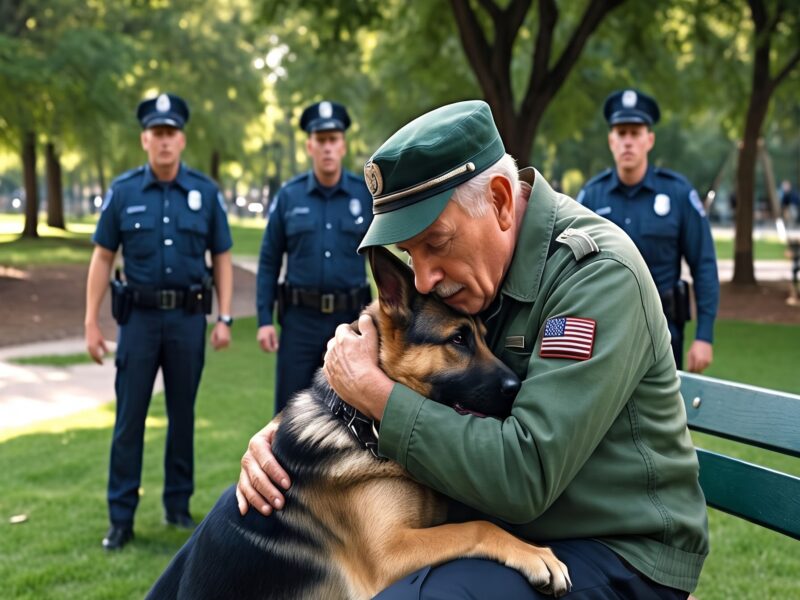
The police dog lunged at my throat in the middle of a crowded Chicago train station while its handler shouted for me to get on my knees
The cold concrete of Union Station seemed to bleed its chill right through the soles of my worn leather boots. At seventy-four, my body was a ledger of past hard labor—aching knees, stiff fingers, and a back that protested every step. I held my worn leather suitcase tightly in my right hand, my knuckles pale against the scratched brass handle. Around me, the afternoon rush hour was a blur of commuters moving under the yellowed glare of the station lights. People brushed past me without a glance, eager to escape into the biting Chicago wind.
I had been standing near Platform 6, catching my breath, when the air suddenly changed. The ambient noise of chattering crowds and screeching train brakes seemed to drop into an uncomfortable silence. Two uniformed officers stepped out from behind a thick concrete pillar, their boots clicking heavy against the tile, blocking my path entirely.
“Hands where we can see them!” one of them barked.
I froze. A few commuters turned to stare, their steps slowing as they smelled trouble. Panic fluttered in my chest like a trapped bird. I looked down at my faded coat, at my frayed cuffs. I was an old man, quiet and broken, who spent his days sitting in an empty house. I had no idea why they were treating me like a criminal.
“Please, son,” I rasped, my voice thin and dry. “I don’t know what this is about.”
“Keep your hands clear of your coat!” the second officer snapped, his hand resting on the grip of his holster.
Before I could ask another question, the heavy double doors near the service entrance burst open. A broad-shouldered K-9 handler strode out, holding a taut black leash attached to a massive German shepherd. The animal was tense, muscles rippling under a thick coat, eyes burning with a fierce, focused energy.
The handler pulled the dog forward, pointing a gloved finger straight at my chest. “Find the threat.”
The dog let out a low, guttural growl that vibrated through the floorboards. Fear tightened around my ribs like an iron band. My hands trembled as I raised them slowly to shoulder height.
“Attack,” the handler commanded sharply.
The German shepherd lunged. He bounded across the distance, a blur of dark fur and sharp teeth, aiming straight for my throat. I squeezed my eyes shut, bracing for the impact, expecting the tearing pain of steel-like jaws.
Instead, the heavy impact never came.
A cold, wet nose pressed hard against the center of my chest, right over my heartbeat. I opened my eyes in disbelief. The dog hadn’t bitten me. He had stopped inches from my coat, his front legs trembling. Slowly, the animal lowered his head, pressed his face deeper into my chest, and let out a long, broken whimper. It was a sound of profound grief, a desperate, weeping noise that didn’t belong to a trained police animal.
The entire concourse fell dead silent. Commutators stopped in their tracks. The ambient hum of the station vanished.
The handler yanked hard on the leash, his face flushed with confusion and annoyance. “What the hell are you doing? Heel! Heel!”
The dog ignored him completely. He leaned his full body weight against my legs, whining softly, his dark eyes locked onto mine with an intensity that made my breath catch. Then, with a sudden, desperate movement, the animal dropped his nose to the ground and began scratching frantically at the leather of my suitcase.
The blood drained from my face. My fingers twitched, desperate to pull the bag back, but my limbs felt heavy as lead.
“Sir,” the first officer said, his voice dropping into a stern, authoritative register. “Open the case. Now.”
“There’s… there’s nothing dangerous inside,” I stammered, my heart hammering against my ribs. “It’s just my personal things. Old things.”
“Step back, old man,” the handler ordered, stepping forward and shoving me back with his forearm. He unlatched the rusty bronze clasps and threw the suitcase lid open on the cold floor.
Inside lay three items: an old black-and-white photograph of a young woman, a neatly folded military dress uniform from my youth, and a small, faded red wool scarf.
That scarf had belonged to my daughter, Clara.
Eleven years ago, Clara had walked into this very station on a wet November evening to catch a train back to college. She had been twenty-two, full of life, her laughter ringing through our small home like music. She had kissed my cheek, wrapped that red scarf around her neck, and promised to call when she landed.
She never called.
She had vanished into thin air. For eleven long years, I had spent every morning staring at her empty room, every birthday lit by a single candle on an untasted cake, wondering whether she was breathing somewhere, or if she was lying cold beneath the earth.
The German shepherd stepped over the open suitcase. He didn’t sniff for explosives or drugs. Instead, he gently touched his nose to the red wool scarf, lifted his head, and let out a sharp, mournful howl that echoed up into the high arched rafters of the station.
I dropped to my knees on the hard floor, my joints popping with pain, and reached out with a trembling hand. “Where… where did you find that scent?” I whispered, looking up at the dog. “How do you know her?”
Nobody answered me. The officers were staring at the dog, their professional composure cracking into sheer bewilderment.
Then, the handler’s radio crackled to life on his shoulder, breaking the heavy silence with static and a sharp burst of noise. A voice came through from dispatch—quiet, breathless, and filled with urgent static.
“Unit 12, come in. We’ve got a critical situation at your location. Over.”
The officer snatched his radio. “Unit 12 receiving. We’re on Platform 6 with a suspicious subject. The dog is acting out of protocol.”
“Disregard the subject,” the radio static crackled back, the dispatcher’s voice trembling slightly. “We just got a flag from the cold case database. The missing girl case—Clara Vance—it just reopened.”
My heart stopped. My vision blurred around the edges.
The handler looked down at me, his eyes widening. “What missing girl case?”
“The daughter,” the voice on the radio replied. “The red scarf in the system matches a DNA hit from a subterranean sweep three miles up the line. And officer… that dog isn’t a weapon detector. He’s a cross-trained cadaver dog from the state registry.”
A cold wind seemed to blow through the station, though all the doors were closed. A cadaver dog. A dog trained to find the quiet, forgotten dead.
I looked down at the German shepherd. Memory, long buried under the heavy soil of trauma and age, suddenly surged back into my mind like a tidal wave.
Eleven years ago. The night she disappeared.
I had come to this station at three in the morning after the police called to say they had found Clara’s purse near the train tracks. Rain had been pouring in sheets. I remembered a police van parked near the edge of the dark riverbank, its red lights flashing against the wet pavement. And beside that van, there had been a dog—a younger, leaner version of the dog standing before me now.
He hadn’t been crying that night. He had been barking furiously, strain against his leash, baring his teeth at a man standing on the periphery of the police tape.
A man wearing a heavy gray wool coat. A man who had stayed by my side during the agonizing weeks of searching. A man who had held my trembling shoulders at Clara’s memorial service when we finally put an empty casket in the ground.
My brother, Arthur.
The officer stepped closer to me, his tone changing from hostile to deeply uneasy. “Sir… where did you get this scarf today? This case was sealed over a decade ago.”
I couldn’t speak. My throat was locked in a vise of pure terror and realization. Arthur had brought me the suitcase this morning. He had handed it to me at the house, telling me he had found some of Clara’s old belongings in his attic while cleaning, suggesting I take them to the historical archive across town to donate them in her memory. He had insisted I take the train. He had insisted I carry this exact bag.
The dog suddenly snapped his head around, turning his body toward the far end of Platform 6, where an old iron door marked STATION PERSONNEL ONLY led down into the dark, abandoned maintenance tunnels beneath the tracks. The animal began pulling against the leash with violent force, his paws slipping on the slick tile as he barked with desperate urgency.
“Get the search team down there now!” the handler barked into his radio, his composure shattered as he was dragged toward the dark doorway. “Call for backup! We have an active hit!”
I dragged myself up from the cold floor, clutching the small red scarf against my chest with both hands, weeping silently as the strength drained from my legs. For eleven years, I had believed my daughter was dead and gone, lost to the cold void of the unknown.
But as the officers forced open the heavy iron door and the dog vanished into the pitch-black stairwell leading down into the bowels of the earth, a sound echoed upward through the grate in the floor beneath my feet.
Thump. Thump. Thump.
Three deliberate, rhythmic knocks against the iron pipe beneath the floorboards.
And then, faintly, rising through the damp, air-conditioned draft of the drainage vent, came a raspy, weak whisper that froze the blood in my veins.
“… Dad?”
The whisper cut through the noise of the gathering crowd like a razor through silk. It was a sound I had heard ten thousand times in my dreams, a voice I had prayed to hear every night for over four thousand days.
“Clara!” I screamed, dropping the suitcase entirely and falling back to my hands and knees beside the iron drainage grate set into the floor. I pressed my face against the dusty metal bars, my hands clutching the dirty iron frame. “Clara! I’m here! I’m here, baby!”
“Sir, stay back!” an officer yelled, grabbing my arm to pull me up, but I fought him with a desperate, wild strength I didn’t know an old man possessed.
“She’s down there!” I wept, pointing blindly into the dark gaps of the floor. “You heard her! She’s alive!”
The handler had already cleared the heavy iron door at the end of the platform, the German shepherd pulling him aggressively down a crumbling concrete stairwell into the darkness. The dog’s frantic barking echoed back up the shaft, hollow and echoing, ringing with absolute certainty.
“Primary unit descending,” the handler’s voice crackled over the tactical radios worn by the platform officers. “It’s pitch black down here. The air is foul. Requesting immediate ventilation and medical support on standby. The canine is pulling hard toward the lower utility corridors.”
Two more officers arrived, pushing the shocked crowd of onlookers behind a perimeter of bright yellow police tape. The station was in complete chaos. People were taking out their phones, shouting, whispering, staring at the old man lying flat on the floor with his face pressed against a drainage grate.
I didn’t care about the people. I didn’t care about the cameras. I pressed my ear flat against the iron bars, listening through the rushing noise of my own blood.
“Clara!” I called down again, my voice cracking with agony. “Can you hear me?”
For a long, agonizing minute, there was only the distant rumble of a train passing on an upper level and the sharp, echoing barks of the police dog deep beneath the station floor. Then came a dry, rattling cough from deep within the darkness beneath the vent, followed by the faint scrape of metal against stone.
“Dad…” the voice whispered again. It was terribly weak, choked with dust and hoarse from lack of water, but it was unquestionably her tone, her cadence. “Dad… it’s so cold…”
My soul shattered into a million pieces right there on the tile. For eleven years, I had believed she was dead. I had held a funeral. I had buried an empty box in the cold dirt of Pine Ridge Cemetery while my brother Arthur stood beside me, his arm around my shoulder, whispering that we had to accept God’s will.
Arthur.
The thought hit me like a physical blow. Why had Arthur given me the suitcase today? Why had he specifically asked me to bring it to this station, on this specific afternoon?
“Unit 1,” the handler’s voice crackled through the radio, louder now, echoing from the speakers of the officers standing near me. “We’ve reached a sub-basement. There’s an old brick partition here that isn’t on the station maps. The dog is going crazy at a reinforced steel door. It’s padlocked from the outside!”
“Break it!” I screamed, tearing myself away from the grate and staggering to my feet. “Break the door!”
I lurched toward the open iron door at the end of the platform. The remaining officer tried to grab my coat, but I shoved past him, driven by a raw, instinctual surge of adrenaline that defied my age and my aching body. I reached the dark stairwell and plunged into the gloom, holding onto the damp concrete wall as I descended step by step into the depths of the station.
“Sir! Stop! You can’t go down there! It’s an active crime scene!” the officer shouted behind me, his heavy footsteps pounding down the stairs after me.
I didn’t stop. I couldn’t stop.
The stairs gave way to a long, damp brick corridor illuminated only by the sharp yellow beams of the flashlight held by the dog handler up ahead. The smell was overpowering—a stifling mix of wet rust, mold, rot, and ancient dirt. Heavy pipes ran along the ceiling, dripping cold water onto the concrete floor.
At the far end of the hallway, illuminated by the flashing tactical light, the German shepherd was threw his heavy body against a rusted iron door set deep into the brick wall. A thick steel chain was looped through the handles, held tight by a heavy, modern padlock that shone bright and silver against the decayed metal—a stark sign that someone had been visiting this forgotten tomb very recently.
“Stand back!” the handler ordered as another officer hurried down the hall carrying a heavy set of bolt cutters.
“Wait!” I cried out, reaching the hallway, gasping for breath, my chest heaving. “Wait… look at the lock.”
The officer with the bolt cutters paused, shining his light directly onto the padlock. It was a high-security brass lock, modern, sharp-edged, completely free of rust despite the heavy moisture in the air. Engraved on the brass housing were small, familiar initials scratched into the metal with a pocket knife: A.V.
Arthur Vance.
My stomach churned violently. The world seemed to tilt on its axis.
“That’s my brother’s lock,” I whispered, the words tasting like ash in my mouth. “That’s my brother’s initials.”
“Step back, sir,” the officer repeated, his voice tight with newfound severity. He positioned the heavy jaws of the bolt cutters over the shackle of the lock, leaned his weight into the arms of the tool, and grunted.
SNAP.
The heavy metal link sheared in two, falling to the floor with a loud metallic clatter that echoed through the narrow tunnel. The heavy steel chain rattled as it was pulled free and dropped to the damp floor.
The handler grabbed the handle of the rusted iron door and pulled. The hinges screamed in protest, shedding flakes of orange rust as the door swung outward, revealing a narrow, pitch-black room beyond.
The dog didn’t rush in this time. He stepped carefully into the threshold, lowering his head, whining softly as he shone his flashlight beam into the interior.
The light illuminated a tiny room, no larger than a storage closet. In the center, sitting on a rusted metal cot covered in dirty, frayed blankets, was a figure.
She was impossibly thin, her skin pale as porcelain, her long dark hair matted and streaked with gray. She wore an oversized, ragged coat that hung off her frail frame like a sail on a broken mast. Her hands were wrapped in filthy rags, shielding her eyes from the blinding glare of the police flashlights.
“Clara?” my voice was barely a whisper, a broken sound forced through a closed throat.
The figure in the beam of light trembled. Slowly, agonizingly, she lowered her thin, frail hands from her face. Her hollow, dark eyes adjusted to the light, searching the shadows of the doorway until they landed squarely on me.
Tears cut clean, clean tracks through the layer of soot covering her gaunt cheeks.
“Dad?” she sobbed, her voice a fragile, rasping thread. “You… you came. He said you were dead.”
I fell to my knees on the damp concrete floor of that horrible, dark cell, reaching out with arms that shook uncontrollably. Clara collapsed off the rusted cot, crawling toward me across the filthy floor, her weak limbs trembling under her weight. I wrapped my arms around her frail body, pulling her tight against my chest, weeping so hard my lungs burned.
She felt like a bundle of dry sticks wrapped in old cloth, so light, so impossibly fragile. But she was warm. She was breathing.
“I’m here, Clara. I’m here,” I sobbed into her matted hair, smelling the heavy dust and age on her skin. “I never stopped looking for you. I never forgot you.”
“He told me… he told me you died eleven years ago,” she whimpered into my shoulder, her fingers clutching at the lapels of my old coat with a desperate, terrifying grip. “He said you were killed in an accident… he said nobody was looking for me…”
The officers stood in frozen shock around us, their flashlights shaking slightly as they took in the full horror of the scene. The K-9 handler sat on his heels beside the dog, who gently approached Clara and laid his wet nose against her knee, letting out a soft, comforting sigh.
“Get emergency medical services down here now!” the handler shouted into his radio, his voice strained with anger and disbelief. “We have a living victim! Repeat, the victim is alive! Send a full medical team and lock down the station!”
The second officer stepped forward, his face pale in the stark beam of his flashlight. “Miss Vance… who kept you down here? Who did this to you?”
Clara pulled back slightly, her wide, hollow eyes filled with an ancient, deeply ingrained terror. She looked at the heavy iron door, at the snapped padlock lying on the damp concrete, and then up at me.
“Arthur,” she whispered, her voice trembling so violently her teeth chattered. “Uncle Arthur.”
A cold rage, deeper and darker than any emotion I had ever felt in my seventy-four years of life, ignited inside my chest.
“Why?” I choked out, tears burning my eyes. “Why would he do this to us? To you?”
“He wanted… he wanted the estate, Dad,” Clara gasped, struggle to find enough breath to form the words. “The land Grandfather left to me in the trust… he said if I vanished, the court would declare me legally dead after seven years, and everything would transfer to him as the secondary beneficiary. But… but he couldn’t bring himself to kill me. So he put me here.”
The reality of her words crashed down on me with terrifying clarity. Eleven years ago, my father—a wealthy real estate developer—had passed away, leaving his entire multi-million-dollar land trust directly to Clara, bypassing my brother Arthur, who had ruined his own life through reckless gambling and failed business ventures. Two months after the will was read, Clara had vanished.
And seven years later, when the state officially declared her dead, Arthur had stepped in to claim the trust, posing as the grieving uncle who would manage the family legacy. He had lived in a grand house on the north side of Chicago while his own niece withered away in a subterranean tomb directly beneath the city’s busiest train station.
“He came every few days,” Clara continued, her tears flowing freely now as she held my hands. “He brought food… water… books. He told me if I ever tried to make noise, he would stop coming, and I would starve in the dark. He said the trains above were so loud that no one would ever hear me anyway.”
“Then why today?” the handler asked, stepping closer, his expression grim. “Why did he give your father that suitcase today? Why send him here?”
Clara looked down at the small red scarf that was still tucked into my coat pocket. “The city… they announced the station renovation project last week. They’re demolishing this subterranean level next month to expand the subway line. He knew the construction crews would find this room.”
I gasped as the full, monstrous brilliance of Arthur’s plan became horrifyingly clear.
“He knew they’d find her,” I said, my voice dropping into a register of pure horror. “He knew he couldn’t keep her hidden any longer. So he put her scarf into my suitcase… he sent me down here to the station with it today…”
“He was framing you,” the officer said, finishing my sentence, his face hardening into absolute disgust. “If the police found her body or found the evidence today, it would all point to you. An old man carrying the missing girl’s scarf at the exact location where she disappeared. He was going to let you take the fall for her murder while he walked away clean.”
Before anyone could say another word, the handler’s radio buzzed violently with a burst of frantic static.
“All units, all units on Platform 6!” a dispatcher’s voice screamed over the channel. “We have a code red at the surface entrance! Suspect Arthur Vance has just been spotted entering the main concourse from the street level! Repeat, Arthur Vance is inside the station!”
Clara let out a muffled scream and buried her face against my chest, her body shaking violently. “He came to watch,” she gasped. “He came to see the police arrest you!”
I looked down at my daughter, at her frail, starved body, at the eleven years of her life that had been stolen by a monster who shared my blood. The aching in my joints vanished. The tiredness of old age melted away, replaced by a searing, primitive fury.
I looked up at the officer. “Give me a flashlight.”
“Sir, you need to stay with your daughter,” the officer said firmly. “We will handle this.”
“He is my brother,” I said, my voice dead and cold as ice, standing up with a strength that terrified even me. “And he is not getting away.”
I didn’t wait for the officers to agree. I grabbed a heavy metal flashlight from the equipment kit on the floor and turned back toward the dark stairwell, my heart pounding a fierce, rhythmic beat against my ribs.
“Dad, no! Don’t leave me!” Clara cried out from the floor, her voice echoing off the damp brick walls.
“I am never leaving you again, Clara,” I said, turning back to look at her one last time, my eyes burning with resolve. “I’m going to finish this.”
The K-9 handler looked at me, then down at his dog. The German shepherd was standing tall now, his ears pinned back, his muscles tense, sensing the sudden shift in energy.
“Go with him, Miller,” the handler barked to the second officer. “Take the dog up! I’ll stay here with the victim until the medics arrive!”
Officer Miller nodded grimly, unclipping the heavy leather lead from the dog’s harness and giving the animal a direct signal. “Track, Boy! Find Arthur!”
reached the top of the stairs first, bursting through the heavy iron door back onto Platform 6. The concourse was in utter turmoil. Police sirens were wailing outside on the street, their flashing red and blue lights reflecting wildly off the station’s high glass windows. Commuters were running in panic, confused by the sudden arrival of dozens of armed officers pouring through the entrances.
I swept my gaze across the vast, crowded floor of the station.
And then I saw him.
Standing near the main ticket counter, half-hidden behind a marble pillar, was Arthur. He was wearing his expensive charcoal gray trench coat, his silver hair neatly combed, holding a leather umbrella. He was staring intensely toward Platform 6, waiting, watching for the police to drag me out in handcuffs.
Then, his eyes met mine.
The colour drained from Arthur’s face instantly. He saw me standing tall, uninjured, holding the flashlight like a weapon, with a uniformed officer and a snarling police dog at my side. He realized in an instant that his pristine, dark plan had completely collapsed.
Arthur turned on his heel and fled toward the rear exits of the station, shoving past terrified commuters, knocking over a luggage cart as he desperately tried to blend into the crowd.
“There he is!” I shouted, pointing my arm straight at his retreating figure. “Arthur!”
The German shepherd didn’t need another word. He let out a piercing, ferocious bark and took off like a bullet, his claws digging into the polished floor for traction. Officer Miller and I ran right behind him, pushing through the chaotic swell of people.
Arthur sprinted through the double glass doors leading out to the rear maintenance yard of the train station—a maze of old tracks, rusted shipping containers, and gravel-covered alleyways that ran along the river edge.
The cold Chicago wind slammed into my face as I burst through the doors into the dusk light. Rain had begun to fall, a light, freezing drizzle that slicked the iron rails and turned the dirt between the wooden ties into mud.
Up ahead, Arthur was stumbling across the track bed, his fine leather shoes slipping on the wet gravel. He looked back over his shoulder, his eyes wide with frantic, cornered terror as he heard the furious barking of the dog closing in on him.
“Arthur! Stop!” I screamed, my voice carrying over the sound of the wind and distant city traffic.
He didn’t stop. He reached into his deep coat pocket and pulled out a small, metallic object—a compact revolver. He turned around, his hands shaking violently as he aimed the gun toward us.
“Stay back!” Arthur shrieked, his voice high-pitched and hysterical, completely stripped of his usual calm, aristocratic composure. “Stay back, Thomas! You were supposed to take the bag! You were supposed to go to jail! It was clean! It was perfect!”
Officer Miller instantly drew his service weapon, stepping in front of me. “Drop the weapon! Drop it now!”
“I can’t go to prison!” Arthur screamed, tears mixing with the freezing rain on his face. “I spent the money! The trust is gone! I have nothing left! If she talked, I was ruined anyway!”
“She’s alive, Arthur!” I yelled, stepping out from behind the officer, taking a step closer into the rain, unheeding of the gun pointed at my chest. “You kept my daughter in a dark hole for eleven years for money?!”
“I couldn’t kill her!” Arthur sobbed, his arm trembling violently as he pointed the gun at my forehead. “I couldn’t do it, Thomas! I gave her food! I gave her blankets! I kept her alive!”
“You didn’t keep her alive!” I roared, the pain of eleven lost years tearing through my soul. “You tortured her! You stole her life! You stole my daughter!”
Arthur’s finger tightened on the trigger. “Don’t come any closer, Thomas! I swear to God, I’ll shoot you!”
Before he could pull the trigger, a dark shape launched itself through the rain-slicked air from the side.
The German shepherd had circled through the shadow of a shipping container, leaping with incredible power. The dog hit Arthur square in the chest, his heavy paws slamming into the man’s shoulders, sending the gun flying into the wet gravel with a sharp splash.
Arthur let out a terrified shriek as he hit the ground hard, the dog landing on top of him, pinning his wrists to the muddy earth, growling viciously inches from his throat.
Arthur lay in the mud, crying and panting, completely defeated, his expensive coat covered in filth. Officer Miller rushed forward, kicking the fallen revolver far out of reach, then dropping his knee onto Arthur’s back as he pulled the man’s arms behind him and snapped the heavy steel handcuffs onto his wrists.
“Arthur Vance, you are under arrest,” Miller growled, pulling the sobbing man roughly up to his knees.
The German shepherd stepped back, sitting down on the wet gravel, his mouth open, panting heavily as he looked up at me as if waiting for approval.
I walked slowly up to my brother. I looked down at his face—the face of the man who had sat at my dinner table every Sunday, the man who had held my hand at Clara’s fake funeral, the man who had watched me weep for over a decade while holding the key to her cage in his pocket.
Arthur looked up at me through his dirty, wet hair, his lip trembling. “Thomas… please,” he whined, his voice pathetic. “I’m your brother. Your own blood. Don’t let them take me away… tell them it was a mistake… we can figure this out…”
I knelt down in the cold mud so my face was inches from his. The rage that had consumed me moments ago had settled into something vast, cold, and final.
“I have no brother,” I said quietly, my voice as steady as granite. “My brother died eleven years ago.”
I stood up, turning my back on him completely, and walked away as more police cars screeched into the yard, their red lights flashing against the rain-slicked pavement. Officers took hold of Arthur, dragging him away toward a waiting van while he continued to weep and beg for mercy, a pitiful figure stripped of all his wealth and lies.
I walked back into the warmth of the station concourse.
Medical personnel were already bringing Clara up from the underground corridor on a wheeled stretcher, wrapped in thick, warm survival blankets. Her face was pale, but her eyes were bright, looking frantically around the crowded terminal until they found me.
“Dad!” she called out.
I rushed to her side, gripping her thin, cold hand in both of mine. “I’m here, Clara. It’s over. He’s gone. It’s completely over.”
She closed her eyes, letting out a long, shuddering sigh of relief, tears spilling over her lashes as she squeezed my hand with all the strength she possessed. “I’m coming home?” she whispered.
“You’re coming home,” I promised her, kissing her forehead. “We’re going home.”
As the paramedics began rolling her stretcher toward the waiting ambulance outside, I paused and looked back toward Platform 6.
The German shepherd was standing beside his handler near the entrance, watching us. The dog’s coat was wet from the rain, his posture proud and alert. He looked at me, gave one short, quiet bark, and wagged his tail once—a silent farewell from an animal that had carried a secret across eleven long years until the day justice could finally be served.
I touched the faded red wool scarf tucked safely into my coat pocket, feeling its warmth through the worn fabric.
For eleven years, my life had been trapped in an endless, freezing winter of grief and unanswered questions. But as I walked out of Union Station beside my daughter into the crisp Chicago air, the dark clouds above began to break, letting the first rays of afternoon sunlight fall across the city floor.
The nightmare was finally over. We were going home.
The end.









