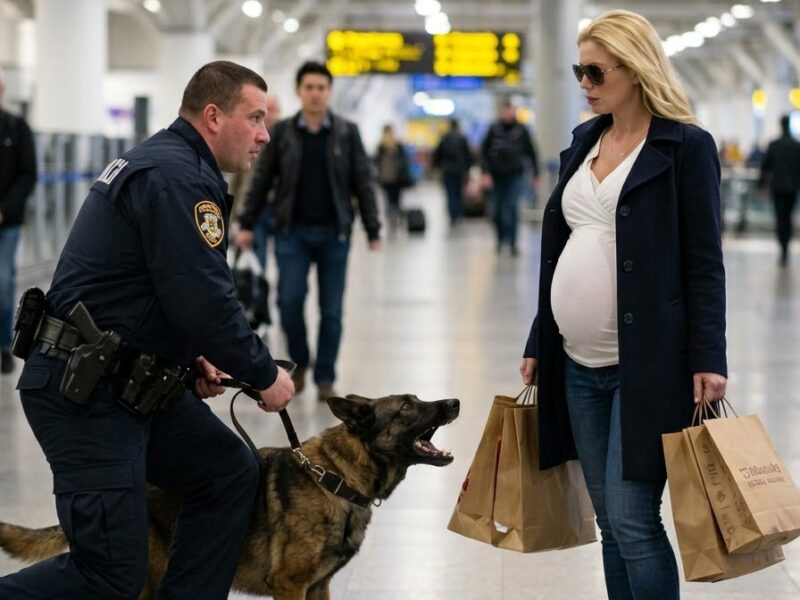
The police dog barked furiously at my pregnant belly outside a Dallas grocery store while strangers watched me in fear
The midday heat of late September in Dallas was suffocating, radiating off the asphalt parking lot of the Oak Lawn Supermarket in heavy, shimmering waves. I carried a single brown paper bag filled with fresh oranges, my right hand resting instinctively over the broad curve of my eight-month-pregnant belly. Every step was a effort, the weight of the child pressing down on my lower back, but the sharp, sweet smell of citrus brought a moment of quiet comfort.
I had reached the sliding glass exit doors when a sudden, harsh commotion broke the hum of the afternoon traffic.
A massive German shepherd, strapped into a heavy black leather tactical harness stamped with K-9 UNIT, hit the glass doors from the outside. His claws skidded across the concrete as he let out a barrage of deep, aggressive barks, his chest heaving, his dark eyes locked directly onto my midsection.
“Control your dog!” a woman behind me shrieked, dropping her grocery basket.
The police handler, a tall, broad-shouldered Dallas officer with a pale face and sharp eyes, yanked back hard on the thick leather leash. The dog didn’t back down. He strained forward until the leather was taut as a guitar string, his fangs bare, his throat vibrating with violent growls.
“Ma’am! Do not move!” the officer shouted, his voice ringing out across the crowded sidewalk. He placed one hand firmly on the grip of his sidearm. “Hands where I can see them!”
I froze. The paper bag slipped from my fingers, orange fruit cascading across the cracked pavement, rolling toward the dog’s boots. A crowd of shoppers began to form a wide ring around us, their phone cameras instantly rising, whispers rippling through the heat like dry grass catching fire.
“Look at her,” a man whispered nearby. “What’s she carrying?”
“Must be drugs,” another voice added. “Right in front of a pregnant woman… disgraceful.”
“Is something wrong, Officer?” I whispered, my voice cracking under the intense weight of dozens of judging eyes. My hands shook as I wrapped both arms over my unborn baby, trying to shield her from the dog’s frantic glare. “I’m just buying fruit. I live four blocks away.”
The officer didn’t answer right away. He kept his stance wide, his eyes darting between my face and the frantic animal at his knee. “Have you taken any prescription medication today, ma’am? Any unlabelled substances?”
“No! Of course not! I’m eight months pregnant!”
“Have you been exposed to hazardous materials or illicit chemicals in the last twenty-four hours?”
“No!” Tears of sheer humiliation burned behind my eyelids. “I haven’t been anywhere except my home and my prenatal checkups!”
The German shepherd suddenly broke his heel position. He didn’t bite, nor did he display true aggression; instead, he lowered his snout to the hem of my cotton coat, sniffing frantically, his breathing fast and shallow. Before the officer could pull him back, the dog raised his paw and began scratching desperately at my leather handbag, his nails tearing through the soft grain.
“Stand back!” the handler ordered, shoving me gently toward the brick wall of the supermarket. “Keep your back against the wall, ma’am!”
I pressed my shoulders against the hot red brick, my heart hammering against my ribs so violently I thought my chest would shatter. “Please… you’re scaring me. My baby…”
“Search the bag, Miller,” a second officer called out as he jogged over from a parked squad car, his radio crackling with static.
With deliberate, slow movements, the handler unzipped my purse. The crowd stepped back even further, expectation thick in the air. He turned the bag upside down, dumping its contents onto the hood of a nearby shopping cart.
A worn leather wallet. A set of house keys. A bottle of prenatal vitamins from the local pharmacy. And a single, neatly folded ultrasound photograph showing the soft, blurred profile of my baby girl.
Nothing else. No contraband. No weapons. No illicit drugs.
The second officer picked up the vitamin bottle, unscrewed the cap, and sniffed it carefully before checking the prescription label. “Standard prenatal iron and folic acid. Clear.”
The surrounding crowd murmured in confusion, some people looking disappointed, others shaking their heads. “False alarm,” someone muttered. “Stupid dog.”
“I just want to go home,” I sobbed, reaching out to gather my belongings. “Please, just let me go.”
But the German shepherd wasn’t finished. He ignored the spilled items on the cart entirely. He turned his head away from me, his nostrils flaring as he caught a subtle scent drifting across the hot asphalt parking lot. He let out a single, piercing bark that echoed off the brick facade, then began pulling his handler with tremendous force toward the far side of the lot, where the employee and long-term parking spaces sat beneath the shadow of a sprawling oak tree.
“King! Heel!” the handler commanded, but the dog ignored the vocal order, dragging the heavy officer through the rows of parked sedans and minivans.
Driven by a strange, sickening knot of dread pulling at my stomach, I followed them at a slow walk, clutching my purse to my chest.
The dog stopped dead in his tracks beside a sleek, black Ford Explorer with tinted rear windows. He sat down heavily, whining low in his throat, and slammed his front paw twice against the rear passenger door.
My blood ran completely cold. The warmth of the afternoon sun vanished instantly, replaced by an icy numbness that crept down my spine.
“That’s… that’s my vehicle,” I stammered, catching up to the officers. “My husband’s car.”
“Is your husband inside?” the handler asked, stepping up to the driver’s side window. He cupped his gloved hands around his eyes and peered through the heavy dark tint. “Sir? Police officer. Roll down the window.”
No response.
The second officer stepped around to the rear passenger door, tried the handle, and found it unlocked. The door swung open with a soft metallic click, releasing a sharp draft of ice-cold air conditioned breeze that smelled faintly of sterile isopropyl alcohol and rubber.
Sitting squarely on the leather rear bench was an insulated white styrofoam medical cooler, its lid sealed tightly with strips of blue biohazard tape. Glued to the center of the lid was a computer-printed label bearing my full name, date of birth, and my obstetrician’s clinic identification code.
The officer pulled on a pair of blue latex gloves, reached inside, and sliced through the tape with his pocket knife. He lifted the lid.
Inside, resting on a bed of condensation-covered gel ice packs, sat three large glass vials filled with a clear, viscous liquid, alongside a set of pre-filled auto-injector syringes.
“Get medical assistance down here right now,” the officer said into his shoulder radio, his voice dropping all trace of routine authority, replaced by an intense, solemn gravity. “Dispatch, code three. We have an unidentified chemical compound marked with a patient ID.”
My knees gave way. I sank against the side of a nearby car, clutching my heavy belly. “What is that? My husband… my husband told me he was picking up my specialized iron infusions from the hospital pharmacy because I was anemic…”
The handler bent down, picking up a printed prescription manifest tucked underneath the ice packs. He read it silently, his eyebrows drawing together into a deep, furious crease. “Ma’am… this isn’t iron. This is a high-potency synthetic hormone block combined with an uterine stimulant. This drug isn’t approved for human use in the United States.”
Before I could process his words, the phone in my hand began to vibrate violently, the screen flashing with my husband’s photo.
MARK
With trembling, frozen fingers, I swiped the screen and pressed the phone to my ear. “M-Mark?”
“Sarah?” His voice was smooth, quiet, completely devoid of the panic that was currently ripping my world apart. “Where are you right now? I thought you were resting at home.”
I looked at the open door of the SUV, at the blue biohazard tape fluttering in the hot Texas wind, at the German shepherd whose dark eyes were fixed on me with profound pity.
“I’m at the grocery store,” I whispered. “Mark… the police are here. They opened your car.”
A long, heavy silence stretched across the line. The background noise of his end was quiet—no traffic, no office hum. Just steady, deliberate breathing.
When he spoke again, his voice had lost every trace of the gentle, affectionate warmth he had shown me throughout our three years of marriage. It was flat, cold, and utterly terrifying.
“Listen to me very carefully, Sarah,” he said, each word spoken with chilling precision. “Do not let them touch those vials. Walk away from the car right now.”
“Mark, what is this stuff?!” I screamed into the receiver, tears blurring my vision. “What were you going to do to me?!”
The line went dead with a sharp click.
A second later, the German shepherd let out a thunderous, furious bark, spinning around toward the pedestrian pathway connecting the parking lot to the adjacent medical plaza.
A tall man in a tailored gray suit was walking quickly toward us, a silver car key held in his hand.
Mark.
He stopped dead twenty feet away when he saw the two uniformed officers standing by his open car door, their weapons unholstered and kept low at their sides.
All the color drained from my husband’s face, leaving his features drawn, gaunt, and ghostly white.
“Sir! Keep your hands where we can see them!” the officer commanded, stepping into the space between Mark and me. “Do not move!”
Mark didn’t look at the officers. He didn’t look at the dog, who was snarling with pure rage at his boots. He looked past them, his dark eyes locking onto my heavy, trembling belly.
He took a slow, agonizing breath, and whispered words that shattered my reality into a thousand unrecoverable pieces:
“She wasn’t supposed to survive the delivery.”
The parking lot seemed to dissolve around me into a chaotic blur of flashing red strobes, wailing sirens, and shouting voices. Dallas police officers swarmed the area, throwing up yellow crime scene tape that fluttered wildly in the heat. Mark was forced to the hot asphalt, his arms pulled behind his back, the metallic click of handcuffs echoing like a gunshot in the afternoon air.
Through it all, I remained frozen on the curb, unable to process the nightmarish reality unfolding around me.
“She wasn’t supposed to survive the delivery.”
The words echoed inside my skull, louder than the sirens, colder than the ice packs in the medical cooler. I looked down at my stomach, where a sharp, sudden movement brought a sudden burst of pain. My baby girl kicked—a strong, defiant thrust against my ribcage, as if she, too, had heard her father’s horrifying confession and was fighting for her right to breathe.
“Ma’am, please sit down. The paramedics are here,” a soft voice urged.
A female officer named Sergeant Ramirez guided me into the back of an ambulance. A team of paramedics immediately attached heart monitors to my chest and wrapped a blood pressure cuff around my arm.
“Her blood pressure is dangerously high,” a paramedic called out to his partner. “We need to get her to Parkland Memorial Obstetrics immediately. Start an IV line with saline.”
“No… wait,” I gasped, pulling against the restraints of the stretcher. “My phone… my purse…”
“I have your belongings right here, Sarah,” Sergeant Ramirez said softly, sitting beside me as the ambulance doors slammed shut and the vehicle accelerated into traffic. “You’re safe now. He’s in custody.”
“Why?” I sobbed, my hands trembling violently as the IV needle entered my vein. “We bought a house… we painted the nursery pale yellow last week. He built the crib with his own hands. Why would he do this?”
Sergeant Ramirez looked down at her notepad, her expression grim. “Sarah, we ran your husband’s driver’s license through the national database while they were loading him into the transport vehicle. Mark isn’t a pharmaceutical sales manager like he told you.”
I stared at her, my breath catching in my throat. “What?”
“His real name is Marcus Vance,” Ramirez explained quietly. “He spent four years in a federal penitentiary in Illinois for illegally manufacturing unauthorized medical trials and distributing untested synthetic pharmaceuticals. He was released three years ago under strict supervised parole.”
Three years ago. The exact time we met at a coffee shop near the University of Texas Southwestern Medical Center.
My mind raced backward through our relationship, frantically re-examining every memory, every conversation, every tender moment through this horrifying new lens.
I had been a thirty-one-year-old high school chemistry teacher living alone, still mourning the sudden loss of my parents in a highway accident. Mark had entered my life like a warm summer light. He was attentive, wealthy, deeply caring, and obsessively interested in my health.
When I got pregnant eight months ago, his devotion turned into an absolute routine. He personally organized all my prenatal appointments, insisted on picking up my prescriptions himself, and insisted on preparing a daily morning smoothie enriched with what he called “advanced liquid prenatal vitamins.”
I had trusted him implicitly. I had drunk those smoothies every single morning for eight months.
“The cooler,” I whispered, the sickening truth settling heavy in my gut. “What was in those vials?”
“Our hazmat unit is testing the compound right now,” Sergeant Ramirez said. “But based on the initial manifest found in the vehicle, the drug is designed to induce extreme placental abruptions during late-stage labor—simulating a massive, unpreventable maternal hemorrhage while accelerating fetal distress.”
The paramedic checking my monitor gasped softly.
“In simpler terms, Sarah,” Ramirez continued, her voice tight with anger, “it was designed to ensure that during childbirth, you would suffer a fatal medical complication that would look like an tragic, natural emergency to any attending doctor. And the baby…”
“The baby would be born alive,” I finished, the realization hitting me with physical force. “He wanted the baby. He didn’t want me.”
The ambulance pulled into the bay of Parkland Memorial Hospital. I was rushed through the doors on a gurney, surrounded by a team of trauma surgeons, nurses, and high-risk obstetricians. They rolled me into a private delivery suite in the high-risk unit, immediately hooking me up to continuous fetal heart monitors.
The steady, rhythmic sound of my baby’s heartbeat—thump-thump, thump-thump—filled the room. It was the sweetest, purest sound I had ever heard, a tiny anthem of survival against an unseen enemy.
Dr. Aris, a senior obstetrician with silver hair and kind, tired eyes, entered the room carrying a stack of digital charts. He dismissed the nurses and closed the door firmly behind them.
“Sarah,” Dr. Aris said, sitting down in the armchair beside my bed. “I’ve just reviewed the preliminary toxicology report sent over by the police crime lab. We ran an emergency blood panel on you the moment you arrived.”
I clutched the white hospital blanket, afraid to ask. “What did you find?”
“Your blood contains elevated levels of a synthetic protein block,” Dr. Aris said solemnly. “It has been accumulating in your system gradually over several months. Small, daily doses.”
My morning smoothies.
“However,” Dr. Aris continued, a small ray of hope entering his voice, “the final dose—the heavy concentration found in the cooler at the grocery store—was meant to trigger the reaction during your planned induction next week. Because that K-9 unit stopped you today, you were never exposed to the lethal threshold.”
I closed my eyes, a ragged sob escaping my lips. The stranger’s dog had saved my life.
“Why would he do it, Dr. Aris?” I pleaded. “Why go through the horror of marrying me, living with me, pretending to love me for three years, just to kill me at the finish line?”
Dr. Aris reached into his coat pocket and pulled out a manila envelope provided by the Dallas Police Department.
“Because, Sarah,” the doctor said softly, “Marcus Vance didn’t pick you at random at that coffee shop three years ago. He knew exactly who you were. He knew who your biological family was.”
He pulled out a document stamped with a red seal from the State of Texas Probate Court.
“Your late father wasn’t just an accountant, Sarah. He was the sole heir to an untouched, seventy-million-dollar land trust in West Texas—a trust that passed entirely to you upon his death, under a clause stating that if you died without a living spouse, it would pass entirely to your surviving biological children, managed by their legal guardian.”
The room went dead silent.
If I died during childbirth, Mark—as my surviving husband and the sole legal guardian of our newborn daughter—would gain absolute, unrestricted control over a seventy-million-dollar fortune.
He hadn’t built a nursery out of love. He had built a gilded cage, waiting for the moment to claim his prize.
Suddenly, the continuous heartbeat monitor beside my bed began to beep erratically. The steady thump-thump slowed down drastically, dropping from 140 beats per minute to 90, then 70.
The warning lights on the monitor flashed brilliant red.
Dr. Aris leapt to his feet, slamming his hand onto the emergency call button above the bed.
“Fetal bradycardia!” he shouted as the room filled with rushing medical staff. “The synthetic compound in her system is triggering early placental distress! Prepare Operating Room 4 for an emergency C-section right now!”
The world dissolved into a flurry of bright fluorescent lights, stainless steel doors swinging open, and the frantic orders of surgical nurses. I was wheeled down the corridor at a breakneck pace, the cold ceiling lights flashing overhead like a terrifying strobe.
“Stay with us, Sarah!” Dr. Aris commanded, walking alongside my gurney while holding an oxygen mask firmly over my face. “Breathe deeply! We’re taking her out right now!”
“Is she going to die?!” I cried into the plastic mask, tears leaking into my ears. “Please, don’t let him win! Save my baby!”
“We’re doing everything we can!”
Inside Operating Room 4, the air was freezing, smelling heavily of antiseptic and fresh linen. I was transferred to the narrow metal operating table. An anesthesiologist worked quickly behind my head, inserting an epidural needle into my lower spine. Within seconds, a wave of cold numbness spread from my waist down to my toes, stripping away the physical pain, but leaving the emotional terror raging hot.
A blue surgical curtain was pulled up across my chest, blocking my view of my lower body.
“Scalpel,” Dr. Aris ordered, his voice echoing under the harsh surgical lamps.
I lay there staring at the ceiling, my chest heaving, listening to the high-pitched alarms of the vital monitors. Every second felt like an eternity. The synthetic poison Mark had fed me over eight long months was attempting to do its job, forcing my uterus to contract violently, cutting off the vital oxygen supply to my daughter.
“Placenta is showing severe localized necrosis,” a assistant surgeon reported, his tone tense. “The compound acted faster than anticipated!”
“Suction! Move fast, people!” Dr. Aris barked. “We have a two-minute window before brain injury occurs!”
I squeezed my eyes shut, praying with every shred of my soul to a God I hadn’t spoken to in years. Take me if you have to, I bargained silently into the cold air of the operating room. Take my life, but let her breathe. Let her live.
Seconds dragged into minutes. The metallic clatter of surgical instruments was the only sound against the steady, horrifying beep of the failing heart monitor.
Then, suddenly, the monitor went completely silent.
A heavy, suffocating stillness fell over the operating room. The nurses stopped moving.
“Dr. Aris?” I whispered, my voice barely audible. “Dr. Aris, please…”
In the quiet, I heard the faint, wet sound of a towel being wrapped around a tiny body.
And then, cutting through the sterile silence like a clarion bell, came a sharp, shrill, furious cry.
Waaaaah! Waaaaah!
A collective, massive sigh of relief washed through the surgical team. Tears poured down my face, hot and fast, soaking the edges of my hair.
“She’s here, Sarah,” Dr. Aris said, stepping around the blue curtain. In his gloved hands, he held a tiny, red, furious baby girl, her fists balled up tight, her chest rising and falling with strong, beautiful breaths. “Five pounds, six ounces. She’s a fighter, just like her mother.”
They wiped her clean and laid her warm, soft cheek against my bare shoulder. Her skin was unbelievably soft, smelling of life and survival. She stopped crying the instant she felt my warmth, her tiny fingers curling instinctively around my thumb.
“I’ve got you,” I sobbed, kissing her wet forehead. “You’re safe. I will never let anyone hurt you.”
While the pediatric team took her to the warming station for observation, Dr. Aris turned his attention back to completing the procedure. “We need to close the incision and stabilize her blood pressure. Get two units of O-negative blood on standby.”
Just as the tension in the room began to ease, the heavy double doors of the operating suite burst open.
A senior hospital security guard stepped into the room, his face pale, his radio blaring with chaotic, distorted static.
“Dr. Aris! We have a breach in the building!” the guard shouted, drawing his taser. “The suspect—Marcus Vance— escaped custody during transport at the parking garage! He had help from an outside vehicle!”
My heart stopped beating in my chest.
“What do you mean he escaped?!” Dr. Aris demanded, dropping his needle driver. “This entire floor is supposed to be locked down!”
“He’s in the building!” the guard yelled over the blaring security alarms that suddenly began to echo through the hallway outside. “He knocked out a deputy in the basement level! He knows she’s in labor!”
Through the small square window of the operating room door, I saw a figure moving rapidly down the dimly lit hallway, stepping past the security checkpoint.
He was wearing a stolen navy blue scrub top over his blood-stained dress trousers. In his right hand, he held a heavy chrome service pistol taken from the fallen deputy.
It was Mark.
His eyes were completely vacant, stripped of all humanity, searching through the glass windows of every delivery room.
And he was walking directly toward Operating Room 4.
“Lock the doors! Right now!” Dr. Aris roared, slamming the emergency lock button beside the surgical entrance.
The heavy steel doors clicked shut just as Mark reached the exterior threshold. Through the small, reinforced wire-glass window, his terrifying face appeared. He looked wild, unhinged, a red streak of blood smeared across his forehead from his violent escape in the basement.
He raised the chrome pistol and slammed the heavy steel frame of the gun against the glass, creating a spiderweb crack in the reinforced pane.
“Sarah!” his muffled voice screamed through the door, distorted and terrifying. “Open the door! Give me the child!”
The nurses screamed, ducking behind the stainless steel supply cabinets. The anesthesiologist threw his body over the mobile incubator where my newborn daughter lay sleeping, shielding her tiny frame with his own back.
I was completely paralyzed from the waist down due to the epidural, trapped on the operating table, unable to move a muscle to protect my child. Panic, absolute and suffocating, seized my throat.
“Mark, stop!” I screamed, tears blinding me. “It’s over! The police know everything!”
“It’s not over!” he screamed back, his face pressed against the cracked glass, his eyes manic and wide. “That trust belongs to me! I spent three years playing the loving husband! I built that damn crib! I earned that money!”
He stepped back and aimed the pistol directly at the electronic door lock mechanism on the wall.
BANG! BANG!
Sparks erupted from the keycard scanner in a cloud of acrid black smoke. The electronic bolt mechanism groaned, heat melting the plastic housing, and the heavy door slowly swung open three inches.
“He’s coming in!” the security guard yelled, pointing his taser at the opening.
Mark kicked the door open with incredible force. The heavy steel door slammed into the guard, throwing him against the wall and sending his taser flying across the slippery linoleum floor.
Mark stepped into the operating room, the smell of gunpowder mixing with the sterile scent of rubbing alcohol. He raised the gun, his hand shaking violently, sweeping the barrel across the terrified surgical staff.
“Nobody move!” he snarled. “Where is she? Where is the baby?!”
“Marcus, don’t do this,” Dr. Aris said calmly, stepping forward, his hands raised in front of his chest. “You’re surrounded by federal officers. There are fifty armed police officers in this building right now. There is nowhere for you to go.”
“Shut up!” Mark shrieked, pressing the barrel of the gun directly against Dr. Aris’s forehead. “Step away from that incubator!”
I looked at my daughter, resting in her clear plastic bassinet just ten feet away from his gun. She was so tiny, so completely helpless, blissfully unaware of the monster standing in the room.
I couldn’t walk. I couldn’t run. But my upper body was free.
Lying on the tray beside my operating table was a heavy, stainless-steel tray holding discarded surgical instruments—including a pair of long, sharp-pointed orthopedic bone shears.
Slowly, carefully, keeping my movements hidden beneath the blue drape sheet, I slid my right hand across the cold metal tray and gripped the heavy steel handles of the shears.
“Mark,” I called out, making my voice sound weak, broken, and terrified. “Mark… look at me. Please.”
Mark turned his head toward me, a cruel, triumphant sneer curling his lips. He lowered the gun from Dr. Aris’s head and took a deliberate step toward my operating table.
“You were always so naive, Sarah,” he mocked, standing directly beside my head, looking down at me with absolute contempt. “Did you really think a man like me could ever love an ordinary, boring high school teacher like you? You were just an account waiting to be cleared.”
He raised the gun, pointing it straight at my face. “Goodbye, Sarah.”
With every ounce of maternal fury, strength, and rage remaining in my body, I pulled my arm from beneath the sheet and drove the sharp, heavy points of the stainless-steel bone shears straight into the side of his neck.
Mark gasped, a horrific wet sound escaping his lips. The gun fired wildly into the acoustic ceiling tiles—BANG!—shattering a fluorescent light tube in a shower of white dust and falling glass.
He stumbled backward, clutching his throat, his eyes wide with utter shock as blood welled between his fingers. He hit the mobile supply cart, sending hundreds of glass medicine vials crashing to the floor, before collapsing heavily onto his back on the linoleum.
The operating room doors were kicked open from the outside.
A tactical police squad burst into the room, their assault rifles raised, lead by the K-9 handler from the grocery store.
Beside him, leaping over the shattered glass and debris on the floor, was the German shepherd.
The dog lunged across the room with unbelievable speed, pinning Mark’s gun arm to the floor with his massive jaws, securing the threat in a matter of seconds.
The officers swarmed Mark, wrestling the weapon from his failing grip and snapping heavy steel restraints onto his wrists.
“Clear! Threat neutralised!” an officer bellowed.
I sank back against the cold pillow, the heavy shears slipping from my numb fingers, as Dr. Aris and the nurses rushed to my side.
In the corner of the room, the German shepherd released his grip on Mark. He didn’t bark. He didn’t snarl. He turned slowly away from the bleeding man on the floor, trotted over to the incubator where my baby lay, and placed his large, heavy snout gently against the clear plastic wall, letting out a soft, protective sigh.
Three weeks later.
The morning sun broke over the rolling green hills of a quiet farm outside of Fort Worth, Texas, casting long, golden shadows across the pristine white horse fences and the sprawling oak trees. The autumn air was crisp, clean, and entirely free of the suffocating heat of the city.
I sat on the wide wooden porch of my new home—a quiet, secure property purchased far away from Dallas, funded by a small, legitimate release from my family’s land trust.
In my arms, wrapped in a soft pink fleece blanket, lay my daughter. I had named her Clara—a name meaning bright, clear, and full of light. She was thriving, her cheeks rosy and full, her deep blue eyes watching the leaves fall from the branches above.
A large black SUV pulled up the gravel driveway, stopping near the front porch steps.
The door opened, and Officer Miller—the K-9 handler—stepped out, wearing a casual flannel shirt instead of his police uniform. He turned and opened the rear door.
Out leaped King, the massive German shepherd.
The dog didn’t bark. He trotted up the wooden porch steps with steady, dignified grace, his tail giving a soft, rhythmic thump against the floorboards. He walked straight over to my rocking chair, lowered his massive head, and gently rested his wet nose against Clara’s tiny blanketed feet.
Clara let out a soft gurgle, her tiny fist reaching out to stroke the dark, coarse fur on his muzzle.
“How is he doing?” I asked, looking up at Miller with a warm smile.
“He’s officially retired as of yesterday,” Miller said, taking a seat on the porch railing. “His hips are starting to slow him down a bit, and after the publicity from the Vance arrest, the department decided he earned his golden years.”
“And the court proceedings?”
Miller’s face hardened slightly, though his tone remained calm. “Marcus Vance pleaded guilty yesterday morning to federal charges of attempted murder, manufacturing controlled substances, identity fraud, and interstate kidnapping conspiracy. The judge sentenced him to life without the possibility of parole at the ADX Florence maximum-security facility in Colorado. He will never see the light of day again, Sarah. You and Clara are completely safe.”
I let out a long, slow breath, feeling the last lingering knot of tension in my chest finally dissolve into the crisp Texas air.
The nightmare was officially over. The deception that had nearly stolen my child’s life and my own future had been stripped away, exposed by the extraordinary instincts of a animal who saw through the lies when no human could.
“The department was wondering if you were still interested in taking him,” Miller added softly, looking down at King, who had now laid his heavy body down across my feet, acting as a living shield between us and the rest of the world. “He doesn’t like staying in the kennels anymore. He keeps looking for you.”
Tears of quiet gratitude welled in my eyes. I reached down, my fingers sinking into the thick fur behind King’s ears, feeling the steady, powerful rhythm of his breathing.
“He saved our lives,” I said quietly, looking down at my sleeping daughter and then back at the majestic dog resting at my feet. “This is his home now. For as long as he lives.”
King lifted his head, looked up into my eyes, and let out a soft, breathy sigh of utter contentment.
The wind rustled through the oak trees, carrying the sweet scent of pine and fresh earth. For the first time in my life, as I rocked my daughter under the morning sun with our protector resting at our side, I knew that the future was finally ours.
The end.









