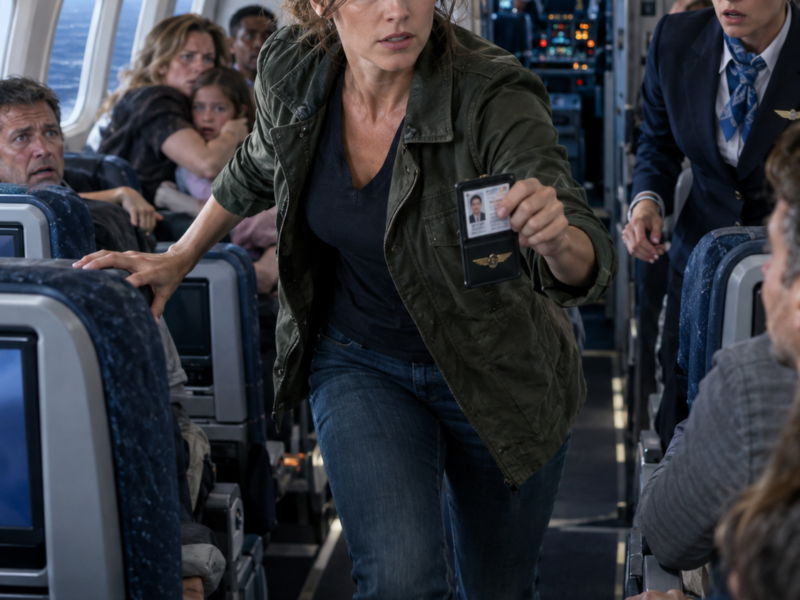
The Plane Lost Hydraulics Over the Atlantic — Until a Woman in Row 18 Revealed Who She Used to Be
The captain had just announced that Flight 607 was losing control over the Atlantic when a terrified businessman mocked the quiet woman in Row 18 for offering to help—until the cockpit radio crackled with a name that made every surviving pilot on the emergency channel fall silent: “RAVEN IS BACK.”
The first warning came as a shudder beneath my feet.
My coffee jumped from the tray table, splashing across my jeans. Overhead compartments rattled, plastic cups rolled down the aisle, and a child began screaming somewhere behind me. Outside the oval window, the Atlantic stretched beneath a ceiling of black clouds, its whitecaps barely visible through the rain.
Then the aircraft dropped.
My stomach rose into my throat. Oxygen masks spilled from the ceiling, swinging like yellow pendulums as passengers grabbed at them. A woman shouted for her husband. Someone began praying. Two rows ahead, a flight attendant stumbled into a seatback, caught herself, and forced a smile that convinced absolutely nobody.
“Ladies and gentlemen, please remain seated.”
The captain’s voice came through the speakers, tight but measured.
“We are experiencing a serious technical issue. Our crew is working to stabilize the aircraft. Please follow all safety instructions.”
A man beside me seized my wrist.
“We’re going to die, aren’t we?”
I looked at his trembling hand, then at the coffee trembling in my overturned cup.
“No,” I said quietly. “Not necessarily.”
I wasn’t sure whether I was reassuring him or myself.
For twelve years, I had avoided airplanes. I chose overnight trains when possible, drove hundreds of miles rather than book a flight, and changed apartments whenever the roar of military jets overhead became unbearable.
I told people I was afraid of flying.
That was easier than explaining why I couldn’t bear the sound of an aircraft struggling against its own failing systems.
My name was Claire Bennett. I was thirty-nine years old, worked as an accountant in Denver, and had spent more than a decade convincing the world that my past was unremarkable.
But when Flight 607 lurched again, my body recognized the emergency before my mind accepted it.
The uneven vibration.
The sluggish response to the aircraft’s roll.
The pause between the warning chime and the captain’s announcement.
I had heard that sequence before.
Twelve years earlier, I had been twenty-seven, strapped into the right-hand seat of a military transport aircraft over Afghanistan. My instructor, Major Daniel Mercer, had been bleeding across the center console while smoke swallowed the forward instruments.
He had taught me everything I knew about flying in bad weather.
He had also been the last person I ever heard speak before our aircraft went down.
The official investigation blamed pilot error.
Mercer was dead. My military flying career was over. And I had signed a statement agreeing not to challenge the findings.
There were things I had seen that night that I had never told anyone.
Things I had spent twelve years trying to forget.
A flight attendant appeared beside my row, gripping the seatbacks with white knuckles.
“Is there anyone onboard with aviation experience?”
Silence.
A dozen faces turned toward her. Most were pale with fear. A gray-haired man shook his head. A young woman clutched her child against her chest.
Then the intercom crackled.
“This is the captain. If there is a qualified pilot among our passengers, please identify yourself immediately.”
My hands went cold.
I could remain seated.
The airline had trained professionals. The captain had his first officer. There was no reason to drag my old life into this one.
I could close my eyes, hold the armrests, and let the people responsible for the aircraft do their jobs.
And if we crashed, I could spend the rest of eternity wondering whether I might have helped.
I unbuckled my seat belt.
“I used to fly aircraft,” I told the flight attendant.
A man across the aisle turned from his expensive leather briefcase. His tailored suit looked absurdly immaculate amid the chaos.
“Used to?” he scoffed. “That’s reassuring. Maybe we can find someone who actually knows what they’re doing.”
I met his eyes.
“If you have a better option, now would be an excellent time to mention it.”
His mouth opened, but nothing came out.
The flight attendant seized the opportunity.
“Please, come with me.”
As we moved toward the front, I noticed details the other passengers couldn’t see: the flight attendants bracing themselves against the aircraft’s lateral movement, the loose service cart wedged against a galley partition, the way the cabin lights flickered as the engines changed pitch.
The aircraft wasn’t simply shaking in turbulence.
Something was wrong with its response to control inputs.
And if my suspicion was correct, the crew had very little time.
The cockpit door opened.
Inside, the captain was fighting to keep his composure. He was in his fifties, with silver at his temples and sweat shining beneath his headset. The first officer gripped the controls, his jaw clenched as the aircraft drifted off its intended attitude.
Warning tones sounded over the headset.
The captain glanced at me.
“Who are you?”
“Someone who used to fly.”
“This isn’t a passenger conversation. Do you have a commercial license?”
“Not anymore.”
His expression hardened.
“Then I need you to step outside.”
I ignored the insult and studied the instrument panel.
The hydraulic system indications weren’t behaving as I expected. The crew had indications of serious control-system trouble, but the relationship between the aircraft’s movement and the reported failure didn’t fit neatly together.
I leaned forward without touching anything.
“Captain, what happened immediately before the first warning?”
“Severe turbulence. Then we lost hydraulic pressure.”
“Both systems?”
“Pressure is dropping across the board. We have multiple warnings.”
I looked at the flight displays. The aircraft’s response seemed inconsistent with a straightforward loss of hydraulic pressure. That didn’t prove another fault, but it meant the crew shouldn’t assume the first warning explained everything.
“Has the aircraft responded normally to your control inputs since the first alarm?”
The first officer glanced at the captain.
“Not consistently.”
I pointed toward the display.
“Then don’t treat every warning as a separate failure. We need to understand which indications are consequences and which might be causes.”
The captain stared at me.
“Are you an engineer?”
“No.”
“Then stop telling my crew how to fly.”
The words landed harder than they should have.
For a moment, I was back in Afghanistan, watching Mercer fight the same invisible enemy while senior officers insisted the instruments couldn’t be wrong.
I forced the memory down.
“Captain, I’m not asking you to trust me. I’m asking you to verify what the aircraft is telling you before you commit to a response.”
The first officer looked at the display again.
“Captain, she’s right about one thing. These indications don’t all line up.”
The captain’s face reddened.
“Enough. Get her out of my cockpit.”
The flight attendant stepped forward, uncertain.
I didn’t argue. I backed toward the door, keeping my eyes on the instruments until the last possible second.
Then I noticed it.
A brief flicker in one system indication, followed by a warning sequence that seemed horribly familiar.
My pulse slowed.
I knew that pattern.
Not from a commercial simulator or a civilian aircraft manual.
From the classified investigation files surrounding the crash that had destroyed my military career.
I had seen the same sequence in a grainy photograph attached to a report I was never supposed to keep. Investigators had dismissed it as an instrument artifact. Mercer had insisted the indications were real.
He had died trying to prove it.
I stepped into the cabin.
The flight attendant closed the cockpit door behind me.
“You should sit down,” she said, her voice breaking.
I looked toward the windows. The clouds had swallowed the horizon, and rain streamed sideways across the glass.
“What’s your name?” I asked.
“Emily.”
“Emily, I need you to keep the passengers calm and make sure everyone follows the crew’s safety instructions.”
She stared at me.
“Can you save us?”
I couldn’t promise that.
“I can try to help.”
A violent shudder interrupted us. The cabin tilted, luggage slammed against overhead bins, and screams rose from every direction.
The cockpit door flew open.
The first officer appeared, one hand gripping the frame.
“Captain needs help! We’ve got another warning, and the aircraft isn’t responding the way it should!”
I moved before he finished speaking.
Behind him, the captain was shouting into his headset, trying to make sense of conflicting indications. The first officer returned to his seat, and I remained just inside the doorway, careful not to interfere with the controls.
Then the cockpit radio crackled.
A voice from ground operations spoke through the static.
“Flight 607, identify all personnel currently present on the flight deck.”
The captain frowned.
“Ground operations, this is Flight 607. We’re dealing with a serious control-system emergency. We need technical support immediately.”
The voice ignored him.
“Flight 607, is there a female passenger in the cockpit?”
The captain turned toward me.
I felt the blood drain from my face.
He keyed the microphone.
“Affirmative. She’s a former pilot assisting us.”
A pause followed.
Then the voice returned, colder than before.
“Captain, remove that woman from the flight deck immediately. Do not allow her access to the flight recorder or any aircraft diagnostic records.”
The captain’s eyes narrowed.
“How do you know she’s here?”
No answer.
I stepped closer to the radio.
“Who is this?”
The channel remained silent for two seconds.
Then a second voice cut through the static, a man’s voice I had not heard in twelve years.
“Claire Bennett. If you’re listening, you need to understand something. The Kandahar crash was never an accident.”
My lungs seemed to stop working.
The captain looked from me to the radio.
“Do you know this man?”
I couldn’t speak.
The voice continued.
“Do not let her retrieve the recorder. Whatever she tells you about Major Mercer, she’s leaving out the most important part.”
Something inside me broke loose.
I reached for the microphone.
“You said he was dead.”
The response came immediately.
“He is.”
A burst of static swallowed the next few words. When the voice returned, its composure had vanished.
“But the people who killed him know you’re alive.”
The captain stared at me as another alarm began screaming across the cockpit.
I looked at the instrument panel, then at the storm swallowing the Atlantic beyond the windshield.
For twelve years, I had believed my silence protected the dead.
Now three hundred people were trapped inside an aircraft with a failing control system, someone on the ground was trying to erase the evidence, and the man responsible for my instructor’s death knew exactly where I was.
I reached for the radio again.
“Flight 607, this is Claire Bennett. If you want to keep these passengers alive, you will listen carefully.”
The captain started to object.
Then the emergency frequency erupted with overlapping transmissions. A military controller had joined the channel, his voice sharp and urgent.
“Flight 607, stand by. We have a priority identification from allied command.”
The captain froze.
The controller continued.
“Confirm the identity of the woman currently on your flight deck.”
I closed my eyes.
Twelve years of hiding.
Twelve years of nightmares.
Twelve years of letting the world believe I was the pilot who had failed Major Daniel Mercer.
The controller’s next words thundered through the cockpit speakers.
“Confirming identity. Former combat search-and-rescue pilot, classified callsign RAVEN. All military aircraft on this frequency, acknowledge immediately.”
The radio filled with a succession of crisp acknowledgments.
Then the controller delivered one final order.
“Raven is back.”
The captain went rigid.
The first officer slowly turned toward me.
And through the open cockpit door, I saw the flight attendant, the armed air marshal, and every passenger who could see inside fall into stunned silence.
For three seconds, nobody in the cockpit moved.
Then the captain looked at me as if the woman standing beside his flight deck had become someone entirely different.
“Raven?”
I kept my eyes on the instruments.
“That’s an old name.”
The military controller came through again.
“Flight 607, confirm Raven’s presence and grant her access to the flight deck. Maintain your current heading while we coordinate emergency support.”
The captain grabbed the microphone.
“With respect, we have three hundred passengers aboard, a serious flight-control emergency, and a civilian passenger claiming military experience. I need to know who is issuing these orders.”
“Captain, this is Lieutenant Colonel Marcus Hale, Atlantic Joint Operations Center. The woman beside you flew combat rescue missions under my command. If she says your indications don’t make sense, you listen.”
The captain looked at me.
“What exactly did you do?”
“Right now? Nothing you haven’t allowed me to do.”
The first officer almost smiled, then another warning sounded, wiping the expression from his face.
“Captain, our deviation is increasing.”
I studied the display. The aircraft was drifting from its intended course, and the crew was working against several conflicting indications. I didn’t know the exact fault yet. Anyone claiming otherwise would be guessing.
“Tell me what the aircraft is actually doing,” I said. “Not what the warning lights suggest. What are you seeing outside the instruments?”
The first officer glanced at the windshield.
“Cloud. No horizon.”
“Then compare the independent flight indications. Cross-check the standby instruments. Don’t assume one display is telling the whole story.”
The captain hesitated.
I met his eyes.
“You don’t have to trust my history. Trust the evidence you can verify.”
He gave the first officer a short nod.
They began cross-checking their instruments and consulting the aircraft’s emergency procedures. I stayed clear of the controls, watching for inconsistencies and listening as they described each indication.
The aircraft shuddered again.
“Altitude is fluctuating,” the first officer reported.
“Is that consistent across the independent displays?”
“Mostly. There’s a discrepancy.”
“Then flag it. Don’t build a decision around an instrument you haven’t validated.”
The captain keyed the radio.
“Colonel Hale, we need technical guidance specific to this aircraft. Can you connect us with our airline’s operational support team?”
“Already working on it.”
I leaned closer to the panel.
There it was again: a brief, irregular flicker in the system indication I remembered from Kandahar.
My throat tightened.
It wasn’t enough to diagnose the fault. But it was enough to make me question whether the failure had begun where the crew thought it had.
“Captain, I need the exact sequence of warnings from the beginning.”
He gave it to me, listing the alerts in order while the first officer checked the aircraft’s emergency reference materials.
When he finished, I asked him to repeat the third warning.
He did.
I stared at the display.
“That sequence matters,” I said. “We need to establish whether the original fault triggered the later warnings or whether we’re dealing with more than one problem.”
The captain nodded slowly.
For the first time since I entered the cockpit, he wasn’t trying to remove me.
He was listening.
Then the cockpit door opened behind us.
The air marshal stood there, one hand braced against the frame.
“Captain, I’ve been instructed to escort the passenger back to her seat.”
“By whom?” the captain asked.
“Someone from ground operations contacted the cabin crew. They say she’s a security risk.”
I turned toward him.
“Did they give you a name?”
He hesitated.
“No.”
“Did they identify an agency, an airline department, or an actual security incident?”
“No.”
“Then you have an anonymous voice giving you orders during an aircraft emergency.”
His expression changed.
Before he could answer, the radio crackled again.
“Flight 607, this is Colonel Hale. We have identified the source of the unauthorized request. Do not comply.”
The air marshal looked toward the radio.
“Understood,” he said.
But I wasn’t listening anymore.
The phrase unauthorized request had brought back a memory I had buried so deeply that even I had stopped examining it.
Twelve years earlier, Major Mercer had received a similar transmission during our final mission over Afghanistan. Someone had ordered him to abandon a damaged aircraft and divert toward a designated landing zone.
He had refused.
Minutes later, our control system had begun behaving erratically.
Mercer had looked at me through the smoke and said six words I had never forgotten.
“Claire, someone changed the flight data.”
Then the aircraft went down.
The official report blamed his judgment.
My testimony was the final piece used to close the investigation.
I’d told the investigators what I’d seen on the displays. I’d told them the sequence had been confusing. I’d told them I couldn’t be certain what happened in those final minutes.
Every word was technically true.
And every omission had helped bury him.
“Claire?”
The captain’s voice pulled me back.
“You look like you’ve seen a ghost.”
“I might have.”
I reached into the small shoulder bag I’d brought aboard the aircraft. Inside was my passport, a wallet, a folded boarding pass, and a sealed envelope I’d carried for twelve years.
The envelope contained a fragment of a military flight-recorder transcript.
I’d taken it from my personal effects before leaving the service. I’d never shown it to anyone, not even the investigator who had contacted me twice after my discharge.
The transcript contained an unexplained command sent to our aircraft seconds before the first warning.
A command that did not appear in the final report.
I had kept it because I couldn’t bear to destroy the last evidence that Mercer might have been telling the truth.
I had also kept it because I was afraid of what would happen if someone discovered it.
The captain noticed the envelope.
“What’s that?”
“Evidence.”
“Evidence of what?”
“Something that shouldn’t have been hidden.”
Before he could ask another question, Colonel Hale returned on the radio.
“Raven, if you can hear me, I need you to answer one question.”
I took the microphone.
“Go ahead.”
“Do you still have the original transcript?”
The cockpit became utterly silent.
I stared at the radio.
“How do you know about that?”
“Because twelve years ago, I was the officer who requested the original flight-recorder data. The copy I received had been altered before it reached my desk.”
My fingers tightened around the microphone.
“Who altered it?”
“We don’t know yet. But someone just accessed the archived investigation files using credentials that should have been permanently deactivated.”
A new alert sounded on the captain’s communications display.
Colonel Hale continued.
“And Claire, whoever did it knows Flight 607 is carrying you.”
The captain turned toward me.
“How could anyone know that?”
I looked down at my boarding pass.
My name. My seat number. My flight.
An ordinary commercial journey, booked through an ordinary website, paid for with my own credit card.
I’d thought I was invisible.
I’d been wrong.
The aircraft shuddered again, forcing the captain to return his attention to the emergency. The first officer continued working through the aircraft’s procedures while the captain coordinated with operational support.
I slid the envelope back into my bag.
“Colonel, can you hear me?”
“Loud and clear.”
“If the archived data was altered, I need the original recorder from this aircraft preserved. I don’t want anyone accessing it without a documented chain of custody.”
“Agreed.”
“And I want the identity of the person who issued that unauthorized order.”
“We’re tracing the transmission.”
I looked through the windshield at the darkness ahead.
“Then you’d better work quickly.”
A burst of static interrupted him.
When Colonel Hale returned, his voice had changed.
“Raven, we have a problem.”
“What kind?”
“The unauthorized transmission didn’t originate from a commercial ground station.”
He paused.
“It came from a military communications relay.”
The captain stared at the radio.
I felt the old fear rise inside me, but this time I didn’t let it take control.
“Colonel, who has access to that relay?”
“Several commands. A limited number of senior officers.”
“And can you identify the sender?”
“Not yet.”
I looked at the sealed envelope inside my bag.
For twelve years, I’d believed the truth was hidden in the wreckage of a military aircraft halfway around the world.
Now the same mystery had followed me into the Atlantic, aboard a commercial flight carrying hundreds of innocent people.
The first officer looked up from the emergency checklist.
“Captain, we need to make a decision.”
The captain nodded, his attention returning to the flight displays.
I stepped back to give the crew room to work.
Then the radio crackled one final time.
A different voice spoke through the static, calm and unmistakable.
“Raven, you should have stayed retired.”
My heart stopped.
I knew that voice.
I’d heard it twelve years ago, in a secure briefing room, while a senior officer explained why Major Daniel Mercer’s death had been ruled pilot error.
The man who had delivered that briefing had assured me the investigation was complete.
He had looked me directly in the eyes and told me there was nothing left to uncover.
Now he was speaking to me over the Atlantic.
And he knew exactly who I was.
I leaned toward the microphone.
“General,” I said, my voice steady despite the fear tightening my chest. “If you’re so certain the truth is buried, why are you afraid of a flight recorder?”
The channel went dead.
Then the aircraft’s warning system sounded again.
And this time, the captain’s expression told me the emergency had just become worse.
The warning alarm screamed so loudly that I felt it in my teeth.
The first officer stared at the instrument panel, then looked at the captain.
“We’re losing another system.”
The captain gripped the controls.
“Tell me something I don’t know.”
“I need you to look at this.”
The first officer pointed toward the display. Several warnings had appeared in rapid succession, and the aircraft was no longer responding consistently to their inputs.
Outside the windshield, the Atlantic had vanished beneath a wall of black cloud. Rain hammered the glass, illuminated by occasional flashes of lightning. The engines produced a deep, uneven rumble that seemed to vibrate through the floor.
I watched the crew work.
Neither man was panicking. They were following procedures, cross-checking indications, and trying to separate the immediate emergency from the growing list of secondary warnings.
But time was running out.
“Captain,” I said, “have you established whether the control problem is mechanical, electrical, or a combination?”
“We’re working on it.”
“Good. Keep working the checklist. Don’t let anyone—including me—talk you into skipping a required step.”
He glanced at me, surprised.
Perhaps he had expected Raven to be a woman who barged into a cockpit and demanded absolute obedience.
That woman didn’t exist.
The pilot I had been was trained to question everything, including her own judgment.
And the first rule of flying a damaged aircraft was simple: confidence could keep you moving, but only discipline could keep you alive.
The captain consulted the aircraft’s emergency procedures while the first officer coordinated with airline operations. I remained beside the cockpit doorway, offering observations when they were relevant and staying silent when they weren’t.
Then Colonel Hale returned on the radio.
“Flight 607, we have an update. A military search-and-rescue aircraft is being dispatched to your position. Estimated arrival is dependent on weather and routing.”
The captain exhaled.
“How far away?”
“Too far to be your immediate solution. Your aircraft remains your responsibility.”
I looked at the storm outside.
A rescue aircraft might help locate us or assist after we reached a suitable diversion airport. It could not make the next few minutes disappear.
“Colonel,” I said, “what is the nearest suitable airport given our current position and weather?”
“We’re calculating options with your airline’s operations team.”
“Then prioritize runway conditions, weather, and the aircraft’s actual controllability. Distance alone won’t decide this.”
“Understood.”
The captain glanced at me.
“You’ve done this before.”
I almost laughed.
“Not in a passenger jet.”
“Then how do you know what to look for?”
“Because the principles of an emergency don’t change just because the cockpit looks different.”
The aircraft lurched violently.
The first officer swore under his breath as the captain corrected their course.
I caught the edge of the doorway.
For a split second, I was back in Afghanistan.
The smell of hot electronics.
The sting of smoke in my eyes.
Mercer’s blood spreading across the console.
And his voice, strangely calm amid the chaos.
Fly the aircraft you have, Claire. Not the aircraft you wish you had.
I shut my eyes.
Twelve years ago, I had failed to save him.
I would not allow that memory to make decisions for me now.
“Captain,” I said, “I need you to tell me what you know about the aircraft’s maintenance history.”
He frowned.
“Why?”
“Because someone may have recognized the same failure pattern I did. I need to know whether this aircraft has had previous control-system discrepancies.”
He looked toward the first officer.
“Contact operations. Request the maintenance history and any deferred defects relevant to the systems we’re seeing.”
The first officer transmitted the request.
A minute later, the reply arrived.
The captain read the message twice.
“There’s a maintenance entry from six weeks ago.”
“What does it say?”
“A sensor discrepancy. The aircraft was inspected, and the issue was signed off.”
“Which sensor?”
He read the details aloud.
I felt a cold line travel down my spine.
The entry wasn’t proof of sabotage. A maintenance discrepancy could be unrelated to the present emergency, and a signed-off repair could be entirely legitimate.
But the timing, combined with the unusual warning sequence, demanded attention.
“Ask them for the complete maintenance record,” I said. “Not just the summary. We need the original fault codes and the work performed.”
The captain relayed the request.
Then Colonel Hale interrupted.
“Raven, we’ve identified the origin of the unauthorized transmission.”
I reached for the microphone.
“Who was it?”
“General Adrian Voss’s command network.”
The name struck like a physical blow.
Voss had been the senior officer who briefed me after Mercer’s death. He had insisted the investigation was conclusive, the evidence complete, and my instructor responsible for the crash.
He had also recommended that I leave military aviation.
I’d spent years believing he was simply protecting the institution.
Now I wondered whether he’d been protecting himself.
“Colonel, I need you to listen carefully,” I said. “If Voss has access to the military relay, he may be able to interfere with the investigation. He cannot be the sole authority handling the recorder evidence.”
“Agreed. I’ve requested independent oversight.”
“Good.”
“Claire,” he added, “there’s something else.”
I waited.
“General Voss has requested that your military records be sealed under an emergency security order.”
The captain turned toward me.
“Can he do that?”
“Not without proper authorization,” Hale replied. “We’re challenging it.”
I felt a strange calm settle over me.
For twelve years, I had been frightened of what the truth might cost.
My career had already been taken. My reputation had been buried. The man who taught me to fly was dead.
What else could Voss threaten me with?
“Colonel,” I said, “tell him he can seal every file with my name on it.”
I looked at the instruments.
“But he can’t seal the truth inside this aircraft.”
The first officer raised his voice.
“Captain, we’ve got the maintenance response.”
The captain opened the message.
His face changed.
“What is it?” I asked.
He turned the display toward the first officer, who read it in silence.
Then the captain looked at me.
“The maintenance team found an unresolved discrepancy in the archived fault data. The original record and the later summary don’t match.”
“Do they know why?”
“No. They’re checking the underlying data now.”
I gripped the doorway.
The discrepancy could have been an error in documentation. It could have been a software issue or a misunderstanding of the record.
But it was the second unexplained inconsistency connected to this flight.
And the third time in twelve years that someone had told me not to look too closely.
The captain spoke into the radio.
“Operations, preserve every relevant maintenance record and make sure the original data is retained. We need a technical assessment from qualified personnel immediately.”
The reply came back promptly.
“Understood, Flight 607.”
For the first time, the captain sounded less like a man fighting a losing battle and more like a commander assembling the facts he needed.
Then the aircraft dropped again.
A chorus of screams rose from the cabin.
The first officer reported their latest indications, and the captain returned to the emergency procedures. I stepped away from the controls, allowing the crew to concentrate.
There was no miracle waiting in my hands. No secret maneuver that could guarantee our survival.
There was only a damaged aircraft, a worsening storm, and a crew trying to bring three hundred people home.
And somewhere on the ground, a man who had spent twelve years burying the truth was desperate to keep it buried.
I looked at the captain.
“Tell me what you need.”
He studied me for a moment.
“Your eyes on the indications. Your experience with that failure pattern. Nothing more.”
“Understood.”
He nodded toward the display.
“Then stay with us, Raven.”
The name no longer sounded like an accusation.
It sounded like a responsibility.
I took my place beside the first officer and watched the instruments as the captain coordinated with the airline’s technical team. Every new indication was cross-checked. Every proposed action was weighed against the aircraft’s procedures and the information available.
Outside, lightning tore through the clouds.
Inside, the crew worked in focused silence.
Then a new transmission came through the radio.
“Flight 607, this is the Atlantic rescue coordination center. We have an urgent message from the military aircraft dispatched to your position.”
The captain keyed the microphone.
“Go ahead.”
A different voice answered.
“Flight 607, we’ve received intelligence indicating your aircraft may have been targeted. You are not to divert to your originally assigned alternate airport.”
The captain stared at the radio.
“Say again?”
The voice repeated the warning.
My stomach tightened.
“Who authorized that message?” I asked.
“Command authority is being verified.”
I leaned toward the microphone.
“This is Raven. I need the source of that intelligence, the identity of the approving officer, and independent confirmation before anyone changes our diversion plan.”
Silence.
Then the rescue controller replied.
“Understood, Raven. Stand by.”
The captain looked at me.
“You think someone is trying to force us somewhere?”
“I think someone has given us an instruction that could put three hundred people at risk. We verify before we act.”
He nodded.
Outside, the storm swallowed the last trace of the horizon.
The aircraft trembled as the engines roared through the darkness.
I thought of Mercer, of the report that had condemned him, and of the transcript hidden inside my bag.
For twelve years, I had carried that evidence because I was afraid to let it go.
Now I understood that keeping it hidden had never protected anyone.
It had only protected the people who wanted it forgotten.
I touched the bag once, then looked back at the instruments.
We still had passengers to save.
And we still had a flight to bring home.
The aircraft lurched so violently that the first officer struck his shoulder against the cockpit wall.
“Captain, we’re getting another series of warnings!”
The captain fought to maintain control while rain hammered the windshield. Beyond the glass, lightning illuminated the Atlantic in brief, blinding flashes.
I watched the instruments, comparing the indications against the crew’s observations.
“Don’t chase the warning lights,” I said. “Confirm what the aircraft is actually doing.”
The captain nodded, concentrating on the flight controls while the first officer cross-checked the available displays and emergency procedures.
Then the radio crackled.
“Flight 607, this is General Adrian Voss. You are ordered to divert immediately to military airfield Northpoint.”
The captain hesitated.
“General, our airline operations team is assessing suitable diversion airports.”
“You will follow my instructions.”
I stepped toward the microphone.
“General, this is Raven. Identify the operational reason for your diversion order.”
A pause followed.
“Your involvement in this emergency is unauthorized.”
“My involvement doesn’t change the aircraft’s condition. If Northpoint is the safest option, provide the weather, runway, and operational information supporting that decision.”
“You are in no position to question me.”
“Then provide the information to the captain.”
The captain glanced at me, then keyed the radio.
“General, I will consider any verified information relevant to passenger safety. I will not divert solely on the basis of an unsubstantiated transmission.”
For several seconds, only static answered.
Then Voss returned.
“Captain, you have no idea who you’re protecting.”
The captain’s jaw tightened.
“I have three hundred passengers to protect. That’s the only priority that matters.”
The transmission ended.
I exhaled slowly.
For the first time in twelve years, someone had challenged Voss without letting his rank decide the argument.
But we had no time to celebrate.
The aircraft shuddered again, and the first officer announced another discrepancy in the flight indications.
The captain returned to the emergency checklist.
“Raven, what do you see?”
I studied the displays.
“I see indications that need to be reconciled. I don’t have enough evidence to identify one definitive cause yet.”
“Can you help us stabilize the situation?”
“I can help you interpret what we’re seeing. You and your first officer remain responsible for the aircraft.”
He nodded.
We continued working through the available information, communicating with airline operations and evaluating the diversion options. The captain rejected an airport whose weather reports indicated deteriorating conditions and requested updated information about another field within reach.
Every decision mattered.
Then Colonel Hale came through the radio.
“Flight 607, we have independent confirmation that Northpoint is not the recommended diversion. There is a severe weather warning affecting the approach corridor.”
The captain closed his eyes briefly.
“Thank you, Colonel.”
Hale continued.
“There’s another development. We’ve secured the archived transcript from the Kandahar investigation.”
My heart skipped.
“Does it contain the original transmission?”
“Yes. An independent review has found a command in the raw data that was omitted from the final report.”
I gripped the edge of the console.
“What did it say?”
“We’re verifying the complete recording. But the transmission originated from a command channel associated with General Voss’s unit.”
The captain looked at me.
I could barely hear the storm anymore.
For twelve years, I’d wondered whether my instructor’s final warning had been a hallucination born of smoke, fear, and grief.
Now there was evidence that someone had altered the record.
“Colonel,” I said, “preserve the original file. Make copies under independent supervision. Do not let Voss’s office handle the evidence.”
“Already arranged.”
A sharp alarm interrupted us.
The first officer looked up.
“Captain, we need to focus on the aircraft.”
He was right.
The investigation could wait.
The Atlantic couldn’t.
The captain returned to the controls while the first officer reviewed the next steps in the emergency procedure. I stayed beside them, watching for inconsistencies and answering questions when I could.
Then a new transmission arrived.
“Flight 607, this is rescue aircraft Guardian Two. We have visual contact intermittently through the weather. We are standing by to assist with communications and coordination.”
The captain responded.
“Guardian Two, we’re evaluating diversion options. Can you provide updated weather information for our available airports?”
“Affirmative. Stand by.”
I glanced at the radar display.
The storm was spreading across the region, and the available routes were narrowing. There was no clean escape, no clear corridor through the darkness.
Only choices, each carrying its own risks.
The rescue pilot returned with updated information. The captain and first officer reviewed it against their aircraft’s condition and the airline’s operational guidance.
Then the captain made his decision.
“We’re diverting to the alternate recommended by operations. We’ll continue following the emergency checklist and reassess as conditions change.”
I nodded.
It was the right kind of decision: based on verified information, made by the people responsible for the aircraft, and open to revision if the facts changed.
For the first time that night, I allowed myself to believe we might survive.
Then Voss came back on the radio.
“Flight 607, final warning. Do not proceed to that airport.”
The captain ignored the interruption.
“Ground operations, confirm the latest weather and runway status.”
A clear reply followed.
“Conditions remain within the reported limits for your planned arrival. Updates will follow.”
Voss transmitted again, his voice suddenly sharp with anger.
“You have no authority to disregard a direct order from this command.”
I leaned toward the microphone.
“General, your order contradicts the verified operational information. If you have new evidence, transmit it through the appropriate channel.”
“You have already destroyed enough.”
The words struck deeper than he could have known.
I remembered Mercer in the cockpit, his face pale beneath the instrument lights.
Claire, someone changed the flight data.
I remembered my testimony, the investigator’s questions, and Voss’s assurance that the case was closed.
My hands trembled.
I forced them still.
“Major Mercer deserved the truth,” I said. “And so do the passengers on this aircraft.”
Voss’s reply came almost immediately.
“You don’t know what happened that night.”
“No,” I said. “But now I intend to find out.”
The channel fell silent.
Then Colonel Hale interrupted.
“Raven, the independent review has confirmed a discrepancy between the original transmission and the final investigation report. A formal investigation is being opened.”
I closed my eyes for one brief second.
Mercer had not been forgotten.
But we were not home yet.
The aircraft dropped suddenly, throwing my shoulder against the seatback. The first officer called out the latest indications, and the captain focused on the controls.
I steadied myself against the doorway.
“I’m here,” I said.
The captain glanced at me.
“So am I.”
Outside, lightning split the sky.
Inside, three people worked together to keep an aircraft full of strangers alive.
No one saluted. No one called me a legend.
There was only the work.
And that was enough.
The captain checked the latest operational update, then looked at the first officer.
“We’re committed to the diversion. Let’s bring everyone home.”
I looked toward the dark windshield.
Twelve years ago, I’d lost an instructor, a career, and the courage to trust my own voice.
Tonight, I had found that voice again.
But as the aircraft entered another band of turbulent cloud, a final message appeared on the communications display.
It was short, unsigned, and addressed directly to me.
RAVEN: THE RECORDER IS NOT THE ONLY EVIDENCE. CHECK MERCER’S LAST FLIGHT BAG.
My breath caught.
The bag I had carried for twelve years contained the transcript.
Nothing else—or so I had always believed.
I looked down at my shoulder bag, then toward the captain.
“Once we’re safely on the ground,” I said, “I need to show you something.”
He kept his eyes on the instruments.
“First, we land.”
I nodded.
“First, we land.”
And for the first time since Flight 607 began falling out of the sky, I prayed that we would.
The runway lights appeared through the rain like a string of distant stars.
For the first time in nearly an hour, I could see the ground.
The captain leaned forward, studying the approach information while the first officer monitored the instruments. Neither man spoke unnecessarily. Every word had a purpose, every movement was deliberate, and the cockpit had settled into the focused silence of people who understood exactly what was at stake.
“Flight 607, airport control confirms emergency services are standing by,” the radio operator announced.
The captain acknowledged the transmission.
I stood behind the pilots, gripping the edge of the doorway as the aircraft shuddered in the turbulence.
“Wind update?” the captain asked.
The first officer read the latest report.
The captain checked the information, adjusted his plan in accordance with the aircraft’s procedures, and continued the approach.
I could not fly this aircraft for him. I was not qualified on its type, and pretending otherwise would have endangered everyone aboard.
But I could do what I had always done best.
Observe. Question. Verify.
“Captain, confirm the latest cross-check against the independent indications,” I said.
He did.
The information agreed.
“Good,” I replied. “Keep going.”
The aircraft descended through another layer of cloud.
For a moment, the windshield became a wall of gray water. The engines roared, and the cabin shook as the wind battered the fuselage.
Then the runway emerged beneath us.
“Runway in sight,” the first officer called.
The captain continued the approach.
I held my breath.
The aircraft touched down with a hard jolt. The landing gear thundered against the runway, and water sprayed outward in enormous white sheets. The captain maintained control as the aircraft decelerated, following the required procedures while emergency vehicles raced alongside us.
A few seconds later, the aircraft slowed to a safe taxi speed.
Nobody spoke.
Then the captain released a breath that sounded as though it had been trapped inside him for an entire lifetime.
“We’re down.”
The first officer lowered his head.
“Everyone’s alive.”
I closed my eyes.
For twelve years, I had dreamed of an aircraft falling through darkness. In every dream, the ending was the same: smoke, alarms, and Mercer’s voice disappearing beneath the noise.
This time, the aircraft had reached the ground.
This time, I had another chance.
The captain turned toward me.
“Claire, I owe you an apology.”
I shook my head.
“Save it until the passengers are safe.”
He stared at me for a moment, then nodded.
The crew completed the necessary checks, and emergency personnel approached the aircraft. Once the captain confirmed that passengers could leave safely, the cabin crew began organizing the disembarkation.
When the cockpit door opened, the businessman who had mocked me in Row 18 stood near the front of the cabin.
His expensive suit was wrinkled. His face was pale, and his hands were still shaking.
He looked at me.
“I said some things back there.”
“You did.”
“I was frightened.”
“So was everyone.”
He swallowed.
“I thought you were just some woman who wanted attention.”
I picked up my bag.
“And now?”
He lowered his eyes.
“Now I know I was wrong.”
I didn’t offer him a speech about courage or judgment. He had survived a frightening experience, and he had recognized his mistake.
That was enough.
I stepped into the terminal, where emergency crews and airport personnel were waiting. Passengers embraced their families over mobile phones. Flight attendants leaned against the wall, exhausted. The captain stood with his first officer, answering questions from the airline’s response team.
Then I saw Colonel Marcus Hale approaching with two investigators.
He stopped several feet away.
“Claire Bennett?”
“Yes.”
“I’m Marcus Hale. We’ve spoken over the radio.”
He extended his hand.
I shook it.
“Your assistance helped the crew organize the information available to them,” he said. “The captain has already submitted an initial report.”
“Good. Make sure his crew receives the credit. They flew the aircraft.”
Hale gave me a measured nod.
“That’s exactly what the report will say.”
One of the investigators stepped forward.
“We need to discuss the document you mentioned.”
I reached into my bag and removed the old envelope.
The paper had yellowed along the edges. My handwriting on the front had faded, but the name inside remained clear.
MAJOR DANIEL MERCER — FLIGHT RECORDER TRANSCRIPT.
I handed it over.
The investigator examined the envelope without opening it.
“Is this the original?”
“It’s a fragment of the transcript I retained after the investigation. I want it examined independently and compared with the original data.”
“Do you understand that this could reopen the inquiry into Major Mercer’s death?”
I looked through the terminal windows at the rain-slick runway.
“For twelve years, I believed staying silent would allow me to move on.”
I turned back toward him.
“It didn’t.”
Colonel Hale’s expression softened.
“General Voss has been relieved of his authority over the relevant records pending an independent investigation. The transmission logs and the original archived data are being secured.”
“Has anyone established that he caused the crash?”
“No. We have evidence of discrepancies that require investigation. We will not declare anyone guilty before the evidence supports that conclusion.”
I nodded.
That was the answer I needed.
Not revenge. Not another convenient story.
The truth.
A few minutes later, Hale’s phone rang. He listened, asked two questions, and ended the call.
Then he looked at me.
“There’s one more thing.”
“What?”
“The investigators found a reference in Mercer’s personnel archive to a second recording device. It wasn’t listed among the evidence in the final report.”
My heart began to pound.
“Where is it?”
“We don’t know yet. But the reference says Mercer believed the recording could prove the aircraft had received an unauthorized command before the emergency began.”
I stared at him.
The transcript in my hand had never been the whole story.
Mercer had known there was more.
And someone had made sure it disappeared.
Hale continued.
“We’re reopening the search. If that device exists, we’ll find it.”
I looked down at the empty space inside my bag where the envelope had been.
For years, I had carried that fragment as a reminder of the night I thought I had failed.
Now it would become evidence.
My evidence.
Mercer’s evidence.
And perhaps the beginning of an answer that should have come twelve years earlier.
A flight attendant from Flight 607 approached us. Her eyes were red, but she was smiling.
“Claire?”
I turned.
She held out a small folded piece of paper.
“One of the passengers asked me to give you this.”
I opened it.
The handwriting was shaky.
I was terrified. You stood up when nobody else did. I don’t know your whole story, but I’m glad you were on our flight.
There was no name.
I folded the note and slipped it into my pocket.
Colonel Hale watched me.
“You know, Raven, people have been telling stories about you for years.”
I shook my head.
“Stories aren’t evidence.”
“No,” he agreed. “But sometimes they remind people to ask the right questions.”
I looked toward the terminal windows again.
Outside, ground crews moved around the aircraft beneath the floodlights. The rain was easing, leaving the tarmac shining beneath the night sky.
For twelve years, I had believed my identity was the worst thing that had ever happened to me.
I had buried the callsign, abandoned the cockpit, and built a life in which nobody knew what I had lost.
But the name itself had never been the problem.
The problem was the silence I had wrapped around it.
I turned toward Hale.
“I’m not ready to fly again.”
He nodded.
“I understand.”
“But I’m ready to tell them what happened to Mercer.”
“Then we’ll make sure you’re heard.”
I straightened my shoulders.
“My name is Claire Bennett,” I said. “I served as a military pilot. I was there the night Major Daniel Mercer died. And I have spent twelve years wondering whether the truth was taken from us.”
Hale held my gaze.
“Then let’s find it.”
For the first time in twelve years, I no longer felt the need to hide.
I wasn’t the woman in Row 18 who had accidentally wandered into a cockpit.
I wasn’t the disgraced pilot described in a report written by people who had never sat beside Mercer as the instruments failed.
I was a witness.
I was a survivor.
And I was finally ready to speak.
As I walked away from the runway, the deep rumble of an aircraft engine rolled across the airport. I stopped for a moment and listened.
The sound no longer felt like a warning.
It sounded like a door opening.
I couldn’t change the night we lost Major Daniel Mercer. I couldn’t erase the years I spent running from the truth, and I couldn’t promise that the investigation would give his family every answer they deserved.
But I could stop running.
And sometimes, the bravest thing a pilot can do isn’t take off into a storm or bring a damaged aircraft safely to the ground.
Sometimes, it’s finding the courage to stand before the world and tell the truth.
My name is Claire Bennett.
My callsign was Raven.
And I had finally come home.
THE END









