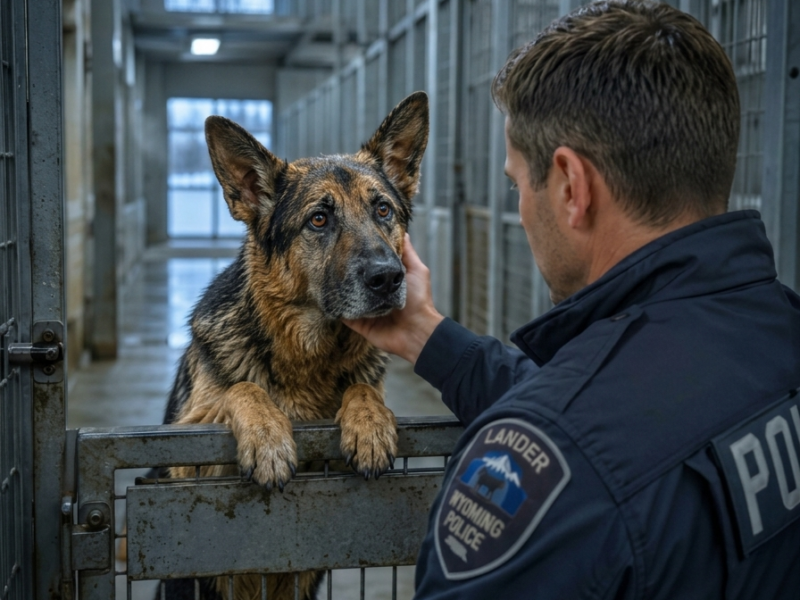
The old German Shepherd suddenly snapped into perfect formation inside a county kennel when I whispered my dead K9’s secret command, and while the other officers laughed at the strange coincidence
The air inside the county animal control facility was thick with the scent of industrial bleach and wet fur, a sharp combination that immediately put my senses on edge. I was a detective with the metropolitan police department, a former K9 unit officer who had transitioned to investigations after a career-altering tragedy. I was only at the kennel to inspect a series of pit bulls seized in a subterranean dog-fighting ring raid the night before. It was routine paperwork, a bureaucratic necessity before the animals could be processed for rehabilitation. The concrete corridor echoed with the deafening chorus of dozens of stressed, displaced dogs barking against the chain-link fences.
Then I saw him.
He was lying completely alone in the farthest corner of the last row. He was an old German Shepherd, gray heavily dusting his muzzle, his ribs protruding subtly beneath a dirty, matted coat. Unlike the other animals throwing themselves against the metal gates, he was completely still. There was no name on his kennel card, just a faded intake number burned into the thick plastic. I stopped walking. The supervisor next to me continued talking about the seizure logs, but his voice faded into a dull hum in my ears.
Something about the animal pulled at my instincts. It was an invisible gravity. I approached the bars slowly. The Shepherd did not lift his head, but his dark eyes tracked my movement. They were clouded slightly with age, but over his left eye was a distinct, jagged scar where the fur had never grown back.
My breath caught in my throat.
“Easy, old boy,” I said, my voice barely above a whisper.
His ears swiveled, snapping backward, then forward. He recognized the cadence.
I crouched beside the bars, ignoring the damp concrete seeping into the knees of my slacks. I looked directly into his eyes and spoke a command I had not uttered in eight years, a phrase buried with my past. “Stay sharp.”
The dog immediately rose. It was not the lazy stretch of a senior rescue. It was a tactical, fluid motion. His head lifted. His shoulders squared. The lethargy vanished, replaced by the rigid, disciplined posture of a military-grade working dog awaiting orders. Then he sat perfectly still, his eyes locked dead onto mine.
My heart started pounding against my ribs like a sledgehammer. That was impossible. It was a generic command, I tried to tell myself. Any police dog might know it.
“Again,” I whispered, the word trembling on my lips. “Three taps.”
I extended my right hand and tapped the metal frame of the kennel door. Two rapid taps. A two-second pause. Then one final tap.
The Shepherd instantly lowered his head and touched his wet nose directly to the concrete floor between his front paws, holding the position with statue-like absolute stillness.
I froze. The world around me spun into a dizzying blur.
That was Rex’s signal. It was a completely custom, undocumented command my K9 partner and I had developed during narcotics interdictions when total radio silence and visual stealth mattered. Nobody outside our immediate tactical unit knew that signal existed. Nobody. Rex had died eight years earlier, bleeding out in my arms after taking a barrage of bullets meant for me during a warehouse raid gone wrong. I had seen the blood. I had felt his heart stop.
I stood up so fast my vision went black at the edges. I grabbed the kennel supervisor by the shoulder. “Where did this dog come from?”
The supervisor blinked, startled by my sudden intensity. “What? Uh, let me check the digital records.” He pulled a tablet from his vest, scrolling frantically. “Intake 409. He was found wandering near an abandoned chemical warehouse on the southside.”
“When?” I demanded.
“Four days ago. Animal control picked him up. He didn’t fight them, just walked right into the truck.”
I stared back at the Shepherd. He had raised his head again and was trembling now. It was not from fear, and it was not from the cold of the damp floor. I knew that vibration. It was the adrenaline of recognition.
“Open it,” I told the supervisor.
“Detective, I don’t know if that’s safe, he’s a stray—”
“Open the damn cage,” I ordered, my voice leaving no room for debate.
The supervisor unlatched the heavy metal gate. The moment it swung open, I stepped inside. The Shepherd did not hesitate. He closed the distance between us and immediately pressed his heavy forehead firmly against the center of my chest, burying his face in my jacket.
I felt something crack wide open inside my chest. It was the stone of grief I had carried for nearly a decade, shattering into dust. Rex had done this exact same thing every single morning before shift. It was his way of checking my heartbeat, his way of grounding us. I wrapped my arms around his thick neck, burying my face in his coarse fur, smelling the dirt and the rain and the undeniable scent of my partner.
“Where have you been, buddy?” I choked out, tears burning the corners of my eyes. “Where the hell have you been?”
He suddenly pulled away, breaking the embrace. He took a step back and began violently pawing at his thick leather collar, a generic stray band the city had likely put on him. He clawed at it until I reached out to stop him.
“Okay, okay, hold still,” I murmured. I ran my fingers under the leather. There was something hard taped to the inside, hidden completely beneath the thickest part of the buckle. I pulled out a small pocket knife and cut the black tape away.
A tiny, waterproof metal capsule dropped into my palm.
I unscrewed the cap with shaking fingers. Inside was a tightly rolled piece of glossy paper. I carefully unrolled it. It was a photograph.
It was a picture of me and Rex, taken during our graduation from the tactical academy. But my eyes immediately drifted to the background. Standing behind us, out of focus but undeniably present, was a man I recognized instantly. Master Sergeant Vance. My former superior handler. The man who had coordinated the raid eight years ago. The man who had personally pulled me out of the warehouse, telling me Rex had died instantly and that I had to leave the body behind before the building exploded.
I flipped the photograph over. Written in black ink across the white paper was a single handwritten sentence.
Your partner didn’t die that night.
I couldn’t move. The air in the facility felt impossibly thin. For eight years, I had mourned a ghost. But the old Shepherd sitting in front of me was staring at me with an urgency I remembered all too well. He turned toward the open kennel door, looked back at me, and gave the secret signal again. He tapped the concrete with his paw. Two taps. Pause. One tap.
He was telling me to follow.
I didn’t wait for the supervisor to ask questions. I grabbed a spare heavy-duty leash hanging from the wall, clipped it to Rex’s collar, and flashed my detective badge at the bewildered staff. “This animal is evidence in an ongoing federal investigation. I’m requisitioning him immediately.”
We moved through the double doors and out into the gray afternoon. A cold drizzle was falling, slicking the pavement of the employee parking lot. Rex pulled against the leash with a strength that belied his age and emaciated frame. He wasn’t leading me toward my unmarked cruiser; he was dragging me toward the overgrown chain-link fence at the rear of the county property.
“Wait, hold up,” I commanded, but he ignored the standard halt order. He squeezed through a rusted gap in the fence, forcing me to unclip the leash and follow him into the dense brush separating the county lot from an old industrial sector.
He led me straight to an abandoned storage building half-swallowed by dead ivy and rotting oak branches. The roof had partially caved in, and the windows were shattered out, leaving black, jagged holes in the brickwork. Rex stopped at the threshold of the rotting wooden double doors and whined, a low, urgent vibration in the back of his throat.
I unholstered my service weapon, holding it close to my chest. “Clear the fatal funnel,” I whispered.
Rex instantly dropped low to his belly and crawled forward, bypassing the center of the doorway and sliding along the interior wall, his nose sweeping the perimeter. The muscle memory was flawless. I followed him inside, my boots crunching softly on the debris-littered floor. The air smelled of mildew, old oil, and decay.
Rex stopped in the far corner of the room, near a rusted forklift. He began digging frantically at the wooden floorboards, his heavy claws tearing up chunks of rotted pine.
I knelt beside him, holstering my weapon to help. We tore up three loose planks. Beneath them, resting in the damp dirt, was a small canvas pouch. I pulled it free and unzipped it.
Inside was an old military identification tag on a broken beaded chain. I wiped the mud from the stamped metal.
REX – K9-447.
UNIT 7 – TACTICAL.
My hands began shaking violently. This was the tag he had been wearing the night of the warehouse raid. The night I was told he burned.
Before I could process the gravity of the object in my hand, Rex suddenly spun around. The hair on his spine stood straight up, forming a rigid ridge of dark fur. He let out a bark that shook the dust from the rafters—a deep, concussive sound directed at the darkness near the front entrance.
I dropped the pouch and reached for my weapon.
A man’s voice echoed from the shadows, calm and chillingly familiar. “You were never supposed to find him, David. He was supposed to die in the streets like any other stray. But I should have known his homing instinct would bring him right back to you.”
A figure stepped out from behind a concrete pillar. He was wearing a dark tactical trench coat over subdued body armor. He held a suppressed pistol casually in his right hand. I didn’t need to see his face clearly to recognize the broad shoulders and the deliberate, heavy cadence of his footsteps.
“Vance,” I breathed out, aiming my weapon directly at his chest. “Put the gun down. Now.”
“You’re out of your depth, David,” Vance said, taking another step forward. “This isn’t a local police matter. This is way above your paygrade. Lower your weapon, hand over the dog, and walk away. I’ll make sure your pension stays intact.”
“You told me he was dead!” I shouted, the betrayal searing through my veins like battery acid. “You pulled me out of that fire, and you told me my partner was gone. Why?”
“Because he was too valuable to waste on city drug busts,” Vance replied coldly. “Rex has a genetic profile and a tactical neuro-plasticity that private contractors pay millions for. He wasn’t just a police dog. He was the prototype. We staged the fire to extract him. He’s been working black operations overseas for the last eight years. He’s cleared bunkers you don’t even know exist. But he got old. He got slow. He escaped a transport truck four days ago during a transfer, and my employers sent me to clean up the mess.”
Vance raised his pistol. “I’m sorry, David. But he’s compromised company property.”
Before Vance’s finger could depress the trigger, Rex moved.
He didn’t charge directly. He used the tactical evasion maneuvers we had drilled hundreds of times. Rex bolted sideways, ricocheting off a rusted metal barrel and launching himself through the air from Vance’s blind spot.
Vance fired, the suppressed weapon making a sharp thwip sound, but the round missed, biting into the dirt floor. Rex slammed into Vance’s weapon arm, his jaws locking onto the thick Kevlar sleeve. The impact sent the pistol spinning into the shadows.
“Get him off me!” Vance roared, struggling to draw a combat knife from his hip.
I didn’t hesitate. I closed the distance in two strides and drove the heel of my boot into Vance’s knee. The joint gave way with a sickening crunch. Vance collapsed with a grunt of pain, but his training kicked in. He slashed upward with the knife, catching the fabric of my jacket and narrowly missing my ribs.
“Rex, out!” I commanded.
Rex instantly released Vance’s arm and leaped backward, avoiding a second wild slash from the knife. I brought my weapon down, pressing the muzzle firmly against Vance’s forehead.
“Drop the knife, Vance,” I said, my voice completely devoid of emotion. “Or I swear to God, I will end this right here.”
Vance glared up at me, his chest heaving. Slowly, he opened his hand, letting the blade clatter to the concrete. He smiled, a bloody, bitter grin. “You think you’ve won? You think taking me down stops them? The tracker is already active. They know exactly where we are.”
I slammed my knee into Vance’s chest, pinning him to the floor while I stripped his communications gear and secured his hands behind his back with industrial zip-ties I carried on my belt. Rex stood guard, a low growl vibrating endlessly in his throat, his eyes fixed on the man who had stolen eight years of his life.
“What tracker?” I demanded, searching Vance’s pockets.
“Not on me, you idiot,” Vance spat out, wincing as I tightened the plastic restraints. “On the dog. Subdermal. Base of the skull. You have exactly ten minutes before an extraction team turns this entire block into a crater.”
I looked at Rex. I ran my fingers through the thick fur at the back of his neck. Sure enough, beneath the skin, I felt a small, hard cylinder the size of a grain of rice. It wasn’t a standard microchip; it felt metallic and rigid.
“Let’s move,” I said, grabbing Vance by the collar and hauling him to his one good leg. “You’re coming with us as an insurance policy.”
“They don’t negotiate,” Vance laughed bitterly. “I’m expendable. The moment they arrive, they’ll shoot through me to get to the animal.”
I ignored him, shoving him forward toward the rear exit of the storage building. We stumbled out into the alley behind the industrial park. My unmarked cruiser was parked a block away. I forced Vance into the back seat, locking the doors and engaging the child locks, then opened the passenger door for Rex. The old dog jumped in, settling heavily onto the seat, his eyes never leaving the rear-view mirror.
I threw the car in drive and accelerated hard, tires squealing on the wet asphalt as we sped away from the kennel district.
I needed a place to go off-grid, a place where their technology couldn’t penetrate. I drove toward the edge of the city, navigating the twisting backroads leading up into the mountains. Thirty minutes later, we pulled into the gravel driveway of an old, abandoned radio relay station I had discovered years ago during a missing persons case. The structure was built entirely of reinforced concrete and lined with lead and copper mesh to prevent frequency interference. It was a perfect Faraday cage.
I dragged Vance inside and dropped him onto a dusty metal chair, securing his zip-ties to a heavy structural pipe. The air inside the bunker was stale and freezing.
I pulled my medical kit from the trunk of the cruiser and knelt beside Rex. “I have to get it out, buddy. I’m sorry.”
Rex didn’t flinch. He sat perfectly still, offering me the back of his neck. I sterilized a scalpel blade with an alcohol prep pad. “Stay steady.”
I made a tiny, precise incision over the hard lump at the base of his skull. Rex whined softly once but didn’t move an inch. I used a pair of tweezers to reach in and extract the device. It was a sophisticated, military-grade GPS transponder, currently blinking with a microscopic red LED.
I set it on the concrete floor and smashed it into fragments with the butt of my pistol.
“That buys us time,” I said, turning to Vance. “Now you’re going to tell me everything. Who are you working for? What syndicate has the resources to hijack police dogs and turn them into black-ops assets?”
Vance leaned back, nursing his broken knee. “They don’t have a name. They’re a coalition of private military contractors. They realized years ago that human operatives leave a paper trail. They talk. They demand hazard pay. A highly trained canine asset? It has no identity. It operates purely on command, it sneaks into compounds undetected, and if it’s caught, it’s just a stray animal. No international incidents.”
“And Rex?” I asked, my blood boiling.
“Rex was special,” Vance admitted. “Your training regimen with him—the silent commands, the independent problem-solving skills—it made him the perfect infiltrator. They used him to plant surveillance tech in foreign embassies. They used him to track high-value targets through terrain drones couldn’t penetrate. But four days ago, during a transport through this city, he smelled something.”
“He smelled home,” I said quietly.
“He smelled you,” Vance corrected. “We drove past your precinct. He went crazy. He tore through a steel transport cage, nearly killed a handler, and vanished into the city. I was dispatched to find him before he led anyone to our local staging facility.”
“Where is the facility, Vance?” I asked, stepping closer.
Vance shook his head. “If I tell you that, I’m a dead man.”
“You’re already a dead man,” I said, leaning in. “Your employers know you failed. They know your signal went dark. The only way you survive tonight is if we dismantle the local operation before they can regroup.”
Rex stepped forward, baring his teeth inches from Vance’s face. The dog’s intent was clear. He remembered the man who had stolen him.
Vance swallowed hard, beads of sweat forming on his forehead despite the cold. “Fine. It’s the old shipping yards. Pier 44. They operate out of a decommissioned freighter called the Iron Tide. That’s where they hold the assets before shipping them overseas. There are at least twenty men there right now. Highly armed. You go there alone, David, you and the dog will both be dead before you cross the gangway.”
“We won’t be alone,” I said, pulling my encrypted police radio from my vest. I switched to a secure channel, calling directly to the SWAT commander, a man who had served with me and Rex eight years ago. “Unit 7, this is Detective Hayes. Declare a Code Red tactical emergency. I need full mobilization at Pier 44. The cartel that hit our unit eight years ago is operating out of the freighter Iron Tide. And Commander… tell the men Rex is coming home.”
The drive to the docks was a masterclass in tension. The rain had intensified into a coastal storm, the windshield wipers of my cruiser fighting a losing battle against the deluge. Rex sat in the passenger seat, staring straight ahead into the darkness. He wasn’t panting. He wasn’t anxious. He was locked in, operating on a frequency of pure tactical focus. It was the same terrifyingly calm demeanor he used to adopt right before we breached a hostile compound.
I parked the cruiser two blocks away from Pier 44, cutting the headlights. Through the rain, the massive silhouette of the Iron Tide loomed against the gray sky. It was a rust-bucket freighter, flanked by towering stacks of shipping containers.
My radio cracked softly. “Hayes, this is Unit 7 Actual. We are on site. Perimeter established. We have thermal signatures of heavily armed tangos on the deck and in the cargo hold. Awaiting your signal.”
“Hold position, Actual,” I whispered into the mic. “They have hostage assets on board. Other K9s in crates. If we go in loud, they might execute the animals to destroy evidence. Rex and I are going in stealth to secure the hold. Wait for my breach command.”
“Copy that. Watch your six, brother.”
I stepped out into the storm, pulling my tactical rifle from the trunk. I checked the chamber, seated the magazine, and turned to Rex. “Just like the old days, buddy. Silent approach.”
We moved through the labyrinth of shipping containers, the darkness swallowing us. Rex led the way, his nose skimming the wet asphalt. He suddenly stopped, raising a paw and freezing. I halted instantly, pressing my back against corrugated steel.
A patrol of two mercenaries rounded the corner of the container thirty yards ahead, rifles slung over their chests, sweeping flashlights through the alleys.
I looked down at Rex and gave the signal. Two taps on my leg. Pause. One tap.
Rex vanished into the shadows. He didn’t make a sound on the wet pavement. I waited, holding my breath, counting the seconds. Five. Ten. Fifteen.
Suddenly, the flashlight beam of the second guard jerked wildly toward the sky. There was a muffled thud, the clatter of a dropped rifle, and the frantic scuffle of boots on asphalt. The first guard spun around, opening his mouth to shout, but I had already closed the distance. I drove the stock of my rifle into his temple, catching him before he hit the ground to silence his fall.
I looked up. Rex had the second guard pinned by the throat to the steel container, his jaws clamped just tight enough to cut off airflow without severing the artery. The man was unconscious.
“Good boy,” I whispered, zip-tying both men and dragging them out of sight.
We approached the boarding ramp of the freighter. Two more guards were stationed at the top. This was the bottleneck. We couldn’t sneak past them on the narrow metal gangway.
I keyed my radio. “Actual, I need a distraction on the west perimeter. Suppressed fire only. Draw their eyes.”
“Copy.”
Three seconds later, the sharp phut-phut-phut of suppressed sniper fire echoed from the cranes a quarter-mile away, striking the metal hull of the ship far from our position. The two guards on the ramp instantly raised their weapons and turned toward the noise, communicating frantically on their headsets.
It was all the opening we needed. We sprinted up the gangway. Rex was a blur of gray fur, launching himself at the closest guard and driving him to the deck. I tackled the second guard, wrenching his weapon away and delivering a devastating elbow to his jaw. We cleared the ramp in less than five seconds.
We slipped through the heavy steel doors into the interior corridors of the ship. The air inside smelled of diesel fuel, rust, and the distinct, heartbreaking odor of frightened animals.
We descended two levels into the cargo hold. The vast space was dimly lit by emergency red bulbs. In the center of the room, stacked three high, were rows of heavy metal transport crates. Inside them, I could hear the whimpering and pacing of dozens of dogs—Malinois, Shepherds, Dutch Herders. Stolen heroes.
“Actual, we have eyes on the assets,” I whispered into the radio. “Cargo hold secure. Standby for breach.”
Suddenly, the heavy blast doors at the far end of the hold clanged open. Floodlights snapped on, blinding me.
“Drop the weapon, Hayes!” a voice boomed over a bullhorn.
I ducked behind a stack of steel crates as a hail of automatic gunfire tore through the space where I had just been standing. Sparks rained down on us as bullets ricocheted off the metal bulkheads.
Through the glaring light, I could see at least twelve heavily armored mercenaries fanning out across the hold, moving with coordinated military precision. They had known we were coming. Vance must have triggered a silent distress code before I smashed his transponder.
“Actual! We are compromised! Breach! Breach! Breach!” I screamed into the radio.
The ship shuddered violently as SWAT teams blew the exterior doors on the upper decks. Flashbangs echoed through the hull like thunderclaps. But help was at least two minutes away from fighting down to the cargo hold.
For now, it was just me and Rex against twelve men.
“Stay low,” I commanded him, returning fire with my rifle to keep the advancing line pinned down. But I was running out of angles. They were flanking us, spreading out to catch us in a crossfire.
I looked at Rex. He wasn’t cowering. His eyes were ablaze with a terrifying intelligence. He looked at the heavy steel chains securing the massive overhead cargo crane, then looked back at me. He understood the geometry of the room better than I did.
“Do it,” I told him.
Rex exploded from our cover. He didn’t run toward the men firing at us; he ran vertically. He scrambled up a stack of wooden pallets, using his momentum to launch himself onto the catwalk running along the upper perimeter of the hold.
“Shoot the dog!” the mercenary leader yelled, pivoting his weapon upward.
I immediately laid down covering fire, forcing the men to duck back behind the shipping crates. Bullets sparked against the steel railing of the catwalk, but Rex was moving too fast. Despite his age, muscle memory and pure adrenaline propelled him forward.
He reached the control panel for the overhead cargo crane. Without hesitation, Rex hurled his body against the heavy industrial release lever, biting down on the steel handle and throwing his entire weight backward.
The lever snapped down.
A deafening groan echoed through the hold as the massive locking gears released. Suspended directly above the advancing line of mercenaries was a shipping container filled with three tons of engine parts. The steel cables went slack. The container plummeted in freefall.
It smashed into the deck with an earth-shattering crash, buckling the metal floorboards and sending a shockwave that threw the mercenaries off their feet. The impact crushed their cover, scattering their formation in a cloud of dust and debris.
Before the dust could settle, the blast doors behind them blew open with spectacular force. SWAT operators poured into the room, their tactical lights piercing the haze, laser sights painting the disoriented mercenaries.
“Police! Drop your weapons! Get on the ground!”
The firefight was over almost instantly. Stunned and completely outmaneuvered, the mercenaries threw their weapons to the deck and surrendered.
I lowered my rifle, my chest heaving, the metallic taste of adrenaline thick in my mouth. I looked up at the catwalk. Rex was standing at the edge, staring down at the chaos below. He looked exhausted. His legs were shaking, and he was panting heavily. The superhero facade had faded; he was just an old, tired dog who had given everything he had left.
“Rex, come,” I called out softly.
He navigated his way down the rusted stairs and trotted over to me. He didn’t look at the arrested men or the SWAT officers securing the room. He walked straight up to me and leaned his heavy body against my leg, nearly collapsing. I dropped to my knees and wrapped my arms around him, burying my face in his neck, ignoring the grime and blood.
“You did it, buddy,” I whispered, my voice breaking. “You did it. We’re going home.”
Footsteps approached from behind. It was Commander Miller, my old SWAT captain. He stood over us, staring at the German Shepherd with an expression of absolute disbelief.
“I heard the radio call, David, but I thought you were speaking in metaphors,” Miller said, his voice thick with emotion. He slowly crouched down, removing his helmet. He reached out a trembling hand. “Hey, Rex. Good to see you, son.”
Rex lifted his head, sniffed Miller’s hand, and gave it a single, weary lick.
“We found the syndicate’s operational files in the captain’s quarters,” Miller said, standing back up. “Vance is singing like a canary to the Feds right now to save his own skin. They’ve got lists of buyers, transport routes, everything. We’re shutting the whole global ring down tonight. Every single dog on this ship is going home.”
“What about him?” I asked, keeping my arm tightly around Rex. “Vance said he’s company property. They’ll try to reclaim him.”
Miller looked at me, a fierce glint in his eye. “Property? The only thing I see here is a decorated police K9 who was presumed KIA in the line of duty, miraculously recovered during a federal raid. As far as the department is concerned, Officer Rex has served his time with distinction. I’ll sign his honorable medical discharge papers myself tonight. He belongs to you, David. Permanently.”
The relief that washed over me was staggering. It felt like breathing pure oxygen after drowning for eight years.
A medical team rushed into the hold to assess the rescued animals. I let them look over Rex. Miraculously, aside from exhaustion and malnutrition, he was uninjured. They gave him an IV of fluids and a clean bill of health to leave the scene.
An hour later, the storm had finally broken. The sky over the docks was beginning to lighten with the pale, fragile pinks of dawn. I walked Rex down the gangway of the Iron Tide for the last time. He walked slowly, his head resting near my knee, no longer pulling on the leash.
We reached my cruiser. I opened the back door, fully intending to let him sleep on the padded seat. But Rex stopped. He looked at the back seat, then looked at the open front passenger door. He let out a soft huff of air and climbed stiffly into the front seat—the partner’s seat.
I smiled, wiping a stray tear from my cheek. I closed his door, walked around to the driver’s side, and got in.
I started the engine, the low hum of the cruiser filling the quiet morning. I looked over at the old German Shepherd. His eyes were already closed, his chin resting comfortably on the center console. He was finally safe. He was finally off the clock.
I reached over, resting my hand on his head, feeling the steady, rhythmic thump of his heartbeat against my palm.
“Stay easy, partner,” I whispered. “We’re going home.”
The end









