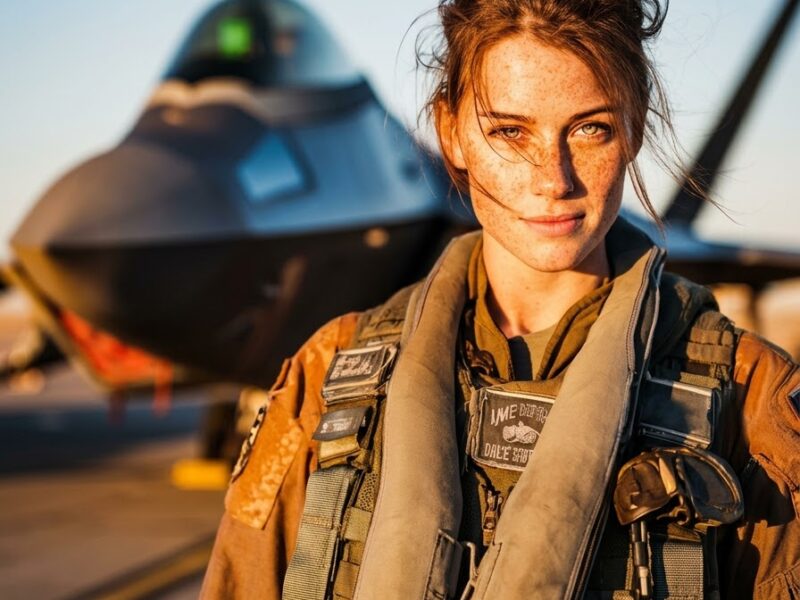
The officers at Nellis Air Force Base laughed when they saw me assigned to ground support, but seventeen minutes later
Major Collins barely glanced up from his encrypted tablet as the glass door of the briefing room slid shut behind me. The air inside smelled of stale coffee, ozone, and the distinct, tense chill of high-altitude tactical planning.
“You’re in the wrong briefing room, Captain,” Collins said, his tone dripping with the bored condescension of a career officer who had spent more time navigating Pentagon politics than dodging radar-guided missiles. “Ground crews and maintenance logistics are two buildings over.”
A ripple of low chuckles echoed through the row of officers seated around the conference table. They saw my faded flight suit, the oil stain near my right cuff, and the silence with which I carried myself. They didn’t see the seven years I had spent pushing F-22 Raptors past their operational limits over hostile territory. They didn’t see the ghost of an entire squadron floating behind my eyes.
“Captain Morgan Hayes,” I said, my voice steady, flat, and stripped of any emotion. “Assigned to the 422nd Test and Evaluation Squadron. Orders signed directly by Tactical Air Command.”
Collins finally raised his gaze, his eyes flicking down to my flight helmet tucked beneath my left arm. He smirked, setting his tablet down on the glass table. “A glorified mechanic with a pilot’s badge. Look, Hayes, Nellis is where we test the future of aerial warfare. We don’t have time to baby sit reassigned officers recovering from… post-operational stress.”
He didn’t say the word disaster. He didn’t mention Operation Blackwing—the classified nightmare over the Baltic Sea where four F-22s vanished from satellite tracking in less than forty seconds. Official reports called it an avionics malfunction combined with extreme weather. The Air Force buried the file, awarded me a Distinguished Flying Cross in secret, and reassigned me to ground logistics.
I didn’t argue. I didn’t defend my record. I simply gave Collins a brief, formal nod, turned on my heel, and walked out into the scorching Nevada heat.
They didn’t know why I had requested Nellis. They thought I was hiding from the sky. They had no idea I was hunting the glitch that killed my team.
Three hours later, the desert peace exploded.
An emergency alarm tore through the airbase, its shrill, rhythmic pulse shattering the quiet of the hangars. Klaxons wailed from every tower as red battle-lights replaced the white fluorescent tubes in the hallways. I was in Hangar 4, hand-checking the fly-by-wire actuators on an unassigned Raptor, when the primary command circuit burst to life over the PA system.
“Condition Red. All units, Condition Red. Unidentified hostile formation crossing restricted airspace Sector 4. Speed Mach 2.2 and accelerating.”
I ran toward the tactical operations center. When I slammed the double doors open, the room was in absolute chaos. Radar displays flickered with ominous red tracks cutting through the restricted zone, heading directly toward the Tonopah Test Range—a highly classified facility housing next-generation propulsion prototypes.
“Where are our frontline interceptors?” someone screamed above the noise.
“Two aircraft are grounded for engine teardowns!” an operator yelled back, her fingers flying across her console. “The alert flight from Luke Air Force Base is airborne, but they’re twenty minutes out! These hostiles will be over Tonopah in less than six!”
Major Collins was standing over the central tactical table, his face devoid of color. He snatched the radio receiver. “Scramble anyone! Is there anything in the air?”
“Nothing combat-ready, sir!”
I stepped through the crowd of panicked staff, placing my palm flat on the glass display, right beside the flashing red threat indicators.
“Give me the Raptor in Hangar 4,” I said.
Collins turned, his eyes wide with a mix of shock and irritation. “Hayes? Are you insane? This isn’t a simulation, and you’re off flight status!”
“That bird in Hangar 4 is fueled and armed with a live combat load for testing,” I said, leaning in until I was inches from his face. “You have six hostile bogies moving at supersonic speed toward a national security asset, and I am the only pilot in this room who has over two thousand flight hours in an F-22.”
“You haven’t flown combat in years!” Collins shouted. “You’re unstable, Captain!”
“Then stop wasting time and let me do my job,” I snapped back.
The room fell deathly silent. For three agonizing seconds, Collins hesitated, trapped between his pride and the impending disaster on the radar screen.
“Do it,” a commanding voice broke from the doorway.
General Marcus Vance, the base commander, stepped into the light. His eyes locked onto mine with cold recognition. “Get her in the air, Major. Now.”
I didn’t wait for Collins to reply. I sprinted out of the control room, my flight boots striking the hard concrete corridor as ground crews scrambled around me in a frantic blur. When I reached Hangar 4, the ground crew chief looked at me in disbelief, but the general’s voice was already barking orders over his headset.
The dark, radar-absorbent skin of the F-22 Raptor gleamed under the industrial lights like a sleeping apex predator. As I climbed the ladder and swung myself into the cockpit, my hands began to tremble violently.
It wasn’t fear. It was muscle memory. It was the crushing weight of the last time I had strapped into this ejection seat—the day my radar screen flickered, my radio went static, and three of my closest friends vanished into thin air.
I slapped the helmet down, locked the visor, and flicked the battery switches. The twin Pratt & Whitney turbofans roared to life behind me with a thunderous, bone-shaking whine that rattled my ribcage.
“Viper One, you are cleared for immediate takeoff, Runway 21 Left,” the tower crackled in my ear. “Godspeed.”
I slammed the throttles forward into full afterburner. The force slammed me back into the seat as twenty-seven tons of metal and composite materials launched into the Nevada sky, piercing through the cloud cover like a thrown spear.
“Viper One, Command,” Collins’s voice came through the comms, tense and stripped of his earlier arrogance. “You have six hostiles approaching from the west. Profile suggests advanced fifth-generation platforms. No transponders. They aren’t responding to warnings.”
“Copy,” I muttered, stabilizing at thirty thousand feet. “I have visual-range radar lock.”
The main display lit up. Six red diamonds were sweeping in a tight, offensive wedge formation. The sheer precision of their movement sent a chill down my spine. This wasn’t a random intrusion. It was a surgical strike.
“Fox Two,” I whispered, pressing the launch button on the stick.
The bay doors opened and closed in a fraction of a second. A Sidewinder missile streaked out into the blue, trailing a thin ribbon of white smoke. Seconds later, the lead red diamond on my display burst into a cloud of static.
“Direct hit! Target destroyed!” Command reported.
“Five left,” I said, pulling the stick hard right as radar warning receivers began to scream in my ears.
The sky transformed instantly into a chaotic tapestry of smoke trails, roaring engines, and violent G-forces. I rolled the Raptor onto its back, plunging into a vertical dive to break a radar lock, my body pressing against the harness as the g-suit inflated against my legs. I pulled up sharp, coming up behind the second enemy jet.
Beep-beep-beep-BEEP!
“Fox Three,” I growled.
Another enemy fighter exploded in a ball of flame, its debris cascading down toward the desert below.
“Viper One, disengage!” Collins screamed over the radio. “You’re outnumbered, and your fuel margin is critical! Fall back to the perimeter!”
“Negative!” I yelled back, snapping the plane into a brutal 9-G turn that made my vision blur at the edges. “They’re within striking range of Tonopah! I’m clearing this sky!”
A missile streaked past my cockpit canopy, missing my left wing by less than ten feet. The shockwave rattled the airframe violently. For a split second, as the sky flipped upside down, the memory of my lost squadron flashed across my mind—the desperate screams over the radio, the sudden silence, the burning wreckage falling into the dark ocean.
Not today, I swore to myself. Not again.
I engaged the third and fourth targets in a blinding sequence of vector-thrust maneuvers, using the Raptor’s unmatched agility to outmaneuver their missile locks. Within seven chaotic minutes, five hostile aircraft had been reduced to smoking craters across the desert floor.
“One remaining,” I panted, my lungs burning as I pulled the plane around.
The sixth jet wasn’t attacking. It had broken away from the engagement zone and was flying low, masking its radar signature inside the deep, twisting canyons leading toward the mountains.
“Viper One, give chase,” Collins’s voice came through, transformed now by sheer awe. “Bring them home, Hayes.”
“Working on it,” I snapped, diving into the canyon right behind the intruder.
The canyon walls rushed past my wings at Mach 1.2, a terrifying blur of red rock and shadow. I nudged the throttle, closing the distance. My HUD locked onto the target’s tailpipes. My thumb hovered over the trigger.
Suddenly, my radio frequency jammed, replaced by a low, digitized voice speaking directly on a secure military channel.
“Captain Morgan Hayes,” the voice said, crystal clear despite the terrain interference. “You don’t know what they did to your squadron.”
My thumb froze on the control stick. Cold sweat broke out across my forehead. “Who is this? Identify yourself!”
“Ask your commander why your wingman was still alive when they buried him,” the voice replied.
Before I could lock onto his signal or demand an explanation, the sixth jet engaged a sudden, impossible burst of speed—an experimental booster system—and shot straight up into the stratosphere, vanishing completely from my radar grid before I could climb out of the canyon.
Seventeen minutes after my wheels had left the tarmac, I brought the F-22 back down onto the runway at Nellis.
The moment the canopy opened, a wave of applause and cheers erupted from the hundreds of mechanics, officers, and technicians lined up along the flight line. They were chanting my name. They had watched the entire tactical display in disbelief.
I barely felt my feet touch the ground as I climbed down the ladder. Major Collins was standing at the base, his face pale, his mouth slightly open as if he wanted to apologize, but couldn’t find the words.
“Who was that pilot?” I demanded, grabbing Collins by the front of his vest, ignoring every protocol in the book. “Who were they communicating with?”
“Hayes, calm down—” Collins stammered.
“Answer me!”
“Captain Hayes,” a voice interrupted.
A young ground technician stepped forward, holding a sealed black envelope in his trembling hands. “This was left at the security gate five minutes before the attack began. It’s addressed to you.”
I snatched the envelope. On the front, written in precise, dark ink, was my name.
I tore it open. Inside was a single piece of paper, containing a set of GPS coordinates deep inside a restricted military zone, and six words that turned my blood to ice:
YOUR WINGMAN HAS BEEN WAITING. FIND US.
The rain began to fall over the Nevada desert at midnight, a rare, cold downpour that turned the dust around the perimeter fences into slick mud. Inside Hangar 4, the silence was suffocating. The F-22 I had flown hours earlier sat under the harsh spotlights, its metal skin clicking softly as it cooled down.
I sat on a wooden crate in the corner, staring at the black paper in my hands.
Your wingman has been waiting.
Lieutenant Daniel “Ghost” Vance—the base commander’s only son, and my flight lead on the day Operation Blackwing went dark. I had watched his radar signature vanish. I had searched the icy waters of the Baltic for six hours until my fuel warning forced me to turn back. I had attended his empty-casing funeral at Arlington National Cemetery. I had shaken General Vance’s hand while he wept for his son.
If Daniel was alive, then everything I had been told for the last three years was a lie.
The heavy steel door of the hangar creaked open, and a long shadow stretched across the concrete floor. I didn’t need to look up to know who it was. The rhythmic, heavy tread of military boots stopped a few feet away from me.
“You should be in quarters, Captain,” General Marcus Vance said. His voice was thick, worn down by the strain of the day’s events.
I folded the black paper carefully and slid it into my flight suit pocket. “I don’t sleep well on land, General. You know that.”
Vance looked at the F-22, his eyes reflecting the dull glow of the hangar lights. “What you did today… six kills in seventeen minutes. The Air Force hasn’t seen airmanship like that since Vietnam. Collins is filing a formal recommendation for the Air Force Cross.”
“I don’t want a medal, General,” I said, standing up to face him. “I want answers.”
Vance’s expression hardened instantly. The proud fatherly warmth he sometimes showed vanished behind a mask of high-ranking military authority. “Answers about what?”
“The pilot of the sixth jet,” I said, stepping closer. “He didn’t just breach our airspace to bomb Tonopah. He was leading me out. He spoke to me on an encrypted frequency—a frequency only tactical leaders in the 422nd possess.”
Vance didn’t flinch. “Psychological warfare, Morgan. The enemy knows who you are. They know about Blackwing. They’re trying to mess with your head.”
“He mentioned Daniel,” I said softly.
The air between us grew painfully thin. General Vance’s jaw clenched, a muscle twitching beneath his scarred cheek. For a second, I thought he was going to snap, to order me court-martialed for bringing up his dead son. Instead, his shoulders slumped slightly.
“Daniel is dead, Hayes,” Vance said, his voice dropping to a whisper. “I buried him. I held his mother while she drowned in her own tears. Do not let some nameless mercenary drag his memory through the dirt.”
“Then explain this,” I said, pulling out the black paper and holding it out to him.
Vance stared at the handwriting. I watched his eyes scan the coordinates, then the final six words. I expected anger, shock, or confusion. But what I saw in his eyes for a split second was something far worse.
It was recognition.
“Where did you get this?” he asked, his tone suddenly low and dangerous.
“It was delivered to the front gate right before the raid,” I lied smoothly, keeping the technician’s identity safe. “What are those coordinates, General?”
Vance didn’t answer. He snatched the paper from my hand, crumpled it into a tight ball, and shoved it into his jacket. “This is classified intelligence material. You are to speak of this to no one. That is a direct order, Captain Hayes. If I hear you repeating these claims to Collins or anyone else, I will have you stripped of your wings and locked in a brig at Fort Leavenworth.”
He turned and walked toward the exit without another word.
I stood alone in the dark hangar, my heart hammering against my ribs. Vance hadn’t been surprised by the message. He had been terrified by it. And that gave me all the confirmation I needed.
Two hours later, I was inside the base network administration building.
The maintenance duty officer was a young corporal named Miller, a tech wizard who owed me a favor after I covered for him during a pre-flight inspection error the previous week. The room was dark, lit only by the blue glare of multiple computer monitors.
“Morgan, if anyone catches me pulling these logs, I’m going to spend the next five years sweeping motor pools in Alaska,” Miller whispered nervously, tapping away at his keyboard.
“No one’s going to catch you,” I said, standing over his shoulder. “I just need the telemetry data from my F-22’s black box during the canyon pursuit.”
“The telemetry from today’s dogfight was locked by Command an hour ago,” Miller said, frowning. “Look, access denied. Level 5 clearance required.”
“Bypassing the file lock isn’t what I need,” I said, reaching down and placing a USB drive on the desk. “I pulled the raw, unencrypted audio stream directly from my helmet’s backup recorder before the ground crew wiped the avionics. I need you to clean up the background audio from that pilot’s transmission.”
Miller looked at me, realizing then that I wasn’t doing an official debrief. He hesitated, then plugged the drive in. “Alright. Let’s see what we’ve got.”
He loaded the audio file. The harsh static of the canyon interference echoed softly through his headphones. Miller adjusted the frequency filters, isolating the pilot’s voice while stripping away the roar of the jet engines and the electronic jamming.
“Ask your commander why your wingman was still alive when they buried him…”
“Creepy,” Miller muttered, shivering. “Sounds like a voice synthesizer.”
“Look deeper,” I instructed. “Isolate the background ambient noise beneath his voice. There’s always an acoustic signature inside a cockpit—cockpit pressurization hum, oxygen regulator clicks, radar warning tones.”
Miller’s fingers flew across his board. He ran the audio through a spectral analyzer. The visual waveform separated into clean, distinct lines.
“Wait,” Miller said, zooming in on a subtle, repeating rhythmic click beneath the pilot’s voice. “That’s weird.”
“What is it?”
“It’s not an F-22 altitude chime, and it’s not a Russian SU-57 warning,” Miller said, pointing at a high-frequency spike. “That’s an internal life-support monitor chime. Specifically, a bio-metric sync pulse used in deep-altitude experimental pressure suits.”
“Who uses those suits?”
“Only one place,” Miller said, turning to look at me with wide eyes. “The Skunk Works facility at Groom Lake. Area 51.”
My stomach dropped. The coordinates on the black paper—the ones Vance had confiscated—corresponded to the high-desert mountain range just south of Groom Lake.
“Miller, can you track where that transmission originated? Not the plane, but the relay tower?”
Miller clicked through several network routing screens. “The signal didn’t come from the enemy jet, Morgan. The jet was just acting as a airborne repeater. The actual transmission was bounced off a military satellite relay originating from… Sector 17.”
“Sector 17?” I repeated. “That’s an abandoned underground nuclear testing bunker on the edge of the Nevada test site. It’s been welded shut since 1994.”
“Apparently, someone turned the power back on,” Miller whispered.
Before I could ask him to pull the blueprints for Sector 17, the computer screens in front of us suddenly flashed bright red. A system-wide override banner swept across all monitors.
SECURITY BREACH DETECTED. LOCATION: TERMINAL 09. SECURITY TEAMS DISPATCHED.
“Shit!” Miller panicked, grabbing his mouse. “They tracked the decryption key! Someone high up was monitoring those audio files!”
“Get out of here, Miller,” I said, grabbing my flight jacket. “Tell them I forced you.”
“Morgan, wait! If you go out there—”
“I’m already a ghost, Miller,” I said, backing toward the side exit. “It’s time I found out who else is dead.”
I slipped out into the pouring rain just as two armored security vehicles screeched to a halt in front of the building, their red and blue strobe lights flashing against the wet asphalt. I cut through the shadow of the maintenance sheds, weaving through the base’s secondary perimeters until I reached the motor pool.
Stealing an un-marked military Humvee was embarrassingly easy for someone who knew the maintenance shift schedules. I bypassed the ignition using a jumper wire from my pocket tool kit, threw the vehicle into gear, and smashed through the secondary security gate, vanishing into the pitch-black desert night.
The storm raged around me as I drove north into the high-desert wasteland, following the memory of the coordinates stamped into my brain.
Two hours later, the Humvee’s headlights cut through the thick wall of rain, illuminating a rusted, chain-link fence topped with razor wire. Beyond it sat a massive, reinforced concrete dome built into the side of a barren mountain peak.
Sector 17.
The main heavy steel blast door was slightly ajar, broken open by industrial cutting torches. Fresh tire tracks cut through the mud, leading straight into the dark abyss of the bunker.
I grabbed my service pistol from my holster, checked the magazine, chambered a round, and stepped out into the freezing rain.
As I approached the dark entrance, a low, mechanical hum vibrated through the damp earth beneath my boots. The facility wasn’t abandoned. It was humming with high-voltage electrical power.
I stepped through the shattered blast door into the darkness.
Ten feet inside, the heavy steel door behind me suddenly slammed shut with a deafening boom. Hydraulics hissed, and iron bolts locked into place with the finality of a coffin lid.
The lights overhead flickered to life, bathing the cold concrete corridor in a sickly, yellow glare.
Standing thirty feet away at the end of the hallway, wearing a dark flight suit stripped of all unit patches, was a man holding a tactical radio.
He slowly turned around.
My breathing stopped. The pistol in my hand trembled as my mind struggled to process the face staring back at me through the dim light.
It was Daniel Vance.
His face was scarred, his left eye clouded over with milky white scar tissue, but there was no mistaking him. My wingman, the man I had mourned for three years, was standing five feet in front of me.
“Hello, Morgan,” Daniel said, his voice raspy and devoid of warmth. “You took your sweet time.”
I couldn’t move. The concrete floor beneath my boots felt suddenly weightless, as if the ground had opened up to swallow me whole. The air in the bunker was thick with the smell of ozone, diesel exhaust, and damp earth.
“Daniel?” I choked out, the name tasting like ash in my throat. My gun hand was still raised, pointing straight at his chest, but my fingers were numb. “How… you died. I saw your jet drop off the radar over the Baltic. I spent hours searching that water.”
“You searched for a corpse that was never in the ocean, Morgan,” Daniel said softly. He stepped forward, his boots echoing in the narrow concrete tunnel. He wore no rank, no callsign patch, only a dark grey flight suit equipped with non-standard harness mounts. “Lower the weapon. If I wanted you dead, those six jets today wouldn’t have targeted Tonopah. They would have targeted you.”
I slowly lowered the pistol, but I didn’t re-holster it. “What happened in Operation Blackwing? What is this place?”
“Blackwing wasn’t a tactical failure,” Daniel said, turning his back on me and walking deeper into the facility. He didn’t seem concerned that I was armed. “It was a harvest.”
“A harvest?” I followed him, my eyes constantly scanning the shadows of the corridor. Pipework ran along the ceiling, humming with heavy current.
“The Air Force didn’t lose four F-22s that day,” Daniel explained, his voice echoing off the curved walls. “They surrendered them. To a black-budget contractor operating outside the jurisdiction of Congress, the Pentagon, or the President. A program called Aegis-Zero.”
We emerged into a massive underground cavern—an old nuclear testing vault converted into a high-tech hangar. Modern server racks lined the far walls, their blue LEDs blinking in silent synchronization. And in the center of the subterranean bay sat four F-22 Raptors.
They weren’t wreckage. They were pristine, fully operational, and painted in a matte-black, light-absorbent coating that looked like liquid shadow.
“Our entire flight,” I whispered, stepping up to the nose of the nearest fighter. I recognized the tail number: 04-4082. It was my wingman’s bird. “They faked your deaths. They faked the entire engagement.”
“Not for all of us,” Daniel said, his tone turning cold and bitter. He gestured to his scarred face and clouded eye. “Miller and Jackson fought back when they realized what was happening after we were forced down at a black site in Poland. They were executed on the tarmac. I chose to live. I chose to wait until the right moment to burn this whole goddamn nightmare to the ground.”
“Why?” I asked, turning to face him. “Why steal four of the most advanced fighters in the world? What is Aegis-Zero?”
“An automated warfare system,” a new voice answered from the gallery above us.
I snapped my pistol up toward the iron catwalk overlooking the hangar floor.
Stepping out from the shadows of the upper deck was General Marcus Vance.
He didn’t wear his dress uniform now. He wore a dark tactical jacket, accompanied by four armed men in unmarked black body armor holding suppressed carbines. Their laser sights danced across my chest.
“Put the gun down, Morgan,” General Vance said calmly, walking down the iron staircase. “You’ve always been an exceptional pilot, but you are out of your depth.”
“General,” I breathed, the realization striking me like a physical blow. “You knew. You’ve known the whole time.”
“He didn’t just know, Morgan,” Daniel spat, his eyes burning with pure hatred toward his father. “He’s the architect. He sold us out.”
“I saved this country!” General Vance roared, his voice booming through the cavern. The calm facade cracked, revealing a man consumed by fanaticism. “The Pentagon is weak! Politicians spend years debating budget allocations while foreign adversaries develop hypersonic missiles and autonomous drone swarms! We are falling behind!”
“So you steal state secret technology and murder your own pilots?” I shouted back.
“Aegis-Zero requires human baseline data from the absolute best air combat minds in the world,” Vance said, coming to a stop at the bottom of the stairs. “We couldn’t just use algorithms. We needed real, high-stress human pilot neural profiles to train an artificial intelligence capable of flying six jets simultaneously without human delay or fear.”
He gestured to the four black Raptors around us.
“That’s what today was,” Vance continued, a terrifying smile spreading across his face. “Today wasn’t an attack on Tonopah. It was a live combat stress-test for the Aegis AI. Six unmanned jets controlled by a single synthetic neural network—trained on Daniel’s brain data, and today, tested against yours.”
“You used me,” I whispered.
“I needed the best,” Vance admitted smoothly. “And today, you proved that human intuition can still outmaneuver the current build of the system. But that only means we need your data to complete the final code.”
“He’s going to upload your neural combat profile into the network, Morgan,” Daniel warned, taking a slow step toward his father’s guards. “Once the upload is complete, human pilots become obsolete. And witnesses become liabilities.”
“Daniel,” General Vance said, his tone softening slightly, though his eyes remained ice-cold. “You were supposed to bring her in willingly. We could have been a family again. We could have run this program together from the shadows.”
“I’d rather burn in hell,” Daniel said.
“A pity,” Vance sighed. He raised his hand toward his security team. “Eliminate Captain Hayes. Preserve her flight helmet and telemetry data from today’s mission. Lock Daniel in the lower holding cells.”
“Now, Morgan!” Daniel screamed.
Before the guards could pull their triggers, Daniel lunged forward, grabbing the nearest guard’s rifle and shoving him into the secondary soldier. Gunfire erupted in the confined underground space, deafening and wild.
I rolled behind the landing gear of the nearest black F-22 as bullets ricocheted off the concrete floor, sending sparks flying into the dark. I raised my pistol and fired three rapid shots, taking down the third guard who was advancing on Daniel.
“Get to the control room!” Daniel yelled, ducking behind an electronics rack as Vance’s main lieutenant opened fire with a heavy automatic rifle. “The master server controls the silo blast doors above the main runway! If you destroy the core, the AI network collapses!”
“I’m not leaving you!” I shouted back, returning fire over the jet’s tires.
“You have to!” Daniel yelled, blood pooling on his shoulder where a round had grazed him. “They’re prepping the main Aegis squadron for an automated strike on the regional command center to frame a foreign power! They’re going to start a global war to justify activating this system nationwide!”
My eyes darted to the far side of the underground hangar. A set of heavy, yellow-painted stairs led up to the central control booth overlooking the entire facility. Inside, I could see bank after bank of glowing mainframe servers uploading blue data bars.
“Move!” Daniel roared, throwing an incendiary grenade he had snatched from a fallen guard’s vest toward Vance’s position.
The grenade exploded in a blinding wall of white-hot fire and thick smoke.
I didn’t hesitate. I sprinted through the blinding haze, my heart pounding in my ears as gunfire rattled behind me. I took the metal stairs three at a time, throwing my shoulder against the reinforced glass door of the control booth and bursting inside.
The main terminal screen was flashing red:
AEGIS-ZERO AUTONOMOUS FLEET: PRE-FLIGHT INITIALIZATION 88% COMPLETE.
TARGET DIRECTIVE: NORAD REGIONAL HUB – CHEYENNE MOUNTAIN.
ESTIMATED TIME TO LAUNCH: 04:00 MINUTES.
Vance was going to spark a war in less than four minutes.
I rushed to the main console, my hands flying across the keys to find the master wipe override. But as I pulled up the root directory, a heavy metal object slammed into the side of my face, sending me crashing onto the hard steel floor.
My vision blurred. Pain exploded behind my eyes. Blood began to warm the left side of my face.
I looked up.
General Marcus Vance stood over me, holding a heavy steel pipe, his eyes wild with cold, unyielding rage.
“You were always too stubborn, Morgan,” Vance snarled, raising the pipe above his head. “Just like my son.”
Pain flared through my jaw, but adrenaline drowned it out instantly. As Vance brought the heavy pipe swinging down toward my skull, I rolled sharply to the right. The steel bar struck the iron floor with a deafening clang, sending vibrations through the metal deck.
I swept my leg outward, catching Vance behind his knee.
He buckled, crashing heavily onto a control console. Glass shattered and warning sirens began to blare across the entire facility as his weight smashed through a diagnostic monitor.
I scrambled to my feet, wiping blood from my eye, and tackled him against the main terminal desk. We fought savagely in the narrow space—a desperate, brutal struggle between a disgraced five-star general fighting to preserve his insane legacy and a pilot fighting for the lives of her fallen friends.
Vance was larger and stronger, his hand clamping around my throat, cutting off my air supply as he pressed me back over the glowing console.
“You… cannot… stop… evolution!” he growled, his knuckles turning white.
My vision began to darken at the edges. My lungs screamed for oxygen. I reached blindly across the console surface behind me, my fingers frantically searching for anything to use as a weapon.
My hand brushed against a heavy, iron maintenance wrench sitting near an exposed wiring harness.
I grabbed it, swung with everything I had left, and brought the iron tool crashing down onto the side of Vance’s head.
The grip on my throat vanished instantly. Vance stumbled backward, groaning in pain, his balance compromised. I followed through with a sharp, ascending kick to his chest, driving him back out through the shattered glass doorway of the booth.
He tumbled down the iron staircase, his body bouncing off the steps before crashing motionless onto the concrete hangar floor below.
I leaned against the console, gasping for air, my chest heaving as I looked down at his unmoving body.
02:15 MINUTES TO LAUNCH.
The digital countdown on the primary wall screen was ticking down mercilessly. On the hangar floor below, four automated F-22 Raptors—their cockpits completely empty, sealed shut, and illuminated by eerie red internal lights—began to power up their engines automatically.
The roar of twin engines starting inside an enclosed concrete vault was terrifying. The low vibration rattled the control booth glass and shook loose dust from the cavern ceiling.
“Morgan!” Daniel’s voice cracked over the internal intercom system. He was kneeling near the lower entrance, holding his bleeding shoulder, pointing toward the main vault roof. “The manual wipe code won’t stop the launch sequence! It’s hardwired into the local avionics of the jets! They’re using an independent hydraulic elevator system to bring them up to the surface runway!”
“How do we stop them?” I yelled into the microphone.
“You can’t stop the elevator!” Daniel shouted back above the rising deafening roar of four jet engines. “You have to take them down in the air before they clear the defensive perimeter! If they reach altitude and disperse, their low-observable stealth will make them invisible to NORAD until it’s too late!”
“With what?” I screamed. “My F-22 is out of missiles at Nellis!”
Daniel pointed across the subterranean floor toward the far bay.
Sitting in the shadow of the fourth vault was a fifth aircraft—not a stealth jet, but a modified, twin-seat F-15E Strike Eagle equipped with massive, experimental pods under its wings.
“The prototype High-Energy Pulse pod!” Daniel yelled. “It was built to test EMP countermeasures against drone swarms! If you can detonate that pod in the center of their flight formation, the electromagnetic blast will wipe the Aegis AI chips clean off their mainboards!”
“What about you?” I asked, looking down at his bleeding frame.
“I’ll hold the ground security!” Daniel pulled a sidearm from a fallen guard. “Get into that Eagle, Morgan! Fly!”
I didn’t waste another second. I bolted down the stairs, ignoring the agonizing pain in my side, and ran straight toward the modified F-15.
The hangar roof began to split open above us. Massive, heavy hydraulic steel doors slid back, revealing the stormy, rain-soaked night sky above the Nevada desert. The four automated black Raptors were raised upward on huge industrial lift platforms, their engine nozzles glowing with bright orange afterburner flames as they prepared for vertical launch.
I scrambled up the ladder of the F-15, strapped myself into the front seat, and slammed the canopy down.
The cockpit layout was familiar, but modified with raw, unpainted circuit boards and a large red toggled switch labeled: EMP DIRECT DISCHARGE – EXTREME RISK.
“Caution,” the computer voice chimed in my headset. “Experimental payload armed. Detonation within 500 meters of host airframe will result in total avionics failure.”
“A suicide weapon,” I muttered to myself, cranking the engines to maximum power.
The twin engines of the Strike Eagle roared to life with thirty thousand pounds of thrust. I didn’t wait for a lift platform. I rammed the throttles straight into full afterburner, releasing the wheel brakes while still inside the subterranean hangar.
The heavy jet shot forward down the short underground access ramp, picking up speed at a terrifying rate. I pulled the control stick back hard just as the nose cleared the edge of the subterranean vault.
The F-15 exploded out of the ground like a missile, launching straight up into the raging thunderstorm outside, trailing a column of fire into the black sky.
On my tactical display, four black radar signatures were already climbing rapidly ahead of me, accelerating toward Mach 2, heading east toward Colorado.
The Aegis AI fleet was airborne.
“Viper One, this is Daniel,” his voice cut through the static in my helmet, weak and distant. “They’re entering… operational cruise altitude. You have one shot… Morgan…”
“I hear you, Ghost,” I said, leaning into the G-forces as I pointed the nose of the F-15 straight into the storm clouds after them. “I’m ending this.”
The dark sky around me was a nightmare of flashing lightning and turbulence. The four automated Raptors flew in a tight, impenetrable box formation—unburdened by human physical limits, pulling sharp, sudden vector shifts that no human pilot could survive.
I pushed the F-15 to its absolute physical limits, the airframe screaming under the aerodynamic stress as I reached Mach 2.3, slowly closing the distance.
Five miles. Four miles. Three miles.
The automated lead Raptor detected my approach. Without a second’s delay, two of the black jets detached from the formation, performing an impossible 180-degree flip in mid-air, turning their noses directly toward me.
Their missile bays opened.
WARNING. MISSILE LOCK. RADAR GUIDED MISSILES LAUNCHED.
The warning sirens screamed in my ears as two red trails lit up the dark clouds, speeding straight toward my canopy.
The world condensed into a single, razor-sharp point of focus.
Two radar-guided missiles were closing on my aircraft at Mach 4. I had less than two seconds to react.
I didn’t drop chaff or flares. Instead, I pulled the F-15’s stick into a violent, barrel-rolling dive, slamming the throttles back to idle for a fraction of a second to dump airspeed. The sudden loss of speed caused the two incoming missiles to overshoot my airframe by less than fifty feet, their rocket motor trails illuminating my cockpit in a blinding flash of orange fire.
Before the automated jets could adjust their trajectory, I shoved the throttles back into full afterburner, kicking the rudder pedals hard to force the heavy fighter into a dangerous high-alpha nose slide.
I was back on their tails.
00:45 SECONDS TO DISPERSAL RANGE.
The two lead automated Raptors were accelerating toward the upper stratosphere, preparing to split their flight paths to evade ground tracking. If they separated, I would only be able to kill one with the EMP pod. The other three would carry out their terrifying strike.
I had to force them back into a single formation.
“Come on, you piece of junk,” I gritted my teeth, pulling the F-15 higher, climbing past 45,000 feet into the thin, freezing upper atmosphere. The airframe shuddered violently, the warning lights on my panel flashing amber as the engines struggled for oxygen.
I maneuvered my jet directly between the two lead fighters, placing myself intentionally in their firing crosshairs.
The AI’s logic was predictable—precise, cold, and calculating. Recognizing a single target attempting to split their line, all four black Raptors clustered back into a tight defensive diamond to surround me and execute a simultaneous multi-angle kill.
They fell right into the trap.
“Human intuition,” I whispered, smiling through the blood drying on my lip. “You can’t code for crazy.”
All four automated fighters closed in, surrounding my F-15 within a radius of three hundred meters. Their weapons bays opened simultaneously.
I flipped the safety cover off the red toggle switch on my panel.
“This is for Blackwing,” I said.
I slammed the switch down.
A blinding sphere of blue electromagnetic energy exploded outward from the pod beneath my aircraft. The shockwave felt like hitting a solid concrete wall at Mach 2.
The sky flashed brilliant white.
Instantly, every electronic display in my cockpit went completely dead. The engine hum vanished. The HUD flickered out. Silence—absolute, cold silence—filled the air inside my helmet as my control surfaces froze in place.
Around me, the four black Raptors fared far worse.
The high-energy pulse ripped through their synthetic neural networks, frying their unshielded prototype processors instantly. The eerie red lights inside their empty cockpits burned out. Their control surfaces locked up, and all four multi-million-dollar ghost fighters plummeted out of the sky like dead stones, spinning wildly down through the storm clouds toward the empty desert below.
I was falling, too.
My F-15 was a thirty-ton glider dropping through thirty thousand feet of pitch-black turbulence. The engines were dead, the flight controls were locked by dead hydraulics, and the altitude warning was a silent, dead screen.
“Reboot… come on…” I muttered, slamming my fist against the main emergency breaker panel on the right side of the cockpit.
The manual, mechanical backup battery bypass.
I pulled the emergency hand-crank three times.
A faint, amber light flickered on the backup altimeter.
12,000 FEET. ACCELERATING.
I pumped the mechanical fuel primer hand lever, spraying raw jet fuel directly into the dead engine igniters, and pulled the emergency ignition cable.
10,000 FEET.
Nothing. The wind howled past the canopy as the ground rushed up to meet me in the dark.
7,000 FEET.
“Work!” I screamed, pulling the lever with everything I had left.
A deep, metallic cough echoed from the right engine. Then a roar.
The right Pratt & Whitney engine caught fire, sputtering to life with a violent burst of thrust. The hydraulic pressure needle flickered into the green zone just as the dark desert floor appeared through the clouds less than three thousand feet below me.
I hauled back on the mechanical control stick with both hands, my body pressing deep into the seat as the plane pulled out of its dive, skimming the tops of the desert sagebrush by less than two hundred feet before climbing back into the night.
I had survived.
Four hours later, as the first rays of dawn broke over the horizon, painting the Nevada sky in shades of deep pink and gold, a lone, battered F-15 Strike Eagle touched down smoothly on the main runway at Nellis Air Force Base.
One engine was smoking. The aircraft’s paint was scorched black around the payload bay.
As the jet taxied to a stop near the main terminal, dozens of military police vehicles, fire engines, and base personnel swarmed the flight line. But this time, there was no cheering. The base was in lock-down.
Federal investigators and Defense Department officials had arrived from Washington forty minutes prior, tipped off by an encrypted data dump transmitted directly from Sector 17 before the facility went dark.
I popped the canopy open and removed my helmet, letting the cold morning air fill my lungs.
Major Collins was standing at the bottom of the ladder. He looked exhausted, his uniform unbuttoned at the collar, but his eyes held something I had never seen in them before.
Respect.
“General Vance was taken into federal custody twenty minutes ago,” Collins said softly as I climbed down. “They found him near the perimeter of Sector 17. The Aegis program has been completely dismantled by order of the Secretary of Defense.”
I stood on the tarmac, my legs shaking slightly from fatigue. “And Daniel?”
Collins looked down at his boots, then handed me a familiar, worn silver dog tag. “The medics got to him in time. He’s in a secure military hospital under guard. They say he’s going to make it, Morgan. He’s alive.”
I took the dog tag, holding it tight in my fist, feeling the cold steel cut into my palm.
“What happens to you now, Captain?” Collins asked, looking at the scorched F-15 behind me. “After what you did up there… you could have any command you want. The 422nd is yours if you ask for it.”
I looked up at the quiet, clear morning sky. The storm had passed, leaving behind a sky so blue and pure it made my chest ache. The ghosts that had haunted me for three long years were finally gone, cleared from my radar forever.
“I don’t need a command, Major,” I said, dropping the dog tag into my pocket and walking toward the hangar where my team was waiting. “I just came back to fly.”
The end.









