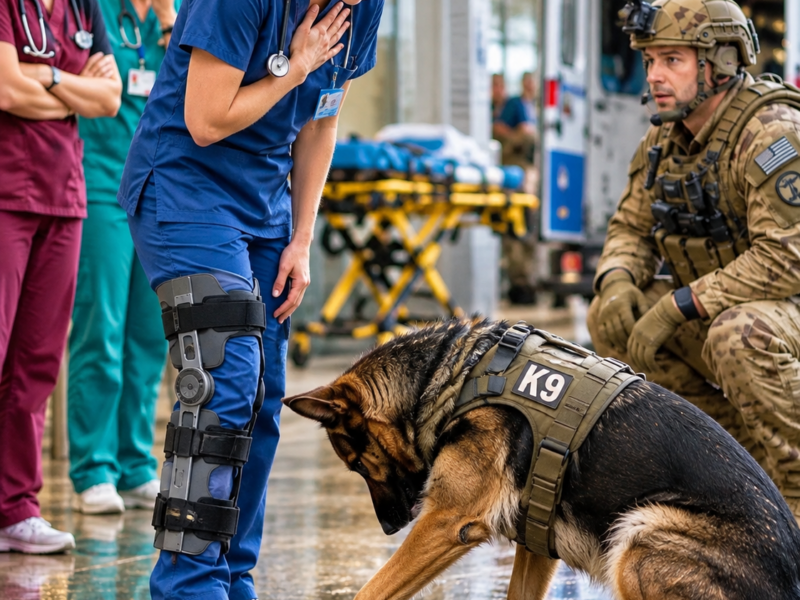
“The nurses laughed when I limped into the emergency room wearing a torn uniform and carrying my medical bag
The name David Miller hit me harder than the truck ever had.
For a moment, the emergency room seemed to tilt. The monitors kept beeping. Nurses hurried past. Someone called for a portable X-ray. But all I could hear was Marcus Reed repeating that name.
“David Miller,” I whispered.
Ranger stood beside my chair, his broad body pressed against my injured leg. His ears were forward, and his eyes moved between Marcus and me.
Marcus noticed my expression.
“You know him?”
I gripped the edge of the chair. “I knew him thirteen years ago.”
“Was he the patient coming in?”
“I don’t know. I haven’t seen him since he disappeared.”
Marcus glanced toward the ambulance entrance. “Emily, I think you need to tell me what happened.”
Before I could answer, the trauma doors swung open.
Two paramedics rushed in with a stretcher. A man lay beneath a gray blanket, his face pale and bruised. His hair had gone almost completely silver. A bandage covered his forehead, and an oxygen mask hid most of his expression.
But I recognized his eyes.
David.
My hands went cold.
“Emily?” Patricia hurried toward me. “What’s wrong?”
I couldn’t answer.
David’s gaze drifted across the room. Then it stopped on me.
Even through the oxygen mask, I could tell he was trying to speak.
“Get him into Trauma Two,” the attending physician ordered.
As the team moved him away, David lifted one trembling hand.
He pointed at me.
Then he mouthed two words.
“I’m sorry.”
I had spent thirteen years wondering whether I would ever see him again.
I had imagined a hundred different conversations.
Not once had I imagined he would return to my hospital on a stretcher, injured, frightened, and apologizing before anyone had even asked him a question.
Ranger suddenly stood.
His body stiffened. A low sound came from his chest.
Marcus put a hand on his collar.
“Easy, buddy.”
The dog didn’t growl at David.
He was watching the hallway behind the stretcher.
A moment later, he turned back toward me and pressed his nose against my brace.
Marcus crouched beside him.
“Emily, we need to get someone to examine your leg.”
“I’m fine.”
“No, you’re not.”
“I’ve been a nurse for twelve years. I know what a fracture feels like.”
“And I’ve spent enough time with working dogs to know when one is trying to tell us something.”
I looked down at Ranger.
His attention never left my injured leg.
The attending physician, Dr. Patel, approached with a chart.
“Emily, Marcus tells me you’ve been having increased pain and tightness in your calf.”
“I’ve had some swelling. That’s normal after a fracture.”
“How long?”
“Since yesterday.”
“Any shortness of breath? Chest pain?”
“No.”
He examined my brace and gently pressed along my calf. I winced.
His expression changed.
“I want an urgent ultrasound to rule out a blood clot. And I want you evaluated before you go anywhere near your next shift.”
My first instinct was to argue.
Then I saw Marcus’s face.
He wasn’t looking triumphant. He looked worried.
I nodded.
“Okay.”
A transport nurse arrived with a wheelchair. Ranger followed us until Marcus gave him a quiet command to stay.
The dog sat, but his eyes followed me all the way down the corridor.
For the first time since my accident, I wondered whether my body had been trying to warn me about something I was too stubborn to notice.
The ultrasound confirmed a deep vein thrombosis in my injured leg.
A blood clot.
The physician explained that fractures, reduced mobility, and swelling could increase the risk. I would need immediate treatment and monitoring. If the clot traveled to my lungs, the consequences could be life-threatening.
I stared at the screen.
A few hours earlier, I had been worried about returning to work and proving I wasn’t weak.
Now I was being admitted to the hospital where I had spent years caring for everyone else.
Patricia sat beside my bed.
“You scared me,” she said.
“I didn’t know.”
“I know. That’s why you have to stop pretending you can handle everything alone.”
I looked toward the door.
“Did Marcus leave?”
“He’s with Ranger. They’re waiting outside.”
“Why?”
Patricia shrugged. “Maybe because that dog likes you.”
I gave a weak laugh.
But the truth was that I wanted them to stay.
Because David Miller had returned, and I had a terrible feeling that the past was about to open its doors.
***
Thirteen years earlier, David had been the first person who made me believe I could build a life outside the hospital.
We met when I was twenty-four and working nights at a small community clinic outside Nashville.
He was a volunteer firefighter, studying emergency management and helping with community disaster training.
He had an easy smile, a quiet sense of humor, and a habit of showing up whenever someone needed help.
He never treated my long shifts like a burden.
He brought me coffee. He waited in the parking lot after late nights. He learned which patients I worried about after going home.
For a while, I thought he was the safest person in my life.
Then one night, a teenager named Lily came into the clinic after a car accident.
She was frightened and bleeding, but conscious. David had been nearby when the crash happened and had helped get her out of the vehicle.
I was the nurse who treated her.
Later, I learned that Lily had been carrying a small envelope containing documents about a local construction company. Her father had been trying to expose unsafe work practices at a site where several accidents had occurred.
David told me he had seen someone remove the envelope from the wrecked car.
He said he was going to report it.
A week later, Lily’s father was found dead in what authorities called an accidental fall at a construction site.
David became convinced the accident was not an accident.
He started asking questions. He made copies of records. He told me someone had threatened him.
I begged him to go to the police.
He said he had already tried.
Then, one evening, he disappeared.
His apartment was empty. His phone was disconnected. His employer said he had resigned.
I called every person I could think of.
I even filed a missing-person report.
The investigator eventually told me there was no evidence of foul play and that David might have left voluntarily.
I didn’t believe it.
But I had no way to prove otherwise.
Months became years.
I stopped calling.
I stopped asking.
And eventually, I learned how to live with a question that had no answer.
Now that question was lying in Trauma Two.
***
Marcus came to my room later that evening.
He had left Ranger with a hospital-approved handler from the veterans’ rehabilitation program.
“Can I come in?” he asked.
“Of course.”
He pulled a chair close to my bed.
“How’s the leg?”
“They started treatment. They’re keeping me overnight.”
“Good.”
I looked at him.
“Why did Ranger react like that?”
Marcus considered his answer.
“I don’t want to pretend I know exactly what he smelled. Dogs can detect changes humans can’t, but we shouldn’t turn that into magic. He may have noticed changes in your breathing, your movement, your stress, or something about the injured area. What matters is that he reacted strongly enough for me to take it seriously.”
“He might have saved my life.”
“He might have helped you get checked sooner. The doctors found the clot. That’s what matters.”
I looked at my hands.
“Why was he so focused on me?”
Marcus leaned back.
“Ranger was trained for search and rescue work before he retired. He spent years learning to locate people in dangerous conditions. After I left the Navy, I worked with him in a rehabilitation program for veterans and first responders.”
“Was he deployed with you?”
“Yes. He was part of my team for several years.”
I studied the dog tags hanging from Marcus’s neck.
“You said he recognized something.”
“I said he was reacting to something. I don’t know what.”
He paused.
“But I know what it looks like when he believes someone needs help.”
I swallowed.
“David needs help too.”
Marcus’s expression became serious.
“Then tell me what you know.”
I told him about Lily, the construction company, the envelope, and David’s disappearance.
I told him how I had spent years believing I had missed something important.
Marcus listened without interrupting.
When I finished, he said, “The name David Miller came up in a conversation I had with a friend a few months ago.”
“What?”
“He works in investigations involving public corruption and contractor fraud. He mentioned a witness who had disappeared years ago after reporting suspicious activity connected to a construction company. He didn’t give me a name then.”
“Why didn’t you tell me?”
“Because I didn’t know it was the same person. And because I didn’t want to make promises.”
I stared at him.
“Do you think David was hiding?”
“I think we should let him explain.”
Before I could answer, a nurse appeared at the door.
“Emily, the patient in Trauma Two is awake. He’s asking for you.”
I looked at Marcus.
He stood.
“I’ll go with you.”
***
David looked smaller than I remembered.
The man who had once carried injured people out of wrecked cars now struggled to lift his head from the pillow.
A nurse had removed his oxygen mask. His lips were cracked, and his voice sounded rough.
“Emily.”
I stopped beside the bed.
For several seconds, neither of us spoke.
Then I said, “You owe me thirteen years.”
His eyes filled.
“I know.”
“You disappeared. No explanation. No goodbye. I thought you were dead.”
“I wanted to come back.”
“But you didn’t.”
He looked down.
“I was afraid.”
I felt anger rise in my chest.
“Afraid of what? Of talking to me?”
“Of putting you in danger.”
I let out a short, bitter laugh.
“You don’t get to decide what I can handle by disappearing.”
“I know.”
“Then why?”
David closed his eyes.
When he opened them again, there was something in his expression I hadn’t seen before.
Shame.
“Because someone knew you had treated Lily. They knew you had seen the envelope before it disappeared. They thought you might remember details that could connect them to what happened.”
I remembered the night in the clinic.
Lily’s trembling hands.
The envelope.
A man standing near the doorway, pretending to read a notice on the wall.
My stomach tightened.
“Who?”
“Richard Voss.”
The name meant nothing to me at first.
Then I remembered the construction company.
Voss Development.
Its signs were all over Nashville.
David continued.
“He was the operations director at the time. His father owned the company. They had been cutting safety corners for years. Lily’s father had evidence. He was going to take it to the state investigators.”
“And the envelope?”
“Copies of inspection reports, photographs, and messages. Lily’s father had given them to her because he thought no one would suspect a teenager.”
I stared at him.
“Did you get them?”
“I recovered some of the documents after the accident. But by then, people were watching me.”
“Why didn’t you trust the police?”
“I tried. One of the officers I spoke to had a connection to the company. My report disappeared. A week later, someone broke into my apartment.”
He took a shaky breath.
“I thought if I stayed, they’d use you to get to me.”
“So you left me with nothing.”
“I thought I was protecting you.”
“You were protecting yourself from having to tell me the truth.”
He flinched.
I hadn’t meant to say it so sharply.
But I couldn’t take it back.
Marcus stood near the doorway, silent.
David looked at him.
“Are you the man with the dog?”
“Marcus Reed.”
“Ranger?”
Marcus nodded.
David managed a faint smile.
“I saw him when they brought me in. He looked familiar.”
“He’s been around a lot of emergency scenes.”
David turned back to me.
“Emily, I didn’t come here by accident.”
My anger faltered.
“What do you mean?”
“I was trying to find you.”
“Why now?”
“Because I finally found someone who could help me bring the evidence forward.”
He shifted painfully.
“I was on my way to meet an investigator when a truck forced my car off the road. I don’t know whether it was deliberate, but I recognized the vehicle. It belonged to a company connected to Voss.”
I felt a chill move through me.
“Did they follow you here?”
“I don’t know.”
Marcus stepped closer.
“Did anyone see you arrive?”
“The paramedics. The highway patrol. Probably the driver who hit me.”
Marcus nodded slowly.
“I’ll notify hospital security. The police can handle the investigation.”
David looked at me.
“I have something for you.”
“What?”
He motioned toward the bedside cabinet.
A nurse brought over a small plastic property bag.
Inside was a folded photograph.
I recognized the people immediately.
Lily stood beside her father. David was behind them, one hand resting on Lily’s shoulder.
On the back, someone had written:
*For the people who refused to look away.*
My throat tightened.
“I kept this,” David whispered. “I carried it every time I had to move.”
I turned the photograph over again.
“Where’s Lily now?”
“She’s alive. She’s an adult now. She has a family of her own.”
“Does she know what happened?”
“She knows some of it. Not everything.”
I looked at David.
“Then we tell her.”
He nodded.
For the first time since he had returned, I saw something other than fear in his face.
Hope.
***
The next morning, the hospital’s security supervisor came to speak with us.
A police detective was with him.
They had reviewed the report from the highway patrol and were investigating whether David’s crash had been intentional.
They also wanted to know whether anyone had approached the hospital asking about him.
“Two men came to the front desk last night,” the security supervisor said. “They claimed to be relatives. They couldn’t provide the patient’s full name or date of birth. When staff asked them to wait, they left.”
David went pale.
“That’s them.”
The detective wrote something down.
“Did you recognize either man?”
“One of them. He worked for Voss Development.”
The detective asked for a description.
David provided it.
Then he turned to me.
“Emily, I need you to understand something. If these people think you have information, they may try to contact you.”
I nodded.
“I understand.”
Marcus stood near the window.
“Hospital security can escort staff and visitors. I’ll make sure the veterans’ program knows not to bring Ranger into the building without clearance.”
I looked at him.
“You don’t have to stay involved.”
“I know.”
“Then why are you?”
He glanced toward Ranger, who was lying quietly beside the door.
“Because someone who needed help was standing in front of us. That’s usually reason enough.”
I looked away before he could see my eyes fill.
Later that afternoon, Jessica came to my room.
She held a paper cup of coffee and looked uncomfortable.
“I heard about the clot,” she said.
“I’m being treated.”
“I’m glad.”
She set the coffee down.
For a moment, she didn’t speak.
Then she said, “I owe you an apology.”
I looked at her.
“For what?”
She shifted her weight.
“For the things I said when you came back. The jokes about your cane. The comments about you being a liability.”
I said nothing.
“I thought I was being funny. I didn’t think about what it was like for you to come back after an accident.”
“You made it harder than it needed to be.”
“I know.”
She swallowed.
“I was frustrated because we were short-staffed. But that’s not an excuse.”
“No, it isn’t.”
Her eyes lowered.
“I hope you get better.”
I nodded.
“Thank you.”
It wasn’t a dramatic reconciliation.
I didn’t suddenly feel close to her.
But I appreciated that she had come.
When she left, Patricia appeared in the doorway.
“Look at you,” she said. “Accepting apologies like a professional.”
“Don’t start.”
She smiled.
Then she sat beside me.
“You know what I think?”
“What?”
“I think you spent so long being the person who takes care of everybody else that you forgot you were allowed to need care too.”
I stared at the blanket.
That sentence hurt because it was true.
***
The investigation moved slowly, but it moved.
David’s vehicle had a damaged rear bumper and a tire that showed signs of being struck before the crash. Investigators recovered footage from a traffic camera showing a dark utility truck following him for several miles.
The truck was registered to a subcontractor working for Voss Development.
A search warrant was issued.
They found copies of old inspection reports, payment records, and internal messages on a storage device hidden in a locked office.
The documents connected several executives to falsified safety inspections.
They also showed that Lily’s father had repeatedly reported dangerous conditions before his death.
The company had ignored the reports.
Worse, some employees had been instructed to remove evidence after his accident.
David had spent thirteen years trying to preserve what remained.
He had moved between temporary jobs, changed addresses, and avoided people who might recognize him.
He had made mistakes.
He had kept me in the dark.
But he had never stopped trying to get the truth into the right hands.
A week after my admission, Marcus brought Ranger to visit under the hospital’s therapy-animal policy.
The dog entered quietly, his nails tapping against the floor.
He came straight to my bedside and rested his chin on the mattress.
I laughed.
“Hello, troublemaker.”
His tail moved slowly.
Marcus smiled.
“That’s the closest thing to a thank-you he’ll accept.”
I reached down and scratched Ranger behind the ears.
“Thank you for not giving up on me.”
Marcus watched us for a moment.
“He doesn’t give up easily.”
“Neither do you, apparently.”
He looked toward the window.
“Some things are worth staying for.”
I wondered what he meant, but I didn’t ask.
Instead, I told him something I hadn’t told anyone.
“When I got hit by that truck, I thought my life had become smaller. I couldn’t run. I couldn’t work a full shift. I couldn’t even walk down my own hallway without planning where to put my cane.”
Marcus pulled his chair closer.
“Being injured changes what you can do. It doesn’t change what you’re worth.”
I looked at him.
“Do you believe that?”
“I’ve had to learn it.”
He touched the small scar near his wrist.
“After I left the service, I didn’t know who I was without my team. Ranger helped me find a different way to be useful. But it took time.”
I glanced at the dog.
“He helped you too.”
Marcus smiled.
“More than he knows.”
***
Three weeks later, I was discharged from the hospital.
The clot was responding to treatment, and my doctors had adjusted my recovery plan. I still needed the brace, the cane, and regular follow-up appointments.
But I was alive.
And I was finally learning not to treat that as a small thing.
David remained in the hospital longer because of his injuries. Before I left, I visited him.
“I’ll come back,” I told him.
He looked relieved.
“I hope you do.”
I stood beside his bed.
“David, I don’t know what happens between us now.”
“I don’t expect you to forgive me.”
“Good. Because I can’t promise that.”
He nodded.
“But I want you to know that I’m glad you’re alive.”
His eyes filled again.
“That’s more than I deserve.”
I shook my head.
“Don’t decide what you deserve for me.”
He gave a small, tired smile.
I left the room with a weight still in my chest, but it was different from the one I had carried for thirteen years.
The unanswered questions were finally becoming answers.
And I no longer had to carry them alone.
***
Two months later, the investigation reached a public hearing.
Lily attended.
She was thirty now, with a little girl who held her hand and a husband who sat beside her.
When she saw me, she walked across the room and hugged me.
“I remember you,” she said. “You were the nurse who stayed with me when I couldn’t stop shaking.”
I held her tightly.
“I remember you too.”
David testified about the documents he had recovered and the threats that had driven him away.
Lily described the reports her father had collected.
I spoke about the night she came into the clinic, the envelope, and the man I remembered near the doorway.
It was difficult.
But it was also the first time I had spoken about those events without feeling like I was shouting into an empty room.
The hearing led to a formal investigation of Voss Development’s past contracts and safety practices.
Several executives were charged with evidence tampering, fraud, and conspiracy. The investigation into the death of Lily’s father remained open, but authorities announced they were reviewing evidence previously overlooked.
Nothing could return her father.
Nothing could give David back thirteen years.
But the truth was no longer buried.
After the hearing, Lily found me in the hallway.
“Thank you,” she said.
I shook my head.
“You don’t owe me anything.”
“I know. I’m saying it because I want to.”
Her daughter tugged at her sleeve.
“Mom, is that the nurse?”
Lily smiled.
“Yes. This is Emily.”
The little girl looked up at me.
“Thank you for helping my grandpa.”
I knelt carefully, mindful of my healing leg.
“Your grandpa was brave.”
Lily’s expression softened.
“He was.”
For a moment, I thought about how close we had come to losing the story entirely.
A teenage girl.
A frightened volunteer.
A nurse who remembered a face.
A dog who refused to ignore something that didn’t seem right.
None of us had been able to fix everything.
But together, we had helped bring the truth back into the light.
***
My first day back at work was not the triumphant return I had once imagined.
I arrived with my brace, my cane, and a list of restrictions from my physician.
I couldn’t lift heavy equipment.
I couldn’t stand for long periods.
I couldn’t take every assignment.
I had to accept help.
Jessica met me at the staff entrance.
“Morning, Emily.”
“Morning.”
She took one look at my cane.
“Need me to carry your bag?”
I hesitated.
Then I handed it to her.
“Thank you.”
It was a small moment.
But it felt like a beginning.
Patricia greeted me at the nurses’ station with a smile and a stack of paperwork.
“Welcome back. We saved you the easy stuff.”
I raised an eyebrow.
“Nothing in this place is easy.”
She laughed.
Across the lobby, Marcus was waiting with Ranger.
They were scheduled to visit the rehabilitation program’s new group of patients.
Ranger spotted me and walked over with his familiar steady steps.
He stopped beside my cane and looked up.
I crouched slowly.
“I’m okay now, buddy.”
He sniffed my brace once, then rested his head against my knee.
Marcus came up behind him.
“He wanted to make sure.”
“I think he has a very low opinion of my judgment.”
“That’s possible.”
I smiled.
Then I looked at the dog who had refused to leave my side when I was too proud to admit I needed help.
“Marcus?”
“Yeah?”
“Would you and Ranger like to come by again next week?”
He smiled.
“I think we can arrange that.”
I glanced at the hospital doors.
For thirteen years, I had believed the past was something I had to survive by myself.
For months, I had believed my injury made me less useful, less capable, less worthy of being seen.
I had been wrong about both.
Sometimes help arrives as a friend who sits beside your hospital bed.
Sometimes it arrives as a colleague who finally learns to say she’s sorry.
And sometimes it arrives on four paws, with a steady gaze and a refusal to walk away.
Ranger had not known the whole story.
He hadn’t needed to.
He had simply noticed that something was wrong when everyone else was busy laughing, rushing, or looking somewhere else.
And that was enough to change everything.
I rested my hand on his head.
“Good boy,” I whispered.
His tail thumped once against the floor.
For the first time in a long while, I didn’t feel like the injured nurse everyone had been watching.
I felt like Emily again.
And I was finally ready to let people stand beside me.
THE END.









