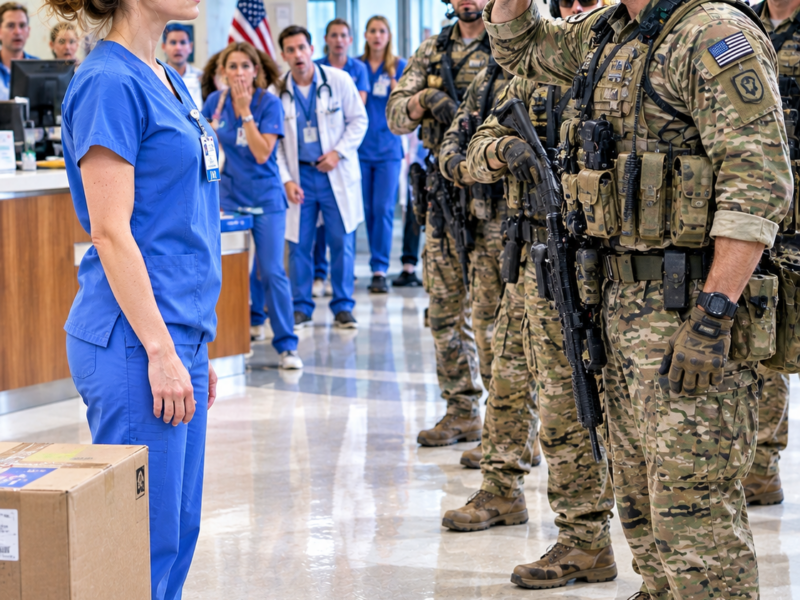
“The nurse had just removed her badge and completed her final shift after thirty years of being overlooked
For several seconds, I couldn’t speak.
Commander Walker stood before me with the open case in his hands, while five Navy SEALs remained at attention behind him.
The emergency department had gone completely quiet.
Even Dr. Brooks had stopped walking.
I stared at the photograph of Daniel Reeves.
Eleven years earlier, I had held that young man’s hand while doctors fought to keep him alive.
Eleven years earlier, I had promised him he would see his mother again.
And eleven years earlier, someone had told me that promise had been fulfilled.
Apparently, someone had lied.
“Commander,” I finally whispered, “what happened to Daniel?”
Walker closed the case halfway.
“Before I answer that, ma’am, may we speak somewhere private?”
I glanced toward the emergency department.
Denise stood near the nurses’ station, her hand pressed against her mouth.
Dr. Brooks looked as though he wanted to ask a dozen questions but couldn’t decide which one to ask first.
“There’s a conference room down the hall,” I said.
Walker nodded to his men.
Two followed us.
The remaining three stayed near the entrance, their expressions alert but respectful.
As we walked, I felt the years between my life now and the woman I had once been begin to collapse.
I was sixty-one.
My husband had been gone for four years.
My daughter lived three states away, and my retirement plans consisted of a small garden, a stack of unread books, and learning how to make bread without burning it.
I had thought my hardest days were behind me.
I had been wrong before.
Inside the conference room, Walker placed the case on the table.
“Please sit, ma’am.”
I gave him a tired look.
“You can stop calling me that.”
He hesitated.
“With respect, I don’t think I can.”
“I’m a retired nurse. I haven’t worn a military uniform in decades.”
“That’s not why I’m calling you ma’am.”
He opened the case again.
The flag lay folded beside the medal.
Underneath was a thick envelope bearing an official seal.
“Eleven years ago,” he began, “a Navy SEAL team was sent to extract an intelligence officer and several wounded personnel from a temporary medical station in Afghanistan. The extraction point came under attack before the aircraft arrived.”
I remembered the night.
The explosions had shaken dust from the ceiling.
The generator had failed twice.
We had worked by emergency lights while injured men were carried through the entrance.
I had been a civilian nurse attached to a military medical support unit, sent overseas because the field hospital was desperately short of experienced medical staff.
I had volunteered for the assignment.
My husband had begged me not to go.
I had promised him I would come home.
“Daniel was one of the wounded,” Walker continued. “He suffered multiple injuries and significant blood loss. The medical team believed he might not survive the night.”
“I remember.”
“You stayed with him.”
“I was his nurse.”
“You did more than your duty required.”
I looked away.
“People always say that when they don’t know what else to say.”
Walker didn’t argue.
Instead, he took a second photograph from the case.
It showed a group of young men standing in front of a transport helicopter.
Daniel stood in the center, thinner than I remembered, with one arm in a sling.
I recognized two other faces.
One belonged to a medic who had worked beside me during the extraction.
The other belonged to a young officer who had spent the night helping carry wounded soldiers through the smoke.
“Daniel survived,” Walker said.
I gripped the edge of the table.
For a moment, the words didn’t seem to mean anything.
Then they did.
My eyes filled.
“He survived?”
“Yes, ma’am.”
I covered my mouth with one hand.
A laugh escaped me, followed immediately by a sob.
I had spent eleven years wondering whether he had made it home.
I had imagined his mother waiting for a knock at the door.
I had imagined a folded flag.
I had imagined a phone call that never came.
And now a stranger was telling me that Daniel had lived.
“Why didn’t anyone tell me?” I asked.
Walker lowered his eyes.
“That’s what we’ve been trying to understand.”
He slid the envelope toward me.
Inside were copies of medical records, an official commendation, and a letter written on lined paper.
The handwriting was familiar.
I recognized the way Daniel crossed his sevens and pressed too hard on the downstroke of every capital letter.
My hands shook as I unfolded it.
Miss Hayes,
If you are reading this, then I hope someone finally found you.
You probably don’t remember everything about that night. I remember more than I wish I did.
I remember waking up and hearing you tell me to keep fighting.
I remember you promising that I would see my mother again.
And I remember you refusing to leave when the alarms started and everyone was told to evacuate.
You stayed until the last wounded man was moved.
You told me later that you weren’t brave. You said you were simply doing your job.
But you need to know something.
You saved my life, and you helped save the lives of the men who couldn’t walk out on their own.
When I recovered, I tried to find you. I was told you had returned home. Later, I was told the records were incomplete and that your service had never been properly documented.
I asked for help. I wrote letters. I submitted requests.
Eventually, I was told there was nothing more to be done.
I never believed that.
I hope you are well. I hope your family knows how much you gave that night.
I hope you know that we remember.
Daniel.
I read the letter twice.
Then I read it a third time.
“They tried to find me?”
Walker nodded.
“Daniel made repeated requests. He wanted to thank you personally and ensure that your actions were formally recognized.”
“Why was my service never documented properly?”
“Some of the medical and operational records from that extraction were sealed during an internal review. Your name was recorded incorrectly in one report, and your civilian employment history was never connected to the military file.”
“That sounds like a paperwork mistake.”
“It may have started that way.”
His expression told me it hadn’t ended there.
“What aren’t you telling me?”
Walker took a slow breath.
“After Daniel recovered, he reported that a number of evacuation decisions had been made without proper authorization. His statement became part of an inquiry. Several records were restricted, and the people who had worked at the medical station were asked not to discuss the incident publicly.”
I stared at him.
“I was never asked anything.”
“According to the records we’ve recovered, a request for your statement was sent to an address you had already left. The request was returned, but no one followed up.”
“Eleven years.”
“Yes, ma’am.”
“Eleven years because somebody sent a letter to the wrong address?”
Walker didn’t answer immediately.
“I can’t tell you whether that was negligence or something deliberate. The review is still ongoing.”
I looked down at the letter.
The pain I felt wasn’t about a medal.
It wasn’t about recognition.
It was the knowledge that for eleven years, I had carried questions that someone might have answered with a simple phone call.
“Where is Daniel now?”
Walker’s expression softened.
“He’s alive. He’s still serving, though he’s no longer assigned to operational missions.”
“Then why isn’t he here?”
The commander glanced toward the closed door.
“Because he wanted to be the one to tell you what happened next.”
He took out his phone and sent a brief message.
A minute later, someone knocked.
Walker stood.
“Come in.”
The door opened.
A man in civilian clothes stepped inside.
He was tall and broad-shouldered, with a slight limp and a faint scar along his jaw.
His hair had begun to gray at the temples.
But his eyes were the same.
I knew those eyes.
I had watched them struggle to stay open beneath the harsh lights of a field hospital.
I had told those eyes that they had a future.
He stopped in the doorway.
“Miss Hayes?”
My chair scraped against the floor as I stood.
“Daniel?”
His face broke into a smile.
“Yes, ma’am.”
I crossed the room before I could think.
He caught me in a careful embrace, holding me as though he was afraid I might disappear.
For a few seconds, neither of us spoke.
Then I struck his shoulder lightly with the palm of my hand.
“You ungrateful young man.”
He laughed, and tears slid down his face.
“I know.”
“Eleven years?”
“I know.”
“I thought you were dead.”
“I know.”
I stepped back to look at him.
“You could have written.”
“I did.”
“I never received anything.”
His smile faded.
“I found out.”
“What does that mean?”
Daniel glanced at Walker, who nodded for him to continue.
“I sent letters through the military contact office. I submitted requests through the hospital administration. I even wrote to the professional nursing association listed in my file.”
“And?”
“Some letters came back. Others were marked delivered, but nobody could confirm who received them.”
I shook my head.
“That makes no sense.”
“No. It doesn’t.”
He reached into his jacket and took out a small envelope.
“I kept one copy.”
He handed it to me.
The letter was dated nine years earlier.
It had my name and the address of St. Catherine’s Medical Center.
The address was correct.
So was the department.
At the bottom was a handwritten note from an unknown recipient.
Do not forward. Subject has no verified connection to military medical service.
I stared at the words.
“What does that mean?”
Daniel’s jaw tightened.
“It means somebody decided you didn’t count.”
For a moment, the room was silent.
Then I folded the letter carefully.
“I’ve spent thirty-two years taking care of people,” I said. “I never needed a medal. I never expected anyone to call me a hero.”
“I know.”
“But I deserved to know you survived.”
Daniel lowered his head.
“Yes, ma’am. You did.”
I looked at him for a long time.
Then I reached for his hand.
“Sit down before your leg gives out.”
He laughed softly.
“Yes, ma’am.”
And just like that, the years between us became a little less impossible.
We talked for nearly two hours.
Daniel told me about his recovery, the long rehabilitation, and the months he spent learning to walk without assistance.
He told me about his mother, who had kept every letter he sent home.
He told me about the men from his team who had survived the extraction and the families of those who hadn’t.
I told him about David, my husband, who had died four years earlier after a sudden heart attack.
I told him about my daughter, Emily, and how she had once threatened to become a nurse just to prove she could survive my stories about night shifts.
I told him about the patients I remembered most.
The little girl who had clutched a stuffed rabbit while waiting for surgery.
The old veteran who had apologized for crying when his wife died.
The young man who had arrived after a motorcycle crash and insisted that his mother must never see him afraid.
Daniel listened to every story.
He didn’t check his phone.
He didn’t look at the clock.
He didn’t interrupt.
It was the first time in years that I had spoken about my work without feeling I needed to make it sound smaller.
At last, Daniel leaned forward.
“There’s something else.”
I sighed.
“I knew there would be.”
He smiled, but his expression soon became serious.
“The Navy wants to recognize what you did that night.”
“I don’t need recognition.”
“I know.”
“Then why bring it up?”
“Because the recognition isn’t just about you. It’s about making sure the record is right.”
He placed a second document on the table.
It was a formal citation detailing the evacuation and the medical support provided under fire.
My name appeared near the top.
Margaret Hayes, civilian registered nurse.
For the first time, the record correctly described what I had done.
It stated that I had remained at the field hospital during the attack, helped stabilize multiple casualties, and assisted in evacuating wounded personnel when the facility came under direct threat.
I read the page slowly.
“I was doing my job,” I whispered.
Daniel nodded.
“You were. And your job saved lives.”
He pointed to the final paragraph.
“There’s another part. The command is reviewing the records of everyone who worked at that station. Some of the people who helped us were never properly credited. They want to correct that.”
I looked at the document.
I thought of the local medical workers who had carried stretchers beside us.
The interpreter who had stayed to guide wounded men through the back corridor.
The driver who had returned for another load of casualties even after his vehicle was damaged.
They deserved to be remembered, too.
“Make sure their names are included,” I said.
Daniel smiled.
“That was the first thing you asked for in your statement.”
I blinked.
“What statement?”
“The one you gave before the extraction. You recorded the names of every person who had helped, even when you were exhausted.”
I had forgotten that.
I had been afraid the people who worked beside us would vanish from the record.
So I had written their names down on the back of a supply list.
I never knew whether anyone kept it.
“They found it?”
“Yes.”
I sat back.
For years, I had assumed that the details that mattered most had been lost.
But somewhere, in a box or an archive, a tired nurse’s list of names had survived.
That evening, I accepted an invitation to attend a small ceremony at the naval medical center the following month.
Not because I wanted to be called a hero.
Because I wanted the men who had survived that night to know that someone remembered them.
And because Daniel had asked me to come.
The story spread through St. Catherine’s before I returned to the emergency department.
By the time I reached the nurses’ station, Denise was waiting for me.
Her eyes were red.
“Margaret Hayes,” she said, “you have some explaining to do.”
I groaned.
“Please don’t start.”
“You spent thirty-two years here and never told us you worked in a combat hospital?”
“I was a civilian nurse supporting a military medical team.”
“You were under fire?”
“Sometimes.”
“You helped evacuate Navy SEALs?”
“I helped evacuate wounded people.”
Denise crossed her arms.
“And you were planning to retire without mentioning any of this?”
I gave her a small smile.
“I didn’t think it was relevant to my retirement.”
She shook her head.
“You are impossible.”
“I’ve been told.”
Dr. Brooks approached from the corridor.
He looked uncomfortable.
“Margaret, may I speak with you?”
I nodded.
He waited until Denise stepped away.
“I owe you an apology.”
I studied him.
“For what?”
“For taking your work for granted. For treating you like someone who could always be asked to do one more thing. And for assuming that because you were quiet, there wasn’t much more to know about you.”
I didn’t answer immediately.
He continued.
“I read the preliminary account of what happened overseas. I don’t think I could have done what you did.”
“Maybe you could have,” I said. “You don’t know until you’re there.”
He looked surprised.
“I don’t feel very heroic when I’m in the emergency department.”
“Good. That means you’re paying attention to the patients instead of yourself.”
He laughed softly.
Then his expression became serious again.
“I hope you enjoy retirement, Margaret. Truly.”
“Thank you, Evan.”
He offered his hand.
I shook it.
The apology didn’t erase every small slight from the years before.
But it was honest, and I accepted it as a beginning.
Denise gathered the staff in the break room that afternoon.
There were no speeches this time.
No grand announcement.
Just a cake, a few paper plates, and a handwritten card covered in signatures.
On the front, someone had written:
To the nurse who taught us that being quiet doesn’t mean being small.
I took it home.
I placed it beside David’s photograph and the old brass compass.
For the first time in years, I opened the drawer where I kept my military identification tag.
I set the card beside it.
Then I closed the drawer gently.
I didn’t need to become someone else to understand my own life.
I only needed to stop pretending the parts I had hidden were unimportant.
The ceremony took place four weeks later.
I wore a simple navy-blue dress and the small silver pin David had given me on our twentieth anniversary.
Emily flew in from Oregon and arrived at my house the night before.
When I opened the door, she looked at me for a long moment.
“Mom,” she said, “why didn’t you ever tell me?”
I pulled her into a hug.
“I didn’t know how to explain it.”
“You could have tried.”
“I know.”
She leaned back.
“I’m proud of you.”
Those four words nearly undid me.
I had spent so much of my life trying to make sure other people were all right that I had forgotten how much it meant to hear someone say they were proud of me.
At the naval medical center, the room was smaller than I expected.
There were no television cameras.
No reporters.
No elaborate stage.
Just service members, medical personnel, several families, and a row of photographs honoring the people who had worked at the field hospital.
Commander Walker greeted me at the entrance.
“Welcome, ma’am.”
I smiled.
“You’re still doing that.”
“Yes, ma’am.”
Daniel stood beside him.
He had put on his dress uniform.
When he saw me, he straightened.
For a moment, I saw the young man from the photograph.
Then he stepped forward and offered his arm.
“Ready?”
I looked around the room.
At the families.
At the medical workers.
At the names printed on the wall.
“No,” I said honestly.
He laughed.
“Good. Neither was I the first time.”
The ceremony began with a short account of the evacuation.
The speaker didn’t describe me as fearless.
He described me as a nurse who stayed with her patients when the situation became dangerous.
That was enough.
When my name was called, I walked to the front.
Commander Walker presented the commendation.
Then Daniel stepped forward.
He held the folded flag in both hands.
“Margaret Hayes,” he said, his voice trembling slightly, “on behalf of the men who came home because you refused to leave them behind, thank you.”
I took the flag.
I looked at him.
Then I looked at the families seated in the first row.
A woman held a photograph of a young man in uniform.
An older couple sat shoulder to shoulder, their hands clasped tightly.
A child watched the ceremony with solemn eyes.
I understood then that this was never really about me.
It was about the people whose names had almost disappeared.
It was about the truth that had been delayed.
It was about the ordinary acts of courage that rarely made it into official reports.
I stepped toward the microphone.
“I was a nurse,” I said. “I was scared that night. I was tired, and I didn’t know whether any of us would get home.”
The room became still.
“But I knew there were people who needed help. So I did what I had been trained to do. Other people did the same. Doctors, medics, drivers, interpreters, and local staff all risked their lives to get the wounded out.”
I paused.
“If you remember anything about that night, please remember all of them. Nobody survives something like that alone.”
I stepped away from the microphone.
The applause began softly.
Then it grew until the room seemed to vibrate with it.
I had never liked being the center of attention.
But this time, I didn’t look down.
I let the applause reach me.
Not because I needed strangers to tell me I mattered.
Because I finally understood that accepting gratitude wasn’t the same as asking for praise.
Sometimes it was simply allowing someone else to say what they had carried for too long.
After the ceremony, Daniel found me standing near a display of photographs.
“There’s one more thing,” he said.
I turned toward him.
“Daniel, if this is another surprise, I may need to sit down.”
He smiled.
“It’s a small one.”
He handed me a plain envelope.
Inside was a photograph of the medical team taken the morning after the extraction.
I recognized myself immediately.
I was sitting on a crate beside a stack of supplies, my hair tucked beneath a cap, my uniform stained with dust.
I looked exhausted.
I also looked younger than I remembered.
Beside me stood Daniel, pale but conscious, his arm resting across my shoulders.
On the back, he had written:
You told me I would see my mother again. You were right.
I pressed the photograph against my chest.
“I wish I’d known.”
“So do I.”
I looked up at him.
“What happens now?”
He thought about it.
“I go back to my work. You start your retirement. And maybe we stop letting eleven years of missing paperwork decide what comes next.”
I laughed softly.
“That sounds suspiciously reasonable.”
“I’m trying something new.”
We walked outside together.
The afternoon air was cool, and the sky was bright after a morning of rain.
Emily waited by the entrance, talking with Commander Walker.
When she saw us, she waved.
Daniel slowed beside me.
“Do you ever miss it?” he asked.
“The hospital?”
“The work. Taking care of people.”
I considered the question.
“I’ll miss the people. I’ll miss the moments when someone who was terrified realizes they’re going to be all right. I’ll miss knowing exactly what needs doing when everyone else is overwhelmed.”
“And the night shifts?”
“Not for one second.”
He laughed.
I looked toward the road, where cars moved through the afternoon traffic.
“For years, I thought retirement meant leaving all of that behind. Now I think it means I finally get to choose what I carry with me.”
Daniel nodded.
“You’ve earned that.”
I gave him a sideways glance.
“You’re going to keep calling me ma’am, aren’t you?”
“Yes, ma’am.”
I shook my head, smiling.
“Then I suppose I’ll have to get used to it.”
At home that evening, I placed the commendation on the mantel beside David’s photograph.
I set the silver tag in a small wooden box.
The brass compass remained in its place.
Then I opened the curtains and watched the sun sink behind the rooftops.
For thirty-two years, I had believed that the most important parts of my life were the parts nobody noticed.
The extra blanket.
The steady hand.
The quiet voice beside a frightened patient.
And perhaps I had been right.
Those things had mattered even when nobody applauded.
But I had been wrong about one thing.
Being overlooked did not mean I was invisible.
Being humble did not mean my story had no value.
And being a nurse did not mean I had to spend the rest of my life pretending that the people I had helped were the only ones worth remembering.
The next morning, I woke without an alarm.
I made coffee.
I watered the small garden David and I had planted years earlier.
Then I sat by the window with the photograph of Daniel and the field hospital team.
I studied every face.
Some were smiling.
Some looked exhausted.
One man had his eyes closed.
I traced the names on the back with my finger.
And for the first time in eleven years, I didn’t wonder whether Daniel had made it home.
I knew he had.
I didn’t wonder whether anyone remembered the night we had survived together.
I knew they did.
And I didn’t wonder whether my life had mattered.
I had never needed a medal to answer that question.
But I was grateful that, at last, the truth had found its way home.
Because sometimes the people who save lives don’t look like heroes.
Sometimes they wear tired shoes, carry cold coffee, and spend decades showing up for one more shift.
And sometimes, just when they believe their story is finally over, six Navy SEALs walk through the door, stand at attention, and remind them that the lives they touched have never forgotten their name.
THE END.









