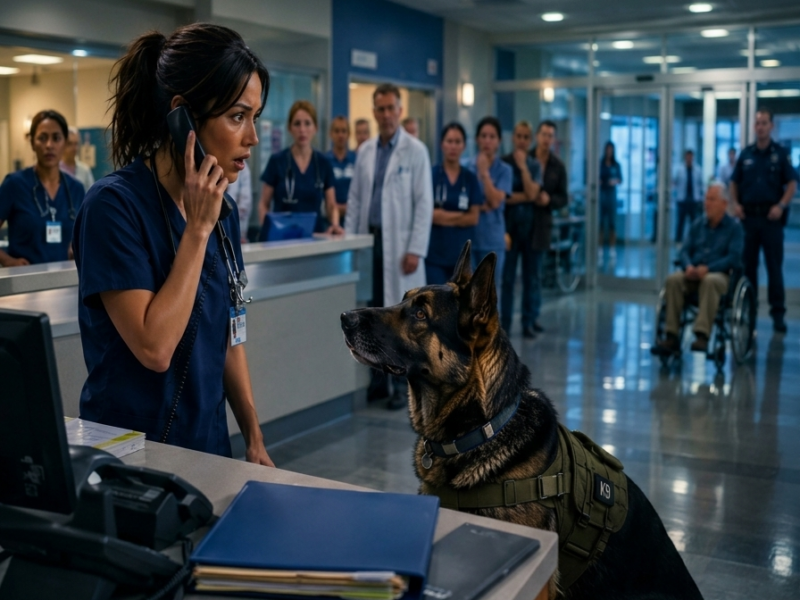
The Nurse Got a Call About a Military K9 — Then Found Him Standing Silently in Front of Her
The cold rain hit the glass of my front window in sharp, rhythmic bursts, mirroring the erratic pounding of my heart. The time on my bedside clock read 2:17 a.m. when my cell phone had vibrated on the nightstand, displaying a restricted military exchange line. A clipped, anonymous voice had delivered a single warning: a high-value military working dog had broken containment from a tactical transit vehicle parked outside the regional VA hospital in Norfolk, Virginia, and was believed to be moving through my suburban neighborhood.
I had barely processed the words before a heavy thud shook my front porch.
When I pulled open the heavy wooden door, expecting to see a team of military police, I found only silence and the dark, wet night. Standing on the mat was a massive German Shepherd. Rain glistened on his sable-and-black coat, and a tattered Kevlar harness hung loosely across his broad chest. He didn’t growl, bark, or wag his tail. He simply stared at me with deep, amber eyes—eyes carrying the same hollow, haunted look as the animal that had vanished into the dust of Helmand Province three years ago alongside my husband, Sergeant Daniel Miller.
My breath caught in my throat. “Shadow?”
The dog lowered his head and pushed a folded slip of heavy water-resistant paper across the porch floor toward my bare feet. My fingers trembled as I picked it up. The handwriting was unmistakable—slanted, sharp, and unmistakably Daniel’s.
If Shadow comes home, don’t let them take him back.
Before I could process the impossibility of those seven words, heavy footsteps crunched on the wet gravel driveway. Two men in crisp dark military uniforms stepped under the yellow porch light. Their faces were impassive, their eyes cold and analytical.
“Ma’am, we’re here for the animal,” the lead officer said, stepping up onto the porch without an invitation. “He’s classified government property. Step away from him.”
Shadow moved instantly, placing his massive frame between the men and me. His ears flattened hard against his skull, and a low, resonant growl vibrated through his chest, vibrating through the wooden floorboards.
“I need to speak to his handler first,” I said, backing slowly toward the threshold while keeping my hand resting firmly on Shadow’s neck.
The second officer exchanged a swift, imperceptible glance with his partner. “His handler is deceased, ma’am. Hand the dog over immediately.”
Shadow whipped his head toward the dark street, barking violently at a black SUV idling without lights at the end of the block. The officers reached for their sidearms, their intentions dropping all pretense of a routine recovery mission.
I pulled Shadow inside, slammed the door shut, and threw the heavy deadbolt just as a gloved fist slammed against the wood.
Leading the dog into the dimly lit kitchen, I knelt beside him on the tile floor. My hands moved frantically over his wet harness until my fingers caught on a concealed waterproof pouch stitched beneath a torn leather strap. Inside was a tactical micro-SD card, a military ID card, and a worn photograph of Daniel standing beside Shadow outside a grey concrete facility I didn’t recognize.
Scrawled across the back of the photo in fresh ink was a date: Tomorrow.
And below it, three words that shattered my entire reality: I’m still alive.
A sharp, violent crash shattered the front door panel as a heavy boot kicked through the lock. Shadow turned, his teeth bared, ready to defend the hallway. Simultaneously, my cell phone vibrated in my palm. The caller ID showed a blocked number.
I answered, pressing the phone to my ear with a shaking hand. “Hello?”
Through a dense wall of radio static came an exhausted, raspy whisper. “Emily… listen to me carefully. If Shadow found you, they already know where I am.”
“Daniel?” My voice cracked, tears burning my eyes. “Is that really you?”
“I can’t explain everything right now,” he breathed, his voice laced with immense pain and urgency. “You need to understand what really happened the night they reported my unit destroyed. It wasn’t an ambush, Emily. It was a lockdown.”
Footsteps echoed in the entryway. Shadow growled, bracing his front legs.
“Emily,” Daniel’s voice dropped to a frantic whisper, “whatever you do next, don’t let them see what’s inside Shadow’s collar.”
The line went dead.
I looked down at Shadow. The dog lifted his heavy head and pressed his wet muzzle against my palm. Tucked deep beneath the thick webbing of his collar, a tiny red LED light was pulsing silently in the dark.
And from the shadow of the broken front hallway, a low voice called my husband’s name into the quiet house.
The silence inside the house was stifling, broken only by the rhythmic clicking of rain against the windowpane and the faint, electrical hum of the red LED pulsing beneath Shadow’s collar.
“Mrs. Miller,” a voice echoed from the dark hallway. It wasn’t the voice of the officer from the porch. It was deeper, smooth, and chillingly relaxed. “We know you answered the phone. We know Sergeant Miller broke protocol to contact you. Hand over the animal and the drive, and this stays a matter of national security rather than a tactical casualty.”
Shadow didn’t bark. He was a trained combat asset; he knew how to move in silence. He nudged my elbow with his nose, directing me toward the rear exit through the laundry room.
I backed away slowly, my hand sliding along the cold kitchen counter, grabbing my car keys from the hook by the sink. In my pocket, the waterproof pouch containing the memory card, the ID, and Daniel’s note pressed hard against my thigh.
“He’s in the kitchen,” a second voice whispered near the doorway.
“Take them both,” the lead voice ordered.
Shadow lunged into the doorway with terrifying speed, slamming his entire weight into the first agent as he rounded the corner. The sound of a heavy body hitting the floor and a suppressed pistol discharging into the linoleum echoed through the small house.
“Go!” my mind screamed.
I threw open the back door into the pouring rain, sprinting across the mud toward the detached garage. Shadow bounded out behind me a second later, the dark blood of an intruder smeared across his tactical harness, but he was uninjured. He jumped straight through the open driver’s side window of my old station wagon before I could even unlock the doors.
I scrambled into the driver’s seat, jammed the key into the ignition, and slammed the gas pedal to the floor. The garage door shattered outward as the heavy station wagon smashed through the thin wooden panels, spraying splinters into the night.
Red light flooded the rear-view mirror as the black SUV from the end of the street accelerated, taking up pursuit down the quiet suburban avenue.
“Shadow, down!” I yelled, pulling the steering wheel hard to the left, taking a sharp turn onto the coastal highway.
The dog hunkered down in the passenger footwell, his heavy head resting on my knees. I reached down with one hand while keeping my eyes glued to the dark, slick road. My fingers found the small, hard square beneath his collar where the red light was blinking.
It wasn’t a tracker. It was a encrypted localized transmitter, emitting a short-range radio signal that pulsed every three seconds.
I looked at the dashboard clock: 2:45 a.m. The date printed on the back of the photograph was today—October 9. Daniel had given me a time frame and a location without ever saying a word on the phone.
The memory card in my pocket was marked with a tiny physical stamp: USAF-TAC-4.
Three years ago, the official Casualty Notification Officer had stood in my living room and delivered a polished mahogany box. He told me that Sergeant Daniel Miller’s squad had been caught in an improvised explosive blast in the Sholtan Valley. They said the recovery team found only shattered equipment, Daniel’s dog tags, and Shadow—badly wounded and wandering the desert miles from the site. I had buried an empty box in a veteran cemetery in Arlington, believing my life was permanently fractured.
Now, as the wipers fought the torrents of rain, the truth was beginning to unspool like a thread pulling from a frayed seam.
The black SUV behind me surged forward, its heavy steel bumper clipping the rear quarter-panel of my car. The station wagon fishtailed wildly across the slick pavement, the tires screeching against the wet asphalt as I fought to regain control.
“They’re trying to push us off the bridge!” I gasped, clutching the wheel.
Shadow sat up, staring directly out the rear window. He let out a single, sharp bark—a command tone.
Ahead of us lay the entrance to the old Great Bridge Lock system—a massive, concrete canal facility operated by the Army Corps of Engineers, surrounded by dense marshland and heavy chain-link fencing. Daniel had spent two summers working security maintenance at these exact locks before he enlisted in the Army. He knew every blind spot, every maintenance tunnel, and every emergency override panel in the entire complex.
I slammed on the brakes, turning the wheel violently into the secondary gravel service entrance marked AUTHORIZED PERSONNEL ONLY.
The station wagon slid through the mud, crashing through a wooden warning gate before coming to a violent stop against a concrete barrier. The black SUV overshot the turn, skidding past the entrance before its brake lights flared violently in the dark.
“Out! Shadow, move!” I screamed, tearing my seatbelt off.
We threw ourselves into the darkness of the marsh, plunging into the freezing rain and tall reeds toward the looming shadow of the industrial lock building.
Behind us, doors slammed, and the heavy metallic clicks of charging handles signaled that the men chasing us were no longer interested in taking us alive.
The cold mud sucked at my boots as Shadow and I ran through the dark perimeter of the lock facility. The rain was blinding, coming down in horizontal sheets that smelled of stagnant river water and diesel exhaust.
Shadow led the way with absolute certainty. He didn’t wander or search; he moved with the precise, deliberate purpose of an asset following a pre-programmed route. He stopped at a rusted iron drainage grate set deep into the concrete embankment near the lower spillway.
The heavy padlock securing the grate was already broken, hanging loosely from the iron latch.
“He’s been here,” I whispered, wiping cold water from my eyes.
Shadow used his powerful muzzle to shove the iron grate outward. I crawled on my hands and knees into the narrow concrete pipe, the rough surfaces tearing at my jeans. Shadow squeezed in right behind me, his heavy body blocking the cold wind from the entrance.
We crawled through fifty feet of pitch-black drainage conduit until the pipe expanded into a cavernous, disused maintenance sub-basement beneath the primary water control pumps. The air down here was thick with the smell of ozone, wet rust, and hydraulic oil.
Emergency utility lights hummed faintly along the ceiling, casting long, sickly yellow shadows across the concrete walls.
I pulled the waterproof pouch from my pocket, my fingers raw and cold. I brought the micro-SD card up to the faint light of a wall-mounted emergency junction box.
Beside the junction box was an old, industrial-grade maintenance terminal used by field engineers—a ruggedized laptop bolted directly to a steel swivel arm, left powered on in low-power standby mode.
My hands shook violently as I inserted the micro-SD card into the reader slot on the side of the terminal.
The screen flickered, reading the encrypted partitions. A command prompt appeared, demanding a security clearance passphrase.
I stared at the blinking cursor. What would Daniel use?
I tried his military service number. ACCESS DENIED.
I tried our wedding anniversary. ACCESS DENIED.
“Think, Emily,” I muttered to myself, tears of frustration hot against my cold cheeks. “Think!”
Shadow stepped forward, nudging my hand with his nose. He lifted his paw and tapped it firmly against the steel casing of the terminal, right beneath a brass serial tag stamped into the frame.
The serial tag read: M-WD-8842-SHADOW.
My breath caught. I typed the tag number into the prompt: 8842-SHADOW.
The terminal chimed softly. The screen refreshed, unrolling dozens of red-flagged military intelligence files, video logs, and satellite surveillance renders.
At the top of the index was a video file dated three years ago: OPERATION_BLACK_DUST_AFTERACTION.MP4.
I clicked the file.
The video was shaky, recorded from a body-worn tactical camera. The terrain was undeniable—the sun-bleached, jagged mountains of southern Afghanistan. A squad of five soldiers, including Daniel, was crouched inside an abandoned stone compound. They weren’t under attack by insurgents. They were surrounding several marked shipping crates carrying high-grade electronic warfare hardware—hardware bearing the contractor seals of a private defense firm based out of Northern Virginia.
A voice off-camera spoke—the cold, smooth voice of the man who had ordered my house cleared twenty minutes ago.
“Sergeant Miller, you were ordered to secure the site, not inspect the cargo. This material doesn’t exist on the official manifest.”
Daniel’s face appeared in the frame. He was younger, his face covered in dirt and sweat, but his eyes were hard as iron. “This is illegal military-grade surveillance hardware, Colonel. It’s cleared for domestic deployment. Who authorized this to be shipped back to the States?”
“Your mission ends here, Sergeant,” the voice replied calmly.
The video cut to sudden, chaotic movement. The sound of silenced gunshots echoed through the small terminal speakers. Daniel fell back, wounded in the shoulder, as Shadow launched himself at the camera operator. The feed spun wildly, capturing glimpses of soldiers being disarmed and detained—not killed.
They hadn’t been killed in an enemy ambush. Daniel and his men had been captured by a rogue contractor unit operating within our own command chain, held in off-the-books black sites while their deaths were fabricated to the Pentagon and their families.
Daniel had escaped. And he had used Shadow to carry the digital key out of the facility where they had been holding him for three long years.
“He never gave up,” I sobbed, pressing my palm against the glass screen showing my husband’s face. “He never stopped trying to get home.”
A soft, mechanical click sounded from the far end of the sub-basement.
Shadow’s ears pinned back instantly. He stepped out from the shadow of the terminal, his posture locking into a rigid, dangerous stance.
From the dark corridor leading to the upper spillway stairs, a tall, gaunt figure emerged from the shadows. He wore a torn flannel shirt, heavy canvas pants, and leaned heavily on a makeshift crutch. His face was covered in a thick, unkempt beard, and a deep scar ran from his temple down to his collarbone.
He stopped ten feet away. His breath was ragged, his frame thin and weathered by years of captivity and survival.
He looked at me, his eyes brimming with tears that reflected the yellow light of the terminal.
“I told you to trust the dog, Em,” Daniel whispered, his voice cracking with emotion.
For a long, terrifying moment, time seemed to stop completely in the cold concrete sub-basement. The hum of the water pumps faded into nothingness, leaving only the sound of our ragged breathing and the soft patter of rain dripping from the ceiling.
“Daniel…”
I dropped the waterproof pouch. I didn’t care about the contractors, the encrypted files, or the black SUV outside. I ran across the damp concrete, throwing my arms around his neck with a force that nearly knocked him off his crutch.
He let out a ragged gasp of pain, but his arms wrapped around me with a desperate, crushing strength that I had dreamed about every night for three long, agonizing years. He smelled of rain, salt, and old iron, but beneath it all was the familiar warmth of the man I had loved since I was nineteen years old.
“I’m sorry, Em,” he choked out, his face buried deep into my wet hair, his body trembling violently. “I’m so sorry I made you mourn me. I couldn’t get a message out… they kept us underground in a private contractor facility three miles from the naval base. I only made it out two days ago when they transferred Shadow to the VA hospital for disposal.”
Shadow moved in close, pressing his massive shoulder against both of us, letting out a high, singing whimper of pure relief.
“They said you were dead,” I sobbed, pulling back to frame his face in my trembling hands, wiping away the tears and dirt on his cheeks. “They gave me a box, Daniel. They gave me a medal and a folded flag.”
“They used my ‘death’ to bury the paper trail,” Daniel said, his eyes darkening with a familiar, dangerous tactical focus. “The firm behind it—Vane Security Solutions—has been using rogue military transport channels to smuggle unauthorized domestic surveillance equipment into Virginia. They’ve been building an unmonitored intelligence network right under the Pentagon’s nose. My team found the crates in Helmand, and when we refused to take the payoff, they erased us.”
“Where are the others?” I asked, my heart sinking.
Daniel looked down, his jaw tightening. “Two died in captivity. One is still inside that facility. I came here to get the drive from Shadow’s collar to the Federal Bureau of Investigation, but Colonel Hayes—the man leading Vane’s domestic operations—tracked Shadow’s transit vehicle when he broke loose.”
Suddenly, the red light beneath Shadow’s collar stopped blinking. It turned a solid, steady crimson.
Daniel froze. “The transmitter stopped pulsing.”
“What does that mean?” I asked, a sudden cold spike of fear shooting through my chest.
“It means they’ve established a localized signal lock,” Daniel said, his voice dropping into an icy register. “They aren’t tracking the radio frequency anymore. They’re tracking the physical unit. They’re on the roof.”
Above us, the heavy iron access doors leading to the upper lock control tower slammed open with a metallic boom. The sound of heavy tactical boots descended rapidly down the steel spiral staircase leading into the sub-basement.
“Emily, take the micro-SD card,” Daniel said instantly, shoving his crutch into my hands and grabbing a heavy steel pipe from a nearby supply rack. “There’s a secondary outflow tunnel behind the main pump that empties directly into the river channel. You and Shadow go now.”
“No!” I shouted, grabbing his arm. “I am not leaving you behind again, Daniel! We survive this together or we don’t survive it at all!”
Daniel looked at me, his blue eyes fierce with a mix of terrifying pride and absolute love. “You never were good at taking orders, were you, Nurse Miller?”
“Never,” I spat, picking up a heavy steel socket wrench from the maintenance bench.
The heavy door at the end of the corridor blew inward as a breaching charge exploded, showering the hallway in sparks, concrete dust, and thick white smoke.
Through the haze, three figures dressed in unmarked black body armor stepped into the sub-basement, their suppressed carbines raised, red laser sights cutting through the dark like crimson threads.
At the center of the squad stood Colonel Hayes—the man from the video, his uniform pristine despite the storm outside, a cold, arrogant smile resting on his face.
“Sergeant Miller,” Hayes said, his voice echoing in the concrete room. “You really are a persistent ghost. But a dead man can only haunt a system for so long before he’s finally buried.”
Shadow stepped forward, his body rigid, his snarl echoing like thunder in the enclosed space.
“Lower your weapons, Hayes,” Daniel said calmly, holding the steel pipe at his side. “The file on that terminal was auto-forwarded to the Department of Justice Inspector General five minutes ago. The moment you breached that door, the encrypted relay cleared the server.”
Hayes’s smile faltered for a fraction of a second. His eyes flicked nervously toward the blinking green light on the industrial terminal behind us.
“You’re bluffing,” Hayes hissed.
“Am I?” Daniel replied softly. “Check your tactical radio, Colonel. Listen to who just entered the perimeter.”
Outside, through the heavy concrete walls, the distant, thundering roar of heavy twin-rotor engines shook the foundation of the lock facility. Bright, blinding white searchlights cut through the rain-soaked windows of the sub-basement, illuminating the concrete dust in brilliant beams of light.
Over a powerful loudspeaker, an authoritative voice boomed across the marshland:
“Attention all personnel in the Great Bridge Lock complex! This is the Federal Bureau of Investigation alongside the United States Marshal Service! Drop your weapons and step into the open with your hands on your heads! You are completely surrounded!”
Hayes turned pale, his tactical composure shattering in an instant. “Eliminate them!” he screamed.
Before the contractors could raise their weapons, Shadow launched himself through the smoke like a dark missile.
The next thirty seconds were a violent, chaotic blur of flashing lights, shattering glass, and deafening noise.
Shadow slammed his heavy ninety-pound frame straight into the lead contractor, his jaws locking onto the man’s tactical vest, taking him down hard onto the wet concrete floor. The contractor’s rifle discharged wildly into the ceiling, blowing out the remaining fluorescent lights and plunging the corridor into the flashing red-and-white brilliance of the searchlights outside.
Daniel moved with a lethal, fluid speed that three years of captivity hadn’t erased. He swept the steel pipe low, shattering the second contractor’s knee before the man could line up a shot, sending him crashing into the metal equipment racks.
Colonel Hayes backed away, reaching frantically for his sidearm as he retreated toward the spiral stairs.
“Hayes!” I screamed.
I swung the heavy steel socket wrench with all the strength in my body, striking the hand holding his pistol. The gun clattered away, spinning across the wet floor until it disappeared down the open drainage sump.
Hayes gasped in pain, stumbling backward right into Daniel, who grabbed the colonel by his tactical collar, slamming him hard against the reinforced concrete wall.
“The mission is over, Colonel,” Daniel growled into his ear, his face inches from the officer’s pale, terrified face. “Your war is done.”
Heavy steel boots thundered down the stairs as a full squad of federal tactical agents clad in dark blue vests bearing the letters FBI flooded the sub-basement, their tactical lights blindingly bright as they secured the room.
“FEDERAL AGENTS! DON’T MOVE! DROP TO YOUR KNEES!”
Daniel released Hayes, letting the disgraced officer slide down the wall into the waiting hands of two federal marshals, who snapped heavy steel handcuffs onto his wrists with sharp, metallic clicks.
Shadow released his grip on the contractor’s vest, stepping back to stand proudly beside Daniel, his tongue lolloping out of his mouth, his tail giving a single, slow wag as he looked up at his master.
A senior federal agent with grey hair and a gold badge pinned to his tactical jacket stepped through the settling smoke, looking between the encrypted terminal, the bound contractors, and the thin, scarred soldier standing in the center of the room.
“Sergeant Daniel Miller?” the agent asked, his voice respectful and grave.
“Yes, sir,” Daniel replied, pulling himself up as straight as his injuries would allow, bringing his hand up into a crisp, perfect military salute. “Sergeant Miller, 75th Ranger Regiment, reporting in.”
The agent returned the salute slowly. “We received the digital ledger ten minutes ago, Sergeant. The Department of Defense has been mobilized. Your record has been cleared, and your unit’s status is being officially updated as of this moment. You’re coming home, son.”
Daniel dropped his hand, his eyes finding mine through the crowd of agents and flashing emergency lights.
The heavy rain outside had finally begun to taper off into a soft, gentle mist. Through the shattered high windows of the sub-basement, the first rays of the morning sun were breaking over the eastern horizon, painting the gray sky in brilliant hues of gold, rose, and pale blue.
We walked out of the dark facility together, stepping onto the wet grass of the embankment as the sun rose over the river locks.
Dozens of federal vehicles, ambulances, and military police cruisers lined the perimeter, their lights flashing uselessly against the bright morning light. The air was cool, clean, and smelled of freshwater and damp pine.
An army medic rushed toward us with a stretcher, but Daniel waved him away, choosing instead to lean his weight against my shoulder, his arm wrapped tightly around my waist.
Shadow walked right beside us, his wet coat glistening in the golden sunlight, his head held high, his amber eyes clear and bright, freed at last from the haunted shadow he had carried for three long years.
I looked up at my husband. His face was weathered, scarred, and aged by pain, but as he looked at me, the warmth in his blue eyes was brighter than the morning sun rising over the water.
“I promised I’d come back to you, Em,” he whispered softly, his breath warm against my cheek as he pressed his lips against my forehead.
“I know,” I murmured, holding his hand tightly, feeling the solid, living warmth of his palm wrapped in mine. “I never stopped waiting.”
Shadow let out a long, happy bark that echoed across the quiet water of the river locks—a sound of pure victory that carried away three years of grief, pain, and dark shadows, leaving only the bright, unbroken promise of the light ahead.
The end









