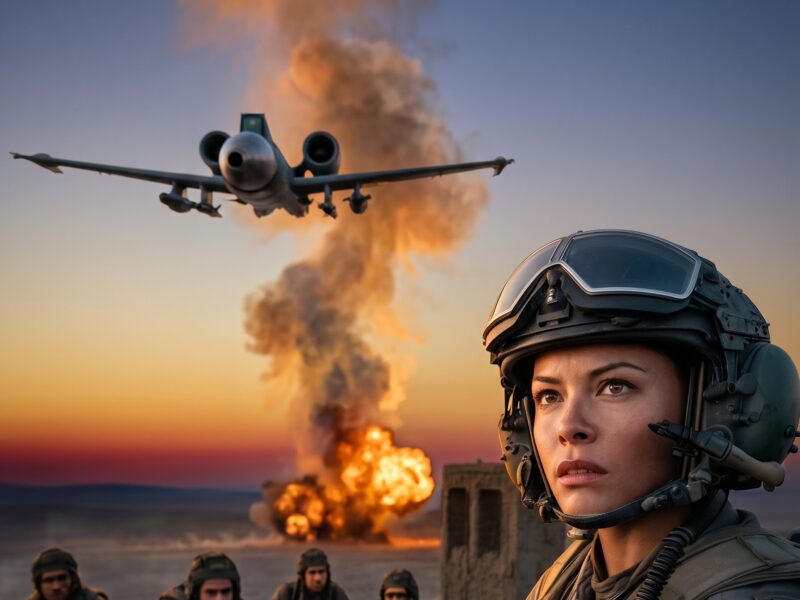
The night over Kandahar turned deadly when our SEAL team called in an airstrike, only to watch a lone female pilot in an aging A-10 Warthog ignore every command
The desert night outside Kandahar did not just swallow light; it swallowed hope. Dust clung to the sweat on my neck like fine sandpaper as I pressed my spine flat against the shattered remains of a mud-brick wall. Every few seconds, the darkness flashed violently—bright, sickly bursts of yellow and orange—accompanied by the deafening crack of small arms fire and heavy machine guns.
“Vance, check your five!” Captain Mason Reed barked into his headset, his voice raspy from smoke and sheer exhaustion.
I shifted my rifle, peering around the concrete barrier. My night-vision goggles painted the world in neon green and obsidian shadows. Thermal signatures flickered across the rocky ridge three hundred meters out. Dozens of them. We were SEAL Team 7, a nine-man element caught in a meticulously planned kill box. What had started as a quiet high-value target extraction in the jagged mountains of southern Afghanistan had collapsed into a desperate last stand.
“Command, this is Alpha 1,” Mason roared, pressing his hand tightly over his left earpiece. “We are taking heavy fire from the east and north! We are overwhelmed and out of positions! Where the hell is that air support?”
We had been pinned down for nearly twenty minutes, surrounded by enemy fighters hidden among abandoned structures and ancient stone outcroppings. Our satellite feed was a sea of red heat signatures. Too many to count. Ammunition was running low, and two of our men, Miller and Rodriguez, were already wounded.
Static tore through our headsets before a cold, distant voice from headquarters replied. “Alpha 1, be advised. Air support is inbound. ETA thirty seconds.”
Relief barely reached my chest before a low, familiar rumble vibrated up through the dirt, vibrating right into my ribcage.
An A-10 Warthog. The iconic tank-killer of the skies.
I looked up into the star-pocked abyss, expecting the thunderous roar of its thirty-millimeter GAU-8 Avenger cannon—the terrifying BRRRRT that usually heralded total destruction. I expected the sky to tear open with chaotic noise.
Instead, the aircraft glided through the darkness with eerie, terrifying precision. It didn’t scream down from the clouds. It slipped through the thermals like a shadow wrapped in velvet.
No radio chatter. No laser designator requests. No warning.
Just a brief, almost blinding flash beneath its titanium wings.
A heavy mortar team on the eastern ridge vanished in a silent, perfectly contained fireball. One second the red cluster was pulsing on our handheld screens; the next, it was gone.
The aircraft banked silently over the valley. Another flash. The northern sniper position blew apart in a precise geyser of pulverized rock and flame.
Then another. And another.
Our thermal screens began clearing. One red mark after another vanished into the night, eradicated with surgical, mathematically impossible efficiency. It wasn’t just close air support; it was an execution.
“Who the hell is flying that thing?” whispered Jackson, our point man, his eyes wide behind his goggles. “That’s not standard protocol. She’s flying way too low for this terrain.”
Mason grabbed his tactical radio, switching to the local air-to-ground frequency. “Unknown aircraft, this is Ground Alpha 1. Identify yourself immediately. You are firing on unregistered coordinates!”
Silence answered. Only the quiet, distant whine of twin turbofan engines overhead.
Mason tried again, his tone sharpening into a command. “Unknown aircraft, acknowledge! You are operating inside a restricted engagement zone without clearance!”
Still nothing.
The Warthog banked sharply, its jagged silhouette cutting directly across the face of the pale moon. Another enemy position behind us vanished into gray smoke. Every single strike landed exactly where it needed to. No wasted movement. No hesitation. No sound from the cockpit.
I had spent eight years in special operations. I had seen top-tier aviators turn battlefields into meat grinders, but I had never seen an A-10 handled like a ghost ship. It moved with a terrifying intimate knowledge of the ground, threading the needle between mountain peaks in pitch blackness without active radar.
Beside me, our intelligence officer, Daniel Brooks, suddenly went rigid. His fingers froze over his encrypted ruggedized laptop. The screen flickered as it decoded the aircraft’s transponder ping—a faint, scrambled military tail number that shouldn’t have been broadcasting at all.
“Captain,” Brooks said carefully, his voice dropping an octave. “You need to see this.”
Mason didn’t look away from the ridge. “Not now, Brooks. Keep watching the tree line.”
“Mason,” Brooks insisted, dropping the ranks. “Look at the transponder ID. Look at the registry.”
Mason finally turned, his brow furrowed in frustration as he leaned over Brooks’s shoulder. I stepped closer, peering over their heads at the glow of the monitor.
The screen read: A-10C Thunderbolt II – Tail No. 81-0964 – Pilot: LT S. WHITMORE.
Brooks swallowed hard, his throat dry. “That aircraft belongs to Lieutenant Sarah Whitmore.”
The name meant nothing to me at first. I looked between Brooks and Mason, expecting a rational military explanation—a reassigned tail number, a glitch in the automated system, an old code reused by command.
Then Brooks added one sentence that chilled the blood in my veins.
“She died three years ago. Shot down over the Helmand province. Body never recovered.”
A heavy, suffocating silence fell over our ditch. The firefight around us seemed to dim, swallowed by the sheer absurdity of the words.
Before anyone could speak, our radios crackled with sudden, violent static. The harsh white noise smoothed out into a clear, crisp transmission.
A woman’s voice came through.
It was calm. Measured. Almost painfully familiar to Mason, who froze as if struck by lightning.
“Ground team,” the voice said, soft yet carrying an unnerving authority. “Your eastern corridor is clear. Move now.”
Mason’s hand trembled as he brought his radio to his lips. I watched the color drain completely from his face, leaving him pale as ashes under the dim moonlight.
“Sarah?” Mason choked out. “Is… is that you?”
Static answered him. A long, agonizing five seconds passed. Then her voice returned, sharper this time, carrying an edge of urgent desperation.
“Don’t follow the lights.”
“What?” Mason blurted. “Sarah, talk to me! Where are you?”
Before he could finish, a missile streaked across the horizon—not from the mountains, but from the low-lying valley ahead. It slammed directly into the ridge where our secondary extraction route had been marked by headquarters just five minutes prior. The explosion shook the earth beneath our boots, showering us in hot pebbles and dirt.
The entire team ducked, covering their heads.
Brooks stared at his monitor, his eyes bulging. “Captain… that wasn’t an enemy missile. That came from our tactical grid. The extraction point was a trap.”
Mason slowly lowered his rifle, his mind visibly struggling to process the chaotic web of lies, ghosts, and high-explosives unfolding around us. “Everyone hold position,” he ordered, his voice barely a whisper. “Nobody moves.”
I looked back up into the blackened sky. The lone Warthog was banking hard, its matte-black wings catching the dying embers of the ridge explosion before circling back into the high clouds.
A thought struck me so hard I could barely breathe. If Lieutenant Sarah Whitmore had died three years ago in a classified wreck, who was flying her aircraft tonight? And how did she know our safe zone was a target?
The Warthog vanished into the soup of low-hanging storm clouds.
And on my headset, just as the signal began to break apart into digital distortion, I heard a final, breathy whisper.
“Tell my daughter I came home.”
I turned slowly toward Mason. The hardened SEAL commander, a man who had survived three tours of brutal close-quarters combat without flinching, had tears tracking lines through the soot on his cheeks.
Then, from the outer edge of our perimeter, Jackson called out, his rifle aimed toward the southern security fence of the abandoned compound. His voice was laced with sheer, unadulterated shock.
“Captain… you need to see this. There’s a little girl standing outside the wire.”
“Hold your fire!” Mason screamed, his voice breaking the stun that had seized the squad. “Do not shoot! Stand down!”
We scrambled over the low rubble, weapons raised but low, sweeping the area for threats. The firefight had completely died out. The silent barrage from the A-10 had neutralized every hostile entity within a half-mile radius, leaving the desert eerily quiet save for the crackle of burning brush.
Standing just beyond the twisted strands of rusted razor wire was a child.
She couldn’t have been more than six years old. She wore a heavy, dust-caked coat that was far too big for her small frame, and dark, hollow eyes peered up at us from beneath a smudged wool cap. She wasn’t crying. She wasn’t running. She just stood there in the dead of night, holding a small, silver object tightly against her chest.
“Vance, cover the perimeter,” Mason ordered as he stepped over the wire, lowering himself to one knee a few feet from the child. “Jackson, Brooks, keep your eyes on the sky.”
I raised my rifle, scanning the empty hills, but my mind was spinning. A ghost aircraft saves us from an ambush, blasts our assigned extraction zone, whispers a message about a daughter, and suddenly a lost child appears in the middle of a warzone at three in the morning? None of this was coincidence.
“Hey there, little one,” Mason said softly, his voice trembling despite his best efforts. He reached out a hand. “Are you okay? Where did you come from?”
The little girl didn’t answer. Instead, she stepped forward, reaching out her small, dirt-streaked hand. She held out the object she had been clutching.
It was a dog tag. Heavy, tarnished, and stained with dried grease.
Mason took it cautiously. I stepped closer, casting the beam of my tactical light onto the metal rectangle.
WHITMORE, SARAH A.
O-POS
USAF
Mason swallowed hard. “Where did you get this?” he asked, looking into the child’s eyes. “Who gave this to you?”
The girl finally pointed up toward the thick cover of clouds where the Warthog had disappeared minutes before. “The bird lady,” she said in clear, unaccented English. “She said the men in uniform would take me to the ocean.”
Brooks ran over, holding his encrypted satellite comms device. “Captain, Command is blowing up our channels. They’re demanding an immediate report. They’re saying the air support we reported was unauthorized and that no Air Force assets were assigned to our sector.”
“Tell them we have a system malfunction,” Mason snapped without looking back. “Tell them we are dark until further notice.”
“Mason, we can’t just disobey direct orders—”
“I said go dark, Brooks!” Mason barked, standing up abruptly. His eyes were fierce, burning with a mixture of rage and overwhelming grief. “Look at the damn board! Command gave us coordinates for an extraction point that was pre-targeted by a cruise missile! If that plane hadn’t dropped its payload, we’d all be dust right now! Someone in our own chain of command just tried to erase us!”
Brooks went pale. He looked down at his terminal, his fingers hovering over the keys before he slowly reached out and flipped the hard switch, severing our connection to Central Command.
We were officially rogue. Off the grid in hostile territory, with a dead pilot’s aircraft circling somewhere above us and a child whose existence made no sense.
“We need to move,” I said, looking toward the burning ridge in the distance. “If Command fired that missile, they know it missed. They’ll send a sweep team to clean up the mess.”
“Vance is right,” Mason said, wiping his face. He looked down at the girl. “What’s your name, sweetie?”
“Maya,” the girl answered softly.
Mason gently picked her up, slinging her over his shoulder with practiced ease. “Alright, Maya. You’re staying with us.” He turned to the squad. “We foot-patrol it south toward the old relay station. It’s five miles through the canyon. It’s out of satellite coverage and has cold-war radio gear. If Sarah… or whoever is in that plane… wants to talk to us, that’s where we can establish a clean frequency.”
We moved out quickly, forming a tight defensive box around Mason and the child. The night air grew colder as we descended into the rocky canyon. The shadows stretched long and menacing against the high sandstone walls.
As we walked, I fell in alongside Mason. “Captain,” I said under my breath so the others wouldn’t hear. “You knew Sarah Whitmore, didn’t you? Real history. Not just file data.”
Mason kept his eyes fixed on the path ahead, but his jaw tightened. “She was my wife, Vance.”
The words hit me like a physical blow. I stopped for a fraction of a second before catching up to his pace. “Wife?”
“We kept it secret,” Mason muttered, his voice thick with raw emotion. “Military protocol. We were both deployed in the same theater three years ago. When her A-10 went down over Helmand, the Air Force classified the whole operation within hours. They told me her plane hit an improvised air defense system and disintegrated upon impact. They gave me a empty casket and a folded flag.”
He looked down at the little girl sleeping against his chest.
“They told me her body was vaporized. But Maya… Maya was three years old when Sarah disappeared. I sent her to stay with my sister in Maine before this deployment.”
I felt a cold sweat break out across my forehead. “If your daughter was in Maine… then who is this girl?”
Mason stopped dead in his tracks. He slowly looked down at the sleeping child in his arms. He reached out and gently pulled back the sleeve of her oversized jacket.
Imprinted on her inner forearm was a dark, blue ink stamp—a series of numbers and letters, formatted exactly like an intelligence tracking marker: PROJECT BLACKWING – SUBJECT 04.
Before Mason could process what he was looking at, the canyon walls echoed with the sudden, high-pitched whine of jet engines. But it wasn’t the distant rumble of the A-10.
It was the sharp, aggressive scream of two modern stealth fighters dropping out of the sky directly above us.
“Get down! Wall cover! Move, move, move!” Mason yelled, diving into a crevice beneath an overhanging rock ledger, clutching Maya tight against his armor.
We hit the dirt just as two dark, needle-nosed aircraft roared low through the canyon gap. They carried no national markings, no insignias, and operated with complete radar-dampening stealth. They were blacked-out F-35 lightnings—assets that belonged to black-budget contractors or off-the-books intelligence divisions, not standard military units.
“They’re sweeping the canyon!” Jackson hissed, pulling a camo netting over his position. “They aren’t looking for insurgents. They’re looking for us!”
“Brooks!” Mason shouted over the thunder of jet engines. “What the hell are those?”
Brooks was huddled against the rock face, his face illuminated by the pale blue light of a portable frequency scanner he had scrambled to turn on. “I’m picking up high-frequency tactical bursts! encrypted, top-tier Black Ops transmission! The call sign… Jesus, Mason, the call sign is Nemesis.”
“Nemesis?” I asked, keeping my optics trained on the canyon ridge above. “Who is Nemesis?”
“Three years ago, when Sarah’s plane went down,” Brooks explained rapidly, his hands shaking as he typed, “she wasn’t on a routine strike. She was escorting a covert transport carrying biological and genetic research assets out of a black site in the Helmand mountains. The site was run by a rogue defense contractor called Aether Dynamics. The official story was that the transport crashed. But the leaked files… the ones that got buried… claimed Aether was running unauthorized human enhancement and survival experiments.”
Mason’s eyes narrowed into slits of ice. “Project Blackwing.”
“Yes,” Brooks said softly. “Sarah didn’t crash because of enemy fire. She found out what was inside that transport—children. Subjects cloned or retrofitted to survive biological warfare. She refused to let them destroy the plane to cover up the evidence. She went rogue, intercepted her own escort team, and forced the transport down.”
“And they hunted her,” Mason realized, his voice dropping to a dangerous whisper. “They hunted her and took her aircraft.”
“Or,” Brooks swallowed, looking up toward the graying dawn, “they captured her, used her to fly high-risk black missions, and kept her alive because she was the only pilot who knew how to navigate the low-altitude dead-zones without triggering satellite surveillance.”
Suddenly, the night sky burst into violent light once more.
Out of the high-altitude cloud cover, the matte-black A-10 Warthog dove like an avenging angel. It glided down directly between the two pursuing stealth fighters.
This time, it didn’t stay silent.
The Warthog’s main cannon roared—a terrifying, earth-shattering BRRRRRRRTTTTT that vibrated through the canyon walls and shook loose rocks from the cliffside. A stream of armor-piercing depleted-uranium rounds tore through the wing of the lead F-35, turning the multi-million-dollar fighter into a blossoming fireball that slammed into the distant canyon wall.
The second stealth fighter banked wildly, dumping flares as it tried to acquire a lock on the older, slower plane. But the A-10 pilot flew with insane, suicidal bravery, pulling tight, high-g turns inside the narrow canyon walls that should have ripped the wings off an aging airframe.
“Alpha 1, move to the relay station now!” Sarah’s voice blasted through our tactical radio, distorted by static and the heavy breathing of someone pulling maximum G-forces. “I can’t hold them off forever! They’re jamming all ground communications! Get the child inside the bunker!”
“Sarah!” Mason screamed into the comms. “Where are you? Let us pull you out!”
“There is no pulling me out, Mason!” she replied, a sudden break of heavy emotion crashing through her disciplined tone. “They put something inside me… inside my head. The moment I land, the automated override takes control. I’m flying on borrowed time on a hardwired system. I stole this bird back tonight just to get Maya to you!”
“Maya isn’t our daughter, Sarah! Who is she?” Mason yelled, sprint-running through the rocky terrain toward the heavy steel doors of the abandoned Soviet-era relay bunker fifty yards ahead.
“She’s the key, Mason!” Sarah’s voice was fading, choked by heavy radio interference. “She holds the digital manifest of every executive involved in Blackwing! They think she’s a test subject, but she’s the drive! Get her to the relay station, plug her tag into the broadcast array, and stream it to the global press! It’s the only way to stay alive!”
A missile detonation rocked the air high above us. We looked up just in time to see the A-10’s left engine erupt into flames.
“She’s hit!” Jackson yelled. “Engine one is out!”
The Warthog wobbled violently, black smoke trailing behind it as it limped through the sky, but the pilot somehow stabilized the aircraft, banking hard to draw the remaining enemy fighter away from our location.
“Get inside! Move!” Mason yelled, kicking open the rusted steel entrance of the Soviet relay bunker.
We threw ourselves inside the concrete bunker just as a heavy barrage of machine-gun fire chewed up the ground outside the doorway. Jackson and Rodriguez slammed the heavy iron doors shut, throwing the locking bars into place.
The darkness of the bunker swallowed us, illuminated only by the faint red glow of emergency battery lights and the tactical screens on our gear.
Outside, the distant scream of jet engines continued to echo, a tragic battle being fought in the clouds by a pilot who was supposed to be a memory.
Mason slid down the wall, pulling Maya close. The little girl looked up at him with unblinking, intelligent eyes. She didn’t look scared. She looked… prepared.
“Alright,” Mason said, his hands trembling as he held up the dog tag she had given him. “Let’s see what your mother died to save.”
The Soviet relay station smelled of damp dust, ancient oil, and old copper wiring. It had been abandoned for decades, but the heavy lead-shielded walls meant it was one of the few places in the region completely impervious to electronic warfare and orbital surveillance.
Brooks rushed to the main console, blowing away a thick layer of dust before slamming his ruggedized laptop into the terminal’s manual override port. “The auxiliary generator is still holding a charge. I can bypass the old Soviet relays, but I need a hardware key to unlock the high-frequency transmitter.”
Mason stepped forward, holding out the tarnished dog tag Sarah had sent with the little girl. He looked at it closely for the first time under bright light. Along the bottom edge of the metal plate was a micro-USB interface concealed beneath a rubber strip.
“It’s not just a tag,” Mason whispered. “It’s a high-grade military encryption key.”
He handed it to Brooks, who plugged it directly into his system.
The screen instantly lit up with thousands of scrolling lines of green code. Decryption bars filled the monitor, flying across the display at breathtaking speed.
DECRYPTING FILE: OPERATION BLACKWING…
ACCESS GRANTED.
Data files, video logs, executive rosters, and satellite coordinates began cascading down the monitor. My eyes scanned the documents in disbelief. It was a massive, illegal military-industrial network involving high-ranking officials within the Pentagon, private defense contractors, and foreign syndicates. They had been using unauthorized black sites to test neuro-cybernetic flight controls on captured or classified pilots—turning human beings into live, hardwired control units for uncrewed war assets.
Sarah hadn’t just gone rogue. She had been turned into a living weapon, locked inside the cockpit of her A-10, her mind hardwired into the plane’s combat computer. She had spent three years fighting the system from the inside, waiting for a single opportunity to break free and save the child who carried the key to tearing it all down.
“Jesus Christ,” Brooks whispered, his face pale. “This isn’t just a corruption scandal. It’s a complete shadow government network. If this gets out, hundreds of high-ranking officials are going to prison for life.”
“Which is why they sent a cruise missile to vaporize us,” I said bitterly. “And why those blacked-out stealth fighters are outside right now.”
Suddenly, the bunker’s heavy steel doors shuddered under a massive shockwave. The sound of heavy explosives detonating against the exterior echoed through the concrete walls. Dust rained down from the ceiling.
“They’re breaching!” Jackson yelled, unholstering his sidearm and taking cover behind a concrete pillar. “We’ve got ground forces outside! Heavy armor and breachers!”
“Brooks, how long until the transmission goes out?” Mason demanded, racking the bolt of his rifle.
“The satellite dish on the roof needs three minutes to align!” Brooks screamed over the sound of drilling and explosives against the bunker door. “If they cut the power or destroy the roof antenna before the upload hits one hundred percent, the file corrupts and it’s lost forever!”
“Then we buy him three minutes,” Mason said, his eyes filled with grim determination. He turned to me. “Vance, take the left angle. Jackson, cover the main corridor. We hold this line to the last mag.”
He knelt down in front of Maya one last time. “Stay behind the console, sweetie. Whatever happens, don’t move.”
The little girl looked at Mason, then reached out her small hand, touching the patch on his chest—the American flag. “She’s coming back,” Maya said softly.
Mason forced a painful smile. “I know she is, kiddo.”
A split second later, the heavy iron doors blew inward with a violent, blinding flash.
Deafening explosions filled the narrow corridor as armored mercenaries clad in unmarked black tactical gear flooded into the bunker, weapons free.
“Fire!” Mason bellowed.
The bunker erupted into absolute chaos. Sparks flew as bullets ricocheted off concrete walls. Mason, Jackson, and I fired in tight, disciplined bursts, dropping the first wave of breachers at the doorway. But more were behind them. They were well-trained, heavily equipped, and moving with lethal coordination.
A bullet clipped Jackson’s shoulder, spinning him backward against the wall. I leaned out from my cover, dumping half a magazine into an advancing contractor, driving them back into the hallway.
“Upload at forty percent!” Brooks yelled frantically over the gunfire, his hands flying over the keyboard to shield the laptop from stray bullets. “Fifty percent!”
“Hold the line!” Mason roared, stepping directly into the open corridor to suppress the enemy advance, his rifle barking continuously until the bolt locked back on empty.
A mercenary lunged around the corner, raising a shotgun directly at Mason’s chest. Mason didn’t have time to reload. He drew his combat knife, stepping into the guard, but he was out of position.
Before the contractor could pull the trigger, a sound cut through the deafening noise of the room.
It wasn’t a gunshot from inside the bunker.
It was the terrifying, apocalyptic scream of twin jet engines passing mere feet above the bunker roof.
The entire concrete ceiling cracked as the A-10 Warthog made a ultra-low-altitude strafing run directly over the entrance of the relay station. The ground shook violently, the sheer concussive blast of its heavy cannon collapsing the entire exterior tunnel, burying the mercenary breach team under hundreds of tons of solid rock and dirt.
The room fell into sudden, ringing silence. The threat inside the corridor had been instantly eradicated, buried beneath the rubble.
Brooks stared at his screen, his jaw hanging open as the final bar clicked to solid green.
UPLOAD COMPLETE. TRANSMITTING TO GLOBAL MEDIA NETWORKS AND FEDERAL COURTS… 100%.
“It’s done,” Brooks whispered, his voice shaking. “It’s gone. The whole world has the files.”
We scrambled out through a side ventilation shaft, dragging our wounded, to reach the open desert air.
High above us, the sky was beginning to turn pale pink with the coming sunrise. The lone A-10 Warthog was trailing thick white smoke from both engines now, its black airframe battered, bruised, and riddled with bullet holes.
It had no more weapons. It had no more fuel.
It was circling one last time over the relay station, floating silently through the morning clouds.
We stood on the rocky ridge outside the relay station, watching the crippled warplane circle low in the twilight sky. The early morning sun caught the edges of its damaged wings, making the matte-black metal gleam like polished gold.
Mason stepped to the edge of the cliff, holding his radio to his mouth with a hand that was finally still.
“Sarah,” he said softly into the microphone. “The file is sent. It’s over. The world knows.”
Static washed over the channel, soft and rhythmic, like the sound of waves crashing on a distant shore.
Then her voice came through. It was clear now. The digital distortion was gone, replaced by the weak, human breath of a woman who was finally at the end of her long, impossible journey.
“Thank you, Mason,” she whispered. “I held on as long as I could.”
“Land the plane, Sarah,” Mason pleaded, tears breaking down his cheeks unchecked. “There’s an abandoned dirt strip three miles west. You can glide it in. We can get you out of that cockpit. We can fix this!”
A soft, mournful laugh drifted over the radio.
“You can’t fix what they did to me, Mason. The system… it’s integrated into my central nervous system. The moment the engine stops, the automated self-destruct protocol initiates to erase the aircraft’s physical tech. If I land, I take everything—and everyone near me—with me.”
Mason gripped the radio so tightly his knuckles turned white. “No. No, Sarah! There has to be another way! I just got you back!”
“You didn’t lose me tonight, Mason,” she said softly, her voice filled with a peaceful, profound calm that cut straight to my heart. “I came back to bring your daughter home. Look at her, Mason. She has your eyes.”
Mason turned slowly to look at Maya, who was standing beside him. The little girl looked up into the sky, raising her small hand to wave at the smoking silhouette of the aircraft.
“I gave her three years of my life in that dark place,” Sarah’s voice echoed through our headsets. “Protect her. Teach her how to see the ocean. Promise me.”
“I promise,” Mason sobbed, falling to his knees in the dust. “I promise you, Sarah.”
“Alpha 1… this is Lieutenant Sarah Whitmore… signing off.”
The twin engines of the A-10 gave out with a final, echoing sigh.
We watched in absolute silence as the magnificent, broken machine banked toward the wide, open expanse of the empty desert, far away from any military bases, towns, or human life. It glided gracefully through the pink morning light, cutting through the sky like a falling star.
It didn’t hit the ground in panic or chaos. It was a smooth, perfect, deliberate final descent.
The aircraft touched down on the distant salt flats miles away. A second later, a bright, silent flash of white light illuminated the horizon as the onboard thermite systems detonated, instantly vaporizing the airframe and leaving nothing behind but ash and light.
The shockwave rolled over us moments later—a soft, warm gust of desert wind that rustled the dust around our boots and blew past us into the valley.
Mason lowered his radio. He sat in the dirt for a long time, his head bowed, his shoulders shaking as the morning sun fully rose over the Afghan mountains, burning away the dark shadows of the night.
Maya walked up to him quietly. She didn’t say a word. She simply reached out her small arms and wrapped them around her father’s neck, resting her head against his tactical vest. Mason pulled her close, burying his face in her hair, holding her as if he would never let go.
Three weeks later, the world was in total upheaval.
The data broadcast from the Soviet relay station had triggered the largest congressional investigation and international criminal prosecution in modern history. Dozens of high-ranking military figures, intelligence directors, and defense executives were arrested. Project Blackwing was dismantled down to its foundation, its victims brought out of the shadows, and its shadow networks eradicated.
I stood on a wooden pier on the coast of Maine, watching the cold Atlantic waves crash against the rocky shore. The salty air was crisp and clean, miles away from the heat and dust of Kandahar.
A few feet away on the sand, Mason was walking hand-in-hand with Maya. She was laughing, pointing out at the sea gulls riding the coastal breeze, her dark eyes bright with a wonder that had been stolen from her for far too long.
As I watched them, I took a deep breath, pulling my coat tighter against the wind.
We never found a piece of that A-10. We never found a trace of the pilot who flew it. But every time I hear the distant thunder of a jet engine rolling through the high clouds, I don’t look up with fear anymore.
I just look up, whisper a silent thank you, and watch the sky.
The end.









