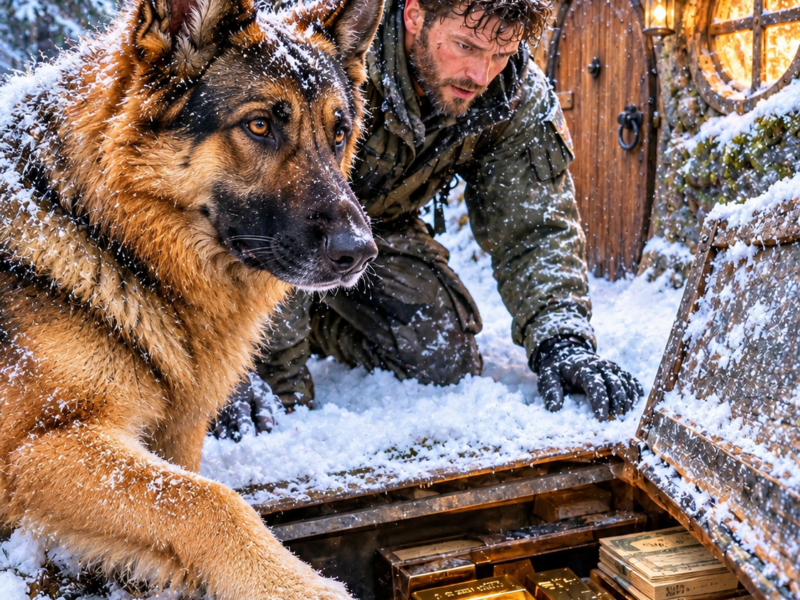
“The night my in-laws threw me out of their Montana lodge with nothing but my old Navy SEAL duffel bag and my German Shepherd, they laughed when I disappeared into the blizzard
Richard Whitmore stood beside the black SUV with his coat collar turned up against the wind.
Even through the blowing snow, I could see the anger in his face.
He had spent eleven months treating me like a broken tool he’d been forced to store in his garage. Now, for the first time since Lauren’s funeral, he looked afraid.
“Nathan,” he called again. “Step away from that door.”
Bear moved in front of me, his fur bristling along his spine. He didn’t bark. He simply planted his paws in the snow and watched Richard with the stillness of a soldier waiting for an order.
I kept one hand on Bear’s collar and the other around the brass key Lauren had left inside the envelope.
“What’s in the cabin, Richard?”
“Nothing that concerns you.”
“Then you won’t mind if I take a look.”
His expression tightened.
Behind him, the SUV’s passenger door opened. A younger man stepped out, wearing a dark parka and leather gloves. I recognized him as Daniel Price, the Whitmore family attorney. He’d attended Lauren’s memorial service, where he’d spent more time watching me than listening to the pastor.
Daniel looked at the brass key in my hand.
“Mr. Cole,” he said carefully, “whatever your wife may have told you, this property is part of the Whitmore estate.”
“Funny. Your client just threw me off his property.”
“This cabin is separate.”
“Separate enough for you to drive through a blizzard to protect it?”
Daniel glanced at Richard.
That was answer enough.
The cabin sat half buried in the hillside, its rounded roof covered with snow and thick moss. From a distance, it looked like something a child might build in a storybook. Up close, it was a carefully engineered structure with reinforced stone walls, a steel door, and a narrow window disguised behind a wooden shutter.
Lauren had always loved places that seemed ordinary until you looked closer.
When we were dating, she once spent an entire afternoon explaining how the best hiding places weren’t necessarily the ones nobody could find. They were the ones nobody thought were worth finding.
I’d assumed she was talking about old houses and forgotten trails.
I was beginning to think she’d been talking about her family.
“Give me the key,” Richard said.
I slipped the envelope into my jacket.
“No.”
His face reddened. “You have no idea what you’re interfering with.”
“Then explain it.”
“There’s nothing to explain.”
He took a step toward me.
Bear gave a low warning growl.
Richard stopped.
For eleven months, I’d watched this man use his wealth the way other people used a weapon. He never needed to shout. He could make a person feel small with a raised eyebrow, a delayed phone call, or a reminder of how much everything cost.
But the mountain didn’t care about his money.
Neither did the dog.
And for the first time in a long while, neither did I.
I turned toward the door.
“Nathan, if you open that door,” Richard said, “you will regret it.”
I slid the key into the lock.
“Probably.”
The mechanism turned with a heavy metallic click.
Behind me, Daniel muttered something under his breath.
The door opened inward.
Warm air rolled across my face.
Not the stale, frozen air of an abandoned cabin. This was heated air, carrying the faint smell of cedar, dust, and coffee.
I stepped inside with Bear at my heel.
The room beyond the entrance was small but meticulously maintained. Wooden beams curved overhead beneath the rounded roof. Built-in shelves lined the walls. A compact woodstove sat beside a leather chair, and a narrow staircase descended into darkness at the far end.
There was no electricity cable leading up the mountain. No visible generator. Yet a row of recessed lights glowed softly overhead.
The cabin was alive.
I heard Richard come through the doorway behind me.
“Turn it off,” he said.
I looked at him. “Turn what off?”
He didn’t answer.
A monitor on the far wall flickered to life.
A woman appeared on the screen.
For one impossible second, I forgot how to breathe.
Lauren sat in a chair in front of a plain wooden wall. Her dark hair was pulled into a loose knot. She wore the gray sweater I’d bought her on our third anniversary, the one with the small tear near the cuff she’d refused to let me repair.
She looked tired.
But she was alive in the recording.
“If you’re watching this,” she said, “then either Nathan found the cabin, or my father finally made a mistake big enough that someone else found it for him.”
I heard Richard whisper, “No.”
The recording continued.
“Dad, if you’re there, I’m sorry. I know you’ll say I betrayed the family. You’ll say I stole what belonged to you. You’ll tell everyone I was confused, or sick, or manipulated.”
Lauren leaned closer to the camera.
“But I kept records. And I made sure Nathan would get them.”
My legs felt unsteady.
For eleven months, I had replayed the last phone call I’d had with her. She’d been driving home from a meeting in Kalispell. I’d been at a rehabilitation appointment in Seattle, trying to regain strength in my injured shoulder. We’d argued about something stupid—whether I should come home early, whether she was working too much, whether I was pushing myself too hard.
She’d laughed before hanging up.
“I love you, Captain Stubborn,” she’d said.
That was the last time I heard her voice.
The official report said a delivery truck crossed the center line on an icy road. Lauren’s car spun, struck a barrier, and caught fire. The truck driver died at the scene. Investigators found no evidence of a deliberate act.
I’d believed them because I couldn’t bear to believe anything else.
Now her face was looking at me from a screen, telling me she’d expected this moment.
“Before you watch anything else,” Lauren said, “look in the desk drawer. There’s a blue folder. Nathan, please don’t let my father convince you that what you find is too complicated to understand. He’s spent his whole life making simple crimes sound like complicated business.”
The screen went dark.
For a few seconds, nobody moved.
Then I crossed the room to a writing desk beneath the monitor.
Richard lunged forward.
Bear moved between us so quickly that Richard stumbled backward.
“Control your animal!” he shouted.
“He’s more under control than you are.”
I opened the drawer.
Inside lay a blue folder, a small encrypted drive, several envelopes, and a photograph of Lauren and me standing on a ridge above Whitefish Lake. It had been taken during the first summer of our marriage. We were sunburned, laughing, and too young to understand how much a family could hide behind a beautiful house.
On the back, Lauren had written four words.
Choose truth over comfort.
I opened the folder.
The first document was a corporate ledger.
The second was a list of bank transfers.
The third was a spreadsheet showing the names of shell companies, offshore accounts, and investment vehicles connected to a company called Whitmore Alpine Holdings.
I recognized the company name. Richard had mentioned it at dinner more times than I could count. He described it as the backbone of the family’s real estate and energy investments.
But these documents showed payments to nonexistent contractors, inflated invoices, and transfers from pension funds belonging to several regional businesses.
At the bottom of one page, a total had been highlighted in red.
$195,400,000.
I stared at the number.
“What is this?” I asked.
Daniel had gone pale.
Richard’s jaw worked as though he were trying to find words that could erase what lay on the desk.
“It’s an accounting reserve,” he said.
“An accounting reserve doesn’t have fake invoices.”
“You don’t understand finance.”
“I understand fraud.”
“You were a soldier,” Richard snapped. “You have no idea how complicated a company like mine can be.”
I turned to the next page.
A list of dates. A list of transfers. A list of initials beside authorization codes.
Several transfers had been signed off by Richard Whitmore.
Others bore Daniel’s initials.
And one document included a draft agreement transferring the remaining assets of Whitmore Alpine Holdings into a private trust controlled by Richard.
The trust had been created three weeks before Lauren died.
I looked at Daniel.
“Did you know?”
He said nothing.
Richard stepped toward the desk, his voice dropping into the smooth, controlled tone I remembered from every family dinner where he’d decided someone needed to be reminded of their place.
“These records are stolen property. They’re incomplete. You can’t walk into a room, glance at a spreadsheet, and decide you’ve uncovered a crime.”
“Then why are you trying so hard to get me away from it?”
“Because you’re grieving. You’re injured. You’re in no condition to understand what you’re seeing.”
There it was again.
The same gentle contempt he’d used when he told me I couldn’t help manage Lauren’s affairs because I was still recovering from surgery. The same tone he’d used when he suggested I sell my truck because it was “an unnecessary expense.” The same voice that had informed me, hours earlier, that I could no longer stay at his lodge.
He wanted me to believe that my pain made me stupid.
But I’d spent years learning to recognize the difference between confusion and deliberate deception.
I turned another page.
A bank statement listed a trust account with an estimated value of $195 million.
The account holder was not Richard.
It was Lauren.
More precisely, it was a trust established by Lauren Whitmore Cole, with a beneficiary designation that had been updated just days before her death.
My name appeared beneath hers.
Nathan Cole.
I read it twice.
Then a third time.
“What did she do?” I whispered.
Daniel finally spoke.
“Your wife discovered irregularities in the company accounts. She had been compiling evidence for months.”
Richard glared at him. “Shut up.”
Daniel swallowed. “She confronted your father.”
“And you helped her?” I asked.
“I tried to persuade her to take it to the board.”
“Instead, you let her keep collecting evidence while the man she accused controlled the company.”
Daniel’s eyes dropped.
“I thought I could manage the situation.”
Richard laughed bitterly. “You thought you could save your own career.”
The words struck Daniel harder than any accusation I could have made.
I opened the next envelope.
Inside was a letter in Lauren’s handwriting.
Nathan,
If you’re reading this, I’m sorry I couldn’t tell you everything while I was alive. I wanted to protect you, but I understand now that keeping you outside the truth also left you unprepared.
I found evidence that Dad had been moving money from company accounts for years. At first, I thought he was hiding losses. Then I found transfers from employee retirement funds and falsified loan documents. Some of the people affected have worked for our family for decades. They trusted him with their futures.
I asked him to stop. He said the company was his, that he’d built everything, and that a few accounting adjustments were necessary to protect jobs. When I told him the money belonged to other people, he said I was too sentimental to understand what leadership required.
He offered to make me a partner in the private trust if I stopped asking questions.
I refused.
I had to pause.
My throat had tightened so badly that the next breath hurt.
Lauren had spent her childhood surrounded by wealth, but she’d never treated money like proof of a person’s worth. She remembered the names of the staff at every hotel we stayed in. She tipped generously. She sent handwritten thank-you cards to people who helped her. When I asked why she worked so hard at the family foundation despite having no need for a salary, she’d said that money was only useful if it could make somebody’s life less frightening.
I had loved that about her.
I’d never known how much it had cost her.
The letter continued.
The cabin is connected to a secure archive beneath the floor. It contains original records, copies of the company’s transaction logs, and messages that establish who approved the transfers. There is also a legal trust holding the assets I was able to recover and protect before Dad realized what I was doing.
The $195 million is not a treasure, Nathan. It is not a prize for finding the right door. It represents money that was diverted, concealed, recovered, or placed beyond Dad’s immediate control. Some of it may be owed to investors and employees. Some of it may be subject to court orders or other claims. Do not spend a dollar until independent lawyers and forensic accountants have determined what belongs to whom.
Your name is on the trust because I trust your judgment. Not because I expect you to become rich.
I lowered the letter.
Richard was watching me with a hatred so naked it almost seemed to strip years from his face.
“She always was dramatic,” he said.
“No,” I replied. “She was careful.”
“She was my daughter.”
“And you used her.”
“I gave her everything!”
“You gave her a life where she had to hide evidence from her own father.”
His face twisted.
“You have no idea what it takes to keep an empire standing.”
I looked at the photograph on the desk.
“Maybe that’s the problem. You thought the empire mattered more than the people holding it up.”
A low vibration came from somewhere beneath the floor.
The lights flickered once.
Then a small panel beside the staircase lit up, displaying a message:
ARCHIVE ACCESS AVAILABLE — AUTHORIZED KEY REQUIRED.
I looked at the brass key still in my hand.
Richard moved suddenly.
He reached for it.
Bear slammed his shoulder into Richard’s thigh, knocking him sideways into the leather chair. Richard shouted and grabbed at the armrest to keep himself upright.
I stepped back.
“Stay down,” I warned him.
“You can’t keep me out of my own property!”
“Then stop trying to steal a key from a grieving man.”
I crossed to the panel and inserted the key into a narrow slot.
A quiet click sounded beneath the floor.
A section of wooden boards slid aside, revealing a steel ladder descending into a lit chamber.
Warm air rose from below.
I took a flashlight from a shelf and checked the opening.
The chamber was deeper than I expected, perhaps twelve feet below the cabin. Shelves lined its walls. Metal cabinets stood beside a small server rack. A heavy fireproof safe was bolted to the concrete floor.
On the nearest cabinet, a label read:
WHITMORE ALPINE — ORIGINAL RECORDS.
Beside it was another label.
LAW ENFORCEMENT COPY — SEALED UNTIL RELEASE.
I turned toward Daniel.
“Why would a private cabin have an archive prepared for law enforcement?”
His answer came quietly.
“Because Lauren didn’t trust the company’s internal investigators.”
“And you knew about this?”
“I knew she’d built a record of what happened. I didn’t know where she’d hidden it.”
Richard had found his voice again.
“This is absurd. You’re letting a dead woman’s paranoia destroy everything she worked for.”
I looked at him.
“She didn’t destroy it. She documented what you did.”
He turned toward the door.
For one moment, I thought he was leaving.
Instead, he pulled a phone from his pocket.
I moved toward him, but he lifted it out of reach.
“You have no idea who you’re dealing with,” he said into the phone. “I need you at the upper trail. Now.”
He ended the call.
I felt the old instinct take over—the same instinct that had kept me alive in places where every movement mattered. I checked the entrance, the narrow window, the staircase, and the space between Richard and the door.
Daniel saw me doing it.
“Who did you call?” he demanded.
Richard ignored him.
Outside, an engine roared through the storm.
Then another.
I heard tires crunch over the frozen track.
“How many people are coming?” I asked.
Richard’s silence told me enough.
I turned to Daniel.
“If you have any part in this, now is your chance to decide what kind of man you want to be.”
He looked at Richard, then at the papers spread across the desk.
“My name is on some of the authorizations,” he said. “I approved transactions I was told were legitimate. When Lauren showed me the discrepancies, I should have gone to the authorities. Instead, I asked her to give me time.”
“Why?”
“Because I had a family. A mortgage. Children. I was afraid of losing everything.”
“And what did you think the employees would lose?”
He had no answer.
The first vehicle stopped outside.
A second pulled up behind it.
Richard straightened his coat as if he were preparing to greet guests at a charity dinner.
“Once this is over,” he said, “you’ll understand that I was protecting my family.”
“No,” I said. “You were protecting yourself.”
The cabin door burst open.
Two men stepped inside, both wearing heavy winter jackets. One carried a flashlight. The other kept his hands tucked inside his coat.
They looked at Richard for instructions.
He pointed at me.
“Take the documents. All of them.”
Neither man moved immediately.
The one with the flashlight looked at the open floor panel, then at the steel ladder.
“Sir,” he said, “you told us there was nothing down here.”
Richard’s eyes narrowed.
“Do your job.”
The man shifted his weight.
I recognized the hesitation. He wasn’t a trained operator. He was a hired hand who’d been promised a simple task and had just discovered it might turn into something else.
I kept my voice level.
“Those records concern a potential financial crime. You can walk out now and explain that you were ordered here. Or you can stay and make yourself part of it.”
The man looked at Daniel.
Daniel stepped forward.
“Nobody touches those documents. I’m a licensed attorney, and I’m telling you that any attempt to remove or destroy them will be recorded as evidence of obstruction.”
Richard stared at him.
“You’re finished.”
“Maybe,” Daniel said. “But I’m finished working for you.”
The second man slowly withdrew his hands from his coat. They were empty.
“I was told to secure the building,” he said. “Not hurt anybody.”
“Then secure the door from the outside,” I told him. “And wait for the sheriff.”
Richard laughed.
“You think the sheriff is going to come up here because you ask him to?”
“I think the sheriff will be very interested in why you sent people to seize records after your daughter documented a hundred and ninety-five million dollars in suspicious transactions.”
I pulled my phone from my pocket.
The signal was weak, but a single bar appeared near the window.
I called 911.
The dispatcher could barely hear me over the wind. I gave the location as accurately as I could, described the threats, and said I had reason to believe evidence of major financial crimes was being targeted for destruction.
I gave my name.
Then I gave Lauren’s.
That changed the dispatcher’s tone.
She asked whether I was in immediate danger.
I looked at Richard, the two hired men, Daniel, and Bear standing squarely between me and the room’s most volatile man.
“Yes,” I said. “But I’m safe for the moment. Please send the sheriff and preserve this call.”
The line crackled.
Then it disconnected.
I tried again and got nothing.
Richard smiled.
“You’ve made a mistake.”
“Maybe,” I said. “But now somebody knows where to start looking.”
He lunged toward the desk.
This time, I caught his wrist.
He was older than me and not nearly as strong as he imagined himself to be. I turned his arm away from the papers and held him just long enough to stop him reaching the folder.
“Don’t,” I said.
He twisted, trying to wrench free.
My injured shoulder sent a sharp line of pain down my arm.
For a second, the cabin tilted.
Bear barked once—loud and sudden.
Richard froze.
I released his wrist and stepped away, breathing through the pain.
I wasn’t going to fight him unless I had to. Not for his pride. Not for his threats. And certainly not in a room filled with evidence Lauren had risked everything to preserve.
I looked at Daniel.
“Help me secure the archive.”
He nodded.
Together, we descended the ladder.
The chamber smelled of cool concrete and electronics. A small battery system kept the lights running, and the server rack hummed quietly in the corner. Metal cabinets held binders organized by year, each labeled with account numbers and transaction categories.
The fireproof safe had a digital keypad and a second key slot.
On top of it lay a sealed envelope.
Nathan — open this last.
I left it where it was.
Instead, I photographed the visible labels and the cabinet numbers. Daniel used his phone to record the condition of the room and the documents already exposed. We did not open the cabinets or remove anything.
The archive had been designed by someone who expected a legal fight.
At the bottom of the nearest shelf sat a small recorder with a note attached.
INTERVIEW 4 — R.W. — OCTOBER 12.
Richard Whitmore.
I didn’t touch it.
I didn’t need to.
The evidence would matter more if it remained intact.
A thump sounded overhead.
Then Richard’s voice.
“Bring me the drive!”
I climbed the ladder.
Richard was standing by the desk, holding the small encrypted drive between two fingers.
I hadn’t seen him take it.
“Give that back,” I said.
“This belongs to my family.”
“It belongs to the investigation.”
“You think you can hand this to the police and walk away with my daughter’s money?”
“I’m not trying to walk away with anything.”
“Don’t lie to me.”
I looked at the drive.
“Lauren’s letter says the money has to be accounted for. If some of it belongs to employees or investors, they should get it back.”
“And what about you?” he asked. “You’re the beneficiary. You could be worth a hundred million dollars by tomorrow.”
“That’s not what she wanted.”
“You have no idea what she wanted!”
For the first time, his voice cracked.
It wasn’t grief. It was the sound of a man realizing he could no longer control the story.
“She wanted you to love her,” I said. “She wanted you to be proud of her. She wanted to believe that if she brought you the truth, you would choose her over the money.”
His hand trembled around the drive.
“You don’t know anything about our relationship.”
“I know she built a bunker under a cabin because she was afraid of her own father.”
The words landed harder than a shout.
Richard looked away.
Outside, a distant siren rose through the storm.
The sound was faint, but it was real.
Daniel moved toward the door.
“The sheriff is coming.”
Richard glanced at the two men he’d brought. Neither looked willing to help him now.
He placed the drive on the desk.
Then he straightened his coat, lifted his chin, and adopted the expression he used when he wanted the world to believe he was the only reasonable person in the room.
“This is a private family matter,” he said. “I expect everyone here to remember that.”
I almost laughed.
Lauren had spent months documenting why it wasn’t.
The sheriff arrived twenty-three minutes later with two deputies and an ambulance crew. The storm had slowed enough for them to reach the cabin, though the road was barely passable.
I stepped outside with my hands visible and explained what had happened.
The deputies separated everyone. They took statements from me, Daniel, and the two men Richard had brought. One deputy stayed with Bear while the other photographed the cabin entrance and the open archive.
Richard demanded his attorney.
Daniel told the sheriff he was an attorney and that he was prepared to cooperate, but he also wanted independent counsel before answering questions about his own involvement.
The sheriff didn’t argue. He simply made sure neither man left before the deputies had recorded their identities and statements.
When I handed over Lauren’s letter, the sheriff read the first few lines and looked at me differently.
“Your wife’s name was mentioned in a report we received last year,” he said. “It concerned a request she made about financial records. We were told the matter had been referred to corporate counsel.”
“Did anyone investigate?”
He paused.
“Not properly, from what I can see now.”
That answer hurt in a way I hadn’t expected.
Lauren had tried to do the right thing. She’d gone through the channels she was told to trust, and the channels had led back to the people she was trying to expose.
The sheriff secured the cabin and contacted state investigators. He also arranged for a forensic team to preserve the archive and make verified copies of the files.
Before the cabin was sealed, I asked to see the final envelope on the safe.
The sheriff allowed it to be photographed and opened under observation.
Inside was a short letter and a small silver ring.
Not my wedding ring. Lauren’s grandmother’s ring, which she’d worn on a chain around her neck for years.
I unfolded the letter.
Nathan,
If you’ve reached this point, then you’ve done what I hoped you would do. You didn’t let fear make the decision for you.
I need you to understand something. I didn’t leave you the trust because I thought money would fix your life. I left you the choice because I knew you would ask who might be harmed if you took it.
There are people who have worked for Dad since before I was born. Some of them are close to retirement. Some have children in college. Some trusted him with savings they can never replace. If the records prove they were cheated, I want them made whole before anyone calls the money a fortune.
If there is anything left after the claims are resolved, I want you to use it to build a life that feels like yours again. Not the life my family expected you to live. Yours.
And please, Nathan, take care of Bear. He always knew when I was sad before I did.
I pressed the letter against my chest.
For the first time since the accident, I let myself cry without trying to hide it.
Bear leaned against my leg, warm and solid beneath his thick coat.
I sank to one knee and buried my face in his fur.
“I’m here,” I whispered, though I wasn’t sure whether I was speaking to him or to Lauren.
The investigation lasted fourteen months.
There were no overnight victories, no dramatic courtroom confession, and no magic moment when the entire truth became easy to understand. There were interviews, subpoenas, court orders, forensic audits, and months of lawyers arguing over what the documents meant.
The $195 million was never a pile of cash waiting beneath the floor.
It was the estimated value of assets, recovered funds, disputed transfers, and investments protected through the trust Lauren had established. Some money had already been moved through accounts that were difficult to trace. Some had been used to cover losses that should never have been hidden. Some belonged to investors and employees who had been misled.
Independent accountants spent months separating legitimate assets from fraudulent transactions.
A court-appointed administrator froze the trust while claims were reviewed.
I was advised not to touch a dollar.
So I didn’t.
I moved into a modest rental house outside town, took a temporary job helping a veteran-owned construction company assess remote properties, and began physical therapy again.
My shoulder was still damaged. Some mornings, the pain was bad enough that I couldn’t lift a coffee mug without using both hands.
But I stopped measuring my worth by how much I could carry.
Bear adapted faster than I did.
He learned the route to the new house, chose the warmest patch of floor beside the living room window, and made it his personal responsibility to greet every delivery driver as if they were old friends.
Sometimes I caught him staring at the empty chair where Lauren used to sit.
On those days, I sat beside him and told him stories about her.
Not the story of the crash.
The other stories.
How she once got lost in a museum because she’d followed a maintenance worker through a door marked STAFF ONLY, convinced there had to be something interesting on the other side.
How she learned to make pancakes from a woman who ran a roadside diner near Helena.
How she laughed so hard during our honeymoon that she snorted lemonade through her nose.
I told him everything I was afraid I might forget.
Meanwhile, the case grew.
The state investigators found evidence that Whitmore Alpine Holdings had concealed losses and diverted money through shell companies. Several executives cooperated after being confronted with the records from the cabin. The original ledgers and recorded interviews helped establish who had authorized key transfers.
Daniel pleaded guilty to a financial reporting offense and cooperated with the broader investigation. He lost his law license and received a sentence that included probation, community service, and a substantial financial penalty. He never asked me to forgive him.
Richard fought every allegation.
He claimed Lauren had misunderstood ordinary business practices. He argued that the trust was invalid. He accused me of exploiting my wife’s death. His lawyers tried to exclude the cabin records, but independent verification confirmed that the files matched company backups and banking records obtained through legal process.
The evidence held.
Richard was eventually convicted of fraud, conspiracy, and obstruction related to the financial scheme. The court ordered restitution and asset forfeiture. Some charges were resolved through separate proceedings, and several former executives were also held accountable.
When the verdict came down, I didn’t feel victorious.
I felt tired.
I sat in the back of the courtroom with Bear resting at my feet, his head against my boot. Richard didn’t look at me as the judge read the findings. He stared straight ahead, wearing the same expensive suit he’d worn to Lauren’s funeral.
Afterward, a reporter asked whether I felt justice had been served.
I thought about Lauren standing in front of the cabin camera, tired but determined.
“I think the truth finally has a place to stand,” I said.
That was all.
The financial settlement took another six months.
The final accounting established that the protected trust held assets worth approximately $195 million before restitution, taxes, litigation costs, and other court-approved obligations. Much of that value was directed toward returning money to investors and affected employees. The final amount available for other purposes was far smaller.
I accepted only what the court and independent trustees confirmed was lawfully mine.
It was still more money than I had ever imagined owning.
But the first thing I bought wasn’t a mansion, a sports car, or a boat.
It was the land around the cabin.
The purchase was approved only after the legal proceedings established that the property could be transferred without compromising the case. I paid a fair market price through the trust, with independent oversight, and made sure the arrangement was disclosed to the court.
I wanted the cabin because Lauren had built it as a place where the truth could survive.
I didn’t want it to become another symbol of the Whitmore family’s power.
I wanted it to become something useful.
The following spring, I returned to the mountain with Bear.
The snow had melted from the lower slopes, leaving dark earth, running streams, and patches of wildflowers along the trail. The cabin looked smaller without the storm, its round roof blending into the green hillside.
I unlocked the door and stepped inside.
The furniture had been restored after the forensic team finished its work. The archive remained secure, but its records had been copied and transferred to the proper authorities. The monitor on the wall was dark.
I stood in the quiet room for a long time.
Then I sat in Lauren’s chair and watched the sunlight move across the floor.
For months, I’d thought the cabin was the last thing she had left me.
I was wrong.
She’d left me a responsibility.
The Whitmore employees who had lost retirement savings were among the first people I met through the restitution process. Some came to thank me, though I reminded them that Lauren had done the hard work and the court had determined the outcome.
An older man named Walter had worked for the family’s construction division for thirty-one years. When we met, he held his cap in both hands and struggled to speak.
“My wife and I thought we’d have to sell our house,” he said. “We thought the money was gone.”
I didn’t know what to tell him.
So I listened.
He eventually received a substantial portion of what had been withheld from his retirement account. He sent me a postcard months later with a photograph of his wife standing on their front porch.
On the back, he wrote, We’re staying.
I kept that postcard on the cabin desk beside Lauren’s photograph.
With the remaining funds, I established a small foundation dedicated to helping injured veterans transition into civilian work and providing financial guidance to families harmed by corporate fraud. I chose independent trustees and published annual reports. Every dollar was accounted for.
I wasn’t interested in building an empire.
I knew what happened when people started believing that an empire belonged to them more than it belonged to the people who made it possible.
The cabin became a meeting place for a handful of people who needed quiet, privacy, and a chance to start again. We didn’t call it a sanctuary or a center. It had no grand sign out front.
It was just a small cabin in the Montana hills.
A place where you could sit by the stove, tell the truth, and make a plan for what came next.
I kept Lauren’s silver ring in a small wooden box on the desk. I didn’t wear it. It belonged to her grandmother, and I wanted it to remain what it had always been: a reminder of the woman who taught Lauren that inheritance meant more than money.
On the first anniversary of the verdict, I took Bear up the trail just before sunset.
He was getting older. A little gray had appeared around his muzzle, and he no longer bounded ahead as he once had. But he still stopped at the same bend where the cabin first came into view, sniffed the air, and waited for me to catch up.
I stood beside him and looked at the rounded roof tucked into the hillside.
The night Richard threw me out, I’d thought my life had ended a second time.
I had lost my wife. I’d lost the home where I’d hoped to recover. I’d lost the illusion that the people who called me family would stand beside me when it mattered.
I’d walked into the storm believing I had nothing left.
But the mountain had been holding a truth I wasn’t ready to see.
Lauren hadn’t left me $195 million because she wanted me to become a rich man.
She’d left me a chance to prove that the value of a person wasn’t measured by what they could take, but by what they were willing to protect.
Bear leaned against my leg.
I rested a hand on his head and watched the last light fade over the trees.
“I think we’re going to be okay, buddy,” I whispered.
He looked up at me, his dark eyes steady and familiar.
Then he turned toward the cabin and started down the path, as if he knew the way home.
And for the first time in a long time, I followed without looking back.
THE END.









