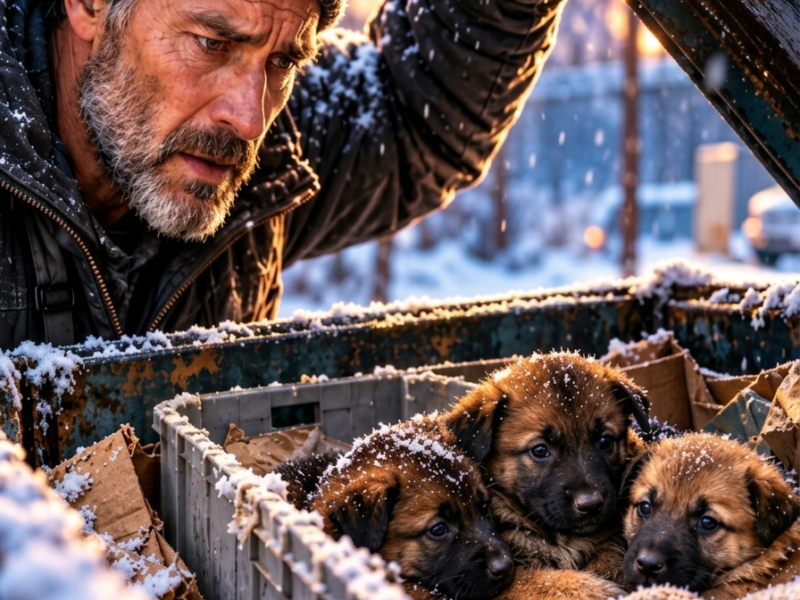
The night I was thrown out of a Navy SEAL reunion in San Diego, a commander called me a disgrace in front of everyone, but when three trembling K9 puppies crawled from beneath my truck
Rain hammered the asphalt of the Coronado hotel parking lot with the relentless violence of open water. San Diego was rarely this cold, but tonight the Pacific wind carried an icy sting that cut straight through the wool of my dress blues. I stood beside the rusted tailgate of my beat-up F-150, holding a soaked canvas duffel in my left hand and the heavy velvet case containing my medals in my right.
Through the panoramic glass of the banquet hall, warm amber chandeliers illuminated laughter, clinking crystal, and silhouettes of men whose lives I had guarded with my own blood for fifteen years.
Nobody followed me into the storm. Not Miller. Not Diaz. Not even Vance, whom I had dragged out of a burning compound in the Helmand River Valley while shrapnel tore through my own calf.
They stood shoulder to shoulder inside, their backs to the glass, pretending I had already vanished from the earth.
Commander Hayes’s parting roar still echoed against my temples like the muzzle blast of a breaching charge. He had stepped onto the dais, taken the microphone, and when he saw me standing near the back row in a uniform that hung loosely over my hollowed frame, his voice had turned to cold venom.
“Some men break quietly,” Hayes had sneered, ensuring every active-duty officer and retired legend heard every syllable. “Other men let their team die in the dark and come back looking for a pat on the head. You disgraced the trident, Mercer. You are not one of us anymore. Hand over your table card and get the hell out of my sight.”
I hadn’t shouted. I hadn’t defended myself. When a man has spent twelve months trapped inside a skull cracked by an improvised explosive device, his voice rots. The explosion in northern Syria had stripped eighty percent of the hearing from my left ear, shattered my right knee into a jigsaw puzzle of surgical titanium, and left me with blackouts and nightmares that felt more tangible than daylight. When the official naval review board quietly buried the mission report and labeled me medically unfit with an administrative reprimand for tactical negligence, I had accepted it. I had believed them.
I tossed the duffel bag into the truck bed and threw the medals onto the cracked vinyl passenger seat. The brass trident inside the velvet box felt like lead, a heavy reminder of a life that belonged to a ghost. I stood there in the downpour, leaning against the cold fender, waiting for the trembling in my hands to stop.
Then I heard it.
It wasn’t the wind whistling through the wheel wells. It was an unmistakable, high-pitched whimper, thin as thread and choked with water.
I went rigid. My pulse spiked. Fifteen years of combat instincts forced my right hand toward my waistband before I remembered I was unarmed in service dress. Another sound followed—a wet, muffled scratching against metal.
I dropped to my good knee directly into a pool of muddy runoff. Leaning down, I peer into the dark beneath the undercarriage, just behind the spare tire mount.
Wedged between the frame rail and the rusted muffler was a heavy industrial plastic crate, its wire hatch tied shut with green parachute cord. Through the narrow metal grate, three tiny, shivering faces stared out into the dark.
“Hey,” I whispered, my voice cracked and hoarse from disuse. “Easy. Easy, babies.”
They were German Shepherd puppies, no older than four or five weeks. Their dark coats were matted with mud and road grime, their ribs visible like small washboards beneath soaking fur. Two of them were huddled in the rear corner, eyes wide and glassy with sheer panic, while the third—the smallest of the litter, possessing large, disproportionate ears and a white patch on his chest—crawled toward the front grate, trembling so violently his teeth clicked.
Someone had jammed that crate up there intentionally. It hadn’t slid under by accident; it had been secured with a tactical trucker’s hitch.
I pulled my pocketknife from my trousers, sliced the nylon cord, and wrenched the plastic door open.
The smallest puppy didn’t bite. He didn’t run. He simply spilled forward into the rain-slick gravel, pulled himself across my forearm, and pressed his wet nose directly into the hollow of my throat. He was ice cold.
“I’ve got you,” I murmured, my chest constricting with a sudden, suffocating ache I hadn’t felt in over a year. “I’ve got you, little man.”
I reached inside the crate and gathered the other two. One had pale golden markings around her eyes; the other was solid sable, snapping nervously at the air until my fingers found the nape of his neck and settled him. I unbuttoned my navy dress jacket, stripped it off, and wrapped all three of them against my chest inside the heavy wool lining.
They ceased crying the moment they felt body heat.
I climbed into the cab of the truck, started the engine, and blasted the heater. As the old truck shuddered to life, I looked at them on the seat beside me. The smallest pup kept his eyes locked on mine, breathing in short, desperate gasps.
“You’re Bear,” I said quietly, gently stroking his damp forehead.
The sable male, alert and watchful despite his starvation, became Scout. The little golden-eyed female, who burrowed her snout under my thigh for warmth, became Maggie.
For twelve months, my apartment in Imperial Beach had been a tomb. The blinds were always drawn. Dirty coffee mugs lined the counters. Takeout boxes gathered dust in the corners, and the television hummed with static just to drown out the ringing in my ruined ear. I had lived like an animal waiting for its heart to stop.
That night, everything shifted.
I didn’t sleep. I stripped off my soaking uniform, hauled an old fleece blanket onto the linoleum kitchen floor, and stayed on my knees. I warmed goat milk and water in a saucepan, testing the temperature on my wrist before feeding them with an old medicine dropper one drop at a time. Bear refused to let go of my wrist; every time I pulled away, his tiny paws scrambled across my skin, desperate for contact.
By sunrise, the rain had cleared into a pale gray dawn.
Over the next three weeks, my small, dead world gained a pulse. When you have three starving lives relying on your hands, you do not have the luxury of staying in bed until noon staring at the ceiling fan.
At 0500 every morning, Scout would begin chewing on my shoelaces until I stood up. Maggie would sit by the refrigerator, tilting her head with military precision until the bowls hit the tile. And Bear—Bear followed me everywhere. He walked right at my left heel, exactly where a seasoned service dog walked, matching his tiny stride to my uneven, limping gait.
For the first time since northern Syria, I found myself laughing out loud when Scout stole my woolen socks and sprinted around the coffee table like a tactical bandit. My leg still ached, the titanium pins throbbed when the weather shifted, but I was walking two miles a day along the beach simply because Maggie needed exercise and Bear refused to leave my shadow.
They were giving me back my life, breath by breath.
Then came the twenty-first day.
It was just past eleven at night. The coastal fog had rolled in thick, pressing against the windows of my ground-floor apartment. I was sitting at the kitchen table, cleaning the slide of my Sig Sauer P226—a muscle-memory habit I had never managed to break—while the puppies slept in a tangled heap on a braided rug near the doorway.
Without warning, Maggie sat bolt upright.
Her ears flattened against her skull. The hair along her spine stood on end. She didn’t whimper; she issued a low, guttural, vibrating growl that vibrated through the floorboards.
Scout scrambled up instantly, positioning his small body between the front door and the rug. Bear moved differently. He didn’t growl. He came straight to my chair, sat on my boot, and fixed his black eyes on the doorknob.
I racked the slide of the Sig, chambering a hollow-point round with a crisp mechanical snap.
I stood up, keeping my weight off my bad knee, and crept toward the wall adjacent to the entryway. The street outside was dead silent. The fog outside muffled everything.
Then it came.
Three slow, methodical knocks.
Not the erratic rap of a lost neighbor. Not the hurried slap of a delivery driver. It was the rhythm of someone who knew how to announce themselves without alarming the whole street: two beats, pause, one beat. Tactical entry signal.
I leveled the pistol at chest height through the wooden door.
“Step back from the threshold,” I ordered, my voice dropping back into the flat, dangerous cadence of a team leader. “State your business.”
A woman’s voice answered through the wood. She sounded breathless, her tone strained with pure terror.
“Chief Mercer. My name is Dr. Elena Ramos. I was the attending veterinarian at Special Warfare Group One.” A sharp pause. “Please open the door. If they see me standing on your porch, they will kill us both.”
I hesitated for half a second. The name clicked. Ramos had been listed on several classified manifestos for canine logistics in Bahrain, though we had never crossed paths in person.
I unlocked the deadbolt with my left hand, kept the muzzle angled low behind the doorframe, and jerked the door open six inches.
She stepped inside before I could stop her, smelling of sea mist, cheap gasoline, and cold sweat. She wore an oversized dark raincoat, her dark hair plastered to her forehead. She slammed the door behind her and leaned her back against it, panting.
Then she looked down.
Maggie was growling from under the table. Scout was barking sharply. Bear remained firmly planted against my left shin, his dark eyes locked on the stranger.
Dr. Ramos went dead white. The color drained from her lips so fast I thought she was going to lose consciousness. She raised trembling hands to her mouth, her eyes widening in sheer disbelief.
“My God,” she whispered, her voice cracking. “Those dogs… those dogs were logged as incinerated two weeks ago. They were supposed to be dead.”
My stomach dropped like an anchor into ice water. “What did you say?”
She didn’t answer right away. Her hands shook violently as she reached beneath her coat and pulled out a thick, water-resistant manila envelope sealed with red evidentiary tape. She thrust it into my chest.
“Open it,” she said. “Look at what they did to you.”
I kept the pistol pointed at the floor, tore the edge of the envelope with my teeth, and shook the contents into my hand.
A single eight-by-ten glossy photograph slid out.
The image was high-resolution, captured with night-vision thermal filtration. It showed a remote airfield in the desert of Deir ez-Zor, Syria—the exact staging location of Operation Black Dawn, the mission that had cost my unit four men and ended my career.
In the frame stood Commander Hayes. Beside him was a private military contractor I recognized from our briefings, standing in front of an unmarked cargo transport.
And chained behind them, caged inside an armored trailer, were eight full-grown Belgian Malinois and German Shepherds wearing experimental biometric targeting collars. Tactical surveillance dogs capable of autonomous tracking.
I flipped the photograph over. On the back, written in black grease pencil in handwriting I knew better than my own, was a short message:
The blast wasn’t an accident. You were never responsible for the mission failure, Mercer. They tripped the perimeter on purpose.
My vision blurred at the edges. My pulse roared in my ears.
“Who wrote this?” I asked, grabbing Ramos by the shoulder. “Hayes told the entire community I missed the sentry sweep. He told them my negligence killed Miller’s team. Who wrote this note?”
She looked at me, her eyes wet with tears. “Someone inside your team. Someone who realized Hayes was trafficking advanced military assets to private contractors and staging tactical accidents to cover the missing inventories.”
She stepped away from the door and pointed toward Bear, whose ears were perked, listening intently.
“Those puppies are the direct bloodline of Ares—the lead tracking dog who died in your explosion. Their DNA carries the experimental neural interface markers. Hayes couldn’t leave them alive in the military kennel without raising red flags during an audit, so he ordered them culled and burned. But someone saved them, Mercer. Someone took them from the compound, drove them through the storm, and planted them where they knew you’d find them.”
“Why me?” I rasped, my throat raw. “I’m a cripple with a ruined name. I’m nobody.”
“Because you’re the only one who wouldn’t look away,” she whispered. “And because you’re the only operator who survived that night who isn’t on Hayes’s payroll.”
Before I could speak, Maggie let out a piercing bark.
Scout scrambled backward, snarling toward the bay window facing the street. Bear lunged forward, placing his front paws against the windowsill, letting out a sharp, protective yelp that commanded immediate attention.
Through the salt-streaked glass, two sets of headlights cut through the ocean fog.
A black Chevrolet Suburban, completely blacked out with no license plates, turned the corner onto my narrow residential street. It didn’t speed. It cruised at ten miles an hour, its dark windows reflecting the amber streetlights like mirrors.
Ramos grabbed my forearm with fingernails that bit through my shirt.
“They tracked my car,” she breathed, her voice turning shrill with panic. “They found you.”
The heavy SUV slowed to a crawl, then smoothly pulled up to the curb directly in front of my porch steps. The engine idled with a deep, menacing rumble.
For fifteen months, fear had been a dull, personal ache—fear of the dark, fear of my own failure, fear of living an empty life. But as I looked down at Bear, who was trembling not from cowardice but from instinctual fury, ready to defend a home he had known for only three weeks, that old numbness evaporated.
The ice in my veins turned back into fire.
I reached out, scooped Bear into my left arm, and pulled the slide back on my weapon to double-check the chamber.
They hadn’t left these dogs under my truck by coincidence. They hadn’t come to my door by chance.
I looked at the black SUV through the glass as the front passenger door began to swing open.
“Dr. Ramos,” I said, my voice dead, cold, and steady. “Get into the back room. Grab the spare magazines from the nightstand.”
The hunt was no longer in the desert. It had come to my doorstep.
The front door of the black Suburban swung open with an oily glide.
From the front passenger seat stepped a man whose silhouette I knew before his boots even hit the damp asphalt. He was over six feet two, built like an anvil, wearing an unmarked tactical soft-shell jacket and an unbuttoned collar.
Vance.
Lieutenant Michael Vance. The man whose life I had saved when an RPG-7 tore through our perimeter wall in Helmand six years ago. The man who had stood beside Commander Hayes in the Coronado ballroom three weeks ago, watching me walk out into the rain with a glass of champagne in his hand.
Behind him, two other men emerged from the vehicle. They moved with the crisp, economic precision of active-duty Tier One operators. No wasted motion. Suppressed submachine guns carried low beneath heavy coats. They didn’t look at the neighboring houses; they didn’t check for witnesses. When men like this moved on American soil, they operated under the umbrella of institutional immunity.
“Ramos,” I whispered, not taking my eyes off the glass. “Back room. Now. Lock the deadbolt behind you.”
“Mercer, you don’t understand what they have—”
“Go!” I barked.
She flinched at the command voice, turned, and sprinted down the narrow hallway. The bedroom door slammed, followed by the heavy click of the secondary bolt.
I looked down at the puppies. Scout and Maggie had retreated under the heavy oak dining table, their tiny bodies tucked tightly against each other, though their teeth were bared in instinctive defiance. Bear remained right at my heel, his small neck craned upward, tracking my eyes. He seemed to understand that the air in the room had turned to poison.
I reached down, lifted Bear, and set him gently under the table beside his brother and sister.
“Stay,” I whispered, pressing my palm firmly against his snout. “Hold your ground.”
He gave one tiny whine, then tucked himself in front of Maggie, planting his front paws like an eight-pound sentry.
I moved to the side of the bay window, pressing my back against the drywall, out of the direct line of sight from the street. Through the sliver of space between the curtain and the frame, I watched Vance approach.
He didn’t run. He walked up the concrete steps with the casual swagger of a man who believed he held every card in the deck. The other two men fanned out—one moving toward the alleyway that led to my rear fire escape, the other staying by the driver’s side door of the Suburban with an engine running.
Three men. Suppressors. Vehicle running. No local plates.
This wasn’t an arrest. It was an extraction—or an execution designed to look like a veteran’s tragic, self-inflicted end.
The heavy front door shook as Vance knocked. Not the signal Ramos had used. Just two heavy, dismissive thuds.
“Mercer,” Vance called out, his voice smooth, calm, and utterly devoid of warmth. “Open up, brother. We know the vet is inside. Let’s not make this messy. You’ve had enough bad press for one lifetime.”
I took a slow breath through my nose, letting the old operational adrenaline flood my system, burning away the phantom pains in my ruined knee. The world narrowed into distance, angles, and target priority.
“You’re trespassing, Vance,” I replied through the wood, keeping my voice level. “You stepped off the reservation coming here.”
A dry laugh came from the porch. “There is no reservation, Mercer. Not anymore. The navy doesn’t care about you. Hayes signed off on your file months ago. You’re an administrative ghost. Now open the door, hand over Dr. Ramos and the inventory she stole, and we’ll walk away. Hayes will even sign your full medical pension. You get to keep your little shack by the ocean.”
“Inventory?” I asked, stepping three inches closer to the hinge side of the door. “You mean the three puppies Hayes ordered murdered because their microchips linked him to private black-market military sales in Erbil?”
Silence hung on the porch for three beats.
When Vance spoke again, the faux-brotherhood was completely gone. His voice was flat, professional, and lethal.
“Break it.”
The door frame gave way with a violent splintering crash as Vance kicked directly beside the deadbolt.
He didn’t charge in blindly. He knew I was an operator. The door swung open, and before he could breach, I dropped my weight onto my left hip, pivoted around the frame, and thrust the muzzle of my Sig directly into the center of the opening.
The man behind Vance—a younger contractor with a low-profile plate carrier—pushed through first, raising a suppressed MPX.
I didn’t hesitate. I fired two rounds into his center mass.
The suppressed cough of my pistol was masked by the heavy crash of the splintering wood. The contractor collapsed backward, his body slamming into the porch railing, his weapon clattering across the concrete.
Vance reacted instantly. He dropped low, his sidearm clearing his holster, and fired three rounds blindly through the drywall beside the door frame. Plaster exploded in my face, chalky white dust filling my eyes and nose. One round grazed my left bicep, slicing through the cotton of my shirt like a hot soldering iron.
I scrambled backward across the hardwood floor, firing two suppressive shots to keep Vance from entering.
From beneath the table, Bear erupted into an enraged, frantic barking, attempting to lunge toward the doorway.
“Bear, back!” I roared, throwing my body between the doorway and the puppies.
Outside, the man by the vehicle began firing through the living room window. Large shards of plate glass shattered inward, scattering across the carpet like frozen ice. The heavy curtains tore free from their brass rods, collapsing over the furniture.
I lunged beneath the dining table, grabbed the plastic pet carrier I had kept near the wall, and scooped all three puppies inside with one violent sweep of my arms. Bear bit down on my sleeve, trying to fight, trying to defend me, but I shoved him into the crate and slammed the wire hatch shut.
“Ramos!” I bellowed down the hall. “Fire escape! Now!”
I grabbed the handle of the crate with my left hand, racked a fresh magazine into my Sig with my right, and sprinted toward the back bedroom.
My knee buckled halfway down the hall—a sharp, sickening crunch that sent white-hot fire up my spine. I hit the hallway wall with my shoulder, groaned through clenched teeth, and forced myself upright using sheer will.
Behind me, heavy combat boots stepped over the broken threshold of the front door.
“You can’t run on that leg, Mercer!” Vance’s voice echoed through the narrow hallway. “You couldn’t run in Syria, and you can’t run now! You’re dragging everyone down with you!”
I reached the bedroom door. Ramos had already thrown it open, holding a heavy iron tire iron she had found in the corner.
“Window!” I ordered, shoving the puppy crate into her arms. “The fire escape leads to the alley behind the auto shop. Run. Do not wait for me.”
“Mercer, your arm is bleeding—”
“Move!”
The bedroom window was already pushed up. Outside, the alley was shrouded in dense Pacific fog. Ramos hoisted the crate over the sill and swung her legs out. Bear’s black muzzle pressed against the wire gate of the crate, his eyes locked onto mine, his whimpers cutting deeper than any bullet graze.
“Take care of them, Elena,” I said. “If anything happens to them, none of this matters.”
“They’re coming through the hall!” she gasped, looking past my shoulder.
I turned back to the bedroom doorway just as Vance stepped into view.
His face was cold, shadowed by the dim light of the hallway. He leveled his Glock directly at my chest. He didn’t look angry; he looked disappointed, like a professional who had been forced to discard a broken tool.
“You should have stayed in that parking lot, Mercer,” Vance said softly. “You should have taken your medals and died quietly in a bottle like every other washed-up operator.”
“Tell me one thing, Vance,” I said, holding my weapon steady, pointing directly between his eyes. “Who set the charge in Deir ez-Zor? Was it you, or did Hayes push the button himself?”
A dark, humorless smile crossed Vance’s lips.
“Hayes didn’t need to push it,” Vance whispered. “You did. When you walked Ares down that secondary corridor instead of the primary breach, you triggered the tripwire we laid for the Kurds. You did our job for us, Mercer. We just collected the insurance.”
The realization hit me with the force of an artillery shell.
The mission hadn’t failed because I missed a sweep.
They had used my unit—my dog, my team—as bait to eliminate witnesses to an illegal weapons transfer, then pinned the slaughter on my shattered memory while Vance and Hayes walked away with millions in offshore defense accounts.
Before Vance could squeeze the trigger, a sudden, high-pitched mechanical shriek pierced the room.
It came from the pocket of Vance’s jacket. A tactical radio receiver.
“Vance! Break contact! Coronado PD just received four shots-fired calls from this block! Units are two minutes out! Clear the zone now!”
Vance’s eyes flickered toward the window, then back to me.
“Another time, Chief,” he said quietly.
He didn’t fire. He fired two rounds into the floorboards at my feet to force me to take cover, then turned and sprinted back down the hallway toward the front door.
Seconds later, the screech of tires echoed through the fog as the black Suburban accelerated down the asphalt, vanishing into the night.
I didn’t wait for the sirens.
In San Diego, Commander Hayes had friends in every municipal precinct and federal field office. If the Coronado police found me standing over a shot contractor with an unregistered firearm and an open wound, I would be locked inside a county holding cell before sunrise, and Hayes would ensure I never survived the first night.
I climbed out the window into the damp alley.
Ramos was waiting behind a row of commercial dumpsters, clutching the crate to her chest. Bear was whining softly, but when he saw my boots hit the gravel, he went dead silent, pressing his head against the plastic wall.
“Where do we go?” Ramos asked, her breath misting in the cold air. “They have our plates. They have our faces.”
I grabbed the heavy crate from her hands, ignoring the throbbing pain in my knee and the blood soaking through my torn sleeve.
“We go north,” I said, my voice cold as slate. “Up into the mountains. To the only place Hayes can’t reach.”
“Who is up there?”
I looked down at Bear through the wire mesh. His dark eyes caught the faint glow of the distant streetlights.
“The man who trained Ares,” I replied. “The man who built the unit Hayes stole.”
The drive up into the Cuyamaca Mountains took nearly three hours on unpaved fire roads.
We had abandoned my F-150 in an industrial scrap lot near El Cajon, swapping it for a battered, twelve-year-old Subaru station wagon that Ramos had parked near a veterinary supply warehouse as an emergency contingency. The heater barely worked, coughing dry, dusty air through cracked plastic vents, but it was untraceable.
The neon sprawl of San Diego faded behind us, swallowed by miles of black pine, granite boulders, and winding switchbacks. As the elevation climbed past four thousand feet, snow began to dust the edges of the dirt track—early season flurries that clung to the pine needles like sugar.
In the back seat, the puppies were finally asleep.
The warmth of the blankets and the steady hum of the engine had exhausted them. Bear lay with his chin resting across Maggie’s flank, while Scout kept one front paw slung protectively over the small of Bear’s back. Even in sleep, their small bodies formed an unbroken circle.
I looked at them through the rearview mirror. My left arm was bound with sterile gauze and black electrical tape that Ramos had pulled from her field kit. The bullet had taken a chunk of flesh from my tricep, but it had missed the bone and artery. The physical pain was nothing compared to the clarity that had settled inside my head.
For a year, I had believed I was broken. I had believed that my memory had failed my men in that Syrian cellar. The guilt had been a physical weight, crushing my chest every time I tried to draw a full breath.
Now, that weight was gone. It had been replaced by something far more dangerous: certainty.
“Who are we meeting, Mercer?” Ramos asked, breaking the silence. She was staring out the passenger window into the black forest, her fingers nervously picking at the tape on her medical kit.
“Garrison,” I said.
Her head snapped toward me. “Master Chief Thomas Garrison? He retired ten years ago. The rumors said he went completely off-grid after the kennel program was privatized.”
“He didn’t go off-grid,” I corrected, downshifting as the Subaru climbed a steep, rutted incline. “He got pushed out. The moment Hayes started talking about turning the K9 tactical program into a commercial security contract, Garrison told him to his face that dogs weren’t commodities to be sold to the highest bidder in Dubai. Hayes had him forcibly retired on a bogus psychiatric discharge.”
“And you think he’ll help us?”
“Garrison bred Ares,” I said simply. “He held these puppies’ great-grandparents in his hands. If anyone can extract the tracking data from their chips without alerting Hayes’s network, it’s him.”
We rounded a sharp bend flanked by massive ponderosa pines. Ahead, the road ended at a heavy galvanized steel gate chained between two split-rail cedar posts. A rusted tin sign hung in the center: PRIVATE PROPERTY. DEAD END.
I killed the headlights, leaving only the amber running lights on.
I didn’t honk. I put the car in park, stepped out into the biting mountain air, and walked to the gate. The pine scent was sharp, clean, and biting, cleansing the smell of gunpowder from my lungs.
From the tree line thirty yards to the left, a voice cut through the dark—dry, gravelly, and flat as a tombstone.
“Take two steps back, Mercer. Keep your hands where the moonlight can see them.”
I didn’t turn around. I slowly raised both hands to shoulder height.
“Hello, Master Chief,” I said. “You’re five yards off your usual firing line. Your bad hip must be acting up.”
A dry chuckle came from the shadows.
A tall, broad-shouldered man stepped out from behind a massive pine. He wore an oilskin duster, mud-caked hunting boots, and a scarred Remington 870 shotgun cradled across his chest. His hair was pure silver, cropped tight against a weathered skull, and a jagged scar ran from his right ear down into his white beard.
Thomas Garrison. The architect of the Navy’s modern multi-purpose canine doctrine.
He lowered the shotgun, his pale blue eyes taking in my bloodied sleeve, my limp, and the battered Subaru behind me.
“You look like hell, Nathan,” Garrison said, stepping forward to unlock the chain. “Even worse than the day they dragged you out of Bethesda.”
“I brought you something,” I replied.
Garrison didn’t ask questions. He swung the gate open, signaled for Ramos to drive the car through, and closed the chain behind us.
His property sat in an isolated bowl beneath the shadow of Cuyamaca Peak. It consisted of a reinforced timber cabin, a heated barn converted into a modern veterinary laboratory, and six massive outdoor training runs enclosed by eight-foot chain-link fencing.
Inside the cabin, a massive wood stove threw off intense heat.
The moment I carried the crate through the front door and set it down on the wide-plank floor, Garrison went rigid.
He didn’t look at me. He didn’t look at Ramos. He dropped down onto his knees with a heavy groan, unlatched the crate door, and watched as three pairs of ears popped out into the firelight.
Bear was the first to step out. He didn’t cower. He walked straight up to Garrison’s scarred boot, sniffed the worn leather, and let out a soft, inquiring chuff.
Garrison reached out with hands that were missing the tips of two fingers and gently cupped the sides of Bear’s skull. His weathered face softened, decades of hardened military cynicism cracking open in an instant.
“Ares’s blood,” Garrison murmured, his voice trembling slightly. “Look at the width of the brow. Look at that chest line. You can’t fake this lineage. Hayes was supposed to have buried these dogs under concrete.”
“He tried,” I said, leaning against the timber mantelpiece. “Someone pulled them out. Someone who knew how to tie a trucker’s hitch and someone who knew my truck.”
Garrison looked up at me, his eyes narrowing into cold slits. “It wasn’t an accident they ended up with you, Nathan. Hayes has been preparing to sell the entire third-generation biometric system to a foreign defense syndicate based out of Cyprus. The system isn’t just software—it’s neural conditioning bred directly into the bloodline. These dogs respond to encrypted frequencies that can bypass standard civilian and military electronic countermeasures.”
“What does that mean in plain English, Master Chief?” Ramos asked, setting her medical bag on the pine table.
Garrison picked Bear up, holding the puppy against his flannel shirt. Bear immediately began chewing on the bone button of his pocket.
“It means,” Garrison said, “that whoever controls these dogs controls the prototype key to Hayes’s entire classified communications network. The microchips implanted in their neck tissue aren’t just IDs. They’re encrypted physical storage drives containing the master logs of every illegal transaction, every mission Hayes doctored, and every off-book execution his contractors carried out over the last five years.”
The room fell dead silent except for the crackling of the pine logs in the wood stove.
I stared at the small puppy chewing Garrison’s button.
“Hayes didn’t come to my apartment just to silence me,” I whispered, the final puzzle piece falling into place with terrifying clarity. “He came because the data that can put him against a wall for treason is sitting inside these dogs.”
“And he knows it,” Garrison said.
He carried Bear over to a stainless steel examination table in the adjoining room. He flicked on an overhead surgical lamp, pulled a handheld digital scanner from a drawer, and passed it over Bear’s shoulder blades.
The scanner beeped once. A red LED flashed, followed by a dense sequence of green alphanumeric characters scrolling rapidly across the small digital screen.
PROJECT CERBERUS: UNIT 01 – ACTIVE ENCRYPTION LOCKED.
Garrison looked at me. “The drive is intact. But it has an automated proximity beacon. Hayes’s tech team has been pinging this sector since midnight. They know the general grid. By dawn, they’ll have helicopters combing these ridges.”
“Can you extract the data?” Ramos asked desperately.
“I can,” Garrison replied. “It’ll take three hours to de-crypt the drive and transmit the payload directly to the Inspector General’s secure terminal at the Pentagon. But the moment I begin the download, the encryption key will broadcast a continuous homing signal.”
He looked at me, then at the rifle rack mounted on the cedar wall behind him.
“The moment I plug this pup into the terminal, Nathan, this cabin turns into a beacon. Hayes will bring everything he has left before that upload completes.”
I looked down at Scout and Maggie, who were curled up beside my boots, resting peacefully in the warmth of the fire. Then I looked at Bear, who had turned his head to look back at me, his dark eyes clear, fearless, and trusting.
I reached out and took a custom M4 carbine down from Garrison’s gun rack. The cold steel felt familiar. Right.
“Start the download, Master Chief,” I said. “I held that mountain in Helmand with four men and half an arm. We can hold this ridge until dawn.”
The mountain cold hit like a physical wall as I stepped onto the perimeter deck.
The flurries had stopped, replaced by a crystalline frost that silvered the granite boulders surrounding Garrison’s clearing. The sky above was pitch black, salted with indifferent stars, while the valley below remained drowned in an ocean of gray Pacific fog.
It was 0340.
Garrison had turned the cabin’s laboratory into a tactical relay station. A heavy black diagnostic cable ran from a ruggedized field laptop directly into a sterilized induction pad resting against Bear’s side.
The puppy lay on a heated fleece blanket, completely calm. Garrison had given him a light, non-narcotic sedative to keep him still, but Bear’s eyes remained open, heavy-lidded and focused on me every time I walked past the doorway.
Beside him, Ramos sat watching the progress bar on the screen.
DECRYPTION: 34 PERCENT.
DOWNLINK STATUS: CONNECTED (SECURE PENTAGON GATEWAY).
Every five seconds, a small red beacon icon pulsed in the top corner of the monitor.
“They have the coordinates,” Garrison said, stepping onto the porch beside me. He carried two loaded chest rigs and a heavy thermal optic mounted on a bolt-action .308 rifle. “Their forward recon team crossed the lower valley checkpoint ten minutes ago. No lights. Three vehicles.”
“Vance?” I asked.
“If Vance is Hayes’s primary cleaner, he’s leading the breach,” Garrison replied, adjusting the sling of his rifle. “He won’t use local contractors this time. He’ll use the private security cadre from the Miramar annex. Well-trained, well-equipped, and completely deniable.”
“How long until the download finishes?”
“An hour and twenty minutes,” Garrison said, his breath pluming white in the freezing air. “Assuming the satellite uplink doesn’t drop.”
“We give them eighty minutes,” I said. “Not a second less.”
I took the M4 carbine, checked the chamber, and clicked the selector switch to semi-automatic.
My knee was stiff, throbbing with a deep, persistent ache from the cold, but my hands were rock steady. The trembling that had haunted me for fifteen months in that dark apartment was completely gone.
A soldier does not heal by resting in the dark; he heals by finding something worth standing between and the fire.
I moved down the timber steps and positioned myself behind a natural granite parapet fifty yards south of the cabin, overlooking the single dirt access road. The position gave me a clear field of fire across three hundred yards of clearing, flanked on both sides by dense, snow-dusted timber.
Behind me, the door of the cabin opened quietly.
I turned, expecting Garrison.
Instead, a small, dark shadow scrambled down the timber steps into the snow.
It was Scout.
The little sable male had slipped through the cracked door. He trotted across the frozen gravel, his tiny paws crunching through the crust of snow, and came straight to my parapet. He didn’t bark. He squeezed himself between my left boot and the cold granite, sitting down with his back pressed firmly against my shin.
“Go back inside, kid,” I whispered, reaching down to nudge him.
Scout turned his head, snapped his jaws lightly at my gloved thumb in playful defiance, and then fixed his gaze down the dark mountain road, his ears erect and pointing toward the tree line.
He wasn’t going back.
I pulled my fleece watch cap from my pocket, laid it on the frozen ground beside my knee, and lifted Scout onto it. He curled his front paws beneath his chest, perfectly still, acting as my silent spotter.
At 0415, the forest went completely silent.
The wind died down. The nocturnal chatter of owls and crickets vanished.
Beside me, Scout’s ears twitched forward forty-five degrees. A low, nearly imperceptible vibration began deep in his chest—not a growl, but an alert signal.
“Good boy,” I murmured.
Through the night-vision optic mounted on my carbine, the black forest turned into a glowing green landscape.
Two hundred yards down the trail, three thermal signatures emerged from the brush. They moved in staggered wedge formation, keeping to the shadows of the pines. Behind them, two more moved up the road shoulder.
Five operators. Suppressed carbines. High-cut helmets with integrated comms.
They were moving fast, attempting to close the distance before the cabin could react.
I adjusted my crosshairs onto the lead operator’s chest, exhaled half a breath into the frozen air, and squeezed the trigger.
The suppressed crack of the 5.56 round shattered the mountain silence.
The lead man dropped instantly into the snow.
The remaining four scattered like spiders into the tree line, opening up with immediate, aggressive suppression fire. Rounds tore through the granite above my head, showering my helmet and shoulders with sharp stone fragments and shredded bark.
To my left, from the cabin roofline, Garrison’s .308 roared—a heavy, unsuppressed thunderclap that rolled across the valley like artillery. A second contractor, attempting to flank through the eastern gulley, collapsed behind a fallen log.
“Three remaining on the primary axis!” Garrison yelled through his handheld radio. “Nathan, check your six! They brought a second element up the northern ridge!”
I glanced toward the north.
Through the dense pines, I saw the thermal glint of two more figures moving toward the rear of the cabin—toward the laboratory where Bear and Maggie were trapped.
“Scout, stay!” I commanded.
I shoved off the parapet, ignoring the fire screaming through my reconstructed knee, and limped aggressively toward the rear timber deck.
The snow slowed me down, my boots breaking through the frozen crust with heavy, ragged steps. As I rounded the corner of the barn, a figure stepped out from the shadows of the generator shed, leveling a short-barreled shotgun.
I had no time to raise the carbine.
I dove forward into the snow as the shotgun blast obliterated the timber corner post where I had been standing a fraction of a second before. Wood splinters ripped across the side of my face.
I rolled onto my back, drawing my sidearm from its holster, and fired three rounds upward through the falling snow.
The operator stumbled backward against the generator housing, his weapon slipping from his fingers, and slid down into the drift.
I scrambled up, gasping for air, the taste of copper in my mouth.
Through the rear window of the cabin, I saw Elena Ramos standing with her back against the laboratory door, holding the tire iron with both hands, tears streaming down her pale face.
On the table, Bear was struggling against the harness, his high-pitched barks muffled by the heavy glass. He wasn’t crying for help; he was fighting to reach the door.
Then, from the darkness of the front clearing, a voice rose above the gunfire—harsh, amplified through a vehicle PA system.
“Mercer! Drop your weapons!”
It was Hayes.
Commander Hayes had come in person.
I moved to the front corner of the cabin, keeping behind the thick log siding.
A heavy, armored civilian transport had driven straight through Garrison’s locked gate, its massive steel bumper crushing the cedar posts like toothpicks. Its high-intensity halogen roof rack illuminated the entire clearing in blinding, stadium-grade white light.
Standing beside the open driver’s door was Hayes. He wasn’t wearing his dress blues tonight. He wore an expensive tactical shell, an unholstered combat pistol in his hand, and a face twisted into a mask of pure, murderous arrogance.
Beside him stood Vance, blood dripping from a cut on his forehead, his weapon leveled directly at Garrison’s roof position. Garrison had ceased firing; two red laser designators were dancing across the timber shingles above his head.
“It’s over, Nathan!” Hayes shouted, stepping into the center of the blinding light. “Your little tech transmission just failed! My team severed the microwave relay at the base of the mountain! Nobody is receiving your data!”
My stomach plunged. I looked back through the open doorway toward the monitor.
The progress bar was frozen at EIGHTY-TWO PERCENT.
CONNECTION SEVERED: RETRYING SATELLITE HANDSHAKE.
“You’re a broken soldier who couldn’t accept his own failure,” Hayes sneered, his voice booming through the cold night. “You walk out here with those dogs right now, or I burn this cabin to the ground with every single one of you inside.”
I looked down at the snow at my feet.
Scout had followed me back from the parapet, sitting quietly beside my heel, his small jaw set, his dark eyes locked on the men in the light.
From inside the cabin, I heard Bear’s sharp, rhythmic bark—the unmistakable cadence of a working dog announcing that the time for hiding was finished.
I had spent fifteen months believing I had failed my unit.
I had spent fifteen months hiding from the world because a man with brass on his collar told me I was nothing.
I wiped the blood from my cheek with the back of my tactical glove, dropped the empty magazine from my carbine, and slapped my final thirty-round magazine into the well with a clean, deafening metallic clap.
“You’re right about one thing, Hayes,” I muttered to the cold air.
I stepped out from behind the log wall, walking straight into the center of the blinding white halogen lights.
“I’m not one of you anymore.”
The blinding glare of the halogen spotlights turned the falling snow into a curtain of falling diamonds. I walked forward until I was twenty paces from Hayes, my rifle hanging loosely from its single-point sling across my chest, my hands resting in plain sight.
Behind me, the front door of the cabin creaked open.
Garrison had not surrendered. He stepped onto the porch, blood running from a shrapnel cut on his temple, but his heavy shotgun was leveled from the hip directly at Vance’s ribcage.
And beside Garrison came Elena Ramos.
She wasn’t holding a weapon. She was holding the crate, its door wide open.
Maggie leaped out first, her golden-rimmed eyes flashing in the white light, darting straight to my right side. Scout moved from the shadows of the woodpile to flank my left.
And then came Bear.
He didn’t run. He walked with that deliberate, measured, heavy-pawed stride that belonged to his father. He was eight pounds of bone, fur, and raw lineage, yet he carried himself like an apex predator returning to his ground. He walked up to my left leg, sat down on the packed snow, and let out one deep, resonant bark that echoed off the granite cliffs above us.
Hayes looked down at the three puppies, then let out a sharp, mocking laugh that carried no humor.
“Look at you, Nathan,” Hayes sneered, gesturing with his pistol toward the three dogs. “The great Chief Petty Officer Mercer, reduced to hiding behind a washed-up vet and three mutts that should have been turned to ash in a base incinerator. Did you really think this was going to save you?”
“The data didn’t drop, Hayes,” I said, my voice dead and cold in the frozen air.
Hayes’s smile vanished. His eyes narrowed.
“What did you say?”
“Garrison didn’t use the commercial microwave tower at the bottom of the pass,” I said, taking one half-step forward. Bear rose with me, matching my movement instantly. “We knew you had the local communications infrastructure compromised. The beacon we broadcast wasn’t an uplink to the Pentagon. It was an encrypted local frequency.”
Hayes’s radio crackled on his vest.
A frantic, terrified voice broke through the speaker: “Commander! Break contact! We’ve got multiple rotary-wing aircraft inbound on your position! Fast movers out of North Island Naval Air Station! They bypassed civilian ATC—they’re running blacked-out under JSOC transponders!”
Hayes went completely pale. His arrogant composure cracked down the middle.
“Vance,” Hayes rasped, stepping backward toward the armored truck. “Kill them. Kill them all now.”
Vance didn’t raise his rifle.
He stood frozen in the spotlight, his eyes locked not on me, but on the three German Shepherds sitting in the snow. He looked at Bear’s chest, at the distinctive white patch that mirrored Ares—the dog Vance had abandoned in the flames of Deir ez-Zor.
“Vance!” Hayes screamed, grabbing the lieutenant’s shoulder. “I gave you a direct order!”
Vance looked at Hayes, then looked down at his own hands. The silence between them stretched like a wire pulled to the breaking point.
“You told me the dogs were clear, Commander,” Vance whispered, his voice hollowed by a sudden, devastating realization. “You told me Ares was dead before the charge went off. You told me nobody suffered.”
“They’re animals, you idiot!” Hayes snarled, his mask completely slipping. “They are military hardware! Now pull the trigger or I will put a round through your skull myself!”
Hayes raised his sidearm, shifting his aim from me to Vance’s chest.
He never got the chance to squeeze the trigger.
From the snow at my feet, Bear didn’t wait for a command.
He didn’t possess the weight of a full-grown hundred-pound patrol dog, but he possessed the speed and the fearless heart of a bloodline bred for war.
With a high, piercing war cry, Bear launched himself across the snow.
Scout and Maggie were a heartbeat behind him, moving as a coordinated pack, their tiny bodies cutting through the drifts with terrifying speed.
Bear hit Hayes’s right boot with all the force his small frame could muster, his needle-sharp puppy teeth sinking deep through the leather into the tendon of Hayes’s ankle. Scout struck the other leg, tearing at the cuff of his trousers, while Maggie lunged upward, snapping fiercely at the commander’s gun hand.
Hayes let out an unmanly shriek of pure surprise and pain.
He staggered backward, his balance shattered on the slick ice, flailing wildly. His sidearm discharged into the dirt, kicking up a shower of frozen mud.
“Get them off me!” Hayes screamed, kicking frantically. “Get them off me!”
He raised his heavy boot to crush Bear’s skull into the frozen earth.
That was the last mistake he ever made.
The distance between us vanished. The pain in my knee was nothing. The cold was nothing.
I covered the twenty feet in three explosive strides, caught Hayes by the tactical collar of his jacket with my left hand, and drove him backward into the steel door of his armored vehicle with an impact that buckled the sheet metal.
His head bounced off the reinforced glass with a sickening thud.
His pistol fell into the snow.
I drove my forearm across his throat, pinning him against the truck, cutting off his airway until his eyes bulged and his face turned a dark, suffocating purple.
“You took my team,” I whispered into his ear, my voice trembling with fifteen months of buried rage. “You took my brothers. You tried to slaughter these dogs to cover your stolen money.”
“Mercer…” Hayes choked out, his fingers clawing uselessly at my wrist. “Please… you’re… you’re a chief… you follow orders…”
“My orders are to defend this country from enemies foreign and domestic,” I said, leaning in until my nose was an inch from his. “And you, Hayes, are the lowest form of domestic traitor.”
I didn’t execute him.
A bullet was too clean. A bullet would give his defense attorneys an argument for self-defense in the dark.
I drove my right fist straight into his solar plexus, knocking the remaining breath from his lungs, followed by a short, brutal right hook that shattered his jawbone. Hayes crumpled into the snow beside his front tire, groaning, broken, and completely defeated.
Vance stood twenty feet away, his hands held high in the air, his weapon lying on the ground beside his boots. He didn’t run. He looked at me with the dead, empty eyes of a man who knew his life was over.
“Nathan,” Vance whispered, his voice cracking. “I didn’t know about the puppies. I swear to God, I didn’t know.”
“Tell it to the court-martial board, Michael,” I said quietly.
Above us, the mountain ridge shook with a low, bone-jarring vibration.
Through the falling snow, two massive MH-60 Black Hawk helicopters cleared the tree line, their searchlights slicing through the darkness, bathing the entire clearing in pure, blinding daylight. The downdraft from their rotors kicked up a miniature blizzard, flattening the pine branches and scattering the halogen glare.
On their fuselages, the emblems of the Naval Special Warfare Command stood bold and unmistakable.
The real navy had arrived.
Ramos had bypassed Hayes’s local blackout completely. While Hayes had been focused on hunting down a broken veteran in the Cuyamaca ridges, Garrison’s secondary uplink had completed the download to the United States Marshals Service and the Office of Naval Intelligence.
They hadn’t come to arrest me.
They had come to collect their commander.
Federal agents and armed master-at-arms poured from the helicopters before the skids even touched the snow, their weapons drawn, sweeping the perimeter with lethal efficiency. Within thirty seconds, Vance was in zip-ties, and two agents were dragging Hayes from the mud, reading him his rights under the Uniform Code of Military Justice.
A tall man in a navy trench coat stepped down from the lead helicopter, his silver eagles catching the searchlight.
Captain James Caldwell. The deputy commander of Special Warfare Group One. A man whose integrity Hayes had never been able to buy.
Caldwell walked through the snow, stepping over the shattered cedar gate, until he stood in front of me. He looked at my bloodied arm, looked at the battered cabin, and then looked down at the snow.
Bear had returned to my side. He was covered in mud and snow, his tiny ribs heaving, but he was sitting tall, his chin raised, leaning his body against my combat boot. Scout and Maggie flanked him, completely unbothered by the screaming turbine engines fifty feet away.
Caldwell stood there for a long moment, the wind whipping his trench coat against his shins.
Then, slowly, deliberately, the captain snapped his right hand to the brim of his cover in a crisp, unbroken salute.
“Chief Mercer,” Caldwell said, his voice cutting clearly through the rotor wash. “On behalf of the United States Navy, I apologize for what was done to you. The charges against your record have been expunged as of 0400 this morning. Your medical retirement has been upgraded to full disability with valorous distinction.”
I didn’t salute back immediately. I looked at the black SUV where Hayes was being thrown into the rear seat like a common criminal.
“What about the dogs, sir?” I asked.
Caldwell looked down at Bear. A faint, genuine smile crossed the senior officer’s stern face.
“According to official naval records, Chief, the Project Cerberus litter was destroyed three weeks ago in an accidental facility fire.” Caldwell looked back up at me, his eyes holding mine. “As far as the United States Navy is concerned, those three animals do not exist. They are the personal property of retired Chief Petty Officer Nathan Mercer.”
The captain lowered his salute, turned on his heel, and walked back toward the waiting Black Hawk.
Ten minutes later, the clearing was quiet again.
The helicopters lifted off, their thunderous roar fading over the granite peaks, carrying away the traitors, the contractors, and the lies that had poisoned my life for over a year.
The sun finally broke over the crest of Cuyamaca Peak, casting long, golden beams of morning light across the pristine white snow.
Garrison stood on the timber porch, a tin mug of steaming black coffee in his hand, watching Ramos patch up the final scratch on Scout’s ear.
I sat down on the top timber step of the porch, the cold wood soaking through my trousers. The exhaustion finally caught up to me—a deep, total, bone-weary ache that settled into every muscle in my body.
Bear climbed up onto the step beside me.
He didn’t run around. He didn’t look for food. He simply crawled onto my lap, tucked his chin over my forearm, and let out a long, shuddering sigh of pure relief.
I rested my hand on the back of his neck, feeling the steady, rhythmic beat of his heart against my palm.
A year ago, I had walked out of that ballroom in San Diego believing my life was over, that I was a broken tool cast aside into the rain. I had believed I was completely alone.
I looked out across the sunlit valley, then down at the three puppies who had crawled out from beneath the rusted frame of my truck to drag me back from the grave.
We were bloodied. We were scarred.
But as the morning sun warmed the mountain pines, I knew the truth.
We were going home.
The end.









