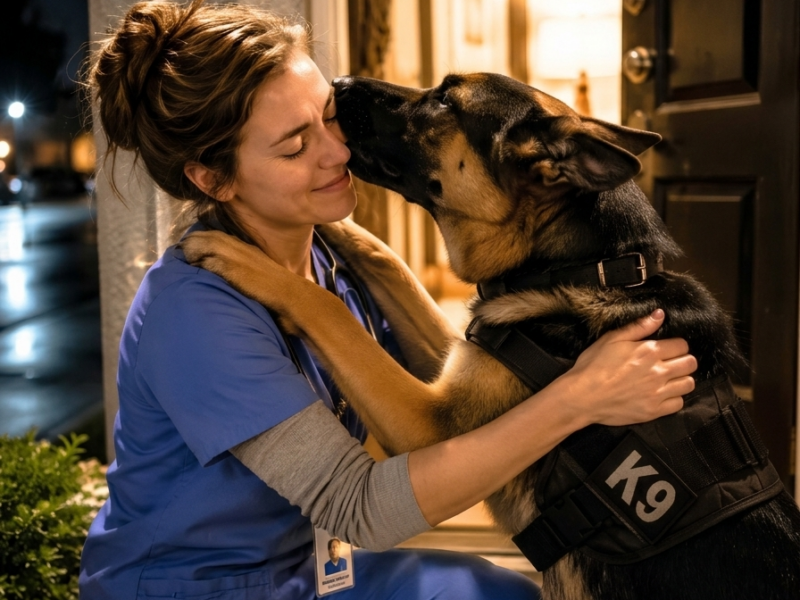
The night I rescued a freezing K9 puppy abandoned behind a hospital dumpster, my supervisor threatened to fire me for bringing an animal into the emergency department
The winter storm of December 2018 had turned the streets surrounding St. Mary’s Hospital into a desolate, ice-encrusted wasteland. Snow whipped violently through the amber streetlights, piling high against the concrete barriers of the emergency department ambulance bay. Inside, the ER was a pressure cooker of noise—monitors chiming, patients coughing, and rubber boots squeaking against wet floor tiles. I was a junior trauma nurse back then, exhausted after a fourteen-hour shift, trying to clear my mind by taking out a bag of medical linens to the industrial dumpsters behind the facility.
That was when I heard it.
It wasn’t a roar or a bark. It was a faint, pathetic whimpering sound—so thin and fragile that the howling wind almost swallowed it whole.
I stopped in my tracks, my breath turning to thick white clouds in the freezing sub-zero air. I pulled my blue scrub jacket tight around my shivering frame and followed the sound toward a rusted green dumpster tucked against the concrete retaining wall. There, resting on a patch of black ice inside a wet, torn cardboard box, was a tiny, shivering ball of dark fur.
It was a Belgian Malinois puppy, no more than four weeks old. He was curled beneath a pile of damp, frozen rags. His tiny black snout was encrusted with frost, his breathing coming in shallow, erratic gasps. Tangled tightly around his neck was a thick, frayed strip of olive-drab, military-grade canvas fabric.
“Oh my god,” I gasped, dropping my trash bag onto the snow.
I dropped to my knees, ignored the sharp cold biting through my pants, and scooped the freezing animal up against my chest. I unzipped my heavy winter coat and tucked his tiny, trembling body inside my fleece lining, pressing him directly against my skin to transfer every bit of warmth I possessed.
“Hey, sweetheart,” I whispered, my voice breaking as my tears froze on my cheeks. “Stay with me. Please, just stay with me.”
His heavy eyelids fluttered open for one brief, agonizing second. Dark, glossy brown eyes looked up into mine with profound vulnerability before closing again.
I sprinted back toward the emergency room double doors. As I burst through the heated corridor, my supervisor, a rigid and heartless head nurse named Vance, stepped out from behind the central triage desk.
“Emily! What do you think you’re doing?!” Vance yelled, pointing an angry finger at the wet fur sticking out of my coat. “Is that a stray animal?! You know company policy! Bringing a biohazard into an emergency trauma sector is grounds for immediate termination! Get that creature out of here right now!”
“He’s freezing to death, Vance!” I shouted back, brushing past him with a force that shocked us both. “Fire me if you want, but I’m not letting him die in the snow!”
I pushed into an empty treatment room in the back, locked the door behind me, and grabbed a stack of heated blankets straight from the warming cabinet. I wrapped the tiny pup in layers of fleece, rubbing his small ribs to stimulate his sluggish circulation while dialing the emergency line for the local 24-hour veterinary clinic attached to the nearby military installation.
Dr. Sarah Lin, a uniformed Army veterinarian, arrived within twenty minutes. Together, under the harsh overhead fluorescent lights, we spent hours administering warmed subcutaneous fluids, gentle oxygen, and constant thermal therapy.
By the time the amber rays of sunrise broke over the snow-covered horizon, the puppy’s body temperature had stabilized. He let out a tiny, high-pitched yelp, his tail giving a soft, hesitant wag against the stainless-steel table.
He was alive.
I named him Buddy.
For the next three weeks, my life revolved entirely around that small, fierce survivor. Because Vance had banned the pup from the main floor, I made a secret arrangement with the night maintenance staff to keep a small travel kennel in a unused basement storage closet. Every single day, I arrived two hours before my shift and stayed three hours late. I bottle-fed him warm puppy formula, cleaned his tiny paws, and slept sitting upright in a hard metal folding chair beside his crate whenever my breaks allowed.
Buddy attached himself to me with an intensity that went far beyond normal animal affection. The moment his shaky legs gained strength, he followed my blue scrubs everywhere within that subterranean haven.
Two years earlier, my younger brother, Leo, a young Army recruit, had been killed in a classified training exercise at a base in Georgia. The military had returned his closed casket with brief, vague condolences, leaving my family shattered. I had never admitted to anyone how suffocatingly quiet my small apartment had become since Leo’s death. I had carried a dark, hollow ache in my chest every single day.
Buddy filled that silence.
Whenever I retreated to the basement break room, weeping quietly after losing a difficult patient on the trauma table, Buddy would scramble up onto my lap, press his small forehead firmly against my collarbone, and rest his heavy snout over my racing heart until the shaking stopped.
But happiness rarely stays simple for long.
On a crisp Tuesday morning in mid-January, as I was preparing Buddy’s morning feeding, the heavy steel basement doors swung open. A tall, immaculate military officer wearing a crisp dress uniform stepped into the dim room, flanked by two armed military policemen.
He introduced himself as Major Marcus Sterling. He carried a thick, classified manila folder beneath his arm.
“Nurse Emily Carter?” Major Sterling asked, his voice cold, precise, and devoid of emotion.
“Yes,” I replied defensively, instinctually stepping in front of Buddy’s kennel.
Major Sterling opened the folder, laying out official adoption documents alongside a high-resolution photograph of a magnificent, full-grown female Belgian Malinois wearing a tactical harness.
“This is Maya,” Sterling said smoothly. “She was a highly decorated search-and-rescue asset assigned to a classified Special Operations unit. Six weeks ago, Maya disappeared during a covert operation near the coast. We had no idea she had delivered a litter before her handler vanished.”
Sterling walked closer, his polished leather boots clicking against the concrete. “Where exactly did you find the puppy?”
I swallowed hard and explained the exact location behind the hospital dumpster, describing the frozen box and the wet rags.
Major Sterling’s stoic expression altered slightly when I pulled the strip of olive-drab fabric from my scrub pocket—the green cloth I had untangled from Buddy’s neck on the night I found him.
Sterling picked up the fabric with gloved fingers, examining a tiny, faint stencil stamped onto the hem. His jaw tightened.
“Ma’am,” Sterling said, locking his sharp gray eyes onto mine with unsettling intensity, “this puppy wasn’t abandoned by accident. He was hidden.”
Before I could ask what he meant, Major Sterling closed the manila folder with a sharp snap, motioned to the two military policemen, and ordered them to crate Buddy immediately.
“Wait! No! You can’t just take him!” I cried, tears springing to my eyes as I reached for the puppy.
“This animal is official government property, Nurse Carter,” Sterling stated coldly, stepping into my path to block me. “His lineage is vital to national security interests. You will be compensated for your medical expenses.”
A week later, despite my relentless phone calls to every military base, shelter, and legal office in the state, Buddy was gone. He had been transferred to a high-security military working dog facility. No one would give me his location. No one would answer my letters.
For six long years, I carried a tiny, faded Polaroid photograph of Buddy in my scrub pocket—a picture of a trembling four-week-old puppy who had saved my soul in the dark.
Six years passed. Time, as it always does, forced me to move forward.
I worked my way up to become the lead trauma nurse in St. Mary’s high-volume emergency unit. I purchased a small, modest home near the hospital, adopted a quiet routine, and learned to live with the lingering phantom ache of the losses that had defined my youth—my brother Leo, and the fierce little puppy who had vanished into the shadow of the military apparatus.
Then came the freezing rainstorm of October 2026.
It was nearly 1:00 AM when I finished an exhausting sixteen-hour emergency shift. The hospital was unusually quiet, shrouded in a heavy coastal fog that rolled off the bay. I wrapped my wool coat tightly around my shoulders, said goodnight to the security team at the front desk, and walked out into the chilly night toward the multi-level parking garage adjacent to the main building.
The garage was dimly lit, the yellow sodium lights humming softly against the cold concrete ceiling. Water dripped from overhead pipes, creating an eerie, rhythmic echoing sound that made the hairs on the back of my neck stand up.
I walked briskly toward my sedan parked in a dark corner on Level 2. My keys were clutched tightly between my fingers—a habit every healthcare worker learns when walking alone late at night.
As I reached my driver’s side door, a shadow detached itself from behind a massive concrete support pillar directly in front of me.
A tall, broad-shouldered man wearing a heavy black jacket and a tactical face mask stepped into my path, completely blocking my way.
“Get in your car,” he ordered. His voice was low, rasping, and chillingly calm.
My blood ran cold. “Excuse me? Stay back!” I shouted, taking a rapid step backward while reaching into my purse for my phone.
Before my hand could touch my bag, the man lunged forward with terrifying speed. He grabbed my left wrist in a crushingly tight grip, slammed me violently against the driver’s side door, and pinned my shoulder against the cold steel. The impact knocked the wind out of my lungs, sending my keys clattering onto the pavement.
“Don’t scream,” he hissed into my ear, pressing a hard, metallic cylinder directly into my ribcage. “Give me the envelope, Emily.”
“I don’t… I don’t know what you’re talking about!” I gasped, hyperventilating as panic surged through my chest. “I’m just a nurse! I don’t have any envelope!”
“Don’t play stupid with me!” the man snarled, tightening his grip on my wrist until bone ground against bone. “Your brother left it! You’ve had it for six years!”
Before I could process the terrifying mention of my dead brother’s name, a sound ripped through the quiet concrete garage—a sound so powerful, deep, and primitive that it felt like an explosion in my chest.
BARK! BARK! BARK!
It was a chest-thumping, predatory war cry that vibrated through the foundation of the concrete structure.
Out from the deep shadows near the stairwell entrance, a massive, muscular Belgian Malinois came charging across the pavement like an incoming missile. The dog moved with blinding velocity, his dark coat a blur against the yellow lights.
Without a second of hesitation, the massive dog launched his eighty-pound frame through the air, slamming his broad shoulders directly into my attacker’s chest.
The masked man let out a wet, strangled grunt as he was violently ripped away from me. He crashed hard onto the concrete floor, his handgun spinning across the oil-stained ground.
The Malinois stood over him in a lethal tactical stance, his sharp front paws planted squarely on the attacker’s chest, his massive jaws snapping inches from the man’s throat. A low, terrifying growl rattled through the dog’s ribcage, holding the attacker in state of absolute paralysis.
“Don’t move! Don’t you damn move!” two hospital security officers came sprinting around the corner, weapons drawn, yelling into their radios.
I slumped back against my car door, sliding down until my knees hit the pavement, gasping for air, my heart hammering like a trapped bird inside my ribs.
The massive military working dog turned his heavy head toward me.
He wore a dark, heavy-duty tactical harness fitted with Kevlar plates and handle attachments. But as he stepped away from the subdued attacker, the dim overhead light caught a small silver identification tag hanging beneath his heavy leather collar.
Engraved across the stainless steel in bold, capital block letters was a single word:
BUDDY.
My breath caught in my throat. My vision blurred as warm tears instantly spilled over my eyelashes.
“Buddy…?” I whispered, my voice barely a thread of sound in the cold garage.
The massive, terrifying war dog—a trained military asset capable of neutralizing lethal threats in seconds—instantly transformed.
His ears pinned back gently against his sleek head. His tense, rigid posture dissolved. He approached me slowly, taking soft, deliberate steps across the wet pavement, his powerful body suddenly trembling with profound gentleness.
He dropped his heavy head, pressing his broad forehead firmly against my shaking hands, sliding his snout into my lap exactly as he had done as a helpless, freezing four-week-old puppy six years ago.
I fell to my knees entirely, wrapping my arms around his broad, muscular neck, burying my face deep into his thick, warm fur, and sobbed uncontrollably.
“You remember me…” I wept, feeling his warm breath against my skin. “Oh god, Buddy… you came back.”
His heavy tail swept back and forth across the concrete with hard, rhythmic thuds.
Footsteps echoed softly nearby. A female handler wearing an Army Special Forces uniform walked out from the shadows, her eyes brimming with emotional tears as she watched the reunion.
“He never forgot you, Emily,” the handler said softly, her voice filled with deep respect. “In six years of elite tactical service, through two deployments overseas, he refused to settle with any other handler whenever we showed him your photograph. He kept that picture in his travel crate for six years.”
I looked up through my tears, stroking Buddy’s soft ears as he licked my cheek. “Why was that man waiting for me? What did he mean about my brother?”
The handler’s expression darkened instantly. She reached down, unclipped a small, waterproof Kevlar pouch from the side of Buddy’s tactical harness, and placed it directly into my trembling palm.
“Because Buddy’s original handler was your brother’s commanding officer,” she whispered. “He disappeared six years ago. And before he vanished, he left something hidden inside Buddy’s collar.”
I unzipped the pouch. Inside was a faded, blood-stained military photograph of my younger brother, Leo, standing proudly beside a armored vehicle in Georgia.
On the back, written in Leo’s bold, unmistakable handwriting, were the words:
IF SHE SAVES YOU, SHE’S THE ONLY PERSON I TRUST.
I stared at the ink, my mind reeling in utter shock.
Then, the handler leaned closer to my ear, her voice dropping into a razor-thin whisper. “There’s one more thing you need to know, Emily. Your brother didn’t die in an accident.”
Before she could finish her sentence, Buddy’s ears snapped upright. He spun around, standing tall in front of me, letting out a deep, venomous growl aimed directly at the garage elevator doors thirty feet away.
The steel elevator doors hummed softly, slid open, and a tall man in a pristine military dress uniform stepped out into the harsh yellow light.
It was Major Marcus Sterling—the exact same officer who had stolen Buddy away from me six years ago.
Major Marcus Sterling stepped out of the elevator with the deliberate, composed grace of a man who owned the entire world. He was flanked by two armed Apex Defense contractors carrying concealed sidearms beneath their civilian jackets. His gray hair was clipped short, his uniform spotless, and his posture aristocratic.
“Stand down, Sergeant,” Sterling ordered, directing his gaze toward Buddy’s female handler. “This is an active Department of Defense recovery operation. You are out of your jurisdiction.”
The female handler—whose nametag read SGT. REED—didn’t flinch. She stepped sideways, placing herself between Sterling’s men and me, her hand resting firmly on the sidearm holstered at her hip.
“Major Sterling,” Reed replied coldly. “My orders come directly from the Joint Special Operations Task Force. K9 Buddy is a decorated combat asset. His deployment to this grid was authorized by General Vance.”
Sterling let out a soft, dismissive chuckle. “General Vance retired six hours ago, Sergeant. The chain of command has shifted. Nurse Carter is holding classified material belonging to Sector 7. Hand over the pouch, Emily, and we can settle this without further unpleasantness.”
I stood up slowly, keeping my body behind Buddy’s massive frame. My thumb traced the worn edges of Leo’s handwriting on the back of the photograph inside the Kevlar pouch.
“You lied to me,” I said, my voice shaking with rising fury as six years of buried grief transformed into blinding anger. “You lied about how my brother died. You lied about why Buddy was hidden behind that dumpster!”
“Your brother was an idealistic fool who didn’t understand the larger scope of national security!” Sterling snapped, dropping his polite facade. His eyes turned dark and menacing. “Leo Carter discovered that Apex Defense was using unauthorized biometric tracking software within military working dog breeding programs. He threatened to go to the Inspector General. He was neutralized to protect the integrity of the program.”
“You murdered him,” I whispered, the horrifying truth settling like lead in my stomach.
“It was a necessary elimination!” Sterling spat. “And before he died, he passed the encrypted master drive to Maya’s handler—who managed to sew the drive inside the lining of that puppy’s collar before my men tracked him down! That puppy was supposed to be drowned in the river that night! How was I to know some bleeding-heart nurse would drag him out of a dumpster and keep him alive?!”
Everything suddenly clicked into place with terrifying clarity.
The olive-drab green fabric I had untangled from Buddy’s neck six years ago wasn’t a leash. It was a padded tactical sleeve designed to conceal a micro-encrypted drive. When Sterling had taken Buddy from me six years ago, he thought he was retrieving the drive. But in my panic on the night I rescued the pup, I had removed the green fabric strip and kept it hidden in my apartment all these years, believing it was just a keepsake from the night I saved his life.
“You never found the drive, did you?” I said, a dark realization dawning on me. “You searched Buddy for six years, put him through military training, and monitored him… but the drive wasn’t on the dog. It was with me.”
“And you are going to give it to me right now,” Sterling sneered, raising his hand to signal his two contractors. “Or Sergeant Reed and your beloved dog will be listed as casualties of an unfortunate garage robbery.”
Before Sterling’s men could draw their weapons, Buddy let out a deafening bark that echoed off the concrete walls like a thunderclap.
The Malinois didn’t attack Sterling directly; instead, he slammed his heavy body into the side of a nearby emergency fire-alarm station mounted on the concrete pillar, smashing the plastic protective glass with his tactical harness plate.
The hospital’s high-decibel fire alarm shrieked to life! High-pressure overhead sprinklers burst open, flooding Level 2 of the parking garage with freezing torrents of water!
“Move!” Sergeant Reed roared, pulling her sidearm and firing two suppression shots into the floor at the feet of Sterling’s contractors.
“Get them!” Sterling screamed, wiping water from his eyes as his men scrambled for cover behind the concrete pillars.
I grabbed my purse, shoved the waterproof Kevlar pouch into my jacket, and sprinted with Sergeant Reed and Buddy toward the garage stairwell. Rain and sprinkler water poured over us, turning the concrete steps into a slick hazard as we rushed down toward the subterranean service tunnels beneath the hospital.
“Where are we going?!” I yelled over the blaring alarm sirens.
“To your apartment!” Reed shouted back, her boots splashing through puddles. “Do you still have that green fabric strip you took from Buddy’s neck six years ago?!”
“Yes! It’s in my memory box in my bedroom!”
“That green fabric contains a flexible, thread-like micro-fiber drive!” Reed said as we burst through the basement service doors. “If we can upload its data to the Federal Special Prosecutor’s network, Sterling and the entire Apex network will be exposed before sunrise!”
Buddy ran right beside us, his dark eyes focused, his powerful stride effortless despite the chaos. He wasn’t just a dog fleeing a threat.
He was a soldier fulfilling the mission my brother had died to start.
The freezing rain poured down in torrents as Sergeant Reed’s unmarked tactical SUV tore through the quiet suburban streets toward my house on Oak Street.
Buddy sat in the back seat between us, his heavy head resting on my shoulder, his warm body providing a fortress of comfort against the biting cold. My hands were stained with dirt and water, but I held onto his tactical harness as if it were the only anchor keeping me tethered to the earth.
“How long have you known about Buddy’s connection to my brother?” I asked Sergeant Reed, looking at her reflection in the rearview mirror.
“Six months,” Reed replied, her eyes scanning the dark mirrors for pursuing vehicles. “I was assigned as Buddy’s handler after his original trainer retired. I found a hidden file in his official service record—a suppressed incident report detailing his recovery from St. Mary’s Hospital six years ago. When I dug deeper, I discovered that every time Buddy was exposed to stress during combat simulations, his heart rate only stabilized when he heard recordings of your voice from the hospital’s old intake tapes.”
She glanced back at me with a soft, respectful smile. “He never forgot the woman who held him through his first night in the cold. When I realized Sterling was planning to decommission Buddy permanently to erase the last link to Leo Carter, I initiated this off-grid extraction.”
Ten minutes later, the SUV pulled into the driveway of my small, single-story craftsman home. The neighborhood was dead silent, dark windows reflecting the rain-slicked streetlights.
“We have five minutes before Sterling’s team tracks our GPS signal,” Reed warned, pulling a high-grade military laptop from the passenger floorboard. “Get the fabric strip, Emily. Fast.”
I threw open the front door, rushing into my bedroom with Buddy trotting tightly at my heels. I went straight to my closet, pulled down a dusty wooden memory box from the top shelf, and opened the lid.
Inside lay Leo’s high school track medals, his letters from basic training, and tucked at the very bottom—the faded, frayed strip of olive-drab canvas fabric I had taken from Buddy’s neck six years ago.
I picked up the fabric with trembling hands. Under the bright bedroom lamp, I could see what I had missed as a grieving young nurse six years ago: woven directly into the heavy hem of the canvas was a microscopically thin, silver-threaded fiber optic strip.
“I have it!” I called out, running back into the living room where Sergeant Reed was boots-deep in setting up her encrypted laptop on my coffee table.
“Plug it into the multi-spectrum card reader,” Reed instructed, handing me a small black adapter device.
I pressed the silver thread into the adapter slot. The laptop screen flickered violently, then flashed a brilliant, neon-blue interface:
ENCRYPTED FILE IDENTIFIED: OPERATION APEX_DARK_NET
AUTHOR: CARTER, LEO J. — SPECIALIST / US ARMY
DECRYPTION STATUS: IN PROGRESS… 12% … 45% … 89%
Suddenly, the front living room window exploded inward in a shower of deadly glass shards!
A heavy flashbang grenade clattered across the hardwood floor, detonating with a blinding, deafening BANG-FLASH!
The concussive force threw me backward onto the rug, my ears ringing violently, my vision reduced to a blinding white light.
Through the haze of smoke and ringing silence, I saw two heavily armed Apex contractors in black tactical gear kick down my front door, rifles raised!
Sergeant Reed was thrown against the wall, stunned by the blast, her sidearm sliding across the floor out of reach.
“Secure the laptop!” Major Marcus Sterling’s voice barked from the porch as he stepped over the shattered door frame, a silenced pistol raised in his hand. “Kill the nurse and the sergeant!”
One of the contractors pointed his rifle directly at my chest as I lay helpless on the floor.
Before his finger could depress the trigger, a dark shadow erupted through the smoke and glass debris.
Buddy!
Despite the disorienting flashbang, the Belgian Malinois launched himself from the hallway with terrifying power. He hit the lead contractor squarely in the throat, driving the heavy man back through the shattered front window frame and onto the muddy lawn outside!
The second contractor swung his weapon toward Buddy, but Sergeant Reed recovered her senses, lunging across the coffee table to slam her body into the contractor’s legs, sending his shots wild into the ceiling.
Sterling, seeing the operation crumbling into absolute chaos, lunged straight for the laptop on the coffee table. “The drive is mine!” he shrieked.
“No, it isn’t!” I screamed.
Ignoring the ringing in my ears, I grabbed a heavy brass lamp from the end table and swung it with all the strength left in my body, striking Sterling squarely across his jaw!
The blow knocked the Major sideways, sending him crashing onto the hardwood floor, dropping his weapon.
On the laptop screen, a green confirmation box flashed brightly:
UPLOAD COMPLETE: 100%. DATA TRANSMITTED TO DEPARTMENT OF JUSTICE & JOINT CHIEFS OF STAFF.
The dawn light of a clear, crisp autumn morning broke over the capital city three weeks later. The storm had passed, leaving behind a brilliant, clear blue sky that painted the marble columns of the Federal Courthouse in gold.
I stood on the broad stone steps of the courthouse, wrapped in a warm wool coat. Standing beside me was Lieutenant Mark Vance—the newly reinstated military investigator who had taken over the case—alongside Sergeant Reed.
Down in the plaza below, dozens of news cameras flashed incessantly as federal marshals led Major Marcus Sterling and six high-ranking executives of Apex Defense out of the building in heavy steel handcuffs.
The data woven into that small strip of green fabric had exposed a decade-long web of military corruption, illegal black-budget weapons testing, and the systemic cover-up of dozens of soldier deaths—including the murder of my younger brother, Leo.
Leo’s name had been officially cleared, his military record restored with full honors, and a posthumous Distinguished Service Cross was to be presented to my family at Arlington National Cemetery the following week.
“It’s finally over, Emily,” Sergeant Reed said softly, laying a gentle hand on my shoulder. “You gave Leo his voice back.”
“We all did,” I replied, my eyes misting with tears as I looked up at the sky. “Leo started it, but Buddy finished it.”
A military transport van parked at the base of the courthouse steps opened its rear doors.
Stepping out onto the pavement—wearing a clean, polished ceremonial leather harness adorned with a shiny gold military service medal—was Buddy.
He looked majestic, broad-chested, and noble. His dark brown eyes scanned the crowded plaza, ignoring the flashing cameras, the shouting reporters, and the noise of the city.
The moment his eyes locked onto mine standing at the top of the courthouse steps, his tail gave a soft, hard sweep against the van door.
He trotted up the long flight of marble stairs, his head held high, until he reached my side. He didn’t act like a dangerous war dog or a classified asset. He nudged his broad snout directly into my palm, letting out a soft, contented sigh as I leaned down and wrapped my arms tightly around his neck.
A senior Army General stepped out from the courthouse doors, holding an official leather-bound folder. He stopped in front of us and executed a crisp, formal salute to the dog and to me.
“Nurse Carter,” the General announced loudly, his voice echoing across the plaza. “By order of the Secretary of the Army, K9 Asset Buddy is hereby granted an honorable medical discharge from active military service.”
The General opened the folder, handing me a set of official, stamped adoption papers bearing my name.
“He is officially retired,” the General added with a warm, genuine smile. “And he is released permanently into your custody and care.”
Tears of pure, overwhelming joy spilled down my cheeks as I took the papers into my hands.
“Thank you, sir,” I whispered.
I dropped to my knees on the cold marble steps, pulling Buddy close against my heart. The massive Belgian Malinois leaned his entire weight against my body, resting his heavy forehead against my chest—right over my heart—exactly as he had done six years ago when he was just a trembling, freezing puppy rescued from a hospital dumpster.
The silence that had haunted my life for so many years was gone, replaced forever by the steady, faithful heartbeat of the hero who had come back to save me.
“Let’s go home, Buddy,” I whispered into his fur. “Let’s finally go home.”
The end









