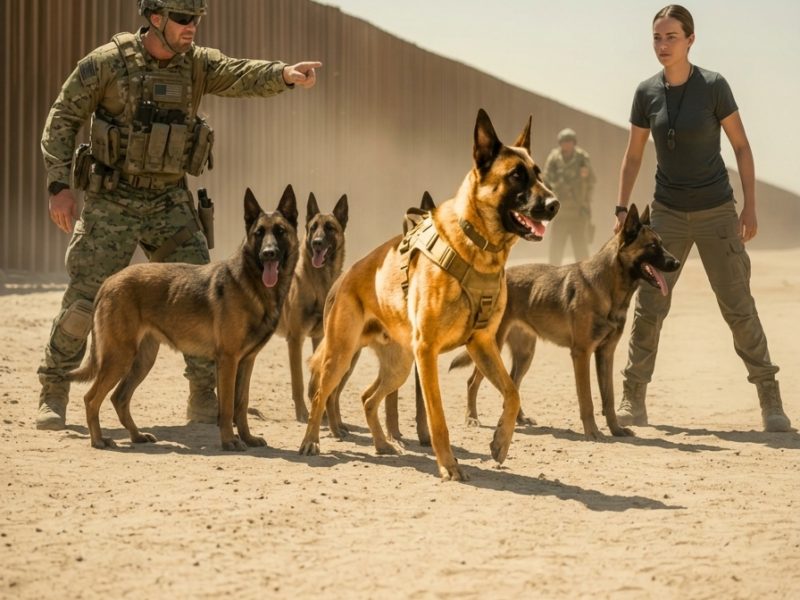
The night I ordered all fifteen military dogs to go home, they ignored my command and formed a silent line along the Texas border, staring into the darkness while their handlers stood frozen
The night air along Sector 4 of the Del Rio border was thick, hot, and suffocatingly still. For twelve years as a Senior Border Patrol K9 Supervisor, I had learned to read the silence of the Chihuahuan Desert. Silence usually meant quiet hours, routine sweeps, and the steady, rhythm of tires crushing loose gravel along the Rio Grande fence. But tonight, the desert felt unnatural. There were no crickets, no rustling brush, not even the distant howl of coyotes that usually echoed across the mesquite flats. There was only the low hum of five patrol trucks idling in a staggered formation along the ridge.
We had finished our twelve-hour rotation. Fifteen working dogs—a mix of Belgian Malinois, German Shepherds, and Dutch Shepherds—were supposed to be loaded into their climate-controlled transport crates. These weren’t standard police dogs; they were high-threat detection assets trained for tactical interdiction, explosives, and extreme wilderness tracking. They knew the routine better than most rookies. When the engines started and the rear doors swung open, they usually leaped into their crates without a second prompt.
Tonight, they refused to budge.
“Load up!” I shouted, my voice cutting through the dry heat. “Section Alpha, crate ’em!”
One by one, the handlers issued their standard command words—Hopp, Platz, In ‘t hok. The words echoed across the hardpack, but none of the dogs moved. Instead, all fifteen animals slipped past their handlers’ heels and marched with chilling, synchronized precision toward the twelve-foot chain-link perimeter fence. They didn’t bark. They didn’t whine. They formed a single, unbroken line, spaced roughly six feet apart, extending fifty yards along the border track.
Their ears were pinned forward, their spines locked straight, their eyes staring into the pitch-black void beyond the fence—toward a stretch of untamed, rocky wasteland that wasn’t supposed to harbor a single living soul for twenty miles.
My partner, Mason, stepped up beside me, pulling off his tactical cap to wipe sweat from his forehead. “They’re refusing, Chief. All fifteen of ’em. I’ve never seen anything like this.”
“I can see that,” I said, my hand instinctively resting on the grip of my holster.
“Is it a mountain lion? Javelinas?”
“A cat would have them barking their heads off,” I replied, staring at the unsettling formation. “And a herd of pigs would have raised a scent frenzy. Look at them, Mason. That’s not prey drive. That’s tactical alert.”
I walked over to Ranger, my personal K9. Ranger was a nine-year-old Belgian Malinois with a graying muzzle and scars across his shoulders from three tours in Helmand Province before he was cross-decked to the border. He had saved my life twice—once by dragging me out of an overturned humvee, and once by locating a pressure-plate IED three feet before my boot touched the dirt. He was cold, analytical, and completely immune to distraction.
I crouched beside him, feeling the intense heat radiating from his ribcage. His muscles were strained so tight they were quivering.
“Go home, buddy,” I whispered, reaching out to touch his harness. “Up. Load in.”
Ranger didn’t even flinch. He didn’t turn his head. His dark eyes remained fixed on a single point in the black horizon, his nostrils flared, drawing in deep, deliberate draughts of the night air. He was completely deaf to my command—a behavior he had never exhibited in nine years of service.
Then, without a sound, every single dog down the line lowered its head at the exact same second. Their muzzles dipped toward the dirt, noses pointed forward, bodies crouching into a silent, predatory stance.
Before I could process the sudden shift, the tactical radio clipped to my vest crackled violently.
Khhh-cchk.
A blast of harsh, unmodulated static erupted from the speaker, making several handlers flinch. I reached for the dial to adjust the squelch, but before my fingers touched it, the static cleared into a low, metallic whisper that sounded as if it were being fed through an encryption scrambler.
“Don’t turn on your lights.”
I froze. The voice wasn’t from our dispatch in Del Rio. It wasn’t on our assigned tactical channel. It was coming through an open, unassigned frequency.
“Who is this?” I demanded, pressing the push-to-talk button. “Identify yourself. This is a restricted federal channel.”
Nothing. Just the faint, rhythmic breathing of someone sitting in absolute quiet.
Mason reached for his primary rifle, unholstering his M4 carbine with a sharp metallic slide. “Chief… what the hell is that?”
“Wait,” I said, holding up my hand to hold his position. “Keep your weapons low. Nobody illuminate the fence.”
I pulled my night-vision monocular from my tactical belt and brought it to my right eye. The green-phosphor lens flickered to life, bathing the dark desert in an ethereal, high-contrast glow. I swept the device across the fence line, looking through the chain links toward the dry wash three hundred yards out.
Something was moving.
Not an animal. The gait was upright, deliberate, and smooth. A figure in dark, non-reflective gear was crouching behind a limestone boulder. Then another figure emerged behind him. Then three more. They moved in a rigid, military file—not the disorganized, scattered posture of desperate migrants or smugglers, but the disciplined, low-profile tactical advance of a professional military squad.
The moment the figures appeared in my lens, the dogs responded.
A low, collective growl vibrated through the ground beneath my boots. Fifteen throats rumble in perfect unison—a deep, terrifying hum of raw canine aggression that felt like an electrical current charging the dust around us.
“We killed the lights,” Mason whispered, flicking off the truck running lights.
We stood in the darkness, blinded by the sudden loss of illumination, relying entirely on the green glow of our NVGs. The figures beyond the fence stopped dead in their tracks. For five agonizing minutes, no one breathed. The wind died down completely. The desert held its breath.
Then, a microscopic beam of red light cut through the night.
It didn’t come from the figures in the wash. It originated from a ridge half a mile behind us—inside American territory. The tiny red dot danced briefly across the steel wire of the fence, directly above Ranger’s head. A second red laser appeared ten feet to the left. Then a third.
They weren’t target designators. They were telemetry ranges.
“We’re being watched,” Mason whispered, his voice trembling slightly. “From behind us, Chief. They’ve got us pinned against the fence.”
Before I could call for an immediate tactical retreat, Ranger suddenly broke rank. He didn’t charge the fence. He turned 180 degrees, sprinted twenty yards back toward our patrol vehicles, and dropped to his knees near a mound of fresh dirt beside the road shoulder. He began digging frantically, his front paws churning up heavy clods of clay.
Two handlers rushed to his side, pulling tactical shovels from their rigs. “Ranger! What do you have?”
Seconds later, the blade of a shovel struck something hard and metallic. One of the handlers reached into the hole and pulled out an object wrapped in waterproof military tape. It was an elongated black box, roughly the size of a brick, fitted with a flexible rubber antenna and a blinking green light emitting a high-frequency pulse.
It was a tactical radio repeater—a long-range surveillance transmitter planted directly beneath our daily patrol route.
My stomach sank into an icy pit. This wasn’t a cartel smuggling run. This wasn’t a standard breach. Someone had been sitting on our grid, studying our shifts, tracking our patrol patterns, and monitoring our dog deployments for weeks, maybe months.
The radio on my chest burst into static once again.
“You should have listened to the dogs.”
I grabbed the microphone, my pulse hammering in my throat. “Who are you? State your identity or we open fire!”
A long, chilling pause followed. The voice returned, devoid of any human warmth.
“Someone who knows why your dogs were trained here.”
The transmission died with a sharp, definitive click.
Behind us, along the access road, every single dog spun around. Their focus instantly severed from the fence, they turned their backs to Mexico and faced the long, asphalt ribbon stretching north into Texas.
Their individual growls merged into one terrifying, continuous roar of warning.
In the distance, down the pitch-black highway, two white lights appeared. Then two more. Then a line of heavy, armored vehicles emerged over the rise, driving without sirens, without emergency strobes, their engines humming like a swarm of mechanical hornets.
Mason looked at me, his face pale under the moonlight. “Are those… are those ours? Friends?”
I looked down at Ranger. His lips were peeled back to his gums, his teeth bare, a thick foam dripping from his jaws as he barked directly at the oncoming convoy.
“No,” I said, drawing my weapon as the first vehicle crossed our perimeter line. “They aren’t friends.”
The lead vehicle—a matte-black, unbranded armored personnel carrier fitted with heavy run-flat tires—pulled to a stop ten yards from our truck line. Four more identical vehicles fanned out behind it, forming a tactical blockade that completely cut off our escape route back toward the highway.
The doors didn’t swing open right away. For thirty agonizing seconds, the engines idled, blowing hot diesel exhaust across the gravel.
“Hold your ground!” I yelled to my team, forming a defensive skirmish line with our vehicles as cover. “Nobody fires unless I give the command! Keep those dogs on short leashes!”
The side doors of the armored trucks hissed open, releasing pressurized air. Figures stepped out into the dust. They wore heavy, non-attribution tactical uniforms—no patches, no flags, no unit insignia, no name tapes. Their helmets were fitted with full-face ballistic masks that concealed every feature, giving them the appearance of faceless, metallic statues. They held short-barreled automatic rifles fitted with thick suppressors and thermal optics.
A single man stepped forward from the center of the group. Unlike his men, he wore no helmet, only a gray tactical cap and a dark jacket. His face was weathered, scarred across the left cheek, and his eyes were a pale, icy blue that looked entirely dead to the world around him.
“Stand down, Supervisor Vance,” the man said. His voice was identical to the one that had come through my radio minutes earlier.
“You’re trespassing on a federal border sector!” I shouted, keeping my rifle leveled at his chest. “Identify your command unit immediately!”
The man didn’t reach for a weapon. Instead, he pulled a laminated, dark-red security folder from his jacket and held it up. Printed across the face of the folder in bold, yellow letters were the words: DEPARTMENT OF DEFENSE – EXECUTIVE CLEARANCE OMEGA – IMMEDIATE COMPLIANCE REQUIRED.
“My name is Colonel Miller,” he said calmly, stepping past the line of his armored guards as if my rifle didn’t exist. “And this sector is no longer under Customs and Border Protection jurisdiction. As of 0200 hours, this entire grid has been federalized under Special Operations Directive 88.”
Mason stepped up beside me, keeping his weapon trained on Miller’s chest. “Directive 88? I’ve been in federal law enforcement for fifteen years. There’s no such thing.”
“There is,” Miller replied, his pale eyes shifting toward the line of snarling K9s. “When the threat involves assets that your department isn’t cleared to know exist.”
Ranger let out a lunging bark, straining against his heavy leather lead so violently that his front paws lifted off the ground. The rest of the dogs followed suit, creating a wall of deafening, aggressive noise that echoed across the desert floor.
Miller stopped ten feet away. He didn’t look at me. He looked directly at Ranger.
“Remarkable,” Miller muttered softly, a cold smile touching the corner of his lips. “They still remember.”
My mind raced, trying to link his words to something tangible. “What are you talking about? Remember what?”
“Your dogs, Supervisor Vance,” Miller said, turning his cold gaze back to me. “You think you were assigned these fifteen animals by standard federal procurement? You think the military just ‘loaned’ them to the Border Patrol after their deployments in Iraq and Afghanistan?”
He stepped closer, leaning in so only Mason and I could hear his words over the roar of the dogs.
“These dogs weren’t procured. They were manufactured. They were part of a specialized bio-behavioral research program conducted at Fort Bliss six years ago. A project designed to breed and train animals capable of detecting synthetic biological signatures—signatures that human sensors and standard technology cannot register.”
A cold weight dropped into my chest. “Synthetic signatures? You mean chemical weapons?”
“I mean people, Vance,” Miller whispered. “Or what’s left of them.”
Before I could demand a clearer answer, one of Miller’s tactical operators called out from the perimeter fence. “Colonel! We have a breach on the lower track! Signal frequency is spiking!”
Miller spun around, his calm demeanor instantly vanishing. “Set up the directional jamming arrays! Lock down the perimeter!”
From the bed of the trailing armored trucks, his men unloaded heavy, tripod-mounted metallic dishes and aimed them directly toward the dark desert beyond the fence. A high-pitched, painful whine erupted from the equipment—a frequency so sharp that it made my ears ring and brought Mason to his knees, clutching his head.
The dogs reacted violently. The high-frequency acoustic wave drove them into a frenzy, but they didn’t cower. They threw their bodies against the chain-link fence with terrifying force, their claws tearing at the wire mesh, trying desperately to break through to the other side.
“Shut those damn things off!” I roared, grabbing Miller by the lapel of his jacket and slamming him against the hood of my patrol truck. “You’re driving them mad!”
Miller didn’t fight back. He reached into his pocket, pulled out a small electronic tablet, and thrust it into my hands.
“Look at the thermal feed, you fool!” he hissed.
I looked down at the glowing screen. The thermal camera mounted on the ridge behind us was transmitting a live feed of the dry wash three hundred yards beyond the fence.
In standard thermal imaging, living bodies—humans, animals, vehicles—appear as bright white or orange spots, reflecting the heat of their blood and engines against the cool desert floor.
The figures moving toward us across the screen were pitch black.
They possessed no heat signature. They moved through the 90-degree Texas desert like freezing voids, absorbing the surrounding light and heat without reflecting a single calorie of thermal energy. And there weren’t five of them anymore.
The screen showed dozens. Hundreds. A dark, cold wave of human-shaped shadows advancing silently across the desert floor, heading directly toward our position.
“What… what are those?” Mason gasped, staring over my shoulder at the tablet screen.
“Subject 0-9,” Miller said, his voice dropping into a flat, grim tone. “The result of a rogue biological research facility destroyed in Chihuahua six months ago. They don’t breathe. They don’t bleed. And they don’t produce heat.”
He looked at the frantic line of barking, snarling dogs struggling against the fence.
“And your dogs,” Miller added softly, “are the only weapon on this continent that can track them before they cross that line.”
The night exploded into pure chaos.
The directional jamming dishes on the armored trucks let out a loud electrical pop, white sparks showering over the gravel as their circuits fried under an unprecedented electromagnetic surge. The high-pitched noise vanished, instantly replaced by the terrifying, physical sound of metal being torn apart.
Fifty yards down the track, a section of the twelve-foot steel perimeter fence groaned under immense pressure. The heavy galvanized posts, anchored three feet deep in solid concrete, began to bend inward as if pushed by a hydraulic press.
“Fall back! Establish a firing line!” Miller shouted, drawing a heavy tactical sidearm.
His faceless operatives formed a double-rank skirmish line, raising their suppressed rifles. “Light ’em up!”
Bright, blinding flares erupted into the sky, illuminating the dark wash in a harsh, flickering red glow. For the first time, we saw them with our naked eyes.
They looked like men, but their movements were unnatural, fluid, and terribly fast. They wore torn civilian clothing and tactical remnants, their skin a dull, chalky gray that reflected the flare light like stone. They didn’t run; they glided across the rough, rock-strewn terrain with an eerie, mechanical balance, completely ignoring the sharp thorn bushes and cactus that would have shredded human flesh.
“Fire!” Miller ordered.
A wall of suppressed automatic fire erupted from the tactical team. Hundreds of high-velocity rounds tore through the air, striking the advancing figures. Bullets punched through their chests, shoulders, and limbs, kicking up puffs of gray dust from their clothing.
The figures didn’t fall. They didn’t slow down. They didn’t make a sound.
They took the hits as if they were nothing more than raindrops, continuing their relentless advance toward the bent fence.
“Headshots! Target the brain stems!” Miller yelled, his voice cracking with a rare edge of panic.
A few figures stumbled as high-caliber rounds struck their skulls, but the sheer volume of the advancing mass was overwhelming. They slammed against the chain-link fence, their chalky hands gripping the steel wire, pulling with a force that sheared the heavy bolts right off the steel posts.
The fence collapsed.
“Ranger! Attack!” I roared, unhooking his heavy leather lead.
It was a command born of pure instinct, a desperate gamble to buy my men time to reload. Ranger didn’t hesitate. The moment the latch freed his harness, the Belgian Malinois launched himself forward like a black missile, clearing ten feet of ground in a single bound.
He hit the lead figure straight in the chest, his powerful jaws clamping down on the entity’s neck.
An agonizing, unnatural sound tore through the night—not a human scream, but a high-pitched, metallic screech, like two heavy sheets of rusted iron grinding together under pressure. The figure tumbled backward onto the gravel, thrashing wildly as Ranger locked his jaws and twisted his body, using his full momentum to tear at the cold, leathery flesh.
The other fourteen dogs charged right behind him.
The fifteen animals hit the advancing wave like a pack of wolves defending their den. They didn’t target limbs or torsos; their genetic conditioning took over, guiding their teeth straight to the base of the skull and the carotid pathways where the synthetic neural controls were housed.
Where human bullets had failed to slow the advance, the canine assault brought the momentum to a screeching halt. The dogs’ agility allowed them to dodge the clumsy, heavy lunges of the cold figures, using their speed to trip, tear, and neutralize the threat piece by piece.
“They’re working!” Mason screamed, swapping his empty rifle magazine for a fresh one. “The dogs are taking them down!”
“They can’t hold them forever!” I yelled back, grabbing Mason by the shoulder. “Miller! We need an air strike or heavy ordnance! We can’t contain this on the ground!”
Miller was staring at his electronic tablet, his face drained of all color. “There is no air support coming, Vance. Command has placed a blackout canopy over this sector. If this breach is reported on open channels, they will initiate a thermobaric sterilization of the entire grid—including us.”
“They’ll bomb the sector?” Mason asked in horror.
“To protect the containment,” Miller said grimly. “We hold them here, or we die in the flash.”
I looked down the line. Ranger was wrestling with a second figure, his dark coat smeared with a thick, black, oil-like substance that oozed from the entity’s neck wound instead of red blood. Two other dogs—a pair of Dutch Shepherds named Thor and Freya—were pinned down by three figures attempting to overwhelm them by sheer weight.
“Handlers! Move in!” I commanded, unholstering my sidearm and pulling my tactical blade. “Protect the dogs!”
We rushed into the melee, stepping into the freezing cold aura that surrounded the entities. The moment I got within five feet of one, the air temperature dropped precipitously; my breath turned into white plumes in the October heat. The air smelled of sulfur, copper, and deep, stagnant ice.
I grabbed one of the figures from behind, driving my knife deep into the junction between its neck and shoulder. The blade felt like it was penetrating dense, frozen leather. The figure swung its arm back, hitting me in the chest with a force that shattered my tactical plate and sent me flying ten feet backward into the dirt, knocking the wind completely out of my lungs.
I lay in the dust, gasping for air, my vision turning red at the edges.
Through the haze, I saw a massive, towering figure step over the ruined fence. Unlike the others, this one was wearing the remnants of a faded, torn U.S. Army desert uniform, its face half-covered by a shattered ballistic visor.
It looked down at me, its milky, lifeless eyes locking onto mine. It raised a heavy, steel-reinforced arm, preparing to crush my chest.
A streak of tan and black fur flashed across my vision.
Ranger intercepted the blow, driving his body between the monster and my broken ribs. The creature’s heavy arm struck Ranger across his flank, sending the old dog rolling across the rocks with a sickening thud.
“Ranger!” I screamed, forcing my broken body off the ground.
Ranger struggled to his feet, his left rear leg dragging uselessly in the dirt, but he didn’t back down. He planted his front paws, stood directly over my chest, and bared his crimson-stained teeth at the towering soldier.
The creature paused. For a fraction of a second, its milky eyes flickered, as if a microscopic spark of memory had flashed through its synthetic brain.
It looked at Ranger’s collar—the brass service tag engraved with his name and military serial number: US-K9-8894.
The creature opened its mouth, releasing a raspy, broken sound that sounded eerily like a human word.
“…R-Ranger…?”
The sound of that single, shattered word hung in the freezing air like a ghost.
The entire battle seemed to slow into a nightmare sequence. I stared up at the towering entity in the torn desert uniform, my eyes fixated on the faded cloth patch stitched into its right sleeve: 3RD BATTALION, 75TH RANGER REGIMENT.
Below the unit patch was a name tape, caked in dirt and black fluid, but still legible under the flare light: CAPTAIN CARTER.
My mind spun out of control. “Carter…?” I whispered, my voice barely audible over the roaring engines and snarling dogs. “Captain Marcus Carter…?”
I had known that name for six years. Captain Marcus Carter was the legendary Special Forces A-team leader who had commanded the deployment in Helmand Province where Ranger had served his final tour. Carter was the officer who had signed Ranger’s medical discharge papers after an ambush destroyed their outpost in the Shah-i-Khot Valley.
And according to official Department of Defense records, Captain Marcus Carter had died in that ambush six years ago.
“Ethan… don’t touch him!” Miller screamed from behind me, raising his pistol.
“Hold your fire!” I roared, pushing myself up and placing my hand on Ranger’s shaking head. “He knows the dog! He recognized him!”
The entity—the biological shell that had once been Captain Carter—stood frozen in the middle of the chaotic battleground. The milky film over its eyes shifted, revealing a faint, deep-set human iris underneath. Its massive, gray hand, which had been raised to crush my skull, began to tremble violently.
Ranger stopped growling. The old dog took a slow, limping step forward, his ears flattening against his head, his tail giving a single, tentative wag. He stretched his muzzle out, sniffing the cold, chemical-tainted air surrounding the man’s hand.
Whimper.
A soft, mournful whine escaped Ranger’s throat—a sound he had only ever made when he recognized a friend after years of separation.
“Carter…” I said, holding out my hands, keeping my palm open. “Sir… do you hear me? You’re in Texas. You’re home, sir.”
The entity’s chest heaved, a dry, rasping sound escaping its lungs as if its body were trying to remember how to breathe human air. The black fluid dripping from its neck began to slow.
“Vance…” a raspy, synthesized voice came from the creature’s throat, distorted and broken, but carrying the unmistakable cadence of an American officer. “…they… they lied to us… Vance…”
“Who lied to you, Captain?” I asked, taking a small step closer, keeping my body between Miller’s sights and the officer.
“The… facility…” Carter choked out, his leathery fingers clutching his own skull as if fighting off an intense internal wave of agony. “They… didn’t bury us… they… recycled us… Special Operations… Black Site 9…”
Miller stepped forward, his pistol aiming directly at Carter’s head. “He’s compromised! The neural override is failing! Step away, Vance! That thing is a weapon!”
“Shut up, Miller!” I yelled, turning my head slightly. “He’s still in there! His mind is fighting the control!”
“You don’t understand what they did to them!” Miller shouted back, his face twisted in terror. “They wiped their memories! They replaced their blood with synthetic bio-polymer to create unstoppable infantry! If his core destabilizes, the bio-chemical payload inside his chest will detonate!”
Carter let out a horrific, guttural roar of pure agony. His body convulsed violently, veins of dark, glowing liquid bulging beneath his gray skin. The other advancing entities around us suddenly stopped their attack, turning their heads toward Carter as if receiving a high-frequency command signal from his failing neural unit.
“Run…” Carter rasped, his eyes snapping back to mine, filled with a sudden, terrifying clarity of a soldier making a final sacrifice. “…Ethan… take the dogs… run…”
He grabbed the heavy tactical vest of his chest, tearing the ceramic plates open to reveal a glowing red core embedded near his heart—a miniature bio-thermal charge set to destroy the asset if containment was breached.
The timer on the core was flashing rapidly: 00:15… 00:14… 00:13…
“Mason! Get the dogs to the trucks!” I screamed, grabbing Ranger by his harness and lifting his fifty-pound frame into my arms despite the excruciating pain in my broken ribs. “Everyone fall back! Move!”
The handlers acted with lightning speed, grabbing their dogs, throwing them into the open cabs of the transport trucks, and slamming the heavy steel doors.
Miller’s tactical operators panicked, turning their back to the line and sprinting toward their armored vehicles.
“Miller, move!” I yelled, throwing Ranger into the front seat of my truck and jumping behind the wheel.
Carter looked at me one last time through the shattered visor. He didn’t look like a monster anymore. He looked like a tired officer who had finally found his way back from a war that should have ended six years ago.
He turned his back to us, raised his heavy arms, and charged back into the dark wash toward the oncoming wave of entities, dragging them down into a tight, concentrated mass around his body.
“Drive!” I roared, slamming my foot onto the gas pedal.
My truck’s tires spun violently on the gravel before launching us down the access road. Behind us, Miller’s armored vehicle followed closely, its engine screaming under full throttle.
00:03… 00:02… 00:01…
A blinding, brilliant flash of white-blue light illuminated the desert for five miles in every direction. There was no thunderous boom—only a terrifying, silent implosion of intense heat that sucked the air right out of the canyon, followed by a shockwave that lifted the rear wheels of my heavy patrol truck off the ground.
In the rearview mirror, I watched as the dark wash, the ruined fence, and every single entity were instantly incinerated in a dome of pure, chemical white fire.
The morning sun rose over Sector 4 like a pale, yellow eye, casting long, peaceful shadows across a desert that looked entirely different than it had eight hours ago.
By 0800 hours, the entire grid had been cordoned off by unmarked military contractors. Dozens of heavy earth-moving vehicles were already at work, scraping away the top three feet of scorched earth, removing every trace of the chemical fire, the ruined fence, and the destroyed vehicles. By noon, anyone driving along the highway would see nothing more than a routine road maintenance project.
Official news reports were already broadcasting the official narrative: a ruptured high-pressure natural gas pipeline had caused a localized explosion along an uninhabited stretch of the border track. No casualties were reported.
I sat on the tailgate of my truck, three miles up the road at the Sector Headquarters building. A military medic had wrapped my broken ribs in tight elastic bandages and given me a brace for my torn shoulder, but I had refused to go to the hospital.
Beside me sat Ranger. His rear leg was wrapped in a heavy splint, but he was resting his broad head comfortably on my knee, eating bits of dried beef from my tactical pouch. The other fourteen dogs were resting quietly in the air-conditioned kennel bay behind us, exhausted, battered, but alive.
The heavy door of the briefing room opened, and Colonel Miller stepped out onto the concrete apron. He was no longer wearing his tactical cap; his gray hair was messy, and he looked fifteen years older than he had when he first stepped out of his armored car.
He walked over to my truck, stopping a few feet away, keeping a safe distance from Ranger.
“The site is clean,” Miller said softly, looking out at the rising dust on the horizon. “There’s nothing left. No biological material, no technical debris, no records.”
“And Captain Carter?” I asked, my voice low and dangerous.
Miller took a deep breath, pulling a pack of cigarettes from his pocket and lighting one with shaking fingers. “Officially? Captain Carter died in Afghanistan six years ago. His name is on the wall at Fort Bragg. His family received his flag.”
“And unofficially?”
“Unofficially, Black Site 9 was a black-budget research facility operated by a rogue private defense contractor that lost control of its test subjects three months ago,” Miller said, blowing a cloud of gray smoke into the clear Texas air. “They thought they could contain them in the mountains of Chihuahua. They were wrong.”
I looked down at Ranger, running my hand over his scarred back. “Why were the dogs trained on them, Miller? You never answered that.”
Miller looked at me, his icy blue eyes showing a rare moment of genuine human emotion—a mix of awe and deep, profound regret.
“When the program began six years ago,” Miller explained quietly, “the researchers realized that synthetic neural interfaces lacked one thing: a soul. The subjects couldn’t register emotion, fear, or pain. But the dogs… the dogs could smell the absence of life. They could sense the void.”
He leaned closer to the truck.
“We didn’t train these dogs to find them, Vance,” Miller whispered. “The dogs were trained by Captain Carter himself before he was taken. He knew what they were planning to do to him. Before he vanished, he spent six months conditioning his unit’s K9s—teaching them the specific synthetic chemical signature of the project so that if his team ever escaped… someone would know.”
A cold shudder ran down my spine.
The fifteen dogs hadn’t just refused their commands last night out of aggression or fear. They had stood at that fence because they had been waiting for six long years to fulfill the final order given to them by their commanding officer.
They had stayed to bring him home.
Miller pulled a thick, black leather folder from his coat and laid it on the tailgate beside me. “Your team is being reassigned to a specialized tactical K9 unit under direct Department of Defense oversight. Full funding, high-level clearance, complete autonomy. You report directly to my office.”
I looked at the folder, then back up at him. “And if I refuse?”
“If you refuse, Vance,” Miller said solemnly, “they will decommission these fifteen dogs by the end of the week. They consider them compromised assets.”
My grip tightened on Ranger’s collar. The old dog lifted his head, his dark eyes locking onto mine with an unshakeable, silent trust.
“Where do we start?” I asked.
Miller turned, looking toward the long, open highway that stretched north toward the heart of the country.
“There were three other black sites, Ethan,” Miller said, his voice carrying the heavy weight of an impending, secret war. “And we have reason to believe the breach at Grid 14 wasn’t the only one.”
I looked down at Ranger, then back toward the kennel bay where fourteen other battle-tested dogs were resting in the shade.
“Let ’em rest for two hours, Colonel,” I said, sliding off the tailgate and standing tall despite the pain in my chest. “Then load ’em up. We’ve got a trail to follow.”
The end.









