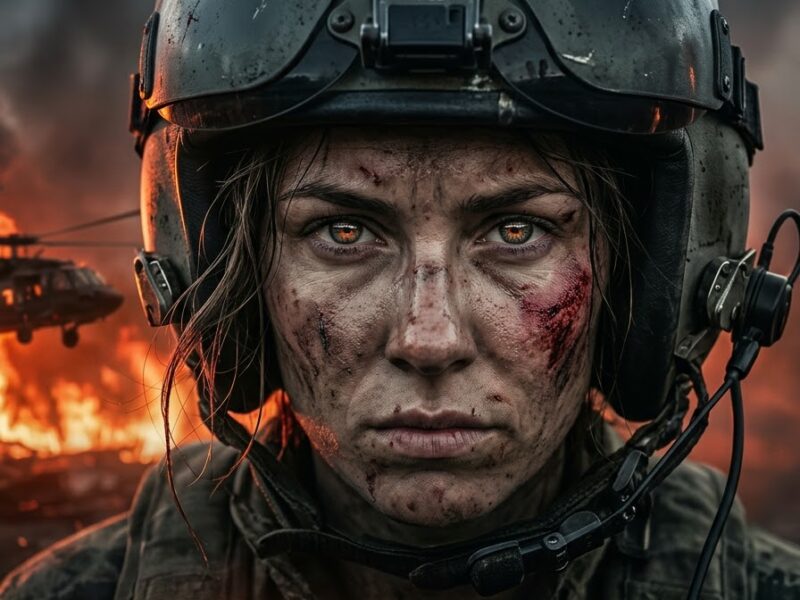
The Navy SEALs laughed when they saw me climbing into the cargo plane, calling me a “box hauler” before dismissing my warnings
The pre-dawn chill at Naval Air Station Coronado cut through flight suits like razor blades, but the cold was the least of my concerns. What bothered me was the laughter coming from the apron.
I stood near the nose gear of my Hercules C-130, grease-stained flight gloves tucked under my arm, watching six men in matte-black gear haul their tactical crates toward the ramp. They moved with the aggressive, deliberate grace of predators who owned every room they walked into. Trident insignias gleamed dully against their uniforms under the harsh floodlights.
“Hey, quartermaster!” one of them called out, his voice dripping with condescension as he eyed the faded paint and patched panels of my aircraft. “Hope this delivery truck can keep up. We’ve got actual work to do today.”
A few of his teammates chuckled. One made a mock engine sound, lazily cranking an invisible handle in the air.
I didn’t blink. I didn’t smile. I stood my ground, five-foot-seven, braided hair pinned tight beneath my cap, holding a clipboard that had seen more combat zones than most of those men had read about in textbooks.
“She’ll fly circles around your ego, Captain,” I replied quietly, my voice flat and devoid of emotion. “Watch your step on the ramp. Hydraulic fluid is slick, and I’d hate for you to scuff your boots.”
The leader of the squad, a broad-shouldered Navy SEAL Captain named Vance with a jawline carved from granite, paused at the base of the cargo ramp. He turned, looking me up and down with barely concealed amusement.
“Lady, this isn’t a mail run to San Diego,” Vance said, leaning in slightly, his voice dropping an octave. “We’re going into a class-five operational envelope. If you get scared, stay in the back and let the real pilots handle it.”
“I am the real pilot,” I said, looking him dead in the eye. “And this is my birds. You’re cargo. Act like it.”
Before Vance could respond, heavy footsteps echoed across the tarmac. Commander Hayes strode into the halo of the runway lights, a thick, red-stamped classified folder clutched tightly against his chest. His face was the color of wet ash.
“Enough,” Hayes snapped, his eyes darting between Vance and me. “Captain Morgan, we have a catastrophic situation.”
The atmosphere shifted instantly. The joking vanished. The SEALs straightened, their combat instincts taking over.
“Forty minutes ago,” Hayes began, opening the folder to reveal satellite thermal imagery, “the USNS Pacific Sentinel lost all primary propulsion and auxiliary power sixty miles off the coast of the Northern Marianas. She’s carrying nearly two hundred personnel—seventy military personnel, the rest civilian engineers and contract technicians. The typhoon wasn’t supposed to hit until tomorrow, but it shifted course. It’s sitting right on top of them now.”
“Send in the Sea Hawks,” Vance said immediately. “Helicopter extraction from the deck.”
“The Sea Hawks tried,” Hayes countered coldly. “One took a tail-rotor strike from seventy-knot wind gusts five minutes after launch. They barely made it back to the carrier. The storm has created an atmospheric wall. Zero visibility, cloud ceiling under two hundred feet, barometric pressure dropping into the basement. The ocean is throwing forty-foot swells over their bow. The ship is drifting straight toward the Ironclad Reef.”
Silence fell over the tarmac, heavy and suffocating. Ironclad Reef was a nightmare of razor-sharp volcanic rock. If a disabled vessel hit it in forty-foot seas, it wouldn’t just ground; it would disintegrate.
“The SEALs are dropping in via heavy-payload paracrate to secure the ship’s hull and coordinate emergency tow tethering,” Hayes continued. “But no standard transport will fly into a super-typhoon. The air currents around that reef are a blender.”
“It can’t be done,” Vance’s second-in-command muttered, looking at the barometric charts. “You drop a C-130 into a wind shear like that, the wings will shear right off the spar. It’s suicide.”
I stepped closer to the briefing chart, ignoring the SEALs entirely. My eyes traced the isobar lines, calculating wind velocities, thermal currents, and pressure differentials. I didn’t see a storm; I saw a puzzle of fluid dynamics written in clouds and rain.
Eleven years of flying supply routes through nameless, forgotten war zones—dropping ammunition into mountain passes in Afghanistan during blizzards, landing on unlit dirt strips in West Africa while dodging artillery—had taught me one truth: air moves like water. It has currents, pathways, and weak points.
I pointed my finger at a razor-thin gap between two violent thermal updrafts on the radar map.
“I can get you there,” I said.
Vance scoffed, shaking his head. “Lady, this isn’t a delivery route. That’s a wall of death.”
“No, Captain, it isn’t,” I said, stepping right up to his chest, looking up into his hardened face. “It’s a vortex pattern. The core of the storm is pulling air inward, creating a low-pressure pressure slip right along the lee side of the ridge. It’s narrow, it’s violent, and if you miss it by ten yards you die. But it’s open. I can fly through it. And right now, I’m the only person on this airbase with the guts and the flight hours to do it.”
Hayes looked at me, a strange, unreadable expression flicker across his weathered features. “Are you sure, Evelyn?”
“I’m sure,” I said. “Get your gear loaded, Captain Vance. We take off in ten minutes.”
Two hours later, the world outside the cockpit vanished into a swirling void of absolute darkness and screaming grey water.
Rain didn’t fall; it hit the armored windshield like burst bursts of machine-gun fire. Lightning ripped through the clouds in violent, jagged sheets of purple and white, illuminating the cockpit in horrific flashes. The turbulence hit us like a physical blow, slamming the C-130 downward fifty feet in a fraction of a second.
In the copilot seat, Lieutenant Miller gripped his control yoke so hard his knuckles turned white as bone. “Captain! Wind shear is topping eighty knots! The starboard engine is temping out!”
“Feather the throttle on engine three!” I roared over the deafening roar of the storm. “Don’t fight the stick, Miller! Let the air push us! Work with it!”
Suddenly, the tactical radio crackled through static, high-pitched and frantic.
“MAYDAY! MAYDAY! This is USNS Pacific Sentinel! We’ve taken water in engine room two! Hull integrity compromised! Emergency generator failing! We have people trapped below deck! We are three cables from the reef!”
My hands tightened on the yoke. Down in the cargo bay, I could hear the heavy equipment shifting, metal straining against steel tie-downs. The SEALs were back there, holding on for dear life.
“They’re running out of time!” Miller yelled. “The designated drop zone is underwater! We can’t drop the gear, and we can’t vector a rescue boat in this!”
My heart hammered against my ribs, but my mind stayed unnaturally calm, locking into that cold, absolute focus that had kept me alive for over a decade. In the chaos, a voice echoed from deep within my memory—a voice I hadn’t heard in fifteen years.
It was my father.
Colonel Arthur Morgan. A legendary Air Force test pilot who had vanished over the Pacific when I was twelve years old during a classified test flight that the military had officially written off as a “tragic navigational error.”
I remembered sitting on his lap in the hangar, smelling aviation fuel and leather, as his rough hands guided mine over the controls of an old Piper Cub.
“Never fight the sky, sweetheart,” he had whispered, his blue eyes bright with a secret knowledge that fascinated and terrified me. “The sky isn’t your enemy. It’s a physical force. It leaves doors open if you know how to look for them. Learn where it wants you to go, and it will carry you anywhere.”
I closed my eyes for half a second, taking a deep breath. I felt the air through the yoke, feeling the tiny micro-vibrations of the airframe, sensing the invisible currents tearing at our wings.
“I see the door,” I muttered to myself.
“What did you say, Captain?” Miller gasped.
“Hold on,” I whispered.
I shoved the yoke forward. The C-130 nose-dived straight into the heart of the tempest.
The dive was terrifying. The nose pitched down at an angle no cargo plane was ever designed to sustain. Miller screamed into his headset as the altimeter spun out of control—4,000 feet… 3,000 feet… 1,500 feet…
“Captain! Pull up! We’re going into the ocean!” Miller shrieked, his hands freezing on his controls.
“Leave the stick!” I commanded, my voice booming through the intercom with absolute authority. “I have the aircraft!”
I didn’t pull up. I banked hard left, slipping the massive four-engine turboprop sideways into a violent updraft that was spiraling around the wall of the storm. The g-forces shoved us down into our seats, heavy and suffocating. The airframe groaned, metal skin shrieking as the atmospheric pressure tried to twist the fuselage into scrap.
And then, with a violent shudder that felt like popping through a sheet of thick glass, the darkness ripped open.
We plunged beneath the low cloud shelf, hovering barely two hundred feet above the raging ocean.
Below us, the sea was a boiling cauldron of black water and white foam. Just three hundred yards off our port wing, massive waves were smashing against the jagged, black spires of Ironclad Reef, sending plumes of spray a hundred feet into the air. And trapped in the middle of that slaughterhouse was the Pacific Sentinel.
She was dead in the water, listing heavily to thirty degrees, her deck crowded with frightened people in bright orange life vests holding onto railings for dear life as huge waves washed over her stern.
“Dear God,” Miller breathed, staring at the sight. “Look at her.”
Down in the cargo hold, the intercom buzzed. Captain Vance’s voice came through, completely stripped of its earlier arrogance, replaced by raw shock.
“Morgan! What the hell was that?! How are we still in the air?!”
“Save the applause for later, Captain,” I said calmly, adjusting the trim tabs to counter the severe crosswinds. “There’s your target. The ship is drifting thirty feet every ten seconds toward the rocks. The water is too shallow for heavy rescue craft, and their lifeboats will be smashed on the reef.”
“We can’t jump into those waves!” Vance shouted back over the roar of the engines. “The impact will kill us!”
“You’re not jumping into the water,” I replied. “I’m going to set up a low-altitude airhead. I’m going to fly this aircraft twenty feet above their deck, hold her steady in a drift, and you are going to drop the heavy inflatable rescue platforms and tether lines directly onto their bow.”
“Twenty feet?!” Vance bellowed. “In fifty-knot crosswinds?! You’ll catch a wave and drown us all!”
“Then you better move fast, Captain,” I said cold-bloodedly. “Because I’m making my first pass now.”
What followed was a masterclass in aerial precision that defied every law of physics taught in flight school.
I brought the giant C-130 down until the propellers were kicking up sea spray that lashed against the cockpit floor. The ocean raged mere yards below us. One wrong twitch of my wrist, one slight gust of unexpected wind, and the wingtips would dig into a swell, flipping the eighty-ton aircraft into a fiery explosion.
Miller was reading off the radio frequencies, his voice trembling, while coordinating with the ship’s frantically waving deck crew.
“Release load one… NOW!” I barked.
In the back, Vance and his team kicked the massive pallets out of the rear ramp. The parachutes deployed barely fifty feet above the deck, opening with loud cracks. The heavy rescue gear landed squarely on the foredeck of the Pacific Sentinel.
“Hit!” Miller screamed, pounding his fist on the dashboard. “Direct hit on the bow!”
“Line up for pass two!” I ordered, pulling the nose up sharply, banking hard into a wall of wind that would have flipped an inexperienced pilot upside down.
For twenty agonizing minutes, I danced the massive aircraft through the teeth of the storm. I rode the updrafts, used the thermal bursts from the ocean surface to cushion our drift, and kept the aircraft suspended in a pocket of stable air that shouldn’t have existed.
We dropped emergency pumps, heavy tether lines, and life-rafts. I used our landing lights to illuminate the safest channel through the rocks, guiding a small civilian tugboat that had been brave enough to approach the boundary of the reef, helping them vector in to attach a towline to the dying transport.
One by one, the life-threatening variables were neutralized. The pumps began clearing the flooded lower decks. The towline tautened. The Pacific Sentinel stopped its deadly drift toward the volcanic rocks.
“Towline secured!” the ship’s captain yelled over the emergency radio, his voice choking with tears. “We are moving away from the reef! Repeat, we are holding! All two hundred crew and passengers accounted for! We are saved!”
In the cockpit, Miller collapsed back into his harness, sobbing with a mixture of sheer exhaustion and overwhelming relief.
I allowed myself a long, slow breath, wiping a bead of sweat from my forehead. My arms were trembling from the sheer physical exertion of holding the yoke against the storm for so long.
Ten minutes later, as we leveled out at 5,000 feet and turned back toward Coronado, the heavy curtain separating the cargo hold from the flight deck was pulled back.
Captain Vance stepped onto the flight deck. His tactical gear was damp, his face was pale, and the cocky strut he had walked with that morning was entirely gone. He stared at the back of my head, looking at me not as a “box hauler,” but as a phantom.
“Captain Morgan…” Vance began, his voice surprisingly quiet, devoid of all malice. “I… I’ve seen the best naval aviators in the world fly. I’ve ridden in the back of stealth transports through hot zones in hostile territory. What you just did down there… that wasn’t standard military training. Who taught you to fly like that?”
I didn’t answer right away. I reached down into my worn leather flight bag sitting beside my seat. My fingers brushed past maps and logbooks until they touched the crisp, worn edge of an old, laminated photograph.
I pulled it out and handed it back to him over my shoulder.
It was a black-and-white photograph of a handsome, sharp-featured pilot standing proudly in front of an experimental prototype aircraft from the late 1990s. He had a brilliant smile, his flight jacket open, his eyes reflecting the exact same determination that currently burned in mine.
“My father,” I said quietly. “Colonel Arthur Morgan.”
Vance took the photograph. He glanced down at it casually at first, but then his entire body froze. His jaw tightened, and the remaining color drained completely from his face.
“That’s… that’s impossible,” Vance whispered, his eyes wide with a sudden, horrifying realization.
I turned in my seat, staring at him. “What do you mean, impossible? You know him?”
Vance didn’t answer immediately. He looked at the photograph, then looked up at me, his eyes filled with a terrifying combination of respect and deep, unsettling pity.
“I don’t know him personally,” Vance said, his voice barely audible over the hum of the turboprops. “But Commander Hayes does. Before we took off… when Hayes handed you that briefing folder… I saw the top-secret routing stamp on his desk. This mission wasn’t a random rescue attempt, Evelyn.”
My chest tightened. “What are you talking about?”
“Your father’s aircraft didn’t suffer a mechanical failure fifteen years ago,” Vance said, leaning closer so Miller couldn’t hear. “He was part of Project Boreas—a classified black-budget research program testing atmospheric manipulation and high-density flight vectors. The report on his disappearance… the document that officially pronounced him dead… it wasn’t signed by the Pentagon.”
Vance swallowed hard, pointing a trembling finger toward the bottom of the photograph where a small, handwritten military serial number was visible.
“It was signed by Commander Hayes. And he didn’t send us out here today to save that ship. He sent you out here to see if you had inherited your father’s ability.”
The plane ride back to Naval Air Station Coronado was conducted in heavy, oppressive silence.
Miller tried to initiate conversation a few times, high on the adrenaline of having saved two hundred lives, but the heavy atmosphere on the flight deck quickly silenced him. Down in the cargo bay, the SEALs sat quietly, no longer laughing, no longer talking tough. Every now and then, I would catch Vance looking toward the cockpit door through the small viewing window, his eyes dark with unasked questions.
My hands gripped the steering yoke mechanically, but my mind was miles away, drifting back fifteen years into the past.
I remembered the day the dark sedan had pulled up to our house in Ohio. Two men in dark suits had stepped out, their faces devoid of emotion, handing my mother a neatly folded American flag and a letter expressing the deep condolences of the United States Government.
“A tragic training accident over the Pacific,” they had said. “No body was recovered. The wreckage sank in deep water.”
My mother had wept for months, eventually fading away into a quiet, broken depression until her heart simply gave out five years later. I had spent my entire life believing that my father had died because of a faulty fuel line or an unexpected storm. I had joined the military, taken the lowliest, most unglamorous transport assignments, just to feel close to him—to feel the same air currents he had once felt.
And now, Vance’s words echoed in my mind like a rhythmic drumbeat. Project Boreas. Signed by Hayes.
When the C-130 finally touched down on the tarmac at Coronado, the sun was just beginning to peek over the eastern horizon, casting long, bloody red shadows across the airbase.
As soon as the engines spooled down, a fleet of black SUVs pulled up directly alongside the aircraft—not emergency medical teams for the SEALs, not press officers to announce the miraculous rescue of the Pacific Sentinel, but armed Naval Investigative Service officers.
“Captain Morgan,” Vance said as we unbuckled our harnesses. “Be careful. Whatever is happening here, it’s bigger than you think.”
“I’m not afraid of Hayes,” I said coldly, placing my father’s photograph back inside my flight jacket.
“You should be,” Vance replied grimly. “Because if Hayes sent you into a class-five typhoon expecting you to survive, it means he doesn’t view you as a pilot. He views you as an asset.”
I descended the rear cargo ramp. Commander Hayes was standing near the back of one of the black SUVs, flanked by two armed guards. He wasn’t smiling. There was no praise in his eyes, no relief that two hundred people were alive. There was only a cold, calculating scrutiny.
“Captain Morgan,” Hayes said, his voice flat. “Step into the vehicle. We need to debrief immediately.”
“Where are the medical teams for my crew?” I demanded, standing my ground on the concrete. “And where is the press brief? Two hundred people were saved today, Commander. Why are armed guards surrounding my plane?”
“Your crew will be taken care of,” Hayes said calmly, waving his hand slightly. Two guards stepped forward, grabbing Miller by the arms and escorting him toward a separate van, despite his loud protests.
“Hayes!” I yelled, stepping forward, but Vance caught my shoulder, holding me back just enough to prevent me from doing something that would get me court-martialed on the spot.
“Go with him, Evelyn,” Vance whispered in my ear. “Find out what he knows. I’ll watch your back from the outside.”
I glared at Hayes, then shoved past the guards and climbed into the back of the SUV. Hayes stepped in after me, shutting the door. The heavily tinted windows blocked out the rising sun, plunging us into shadow as the vehicle accelerated toward the far side of the airbase—toward the old, decommissioned hangars that hadn’t been used since the Cold War.
We drove in silence for five minutes before Hayes finally spoke.
“Your father was a brilliant man, Evelyn,” he said, looking out the window. “A genius ahead of his time.”
“You lied to my mother,” I said, my voice shaking with suppressed rage. “You lied to me for fifteen years. You told us he died in a routine flight accident.”
“It was necessary,” Hayes replied without a trace of guilt. “What Arthur discovered during his time with the Air Force Flight Dynamics Laboratory wasn’t something the world was ready for. He wasn’t just a pilot. He possessed an innate, hyper-advanced neurological capability—a form of spatial intuition that allowed him to read fluid dynamics, barometric fluctuations, and atmospheric turbulence in real-time, integrating with the aircraft as if it were an extension of his own nervous system.”
I stared at him, bewildered. “That’s absurd. He was just a skilled pilot who understood weather patterns!”
“Is it absurd?” Hayes turned his head, his cold eyes locking onto mine. “You flew an eighty-ton, un-modernized C-130 into a class-five super-typhoon. You navigated a wind-shear corridor that mathematically guarantees structural failure for ninety-nine percent of aircraft. You dropped rescue payloads onto a swinging ship deck twenty feet above forty-foot waves without a single error. Do you really think that was just ‘skill’, Captain?”
My breath hitched in my throat. I wanted to deny it. I wanted to tell him he was crazy. But deep down, I knew what I had felt in that cockpit. I hadn’t been looking at gauges or reading instruments; I had felt the air. I had known where the currents were turning before the wind even hit the wings.
“Where is he?” I demanded, my voice cracking. “If he didn’t die in that crash… where is my father?”
Hayes didn’t answer immediately. The SUV came to a smooth stop inside a massive, dimly lit hangar. The heavy steel doors slid shut behind us, cutting off the light from the outside world.
“Your father made a choice, Evelyn,” Hayes said, stepping out of the vehicle. “When he realized the true potential of Project Boreas, he refused to allow the military to weaponize his research. He tried to disappear. He tried to hide the data.”
“So you killed him?” I asked, stepping out into the cold, concrete expanse of the hangar.
“No,” Hayes said, pointing toward the far end of the hangar, where a massive shape sat shrouded under a giant black tarp, illuminated by overhead spotlights. “He hid himself. But he left something behind. Something that only someone with his specific neurological blueprint can operate.”
Hayes turned back to me, a dark, triumphant smile spreading across his face.
“Welcome to the real Project Boreas, Captain Morgan. And it’s time for you to finish what your father started.”
The black tarp was pulled away by four technicians in unblemished bio-hazard suits, revealing the machine hidden underneath.
I gasped, taking an involuntary step back.
It wasn’t a standard aircraft. It was an experimental, matte-black lifting-body aircraft, sleek and predatory, with delta wings that merged seamlessly into an armored fuselage. It had no visible jet intakes, no standard flight control surfaces, and no glass cockpit windows. Instead, the nose was smooth metal, wrapped in intricate networks of fiber-optic sensors that looked almost like organic nerve pathways running along the hull.
“The Boreas Experimental-1,” Hayes said, walking toward the aircraft with an air of reverent obsession. “Designed thirty years ago, updated in secret over the last decade. It utilizes electro-hydrodynamic propulsion and high-altitude atmospheric routing. It can fly at Mach 8 at the edge of the atmosphere, or hover inside a hurricane without a single twitch. But standard computers can’t fly it. The control lag is too high. It requires a direct neural-spatial interface.”
“A pilot,” I whispered, staring at the terrifying beauty of the machine.
“A very specific pilot,” Hayes corrected. “We spent ten years trying to train elite aviators to fly this thing. Every single one of them suffered severe neurological breakdown within three minutes of system integration. Their brains simply couldn’t process the sheer volume of spatial and atmospheric data the craft feeds directly into the visual cortex. Their minds broke under the weight of the sky.”
Hayes turned back to face me, his eyes gleaming with an unnatural intensity.
“Except Arthur. He flew it once. In 2011. He proved it worked. And then, he realized what this craft could do—how it could render entire national air-defense grids obsolete, how it could deliver payload anywhere on Earth in under twenty minutes without detection. He panicked. He stole the core flight key, sabotaged the primary database, and vanished.”
“He didn’t panic,” I said, my teeth clenched, tears of anger pricking my eyes. “He was protecting the world from people like you.”
“He was a coward!” Hayes snapped, losing his composure for a split second before smoothing his tie and regaining his cold demeanor. “He chose to bury the greatest leap in human aviation history! But he made one fatal mistake, Evelyn. He didn’t account for genetics.”
Hayes raised a small remote control and pressed a button. A glass display case rose from a podium beside the aircraft. Inside sat a heavy, metallic flight helmet, lined with hundreds of delicate micro-needles and bio-sensors.
“For eleven years, we watched you,” Hayes continued, his voice dropping into a chilling monotone. “We kept you locked in low-priority transport units. We monitored every flight, every weather bypass, every maneuver you made. We waited for the storm today. We manufactured the rescue scenario—yes, Evelyn, the Pacific Sentinel was deliberately routed into that storm path—to force you into a position where you had to use your full potential.”
A cold dread flooded through my veins, freezing the blood in my heart.
“You… you put two hundred people in danger… just to test me?” I gasped.
“Two hundred lives are a minor variable when compared to global technological dominance,” Hayes said casually, as if talking about the weather. “And you passed the test with flying colors. You proved that Arthur’s unique neural architecture was passed on to you. You are the only person alive who can fly the Boreas.”
“I’ll never fly this for you,” I said, backing away toward the hangar exit. “Never.”
“You don’t have a choice,” Hayes said softly.
He waved his hand, and four armed guards stepped out from the shadows, raising their weapons, pointing them directly at my chest.
“You are going to put on that helmet, Captain Morgan,” Hayes said. “You are going to fly the test flight, unlock the encrypted files left behind by your father, and deliver the command codes to this command staff. If you refuse… Lieutenant Miller will be executed for high treason within the hour. Captain Vance and his SEAL team will be framed for an operational accident over the Pacific, and you will spend the rest of your life in a black-site prison facility.”
I stood frozen in the center of the giant hangar, surrounded by men with guns, looking at the black, demonic silhouette of the aircraft my father had died trying to hide.
The silence stretched for ten long, agonizing seconds. The air felt heavy, suffocating, like the moment right before a lightning bolt strikes the earth.
I looked at Hayes, seeing the monstrous ambition burning in his eyes. Then I looked at the flight helmet sitting in its glass case.
My father’s words echoed through my mind once again: “Never fight the sky, sweetheart. Learn where it wants you to go.”
A slow, terrifying realization washed over me. Hayes thought he had backed me into a corner. He thought he was using me as a key to open a cage. But he didn’t understand the fundamental rule of the sky that my father had taught me.
You don’t fight the force. You yield to it, ride it, and use its momentum to turn the world upside down.
“Fine,” I said, my voice dripping with icy calm as I wiped the tears from my eyes. “I’ll fly your plane, Commander.”
Hayes smiled, a look of ultimate victory spreading across his face. “A wise decision, Evelyn.”
“But I have one condition,” I added, walking toward the podium and reaching out to pick up the heavy, bio-sensor helmet.
“Name it,” Hayes said generously.
I turned to face him, slipping the helmet over my head, feeling the cold steel needles resting gently against my temples.
“When I take off,” I said, my voice echoing strangely through the helmet’s internal comms, “you better hold on to something.”
The moment the helmet locked into place around my skull, the world exploded into pure light.
There was no transition, no warm-up period. It felt as if my consciousness was torn from my physical body and scattered across a thousand miles of sky.
Suddenly, I wasn’t sitting inside a cockpit; I was the aircraft.
I felt the structural integrity of the composite hull, the cold temperature of the liquid hydrogen fuel sloshing in the tanks, the precise resistance of every control surface. But more than that, I felt the air outside the hangar—I felt the barometric pressure drops, the temperature gradients over the ocean, the electric potential of the clouds three miles away. It was an overwhelming wave of sensory data that threatened to split my skull in two.
Focus, Evelyn, I told myself, fighting through the nausea and intense vertigo. Don’t fight the sky. Let it flow.
I breathed slowly, opening the mental floodgates, allowing the vast torrent of data to organize itself inside my mind. What would have driven a normal pilot mad felt, after a painful moment of adjustment, like coming home. It was the exact same feeling I had experienced during the typhoon, but amplified a million times.
Across my visual field, floating like shimmering golden threads against the darkness, were encrypted lines of code—the flight computer’s core database, locked behind my father’s security protocol.
A voice, synthesized and soft, echoed directly inside my mind. It was a recorded message, left behind by Arthur Morgan fifteen years ago.
“If you are reading this… it means they found you, Evelyn. I am so sorry I couldn’t be there to protect you. But I knew this day might come. The Boreas isn’t just an aircraft, my sweet girl. It is a key. It contains the complete digital evidence of Hayes’ illegal black-budget operations, his treasonous arms deals, and the true events of my disappearance. I locked it inside the craft’s atmospheric telemetry drive. The moment you take this ship above Mach 5, the encryption breaks, and the signal will broadcast across every open civilian and military satellite frequency in the Western Hemisphere.”
Tears welled in my eyes inside the dark visor. Dad…
“Fly, Evelyn,” my father’s voice whispered softly in my head. “Be free.”
Outside, in the physical world, Commander Hayes stood near the control console, watching the diagnostic monitors light up in brilliant shades of green.
“Sensors are stable!” a technician yelled in excitement. “Her neural sync rate is at ninety-nine percent! It’s working! She’s fully integrated!”
“Initiate power sequence!” Hayes ordered, his voice trembling with unholy delight. “Open the hangar bay roof!”
The massive steel roof of the secret hangar creaked loudly, slowly sliding open to reveal the morning sky above Coronado.
Inside the cockpit, my eyes snapped open. The matte-black engines of the Boreas screamed to life—not with the deep thunder of standard jet engines, but with a high-pitched, terrifying hum of electro-hydrodynamic energy that rattled the concrete floor of the hangar.
“Captain Morgan,” Hayes’ voice came through my neural link, cold and commanding. “Execute vertical liftoff and maintain hover at five hundred feet for system diagnostic.”
” negative, Commander,” I whispered.
“What did you say?” Hayes’ voice sharpened with sudden suspicion. “Morgan, stand down! Follow protocol!”
“You wanted to see what this aircraft could do,” I said, my voice echoing through the hangar’s loudspeaker system as the engines roared to maximum output. “You wanted to see what my father built.”
“Guards! Shut down the power grid!” Hayes screamed, realizing too late what was happening. “Override her interface!”
“Too late, Hayes,” I said.
I didn’t use a joystick or a throttle. I simply willed the craft to move.
The Boreas shot vertically out of the open hangar roof like an arrow fired from a bow. The sheer acceleration slammed me back into the seat, but the advanced inertial dampeners absorbed the blow. Within three seconds, we had cleared 10,000 feet, leaving the naval base far below like a tiny toy model on a table.
“Warning! Unauthorized airspace departure!” alarms blared inside Hayes’ control room, but I had already cut their local comms link.
I tilted the nose upward, aiming straight for the upper atmosphere.
10,000 feet… 30,000 feet… 70,000 feet…
The deep blue sky began to fade into the velvet blackness of near-space. Below me, the blue curve of the Earth stretched out in breathtaking splendor, surrounded by the swirling white spirals of the storm system we had survived just hours before.
Speed passing Mach 3… Mach 4… Mach 5…
A bright gold light flashed across my visual interface as my father’s override protocol unlocked.
[PROJECT BOREAS: ENCRYPTION BROKEN][BROADCASTING CLASSIFIED DATA PACKET…][TARGET: PENTAGON / MEDIA NETWORKS / INTERNATIONAL MARITIME COURTS]
Down below, millions of data streams began transmitting simultaneously—every audio recording of Hayes manufacturing the storm crisis, every document proving his illegal weapons trades, every piece of evidence clearing my father’s name and exposing the corrupt syndicate that had hidden inside the military command for decades.
In the command center at Coronado, Hayes watched in horror as his monitors turned red, receiving notifications from Military Intelligence, the Department of Defense, and federal prosecutors simultaneously. His empire, built on fifteen years of lies and secrecy, collapsed in a single second.
High above the world, floating on the edge of space where the air was thin and the stars burned with unwavering clarity, I turned the Boreas toward the horizon.
Below me, two Navy F-35 fighters climbed through the cloud layer, sent to intercept me. But as they approached, their pilots looked up in awe at the sleek, black phantom hovering silently above them.
Over the open radio channel, I spoke one last time, my voice calm, clear, and unburdened for the first time in my life.
“This is Captain Evelyn Morgan to all units,” I said. “The truth is out. The sky belongs to the free now.”
I pushed the neural throttle forward. The electro-hydrodynamic engines flared with brilliant blue light, and the Boreas vanished into the sunset at Mach 8, leaving behind a sonic boom that echoed across the entire Pacific Ocean—a sound like thunder, announcing to the world that the box hauler had finally found her way home.
The end.









