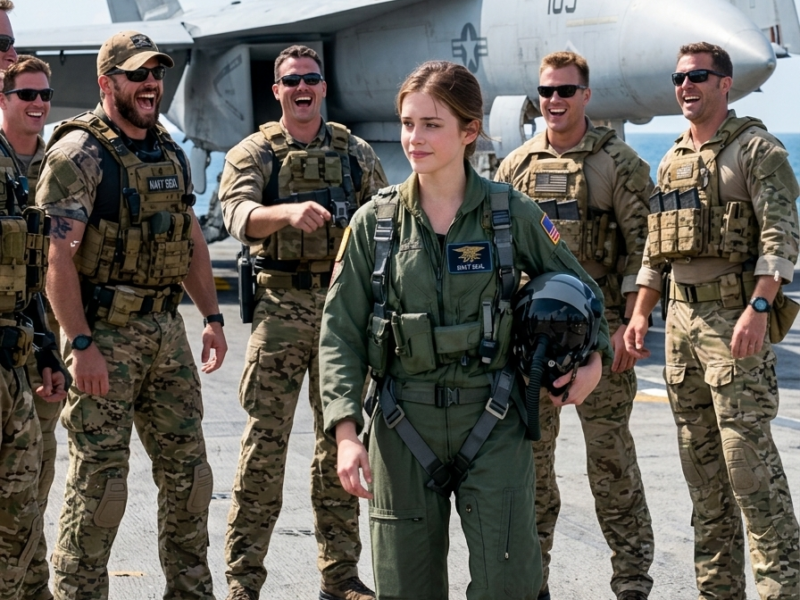
The Navy SEALs laughed when I stumbled during my first briefing at Naval Air Station Patuxent River, and their commander coldly asked whether I belonged in a cockpit at all
The hum of the environmental control systems inside Hangar 4 at Naval Air Station Patuxent River was usually enough to drown out casual chatter, but it did nothing to muffle the deliberate, condescending laughter echoing off the polished concrete floor.
I had dropped my briefing tablet. It was a simple, stupid mistake—my palm had been slick with nervous sweat, and the heavy plastic device had clattered against the front landing gear tire of an F/A-18 Hornet before skidding to a halt near the polished boots of Commander Marcus Hayes.
I was Lieutenant Claire Bennett. I had been stationed at Pax River for exactly eleven days, transferred in under a silent, high-level administrative reassignment that came without an attached squadron or an explicit mission profile. At twenty-seven years old, I was painfully aware of how I looked to the veteran operators assigned to the elite Special Warfare Development Group detachment currently sharing our facility: small, quiet, perpetually stooped as if trying to minimize the space I occupied, and entirely lacking the aggressive, iron-jawed swagger that defined the flight line.
Commander Hayes, a broad-chested SEAL officer with a scar running from his left temple down to his jawline, leaned down, picked up the tablet with two fingers, and looked at me with open amusement.
“You’re telling me this little lieutenant is our backup test pilot?” Hayes asked, his voice booming effortlessly across the open bay. He handed the tablet not to me, but to a master chief standing beside him. “She looks like she’d get blown out of the canopy if she opened the canopy window at taxi speed.”
A snort of laughter went up from the four SEALs standing in a semicircle around him.
“Does she even know how to start that thing?” one of the team members added, tossing a grease rag onto a tool cart. “I’ve seen academy recruits with more iron in their spine.”
I kept my eyes fixed firmly on the ground, my cheeks burning with a deep, furious red. I forced my posture to stay rigid, refusing to give them the satisfaction of a verbal defense. I had spent six years in the Navy learning that when men like Hayes decide you are weak, speaking up only provides them with fresh fuel. So I stayed silent, reaching out to retrieve my tablet with a quiet, practiced nod of fake gratitude.
Yet, as the SEALs turned back to their gear, my eyes drifted past them, crossing the yellow warning lines painted on the hangar deck toward the far corner of the facility.
There, behind heavy steel security stanchions and guarded twenty-four hours a day by armed sentries, sat the VX-9 Aegis Strike.
It was an experimental, dark-grey airframe with forward-swept wings and a seamlessly integrated ceramic skin designed to absorb both radar waves and thermal spikes. The VX-9 was a miracle of modern aerospace engineering, but to everyone at Pax River, it was a death trap. Its flight-control system was entirely fly-by-light—relying on experimental fiber-optic networks rather than traditional hydraulic backups. Its engine response was notoriously aggressive, and its emergency recovery protocols were so brutally complex that the test program required two pilots working in complete, synchronized harmony just to keep the aircraft level during low-altitude transitions.
Only three aviators had ever taken the VX-9 into the upper atmosphere.
The first, Lieutenant Commander Miller, had resigned his commission twenty-four hours after his third flight, refusing to speak to naval investigators.
The second, Major Vance, had suffered a catastrophic neurological breakdown mid-flight due to the high-frequency cockpit pressure fluctuations and had been permanently grounded.
The third was Commander Daniel Bennett. My father.
Twelve years ago, my father’s VX-9 prototype had vanished from military radar forty miles off the coast of Cape Hatteras during a night interception test. The Navy had recovered a single scorched wingtip from the Atlantic Ocean, held a closed-door memorial service, and handed my mother a folded flag alongside a classified casualty report. They claimed the aircraft had suffered a total structural disintegration at Mach 3.2, killing him instantly. But they never explained why his final radio transmission had been scrubbed from the official flight log, or why his name was quietly erased from the hangar wall where Pax River honored its fallen test pilots.
I had built my entire military career on trying to run away from that shadow. I had accepted boring transport assignments, logistics flights, and desk duty—anything to keep from facing the reality of what happened to him.
Until thirty seconds ago.
Without warning, the hangar’s peaceful atmosphere was shattered by the harsh, rhythmic blare of the primary red alert siren. The flashing amber beacons along the ceiling began to rotate, casting long, bloody shadows across the shiny concrete floor.
“ALL HANDS, THIS IS TOWER CONTROL. EMERGENCY IN PROGRESS. FLIGHT LINE CLEARANCE CODE RED.”
The technicians working on the Hornets scattered, clearing the central thoroughfare. Commander Hayes immediately snapped to attention, pulling a tactical headset over his ears as the Air Boss—a grizzled, white-haired Master Chief named Vance—strode out of the primary telemetry room, his face dark with panic.
Over the hangar’s public address speakers, a voice crackled through a wall of static. It was strained, ragged, and laced with absolute, raw terror.
“Pax Control, this is Alpha-One! I have a total flight control lock! The primary fiber-optic bus just fried! I’m in a pitch-up attitude at twenty-five thousand feet… I can’t level her out!”
It was Captain Ryan Cole. He was the chief test pilot for the VX-9 program, a legendary aviator with over four thousand flight hours.
“Cole, this is Tower!” Master Chief Vance shouted into his headset, slamming his hand onto the telemetry desk. “Engage the mechanical backup flight computer! Toggle switch Alpha-Niner!”
“It’s dead!” Cole’s scream was almost drowned out by the roaring wind audio in his cockpit. “The backup system isn’t responding! The nose is bouncing! She’s going into an inverted flat spin! I’m losing altitude… dropping through eighteen thousand!”
In the hangar, the technicians stared at the telemetry screens in stunned horror. The green line representing Cole’s aircraft on the main monitor was squiggling erratically, dropping toward the red zone that marked the fatal deck height.
“He needs to eject now!” Hayes demanded, stepping up to the console. “Command, order him to punch out before the frame disintegrates!”
“He can’t!” the radar operator yelled back. “The canopy latch is tied to the primary electrical bus! If he pulls the ejection handle without power to the canopy explosive bolts, he’ll blow himself directly into the glass!”
The silence that followed was suffocating. Captain Cole was trapped inside a multi-million-dollar coffin, falling out of the sky at seven hundred miles an hour, and the most experienced engineers in the United States Navy were standing helpless on the ground.
My heart was beating so violently against my ribs that I could barely breathe. I looked at the telemetry screen, then at the technical schematic of the VX-9 glowing on the secondary monitor.
I took a deep, shuddering breath. My hands were trembling, but as I stepped forward, the fog of fear that had dominated my entire life suddenly vanished, replaced by an eerie, lethal clarity.
“He’s using the wrong protocol,” I said.
My voice wasn’t loud, but in the absolute silence of the hangar, it carried like a gunshot.
Commander Hayes spun around, his eyes narrowing in fury. “Shut your mouth, Lieutenant! This isn’t the time for a rookie to play hero!”
“I’m not playing hero, Commander,” I said, stepping past him until I was standing directly in front of Master Chief Vance. I didn’t look down at the floor this time. I looked the Air Boss dead in the eye. “Captain Cole is trying to engage the digital recovery loop. It won’t work because the optical bus is dead. He needs to manually isolate the hydro-static valves using the mechanical cut-off beneath the stick.”
Vance stared at me, his jaw dropping slightly. “That cut-off isn’t in the flight manual. It was removed after the prototype phase.”
“It wasn’t removed,” I replied, my voice stone-cold and steady. “It was hidden. My father built a mechanical override directly into the control column assembly so a pilot could physically steer the elevators using manual cable tension if the digital brain ever failed.”
Vance’s face drained of all color. His hand, which had been resting on the emergency radio console, began to shake.
“You’re… you’re Daniel Bennett’s daughter?” he whispered.
“I am,” I said. “And if you want Ryan Cole to live through the next two minutes, you need to put me on that radio right now.”
Master Chief Vance didn’t ask another question. He didn’t check my security credentials or consult the duty officer. With a swift, decisive movement, he pulled his own master headset off and jammed it into my hands, unlocking the primary emergency radio transmitter with a small brass key he wore around his neck.
“Lieutenant,” Vance said, his voice dropping into a raspy whisper that only I could hear, “if you know how to use your father’s system, you use it now. Because if that plane hits the ground, it takes everything he died for with it.”
Commander Hayes lunged forward, grabbing the edge of the console. “Master Chief, this is a breach of protocol! She’s an unrated officer! You can’t let her command an emergency flight recovery!”
“Shut up, Hayes!” Vance roared, slamming his fist onto the steel desk with enough force to dent the metal plate. “She’s the only person in this room who isn’t staring at that screen like an idiot! Stand back or I’ll have my sentries remove you from this deck under wartime authority!”
Hayes froze, his eyes burning with anger, but he backed away three paces, his fists clenched tightly at his sides. The rest of the SEAL team stood completely frozen, their smirks entirely wiped away, their attention glued to the small, quiet female lieutenant now leaning over the master communications array.
I pressed the radio transmitter switch against my thumb.
“Alpha-One, this is Pax Control,” I said into the microphone. My tone was flat, rhythmic, and stripped of all panic—the exact voice my father used to use when he was teaching me how to navigate light aircraft over the Maryland coast when I was a child. “Captain Cole, do you read me?”
“I… I read you!” Cole’s voice was barely human now, choked by the brutal G-forces ripping through his cockpit as the jet tumbled through twelve thousand feet. “Who is this? Where is the Air Boss?”
“Ignore the Air Boss, Captain. Focus on my voice,” I instructed calmly, my eyes scanning the live flight telemetry data scrolling down the monitor. “You are in an inverted flat spin. Your optical controls are dead, but your flight surfaces are not jammed. I need you to reach down between your knees, past the ejection safety pin.”
“There’s… there’s nothing there but the seat frame!” Cole gasped over the radio.
“There is a recessed yellow access panel stamped with a serial number,” I continued, speaking with absolute certainty. “Pop the cover with your thumb. Inside is a steel T-handle connected to a heavy stainless steel cable. Pull it out four inches until it clicks.”
“That’s… that’s an uncertified modification!” Cole yelled back. “It’s not in the checklist!”
“It’s my father’s manual reversion linkage, Captain!” I shouted over the speaker, dropping my professional mask for a fraction of a second. “Pull the damn handle or you are going to die in ten seconds!”
A terrible, agonizing silence stretched over the radio waves. On the telemetry screen, the green altitude counter dropped through six thousand feet… five thousand… four thousand.
Then, a heavy metallic CLACK echoed through the radio line.
“I pulled it!” Cole screamed. “The stick… the control stick just got incredibly heavy! It feels like I’m pulling against concrete!”
“That’s hydraulic resistance!” I said immediately, leaning closer to the microphone. “The controls are now mechanical! You are physically moving those elevators with your arms! Pull the stick straight back into your ribs, drop your left rudder pedal all the way to the floor, and don’t you dare let go!”
In the hangar, fifty men held their breath. Nobody moved. Nobody breathed.
On the radar screen, the wild, chaotic spiral of the green blip suddenly shuddered. The altitude drop slowed. The descent vector flattened out from a vertical dive into a shallow, horizontal glide.
“I’m… I’m level!” Cole panted over the radio, his breathing heavy and ragged. “Nose is ten degrees up! Passing through eighteen hundred feet… I have visual contact with the runway!”
“Keep your hands on that T-handle, Captain,” I said, a soft, exhausted tremor finally entering my voice. “Maintain one hundred and eighty knots on final approach. Don’t touch the airbrakes. Just bring her home.”
Three minutes later, the dull, thunderous roar of a twin-engine jet echoed through the open hangar doors as the VX-9 swept low over the airfield, its nose held steady, its landing gear locking into place with a loud mechanical thud. The aircraft touched down on Runway 14-Left, tires smoking against the asphalt, before coasting safely to a stop near the crash trucks that had rushed out to meet it.
Inside Hangar 4, a wild, deafening cheer erupted from the assembly of technicians, mechanics, and tower operators. Men were clapping each other on the back, slamming their hands on tool chests, and shouting in relief.
Commander Hayes stood near the security barrier, his arms limp at his sides, staring at me with a look that was no longer arrogant or dismissive. It was a look of pure, unadulterated shock. The SEALs behind him were silent, looking down at the floor in shame.
I didn’t join in the celebration. I slowly took off the headset and set it gently back on the control desk. My hands were shaking so violently that I had to slip them into the pockets of my flight suit to hide the tremor.
Master Chief Vance stepped up beside me. He didn’t smile. His face was grave, lined with deep, dark worry.
“He was right,” Vance whispered, leaning in close so that the cheering crew couldn’t hear him. “Your father told me twelve years ago that if the control system ever suffered a total optical melt, only someone who knew his secret geometry could save the airframe.”
“Why did he hide it, Vance?” I asked, turning to him, my voice trembling. “Why wasn’t that manual reversion system listed in the official technical manuals?”
Vance didn’t answer right away. Instead, he reached into his uniform pocket, pulled out a heavy brass keycard, and stepped over to a small, secure computer terminal mounted on the wall behind the main telemetry deck—a terminal stamped with the red markings of the Naval Criminal Investigative Service and Central Command.
“Because your father didn’t design that backup system to save the plane, Claire,” Vance said quietly, tapping the keycard against the reader. “He designed it so he could land the plane himself after he discovered what the flight control computer was actually doing.”
The terminal monitor flickered awake, bypassing three layers of military encryption before opening a secure audio file archive that had been sealed under Executive Order 12958.
The date on the file was October 14, 2014. The night my father died.
And directly beneath the audio waveform, printed in bold, red system text, was a single sentence that made my blood run ice-cold:
STATUS: SUBJECT DANIEL BENNETT DID NOT DIE IN THE AIRCRAFT. CASUALTY REPORT FABRICATED PER ORDER OF NAVAL INTELLIGENCE DIRECTORATE.
My breath hitched in my throat. The ambient noise of the hangar—the cheering technicians, the clattering tools, the idling crash vehicles outside—seemed to instantly drop away into a dull, meaningless murmur.
“What is this?” my voice was barely audible, a ragged whisper floating in the small space between me and the glowing terminal screen. “Vance… what is this?”
Master Chief Vance didn’t look at the monitor. He kept his eyes locked on the hangar doors, watching two armed sentries who were currently escorting Captain Cole away from his landed jet toward the medical bay.
“Twelve years ago, your father wasn’t flying a standard test mission, Claire,” Vance said, his voice laced with a bitter, ancient pain. “The VX-9 program wasn’t designed by the Navy. It was funded by a private defense consortium called Apex Dynamics, operating under a classified black-budget authorization. They were testing an autonomous flight override—a software protocol designed to take complete control of a combat aircraft away from the pilot in the event of an unauthorized flight path.”
“A remote hijack system,” I said, the realization settling in my stomach like a block of lead.
“Worse,” Vance replied. “An automated execution system. If a pilot attempted to fly an experimental aircraft outside of designated test boundaries, or if the system detected that the pilot was attempting to land at a non-approved civilian airfield, the flight computer was programmed to simulate a structural failure, pitch the aircraft into an unrecoverable dive, and force an artificial crash.”
I looked back at the screen. “And my father found out.”
“He found out because he was the one who caught them uploading the code into the flight software three days before his final flight,” Vance whispered. “He knew he couldn’t just report it through the chain of command. The Director of Naval Intelligence at the time was on Apex Dynamics’ board of directors. So, Daniel built a backdoor into the hardware—that T-handle you just told Cole to pull. It completely bypassed the optical computer, severing the remote link.”
Vance pressed his thumb against the terminal’s biometric sensor. The red waveform icon on the screen began to pulse.
“Listen,” Vance said.
He plugged a set of heavy, noise-canceling headphones into the terminal jack and placed them over my ears.
The audio track began with a heavy surge of atmospheric static, followed by the deep, rhythmic hum of a jet engine operating at high altitude. Then came my father’s voice. Hearing it after twelve years hit me like a physical force—it was warm, steady, and rich, exactly as I remembered it from the stories he used to read to me before bed.
“Pax Control, this is Bennett on test vector Three-Zero-Alpha,” my father’s voice said over the static. “I have confirmed the presence of the secondary logic string in the flight bus. The system is attempting to override my manual stick inputs. It is turning the aircraft toward coordinate grid Uniform-Seven.”
A second voice came over the recording—a cold, flat, synthesized voice that didn’t sound like any military air controller I had ever heard.
“Test Pilot Bennett, you are deviating from your approved flight corridor. Turn back to heading Zero-Niner-Zero immediately or emergency protocols will be initiated.”
“I know what Uniform-Seven is,” my father replied on the tape, his voice dropping into a hard, unyielding edge. “It’s an offshore platform. You aren’t testing flight controls out here. You’re shipping unmanifested hardware out of the country. I’m bringing this plane back to Pax River, and I’m handing these flight logs to the Federal Bureau of Investigation.”
“Override initiated,” the cold voice answered instantly. “Structural failure simulated in three… two… one…”
Over the headphones, I heard the sudden, terrifying scream of an aircraft engine being forced into an intentional compressor stall. The sound of metal straining under extreme G-forces filled my ears, followed by the loud, mechanical CLACK of my father pulling the T-handle T-bar.
“Nice try,” my father’s voice came back, calm and victorious over the roaring wind. “Manual reversion engaged. Optical bus disconnected. I’m off your grid, Apex. See you on the ground.”
The recording didn’t end with a crash. It didn’t end with explosions or screaming alarms.
It ended with the sound of a successful landing—the heavy, rhythmic thud of tires contacting asphalt, followed by the whistle of jet engines spooled down to idle.
And then, a final, chilling voice came through the cockpit recorder—a voice speaking from inside the aircraft landing area, over a hand-held radio channel:
“Secure the pilot. The public gets a wingtip in the ocean and a military funeral. Make sure his family receives the standard benefit package. If his daughter ever applies to the academy… keep her on a short leash.”
The audio track went dead.
I pulled the headphones off my ears, my head spinning, my lungs refusing to expand. Tears were stinging the corners of my eyes, but they weren’t tears of grief—they were tears of absolute, blinding rage.
“He didn’t crash,” I breathed, turning to Vance, my voice trembling with fury. “He landed the plane. He brought it back! Where is he, Vance? WHERE IS MY FATHER?”
Before Vance could answer, a heavy hand descended onto my shoulder.
I spun around, expecting to see Commander Hayes or one of his SEAL operators.
Instead, I found myself looking at an older man standing directly behind the telemetry console. He was wearing a faded, grease-stained flight suit, a dark tactical cap pulled low over his forehead, and a brass flight badge pinned to his chest—a badge bearing the call sign PHANTOM-ONE.
His hair was grey at the temples, his face was lined with deep, weather-beaten scars, and his left arm moved with the slight, mechanical stiffness of a prosthetic limb.
But his eyes—bright, piercing, and brilliant blue—were unmistakably the eyes from the framed photograph that had sat on my mother’s mantlepiece for twelve long years.
“Hello, Claire,” the man whispered. His voice was raspy, broken, and filled with a warmth that completely destroyed the dark gloom of the hangar. “You’ve grown into a fine pilot.”
My knees almost buckled beneath me. I reached out, my hand grasping the edge of the telemetry console to keep myself from falling to the floor.
“Dad?” I choked out, the word feeling strange, heavy, and completely foreign on my tongue after a decade of silence.
The man took a step closer, slowly pulling off his dark tactical cap. The light from the overhead fluorescent fixtures illuminated the deep, jagged scar running across his forehead—a scar that could only have come from a violent canopy ejection or a severe cockpit impact.
“I’m sorry, Claire,” Daniel Bennett said softly, his eyes shining with unshed tears. “I am so terribly sorry for letting you grow up thinking I was buried in that empty box in Arlington.”
“How… how are you standing here?” I asked, my voice cracking as I looked at him, half-believing he was a hallucination brought on by the stress of the landing. “Vance said… the recording said you were captured!”
“I was,” my father replied, taking my trembling hand in his. His skin was rough, calloused, and cold to the touch. “Apex Dynamics had deep roots inside the Department of Defense. When I landed the prototype at a remote naval auxiliary field near Buxton that night, I was met not by military police, but by private contractors. They took the aircraft, classified the entire incident under a top-secret SAP clear-code, and held me in a black-site facility in northern Maine for five years.”
“Five years…” I gasped, my stomach dropping. “Why didn’t they kill you?”
“Because I was the only person alive who had written the underlying kernel code for the VX-9’s stabilization matrix,” he said, a bitter smile touching his lips. “Every time they tried to fly the production models without me, the optical computers crashed. They needed me alive to keep their multi-billion-dollar contract from being cancelled by Congress. I was a ghost, working in a basement lab under a armed guard, fixing flight software for an airframe I hated.”
“Then how did you get out?” I demanded.
My father looked over at Master Chief Vance, who gave him a slow, solemn nod.
“Seven years ago, Vance found out I was still alive,” my father explained. “He used his access as Chief of the Flight Deck at Pax River to pull off a black-budget rescue operation with a small group of retired test pilots who still remembered what honor meant. They got me out of that facility, but we couldn’t go public. Apex Dynamics owned the inspectors, the generals, and the political committees. If I came forward, they would have erased me permanently—and they would have targeted you and your mother to make sure no one else asked questions.”
“So you stayed hidden here?” I looked around the hangar, realization dawning on me. “In plain sight?”
“Under the floor,” Vance interrupted quietly, pointing to a heavy steel hydraulic hatch built into the rear maintenance pit beneath the VX-9’s parking bay. “Your father has been living in the subterranean testing bunker beneath Hangar 4 for seven years, Claire. He’s been working in the dark, maintaining the manual reversion systems on every experimental prototype we built, waiting for the day when Apex would finally make a mistake big enough for us to strike.”
“And today was that mistake,” my father said, his voice turning cold and sharp. “Captain Cole’s flight wasn’t an equipment failure. Apex knew you were transferred here eleven days ago, Claire. They realized who you were. They intentionally triggered the remote control failure on Cole’s jet while he was over the facility, hoping he would crash directly into Hangar 4, destroying this building, the subterranean laboratory beneath it, and both of us in a single ‘accidental’ tragedy.”
A cold, terrifying chill ran down my spine. “They tried to kill us all… just to cover up a software contract?”
“It’s not just a software contract anymore, Lieutenant,” a cold voice spoke up from behind us.
We all turned.
Commander Hayes was standing near the entrance of the maintenance bay. But he wasn’t alone.
Behind him stood six heavily armed men dressed in dark, unbadged tactical gear, carrying suppressed carbines—not the SEAL operators from earlier, but private security contractors wearing the insignia of Apex Dynamics on their shoulder straps.
Hayes was holding a heavy military-grade tactical detonator in his left hand, his finger resting lightly on a red toggle switch.
“I have to admit, Bennett,” Hayes said, looking at my father with a disgusted smirk, “you played your part well for seven years. But bringing your daughter into this facility was a fatal mistake.”
“You work for them, Hayes,” I spat, stepping in front of my father, my hands instinctively curling into fists. “You’re not a Navy SEAL. You’re a mercenary on a corporate payroll.”
“I’m a businessman, Lieutenant,” Hayes corrected smoothly, motioning with his chin for his contractors to spread out, blocking the exit to the hangar. “And business dictates that loose ends must be cut. Master Chief Vance was a nuisance, but manageable. Your father was an asset. But you, Claire… you proved today that your father’s manual reversion knowledge can be passed on. That makes you a dangerous variable.”
Hayes raised the tactical detonator high enough for us all to see the blinking green LED light on its side.
“In thirty seconds, a secondary fuel line in the maintenance pit will suffer an ‘accidental’ ignition,” Hayes said, his smile widening into a terrifying mask of malice. “The resulting explosion will destroy Hangar 4, kill the rogue test pilot Daniel Bennett, eliminate the negligent Air Boss Vance, and tragically claim the life of young Lieutenant Claire Bennett. The Navy will mourn you all as heroes of a tragic testing disaster.”
“You won’t get away with this, Hayes,” my father said, his voice completely devoid of fear. “The telemetry from Cole’s flight was broadcast across a open military frequency. The entire Atlantic Fleet knows the control system failed!”
“They know what I tell them they know,” Hayes replied coldly. He raised his hand, his thumb hovering over the red detonator switch. “Goodbye, Bennett family.”
“NOW, CLAIRE!” my father roared.
Before Hayes could depress the red toggle switch, my father reached out with his good hand and slammed his fist down onto the primary hydraulic maintenance override mounted on the wall beside us.
WHOOSH-CLANG!
The massive, ten-ton steel maintenance lift beneath the VX-9 aircraft instantly triggered, its heavy steel arms dropping three feet into the deck with a deafening hydraulic screech. The sudden movement rocked the entire hangar, throwing Hayes and his six armed contractors off balance.
One of the contractors accidentally pulled his trigger as he stumbled, sending a burst of suppressed automatic gunfire screaming into the concrete ceiling, shattering the overhead floodlights and plunging the rear half of the hangar into dark, shadow-filled chaos.
“MOVE!” Master Chief Vance screamed, grabbing a heavy steel tool chest and shoving it violently into the path of two advancing contractors, knocking them to the floor in a cloud of sparks and flying wrenches.
My father grabbed my arm, pulling me toward the dark safety of the VX-9’s wing section. “Claire, get into the rear cockpit!”
“What?” I shouted over the sudden roar of yelling men and clattering tactical gear. “The aircraft is down! It’s hooked to the maintenance rig!”
“The rig is what powers the auxiliary starting system!” my father yelled back, his eyes blazing with a fierce, wild energy as he grabbed a pair of flight helmets hanging from the staging ladder. “Cole’s flight didn’t drain the main fuel cell! The tanks are eighty percent full! If we can spool up the engines using the ground power unit, we can use the forward thrust to blast through those security doors and escape before Hayes triggers the charges!”
“You’re going to fly an experimental jet through a closed hangar door?” I yelled, incredulous.
“I’m not flying it, Claire!” my father said, jamming the helmet down over my head and buckling the strap with lightning speed. “You are! You know the manual recovery sequence! I’ll handle the engine overrides from the rear station! Now move!”
I didn’t argue. I didn’t hesitate. I scrambled up the staging ladder of the dark, sleek airframe, throwing myself into the front command seat of the VX-9. My father leaped into the instructor seat directly behind me, slamming the heavy composite canopy shut as the electric latches whined into place.
Through the rain-streaked canopy glass, I saw Hayes scramble back to his feet, his face twisted in absolute fury. He held up the tactical detonator, screaming at his men to fire at our cockpit.
SPAT-SPAT-SPAT-SPAT!
High-velocity rounds slammed against the reinforced ceramic skin of the jet’s nose cone, bouncing off harmlessly, leaving bright white streaks on the grey paint.
“Initiate manual starter!” my father’s voice boomed inside my helmet through the interior intercom system. “Pull the T-handle, Claire! Lock us into mechanical control!”
I reached down between my knees, popped the yellow access cover, grabbed the heavy steel T-bar, and yanked it back with every ounce of strength in my body.
CLACK!
The green flight displays in front of me flickered, bypassed the primary optical computer, and locked into a raw, red analog operational mode.
“Auxiliary power connected!” I shouted, slamming the dual throttle levers forward into full ignition.
Behind us, the two massive turbofan engines erupted into life with a deafening, earth-shaking roar that shook the entire structure of Hangar 4. The immense heat from the afterburners blasted backward across the floor, creating a wall of superheated air that swept Hayes’s contractors off their feet, tossing them like ragdolls across the concrete deck.
“Tear down the barrier!” my father shouted. “Full military thrust!”
I released the emergency wheel locks.
Thirty thousand pounds of raw, unadulterated thrust hit the airframe. The VX-9 shot forward down the maintenance bay like a rocket, dragging the heavy steel ground-power cables behind it until they snapped with a shower of brilliant blue electrical arcs.
Ahead of us sat the thick, reinforced steel blast doors of Hangar 4, closed tight against the afternoon sky.
“Claire, hold the stick steady!” my father yelled into the intercom. “We aren’t lifting off—we’re breaching!”
I lowered my head, locked my arms against the control column, and kept the jet’s nose pointed dead-center at the seam between the two massive steel doors.
BOOM!
The heavy nose tip of the VX-9, reinforced with dense titanium composites, slammed into the central locking mechanism of the hangar doors at eighty miles an hour. The steel doors burst outward under the immense kinetic impact, tearing off their heavy overhead tracks and collapsing onto the asphalt outside in a twisted heap of metal.
The jet shot out of the dark, smoke-filled interior of Hangar 4 into the bright, brilliant sunlight of the flight line, rolling down the taxiway in a cloud of dust, sparks, and shredded steel.
I stomped on the dual mechanical brakes, pulling the throttle levers back to flight idle. The jet coasted to a smooth, controlled halt directly in the middle of the active runway, surrounded by dozens of stunned naval personnel, fire trucks, and military police vehicles that had responded to the alarm.
Behind us, inside Hangar 4, a series of small, muffled explosions went off as Hayes’s charges detonated harmlessly in the empty maintenance pit, blowing smoke out through the shattered front entrance.
I threw open the canopy. The fresh, cool air of the Maryland coast flooded into the cockpit, washing away the smell of jet fuel, ozone, and burnt copper.
A dozen military police officers rushed the aircraft, weapons drawn, but they weren’t looking at us with hostility. Standing in front of them was the Base Commander, flanked by three federal agents wearing jackets stamped with the letters FBI.
Captain Cole, his head wrapped in medical bandages, stood beside them, pointing toward Hangar 4 where Hayes and his surviving contractors were stumbling out of the smoke, hands raised in surrender as armed security guards surrounded them.
My father pulled off his helmet, standing up in the rear cockpit seat.
The Base Commander looked up at him, his mouth opening in absolute, unbelievable shock as he recognized the face of the man who had officially been declared dead twelve years ago.
“Commander Bennett…” the Base Commander whispered, slowly bringing his hand up to his forehead in a crisp, respectful salute. “Welcome back, sir.”
My father didn’t look at the commander. He leaned forward over the cockpit coaming, placing a heavy, warm hand on my shoulder.
“You brought us home, Claire,” my father said, his voice thick with pride, tears clearing clean tracks through the soot on his cheeks. “You brought us both home.”
I looked out over the sunlit airfield, feeling the heavy, suffocating weight that I had carried for twelve years finally melt away into the blue sky above.
I was no longer the quiet, frightened lieutenant who dropped her tablet on the hangar floor.
I was Lieutenant Claire Bennett.
I was a test pilot.
And my father’s story was finally complete.
The end.









