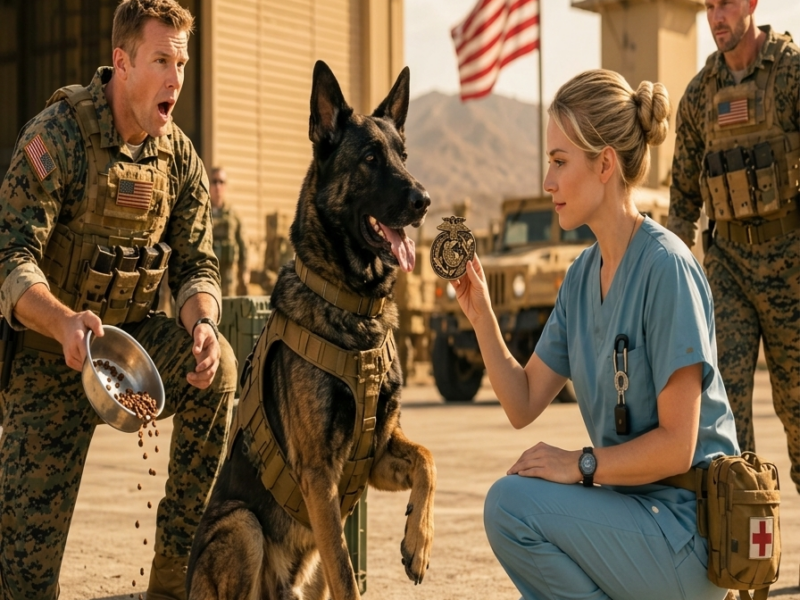
The Navy SEAL’s K9 suddenly lunged at the funeral flag and snarled at everyone who came near, while his commanding officer called the dog “broken”
The air inside the military hospital’s basement storage unit tasted like rust and ozone. A single fluorescent tube hung above the metal shelves, buzzing with a high-pitched drone that seemed to vibrate directly inside my skull. On the computer screen in front of me, the digital timestamp flashed in harsh blue pixels.
Daniel Hayes was alive. Or at least, he had been when this file was rendered three days ago inside the very facility where I had worked sixty-hour weeks for the past four years.
“Nurse Emily, if Ranger found you, it means you’re the only person I trusted.”
The audio cut out with a sharp pop of static. My breath hitched in my chest. The name Chief Petty Officer Daniel Hayes meant nothing to me prior to this week. To the rest of the base, he was a decorated Navy SEAL whose unit had been ambushed during a covert insertion somewhere near the Black Sea. To the military brass, he was an unfortunate casualty of a mission that officially never happened. To the hospital staff, he was just a ghost whose Belgian Malinois, Ranger, had been brought to our veterinary hold after being found dehydrated and near-dead beside the air base perimeter.
Yet, as I stared at the frozen video frame, the truth began to fracture around me. Daniel’s face on the screen was bruised, his left jaw swollen and discolored, but his eyes were sharp, dark, and unmistakable. And beneath his resting wrist in the lower right corner of the video frame was a stark white silicone band. Printed across it in bold, black lettering was: ST. MICHAEL MILITARY MEDICAL CENTER — ICU WARD B.
I had personally signed off on the ICU Ward B shift logs every night for the past fortnight.
Before I could process the impossibility of the video, a heavy metallic latch clicked behind me.
The heavy steel door of the unused basement storage room slammed shut with a deafening bang that echoed down the concrete corridor. The automatic light sensor blinked out, plunging the room into shadow, illuminated only by the pale blue glare of the workstation monitor.
“You shouldn’t have opened that,” a low, gravelly voice whispered from the gloom near the doorway.
Beside my knees, Ranger’s body coiled like a steel spring. The Belgian Malinois didn’t bark. He let out a low, guttural vibration that started deep within his chest—a lethal sound honed by years of tactical warfare. His lips peeled back, exposing long white canines dripping with saliva. The bandage wrapped around his front left paw, bloody from where he had scraped against the brass hinges of the ceremonial coffin earlier that afternoon, began to bloom fresh crimson.
I shoved the memory card deeper into my pocket and backed away until my spine hit the edge of the metal desk. “Who are you?” I demanded, trying to keep my voice from trembling. “This room is restricted access.”
The man stepped out of the shadow cast by the towering metal supply racks. He was dressed in the dark grey tactical fatigue of base security, but he wore no rank insignia, no name tape, and no unit crest. In his right hand, he held an unmarked suppressed sidearm pointed directly at my chest.
“Hand over the drive, Emily,” the man said softly. His voice had no inflection, no anger, no panic. It was the voice of an auditor settling an balance sheet. “You’re a good nurse. You’ve got an immaculate record. Don’t ruin it over a ghost.”
Ranger didn’t wait for my command.
With a terrifying, explosive launch, the dog leaped across the five-foot gap separating us. The officer fired once—the sound a dull thwack against the concrete—but Ranger was already underneath the sightline. The dog’s jaws locked onto the man’s forearm with bone-crushing force.
The gunman screamed, dropping the weapon as the sheer momentum of ninety pounds of muscle slammed him backward into a row of stainless steel utility carts. Trays of surgical instruments, glass vials, and sterilized cotton clashed against the concrete floor like a falling chandelier.
“Run!” my mind screamed, but my legs felt leaden.
Ranger thrashing wild on the man’s arm, his hind legs driving into the floor, dragging the assailant toward the wall. The man used his free hand to reach for a combat knife strapped to his vest.
“Ranger, OUT!” I shouted, using the standard military K9 recall command I had heard the handlers use in the courtyard.
The dog instantly released his grip, sprang backward, and stood between the bleeding man and me, his chest heaving, his dark eyes locked on the target.
“Come on!” I grabbed the back of Ranger’s tactical harness.
We sprinted out the side door into the narrow service corridor that ran beneath the hospital’s main wings. My heart pounded against my ribs like a trapped bird. Every instinct I had as a nurse—to call for help, to ring the security alarm, to pull the emergency stations—was screaming at me. But who could I call? The man with the gun was wearing an official security uniform. Commander Sterling himself had declared Ranger “broken” and ordered him euthanized or removed from the base only three hours ago during the memorial service.
As we reached the stairwell leading up to the ground floor, Ranger suddenly pulled back on his leash, whining softly. He planted his weight and stared at the dark service elevator at the end of the hall—a freight lift marked with a faded hazard sign: INACTIVE — MAINTENANCE ONLY.
“Ranger, we have to get out of the building,” I gasped, wiping sweat from my forehead.
The dog ignored me. He walked to the steel elevator doors, pressed his wet snout against the gap between the sliding panels, and let out a single, desperate whine. Then, he looked up at me, his eyes wide and brown, filled with an intelligence that felt almost human.
He didn’t want to run away. He wanted to go down.
I stepped closer to the freight lift. The floor indicator above the door was dark, but as I stood there, I heard a faint, rhythmic sound rising through the floorboards.
Thump. Pause. Thump. Pause.
It wasn’t a mechanical noise. It was the slow, measured pulse of an industrial mechanical ventilator—the exact sound I listened to every single night in the Intensive Care Unit.
I looked down at Ranger. “He’s down there, isn’t he?”
The K9 gave a single, firm nudge against my knee, then sat down, refusing to move another step toward the exit.
My hand reached into my coat pocket, touching the jagged plastic edge of the broken duffel bag lining and the memory card. The pieces were beginning to fit together into a nightmare. The flag-draped coffin at the memorial service wasn’t empty because Daniel’s body was unrecoverable overseas.
It was empty because Daniel Hayes was still breathing right beneath our feet.
The sub-basement of St. Michael Military Medical Center did not exist on any of the standard floor plans posted in the administrative offices. I had worked here for four years, believing the basement level held only the laundry facilities, the morgue, and the archival record rooms. But as Ranger guided me past the boiler room down a narrow, unpainted utility corridor, the air grew noticeably colder, smelling heavily of bleach and fresh paint.
We stopped before a heavy reinforced door equipped with a digital keypad and an optical scanner. There were no markings on the steel surface.
“We can’t get through this, boy,” I whispered, reaching out to touch the cold steel panel. “I don’t have access level four.”
Ranger didn’t look at the keypad. Instead, he dropped his nose to the baseboard, sniffing along the seam where the metal frame met the poured concrete floor. He paused at a small electrical junction box mounted three feet to the left. He nudged the plastic cover with his nose until it swung open on a loose hinge.
Inside was a manual override keyhole and a small proximity sensor.
I reached into my pocket, my fingers brushing against my own staff ID badge. Standard hospital badges used low-frequency RFID chips. But three days ago, all senior night-shift nurses had been issued updated security passes under the pretense of a system-wide software upgrade. At the time, I hadn’t thought twice about it.
I pulled out my badge and held it against the junction box sensor.
A soft chime sounded. The indicator light above the heavy steel door flipped from solid red to a slow, pulsing amber. The pneumatic seal released with a deep hiss, and the door swung inward by an inch.
My hand hovered over the door handle. A sensible voice in my head—the voice that had guided me through four years of nursing school and a quiet, predictable life—was begging me to turn around, walk out the back gate, and never look back. If I stepped through this door, there would be no returning to my old life.
Ranger nudged my hand with his cold nose, pushing my fingers against the handle.
“Okay,” I whispered. “Okay.”
I pushed the door open and stepped inside.
The hallway beyond was immaculate. Bright LED strip lights ran along the ceiling, illuminating a pristine white corridor lined with glass-walled observation rooms. Unlike the chaotic, crowded wards upstairs, this facility was silent, save for the rhythmic humming of medical machinery.
We moved quietly along the rubberized flooring. The first two observation rooms were empty, their beds stripped, monitors powered down. But as we reached the third room, Ranger’s body went rigid. He let out a breathy, suppressed huff.
Inside the room, suspended in a matrix of monitoring wires, IV lines, and a heavy-duty mechanical respirator, lay a man. His chest rose and fell with artificial slowness. His face was obscured by an oxygen mask, but the jagged scar running from his left temple down to his jawline matched the photograph of Chief Petty Officer Daniel Hayes exactly.
“Daniel,” I breathed, pressing my hand against the double-paned glass.
He was alive. But he was in a medically induced coma. His vital signs were displayed on an overhead monitor: pulse steady at 52, blood pressure low but stable, intracranial pressure artificially suppressed using high-dose barbiturate infusions. Someone was keeping him under—not to save his life, but to keep him silent.
I moved toward the door handle of the isolation room, but a heavy shadow stepped into the hallway at the far end of the corridor.
“I hoped you wouldn’t be clever enough to find this place, Emily.”
I spun around.
Standing twenty feet away was Commander Thomas Sterling. He was still wearing his full dress whites, the rows of medals on his chest gleaming under the LED lights. His silver hair was neatly slicked back, his expression calm, almost fatherly. In his hands, he held a sleek black tablet device.
“Commander,” I said, stepping between him and the glass room, though I knew I offered no real protection. “What is this? Why is Chief Hayes logged as deceased? Why is he hidden in a decommissioned wing?”
Sterling let out a tired sigh, stepping closer. Ranger growled, his ears pinned back, his body locked in an attack stance, but Sterling didn’t even look at the dog.
“What you see here, Emily, is a matter of national security that far exceeds your pay grade or your medical ethics,” Sterling said, his voice smooth and controlled. “Daniel Hayes and his team were sent into a situation that turned… politically inconvenient. They were exposed to something that shouldn’t exist. Something that our foreign partners were not supposed to be manufacturing.”
“He’s a decorated soldier!” I snapped. “You held a memorial service for him upstairs two hours ago! You had his wife weeping over an empty box!”
“His wife will receive a full officer’s pension and a hero’s legacy,” Sterling replied coldly. “Which is far better than the alternative. If Daniel wakes up and speaks to the press or a senate committee, sixty men in his unit will be tried in an international court for operations that were never authorized. His silence protects the Navy. It protects the nation.”
“You’re keeping him in a chemical coma,” I said, my voice shaking with outrage as I recognized the drug vials hanging on the IV pole. “You’re slowly destroying his brain function!”
“I am preserving stability,” Sterling corrected. He tapped a command on his tablet. A harsh red light began to flash on the control panel beside the glass door. “And unfortunately, Emily, you have stumbled into a script you were never meant to read.”
Behind us, the glass door to Daniel’s room locked with a loud, electronic deadbolt. At the same time, the overhead ventilation system changed pitch. The crisp, clean air in the hallway was suddenly replaced by a faint, sweet chemical smell.
“What did you do?” I gasped, coughing as my eyes began to burn instantly.
“A simple anesthetic agent,” Sterling said, stepping back toward the exit door and placing a gas mask over his face. “In three minutes, you and the dog will be fast asleep. By tomorrow morning, you will have died of an tragic, accidental gas leak in the old utility tunnels. Ranger will be euthanized as a dangerous, unstable animal, just as I ordered earlier.”
He stepped through the heavy exit door and slammed it shut. The electronic lock engaged with a final, sickening click.
The air grew thicker, heavier. My knees buckled slightly as a wave of intense dizziness washed over me. Beside me, Ranger whimpered, his legs shaking as the gas began to take effect on his smaller body.
“No… no, no,” I stumbled toward the glass room, my vision blurring.
I looked through the window. Inside the room, the monitors began to beep frantically. Daniel’s eyelids fluttered. His hand, hooked to an arterial line, twitched.
He was waking up.
The sweet, heavy smell of the anesthetic gas filled my lungs with every ragged breath. My vision burned at the edges, narrowing into a tunnel of dark grey dots. Beside me, Ranger collapsed onto his side, his broad chest rising and falling in rapid, shallow hitches. His legs twitched helplessly against the polished floor.
“Ranger… get up…” I slurred, falling to my knees beside him.
My mind fought wildly against the creeping paralysis. As a critical care nurse, I knew the chemical profile of gas-based sedatives. Sterling was using a high-concentration sevoflurane derivative. In a closed space without ventilation, it would induce unconsciousness within ninety seconds and respiratory arrest in under five minutes.
I needed oxygen. I needed a counter-agent.
My eyes swept the hallway frantically through the haze. Outside Daniel’s glass room was an emergency crash cart—a standard red medical trolley stocked with advanced airway tools and resuscitation drugs.
I dragged myself across the rubber floor, my limbs feeling as though they were filled with wet sand. Every inch was an agonizing effort. I reached the cart, grabbed the bottom drawer, and yanked it open. Syringes, tubing, and ampoules spilled across the floor.
My trembling fingers searched through the glass vials until I found what I needed: Atropine and Epinephrine. Not a cure for the gas, but a massive stimulant jump-start for the central nervous system that could keep our heart rates elevated enough to fight the sedative.
I snapped the neck of an epinephrine ampoule, drew the clear liquid into a three-milliliter syringe with unsteady hands, and jabbed it directly through Ranger’s thigh muscle into the meat of his leg.
“Stay with me, boy,” I gasped.
I drew a second dose and drove the needle into my own outer thigh, slamming the plunger down.
The reaction was almost instantaneous. It felt as though a lightning bolt had been injected straight into my bloodstream. My heart hammered against my ribs like a sledgehammer—120, 140, 160 beats per minute. The fog in my brain snapped apart under a tidal wave of synthetic adrenaline.
Beside me, Ranger let out a sharp gasp, his eyes flying open. He pushed himself up onto his front legs, shaking his head violently, his breathing heavy but strong.
“Good boy,” I panted, wiping cold sweat from my forehead. “Good boy. Now help me.”
I grabbed an emergency oxygen tank from the lower rack of the crash cart, cracked the valve open, and let the pure oxygen flow over Ranger’s snout before taking deep, lung-clearing breaths myself.
With the fog temporarily cleared, I turned back to Daniel’s isolation room. Inside, the monitors were screaming. Daniel’s eyes were wide open now, dark and wild with panic. He was fighting the mechanical ventilator tubing taped into his throat, his heart rate spiking past 180 beats per minute on the display. He was drowning in his own forced sedation.
“I have to get him out,” I muttered.
The glass door was electronically locked from the outside control panel, which Sterling had disabled using his tablet. The glass itself was reinforced safety laminate—impossible to break with human strength.
I looked at the heavy steel oxygen cylinder in my hands.
“Ranger, move back!”
I swung the fifty-pound steel tank like a battering ram, slamming the brass valve head directly into the center of the reinforced glass panel. A deafening CRACK reverberated down the hallway. Spiderweb fractures spread across the glass, but it didn’t shatter.
I swung again. And again. On the fourth strike, the center of the panel gave way with a shower of laminated glass shards.
I cleared the jagged edges using a rolled-up medical tray and tumbled into the room.
Daniel’s eyes locked onto mine. He couldn’t speak through the endotracheal tube, but the desperation in his gaze was terrifyingly clear. He reached out with a trembling, IV-marked hand, his fingers clutching my scrub top.
“I’ve got you, Chief,” I said quickly, my nursing instincts taking over despite the adrenaline surging through my veins. “I’m Emily. Ranger brought me here. I’m going to pull the tube. You need to cough on three. Understand?”
He gave a slight, weak nod.
I deflated the retention balloon with a syringe, yanked the plastic airway tube from his throat, and tossed it aside.
Daniel sat up instantly, doubled over in a violent fit of coughing, gasping for air. His body was weak from days of chemical restraint, but the physical mass of the man was imposing. He looked down at his arms, at the lines taped to his skin, and then his eyes fell on the Malinois who had leapt through the broken glass window.
“R-Ranger…” Daniel rasped, his voice shredded and raw.
The dog didn’t bark. He placed his front paws gently on the edge of the hospital bed and pressed his forehead against Daniel’s chest, letting out a soft, trembling whine that broke the silence of the room. Daniel wrapped his thick, tattooed arms around the dog’s neck, burying his face in Ranger’s fur.
“Good boy,” Daniel croaked, his shoulders shaking slightly. “You found her… good boy.”
“We don’t have time,” I said, checking his pulse. “Sterling filled the hallway with anesthetic gas. The epinephrine I took will give us twenty minutes before the crash hit us. Can you stand?”
Daniel swung his legs over the side of the bed. His hospital gown hung loosely on his frame, his feet bare on the cold floor. He tried to put weight on his legs, but his knees buckled immediately. I caught him under his armpits, gritting my teeth as I supported his weight.
“They… they injected me with a paralytic agent four hours ago,” Daniel grunted, forcing his muscles to contract. “It hasn’t fully cleared my system.”
“Then you lean on me,” I said firmly.
Suddenly, the red emergency strobe lights in the ceiling stopped flashing. The heavy steel door at the end of the outer corridor gave a loud, pneumatic click.
Sterling was coming back—and he wouldn’t be alone this time.
“The service hatch behind the bed,” Daniel croaked, his voice gaining strength as his combat training fought through the lingering drugs. “It connects to the old utility risers… leads under the laundry building.”
I looked behind the headboard. A heavy gray access panel, screwed into the wall, covered an air duct. I grabbed a scalpels from the crashed medical tray and furiously backed out the four corner screws. The panel clattered to the floor, revealing a dark, narrow shaft lined with vertical metal rungs.
“Go first,” I told Daniel. “I’ll guide Ranger.”
“No,” Daniel said, his dark eyes locking onto mine with absolute authority. “You go first. If I drop, I don’t want to fall on you.”
Before I could argue, the outer hallway doors burst open with a heavy metallic crash.
“Find them!” Sterling’s voice echoed down the corridor, stripped of its previous calm composure. “They couldn’t have gone far! Shoot the dog on sight!”
Heavy combat boots thundered against the floorboards.
I scrambled into the duct, pulling myself up three rungs on the vertical ladder. Daniel followed, his movements painful and slow, but driven by raw survival instinct. Ranger came last—he was a trained multi-terrain assault K9; he gripped the metal crossbars with his paws and scrambled up the shaft behind his handler with incredible agility.
I pulled the steel access panel back into place just as flashlight beams swept into the room below. Through the small ventilation slits, I saw three armed men in unmarked black tactical gear flood the room, their weapons raised.
Sterling stepped through the shattered glass window, his face pale with fury as he stared at the empty hospital bed and the disconnected IV lines.
“Search the sub-basement! Block all perimeter gates!” Sterling roared into his tactical headset. “If Chief Hayes leaves this facility alive, every single one of us goes to Leavenworth for the rest of our lives!”
We climbed in absolute darkness for what felt like an eternity. The air inside the vertical shaft was hot, choked with decades of dust and lint from the laundry facilities above. My heart was pounding so hard from the epinephrine that I could hear my pulse echoing in my ears like a drumbeat.
Finally, my hands brushed against an upper hatch latch. I shoved it upward with all my remaining strength.
Fresh, cold night air swept over my face.
We emerged into an abandoned concrete loading bay behind the hospital’s central laundry building. The night sky was clear, dark, and filled with stars. In the distance, the perimeter sirens of the military base began to wail—a long, terrifying screech that signaled an active base-wide lockdown.
Daniel collapsed against the brick wall of the loading bay, clutching his chest, his breathing ragged.
“We can’t get past the main gate,” I panted, looking toward the bright perimeter lights half a mile away where security barricades were already rising. “They’ve locked down every vehicle exit. They’ll search every trunk, every ambulance.”
“We’re not going to the gate,” Daniel said, wiping blood from his nose. He looked at me, his gaze intensely focused. “Emily… why did you come down there? Why did you open that bag?”
“Ranger wouldn’t let anyone touch your coffin,” I said simply. “He bled his paws raw trying to get under it. When I looked into his eyes, I knew he wasn’t crazy. He was trying to tell us something.”
Daniel looked down at the dog sitting at his feet. Ranger pressed his head firmly against Daniel’s thigh, his tail giving a single, slow thump against the concrete floor.
“He saved my life in the Valley three months ago,” Daniel said softly. “I promised him I’d never leave him behind. Guess he held me to it.”
“Daniel,” I said, leaning close as the sound of distant vehicles echoed around the hospital perimeter. “In the video, you said I was the only person you trusted. But I swear… I’ve never met you before tonight. Why did you say that?”
Daniel reached into his hospital gown pocket. He pulled out a small, worn metallic object suspended on a beaded chain—a set of military dog tags. But beside his own tag hung a small, antique silver medical locket.
He handed it to me.
I opened the locket with a trembling thumb. Inside was a tiny, faded black-and-white photograph of a young woman in a 1940s nurse uniform sitting beside a young soldier.
“That’s my grandmother,” I whispered, shock arresting my breathing. “Nurse Margaret.”
“My grandfather was in her ward in 1945,” Daniel said, his voice low and solemn. “He survived because she refused to give up on him when the doctors declared him unrecoverable. Before he died three years ago, he told me: If you ever find yourself in the darkest hole of your life, look for a woman wearing that name tag. The family doesn’t run from a fight.”
Tears welled in my eyes, blurring the moonlight. It wasn’t a coincidence. It wasn’t luck. It was a debt owed across eighty years of history.
“Sterling thinks he controls this base,” Daniel said, his posture straightening as the last of the paralytic drug burned out of his system, replaced by the sheer will of a combat veteran. “But he forgot one thing.”
“What?”
Daniel looked out toward the dark tree line bordering the north edge of the base—the dense, unlit wilderness of the state forestry reserve.
“He forgot that this base was built on land my team uses for evasion training.”
The northern perimeter of St. Michael Base was bounded by a twelve-foot chain-link fence topped with razor wire, patrolled by automated motion sensors and sweep spotlights. Beyond it lay thousands of acres of dense, swampy pine forest—a natural barrier that the base command considered impassable without heavy equipment.
We crouched in the shadow of an old transformer station fifty yards from the fence line. The epinephrine rush in my body was finally fading, replaced by a crushing, leaden exhaustion. My knees shook, and my vision swam with dark spots.
“They’ll be sweeping the outer fence with thermal drones in ten minutes,” Daniel whispered, peering around the concrete transformer box. He had pulled a discarded fatigue jacket over his hospital gown, taken from a maintenance locker in the laundry building. “We have one window.”
“How do we get over razor wire without cutting gear?” I asked, my voice barely a breath.
Daniel pointed to a massive oak tree whose upper branches stretched out over the perimeter fence, hanging six feet above the top strand of razor wire.
“We don’t go through,” he said. “We go high.”
Before we could move, a pair of headlights swept across the access road twenty yards behind us. A heavy security patrol SUV ground to a halt. Two men armed with carbines stepped out, their tactical flashlights cutting through the darkness.
“They’re searching the utility structures!” one shouted. “Check the transformer bank!”
Ranger let out a barely audible breath, his body tensing against the dirt.
“Emily,” Daniel whispered, turning to me. “When I draw their fire, you and Ranger sprint for the base of that oak. Climb the lower ladder rungs on the trunk.”
“No,” I whispered back, grabbing his sleeve. “I’m not leaving you behind. We do this together.”
Daniel looked at me for a long moment, then a ghost of a smile broke through his bruised face. “You really are Margaret’s granddaughter.”
He grabbed a heavy iron wrench from the maintenance kit on his belt and hurled it with terrifying precision across the access road. It smashed through the windshield of the parked patrol SUV with a deafening shatter.
“CONTACT LEFT!” the guards screamed, spinning around and opening fire into the darkness opposite our position.
“NOW!” Daniel yelled.
We broke cover, sprinting across the open gravel patch toward the base of the oak tree. The heavy beat of combat boots behind us signaled that the guards had realized the distraction.
“HALT! COVER THE FENCE!”
Bullets snapped through the night air, tearing through the leaves above our heads with the sharp sound of whipping canvas. Ranger surged ahead, leaping onto the low-hanging wooden steps nailed into the oak’s trunk. Daniel grabbed my waist and lifted me bodily onto the first branch before pulling himself up with a grunt of immense pain as his stitches tore.
“UP! GO UP!”
We scrambled into the thick canopy of the oak just as a searchlight beam washed over the trunk beneath us. Below, three guards rushed past, their weapons raised, swept toward the perimeter gate fifty yards away, assuming we had made a run for the ground line.
Daniel led the way along a thick, horizontal branch that extended directly over the glittering silver coils of razor wire. The branch swayed dangerously under our combined weight.
“Reach for the pine branch on the other side,” Daniel instructed, pointing to a massive white pine growing outside the base fence. “It’s a four-foot leap. You miss, you fall into the wire.”
I looked down. Twelve feet below us, the deadly steel barbs gleamed under the moonlight. My stomach churned.
“Don’t look at the wire,” Daniel said, his voice steady, anchoring me in the dark. “Look at the pine branch. Trust your legs.”
I took a deep breath, stepped forward on the swaying oak limb, and leaped.
For a terrifying second, I was weightless in the dark air. Then my arms wrapped around the rough, sap-covered bark of the pine branch. My legs swung wild over the boundary, but my grip held. I hauled myself onto the limb, gasping for breath.
“Ranger, HYAH!” Daniel commanded.
The Belgian Malinois didn’t hesitate. He launched himself off the oak branch, sailing gracefully through the night sky like a dark missile, landing cleanly beside me on the wide pine bough.
Daniel leaped last. He hit the pine branch hard, his hands slipping momentarily on the wet needles, but Ranger grabbed the shoulder of Daniel’s fatigue jacket with his jaws, giving his handler the crucial second needed to regain his footing.
We scrambled down the pine trunk, dropping onto the soft, needle-covered earth of the state forest.
We were outside the base.
We ran for two miles through the pitch-black forest, guided only by Ranger’s uncanny sense of direction and the pale moonlight filtering through the canopy. We didn’t stop until we reached an old timber logging road two miles deep into the state park reserve.
An old, battered pickup truck was parked under a wooden lean-to—an emergency cache Daniel had set up years ago for survival exercises.
Daniel pulled a hidden key from under the frame, unlocked the cab, and started the engine. The old V8 motor roared to life with a comforting, steady rumble.
I collapsed into the passenger seat, my body trembling uncontrollably as the adrenaline fully drained from my system, leaving a bone-deep exhaustion in its place. Ranger leaped into the middle section, curling his massive head on my lap, his soft, rhythmic breathing filling the cab.
Daniel pulled out the small memory card I had retrieved from his duffel bag hours ago. He looked at it, then looked at me, his face illuminated by the green glow of the dashboard lights.
“This card contains the raw telemetry and audio logs from the Black Sea operation,” Daniel said softly. “It proves Sterling ordered his own men into an illegal strike zone and then faked our deaths to cover the diplomatic fallout. It’s enough to bring down him and half the command staff at St. Michael.”
“Where do we go now?” I asked, looking out at the long, dark stretch of highway ahead of us.
Daniel reached over and touched the locket resting against my collarbone.
“We go to federal court in Washington,” Daniel said, his voice iron-firm, filled with a quiet, unstoppable resolve. “We make sure the truth comes out. For my team. For your grandmother’s legacy. And for everyone they tried to erase.”
He shifted the truck into drive and stepped on the gas.
As we pulled onto the open highway, heading south toward the capital, the morning sun began to break over the horizon, painting the sky in brilliant strokes of gold and crimson. Beside me, Ranger let out a long, contented sigh and closed his eyes, resting his chin on my knees as the dark base disappeared forever in our rearview mirror.
The end.









