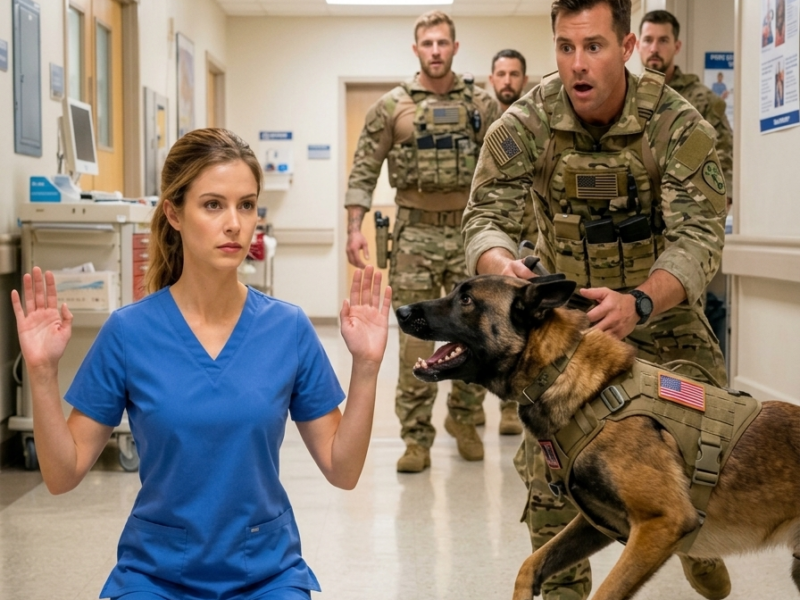
The Navy SEAL’s K9 suddenly broke formation outside the San Diego VA hospital, sprinted toward a quiet nurse, and collapsed at her feet while his handler shouted, “Stay away from him,”
The morning air outside the San Diego VA Hospital carried the sharp, salty tang of the Pacific Ocean, mixed with the faint exhaust fumes of morning traffic along the avenue. I stood near the concrete edge of the courtyard, holding a lukewarm paper cup of black coffee, my mind completely numb from a grueling twelve-hour night shift in the intensive care unit. The sun had barely crested the horizon, casting long, bruised-purple shadows across the manicured lawns and concrete walkways. For three years, this quiet, predictable routine had been my sanctuary. I was Maya Vance—or at least, that was the name forged on my California nursing license, my social security card, and my apartment lease. To the rest of the world, to the Department of Defense, and to the small cemetery plot back in Ohio, Captain Maya Lin of the Army’s 12th Special Operations Medical Detachment had been dead for thirty-six months.
I took a slow sip of coffee, watching a group of active-duty sailors and veterans walk toward the main entrance. Then, a low, rhythmic jingle of metal tags caught my attention.
Coming up the eastern walkway was a Navy SEAL in working dress uniform. He walked with the rigid, mechanical precision of a operator who had spent years carrying heavy loads through terrible terrain. But it wasn’t the man who made my lungs instantly lock up. It was the animal at his side.
A massive, sable-coated German Shepherd moved in a tight, disciplined heel beside the operator. The dog wore a heavy tactical harness fitted with handles, side pouches, and an embroidered patch that read K9 WORKING DOG. He was muscular, scarred across the bridge of his snout, and held his head with an alert, intelligent stillness.
My hands began to tremble so violently that coffee spilled over the plastic lid, scalding my thumb. I couldn’t breathe. I knew those dark, expressive eyes. I knew the specific, jagged white scar running through the fur above his left shoulder blade.
His name was Atlas.
Before the handler could issue a command, Atlas stopped dead in his tracks. His ears swung forward, twitching wildly. His head turned toward the shadow of the portico where I stood. For a fraction of a second, the dog stood frozen, his nostrils flaring as he caught my scent on the light ocean breeze.
Then, the world shattered.
Atlas broke formation. He didn’t just walk; he exploded forward in a full-blown, desperate sprint, his heavy paws slapping against the concrete floor.
“Atlas! Heel! Fuss!” the SEAL shouted, his voice cracking like a rifle shot across the quiet courtyard. He lunged forward to grab the tactical leash, but the sudden momentum yanked the line clean out of his grip. “Atlas! Stop! Stay away from her!”
The dog didn’t listen. He ignored every high-level operational command that had been beaten into his muscle memory over years of combat training. He drove straight toward me, his dark eyes locked on mine.
I couldn’t move. I couldn’t run. The coffee cup slipped from my fingers, hitting the pavement and bursting open, dark liquid splashing over my white medical clogs.
Atlas reached me in two seconds. He didn’t attack. He didn’t bark. The moment he reached my feet, his legs gave out, and he collapsed onto the hard concrete, pressing his heavy, warm forehead directly against my shins. A low, whimpering whine bubbled up from deep inside his chest—a sound so raw, so full of agonizing relief, that it tore right through my soul.
I dropped to my knees right there in the spilled coffee. My hands reached out instinctively, my fingers sinking into the thick, coarse fur behind his ears.
“Atlas…” I whispered, the name slipping out before my brain could stop my mouth.
His tail gave a single, hard thump against the ground. He leaned his entire weight against my body, shoving his snout into the crook of my neck, panting heavily as if he had just run across a thousand miles of desert to find me.
“Hey, buddy… hey, sweet boy,” I murmured, my vision blurring with sudden, uncontrollable tears. I traced the faint line of the scar on his shoulder. I remembered the night he got that scar. I remembered the smell of burning jet fuel, the sound of mortar shells raining down on an unmarked compound near the Kunar Province, and the feeling of my own blood soaking through my fatigue trousers as I hauled this very dog into the back of a hovering Black Hawk helicopter while he was bleeding out from a shrapnel wound.
“I’m sorry! I’m so sorry, ma’am!” The SEAL came skidding to a halt beside us, his boots grinding into the concrete. He reached down cautiously, grabbing Atlas’s tactical harness with a look of utter bewilderment and alarm. “He doesn’t do this. Ever. He’s a military working dog—he doesn’t break heel for strangers.”
I quickly lowered my head, letting my long brown hair fall forward to shadow my face. I wiped my cheeks with the back of my sleeve, trying desperately to pull the nurse’s mask back over my crumbling composure.
“It’s… it’s fine,” I said, my voice raspy and thin.
The SEAL tried to pull Atlas back, but the seventy-pound dog braced his paws and refused to budge, keeping his head firmly glued against my knee. The operator frowned, his sharp blue eyes shifting from his dog to my trembling hands. He was tall, late thirties, with a jawline carved from granite and the faint, permanent lines around his eyes that come from staring into bright sunlight through combat optics. His chest bore the Navy SEAL Trident and a name tape that read VANCE. My heart skipped a beat—a pure, bizarre coincidence in names, or something far worse.
“I’m Lieutenant Commander Eric Vance,” he said, watching me closely. “Atlas is usually fiercely protective. He doesn’t let anyone touch him except his handler. But he’s acting like…” Vance trailed off, his brows furrowing as he took in my reaction. “He’s acting like he knows you.”
“I… I just have a way with animals,” I lied, my heart hammering against my ribs like a trapped bird. I gently pushed Atlas away, forcing myself to stand up. “I should go. My shift is over.”
“Wait,” Vance said, taking a half-step forward. Atlas whined again, trying to follow me, but Vance managed to shorten the leash. Vance’s eyes narrowed as he studied the profile of my face, taking in the small, faint surgical scar running along my left jawline. “Have we met?”
I looked down at the concrete, refusing to make eye contact. “No.”
That was the first lie.
I turned and walked away as fast as my legs could carry me, ignoring the desperate, agonizing whines of the dog behind me. I pushed through the heavy glass doors of the hospital, my pulse roaring in my ears.
Three years ago, a brass plaque had been delivered to my mother’s house in Ohio. A folded American flag sat in a glass case above her fireplace. Official military records maintained by the Department of Veterans Affairs documented that Captain Maya Lin had perished during an unsanctioned extraction mission deep in the mountains of eastern Afghanistan. My name was carved into a black granite memorial wall at Fort Liberty.
They weren’t entirely lying. Maya Lin did die that night.
The woman who survived was pulled from the burning wreckage of a non-marked transport truck by a clandestine intelligence unit. I had spent two months in a medically induced coma in an underground facility in Germany. When I woke up, my face had been reconstructed, my military dog tags were gone, and a man in a black suit gave me a choice: assume a completely synthetic identity and live in the shadows forever, or be buried in a real grave. The people who ambushed my team were high-ranking figures within our own intelligence apparatus, and if they knew I had survived, they would finish the job.
So, I became Maya Vance. A quiet trauma nurse. A ghost living in San Diego.
I spent the rest of the day in my tiny, third-floor apartment three blocks from the ocean, pacing the floorboards until the soles of my feet burned. The walls felt like they were closing in. Atlas being here wasn’t just a coincidence; it was a terrifying crack in the dam I had built around my life.
At 7:00 PM, I returned to the hospital for my next night shift. I tried to drown myself in patient charts, IV drips, and heart monitor readouts. But around midnight, the quiet hum of the ICU ward was broken by the rhythmic sound of heavy footsteps coming down the main hallway.
I looked up from the central nurse’s station.
Lieutenant Commander Vance was walking toward me. He was out of uniform now, wearing a dark civilian jacket and jeans. But he wasn’t alone. Atlas was at his heel, his dark eyes instantly fixing on me the moment he rounded the corner.
“Lieutenant,” I said, standing up behind the counter, my muscles tensing for flight. “Visiting hours ended at nine. And animals aren’t allowed in the ICU unless they are official service dogs on duty.”
Vance stopped at the counter. He didn’t look angry; his expression was heavy, clouded with a mixture of intense shock and deep suspicion.
“He’s on duty,” Vance said quietly.
Without a word, Vance reached inside his leather jacket and pulled out a manila envelope. He slid it across the marble countertop toward me.
“What is this?” I asked, my voice barely a breath.
“Open it,” he replied.
My fingers hesitated, trembling as I opened the metal clasp and pulled out a high-resolution, black-and-white photograph.
The image was five years old. It showed a younger, smiling woman in desert camouflage kneeling in the dirt outside an airfield in Bagram. Her arm was wrapped affectionately around a young, energetic German Shepherd puppy who was wearing a red training vest.
It was me. And Atlas.
“You trained him,” Vance said softly, his voice cutting through the quiet hum of the medical equipment around us. “Before he was assigned to SEAL Team 7. He was a multi-purpose canine assigned to an experimental medical-tactical unit.”
I swallowed hard, staring at my own young face in the photo. “I don’t know where you got this picture, sir, but—”
“Stop lying,” Vance interrupted gently. “You weren’t just a nurse, were you?”
He reached into the envelope again and pulled out a second photograph, slapping it down on top of the first.
This photo was taken from a surveillance camera. It showed a woman in a pitch-black tactical uniform, a suppressed carbine slung across her chest, standing over a wounded soldier in a burning hallway. Blood was soaking through a heavy bandage wrapped around her left forearm, but her eyes were cold, sharp, and intensely focused.
“That was taken inside a classified CIA black site near Jalalabad six months before you officially ‘died,'” Vance said, stepping closer to the desk. His eyes held a terrifying level of intensity. “You were part of Task Force Vane. A forward surgical and special reconnaissance unit that officially never existed.”
My hands were shaking so hard I had to press my palms flat against the desk to keep from falling. The air in the hallway suddenly felt thin, suffocating.
“Where did you get these?” I whispered, my voice breaking.
“My former commanding officer,” Vance said. “He was reviewing old personnel files for a joint task force security audit this morning. When I told him about a nurse at the San Diego VA who made my combat dog collapse in tears, he sent me these within three hours.”
“Why?” I choked out, tears stinging the corners of my eyes. “Why would he send you these?”
Vance leaned in closer, lowering his voice to a dangerous whisper. “Because he checked the military mortality database. Captain Maya Lin was declared dead three years ago. But when he pulled the digital signature on your autopsy report, he realized it was forged by a high-level authority inside the Defense Intelligence Agency.”
Vance took a deep breath, his blue eyes locking onto mine with lethal seriousness. “He didn’t send me these photos to arrest you, Maya. He sent them because if someone inside the DIA finds out you’re alive… they are going to come here to finish what they started.”
Before I could answer, before my brain could even process the horror of his words, Atlas suddenly let out a low, guttural growl.
The dog stood up, his fur rising along his spine. He didn’t look at Vance, and he didn’t look at me. He turned his head toward the far end of the long hospital hallway, staring directly at the sliding glass doors of the emergency entrance.
Atlas began to bark. It wasn’t the affectionate whimpering he had made that morning. It was his combat warning bark—sharp, violent, and echoing off the sterile walls like thunder.
“Atlas, quiet!” Vance commanded, his hand instantly dropping toward the concealed sidearm under his jacket.
I turned my head toward the glass doors.
Standing in the shadows just outside the automatic doors was a tall man wearing a heavy dark jacket and a black baseball cap pulled low over his eyes. He stood completely still, unfazed by the dog’s violent barking.
Slowly, the man reached into his jacket pocket. He didn’t pull out a weapon.
Instead, he pressed a small, plastic card against the clear glass window.
My blood turned to ice in my veins. My breath hitched in my throat, and the world around me seemed to tilt on its axis.
It was a military identification card—dusted with faint traces of dried dirt, scratched, and worn at the edges. The name printed on the card was Captain Maya Lin. It was the exact ID card that had been stripped from my neck three years ago before they left me in the burning rubble of the mountain compound.
The man outside smiled—a cold, lifeless curl of his lips—and slowly raised one finger to his mouth, making a subtle shh gesture.
“Who the hell is that?” Vance growled, unholstering his weapon beneath his coat and moving to place himself between me and the glass doors.
I couldn’t speak. I couldn’t move. My lungs refused to expand.
Because I knew exactly who he was. His face was burned into my nightmares. He was Colonel Marcus Reed—the rogue intelligence officer who had ordered the execution of my entire team in Afghanistan, the man who had shot me in the chest and left me for dead.
And he hadn’t come to San Diego to talk. He had come to ensure the ghost was finally buried.
“Get down!” Vance roared, his hand wrapping firmly around the back of my medical scrubs and hauling me below the edge of the marble reception desk just as a sharp, muffled crack-crack echoed through the night air.
The high-impact rounds shattered the thick glass doors of the emergency entrance, sending a rain of razor-sharp tempered shards cascading over the linoleum floor. The sound was deafening in the enclosed, sterile hallway. Heart rate monitors began to beep frantically in nearby rooms, and panic erupted from the nurse’s station further down the corridor.
Atlas didn’t flinch. The moment the glass exploded, the German Shepherd shifted into pure war-dog mode. He dropped low to the ground, his teeth bared in a silent, murderous snarl, positioning his body directly over mine as I crouched on the floor.
“Maya, stay behind me!” Vance barked, drawing his SIG Sauer P226 from beneath his jacket and pressing his back against the side of the reception counter. He glanced over his shoulder at me, his eyes sharp with adrenaline. “Does he have a team with him?”
“He… he never works alone,” I gasped, my chest heaving as my former tactical training fought its way through three years of buried trauma. “Reed always operates with a four-man security element. Silenced weapons, localized radio jammers, clean entry and exit.”
“Great,” Vance muttered. “And I brought a dog to a gunfight.”
Right on cue, the fluorescent overhead lights in the hallway flickered twice and died, plunging the entire floor into darkness. A second later, the backup emergency generators kicked in with a low, thrumming hum, casting a sickly, deep red glow across the blood-like glass scattered across the corridor.
“They cut the main power grid,” I said, my voice hardening. The fear that had paralyzed me moments ago was rapidly giving way to the cold, icy clarity that used to save my life in Afghanistan. “They’re going to clear the building floor by floor. They won’t leave witnesses.”
“Not on my watch,” Vance said smoothly. He racked the slide of his pistol. “Can you run?”
“I ran across twelve miles of Hindu Kush with a shattered fibula, Commander,” I replied, looking him dead in the eye. “I can run.”
“Good. Atlas, Fuss!”
The dog moved in tight against Vance’s left leg. Vance peeked around the corner of the reception desk. The main entrance was clear, but the far double doors leading toward the rear parking garage swung open softly. Two tall silhouettes stepped through the red emergency light, moving in a tactical wedge formation. They were wearing dark civilian clothes, but their movement—light on their feet, weapons held at low-ready with suppressed muzzles—was unmistakably elite military.
“They’re moving toward the stairwell to flank us,” Vance whispered. “We need to get to the lower level. Is there a secure exit through the basement?”
“The pharmacy supply tunnel,” I answered instantly. “It connects the main hospital building to the old VA storage facility across the street. It requires a biometric keycard, but I have supervisor access.”
“Lead the way,” Vance said.
We moved fast and low. I led Vance and Atlas down a secondary service corridor, away from the main ER bays where terrified staff members were hiding beneath desks. Atlas moved like a shadow beside us, his paws making zero sound against the rubber flooring. His ears were constantly swiveling, picking up every metallic clink and whispered comms check from Reed’s men behind us.
We reached the heavy steel doors of the service elevator. I slammed my palm against the emergency bypass panel, opening the manual stairwell access door beside it. We ducked inside just as a burst of suppressed automatic gunfire tore through the drywall behind us, sending plaster dust raining down into our hair.
“Down! Down!” Vance ordered, taking the stairs three at a time.
We hurtled down two flights of concrete stairs, entering the cold, echoing basement level of the hospital. The air down here smelled of industrial floor cleaner, diesel fuel, and damp concrete. The red emergency lights were dimmer here, casting long, twisting shadows along the maze of exposed pipes running across the ceiling.
“They’re right behind us,” Vance said, pausing at the landing to listen. The rhythmic, heavy stomping of tactical boots echoed down the concrete stairwell above us. “They’re moving fast. Maya, how far is the tunnel?”
“Fifty yards down this hall, through the double doors marked Biohazard,” I said, pointing down the narrow corridor.
“Take Atlas and go,” Vance commanded, turning his back to the hall and aiming his pistol up the stairwell. “I’ll hold the landing and slow them down.”
“No,” I said, grabbing his forearm. “You don’t know how Reed operates, Commander. He doesn’t chase you into a funnel unless he’s already set a trap at the other end. If he drove us to the basement, it’s because he wants us down here.”
Vance paused, looking at me with newfound respect. “A drive-and-ambush kill box.”
“Exactly,” I said.
Before Vance could re-evaluate, Atlas let out a sharp, low growl and lunged toward a set of metal double doors twenty feet ahead of us. The heavy doors burst open, and a mercenary stepped into the corridor, raising a short-barreled carbine directly at my chest.
“Atlas, FASS!” Vance screamed.
The German Shepherd didn’t hesitate. He hit the air like a launching missile. Seventy pounds of muscle, teeth, and raw fury collided with the gunman’s chest before the man could squeeze the trigger. The mercenary hit the concrete floor with a sickening crunch, his weapon clattering across the floor. Atlas clamped his jaws around the man’s tactical vest, thrashing his head with terrifying force.
Vance stepped forward and delivered a swift, brutal kick to the gunman’s temple, instantly knocking him unconscious. Vance quickly snatched up the dropped carbine, checking the magazine with practiced ease. “Standard submachine gun, high-grain ammo. Unmarked. These guys are contractors.”
“They’re Reed’s private military company,” I said, leaning over the unconscious man and pulling a radio headset from his ear. I put the earpiece in my ear just in time to hear a familiar, raspy voice come through the static.
“Alpha Team, report. Have you contained the target?”
It was Marcus Reed. Hearing his voice again after three years sent a cold spike of adrenaline straight into my gut.
“He’s expecting us to head for the main exit,” I whispered to Vance. “We need to change the game.”
“What’s the plan, Captain?” Vance asked, using my real military rank for the first time. The title felt strange, heavy, and empowering all at once.
“The laundry chute facility,” I said, a dark smile touching my lips. “It leads to the underground incinerator room. It’s a dead end, but it has access to the main ventilation shafts that run directly out to the ambulance bay.”
“A funnel we control,” Vance agreed. “Let’s move.”
We dragged the unconscious mercenary into a storage closet and hurried down the hall, Atlas trotting closely beside me. The dog kept pressing his side against my leg every few paces, as if constantly reassuring himself that I was real, that his former handler hadn’t vanished into thin air again. I reached down, running my hand over his back, feeling the steady, powerful rhythm of his heart.
“You saved him, you know,” Vance said softly as we moved down the dark hallway.
“What?” I asked, glancing at him.
“Atlas,” Vance said, keeping his weapon raised as he checked a corner. “When I took command of him eighteen months ago, his service record said he was found in a military compound in Pakistan, severely malnourished, guarding a bloodstained stretch of floor. He wouldn’t let anyone touch him for six months. They were going to put him down because they thought he was untrainable. Broken.”
Vance looked at me, his eyes softening in the dim red light. “The only reason he survived was because a lead vet noticed he had a hand-written serial number tucked inside his tactical harness. It matched a field medic’s custom gear. Your gear, Maya. He wasn’t untrainable. He was just waiting for you.”
Tears pricked my eyes again, but I forced them back. “I never meant to leave him,” I whispered. “They carried me out on a stretcher. I was unconscious. If I could have gone back for him—”
“He knows,” Vance said simply. “Look at him. He knows.”
We reached the heavy reinforced doors of the laundry and waste management facility. I punched a security code into the electronic keypad beside the frame. The lock clicked, and the heavy door swung open with a hiss of pneumatic pressure.
We stepped into a massive, cavernous room filled with industrial washing machines, towering stacks of metal linen carts, and massive air duct pipes running along the high ceiling. The air was warm and smelled of bleach and dry heat.
“In here,” I said, leading them toward a metal catwalk that wrapped around the central furnace unit.
Suddenly, the steel doors behind us slammed shut with a deafening bang. The electronic lock emitted a sharp, high-pitched beep, signaling that it had been locked from the outside.
Over the overhead PA system, static hissed, followed by the cold, dry laugh of Colonel Marcus Reed.
“Impressive, Maya,” Reed’s voice echoed through the vast, empty room, distorted by the metal walls. “I must admit, when my contacts in the DIA told me that a nurse in San Diego matched your dental records, I didn’t believe it. I personally saw three bullets hit your torso in that compound. You always were remarkably difficult to kill.”
Vance immediately pulled me behind a thick steel pillar, raising his carbine toward the upper observation windows overlooking the laundry room.
“Reed!” I shouted, my voice echoing off the concrete walls. “It’s over! The hospital security team has already alerted the San Diego PD and federal authorities! You can’t walk out of here!”
“Oh, my dear Maya,” Reed chuckled over the speakers. “Look around you. This isn’t a government operation anymore. You and your Navy SEAL friend are standing inside a sealed facility. In three minutes, the natural gas lines feeding the hospital incinerators will experience an unfortunate ‘accidental leak.’ A tragic industrial explosion. The police won’t find gunshots. They will only find ashes.”
Atlas let out a fierce, chest-deep bark, stepping out from behind the pillar and staring up at the glass observation booth above us.
Through the reinforced glass of the second-floor control room, a shadow stepped forward. Marcus Reed was standing there, holding a remote detonator in his left hand.
“Three years ago, you uncovered my offshore accounts, Maya,” Reed said, his voice dropping into a sinister, icy register. “You thought you were playing the hero by trying to deliver that flash drive to Joint Special Operations Command. You cost me fifty million dollars and forced me into early retirement. I’ve spent three years searching for the ghost who ruined my life.”
Reed looked down at us through the glass, his eyes dark with murderous intent.
“And now,” Reed whispered, “the ghost finally burns.”
He raised his thumb and slammed it down on the red button of the detonator.
A deafening, metallic screech echoed through the subterranean chamber as the heavy industrial gas valves mounted along the back wall burst open simultaneously. High-pressure natural gas began hissing violently into the enclosed laundry facility, filling the air with the sharp, sickening stench of mercaptan.
“Masks! Put something over your face!” Vance shouted, grabbing a stack of clean surgical towels from a nearby cart and throwing one to me.
“The spark will come from the main furnace ignition in thirty seconds!” I yelled over the deafening hiss of the gas pipes. I soaked the towel with water from a sink basin and tied it tightly around my nose and mouth. “If that gas hits the open pilot flame, this entire basement will vaporize!”
“Where’s the manual shutoff?” Vance demanded, his eyes scanning the looming walls of machinery and pipes.
“On the upper catwalk! Right next to the observation booth where Reed is standing!” I pointed up toward the steel staircase winding around the central incinerator structure.
“I’ll buy us time,” Vance said, his face hardening into absolute determination. He turned to the German Shepherd. “Atlas! Hier!”
The dog leaped to his side, his muscles coiled like steel springs.
“We take the catwalk together,” Vance said to me. “On three. One… two… THREE!”
Vance stepped out from behind the steel pillar, raising his captured carbine, and fired a rapid three-round burst at the glass window of the control booth. The reinforced glass spider-webbed under the impact, forcing Reed to dive to the floor inside.
“Go! Go! Go!” Vance barked.
We sprinted across the concrete floor toward the metal staircase. Above us, the remaining two mercenaries from Reed’s security detail appeared on the upper catwalk, leaning over the railings with handguns drawn.
Pop-pop-pop!
Bullets slammed into the metal floor around our feet, sending brilliant showers of sparks flying through the haze of gathering gas.
“Atlas, up!” I screamed, pointing toward the stairs.
The Shepherd didn’t need to be told twice. He bounded up the open-grate metal stairs with terrifying speed, a blurred shadow of fur and teeth. The mercenary at the top of the landing swung his weapon toward the dog, but Atlas leaped from four steps down, hitting the man full in the chest.
The weight of the dog sent the contractor crashing over the railing. The man fell twenty feet, hitting the top of an industrial washing machine with a sickening crash before collapsing motionless on the concrete below.
“Clear!” Vance shouted, charging up the stairs right behind Atlas.
I was right on his heels. As we reached the upper catwalk, the air was getting thicker, making my eyes burn and my lungs ache despite the wet towel. A high-pitched, electronic warning siren began to blare throughout the facility: WARNING. GAS LEAK DETECTED. IGNITION CYCLE IMMINENT.
“The shutoff valve is over there!” I yelled, pointing to a bright red wheel mounted on a thick yellow pipe near the control room door.
Suddenly, the metal door of the control booth slammed open.
The second mercenary stepped out, holding a heavy tactical combat knife. He lunged at Vance before the SEAL could raise his rifle. The two men collided with brutal force, slamming against the steel safety railing. Vance blocked a lethal downward strike, grabbing the mercenary’s wrist, but the weapon knocked his carbine from his hands, sending it plunging down into the darkness below.
“Maya! The valve!” Vance grunted, struggling against the mercenary’s sheer physical weight as they grappled against the railing.
I surged past them, sprinting toward the red wheel.
Out of the corner of my eye, I saw a dark figure step out from the shadows of the control room doorway.
It was Reed.
He held a suppressed 9mm pistol pointed directly at my head. His face was twisted into a malicious, triumphant sneer.
“Goodbye, Captain Lin,” Reed said, his finger tightening around the trigger.
BANG!
A flash of gray and brown fur exploded from the side of the catwalk. Atlas threw himself between Reed’s gun and my body.
The bullet struck Atlas in the side. The dog let out a sharp, painful yelp, but his momentum didn’t stop. The force of his leap slammed into Reed’s arm, knocking the pistol wild. The gun went off a second time, the bullet punching through the yellow gas pipe beside us.
A massive plume of pressurized gas erupted from the bullet hole, spraying directly into Reed’s face with freezing force. Reed shrieked in pain, dropping his weapon and clawing blindly at his eyes as the liquid gas burned his skin.
“ATLAS!” I screamed in pure agony, dropping to my knees beside the falling dog.
Blood was pooling thick and crimson on the metal mesh catwalk beneath Atlas’s ribs. He collapsed onto his side, his breathing rapid and shallow, his dark eyes looking up at me with deep, unquestioning loyalty.
“No, no, no! Not again! I won’t lose you again!” I cried, my fingers plunging into his fur, pressing my hand down as hard as I could over the entrance wound on his ribs. My medical instincts took over in an instant, cutting through the horror. “Vance! I need a chest seal! He’s got a sucking chest wound!”
Beside us, Vance delivered a brutal knee to the last mercenary’s stomach, followed by a devastating short-hook punch that sent the man crashing unconscious onto the metal walkway.
Vance dropped down next to us, his face pale as he saw the blood soaking through Atlas’s fur. “Hold him! Hold him steady!” Vance reached into his tactical belt, pulling out a sealed emergency trauma kit. He ripped open a sterile plastic chest seal with his teeth and slapped it directly over the wound on Atlas’s ribs.
Above us, the automated computerized voice screamed over the blaring alarm: CRITICAL WARNING. IGNITION IN TEN SECONDS. NINE. EIGHT…
“The valve!” I screamed at Vance, pointing at the red wheel three feet away.
Vance lunged forward, grabbed the heavy iron wheel, and threw his entire body weight into it. The rusted valve groaned, resisting at first, then turned with a sharp metallic screech. He spun it three times until it locked flush against the pipe.
The violent hissing of the main gas lines instantly died down to a faint whisper.
… IGNITION CANCELLED. SYSTEM SHUTDOWN INITIATED.
The high-pitched siren dropped in tone, changing to a slow, amber emergency pulse.
Silence descended over the cavernous laundry room, broken only by the heavy, ragged breathing of three survivors and the faint, agonizing whines of a wounded combat dog.
I collapsed forward, resting my forehead against Atlas’s snout. “You’re okay, boy… you’re okay. I’ve got you. I’ve got you, Atlas.”
The dog gave a weak, faint lick to my bloodstained cheek, his tail trembling slightly against the metal floor.
Behind us, a raspy, painful cough broke the silence.
Colonel Marcus Reed was crawling across the catwalk toward his fallen pistol, his face red and blistered from the chemical frostbite, his eyes wild with unhinged rage.
“It… it doesn’t matter…” Reed wheezed, his bloody fingers reaching for the grip of the handgun. “You… you can’t prove anything, Maya. The DIA… they’ll protect me. They’ll bury you… they’ll burn your record… you’re a ghost…”
Vance stepped over Atlas, his combat boots heavy against the metal grating. Before Reed’s fingers could touch the weapon, Vance brought his heavy boot down, crushing Reed’s wrist against the steel floor with a sickening crack.
Reed screamed in pain, collapsing onto his back.
Vance reached down, snatched the suppressed pistol from the floor, and aimed it directly between Reed’s eyes.
“She might be a ghost,” Vance said, his voice dropping into an icy, lethal growl that sent shivers down my spine. “But I’m active-duty Navy SEAL. And you just tried to murder my squad mate.”
Vance reached into his jacket pocket with his left hand and pulled out a small, black digital recording device. A tiny red light was blinking steadily on the side.
“By the way, Colonel,” Vance added with a cold, terrifying smile. “My former commander has been listening to every single word you’ve said through my tactical comms relay for the last twenty minutes. Federal marshals and the Navy Criminal Investigative Service are in the parking lot right now.”
Reed’s face drained of what little color it had left. He stared up at the barrel of the gun, realizing in an instant that his empire of lies, cover-ups, and corruption had just completely crumbled.
The dawn sky above San Diego was painted in brilliant shades of rose and gold when the heavy metal doors of the hospital basement were finally thrown open.
The alleyway behind the VA hospital was filled with a swirling sea of red and blue emergency lights. Dozens of federal vehicles, military police cruisers, and Navy NCIS sedans formed an impenetrable perimeter around the building. Tactical officers in heavy body armor were escorting Reed and his surviving mercenaries away in handcuffs, their faces grim and silent.
A team of military veterinarians and trauma doctors met us at the emergency ramp. They had a specialized medical gurney waiting.
“Careful with him! He’s got a left-side chest tube in place!” I shouted, walking alongside the gurney, holding an IV bag of fluids high above my head as they wheeled Atlas out into the cool morning air.
My nursing scrubs were ruined—soaked in blood, covered in dust and grease from the laundry room floor. But I didn’t care. My eyes were locked on the German Shepherd.
Atlas was heavily sedated now, a plastic oxygen mask strapped gently over his snout, but his vitals were stable. The chest seal Vance and I had applied on the catwalk had saved his life, keeping his lung from collapsing until the emergency trauma team could stabilize him.
“He’s going to make it, Captain,” the lead military vet said, placing a reassuring hand on my shoulder as they loaded the gurney into an armored veterinary ambulance. “He’s tough as nails. The bullet missed his heart by less than an inch. He’ll need surgery to repair the muscle tissue, but he’s going to walk again.”
I let out a long, shuddering breath, the tension that had held my body rigid for the last twelve hours finally melting away. “Thank you,” I whispered.
The rear doors of the ambulance closed, and it pulled away toward the Naval Medical Center with its sirens blaring softly.
I stood on the asphalt of the ambulance bay, feeling the warmth of the rising sun hit my face for the first time in what felt like a lifetime.
Footsteps approached from behind. Lieutenant Commander Vance walked up beside me, holding two paper cups of hot coffee he had pulled from a support truck. He handed one to me without a word.
I took the cup, letting the warmth soak into my stiff, aching fingers. “You recorded the whole thing?” I asked, looking up at him.
“From the moment I walked into your ward tonight,” Vance said, taking a sip of his coffee. “My commander knew Reed was dirty, but we couldn’t prove it without catching him in an unsanctioned action on American soil. We used ourselves as bait.”
I looked at him, my eyebrows raising in disbelief. “You used me as bait?”
“I used us,” Vance corrected gently. “And honestly, I didn’t know Reed was going to show up with a rocket-launcher mentality and try to blow up a hospital. But it worked. The DIA has already initiated a full internal purge. Reed’s network is done. The men who hunted you are being rounded up as we speak.”
I stayed silent for a moment, watching the morning traffic move along the distant highway. “What happens to me now?” I asked softly. “Maya Lin is officially dead. My identity… my license… my whole life here was built on a lie.”
Vance pulled a thick blue folder from under his arm and handed it to me.
“That’s from the Department of the Navy and the Office of the Secretary of Defense,” Vance said. “Inside that folder is a full executive pardon, a restoration of your active-duty rank as Major Maya Lin, and a full military discharge with honors if you want it.”
I opened the folder with trembling hands. Typed in dark black ink across the top of the official parchment were the words: RESTITUTION AND REINSTATEMENT OF RECORD.
“Your sacrifice wasn’t forgotten, Maya,” Vance said, his voice filled with deep, sincere respect. “The government covered up what happened to you three years ago because Reed threatened to destroy the entire chain of command. But the cover-up is over. The truth is being entered into the official military archives today.”
Tears trickled down my cheeks, washing thin tracks through the soot and blood on my face. For three years, I had lived in terror, looking over my shoulder at every shadow, believing that my service, my name, and my sacrifices had been erased from the world forever.
“And if I don’t want to go back to the military?” I asked, looking at him through my tears.
Vance smiled—a warm, genuine smile that reached his eyes.
“Then Major Maya Lin can officially retire,” Vance said. “The VA hospital board met an hour ago. They’ve offered you a permanent position as the Director of Tactical Trauma Nursing at the San Diego Facility. A real identity. A real life. No more shadows.”
I looked down at the documents, feeling an overwhelming weight lift off my chest. The ghost was finally coming back to life.
“There’s just one condition,” Vance added, his smile turning into a slight, teasing grin.
“What’s that?” I asked, wiping my eyes.
“Atlas is being officially retired from active service due to his combat injuries,” Vance said, looking toward the road where the veterinary ambulance had vanished. “He needs a permanent handler. Someone with tactical medical experience who knows how to deal with a stubborn, hard-headed German Shepherd.”
A quiet, breathless laugh escaped my lips—the first real laugh I had uttered in three years.
“I think I can manage that,” I said.
Two months later, the Pacific sun was dipping low over the horizon, painting the sky above Ocean Beach in brilliant shades of amber, violet, and deep crimson. The ocean waves crashed gently against the shore, sending a cool, mist-filled breeze dancing across the wooden deck of my small beach cottage.
I sat on the deck steps, wearing a comfortable oversized sweater and jeans, holding a warm mug of chamomile tea. The air was peaceful, filled only with the rhythmic sound of the sea and the distant calls of seagulls heading home for the night.
A low, soft rustle of movement came from the doorway behind me.
Atlas walked slowly out onto the deck. He was wearing a soft leather collar instead of his heavy tactical harness. A long, clean surgical scar ran along his left side beneath a fresh coat of thick sable fur, but he walked without a limp. His head was high, his eyes bright, clear, and brimming with life.
He trotted over to where I sat, nudging his large, cold nose directly under my palm.
“Hey, buddy,” I smiled, wrapping my arm around his neck and pulling him close. I buried my face in his thick fur, breathing in the clean scent of ocean air and dog shampoo. “How are you feeling today?”
Atlas gave a soft, satisfied grunt, leaning his heavy weight against my side, exactly as he had done in the hospital courtyard two months ago. But there was no fear now. No tension. No shadows hunting us in the dark.
A truck pulled into the gravel driveway behind the cottage. The driver’s side door clicked open, and Eric Vance stepped out. He was dressed in civilian clothes—a simple flannel shirt and jeans—carrying a wooden crate filled with fresh groceries and a massive new dog bone wrapped in red ribbon.
Atlas’s ears instantly perked up. He gave a single, happy bark, but stayed right by my side, looking up at me for permission before moving.
“Go on,” I laughed, patting his side. “Go see your uncle.”
Atlas bounded off the deck, his tail wagging furiously as he greeted Vance in the driveway. Vance laughed, setting the crate down on the hood of his truck so he could rough up the Shepherd’s ears.
“Look at you, big guy,” Vance said, tossing the wrapped dog bone into the air. Atlas caught it effortlessly in mid-air, trotting off toward the grass to inspect his prize.
Vance picked up the crate of groceries and walked up the deck steps, dropping into the wooden chair beside me. He looked out over the glowing ocean, letting out a long, content sigh.
“How’s the new job treating you, Director Lin?” Vance asked, turning his head to smile at me.
“It’s Maya,” I corrected with a smile. “And it’s incredible. We finished setting up the new emergency simulation center this morning. The first class of Navy corpsmen starts their trauma rotation next Monday.”
“They’re lucky to have you,” Vance said softly. “There isn’t a medic in the entire Pacific Fleet who has lived through what you have.”
“We’re both lucky,” I said, looking out at the sunset. “Reed’s trial started yesterday in Washington, didn’t it?”
Vance nodded, his expression turning serious for a brief moment. “He pled guilty to all charges. Treason, attempted murder, embezzlement of government funds. He’s going to spend the rest of his life inside a maximum-security federal penitentiary in Colorado. He’ll never see the light of day again.”
Vance reached into his pocket and pulled out a small velvet box. He handed it to me.
“What’s this?” I asked, looking at the box in confusion.
“It came in the mail from Fort Liberty this morning,” Vance said. “It belonged to Captain Maya Lin. I thought it was time it came back to its rightful owner.”
I gently opened the velvet box. Inside, resting on a bed of dark black silk, was my original Silver Star medal—the combat decoration I had been awarded for my actions during that fateful mission three years ago. The brass star gleamed brightly under the fading sunlight.
I stared at the medal for a long time, feeling a quiet, profound sense of closure wash over my soul. For three years, that medal had represented a lie, a tragedy, and a life that had been ripped away from me. But now, holding it in the warm light of the California sun, it represented something entirely different.
It represented resilience. Survival. The unbreakable bond between soldiers, and the legendary loyalty of a dog who refused to let his handler be forgotten by the world.
I closed the box and set it on the table beside my tea.
Atlas walked back up the steps, holding his giant bone in his jaws. He trotted over to my chair, dropped the bone at my feet, and laid his heavy head across my lap, resting his dark eyes on mine.
I stroked his soft ears, feeling the steady, calming rhythm of his breathing.
“We made it home, boy,” I whispered softly.
Atlas closed his eyes, letting out a long, contented sigh as the sun finally dipped below the horizon, painting the world in a warm, golden light that banished the shadows forever.
The end









