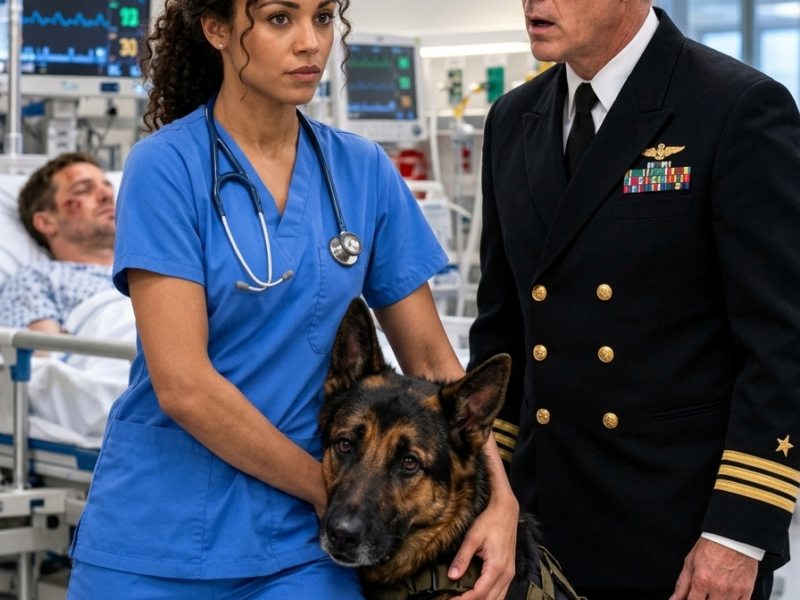
The Navy SEAL’s K9 suddenly abandoned him in the middle of a crowded VA hospital and dropped at my feet while he called me “just a nurse,”
The air in the atrium of the San Antonio Veterans Affairs Hospital was always heavy with a cocktail of floor polish, stale coffee, and the quiet, crushing weight of forgotten history. It was 0600, the changing of the shift, and the fluorescent lights hummed overhead like a swarm of brass mechanical insects. I stood by the central triage desk, clutching a lukewarm paper cup, my uniform a dull medical blue. To the doctors, the administrative staff, and the broken men walking through those double glass doors, I was Nurse Clara Vance—quiet, efficient, and thoroughly invisible.
To the United States Department of Defense, however, Sergeant Clara Mercer of the 24th Special Tactics Squadron had ceased to exist forty-eight months ago.
I took a slow, deliberate breath, resting my fingers against the rim of my cup. Beneath the fabric of my left sleeve, my wrist throbbed with a phantom heat—a jagged, pale white scar running three inches up the radius, where a piece of hot shrapnel from an improvised explosive device had torn through tendon and bone in the high, cold dust of the Helmand Province.
Then, the heavy glass doors at the main entrance slid open, and the atmosphere in the atrium shifted.
A tall, broad-shouldered man in tactical fatigue pants and a dark civilian jacket stepped inside. But it wasn’t the operator who drew every eye in the room; it was the animal at his heel.
He was a Belgian Malinois—lean, muscular, with coat the color of burnt caramel and a face like a dark iron mask. Above his right eye ran a thick, raised scar, a jagged streak of white fur that interrupted the deep black skin around his brow. He moved with a terrifying, coiled grace, his amber eyes scanning the lobby with calculating, lethal efficiency. On his side was a high-threat tactical harness, fitted with cobra buckles and a patch that read: K9 WORKING DOG – DO NOT APPROACH.
The dog’s name was Ranger.
I knew that name before I ever saw the embroidered patch. My throat went dry, my chest tightening so violently that my thumb caved in the side of my paper cup, spilling cold coffee over my knuckles.
I had seen him from a distance twice over the past three months, brought in for routine veterinary clearances or to accompany his handler for administrative debriefs. Every time, he had walked with his head held high, his gaze locked strictly forward, ignoring the sea of crutches, wheelchairs, and staring eyes. He had never looked at me twice.
Until that morning.
A dozen yards away, an environmental services worker accidentally dropped a heavy stainless steel tray onto the tiled floor. The metallic CLANG shattered the quiet atrium like a gunshot.
Instantly, Ranger didn’t jump or cower; he pivoted, his hind legs driving against the slick tile as he pulled hard against his leash, breaking his heel.
His handler’s hand snapped tight around the short leash handle. “Easy, boy. Sitz!”
Ranger ignored the command completely. His dark ears flared forward, nostrils working frantically as he caught a faint, subtle scent drifting through the air-conditioned currents of the lobby. His amber eyes locked onto mine.
“Ranger! Fuss!” the SEAL barked, his voice carrying the sharp, non-negotiable tone of a man accustomed to immediate compliance in combat zones.
The dog paid him no mind. He walked straight toward me, his heavy paws clicking rhythmically on the floorboards, cutting through the crowd like a knife through canvas.
The SEAL’s face darkened. He stepped forward to intercept, his frame towering and tense. “Ma’am, step back,” he warned, his voice a low rumble. “He’s an active working dog. Don’t touch him.”
I didn’t move. I couldn’t move. My boots felt as if they were bolted to the linoleum.
Ranger stopped mere inches from my white clinical shoes. The deep, tense ridge of muscles along his spine relaxed. He lowered his broad, dark head, his ears pulling back into a soft, submissive posture that no attack dog was ever trained to show a stranger.
Then, gently, deliberately, he pressed his wet nose directly against the inside of my left wrist—right over the concealed scar.
My breath caught in my throat. My heart slammed against my ribs like a trapped bird.
That scar was a secret buried under layers of scar-gel, foundation, and long sleeves. Nobody at the hospital knew about it. No doctor had ever asked.
The SEAL’s sharp blue eyes tracked the dog’s movement, then snapped up to my face. The sheer impossibility of the scene registered across his featureless, hard-set jaw.
“Who are you?” he asked, his voice low, probing, dangerous.
I swallowed the lump in my throat and forced a small, practiced nurse’s smile—the kind I had offered a thousand dying veterans to keep them calm. “Just a nurse, sir.”
He didn’t believe me. His jaw muscles clenched as Ranger, without being ordered, sat down heavily right beside my left leg, leaning his seventy-pound body against my shin, his tail giving a single, heavy thud against the floor.
Around us, a few passing doctors and elderly patients had stopped to stare. A Malinois trained for close-quarters combat didn’t nestle against civilian healthcare workers.
The SEAL dropped into a deep crouch beside his dog, his hand hovering near Ranger’s harness. He searched the dog’s eyes, then looked back at me. “Ranger hasn’t trusted a stranger since his last deployment in the East,” he said, his voice dropping an octave. “He doesn’t do this. Not with civilians. Not with anyone.”
I lowered my eyes, watching the dog’s ears twitch at the sound of my raspy, uneven breathing.
“Maybe I’m not a stranger,” I whispered.
The words escaped before my brain could filter them. The moment they hung in the air, a cold wave of regret washed over me.
The SEAL stood up slowly, unfolding his frame until he loomed over me again. His eyes narrowed into slits of blue ice. “Have you met him?”
“No,” I lied.
That was the second lie I had told him in sixty seconds.
My mind raced backward, four years across space and time, to a narrow, gravel-filled dried riverbed outside a burning compound in the foothills of the Hindu Kush.
Ranger hadn’t been an imposing, fully armored attack dog then; he had been a three-year-old patrol and explosives detection canine, shivering and bleeding from a massive shrapnel wound in his flank beside an overturned, burning Stryker vehicle. The air had been thick with the stench of cooking ammunition, diesel fuel, and cordite. Bullets were snapping through the air overhead like whip-cracks, kicking up spouts of dirt around my elbows.
I was the combat medic who had crawled through thirty yards of open crossfire to reach him. I had pressed my hands into his open flesh, wrapping his leg with pressure bandages while his original handler lay motionless ten feet away in the dust. I remembered the cold sweat on my skin, the roar of the incoming rescue helicopter, and how I had leaned down, my lips close to his torn ear, whispering through the chaos: “Stay alive, buddy. Find your way home.”
Minutes later, an artillery shell had impacted the ridge above us.
When I woke up three weeks later in an underground medical facility in Landstuhl, Germany, I was told my entire detachment had been wiped out. My dog tags had been retrieved from a mass of charred metal. Official military records reflected that Sergeant Clara Mercer was dead. I was given a forged birth certificate, a new identity, and a quiet order from a man wearing no insignia: Live a quiet life, Clara. The people who ambushed your convoy wear high-ranking uniforms in Washington. If they find out you survived, they won’t miss a second time.
So, I became Clara Vance. I buried the medical kits, the tactical boots, and the woman who used to fire back.
Until Ranger smelled the iron in my blood.
The SEAL took a small step closer, his body language shifting into a tactical interrogation posture. “What was your unit?” he demanded softly.
I remained silent, keeping my lips pressed into a rigid line.
Seeing my silence, the operator reached inside his tactical vest. He pulled out a worn, leather-bound notebook, reached into a plastic sleeve inside it, and extracted a faded, glossy photograph.
He held it out. My hands went completely numb.
The photo was four years old, stained at the corners with dried dirt and thumb-grease. It showed a woman in dust-covered camouflage kneeling in the dirt behind a sandbag wall, her face smeared with sweat and carbon, her arm thrown protective over a younger Belgian Malinois.
It was me.
On the back of the photograph, written in faded black permanent marker, were three short words: SHE SAVED HIM.
My hands began to shake so violently that I had to clench my fists at my sides. “Where… where did you get that?” I choked out.
“From Ranger’s previous handler,” the SEAL said, watching my every breath.
My heart tightened into a knot. “Sergeant Miller is dead,” I blurted out. “He died in the valley.”
The SEAL’s eyes darkened, a shadow of cold suspicion passing over his face. “That’s what I was told, too,” he murmured. “Until this photo was left in my locker at Naval Amphibious Base Coronado three days ago.”
Before I could digest the horror of his words, Ranger’s head snapped up.
The dog didn’t whine. He didn’t bark. A deep, vibrating growl rolled out from the depths of his chest, a sound so primal and menacing that the air in the atrium seemed to drop ten degrees. His fur bristled along his back, standing up in a harsh ridge from his neck to his tail.
He was staring directly at the main entrance glass doors.
A man in a heavy dark gray trench coat had just crossed the threshold into the hospital lobby. He had his hands buried in his pockets, his collar turned up against the morning draft. As his eyes swept the room, they locked onto me—and stopped.
His face changed instantly. The color drained from his skin, replaced by a terrible, recognition-filled stillness.
I knew him. God help me, I knew that face better than my own.
It was Major Thomas Vance—my former commanding officer, the man who had radioed in our final coordinates before the artillery strike four years ago. The last man who had looked me in the eye before my world ended.
And according to the military casualty reports I had read on a redacted terminal three years ago, Major Vance had been killed in action in the very same ambush.
The SEAL shifted his weight, following my frozen, terrified stare toward the entrance. His hand dropped instinctively to the concealed holster beneath his jacket.
“Who is that?” he demanded, his voice low and sharp as steel.
I couldn’t answer him. My throat was paralyzed.
Because the dead man had just taken his hands out of his pockets—revealing a small, silver detonator switch—and started walking straight toward us.
“Down!”
The word left my mouth before I even processed the motion. Four years of suppressed combat instincts exploded through my veins like liquid fire. I grabbed the back of the SEAL’s tactical vest and slammed my weight downward, driving us both behind the concrete support pillar supporting the atrium roof.
Ranger moved with us in a blurred arc of brown and black fur, pressing his body flush against the floor behind my boots, his eyes never leaving the man in the gray coat.
“What the hell is going on?” the SEAL growled, unholstering a suppressed SIG Sauer P226 from his side in a single, fluid motion. He checked the red-dot sight, his thumb flicking the safety off. “Who is that guy, nurse—or whatever your real name is?”
“He’s Major Thomas Vance,” I rasped, my hands gripping the cold concrete edge of the pillar. “He was my unit commander in Helmand. He’s the man who betrayed our position to the private military contractors who ambushed us.”
The SEAL’s blue eyes narrowed into slits of pure, lethal focus. “Vance? He was listed as KIA during Task Force Blackout four years ago.”
“So was I!” I snapped back, my voice barely above a whisper, filled with raw adrenaline. “He didn’t die! He faked his death, collected his payout from the intelligence brokers, and buried the rest of us! Look at his right hand!”
The SEAL leaned out half an inch, taking a split-second sight picture through his red-dot optics.
Across the wide expanse of the sunlit lobby, Thomas Vance was walking at a steady, measured pace. He wasn’t running. He wasn’t screaming. He moved with the cold, mechanical purpose of an operative who knew he had already won. In his right hand, a thumb was rested squarely over the recessed red button of a heavy-duty industrial radio detonator.
“He’s got a dead-man’s trigger,” the SEAL reported, leaning back behind the pillar. “If I drop him now, his thumb relaxes, and whatever he’s wired up goes off. Where is the charge?”
I looked around the bustling atrium. Dozens of elderly veterans in wheelchairs, nurses holding charts, and young families were walking back and forth, entirely oblivious to the silent drama unfolding twenty yards away. Near the center of the lobby sat a stainless steel trash receptacle, directly adjacent to the main oxygen line supply access door for the northern wing.
“The oxygen manifold,” I whispered, horror pooling in the pit of my stomach. “If he detonates an explosive near the main medical gas lines, it won’t just blow up the lobby. It will trigger a chain reaction through the entire floor. The whole front building will collapse.”
“We need to clear the floor,” the SEAL said, reaching for his radio.
“No!” I caught his wrist. “If he sees security or military police moving, he’ll press it immediately. He isn’t here to escape, Commander. He’s here to erase the last witness.”
The SEAL glanced down at my grip on his arm, then at the fierce, unyielding look in my eyes. The skepticism in his expression vanished, replaced by the grim recognition of a fellow soldier.
“I’m Lieutenant Commander Jesse Cole, SEAL Team 7,” he said briskly. “What’s the call, Sergeant?”
Hearing my true rank spoken aloud after four long years sent a chill down my spine, followed instantly by a surging wave of purpose. Clara Mercer wasn’t dead. She was standing in the lobby of a San Antonio hospital, and she had a job to do.
“We split his focus,” I said, my mind calculating distances, cover, and line-of-sight with terrifying speed. “He expects me to run or hide like a civilian. He doesn’t know you’re with me, and he doesn’t know Ranger remembers who I am. I’ll walk out into the open space near the reception desk. I’ll draw his eye.”
“And what do I do?” Cole asked.
“You take Ranger through the secondary service hallway to his left,” I replied, looking down into the Malinois’s bright, intelligent amber eyes. “Get around his blind spot. When I give the signal, you don’t shoot him—you have Ranger take the hand holding the detonator.”
Cole looked at the dog, then back at me. “Ranger hasn’t executed a live bite command in six months. He’s been recovering from PTSD and spinal trauma.”
I dropped to my knees for a brief second, bringing my face level with the dog’s. I placed my left hand over his scar and leaned in close, whispering into his twitching ear.
“Ranger… Fuss und Fassen,” I whispered in the specific German operational dialect we had used during his initial training in Kentucky. “Do it for the team, boy.”
Ranger let out a low, barely audible huff, his tail giving one sharp flick against the floor. He understood every word.
“He’s ready,” I told Cole, standing back up. “Move now.”
Cole nodded once, pulled Ranger by his collar, and slipped silently behind the administrative wall leading to the utility corridors.
I turned, smoothed down my blue medical scrubs, took a deep breath, and stepped out from behind the concrete pillar into the wide, open sunlight of the lobby.
Thomas Vance stopped five yards away.
His gray trench coat hung heavy on his frame. His hair was streaked with gray, and a jagged scar ran down his cheek—courtesy of the same artillery blast that had ruined my life. But his eyes were unchanged: cold, calculating, and devoid of humanity.
“Hello, Clara,” he said, his voice a dry, gravelly rasp that sent a shiver through my ribs. “I must admit… when my contacts in the VA administrative network flagged a fingerprint hit on a routine background check update last week, I didn’t believe it. I saw the wreckage of your medical transport. You should be six feet under the dirt in Arlington.”
“I missed the appointment, Major,” I said, keeping my hands visible, my voice steady and completely emotionless. I took a slow step to the right, positioning myself so his back was turned toward the shadowy archway of the service corridor. “I see you didn’t stay dead either. How much did the syndicate pay you to sell out Task Force Blackout?”
A faint, bitter smile touched the corner of Vance’s lips. “Fifty million dollars, Clara. Enough to buy a new face, a new life, and a quiet island in the South Pacific. But a ghost in Texas ruins the retirement plan. The people I work for don’t like loose ends.”
He raised his right hand slightly, showing me the heavy steel detonator clamped in his palm. His thumb was pressed firm and flat against the red spring-loaded switch.
“There’s a fifteen-pound C4 charge resting inside that oxygen panel behind you,” Vance said softly. “You come with me quietly out the side entrance, or I flatten this entire building. Every broken soldier in this room dies because of you.”
“They’re already dead to men like you, Thomas,” I said, taking another subtle step to the right. Out of the corner of my eye, I caught a flicker of motion in the dark shadow behind a large potted palm tree fifteen feet behind Vance’s left shoulder.
Cole was in position. Ranger was coiled like a steel trap at his heel.
Vance frowned, noticing the slight shift in my eyes. “What are you looking at?”
“I’m looking at a dog who remembers his training,” I said.
Before Vance could process the sentence, I raised my left hand high into the air, exposed the white scar on my wrist to the sun, and shouted at the top of my lungs:
“RANGER! FASS!”
The sound of the command tore through the vaulted ceiling of the atrium like a thunderclap.
Before Thomas Vance could swing his head around, a seventy-pound brown projectile hit the air with terrifying speed. Ranger didn’t bark. He didn’t growl. He launched himself off the slick tile floor, his body extending in a perfect, lethal horizontal line straight through the gap between the potted palms.
Vance’s eyes widened in sudden, chaotic horror. He tried to pull his arm inward, his thumb flexing to slam down on the red detonator button.
He was a microsecond too late.
Ranger’s jaws clamped down around Vance’s right forearm with the bone-crushing force of three hundred pounds per square inch. The impact of the dog’s momentum slammed Vance’s upper body backward into the marble wall with a deafening crash.
The silver detonator flew out of his paralyzed fingers, spinning through the air like a flipped coin before skidding harmlessly across the polished floor toward my feet.
“Arrgh! Get it off me!” Vance shrieked, his professional composure shattering into pure panic as Ranger thrashed his head violently, keeping his teeth locked like an iron vise around the thick fabric of the coat and the flesh beneath.
I lunged forward, sliding across the slick tile on my knees, and snatched the detonator off the floor. I instantly pressed the safety override toggle on its side, disarming the radio frequency loop before holding it tight against my chest.
“Clear!” I screamed.
Lieutenant Commander Cole materialized from the shadows, his SIG Sauer raised. He closed the distance in two steps, driving his heavy combat boot directly into Vance’s exposed ribs, knocking the breathing out of the former officer. With a swift downward strike of his pistol grip, Cole struck the side of Vance’s neck, instantly neutralizing his movement.
“Ranger, Aus!” Cole ordered sharply.
The Malinois released his grip instantly, stepping back two paces, his teeth still bared, his chest heaving violently as he stood guard over the groaning, semi-conscious man on the floor.
“Good boy… good boy,” I gasped, dragging myself over to Ranger and throwing my arms around his neck. I buried my face in his thick, coarse fur, my body shaking with a mixture of sheer adrenaline and sudden, overwhelming relief. Ranger turned his head, giving my ear a fast, wet lick before letting out a low, deep breath.
The lobby was in absolute chaos now. VA security guards were rushing forward with drawn sidearms, screaming orders, while panicked visitors scrambled behind chairs.
“Federal agents! Stand down!” Cole roared, pulling a gold credential badge from his jacket and holding it high above his head while keeping his body positioned firmly between the security guards and us. “Navy Special Warfare! The threat is neutralised! Secure the perimeter and call the bomb squad for that oxygen panel!”
The security chief took one look at Cole’s authoritative stance, the disarmed detonator in my hands, and the bleeding man on the floor, and immediately began shouting orders to evacuate the northern wing.
Cole dropped to one knee beside Vance, searching his coat pockets with practiced efficiency. He pulled out two burner phones, a encrypted satellite communicator, and a stolen diplomatic passport bearing Vance’s picture under an alias.
“He wasn’t acting alone,” Cole muttered, scanning the digital screen of one of the burner phones as it lit up with an incoming encrypted call. “This phone has been pinging a local IP address in downtown San Antonio every ten minutes. He has a backup team monitoring his progress.”
I looked down at Vance, who was coughing up blood on the floor, his eyes rolling back in his head. “He said he was flagged by a fingerprint hit on a routine background check update last week,” I remembered, my blood running cold. “I submitted my digital nursing license renewal to the state board five days ago.”
Cole looked up at me, his blue eyes sharp. “The state licensing database is routed through federal servers. If someone inside the intelligence apparatus put a passive flag on your biometric markers, the moment your fingerprints cleared the system, a trace signal was sent straight to Vance’s syndicate.”
“Which means,” I said, the realization hitting me like a physical blow, “they know I’m alive. And when Vance doesn’t call in to confirm the explosion…”
“They’ll send a clean-up squad to finish the job,” Cole finished my sentence. He stood up, grabbed his radio, and keyed the military frequency. “Panther Main, this is Commander Cole. I have a Code Red situation at the San Antonio VA. Tactical asset compromised. Hostile target neutralized, but secondary strike team is likely en route. Request immediate QRF extraction to Safehouse Alpha.”
A voice crackled through the speaker, distorted by static: “Copy that, Commander. Quick Reaction Force is five minutes out. Hold your position.”
Cole turned to me, his eyes locking onto mine with unwavering intensity. “Sergeant Mercer, you have two choices right now. You can let the VA security take you into protective custody, enter the witness protection program, and spend the rest of your life running from new names and new faces…”
He paused, looking down at Ranger, who was sitting quietly between us, his dark muzzle resting against my knee.
“… Or you can step back into the fight, come with us, and help me tear down the men who destroyed your life four years ago.”
I looked down at the pale white scar on my left wrist. For four long years, I had treated that scar like a mark of shame—a reminder of a failed mission, dead comrades, and a stolen life. I had hidden it beneath bandages, uniform sleeves, and lies.
I reached down, took Ranger’s tactical lead into my hand, and looked Lieutenant Commander Cole straight in the eye.
“I’m done running, Commander,” I said, my voice as hard as cold steel. “Lead the way.”
The safehouse was a non-descript brick warehouse located in the industrial rail yards of eastern San Antonio, hidden behind rusted chain-link fences and stacks of shipping containers. Inside, however, it was a high-tech tactical operations center, illuminated by the cool blue glow of dozen computer monitors, satellite maps, and encrypted communications gear.
It was 1400 hours. Outside, a heavy rain had begun to fall, drumming a steady, relentless beat against the corrugated iron roof.
I sat on a wooden crate near the central map table, wearing a dark green tactical fleece and fatigue trousers that Cole’s team had provided. A medical corpsman had cleaned and dressed the minor scrapes on my knees, but I refused to sit in the medical bay. I sat with a hot cup of black coffee between my hands, watching the digital screens update in real time.
Ranger lay curled up at my feet, his head resting squarely across my tactical boots. He refused to move more than two feet away from me. Every time a door clicked or a keyboard clacked loudly, his dark ears would twitch, but his body remained relaxed, anchored by my presence.
Cole stepped out from an inner office, tossing a tablet onto the table in front of me.
“NCIS and the FBI just raided a private residence in the King William district,” Cole said, dragging a folding chair across the floor and sitting down across from me. “It was the command node Vance’s syndicate was using. They found three heavily armed contractors, five million in bearer bonds, and a server rack connected to a private intelligence firm named Apex Global Solutions.”
I scanned the data scrolling across the tablet screen. “Apex Global… they were the primary logistics contractor for my unit in Helmand. They managed our supply lines, our communications relays, and our casualty evacuations.”
“And they were selling real-time troop movements to regional warlords and corrupt intelligence officers,” Cole added, his jaw setting tight. “Your unit didn’t get ambushed by chance, Clara. Apex Global deliberately routed your Stryker convoy into an artillery kill-box because your detachment commander had uncovered an illegal arms-trafficking ring operating out of the airfield.”
I closed my eyes as a wave of hot, bitter anger surged through my chest. Four years of living as a ghost, four years of night terrors, four years of believing that my friends had died because of a tragic military miscalculation—all of it had been orchestrated for profit by men sitting in air-conditioned boardrooms.
“Who owns Apex?” I asked, opening my eyes.
Cole tapped the tablet screen, pulling up a high-resolution photograph of a middle-aged man with sharp gray hair, wearing a tailored navy suit and a military retirement lapel pin.
“General Arthur Vance,” Cole said quietly. “Thomas Vance’s older brother. Retired three-star general, former Deputy Director of the Defense Intelligence Agency, and current CEO of Apex Global Solutions.”
I stared at the screen. “A family business of treason.”
“Arthur Vance has spent the last forty-eight hours lobbying the Pentagon for an emergency defense contract expansion in Eastern Europe,” Cole explained, leaning back in his chair. “He’s currently staying at a private estate outside Austin, preparing to board a private jet to Switzerland at midnight. If he steps on that plane, he’s beyond the reach of federal extradition warrants forever.”
“Can NCIS arrest him now?” I asked.
Cole shook his head frustration. “Not yet. All the physical evidence linking him directly to Thomas Vance and the hospital bomb is encrypted on a black-box server inside his estate’s private vault. The Department of Justice won’t issue an emergency arrest warrant for a retired three-star general based solely on the word of a dead soldier and a captured hitman.”
I set my coffee cup down on the table, the ceramic clinking sharply against the metal surface.
“They don’t need to rely on the word of a dead soldier,” I said softly, my eyes narrowing as a cold, precise tactical plan formed in my mind. “They can rely on the live transmission from his own server room.”
Cole looked at me, a slow, dangerous smile creeping onto his face. “You know the layout of Apex’s field server architecture?”
“I was the primary signals and medical specialist for Task Force Blackout,” I said, standing up from the crate. Ranger immediately stood up with me, his tail giving a low, disciplined wag. “Apex uses the same proprietary tactical hardware across all their facilities. I can bypass their biometric security doors in ninety seconds using a standard medical diagnostic bypass key.”
Cole stood up as well, walking over to a heavy weapons locker at the back wall. He unlocked the steel door, revealing racks of suppressed carbines, tactical vests, and night-vision gear.
He pulled out a light-weight tactical harness, an extra magazine pouch, and a pair of reinforced gloves, laying them on the table before me.
“Then pack your gear, Sergeant Mercer,” Cole said, his voice ringing with absolute confidence. “We have a flight to Austin.”
The rain outside the private estate in the rolling hills of Austin fell in blinding sheets, turning the dense pine woods surrounding the compound into a world of mud and dark shadows.
It was 2300 hours. Sixty minutes before General Arthur Vance’s private jet was scheduled to depart from the local executive airfield.
Through the green-tinted lens of my night-vision goggles, the high-security perimeter fence surrounding the sprawling stone mansion looked like an emerald cage. Thermal cameras swept the treeline every thirty seconds, and four heavily armed private security guards walked double-patrols along the gravel driveway.
Cole lay in the wet brush beside me, his suppressed M4 carbine rested across a fallen log. Two other SEAL operators from his team were positioned on the northern flank, ready to cut the main power lines on his signal.
Ranger crouched flat in the mud between us, wearing a dark rain cover over his tactical harness. He didn’t make a sound, his breathing slow and steady despite the cold wind whipping through the trees.
“Team is in position,” Cole whispered into his throat mic. “Power grid drop in three… two… one… Execute.”
A sharp THUD echoed from the distant transformer station.
Instantly, the brilliant floodlights illuminating the estate went pitch black. The security cameras swung limply on their mounts as the perimeter perimeter fence lost its electrical charge.
“Go! Go! Go!” Cole ordered softly.
We moved like shadows through the breach in the fence. Cole took the lead, his weapon sweeping the darkness, while I followed right behind him, Ranger keeping pace at my hip.
We cleared the rear terrace in ten seconds, slipping through a shattered glass patio door into the main house. The interior was dead quiet, save for the muffled red glow of emergency exit signs reflecting off polished hardwood floors.
“Server room is in the basement,” I whispered, pulling a small electronic bypass drive from my vest pocket. “Follow me.”
We moved down a grand spiral staircase, descending into the reinforced subterranean level of the estate. We reached a heavy, steel-reinforced door fitted with a digital keypad and an optical scanner.
I stepped forward, plugged the diagnostic drive into the maintenance port beneath the keypad, and began typing a rapid sequence of tactical override commands. The screen flickered, flashing yellow lines of code before turning bright green: ACCESS GRANTED.
The heavy steel door clicked open with a soft hiss of hydraulic pressure.
Inside, towering racks of black servers hummed loudly, their indicator lights blinking rapidly in the dark. Sitting at a massive mahogany desk at the far end of the room was General Arthur Vance.
He was holding a leather briefcase packed with hard drives and passports. He didn’t look panicked; his face was a mask of cold, arrogant disdain as he looked up at the barrel of Cole’s rifle.
“Lieutenant Commander Cole,” General Vance said, his voice rich and smooth, unused to being questioned. “You are trespassing on private property during an unsanctioned military action. Lower your weapon before I have your commission revoked by morning.”
Cole didn’t move an inch. “General Vance, you are under arrest for treason, conspiracy to commit murder, and financing illegal paramilitary operations against US armed forces.”
Arthur Vance chuckled—a dark, patronizing sound that echoed off the metal server racks. “Arrest me? On what evidence? A power outage and a few broken doors? My lawyers will have me out of custody before the sun comes up. You have nothing that links me to Thomas or your little hospital drama.”
“He doesn’t,” I said, stepping out from behind Cole’s shoulder into the soft light of the monitor screens. “But I do.”
Arthur Vance’s breath hitched in his throat. His aristocratic composure cracked, his eyes widening in sudden, primal terror as he stared at my face.
“Clara… Mercer,” he breathed, his hand trembling slightly against the handle of his briefcase. “You… you were dead. The files… the reports…”
“I survived your brother’s ambush, General,” I said, walking toward his desk until only five feet separated us. “And for four years, I saved every single piece of encrypted telemetry data from my unit’s medical locator beacons. The data that proves Apex Global deliberately jammed our distress signals while your brother’s contractors opened fire.”
I pulled a small, silver flash drive from my tactical vest and plugged it directly into the master terminal on his desk.
“And right now,” I added, looking him straight in the eyes, “that data—along with every file resting on your private servers—is being broadcast live to the Department of Justice, the Senate Armed Services Committee, and the Director of the FBI.”
On the desk screen, a massive progress bar reached 100%. A bright green notification flashed: DATA TRANSFER COMPLETE. FEDERAL WARRANTS ISSUED.
Outside the mansion, the sudden, deafening roar of multiple helicopter rotors shattered the quiet rain. Bright searchlights cut through the high basement windows, illuminating the room in brilliant, blinding white light. Over a loudspeaker, a booming voice echoed across the estate grounds:
“GENERAL ARTHUR VANCE! THIS IS THE FEDERAL BUREAU OF INVESTIGATION! THE BUILDING IS SURROUNDED! STEP AWAY FROM THE DESK AND PUT YOUR HANDS ON YOUR HEAD!”
Arthur Vance slumped back into his leather chair, the color completely drained from his face, realizing that his fortune, his power, and his freedom had vanished into thin air in a single night.
Cole stepped forward, snapped heavy steel handcuffs around the General’s wrists, and hauled him out of his chair.
I stood in the center of the server room, listening to the thunder of the federal tactical team storming the upper floors.
Ranger walked up to my side, resting his broad, warm head against my hand. I reached down, my fingers sinking into his soft fur, tracing the familiar scar above his right eye.
“It’s over, buddy,” I whispered, a single tear slipping down my cheek—not of sorrow, but of profound, beautiful freedom. “We finally made it home.”
Ranger gave a low, happy huff, nudging my wrist gently with his nose.
Four years ago, I had lost my name, my identity, and my purpose in the burning sands of Afghanistan. But as I walked out of that dark basement into the flashing red and blue lights of the dawn, flanked by a Navy SEAL and the dog who had refused to let me stay a ghost, I knew I wasn’t running anymore.
Sergeant Clara Mercer was finally back from the dead.
The end









